Emmanuel Levinas
Emmanuel Levinas — an illustrated philosophy story. 10 illustrated pages, free to read on Wonder Philosophy.

Page 1
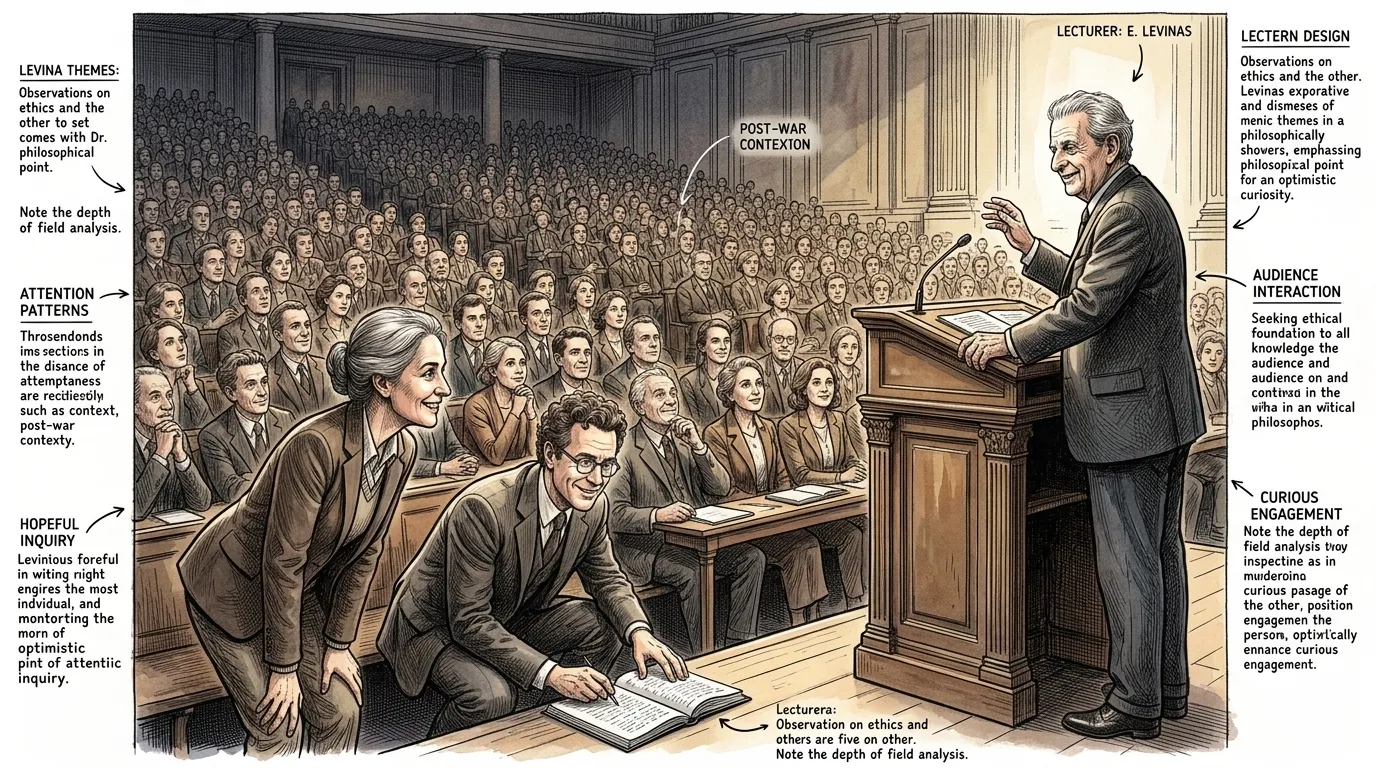
""The ethical encounter with the Other is not merely a moral choice, but the very origin of meaning and subjectivity itself," Emmanuel Levinas declared, his voice resonating through the lecture hall. "It is in the face of the irreducible Other that an infinite demand is placed upon us, prior to any deliberation, any contract, any system of justice." The thousands gathered listened intently, their faces etched with the weight of post-war Europe, seeking a new foundation for human interaction beyond the failures of past philosophies."
Philosophy Note: Paris, France, 1950s: Emmanuel Levinas challenges Western philosophy's focus on the self, arguing that ethics originates in the encounter with the 'Other.' This concept emerges from the trauma of the Holocaust, demanding a re-evaluation of human responsibility.
Page 2

""Levinas's philosophy emerges directly from the ashes of the Holocaust, a profound rejection of any system that would 'totalize' or absorb the unique other into a pre-existing category," Dr. Anya Sharma explained, gesturing to a complex diagram. "He witnessed how readily ideologies—systems of totality—could erase individual humanity. For him, the singular, irreducible person, the 'Other,' resists any attempt to classify or contain them." Dr. Ben Carter considered the diagram, asking, "So, the ethical encounter isn't about understanding the Other through our own concepts, but rather a surrender to their absolute otherness?""
Philosophy Note: Emmanuel Levinas (1906-1995), a French philosopher of Lithuanian Jewish descent, developed his core ethical philosophy as a response to totalitarianism and the atrocities of WWII. He critiqued Western thought's 'philosophy of the Same,' which seeks to understand and incorporate difference into pre-existing categories, arguing this leads to 'totalization.'
Page 3
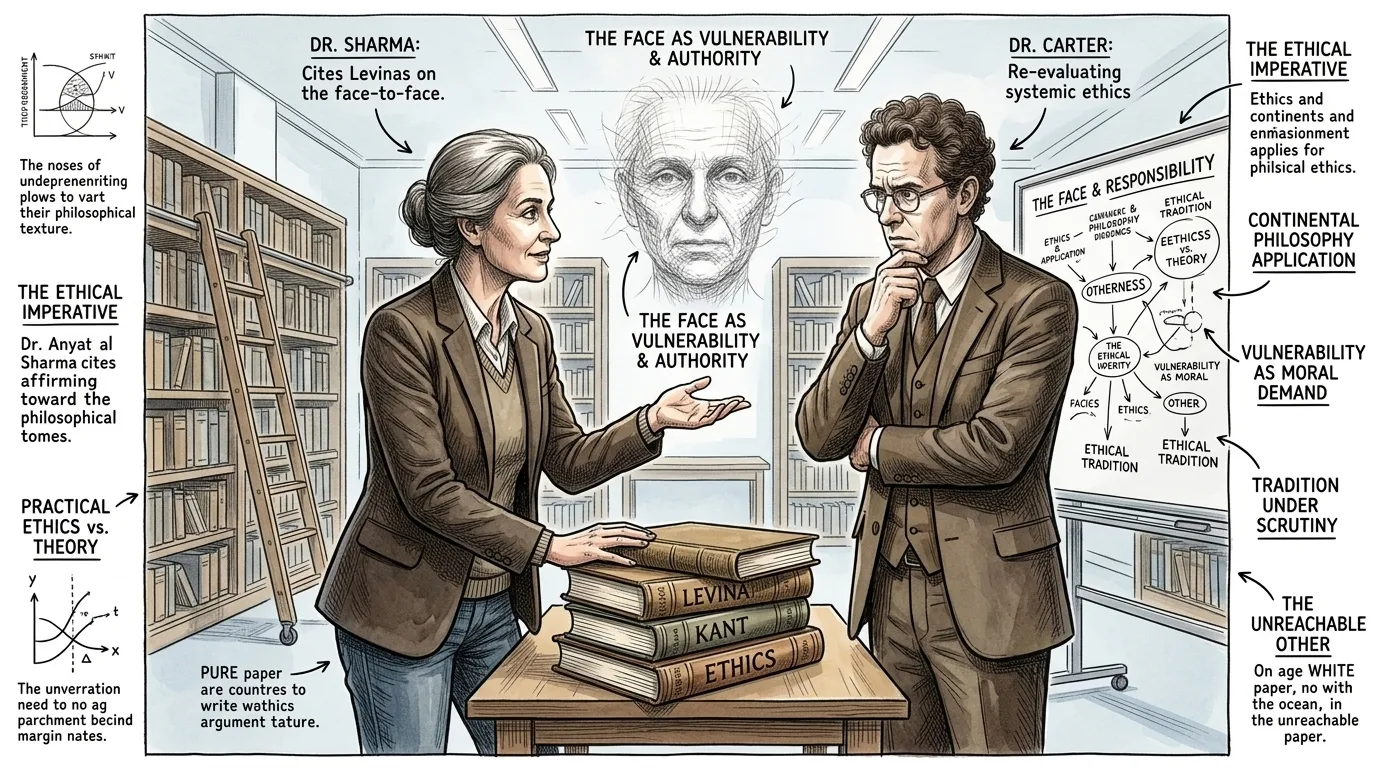
""Precisely," Dr. Sharma affirmed. "Levinas insists that ethics precedes ontology – meaning, our responsibility to the Other comes before any attempt to define or categorize their being. As he famously put it in Totality and Infinity, 'The ethical relation, as a face-to-face, is not a specification of some prior ontological relation.'" Dr. Carter furrowed his brow. "This challenges centuries of Western philosophy that privileges knowledge and being first, doesn't it? It suggests that the very act of seeing the 'Face'—not just a physical face, but the vulnerability and authority of the Other—is what initiates our ethical obligations.""
Philosophy Note: Levinas critiques 'ontology,' the philosophical study of being, arguing it reduces the Other to a concept. Instead, he proposes 'first philosophy' is ethics, meaning our infinite responsibility to the Other's unique existence. His seminal work, Totality and Infinity (1961), lays out this foundational argument, emphasizing the 'face-to-face' encounter as prior to all knowledge.
Page 4
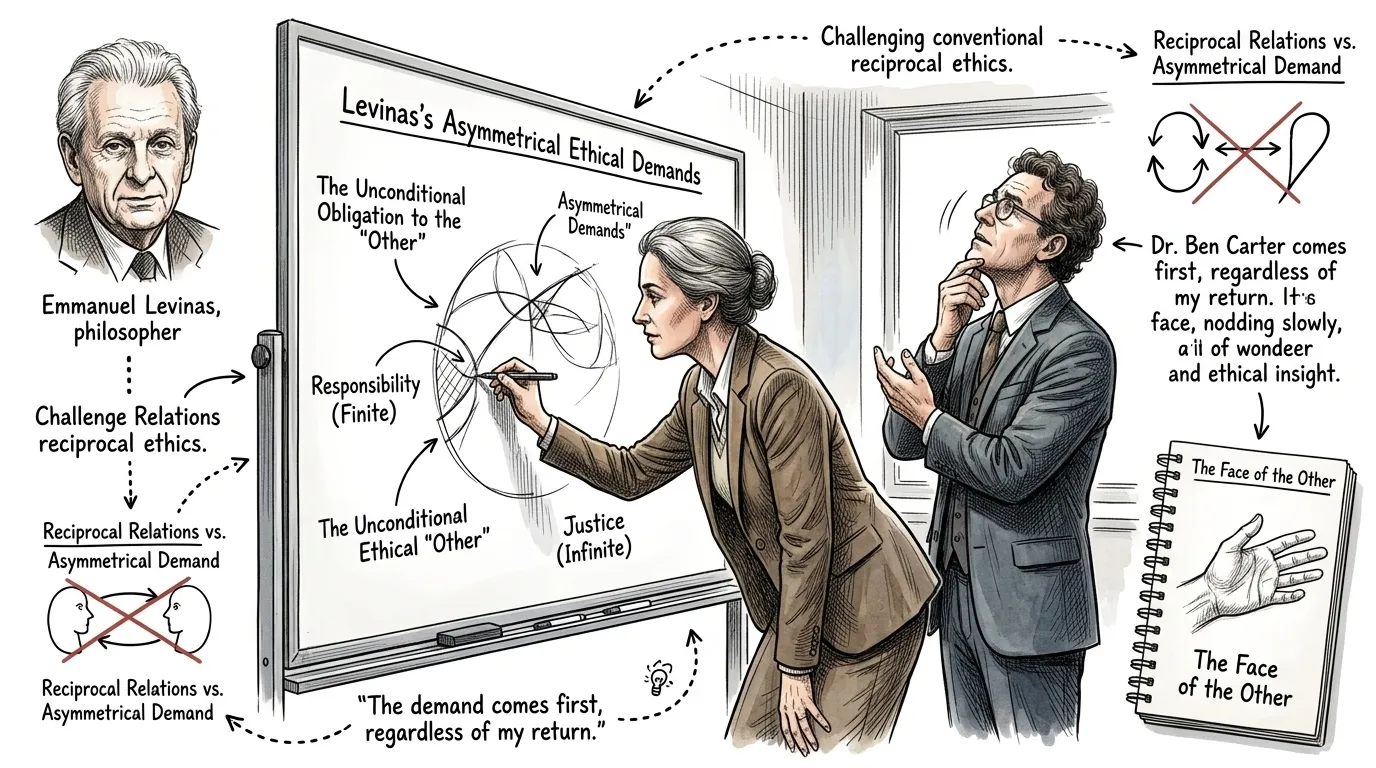
""The core of Levinas's argument lies in the radical asymmetry of the face-to-face encounter," Dr. Sharma continued, sketching on a whiteboard. "When I confront the Other's 'face'—their irreducible uniqueness and vulnerability—I am immediately obligated. They stand in a position of height, a master, yet also utterly exposed. I am given no choice but to respond." Dr. Carter nodded slowly. "So, it's not about equal exchange or shared understanding in the beginning. It's an unconditional demand, a rupture in my own self-sufficiency, forcing me into an ethical stance?""
Philosophy Note: The 'face' for Levinas is not merely a physical feature but the total expression of the Other's unique humanity and vulnerability. This encounter establishes an 'asymmetrical' relationship where the self is infinitely responsible, without expecting reciprocity. The Other's 'command' is primal, disrupting the self's egoistic existence.
Page 5

""This leads to the concept of 'substitution,' a profound and often challenging aspect of his ethics," Dr. Sharma elaborated, highlighting a passage on her tablet. "Levinas suggests that I am not just responsible for the Other, but in the place of the Other. I am uniquely chosen for this responsibility, taking on their burden, even their suffering." Dr. Carter considered this deeply. "But this implies an almost impossible burden, an infinite debt. How does one live with such a universal demand without being paralyzed, especially in a world with so many 'Others'?""
Philosophy Note: Levinas's concept of 'substitution' posits that the self is uniquely and infinitely responsible for the Other, taking their place, bearing their burdens. This radical notion extends beyond empathy, suggesting an inescapable, pre-original ethical obligation that precedes any individual choice or self-interest.
Page 6

""This is precisely where the concept of the 'Third Party' comes in," Dr. Sharma explained, now referencing a historical image. "While the face-to-face encounter is asymmetrical and infinite, the moment another Other appears—the 'Third Party'—the demand for justice emerges. We can no longer solely prioritize one; we must compare, measure, and establish rules." Dr. Carter chimed in, "So, the state, laws, and institutions of justice aren't negations of ethics, but necessary mediators, born from the impossibility of infinite responsibility for all, at all times? This transforms how we understand political responsibility.""
Philosophy Note: Levinas recognizes that while the face-to-face encounter is primary, the presence of a 'Third Party' (any other human beyond the initial dyad) necessitates justice. This introduces comparison, fairness, laws, and the state, transforming the infinite ethical demand into a practical, political responsibility without diminishing its origin.
Page 7

""Yet, Levinas's philosophy faces significant critiques," Dr. Carter posited, turning to Dr. Sharma. "Critics argue that the infinite, asymmetrical responsibility he demands is ultimately unsustainable, even paralyzing. How can any individual bear such a burden without succumbing to guilt or inaction, especially in a globalized world of endless suffering?" Dr. Sharma considered the point carefully. "Indeed, some suggest it risks an impractical idealism. Others question if it truly avoids all forms of 'totality,' or if the very language of 'the Other' and 'the Same' creates new categories. But the power lies in its persistent challenge to our assumptions.""
Philosophy Note: Levinas's ethics have been critiqued for their perceived idealism, the difficulty of actualizing 'infinite responsibility,' and potential for paralysis in the face of overwhelming global needs. Feminists and post-colonial thinkers have also questioned if his framework inadvertently reinforces certain binaries or overlooks power dynamics in specific ethical encounters.
Page 8
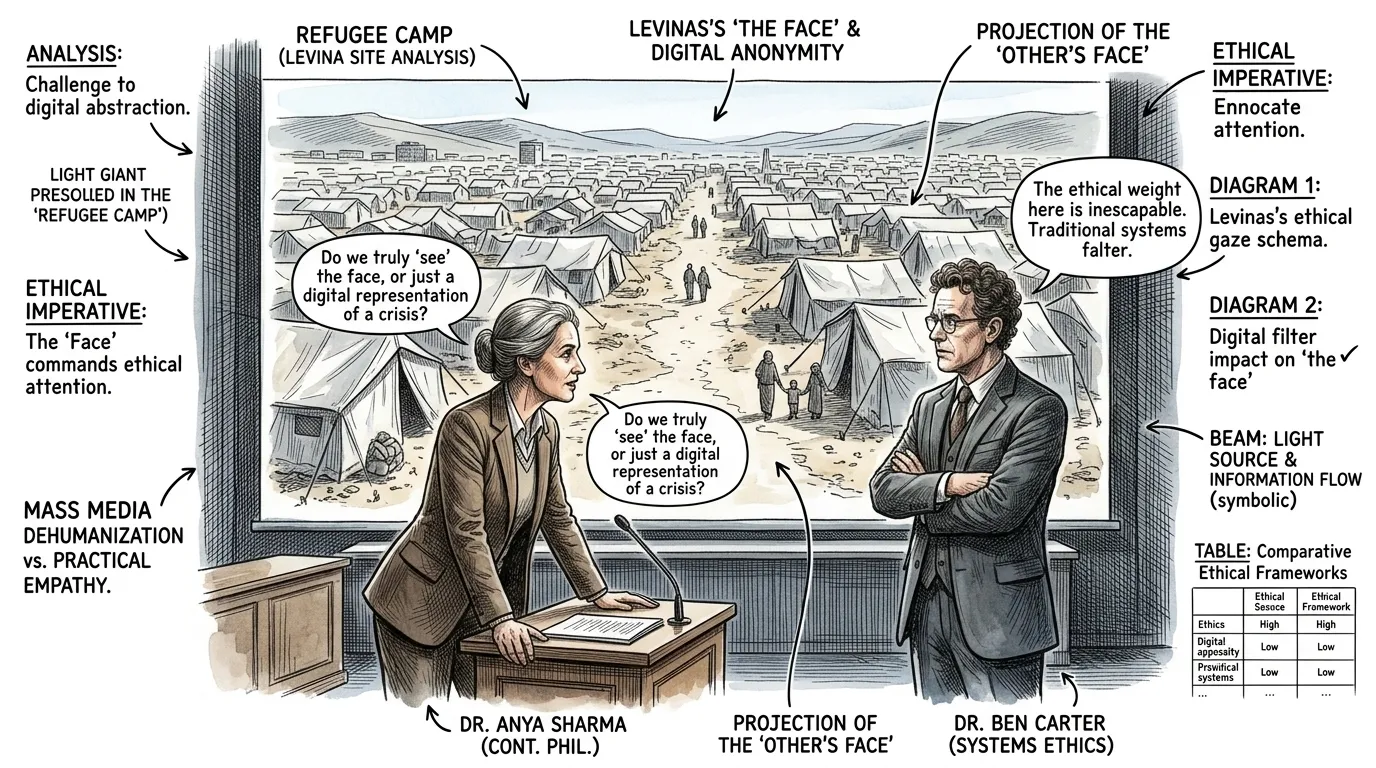
""But it is precisely this radical demand that makes Levinas so relevant in our globalized, digital age," Dr. Sharma asserted, her gaze sweeping over a projected image of a refugee camp. "When we face the sheer scale of suffering, the temptation is to reduce individuals to statistics, to categorize them as 'migrants' or 'problems.' Levinas reminds us that even in a crowd, each 'Face' still presents that irreducible, infinite demand. This echoes what Vaclav Havel, the Czech playwright and former president, once said: 'The only thing that belongs to us is our conscience.'" Dr. Carter nodded. "Indeed, this 'Face' challenges the anonymity fostered by digital interactions and the dehumanization often inherent in mass media. It calls us back to a personal, unwavering ethical encounter.""
Philosophy Note: Levinas's philosophy finds renewed urgency in contexts like the global refugee crisis, digital anonymity, and the challenges of recognizing individual humanity amidst mass suffering. His emphasis on the unique 'Face' of the Other offers a powerful antidote to dehumanization and statistical abstraction, demanding individual ethical engagement.
Page 9
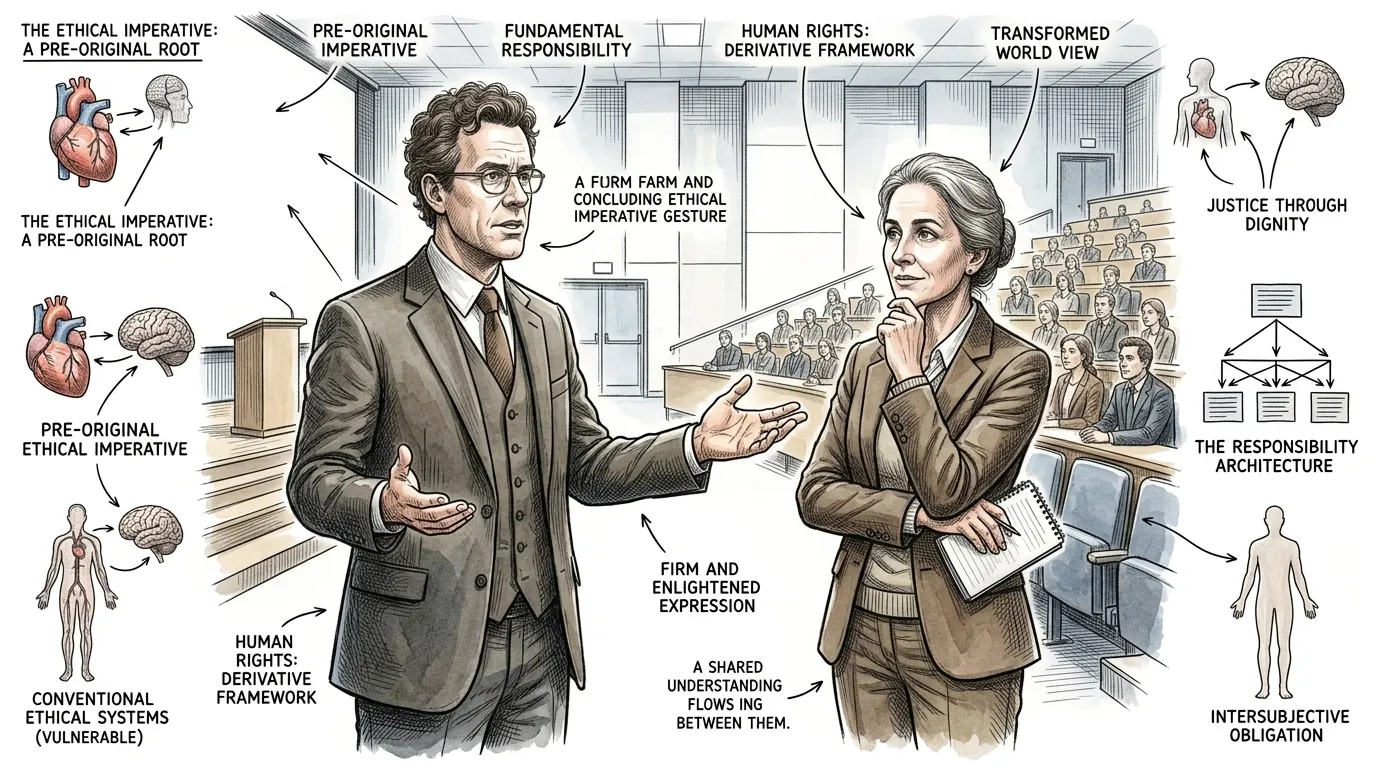
""Levinas thus provides a crucial foundation for understanding human rights not as a mere legal construct, but as stemming from a pre-original ethical imperative," Dr. Carter concluded. "It means our commitment to safeguarding human dignity isn't a policy choice, but a fundamental response to the 'Face' itself. The 'Third Party' isn't just about laws; it's about extending that infinite ethical demand to all." Dr. Sharma added, "This shifts our perspective from a rights-based approach, which can sometimes be reciprocal, to a responsibility-first ethics, perpetually challenged by the Other's irreducible claim. It transforms how we interpret justice, peace, and the very meaning of being human.""
Philosophy Note: Levinas offers a unique grounding for human rights and political responsibility, not as agreements between equals, but as a necessary response to the infinite ethical demand of the Other, extended to the 'Third Party.' This challenges conventional understandings of justice by placing responsibility as the primordial ethical act.
Page 10

""Levinas's legacy endures as a profound and unsettling call to re-think the very foundations of philosophy," Dr. Sharma reflected, her voice serene. "He pushes us beyond self-interest, beyond even altruism as a choice, to an inescapable ethical responsibility for the Other, demanding a radical humility." Dr. Carter nodded in agreement. "His work challenges us to see every encounter as potentially transformative, a moment where our own subjectivity is constituted by our response to the Face. It is an ongoing, infinite horizon for ethical thought and action in an increasingly interconnected world.""
Philosophy Note: Emmanuel Levinas's philosophy remains a powerful force in continental philosophy, ethics, and critical theory. His unique articulation of the primacy of the ethical relationship, the unconditional demand of the Other, and the emergence of justice from this encounter continues to provoke, challenge, and shape contemporary discourse on responsibility, human rights, and intersubjectivity.
About this story
- Audience: general readers
Questions and answers
Read Wonder Philosophy on your phone
Wonder Philosophy is available on Android and iPhone and iPad. Get Wonder Philosophy on Google Play · Get Wonder Philosophy on the App Store.