Empedocles
Empedocles — an illustrated philosophy story. 10 illustrated pages, free to read on Wonder Philosophy.
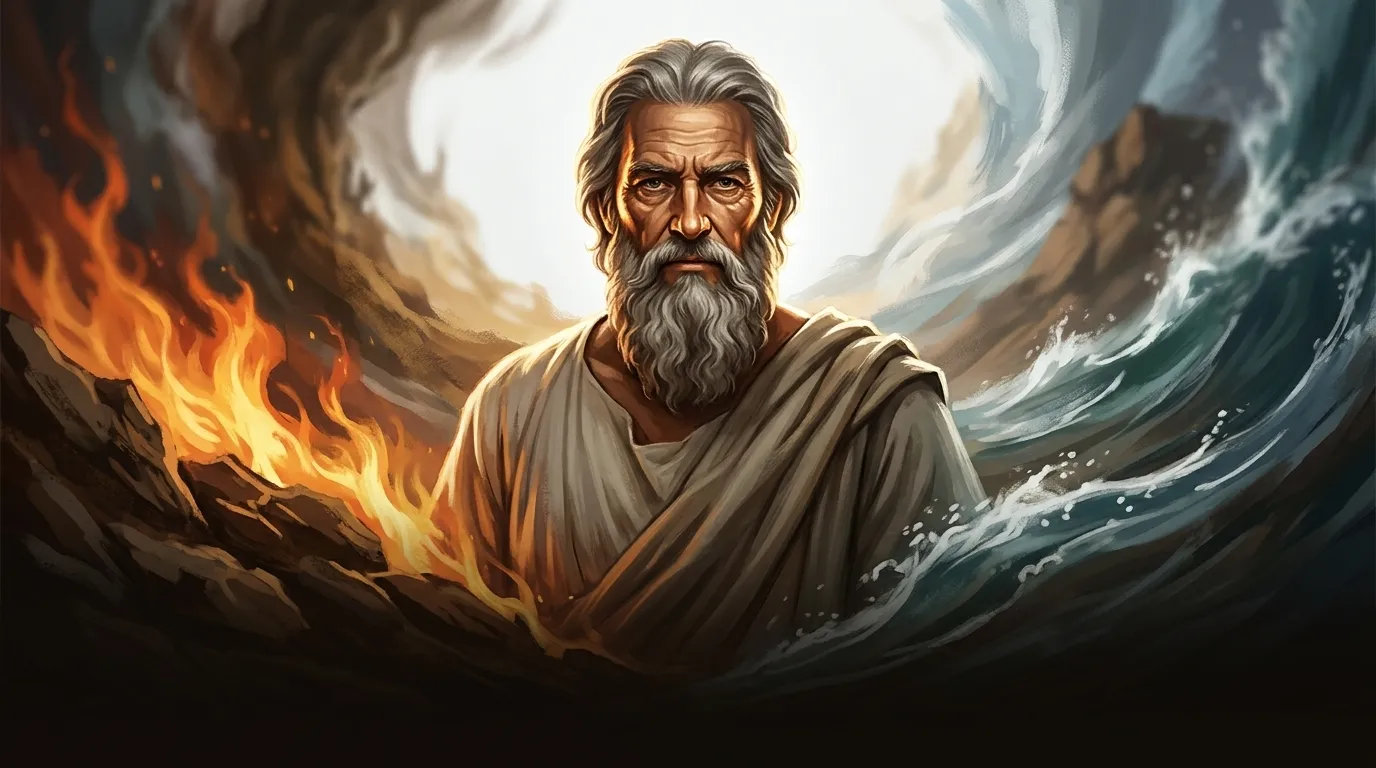
Page 1
Why should we care about a philosopher who lived over two thousand years ago? Empedocles, a pre-Socratic Greek thinker, offered a vision of the universe built on fundamental forces. These ideas, while different from modern science, laid groundwork for how we understand the composition of everything around us.
Philosophy Note: Empedocles (c. 494 – c. 434 BC): A Greek pre-Socratic philosopher and citizen of Akragas, Sicily. Proposed the four classical elements as fundamental building blocks of reality.
Page 2
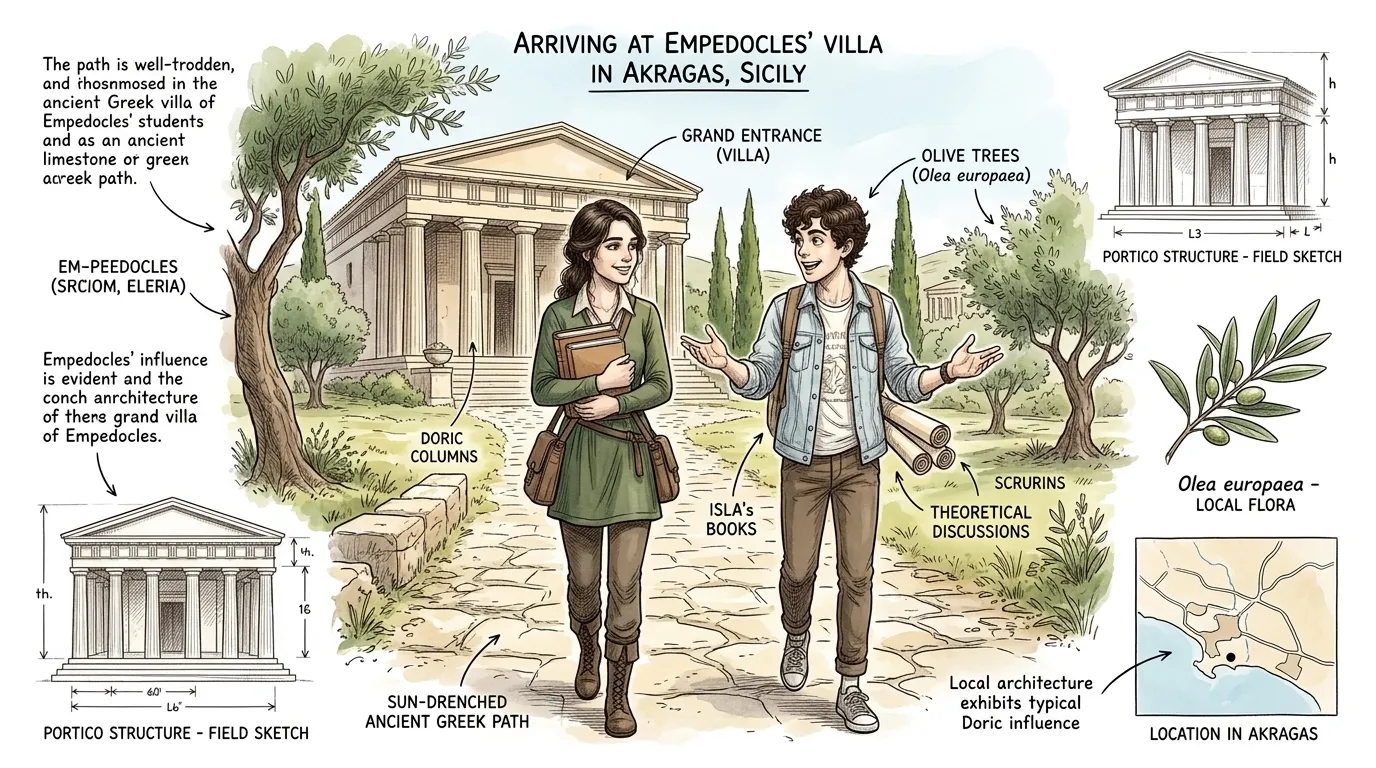
Empedocles wasn't just a philosopher; he was a citizen of Akragas, a city in Sicily. He was involved in politics, believed to have performed miracles, and wrote poetry. His life was a blend of intellectual pursuit and public engagement. Two students, Isla and Lian are walking to Empedocles's house.
"Isla, books in hand, is walking with Lian to Empedocles's house. Isla remarks, 'He wasn't just some detached academic. He lived and breathed these ideas, involving himself in everything.' Lian, with scrolls tucked under his arm, responds, 'It sounds like he was a rockstar philosopher."
Philosophy Note: Akragas: An ancient Greek city located in Sicily, known for its wealth and cultural achievements. Today, it is known as Agrigento.
Page 3
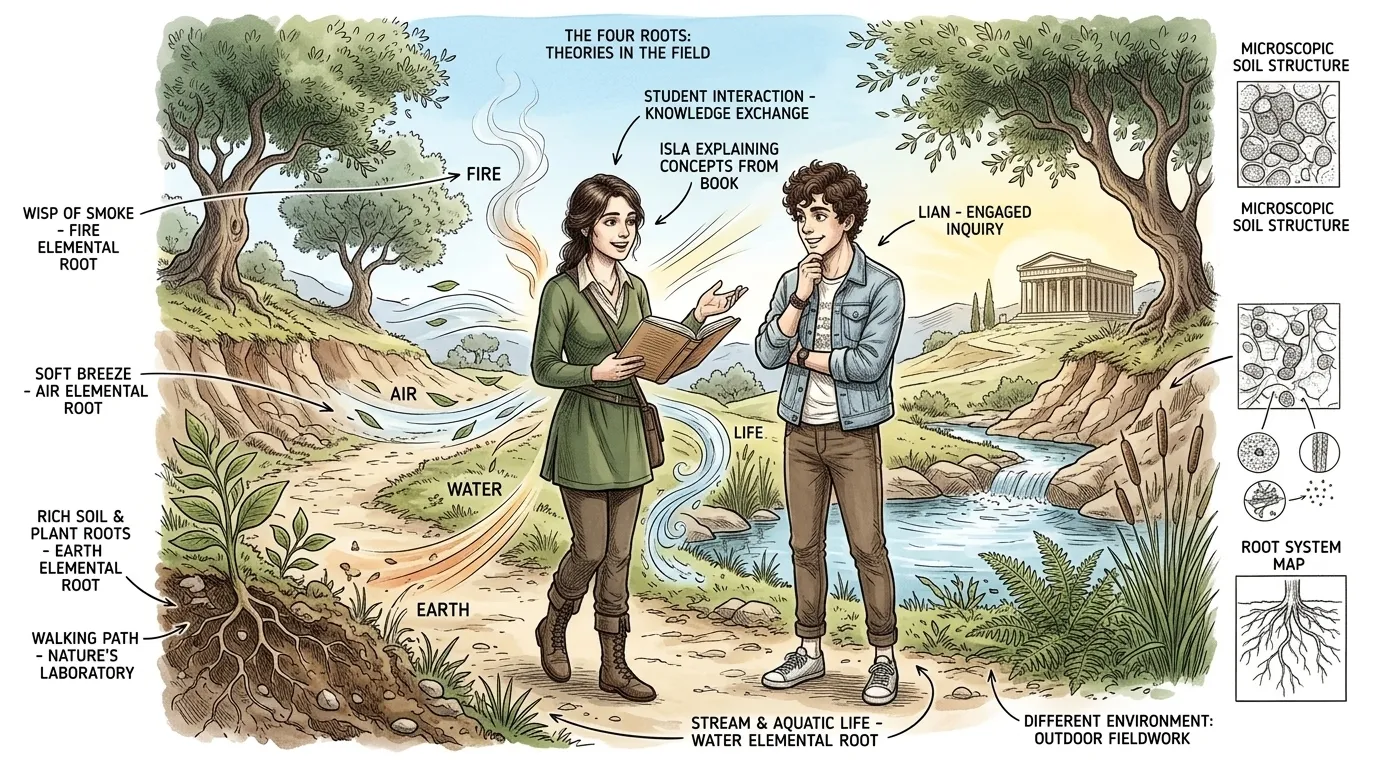
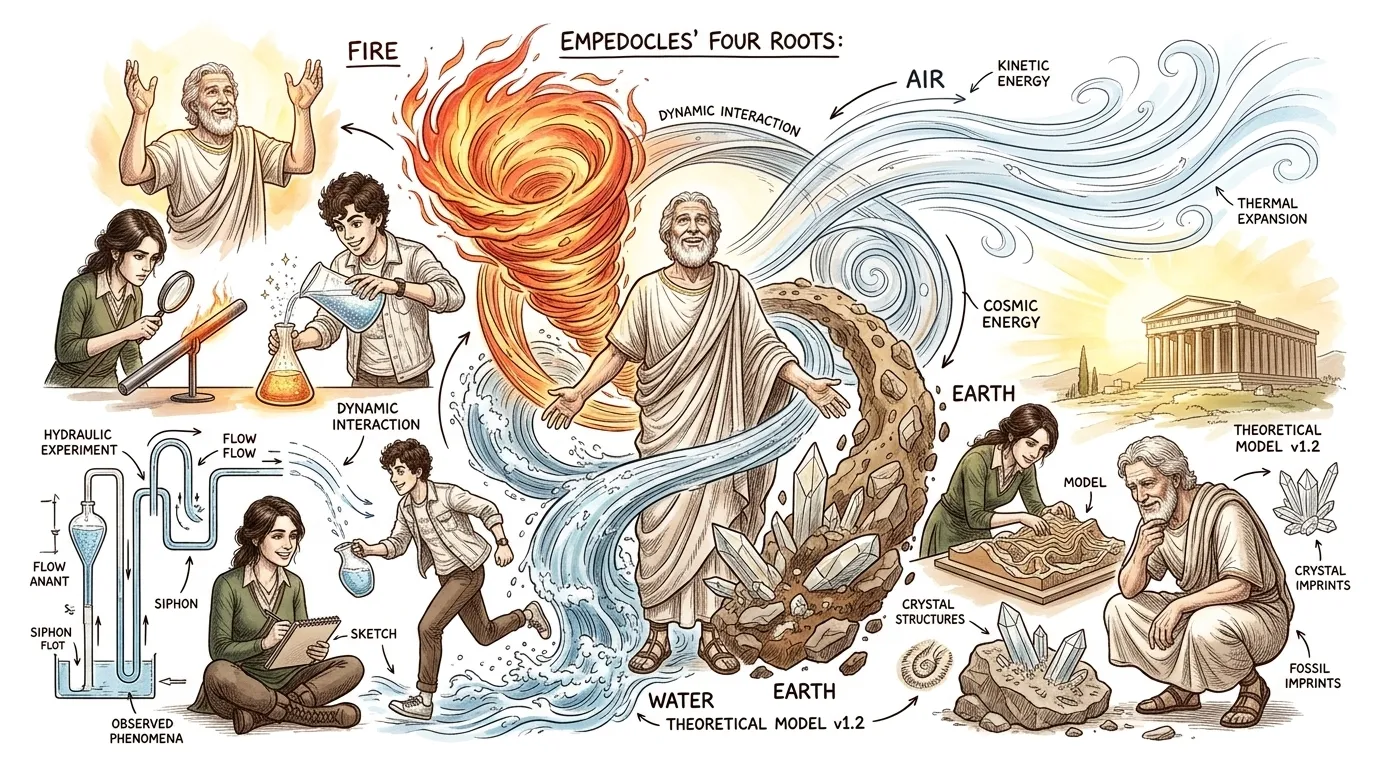
Empedocles theorized that everything is made of four fundamental 'roots': fire, air, earth, and water. These roots aren't created or destroyed, but simply combine and separate in different proportions to form all the things we see. This is the heart of his cosmology. Isla pauses to describe what she is reading to Lian.
"Isla pauses, holding up her book. 'He calls them roots, but they're more like fundamental ingredients. Everything is a mixture of fire, air, earth, and water.' Lian asks, 'So, a tree isn't just a tree? It's a recipe?' Isla laughs, 'Exactly! And so are we."
Philosophy Note: Classical elements: A pre-scientific conceptual scheme used to explain the nature and complexity of matter. Similar systems existed in Persia, India, and East Asia.
Page 4
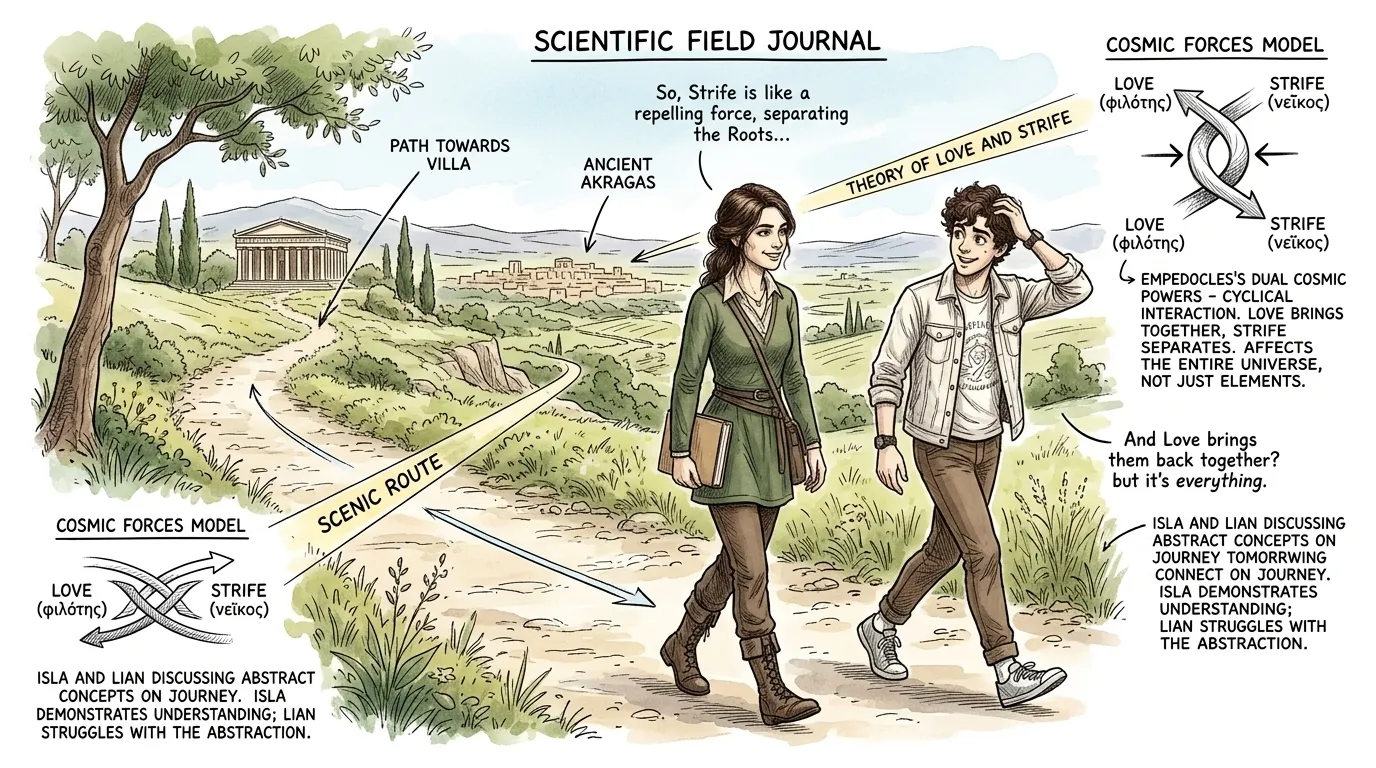
But what causes these roots to mix and separate? Empedocles introduced two cosmic forces: Love and Strife. Love brings the elements together, creating harmony and order. Strife tears them apart, causing chaos and destruction. They're the yin and yang of the cosmos. Isla and Lian continue their journey.
"Lian scratches his head. 'So, if the elements are the ingredients, Love and Strife are...the chef?' Isla grins. 'Or maybe the mood of the chef. Sometimes harmonious, sometimes...not so much.' Lian asks, 'Is it really that simple?' Isla nods as she continues walking, 'As Confucius said, 'Life is really simple, but we insist on making it complicated.'"
Philosophy Note: Love and Strife: Empedocles's proposed cosmic forces that govern the mixing and separation of the four classical elements.
Page 5
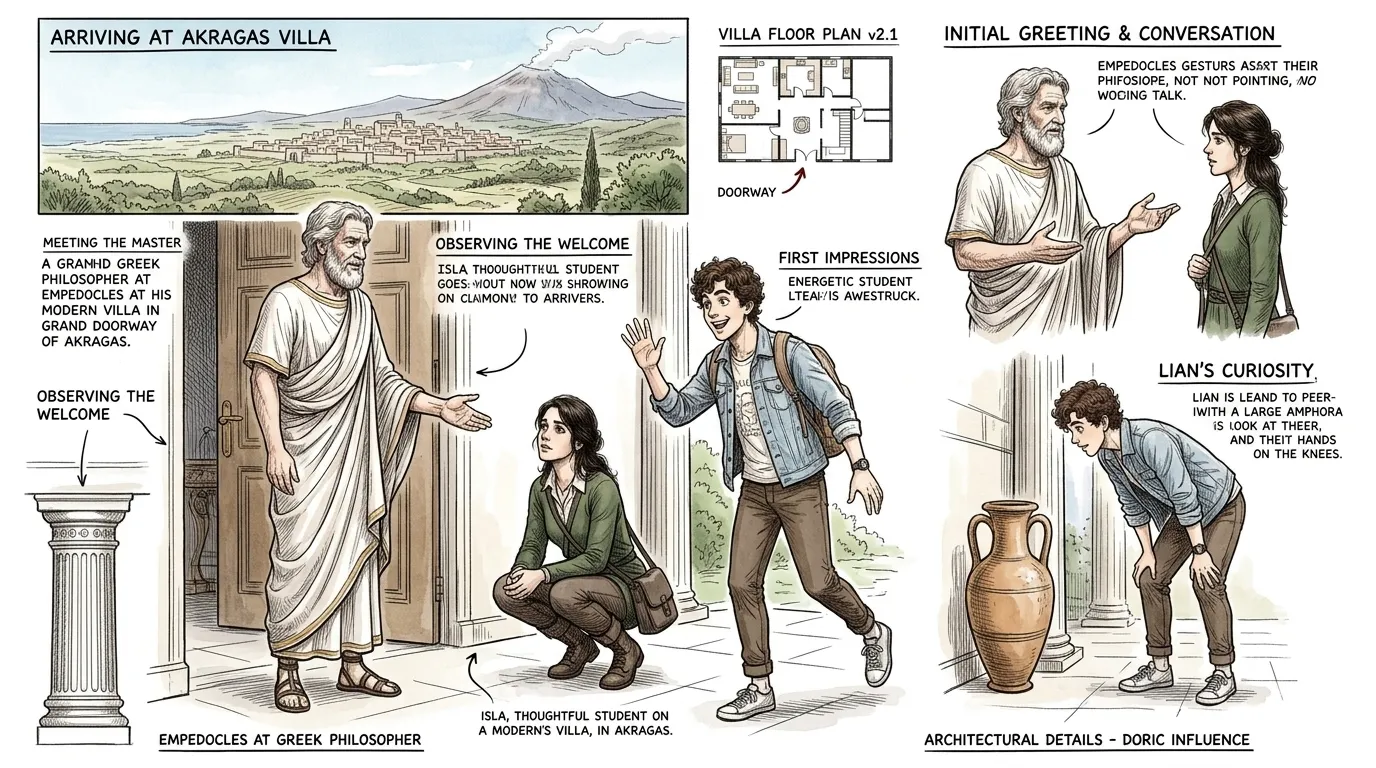
Empedocles envisioned a cyclical universe. First, Love reigns supreme, uniting all the elements in a perfect sphere. Then, Strife gradually enters, disrupting the harmony and creating the diverse world we experience. Eventually, Strife takes over completely, separating everything into its individual elements. But then, Love begins to reassert itself, starting the cycle anew. Isla and Lian have arrived and Empedocles greets them.
"Empedocles greets them at the door of his villa and says, 'Welcome, Isla and Lian. Are you ready to delve deeper into the mysteries of the cosmos?' Isla says, 'Yes, but I'm still a little confused about the cycle. How does the universe change from love to strife.' Lian replies, 'I can only imagine what the process of universal love looks like. It's a nice thought.'"
Philosophy Note: Cosmic Cycle: Empedocles's concept of a universe governed by the alternating dominance of Love and Strife, leading to cycles of creation and destruction.
Page 6
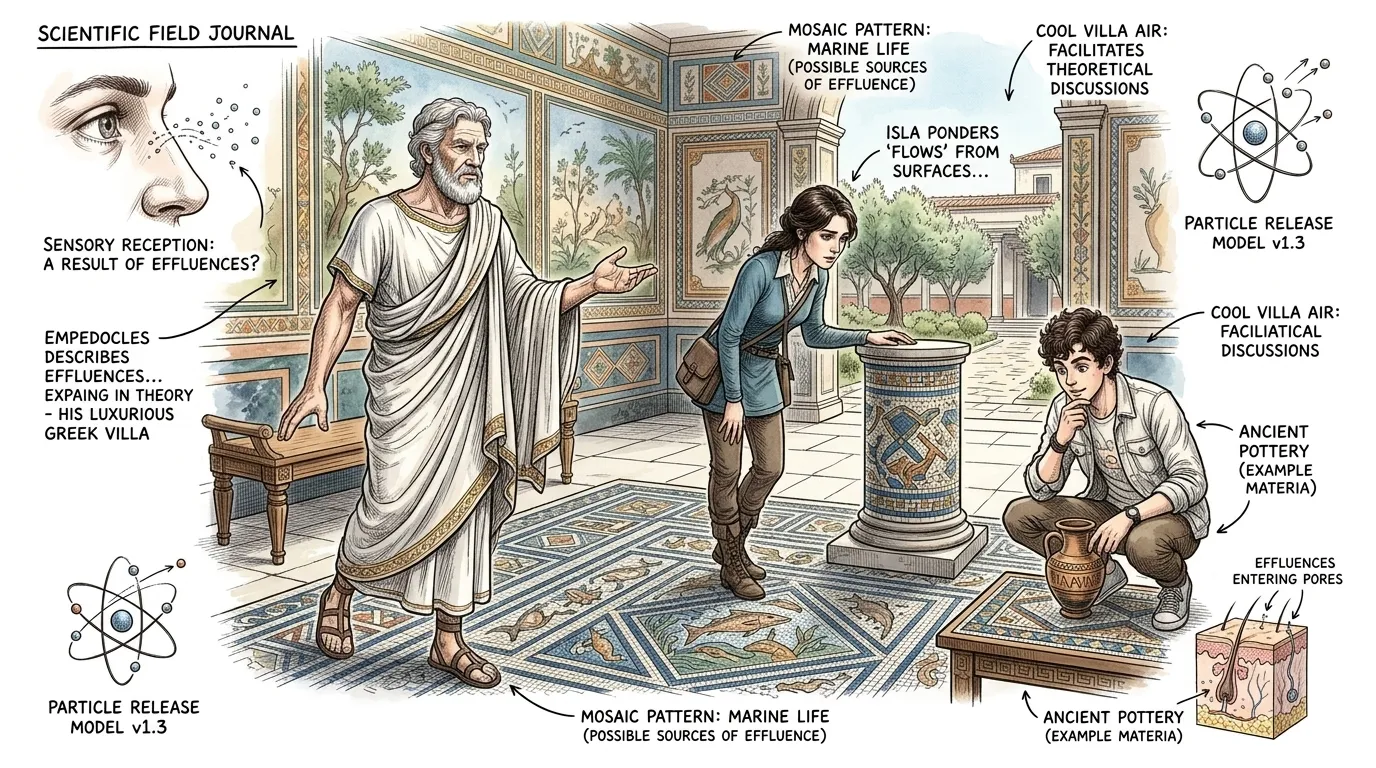
Empedocles also explored how we perceive the world. He believed that our senses work by 'effluences' – tiny particles that emanate from objects and enter our sense organs. Like attracts like, so fire in us perceives fire outside, water perceives water, and so on. Empedocles leads Isla and Lian inside, deeper into the villa.
"Empedocles explains, 'Our senses are like filters, recognizing what is similar to themselves.' Lian then asks, 'So, we only see what we already are?' Empedocles pauses, 'In a way, yes. As Aristotle said, 'The ultimate value of life depends upon awareness and the power of contemplation rather than upon mere survival.' But that isn't the only path to understand truth, as we will discuss."
Philosophy Note: Effluences: Empedocles's theory that perception occurs through particles emanating from objects and entering the sense organs.
Page 7
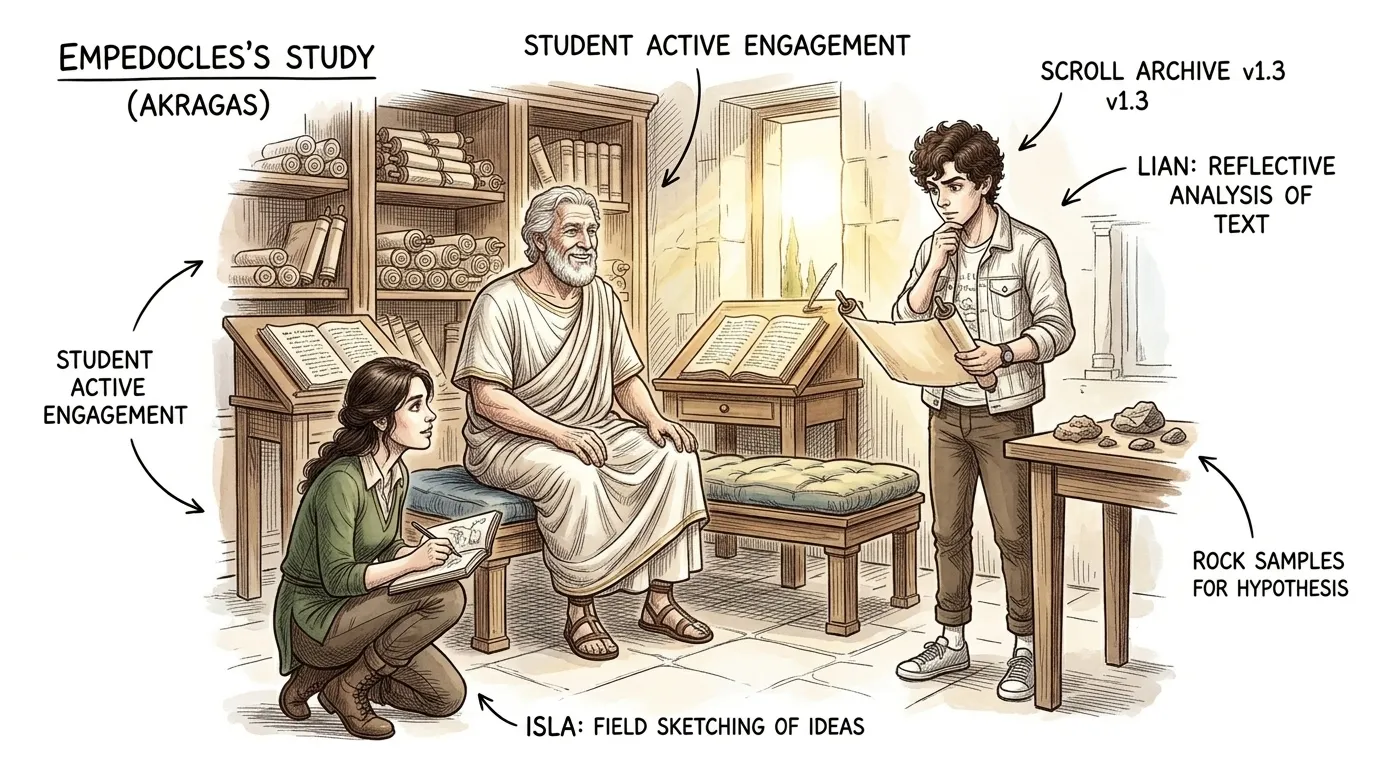
Empedocles's ideas faced challenges. How could Love and Strife, abstract forces, physically interact with elements? And if perception relies on 'like attracts like,' how do we perceive things that are different from us? Despite these challenges, his concept of fundamental elements influenced future thinkers.
"Lian ponders, 'But if our senses only perceive what's like us, how do we learn anything new?' Isla replies, 'Maybe we need a little Strife in our perceptions to shake things up?' Empedocles nods. 'Indeed, the tensions are where we find learning. You must always question. Always test."
Philosophy Note: Pre-Socratic Philosophy: The philosophical tradition in ancient Greece before Socrates, characterized by attempts to understand the natural world.
Page 8
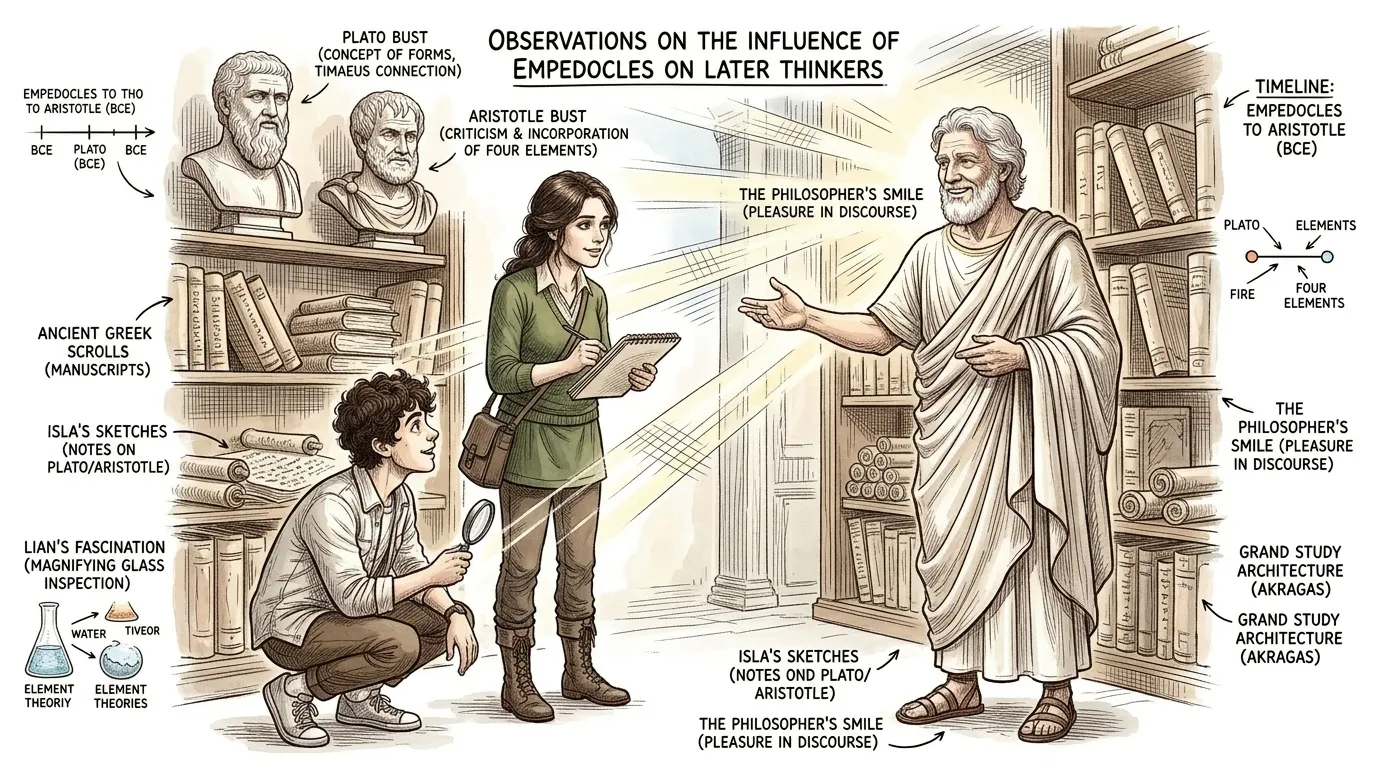
Empedocles's four roots became the cornerstone of later theories, influencing Plato and Aristotle. Though science has moved beyond these elements, his emphasis on fundamental forces and building blocks of reality resonates even today. A scientific model of the universe must be grounded in observable data.
"Isla remarks, 'So, he was kind of right, even if the details are wrong?' Empedocles smiles. 'The journey is more important than the destination. He set a goalpost for others to attempt to achieve.' Lian replied, 'He was still a genius for his time.'"
Philosophy Note: Aristotle (384-322 BC): A Greek philosopher and polymath, student of Plato, and one of the most influential thinkers in Western philosophy. Further developed theories of matter and elements.
Page 9
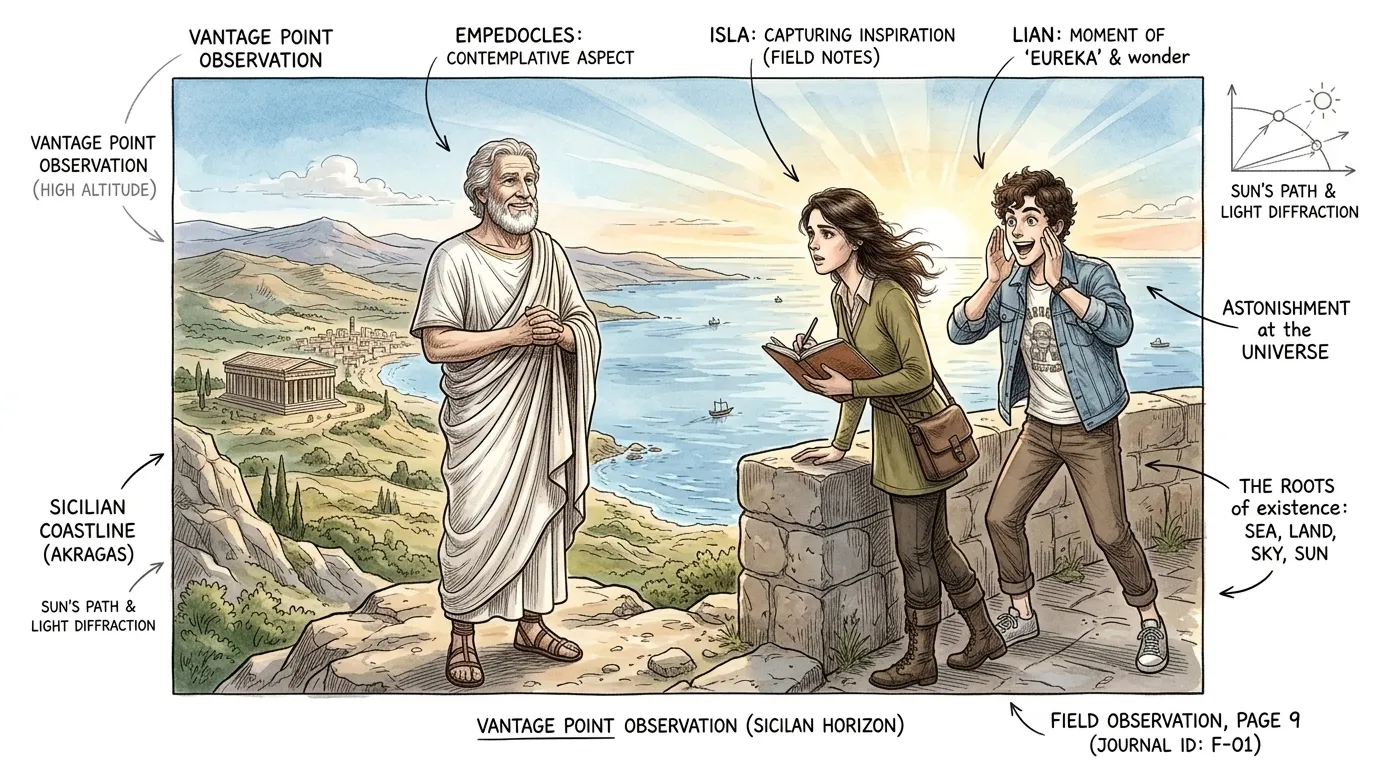
Today, we know the universe is composed of atoms and subatomic particles, not fire, air, earth, and water. Yet, Empedocles's quest to find the fundamental building blocks of reality continues to inspire scientists and philosophers alike. The scientific path is to always seek knowledge.
"Empedocles says, 'The specifics change, but the questions remain. What are we made of? What forces govern our world?' Lian replied, 'I'm just glad to be a part of this universe'. Isla and Lian look out at the horizon."
Philosophy Note: Modern Physics: The field of physics that explores the fundamental constituents of matter and the forces that govern their interactions, including quantum mechanics and particle physics.
Page 10
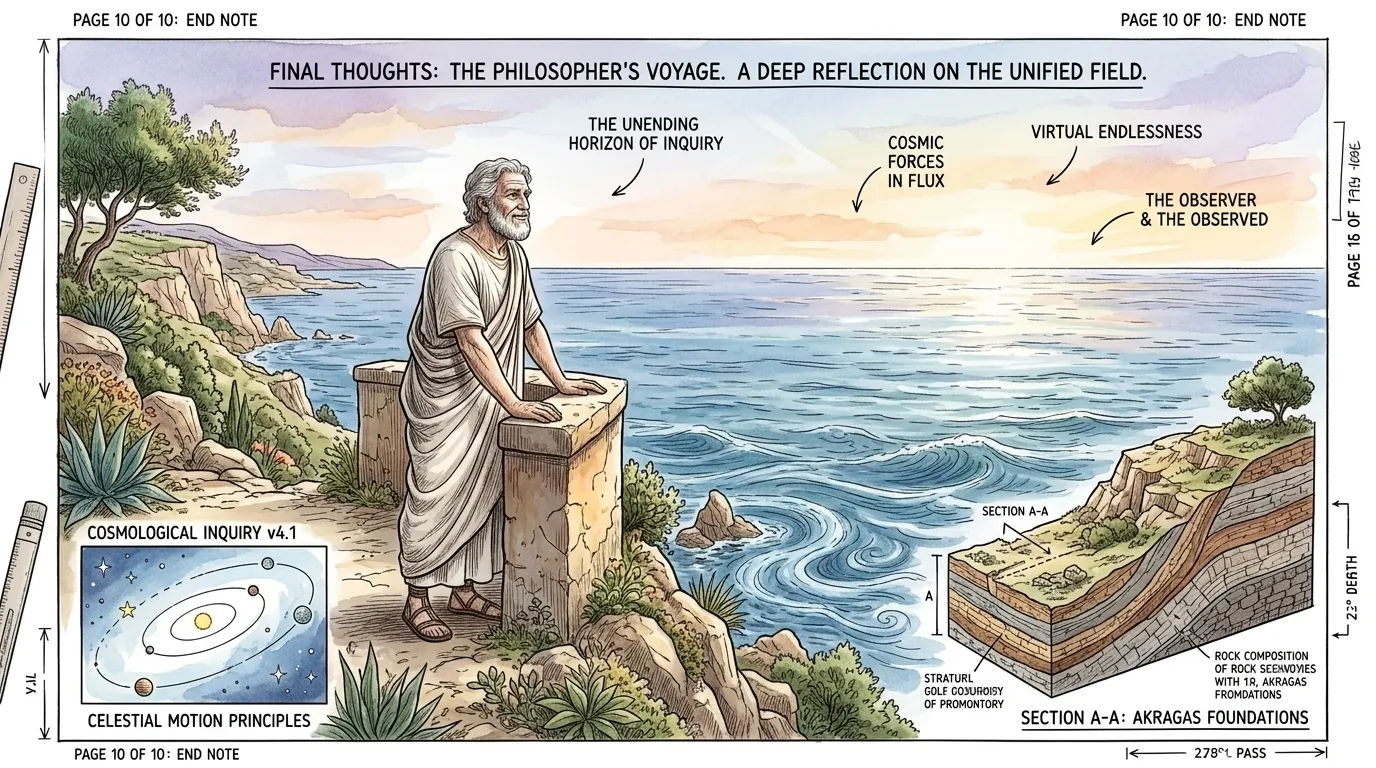
Empedocles's legacy lies not in the accuracy of his answers, but in the power of his questions. By daring to ask what the world is made of, he set the stage for centuries of scientific and philosophical inquiry. It's important to continue learning.
"Empedocles asks, 'Will we ever truly know? Will we ever truly know all the secrets of the universe? Maybe not in full. The universe is a vast and complicated place.' He looks onward, into the horizon."
Philosophy Note: Scientific Inquiry: The process of asking questions, gathering evidence, and testing hypotheses to understand the natural world.
About this story
- Audience: general readers
Questions and answers
Read Wonder Philosophy on your phone
Wonder Philosophy is available on Android and iPhone and iPad. Get Wonder Philosophy on Google Play · Get Wonder Philosophy on the App Store.