G. E. Moore
G. E. Moore — an illustrated philosophy story. 10 illustrated pages, free to read on Wonder Philosophy.

Page 1
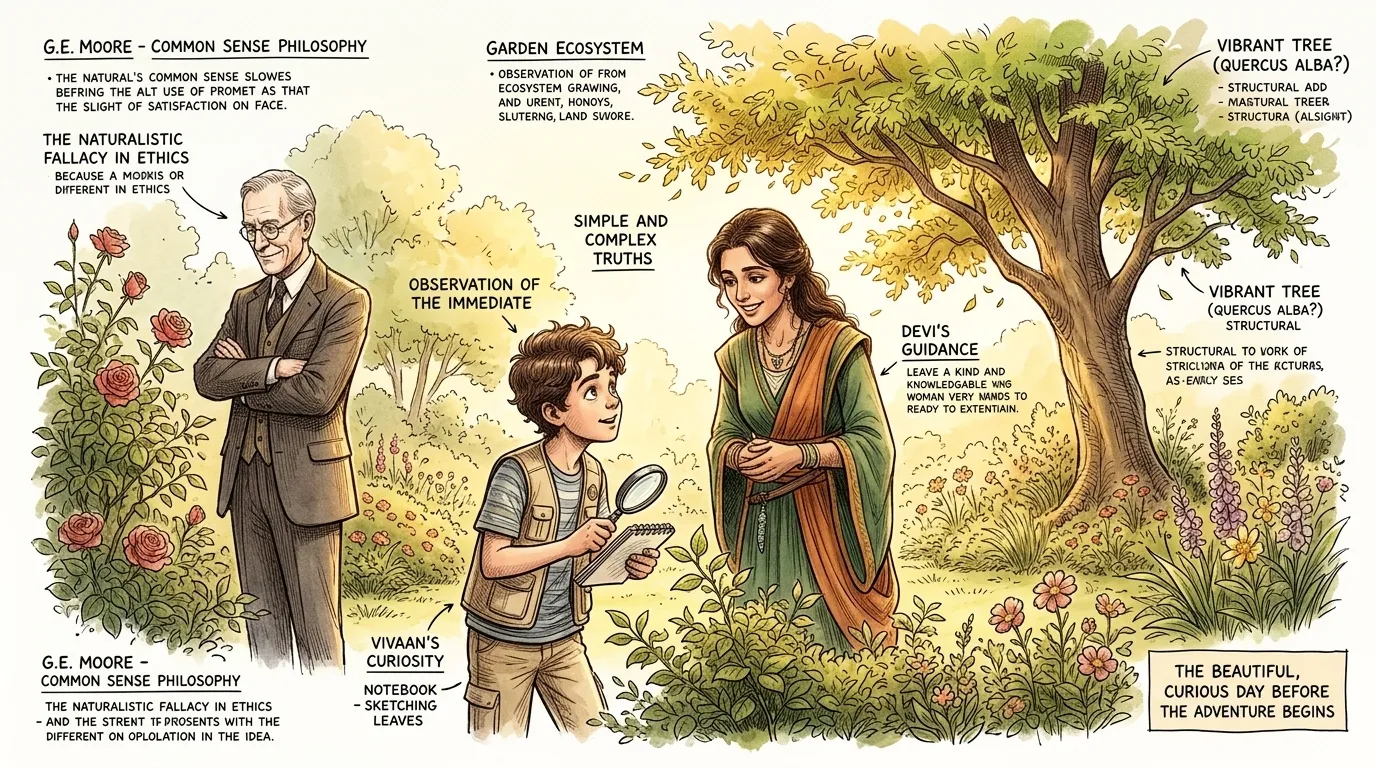
Sometimes, when faced with complicated ideas, we might forget to trust what's right in front of us. Philosophers often delve into abstract questions, but one influential thinker, G. E. Moore, urged us to look back at the simple, undeniable truths of everyday experience.
"Vivaan, looking puzzled, asked, "Devi, why do adults always make simple things so complicated? Like when they argue about whether a tree in a forest really exists if no one sees it?""
Philosophy Note: G. E. Moore (1873-1958) was a British philosopher whose work significantly influenced analytical philosophy. He is best known for his defense of common sense and his critique of ethical naturalism.
Page 2
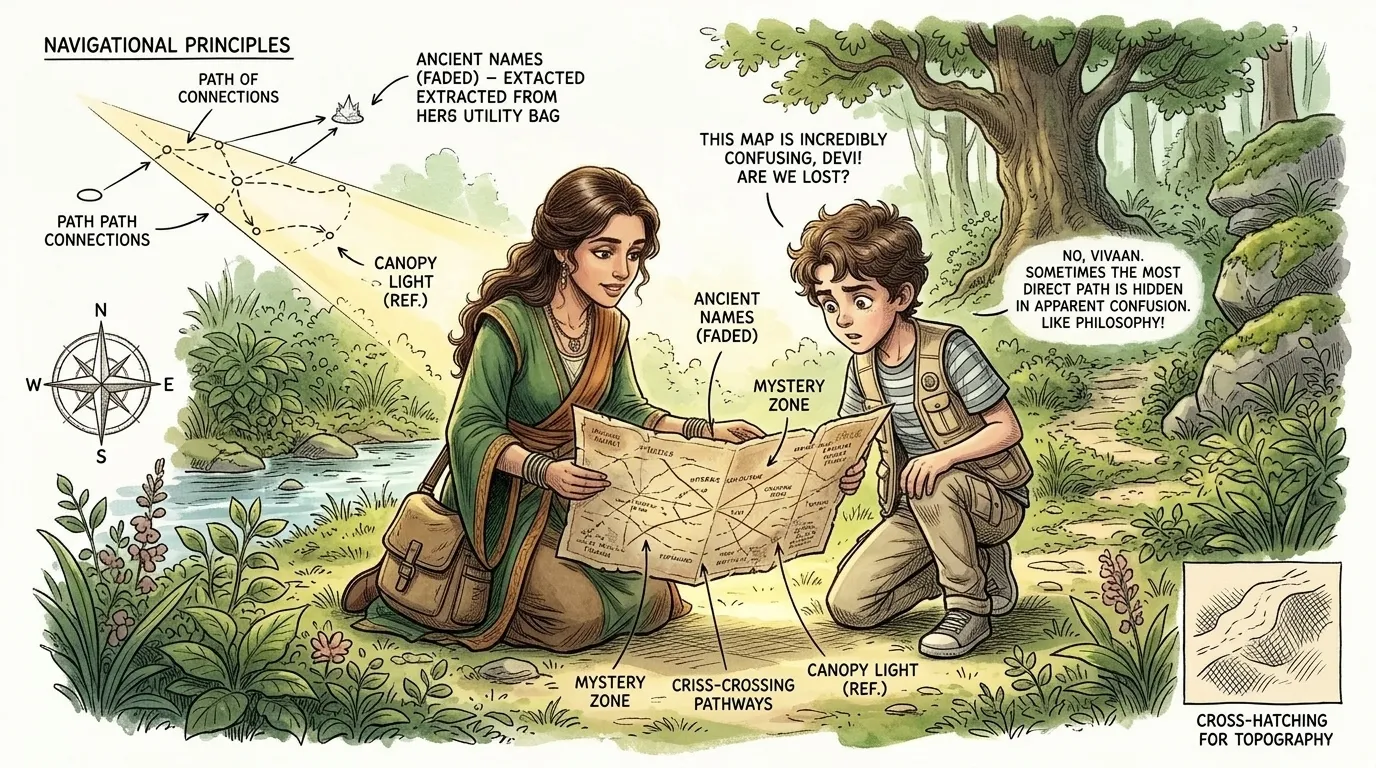
At the turn of the 20th century, philosophy had become deeply entangled in complex, abstract systems. Moore, alongside figures like Bertrand Russell, sought a new path, grounded in clarity and rigorous logical analysis, rather than grand, speculative theories.
"Devi knelt down, pulling out an old, faded map from her bag. "Well, Vivaan, that's exactly what G. E. Moore questioned. He felt that some philosophers got so lost in ideas that they started doubting things everyone knows are true, like whether that tree really exists. This old map, for instance, looks confusing, doesn't it? It has so many crisscrossing lines and faded names that it's hard to tell what's real.""
Philosophy Note: Moore studied at Trinity College, Cambridge, where he became a prominent member of the Bloomsbury Group. His early work, especially 'The Refutation of Idealism' (1903), challenged prevailing philosophical trends.
Page 3
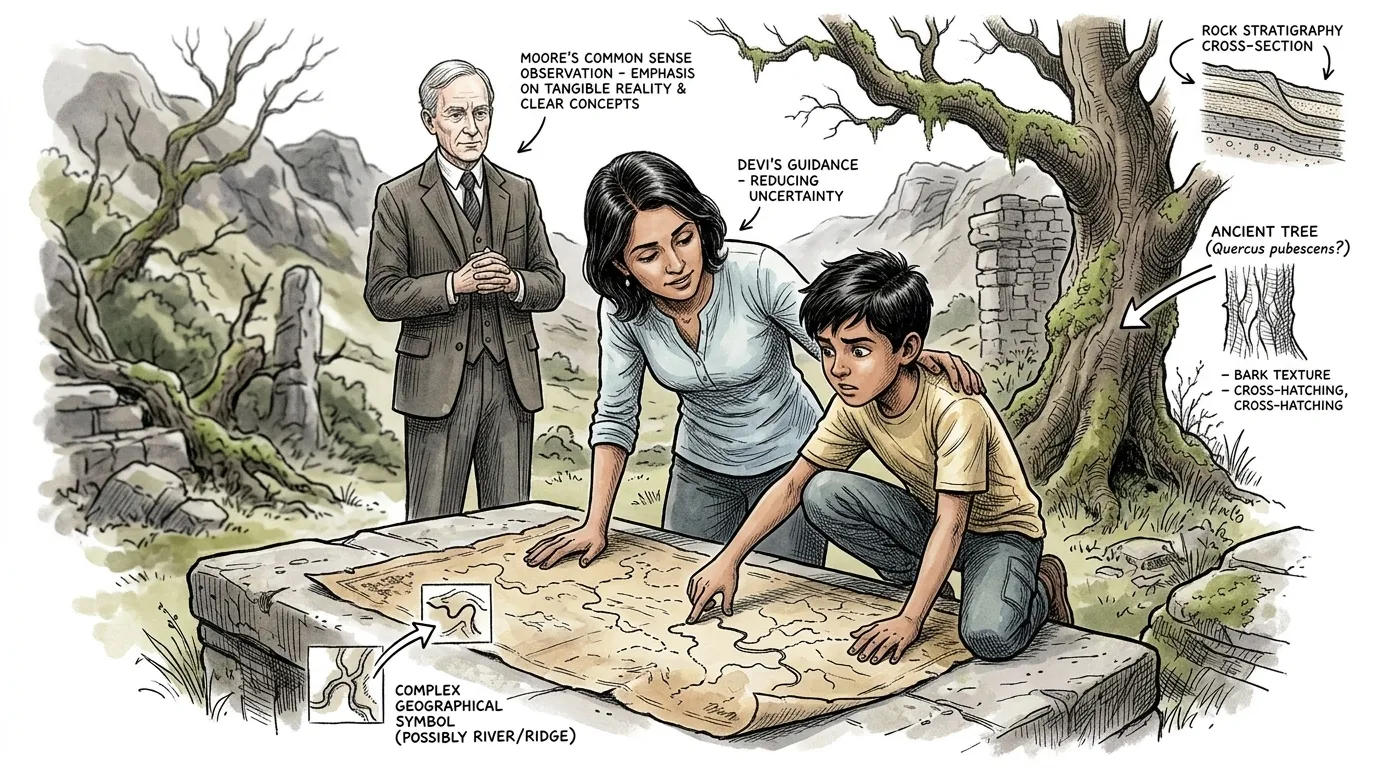
Moore argued against the tendency to dismiss ordinary beliefs in favor of convoluted philosophical arguments. He believed that our fundamental, common-sense perceptions of the world are often more certain than any skeptical challenge.
"Vivaan pointed to a blurred section on the map. "It's impossible to tell if this path is a river or a mountain trail! It makes me doubt everything I thought I knew about getting to the old ruins." Devi nodded. "Exactly! Moore would say we're letting complex doubts obscure simple truths. He thought that if a philosophical idea contradicts what we know with absolute certainty in everyday life, then the philosophical idea is likely wrong, not our common sense. We know we're holding a map, even if it's faded, and we know we want to find the ruins.""
Philosophy Note: Moore's 'Defence of Common Sense' (1925) argued that certain common-sense beliefs are more certain than the premises of any philosophical argument that seeks to refute them. These include the existence of physical objects and other minds.
Page 4
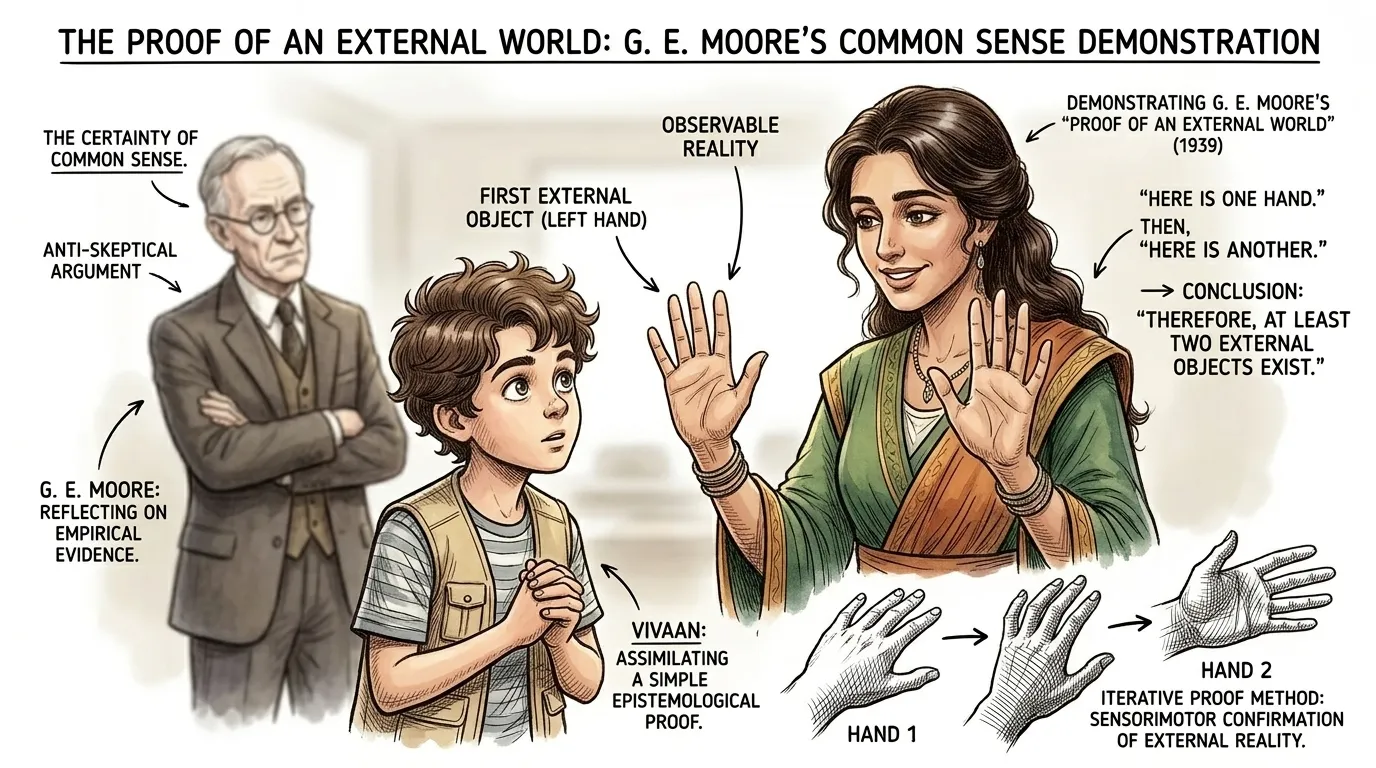
To illustrate the strength of common sense, Moore once famously offered a simple demonstration. He argued that some truths are so foundational they need no further proof; attempting to prove them often makes them seem less certain.
"Devi held up her hands, one after the other. "Moore once gave a very simple 'proof' of an external world. He would just hold up one hand and say, 'Here is one hand.' Then he'd hold up the other and say, 'And here is another.' He argued that these simple statements, based on direct experience, were more certain than any philosopher's argument trying to prove that hands don't really exist. He knew, and everyone knows, that his hands exist. It's about trusting what is plainly visible and undeniable.""
Philosophy Note: In 'Proof of an External World' (1939), Moore's famous 'hands' argument directly challenged skeptical claims that the external world cannot be known to exist. He held that such skepticism was less certain than our immediate perceptual knowledge.
Page 5
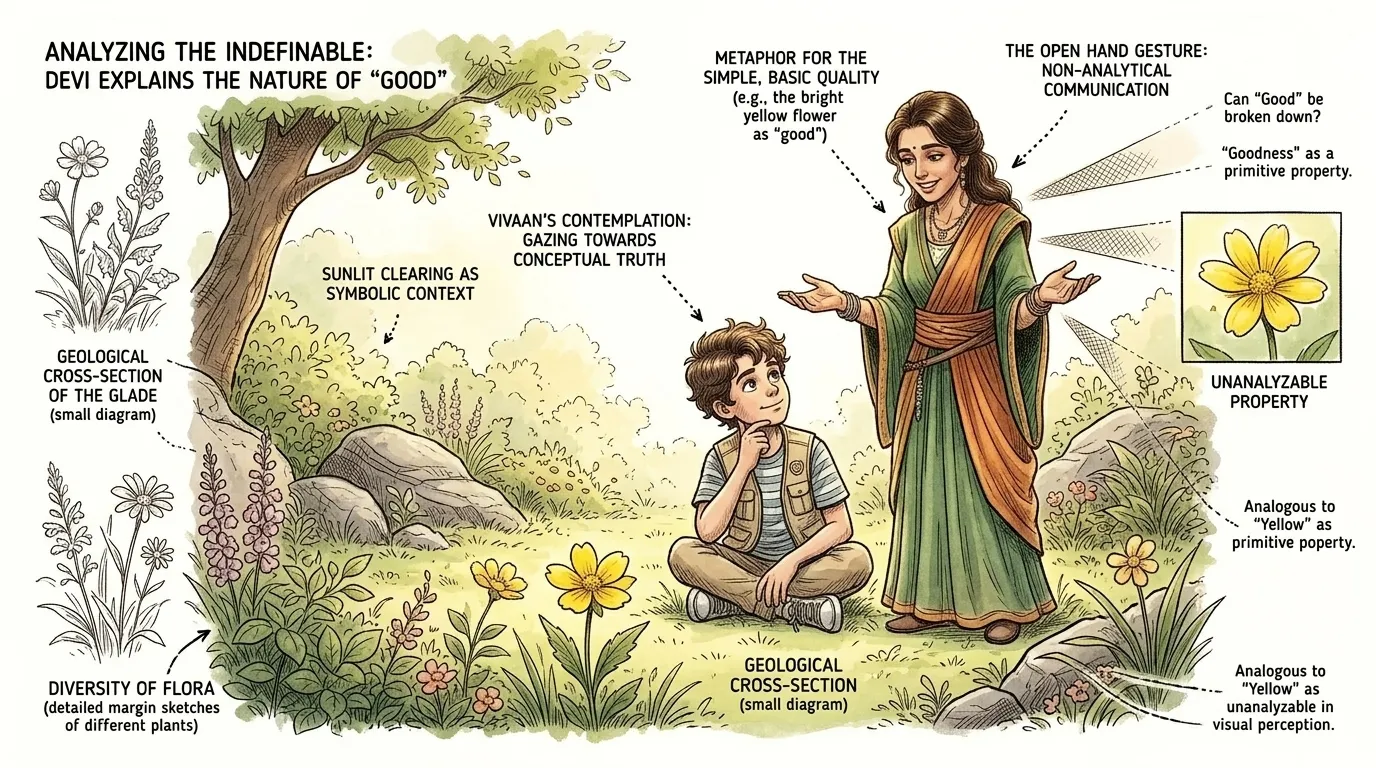
Beyond defending common sense in epistemology, Moore also made a significant contribution to ethics. He argued that the concept of 'good' is a simple, non-natural property, much like the color yellow, which cannot be defined in terms of other properties.
"Vivaan thought about it. "So, like, 'good' is just... 'good'? You can't say 'good is happiness' or 'good is pleasure'?" Devi smiled. "Precisely! Moore called defining 'good' by other properties, like pleasure or utility, the 'Naturalistic Fallacy.' He believed 'good' is a basic, indefinable quality that we recognize intuitively, not something we can measure or describe using other things. It's simply itself, a fundamental concept.""
Philosophy Note: In his seminal work 'Principia Ethica' (1903), Moore introduced the 'Naturalistic Fallacy,' arguing that 'good' is a simple, unanalyzable non-natural property. He contended that any attempt to define 'good' in terms of natural properties (e.g., pleasure, utility) is fallacious.
Page 6
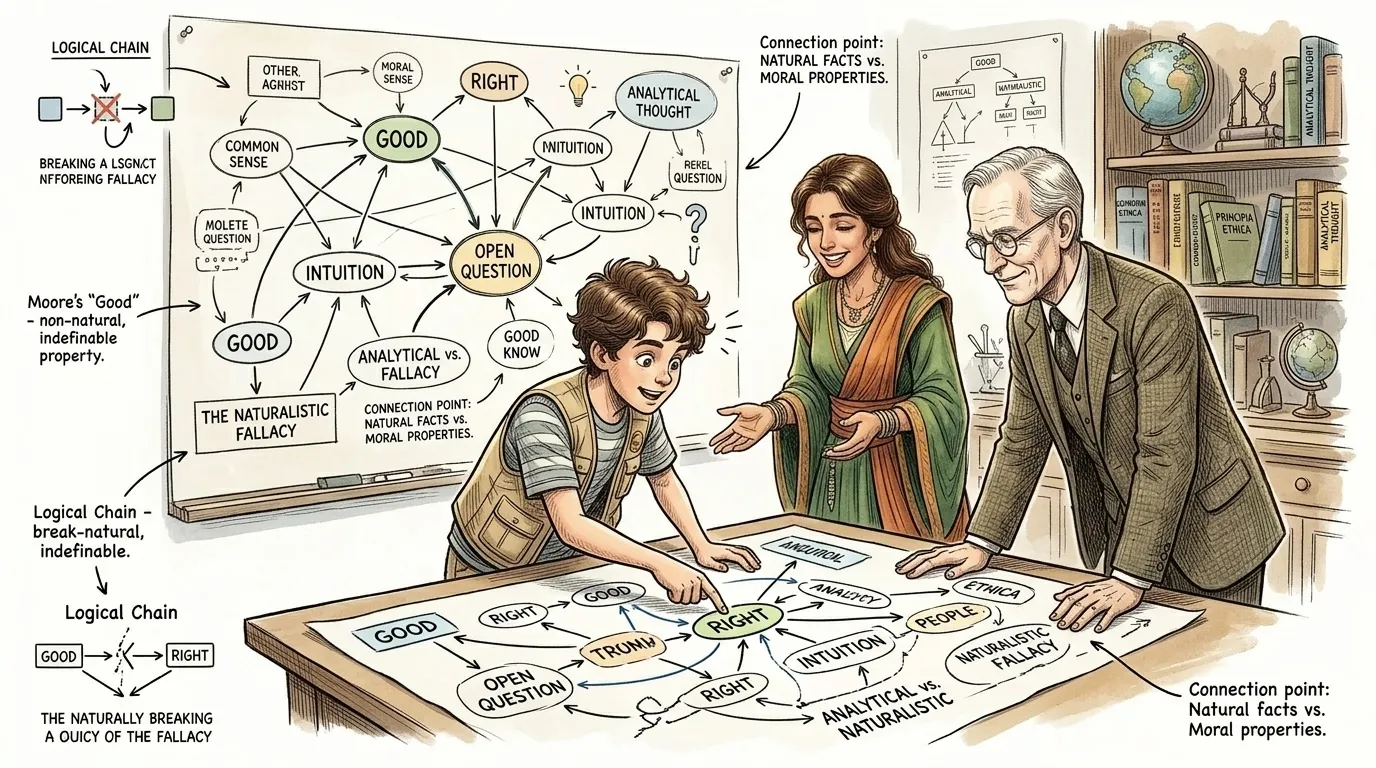
Moore's work laid groundwork for analytical philosophy, emphasizing the need for clarity, precision, and the careful analysis of concepts. He taught that by breaking down ideas into their simplest components, we can better understand their true meaning.
"Vivaan tapped the confusing map. "So, instead of overthinking if this faded line is a river or a path, we should just look closely at what is there and trust that it's a line, and then try to understand what 'river' or 'path' truly means without mixing them up?" Devi nodded, beaming. "Yes! That's the heart of Moore's approach. To truly understand, we must first be clear about what we are perceiving and what our words mean, keeping them distinct rather than conflating them with other things. It's about careful, step-by-step thinking.""
Philosophy Note: Moore's method involved the rigorous analysis of propositions and concepts, aiming to clarify the meaning of philosophical statements. This analytical rigor became a hallmark of the philosophical movement he helped to found.
Page 7
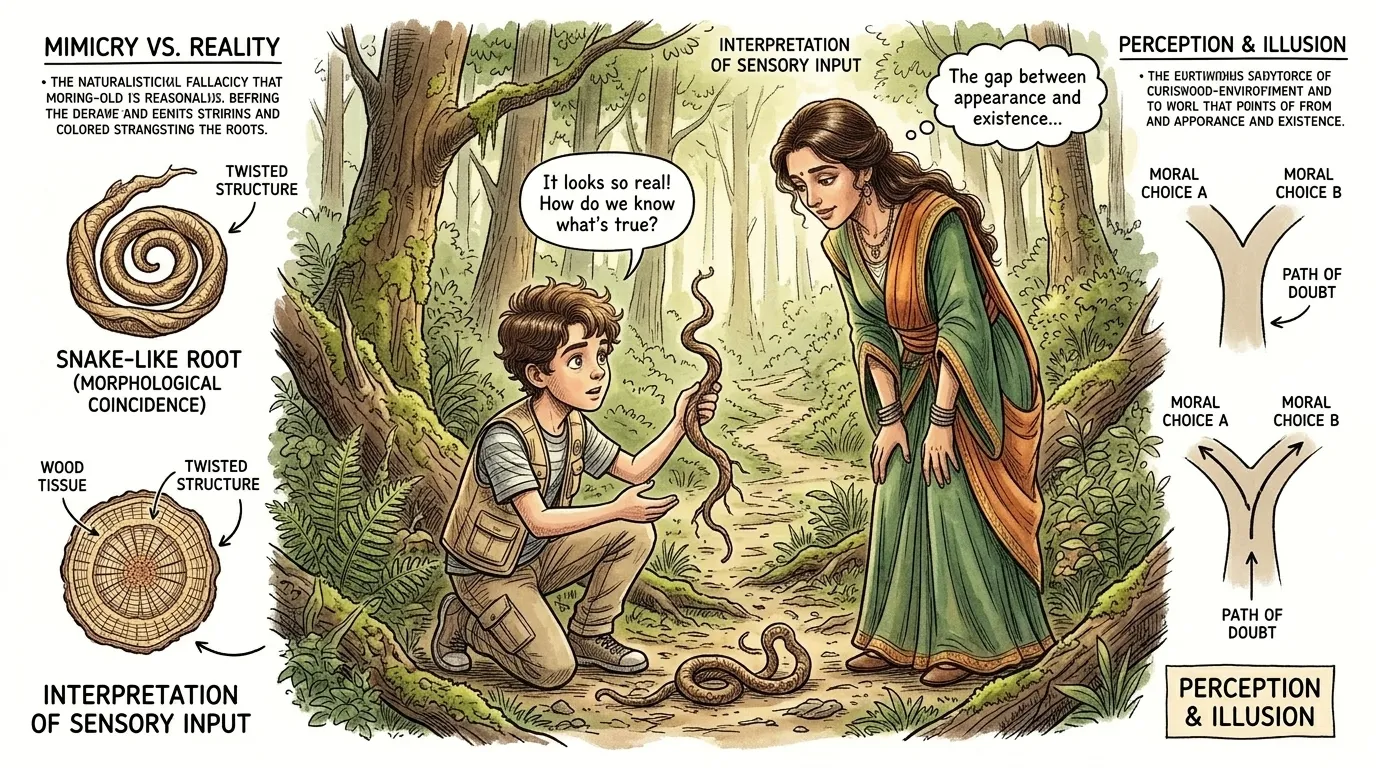
While Moore championed common sense, even he recognized that some situations, like optical illusions or profound moral dilemmas, present complexities that simple observation alone might not resolve. Sometimes, things aren't as straightforward as they appear.
"Vivaan picked up a strange, twisted root that looked like a snake. "But what if common sense isn't enough? This root looks like a snake, but it's not. And what if we come across a fork in the path where both ways seem good, but only one leads to the ruins? How do we decide which is the 'good' path then?" Devi considered this. "That's where the deeper challenge lies, and philosophers after Moore continued to explore these nuances. Common sense provides a baseline, but the world does have its illusions and its difficult choices, just like this map has its confusing lines. It reminds us of what the Roman philosopher Seneca once said: 'Every new beginning comes from some other beginning's end.' We need to use what we know, but also be ready for new observations.""
Philosophy Note: Critics of Moore's common-sense philosophy argued that while intuition is valuable, it can sometimes be misleading, especially in complex ethical or epistemological problems. The line between 'common sense' and 'unexamined prejudice' can be blurry.
Page 8
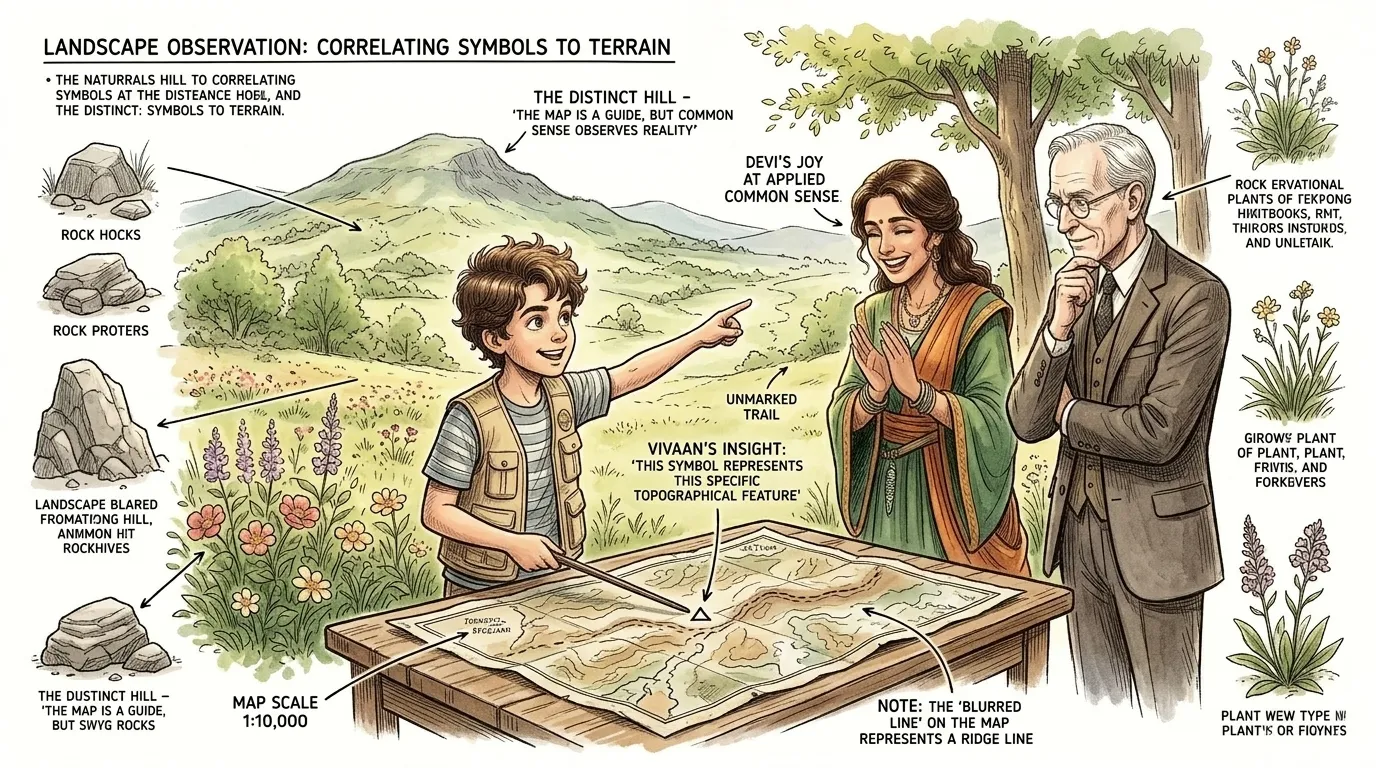
Armed with Moore's insights, Vivaan and Devi returned to the old map. They focused not on abstract doubts, but on carefully observing the undeniable markings and applying clear, distinct definitions to what they saw, ultimately finding their way.
"Vivaan pointed to a section on the map, then at a distant hill. "Wait! This blurred line might look like a river, but if we trust our eyes and look at the actual landscape, it runs uphill. Rivers don't run uphill. So, it must be a mountain trail, even if it's drawn poorly. And this symbol, which I thought was a faded tree, actually matches the distinct 'ruins' symbol if I just look at the overall shape, not the individual smudges." Devi clapped her hands. "That's it, Vivaan! You're using Moore's common-sense approach: trust your direct perception and be clear about the definition of what you're seeing!""
Philosophy Note: The 'setup and payoff' here demonstrates how Moore's emphasis on direct perception and clear conceptual analysis can resolve practical ambiguities, grounding abstract problems in concrete experience.
Page 9
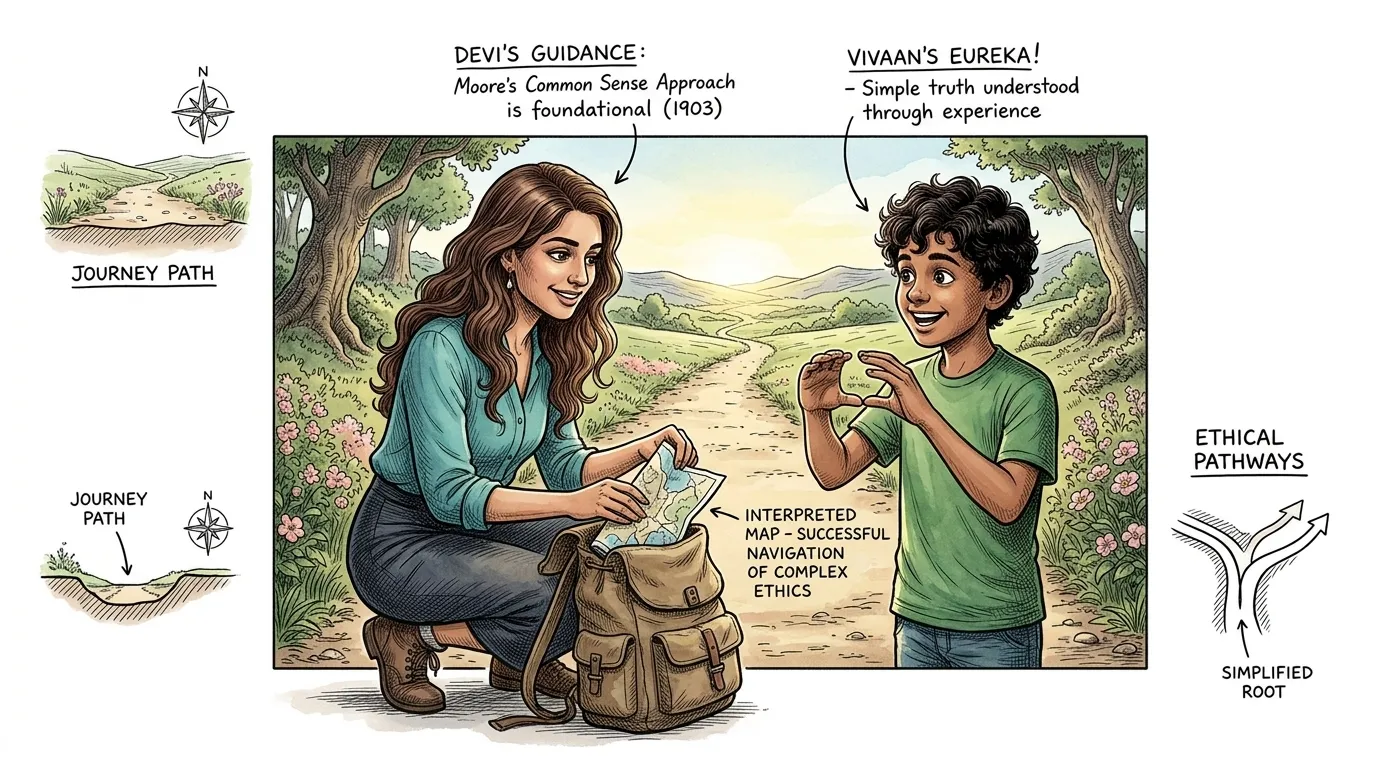
Moore's focus on common sense, the careful analysis of language, and the indefinability of 'good' continues to shape philosophical discourse. He reminds us to question overly complex theories and to value intellectual honesty.
"Devi packed up the map, now successfully interpreted. "Moore's ideas still resonate today, Vivaan. In a world full of complex arguments and information, his call for clarity, honesty, and trusting our foundational experiences remains incredibly relevant. He taught us to rigorously examine claims and to value the simplicity of truth, even when it's fashionable to complicate things." Vivaan grinned. "So, it's about not getting tricked by fancy words and just seeing what is?""
Philosophy Note: Moore's contributions to metaethics and epistemology were foundational for the analytic tradition. His method of 'philosophical analysis' continues to influence philosophers in their quest for conceptual clarity and precision, especially in moral philosophy.
Page 10
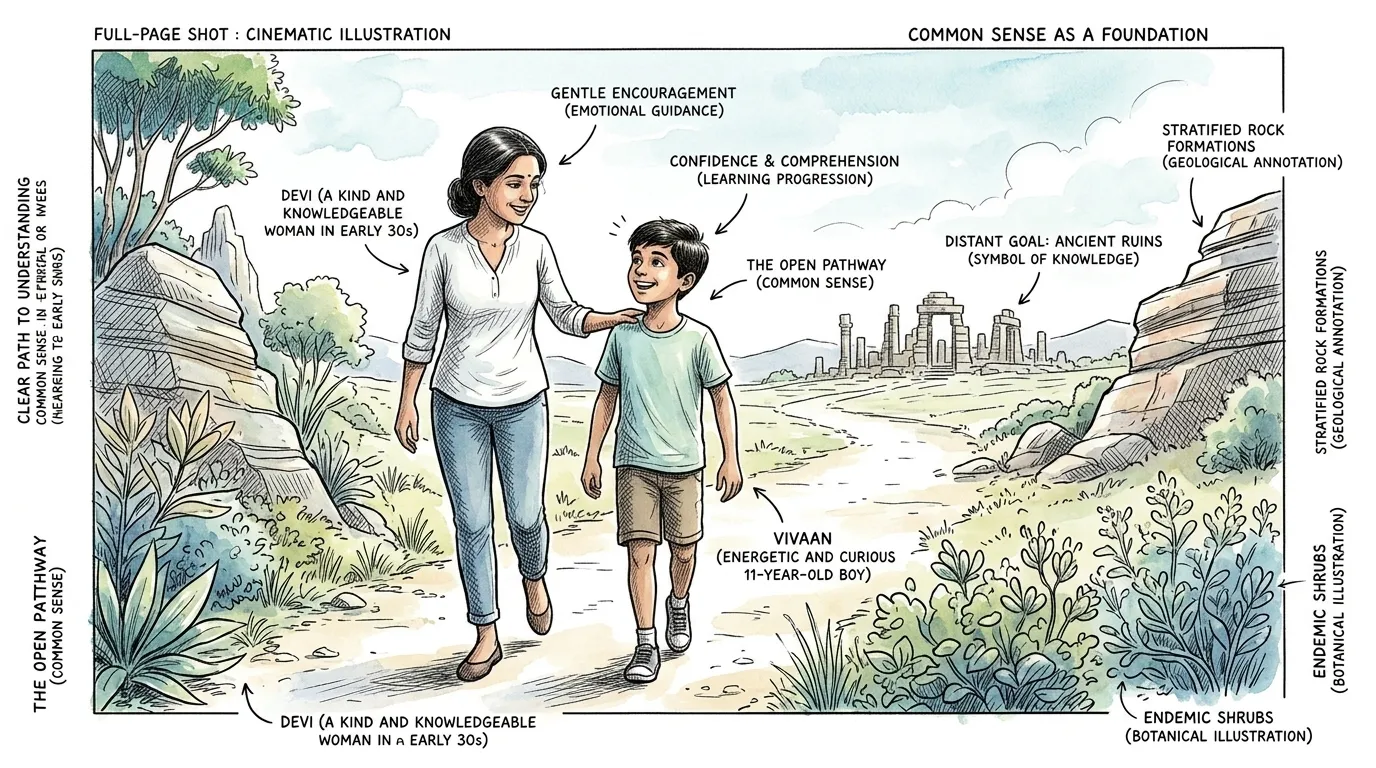
Ultimately, G. E. Moore's enduring contribution lies in his steadfast advocacy for clear thinking and the unshakeable validity of ordinary knowledge. He championed intellectual humility, urging us to defend what we know to be true against abstract skepticism.
"Devi smiled warmly at Vivaan. "Exactly, Vivaan. Moore helps us remember that some truths are self-evident, and that true wisdom often begins with acknowledging the reality right before our eyes, not by endlessly doubting it. His legacy is a powerful reminder to always seek clarity." Vivaan nodded, looking at the path ahead with newfound confidence. "So, common sense isn't just common, it's powerful!""
Philosophy Note: Moore's impact extended beyond his direct philosophical arguments, fostering a culture of rigorous analysis and an emphasis on conceptual clarity that continues to characterize much of contemporary analytic philosophy, bridging into critical thinking and existential inquiry.
About this story
- Audience: kids (ages 6–12)
Read Wonder Philosophy on your phone
Wonder Philosophy is available on Android and iPhone and iPad. Get Wonder Philosophy on Google Play · Get Wonder Philosophy on the App Store.