Heraclitus
Heraclitus — an illustrated philosophy story. 10 illustrated pages, free to read on Wonder Philosophy.
Page 1

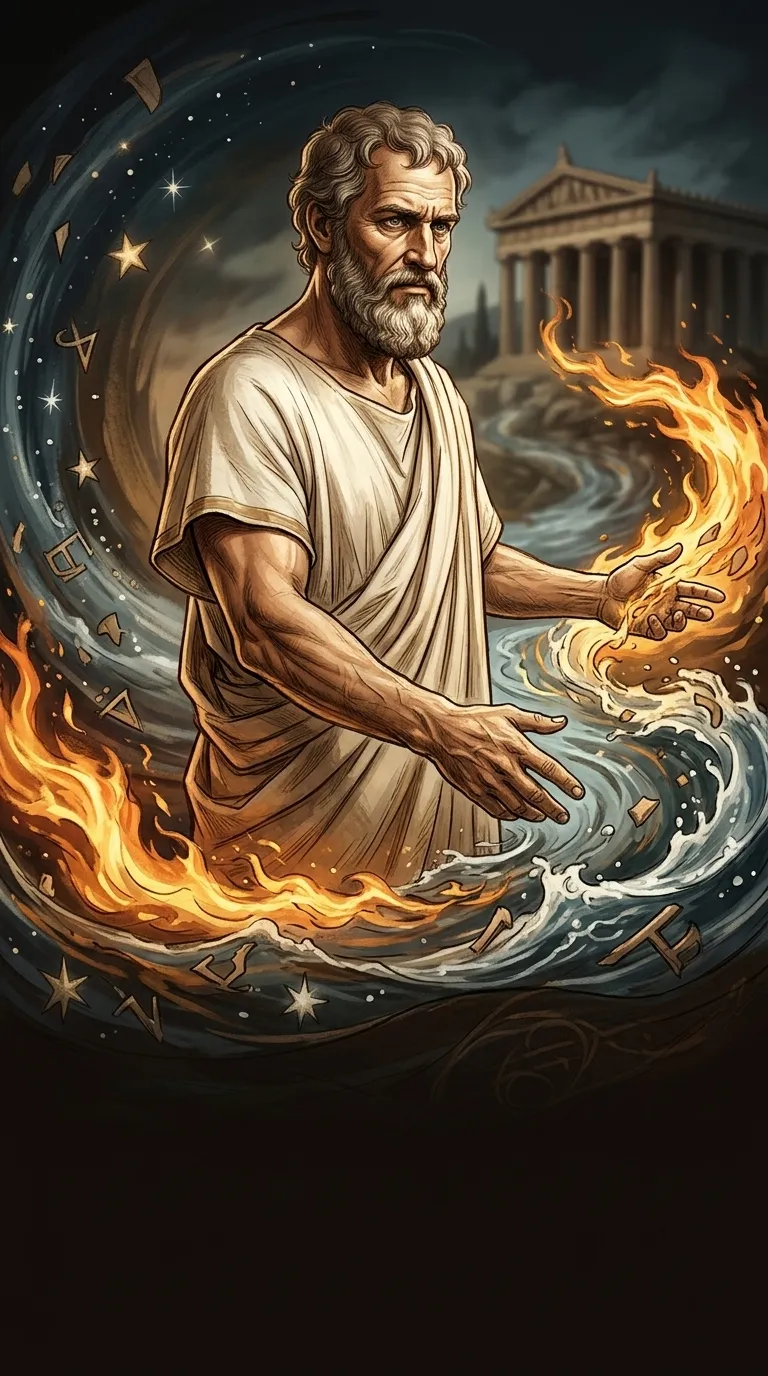
The idea that 'everything flows' might seem simple, but it has profound implications. It suggests that nothing stays the same, not even for a moment. This constant change, or flux, challenges our understanding of identity, reality, and even the possibility of knowledge. Why does this matter today? In a world of rapid technological and social shifts, Heraclitus's ancient wisdom reminds us to embrace change, adapt to new realities, and find stability in the midst of constant transformation.
Philosophy Note: Heraclitus of Ephesus (c. 500 BCE) was a pre-Socratic Greek philosopher.
Page 2
![Heraclitus [c. 500 BCE] lived in Ephesus [a city in modern-day Turkey]. He was known for his obscure and paradoxical sayings.](https://thewonderbooks.com/images/stories/heraclitus/illustrations/heraclitus_page_02_v1775181575804.webp "Heraclitus [c. 500 BCE] lived in Ephesus [a city in modern-day Turkey]. He was known for his obscure and paradoxical sayings.")
Heraclitus [c. 500 BCE] lived in Ephesus [a city in modern-day Turkey]. He was known for his obscure and paradoxical sayings. Unlike other philosophers who sought stable, unchanging principles to explain the universe, Heraclitus focused on the ever-changing nature of reality. His emphasis on change set him apart from contemporaries like Parmenides [5th century BCE], who argued for the unchanging nature of being, marking a fundamental divergence in early Greek philosophy.
"Kaya, tell me more about this Heraclitus, the man who saw change everywhere."
Philosophy Note: Parmenides emphasized permanence, contrasting with Heraclitus's focus on flux.
Page 3
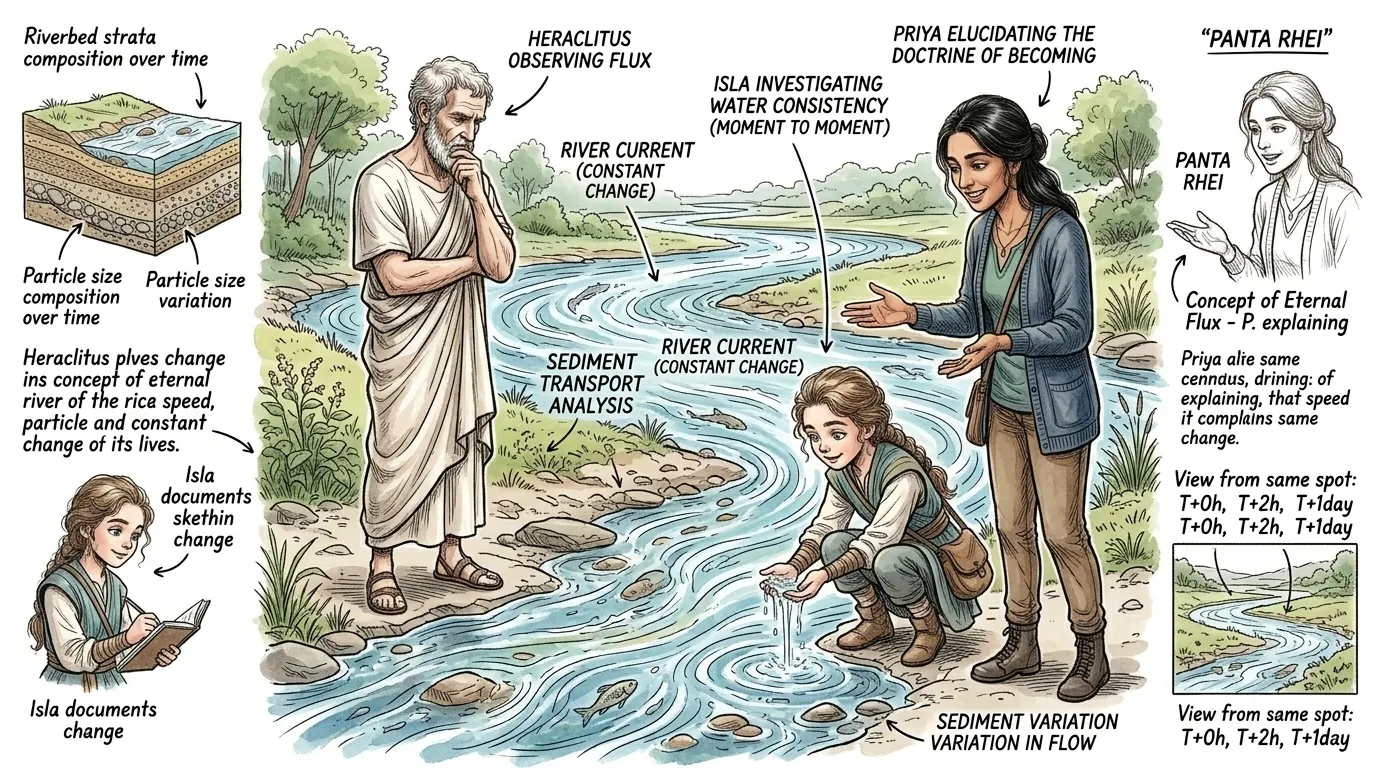
Heraclitus famously said, 'No man ever steps in the same river twice, for it's not the same river and he's not the same man.' This illustrates his core belief that everything is in a state of constant flux. It's not just physical things that change, but also our own selves, our thoughts, and our experiences. This raises a difficult question: If everything is constantly changing, can we ever truly know anything with certainty?
"Saanvi, imagine trying to hold water in your hands, always slipping away."
Philosophy Note: Heraclitus used fire as a metaphor for the constant change in the world.
Page 4
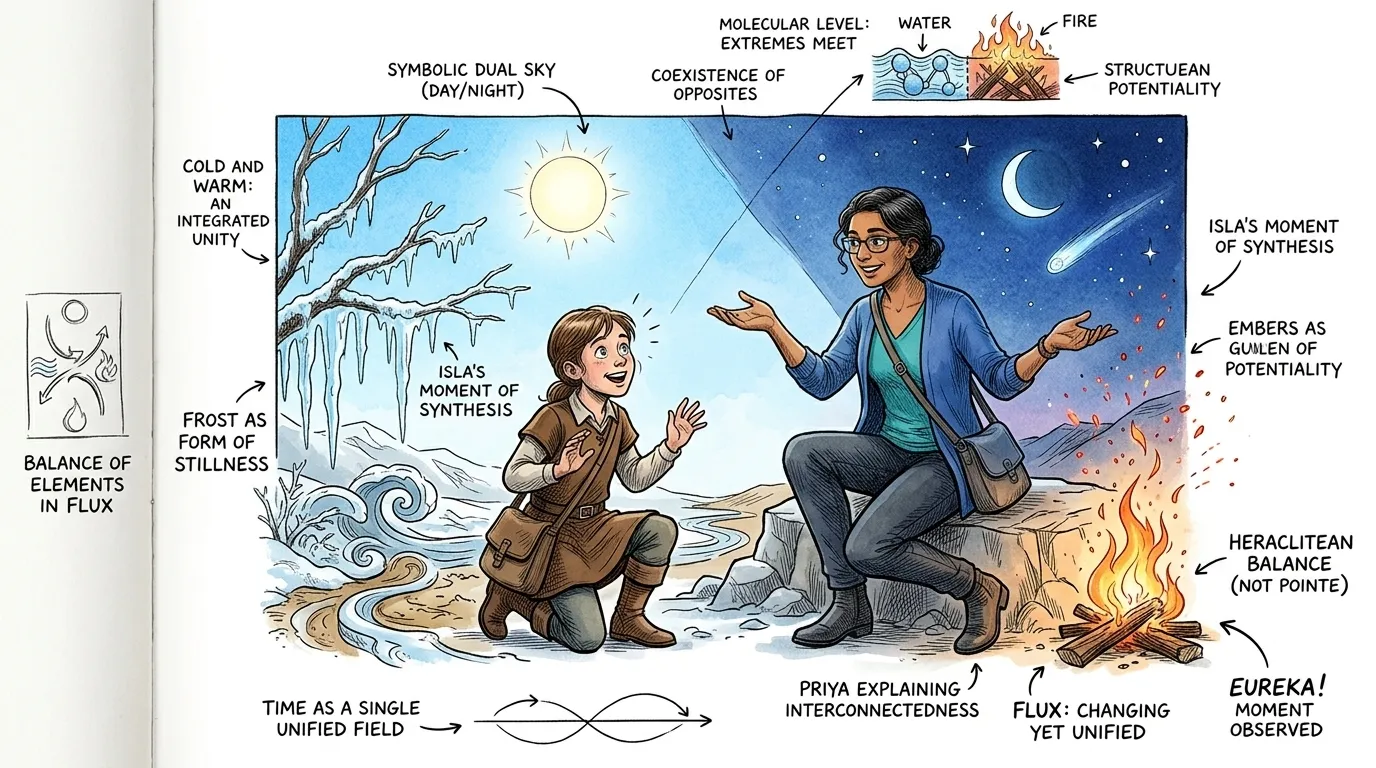
Another key aspect of Heraclitus's philosophy is the idea that opposites are interconnected and necessary for each other. He believed that day and night, hot and cold, good and bad are all part of a single, unified reality. One cannot exist without the other. This tension between opposites drives the constant change and transformation that he saw as fundamental to the universe.
"Kaya, can you imagine a world without sadness so we can't know how much joy we feel?"
Philosophy Note: Heraclitus argued that 'the way up and the way down are one and the same.'
Page 5
![Heraclitus also introduced the concept of the 'Logos' [λόγος]. This can be understood as an underlying principle or reason that governs the universe.](https://thewonderbooks.com/images/stories/heraclitus/illustrations/heraclitus_page_05_v1775181655346.webp "Heraclitus also introduced the concept of the 'Logos' [λόγος]. This can be understood as an underlying principle or reason that governs the universe.")
Heraclitus also introduced the concept of the 'Logos' [λόγος]. This can be understood as an underlying principle or reason that governs the universe. While everything is in constant flux, the Logos provides a kind of order and structure. It's the hidden pattern that connects all things and makes the continuous change intelligible. Understanding the Logos means understanding the underlying harmony of the universe.
"Even in chaos, there is order, Saanvi."
Philosophy Note: The concept of the Logos influenced later philosophical and theological thought.
Page 6
![Heraclitus's ideas weren't without critics. Parmenides [5th century BCE] argued that change is an illusion and that true reality is unchanging.](https://thewonderbooks.com/images/stories/heraclitus/illustrations/heraclitus_page_06_v1775181682617.webp "Heraclitus's ideas weren't without critics. Parmenides [5th century BCE] argued that change is an illusion and that true reality is unchanging.")
Heraclitus's ideas weren't without critics. Parmenides [5th century BCE] argued that change is an illusion and that true reality is unchanging. Others questioned how knowledge is possible if everything is constantly changing. If nothing stays the same, how can we form stable concepts or make reliable judgments? These criticisms highlight the difficulty of reconciling the apparent stability of our experience with the constant flux that Heraclitus emphasized.
"If nothing is permanent, then what can we truly know?"
Philosophy Note: Zeno's paradoxes challenged the possibility of motion and change.
Page 7

Despite these criticisms, Heraclitus's ideas continue to resonate today. His emphasis on change is particularly relevant in our rapidly evolving world. From technology to social norms, we are constantly confronted with new realities. Adapting to change, embracing uncertainty, and finding stability in the midst of flux are essential skills for navigating the modern world.
"Remember what Charles Darwin said, Kaya. It is not the strongest of the species that survives, nor the most intelligent that survives. It is the one that is most adaptable to change."
Philosophy Note: Heraclitus's philosophy influenced later thinkers like Hegel and Nietzsche.
Page 8
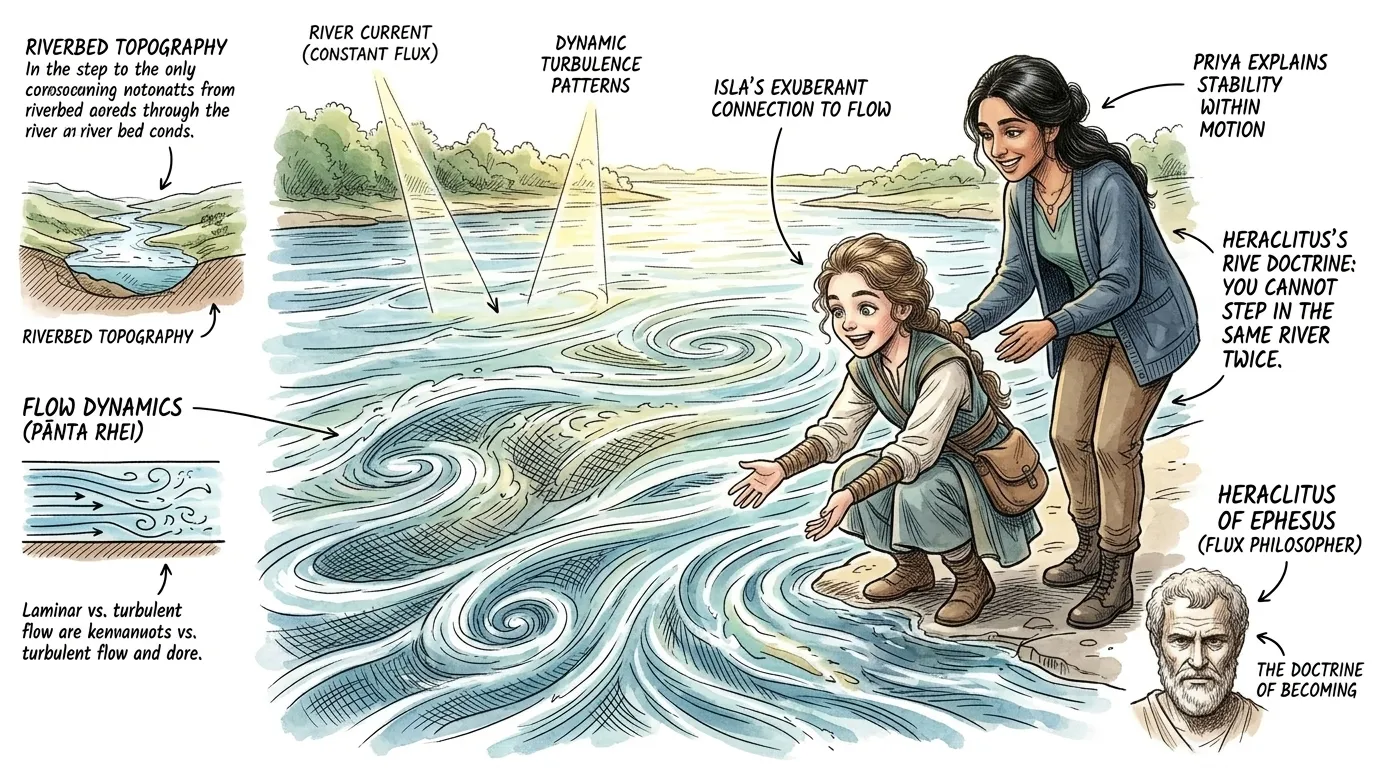
Heraclitus's message is not one of despair but of empowerment. By recognizing the inevitability of change, we can learn to adapt, to find new opportunities, and to appreciate the present moment. Like a river, life is constantly flowing. Instead of resisting the current, we can learn to navigate it, to embrace the journey, and to find our own way forward.
"Then we must be like the river, Saanvi! Flowing and ever-changing."
Philosophy Note: Heraclitus encourages us to find stability within constant change.
Page 9
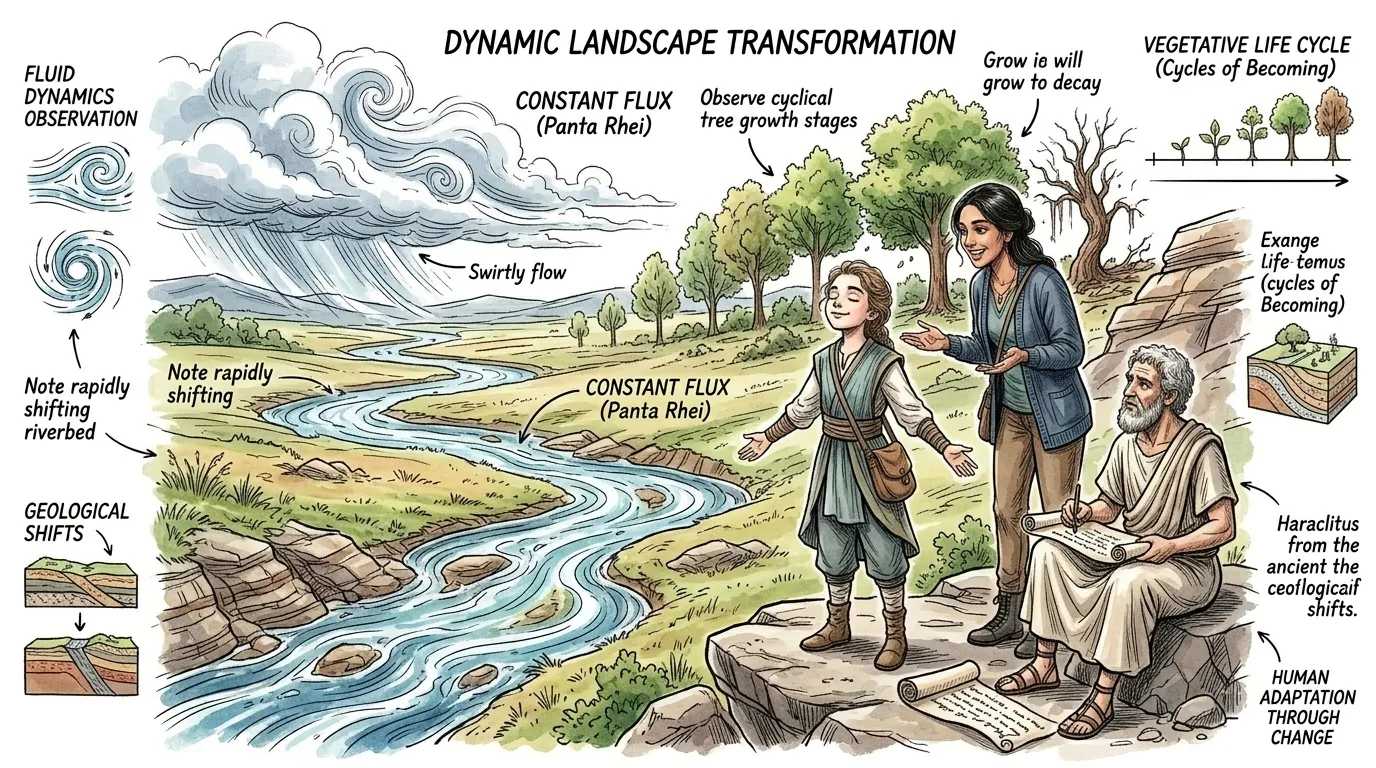
The core idea of Heraclitus remains a potent and useful way of interpreting reality today. If Heraclitus can teach the value of embracing change, then he can empower us to accept each moment as it is and to adapt to a world of constant flux.
"Do you understand the true value of change Saanvi?"
Philosophy Note: Understanding flux helps us to adapt to a world of chaos.
Page 10

Like the river, life is constantly flowing. Instead of resisting the current, we can learn to navigate it, to embrace the journey, and to find our own way forward. Though the river may change, its essence remains, just as we change while still being ourselves.
Philosophy Note: Heraclitus and modern ideas of constant change empower us.
About this story
- Audience: kids (ages 6–12)
Questions and answers
Read Wonder Philosophy on your phone
Wonder Philosophy is available on Android and iPhone and iPad. Get Wonder Philosophy on Google Play · Get Wonder Philosophy on the App Store.