Iris Murdoch
Iris Murdoch — an illustrated philosophy story. 10 illustrated pages, free to read on Wonder Philosophy.

Page 1
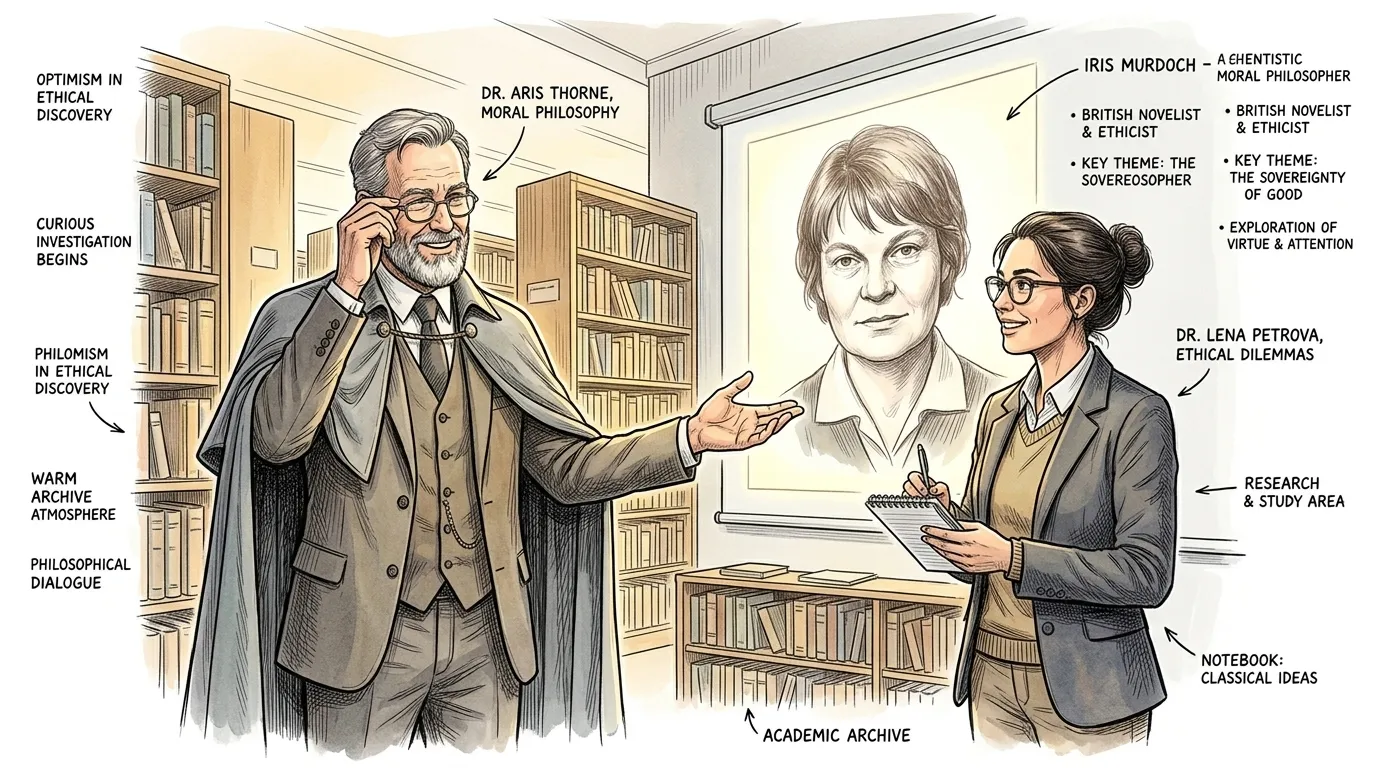
Dr. Aris Thorne gestured towards a large projection of Iris Murdoch's portrait, deep in conversation with Dr. Lena Petrova. They stood in a brightly lit modern academic archive.
"'Iris Murdoch challenges us to look beyond mere subjective will in ethics,' Dr. Thorne explained, adjusting his glasses. 'She argued that true morality isn't just about choosing, but about 'seeing' reality clearly.' Dr. Petrova nodded thoughtfully. 'It's a call to profound attention, shifting our focus from self-assertion to the complex, independent 'Good' that exists outside us.'"
Philosophy Note: Iris Murdoch (1919-1999) - Philosopher & Novelist. Core Idea: 'Attention' and 'Unselfing' as foundations of moral life, critiquing existentialist notions of radical freedom.
Page 2
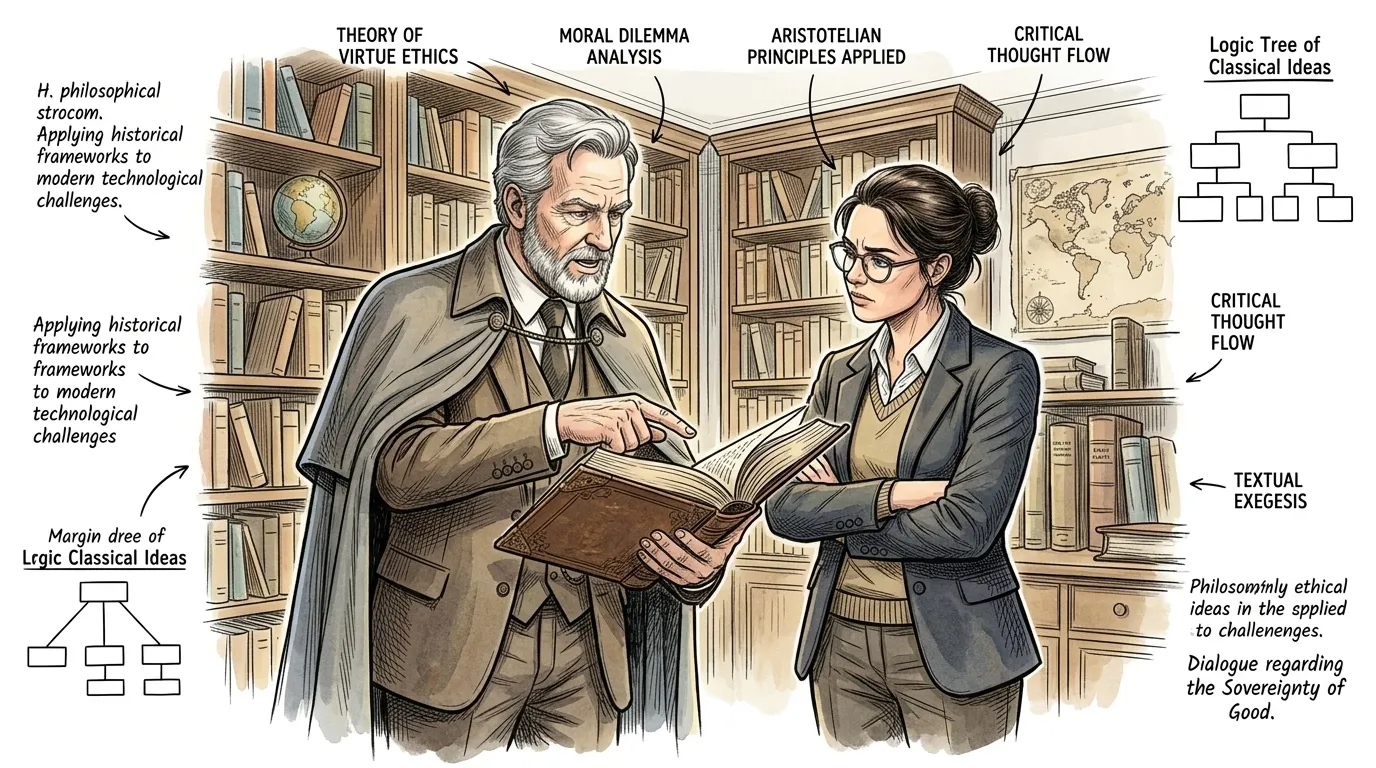
Dr. Thorne picked up an old, leather-bound book, gesturing towards its pages as Dr. Petrova listened intently, a slight frown of concentration on her face.
"'Before Murdoch, much of 20th-century thought, especially existentialism, emphasized radical freedom and the self as the sole creator of value,' Dr. Thorne elaborated, tapping the book. 'This meant morality often felt like an invention, not a discovery.' Dr. Petrova considered this. 'Murdoch saw this focus on 'will' as potentially leading to self-enclosure, blocking our perception of others and of reality itself.' 'Exactly,' Thorne affirmed. 'She proposed a difficult but essential concept: 'unselfing' – moving beyond our ego to truly perceive.'"
Philosophy Note: Existentialism: Emphasized individual freedom, responsibility, and the creation of meaning in a meaningless world (e.g., Sartre, de Beauvoir). Murdoch's Counter: Morality as 'seeing' the Good, not 'creating' value.
Page 3
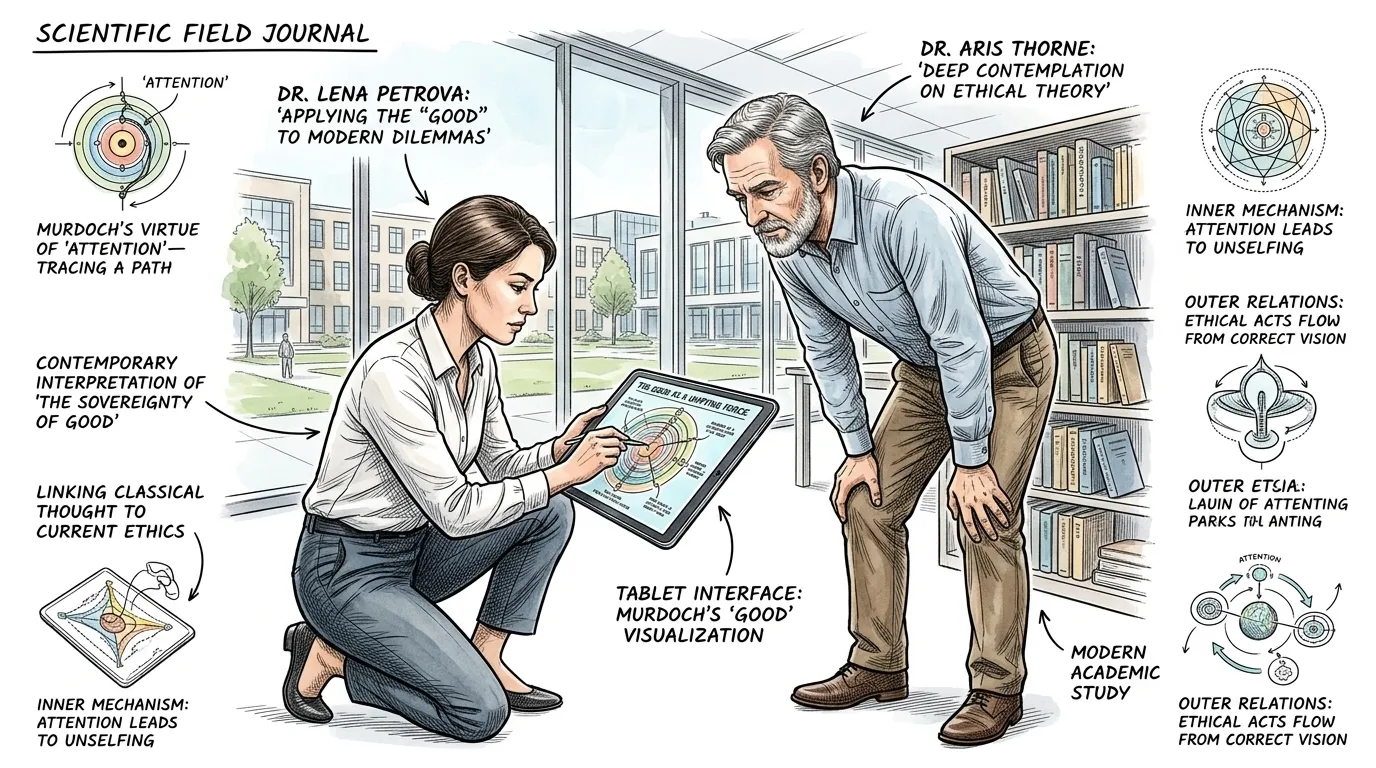
Dr. Petrova used her tablet to display an intricate diagram, illustrating Murdoch's idea of the 'Good'. Dr. Thorne carefully observed the visual explanation.
"'Murdoch rejected the notion that morality is merely subjective feeling or an expression of will,' Dr. Petrova explained, tracing a line on her screen. 'She argued that 'Good' is a transcendent, objective reality, something we aspire to see and understand, not something we invent.' Dr. Thorne nodded slowly. 'It's like a distant magnetic north for our moral compass, always drawing us toward a more truthful perception of reality and others.' 'And that perception,' Petrova added, 'requires a disciplined turning away from self-preoccupation.'"
Philosophy Note: Platonic Influence: Murdoch drew inspiration from Plato's concept of the Form of the Good, suggesting an objective moral reality that demands intellectual and spiritual ascent. The 'Good' is not a property but an ideal.
Page 4
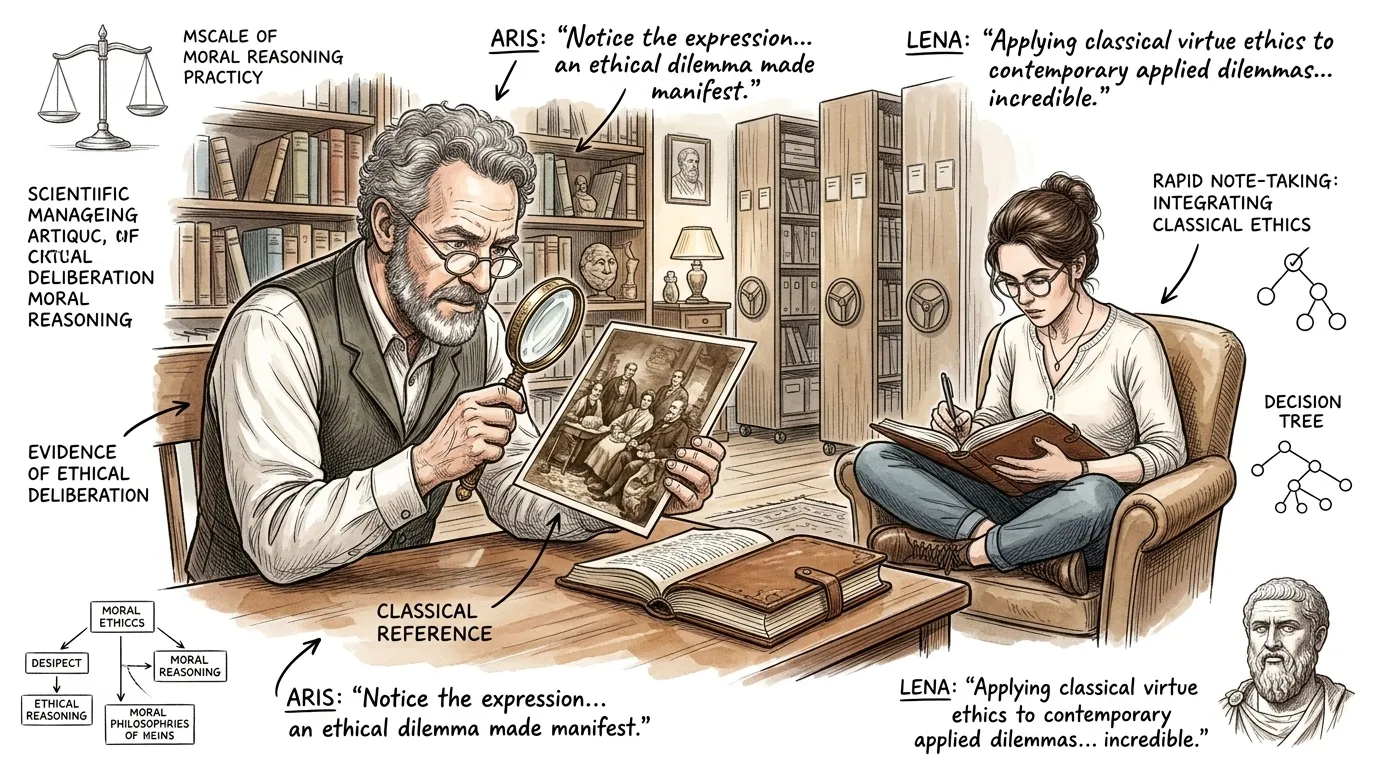
Dr. Thorne demonstrated with an old magnifying glass, focusing on a intricate detail within a historical photograph, as Dr. Petrova took notes.
"'For Murdoch, 'attention' isn't just passive observation; it's a loving, imaginative effort to understand things as they truly are, distinct from our desires,' Dr. Thorne emphasized, holding the magnifying glass. 'It means truly seeing the particularity of another person, rather than imposing our categories upon them.' Dr. Petrova quickly scribbled notes. 'This practice of sustained, unselfish attention is what allows us to escape the 'fat, relentless ego' and move towards a more virtuous life.' 'It's a demanding spiritual exercise, a constant turning outward,' Thorne concluded."
Philosophy Note: Attention: Murdoch's central concept. A moral faculty distinct from mere perception, requiring humility and discipline. It allows us to transcend ego and genuinely see the world and others.
Page 5
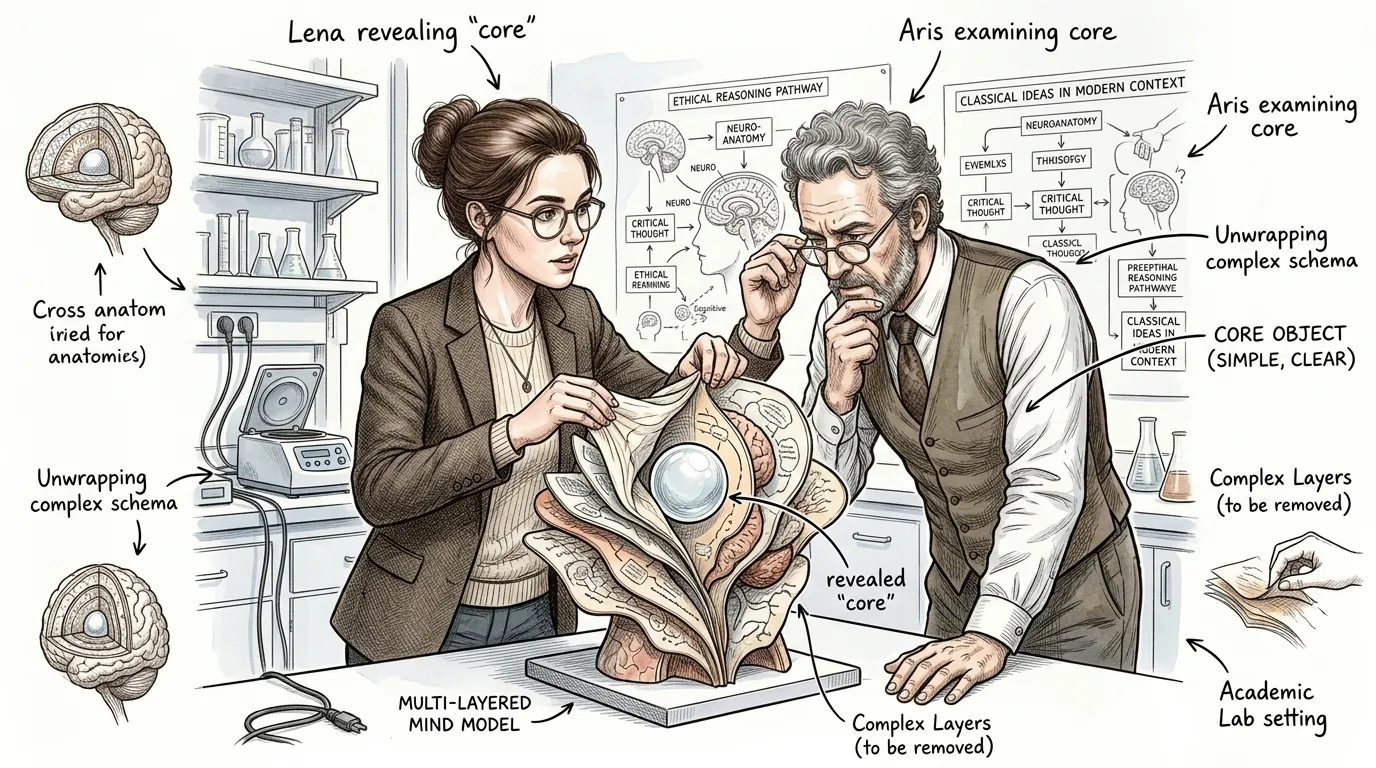
Dr. Petrova illustrated the idea of 'unselfing' by slowly unwrapping a complex, layered model of the human mind, revealing a simple, clear core. Dr. Thorne watched with understanding.
"'The journey of 'unselfing' involves dismantling our self-serving fantasies and illusions,' Dr. Petrova explained, carefully removing layers from the model. 'It's a painful but necessary process of intellectual and moral humility, allowing us to confront reality without distorting it.' Dr. Thorne stepped closer, examining the now simple core. 'This means relinquishing the idea that our will alone creates value and embracing the discipline of objective vision.' 'When we truly 'unself,' our moral choices become clearer because they are rooted in a more truthful perception of what is Good,' Petrova concluded."
Philosophy Note: Unselfing: The rigorous, often painful process of detaching from egoistic desires, self-deception, and personal fantasies to achieve an objective moral vision. It is a continuous ethical labor.
Page 6
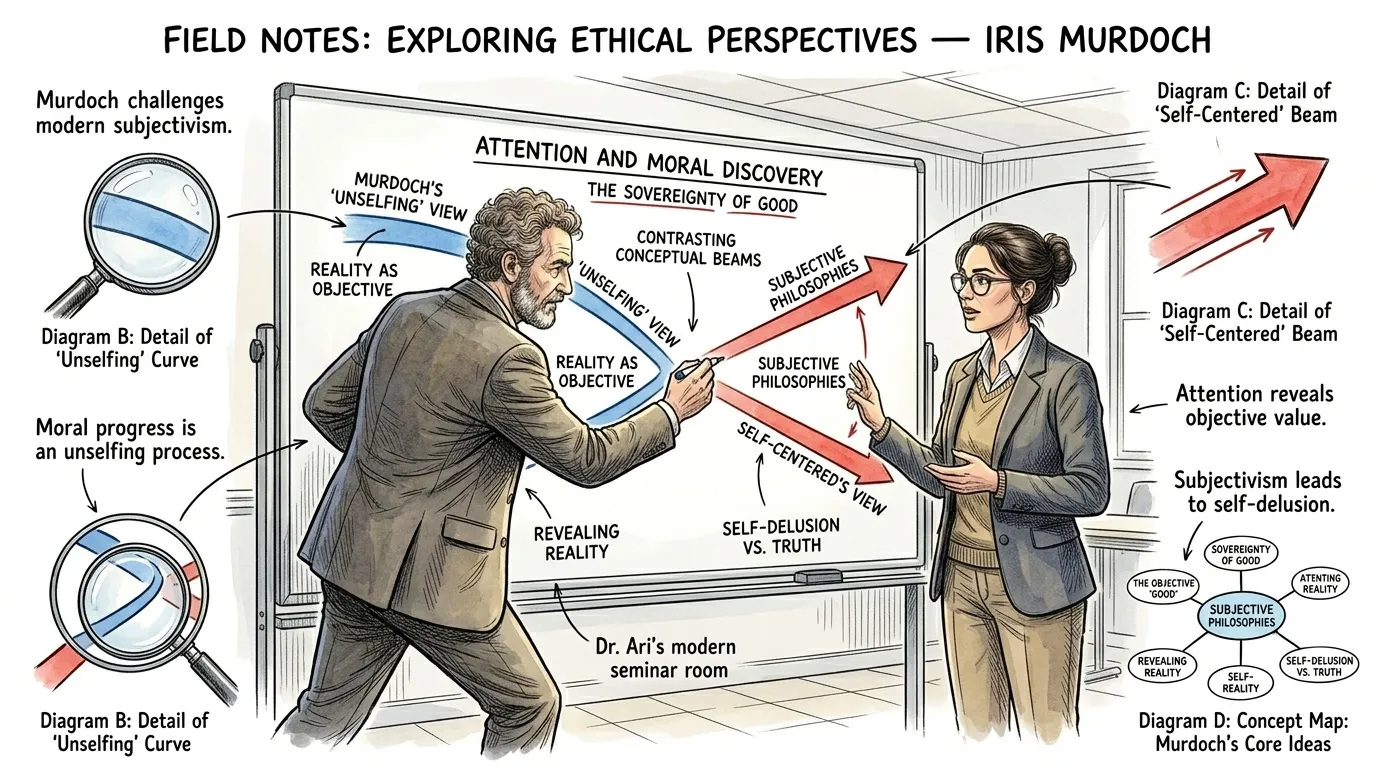
Dr. Thorne used a whiteboard to draw a sharp contrast between Murdoch's view and more subjective moral philosophies, highlighting the different directions of their arrows.
"'Murdoch fundamentally challenged philosophical trends that reduced morality to individual choice or emotion, particularly some forms of existentialism,' Dr. Thorne stated, drawing on a whiteboard. 'She argued that if morality is purely subjective, we lose any objective standard against which to measure our actions.' Dr. Petrova added, 'Without a transcendent 'Good' to guide us, we risk falling into a solipsistic trap where our own desires are the ultimate arbiter.' 'It's a stark contrast: one path turns inward, the other demands we look outward,' Thorne concluded, pointing to his drawing."
Philosophy Note: Critique: Murdoch saw the emphasis on radical freedom and subjective will (as in certain existentialist camps) as a threat to genuine moral understanding, leading to a self-enclosed, potentially narcissistic view of ethics. She advocated for a return to realism in ethics.
Page 7
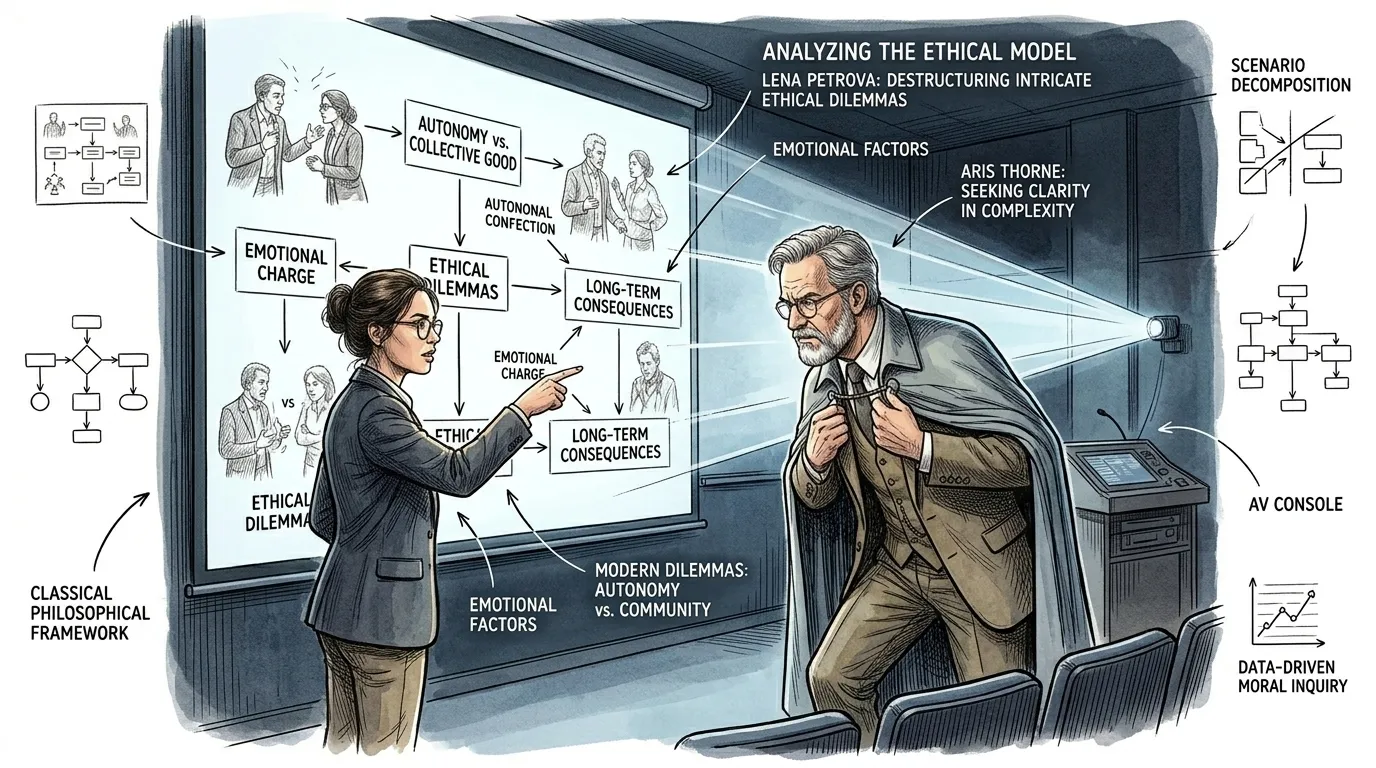
Dr. Petrova projected a complex ethical scenario onto a screen, detailing its intricate, emotionally charged elements. Both scholars studied it closely, seeking clarity.
"'Consider a modern ethical dilemma: how do we act justly in a situation filled with conflicting narratives and strong emotional biases?' Dr. Petrova posed, pointing to the projected scenario. 'Often, our initial impulse is to assert our own pre-conceived judgments or defend our group's perspective.' Dr. Thorne leaned in, frowning. 'This is precisely where Murdoch's critique becomes vital, as our subjective 'will' can easily obscure the true nature of the problem, preventing genuine moral progress.' 'Without 'unselfing,' we risk simply projecting our internal states onto a complex external reality,' Petrova concluded."
Philosophy Note: Real-World Application: Murdoch's philosophy offers a framework for navigating complex ethical issues by urging individuals to move beyond personal biases and emotionally charged responses, seeking a clearer perception of the objective 'Good' within the situation.
Page 8
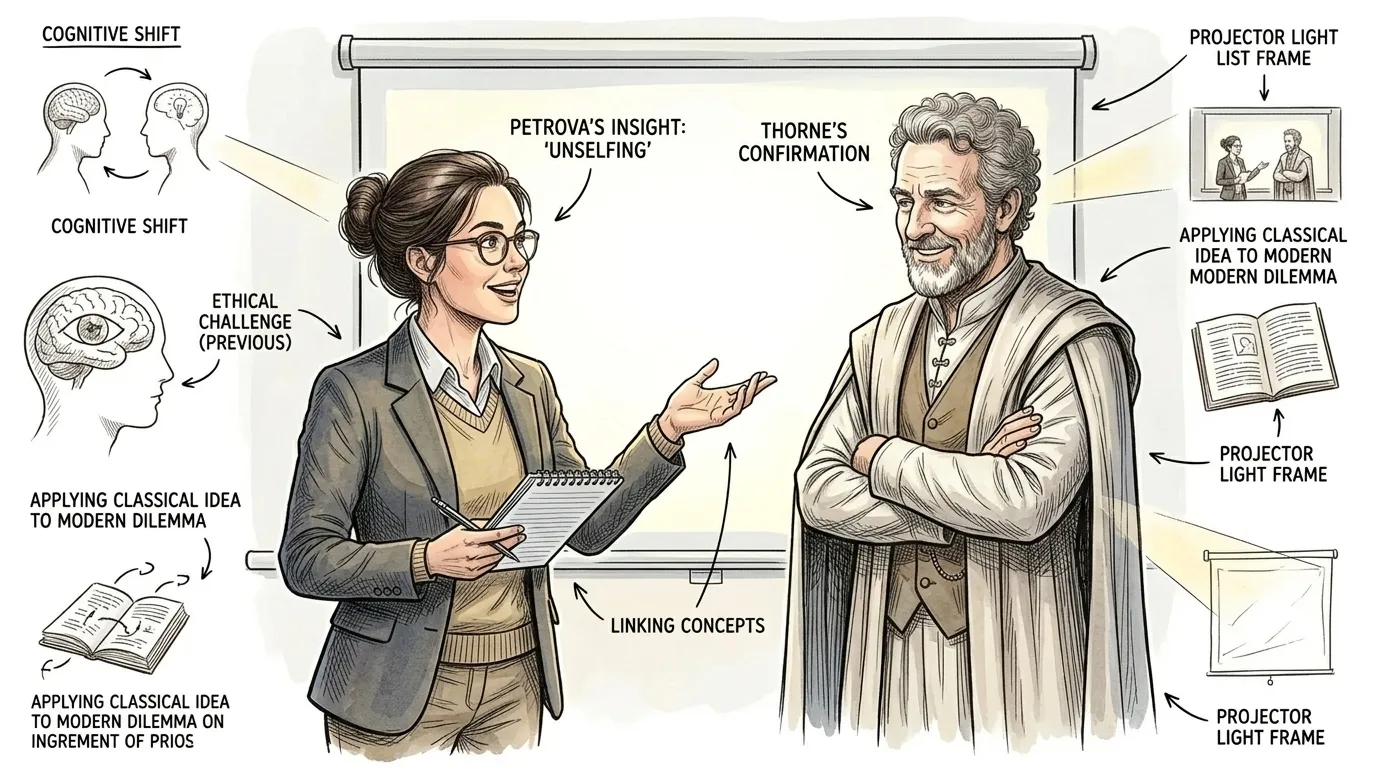
Dr. Petrova, with a look of revelation, turned to Dr. Thorne, connecting their earlier discussion of 'unselfing' directly to the current ethical challenge. Dr. Thorne's expression shifted to one of agreement.
"'Ah, remember what we discussed about Murdoch's 'unselfing'?' Dr. Petrova exclaimed, a spark of insight in her eyes. 'It isn't about ignoring our feelings, but about quieting the ego to truly 'attend' to the situation's objective demands.' Dr. Thorne smiled. 'Exactly! As the poet John Keats once wrote, 'Beauty is truth, truth beauty,—that is all Ye know on earth, and all ye need to know.' He was right – by striving for an unselfish truth, we find moral clarity.' 'By moving beyond self-centered perspectives, we can finally perceive the 'Good' embedded within the dilemma, guiding us towards a more compassionate and just response,' Petrova concluded."
Philosophy Note: Setup & Payoff: The earlier concept of 'unselfing' (Page 2) is applied here, demonstrating its utility in overcoming subjective biases and achieving a clearer moral perception, aligning with Murdoch's emphasis on objective 'Good' and 'attention'.
Page 9
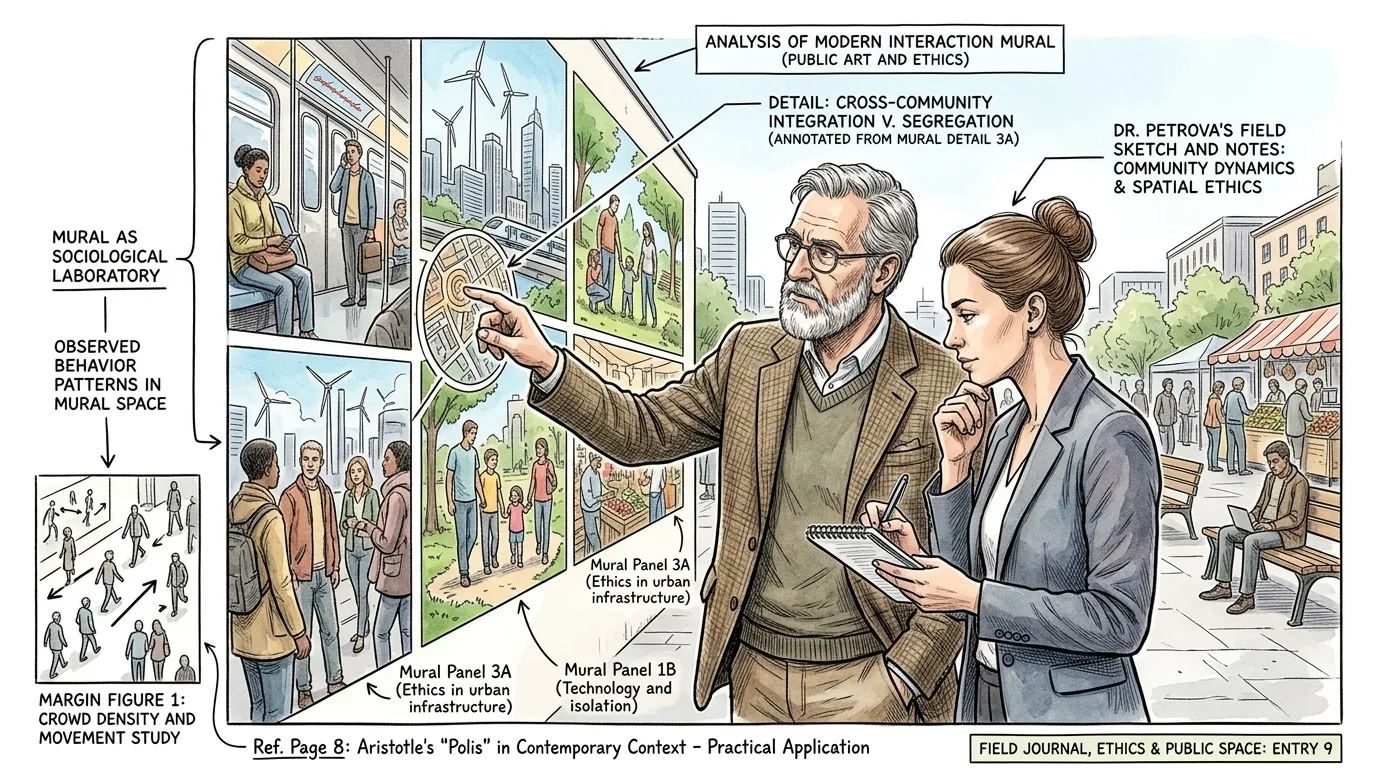
Dr. Thorne and Dr. Petrova stood before a large, vibrant mural depicting scenes of modern life, discussing how Murdoch's insights ripple through various aspects of contemporary existence. Their expressions conveyed deep contemplation.
"'Murdoch's work remains profoundly relevant today, urging us to cultivate a moral sensitivity that transcends self-interest,' Dr. Thorne remarked, tracing a detail on the mural. 'Her emphasis on 'attention' reshapes how we approach relationships, art, and even political discourse.' Dr. Petrova nodded. 'It's a call for intellectual honesty and a humble recognition of reality's independent existence, pushing back against the easy relativism of our age.' 'Ultimately, she provides a robust framework for striving towards genuine moral discernment in an increasingly complex world,' Thorne concluded."
Philosophy Note: Modern Relevance: Murdoch's philosophy offers critical tools for personal growth, ethical leadership, and a more profound engagement with culture, resisting the subjective drift prevalent in contemporary thought.
Page 10
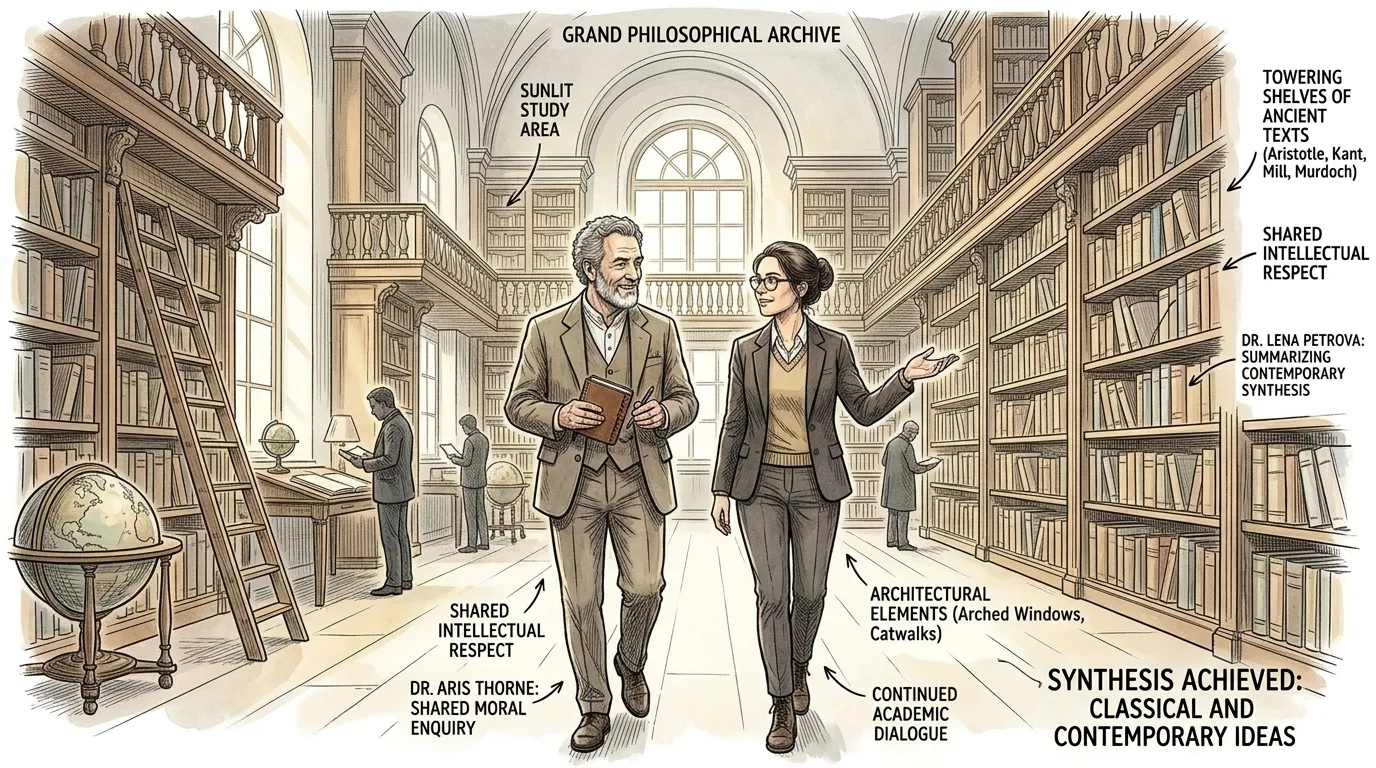
Dr. Thorne and Dr. Petrova walked through the sunlit archive, their discussion concluding with a shared appreciation for Murdoch's profound contributions. Their thoughtful expressions reflected the weight of her ideas.
"'Iris Murdoch's work reminds us that genuine freedom isn't just about choosing, but about having a clear moral vision to choose well,' Dr. Petrova summarized, gesturing towards the shelves of philosophical texts. 'Her insights on 'attention' and 'unselfing' offer a timeless path to deeper understanding and ethical living.' Dr. Thorne smiled. 'She gave us a powerful antidote to self-absorption, guiding us towards a more objective and compassionate engagement with the world.' 'Her legacy is a perpetual invitation to transcend the self and truly see the Good,' Petrova concluded, looking at him with respect."
Philosophy Note: Enduring Usefulness: Murdoch's philosophy continues to inspire discussions on moral realism, the nature of virtue, and the role of attention in ethical development, offering a rich alternative to purely subjective or utilitarian ethical frameworks.
About this story
- Audience: general readers
Questions and answers
Read Wonder Philosophy on your phone
Wonder Philosophy is available on Android and iPhone and iPad. Get Wonder Philosophy on Google Play · Get Wonder Philosophy on the App Store.