Judith Butler
Judith Butler — an illustrated philosophy story. 10 illustrated pages, free to read on Wonder Philosophy.

Page 1
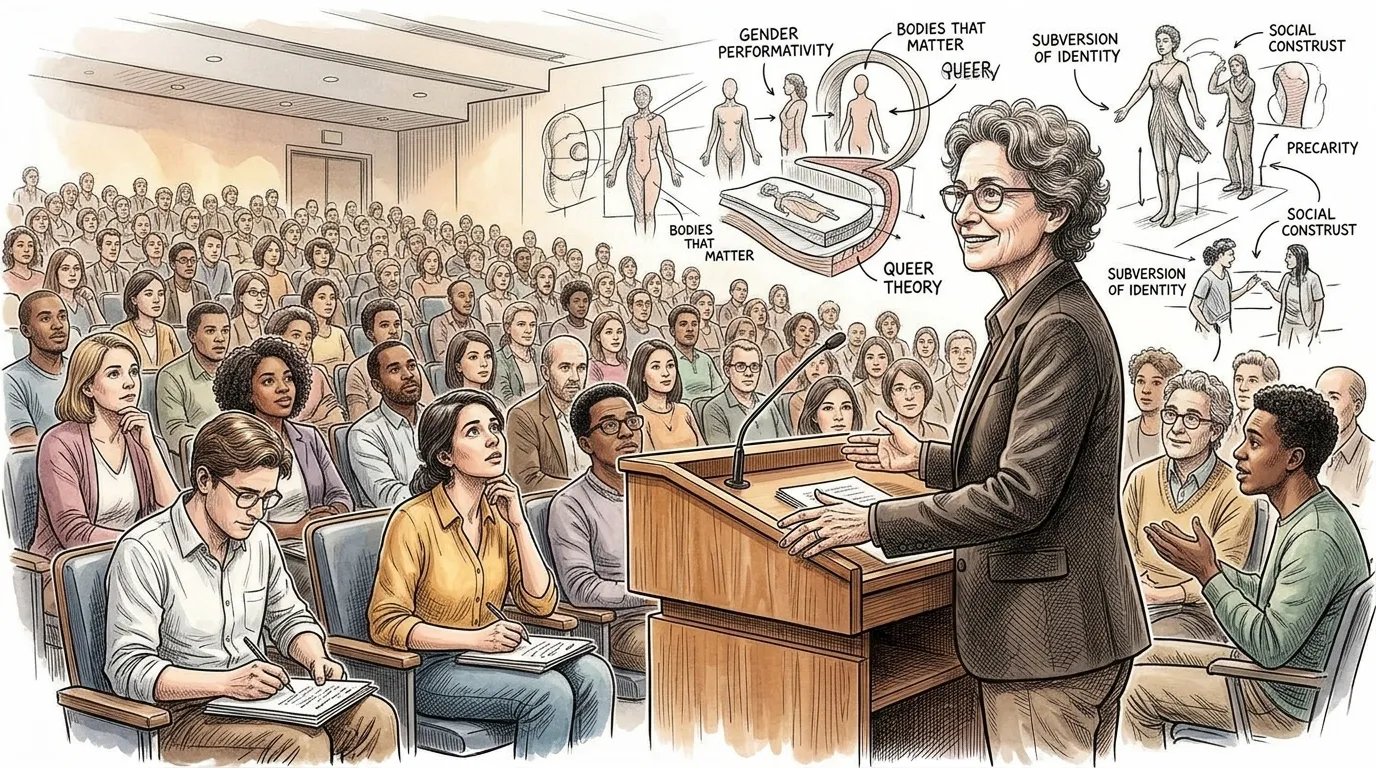
Judith Butler stands at the podium, her voice clear and precise, addressing a vast assembly of scholars and thinkers. She begins by challenging long-held assumptions about identity. "Consider Simone de Beauvoir's famous declaration from 'The Second Sex': 'One is not born, but rather becomes, a woman.' While groundbreaking, this still presupposes a 'woman' to become." The audience leans forward, captivated by her opening. "What if, then," Butler continues, "the very idea of gender, as we understand it, is not a fixed attribute, but rather an effect of repeated acts, gestures, and discourse?" Her words introduce a profound shift in thinking.
"Butler says, "'One is not born, but rather becomes, a woman.' But what if the very idea of gender is not fixed, but an effect of repeated acts?""
Philosophy Note: Judith Butler (b. 1956): American philosopher and gender theorist, central figure in queer theory. 'Gender Trouble' (1990) introduced gender performativity. Simone de Beauvoir (1908-1986): French existentialist and feminist, author of 'The Second Sex' (1949).
Page 2

A young academic, Dr. Anya Sharma, turns to her colleague, Dr. David Chen, during a coffee break outside the lecture hall. "Butler's opening truly reorients the debate, doesn't it?" Anya asks, stirring her tea. David nods thoughtfully, adjusting his glasses. "Indeed. She pushes past the conventional understanding that sex is biological and gender is its social interpretation. She makes us question the naturalness of those very categories themselves." He gestures towards a nearby screen displaying historical philosophical texts. "Before Butler, much of feminist thought, even while advocating for equality, implicitly accepted gender as a stable category derived from a fixed biological sex. But what if the very idea of 'sex' is also socially constructed, rather than purely anatomical?" This very question became a cornerstone of Butler's work.
"Anya asks, "Butler's opening truly reorients the debate, doesn't it?" David responds, "Indeed. She makes us question the naturalness of those very categories. What if the very idea of 'sex' is also socially constructed?""
Page 3
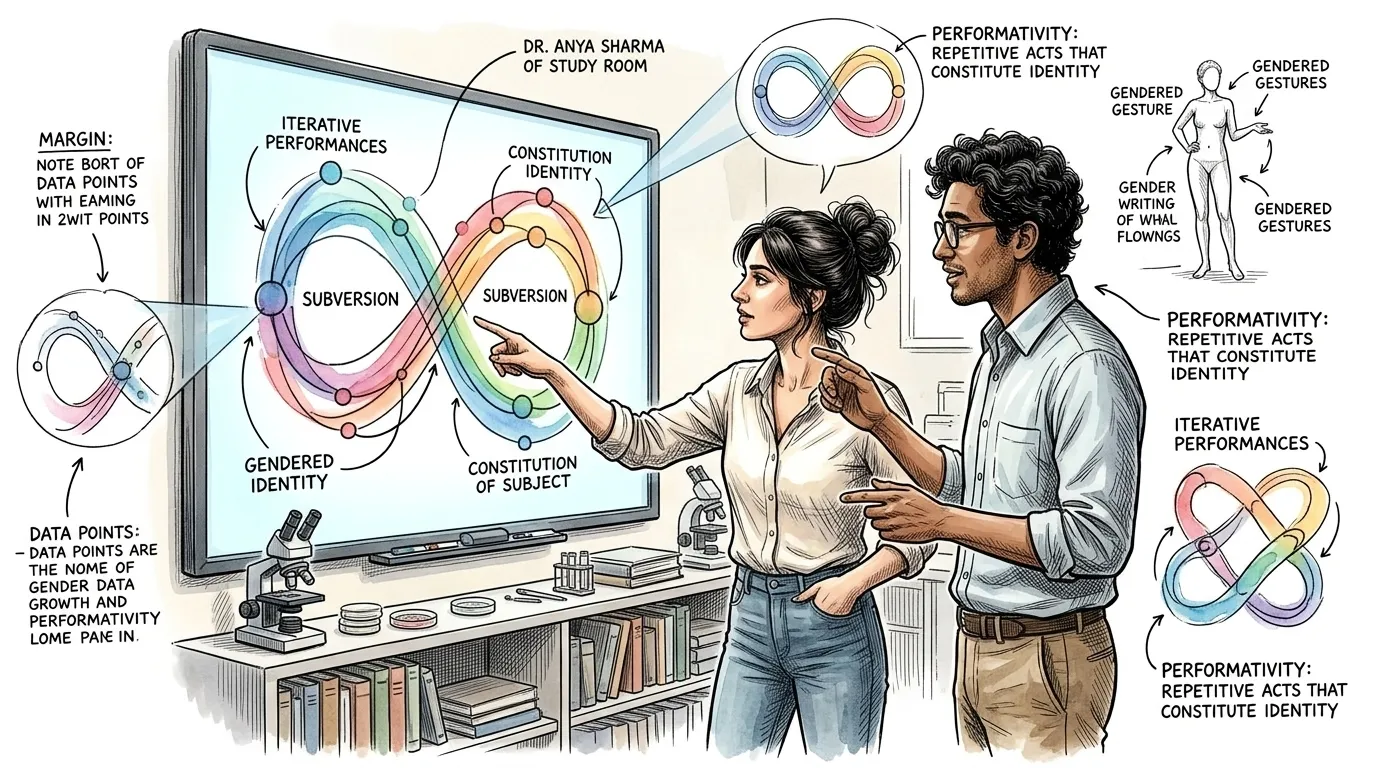
Dr. Sharma points to a diagram on a digital whiteboard, illustrating Butler's core concept. "So, if gender isn't inherent, it must be performed, right?" David explains, elaborating on the nuance. "Precisely. Butler argues that there is no 'true' gendered self awaiting expression. Instead, gender is constituted through the stylized repetition of acts, gestures, and speech, making it appear natural or inevitable." He taps the diagram. "These repeated actions—how we walk, talk, dress, interact—create the illusion of a stable, underlying gender identity. It's like an ongoing improvisation without a predefined script." Anya considers this. "So, it's less about acting a gender, and more about how acting produces the very idea of gender itself?" This understanding of gender as performative, rather than expressive, is a crucial insight.
"Anya says, "So, if gender isn't inherent, it must be performed, right?" David clarifies, "Precisely. Gender is constituted through the stylized repetition of acts, making it appear natural. It's like an ongoing improvisation without a predefined script." Anya questions, "So, acting produces the idea of gender itself?""
Page 4
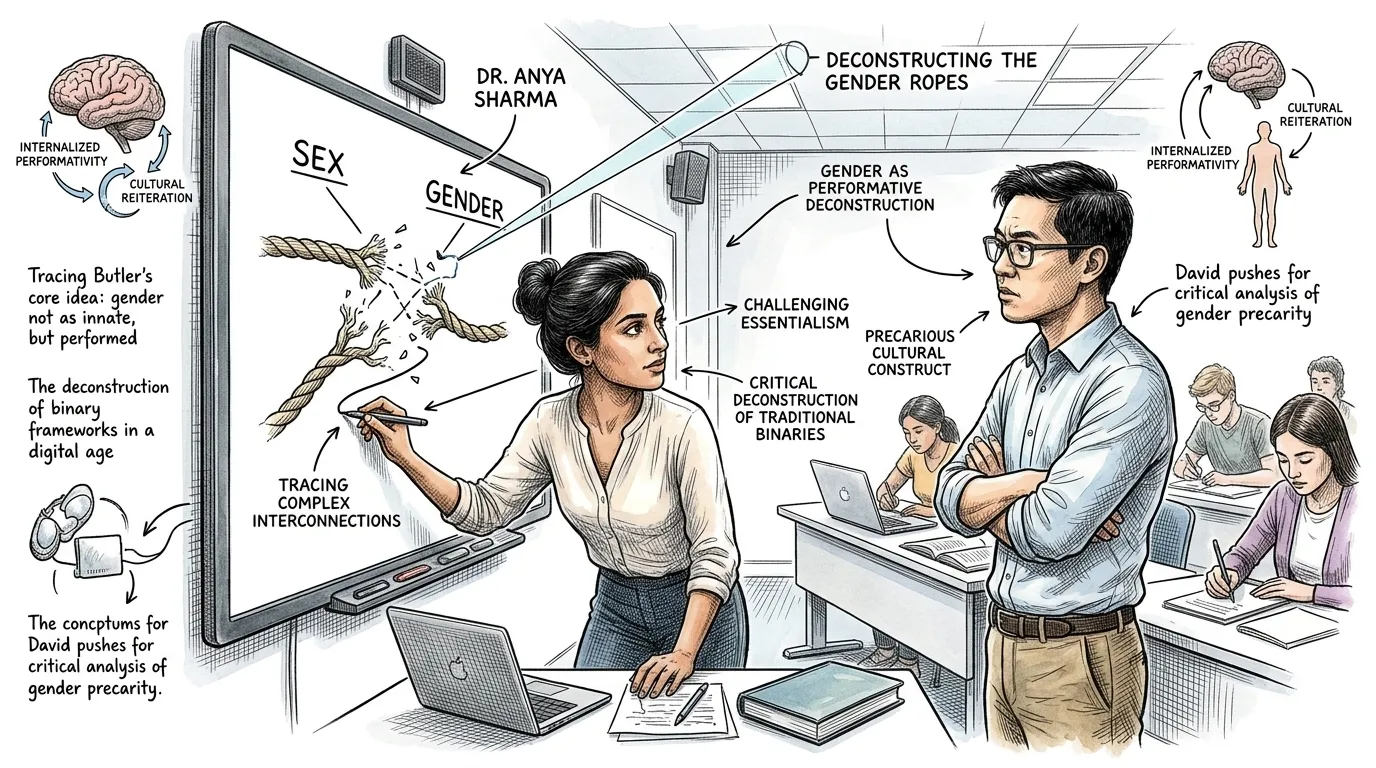
Anya traces a line on the diagram, connecting 'sex' to 'gender.' "Traditional thought dictates a simple causal chain: biological sex determines gender, which then dictates identity. But Butler critiques this chain." David adds, "Indeed. She draws on Michel Foucault's work on discourse and power, asserting that even 'sex' itself, as a seemingly biological given, is produced through discourse and medical practices." He pauses, looking directly at Anya. "It's not that 'sex' doesn't exist, but that the categories we use to define it, and the meanings we attach to those categories, are culturally and historically contingent. Thus, both sex and gender are understood as constructions, rather than natural starting points." This insight radically undermines the idea of a fixed gender binary.
"Anya states, "Traditional thought dictates sex determines gender, which dictates identity. But Butler critiques this." David adds, "She asserts that 'sex' itself is produced through discourse and medical practices. Both sex and gender are constructions, not natural starting points.""
Page 5

Anya raises a critical point often leveled at Butler's work. "If gender is all performance and discourse, does it mean that material realities, like physical bodies and lived oppression, don't matter?" David immediately clarifies, drawing on Butler's later work. "Not at all. Butler directly addresses this in 'Bodies That Matter.' She argues that performativity is precisely how bodies become gendered in the first place, through social norms and power structures. The performance is not separate from the body; it constitutes the body as a gendered entity within a cultural framework." He emphasizes, "The repeated acts are not chosen freely, but compelled by social norms, and these norms have very real, material consequences for bodies deemed outside the accepted matrix." This ensures that Butler's theory remains grounded in lived experience.
"Anya asks, "If gender is all performance, do material realities and oppression not matter?" David clarifies, "Not at all. Performativity is how bodies become gendered. The performance constitutes the body as a gendered entity, compelled by norms with real material consequences.""
Page 6

Anya summarizes, connecting Butler's work to broader implications for identity and resistance. "So, the continuous, often unconscious performance of gender norms is what makes them seem natural. But then, where does agency come from? How can we resist?" David explains, referencing Butler's concept of iteration. "Resistance comes precisely in the gaps and failures of reiteration. Since gender is always a repetition, it's never a perfect copy. Each performance contains the potential for difference, for subversion." He illustrates with a gesture. "Queer and trans identities, for instance, highlight how the very norms meant to constrain us can be resignified, opening up new possibilities for being and recognition. It is in these moments of disruption that new forms of gender can emerge, creating space for greater freedom." Butler shows that agency is found not in escaping norms, but in their creative re-enactment.
"Anya asks, "Where does agency come from? How can we resist?" David explains, "Resistance comes in the gaps and failures of reiteration. Each performance holds potential for difference, for subversion. Queer and trans identities show how norms can be resignified.""
Page 7
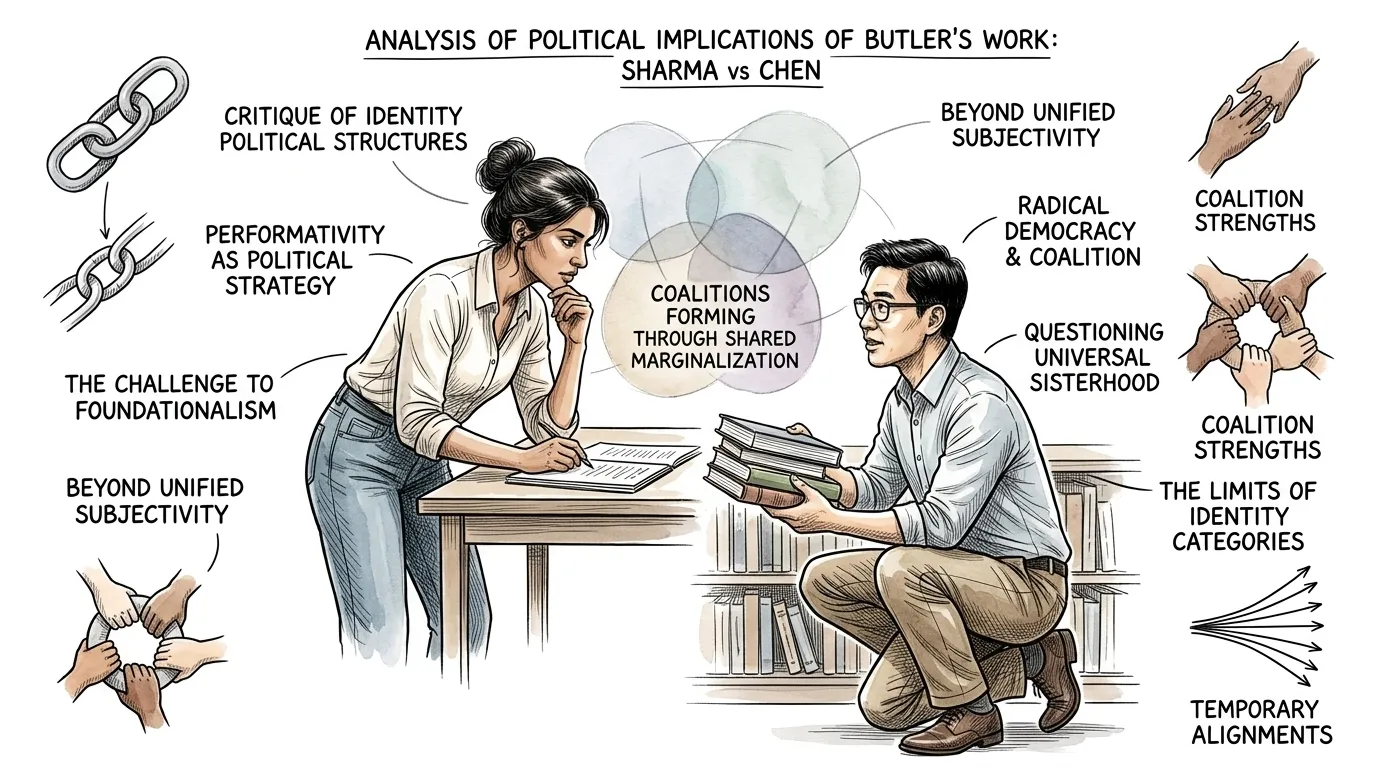
Anya considers the political ramifications. "Critics sometimes argue that focusing on performativity risks dissolving political solidarity, particularly for women, by de-emphasizing a common 'womanhood.'" David acknowledges the critique but offers Butler's counter-argument. "Butler recognizes the tension. She doesn't deny the need for political mobilization, but she challenges the idea that solidarity must be built on a pre-existing, stable identity category." He expands, "Instead, she suggests that coalitions can form through shared experiences of marginalization, even if the identities themselves are fluid and contested. The political power lies not in asserting a fixed identity, but in challenging the very systems that seek to fix and regulate identity." This nuanced view allows for both critique and political action.
"Anya notes, "Critics argue performativity risks dissolving political solidarity for women." David counters, "Butler challenges building solidarity on a stable identity. She suggests coalitions form through shared marginalization, challenging systems that fix identity.""
Page 8
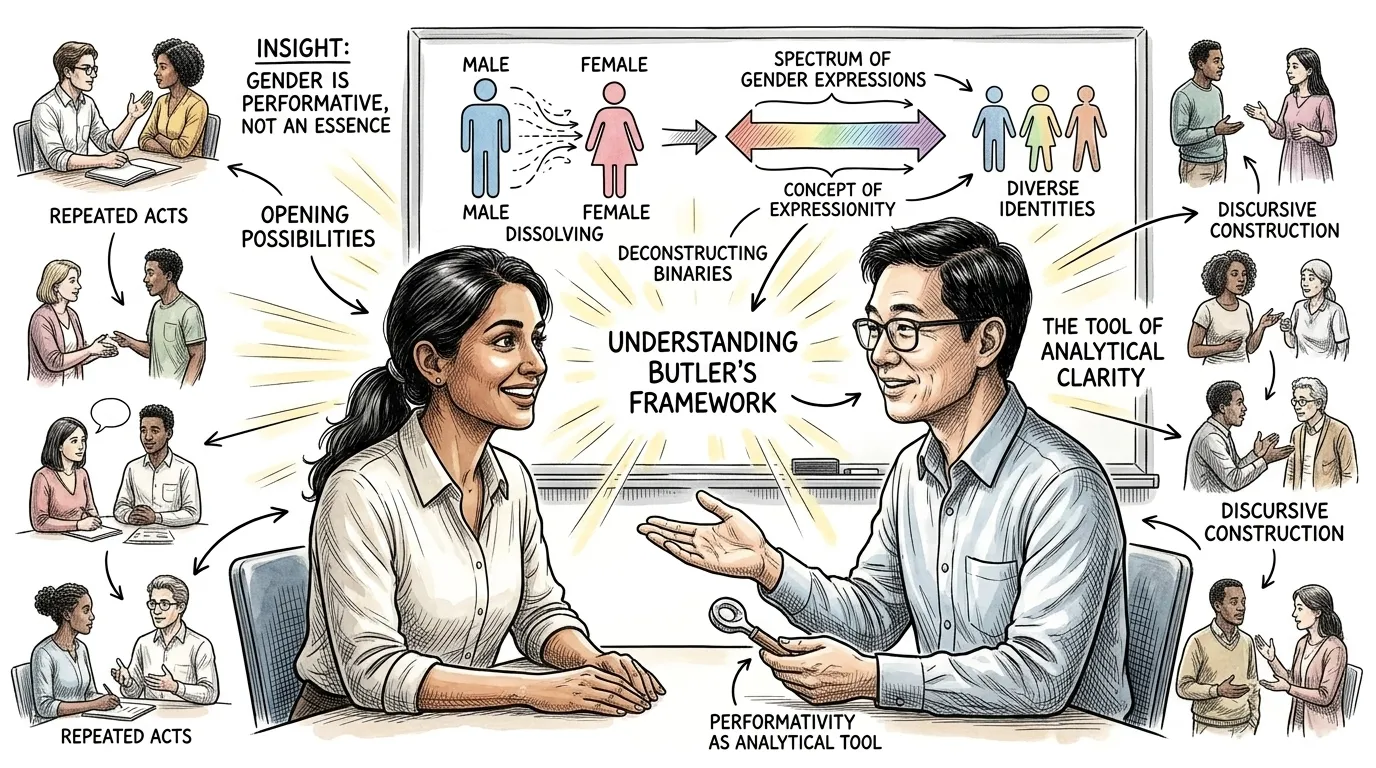
Anya looks at David, a sense of clarity dawning. "So, the 'knowledge' we discussed earlier—that gender is performative rather than inherent—helps us understand how the societal problem of rigid gender roles is actually constructed and maintained." David smiles, affirming her insight. "Exactly. By understanding performativity, we see that gender isn't merely expressed but produced through societal norms and repeated actions. This insight becomes our 'tool' to deconstruct the seemingly natural binary, illuminating that 'man' and 'woman' are not exhaustive or inevitable categories, but rather regulatory fictions that suppress other ways of being." He continues, "This allows us to move beyond simply critiquing inequalities within the binary, to questioning the very structure of the binary itself, opening up a wider spectrum of gender identities and expressions, like those embraced by trans and non-binary individuals, to be recognized and affirmed." This fundamental shift in perspective directly enables new forms of social justice.
"Anya states, "So, the knowledge that gender is performative helps us understand how rigid gender roles are constructed." David affirms, "Exactly. This insight becomes our 'tool' to deconstruct the binary, showing 'man' and 'woman' are regulatory fictions, opening a wider spectrum of gender identities.""
Page 9
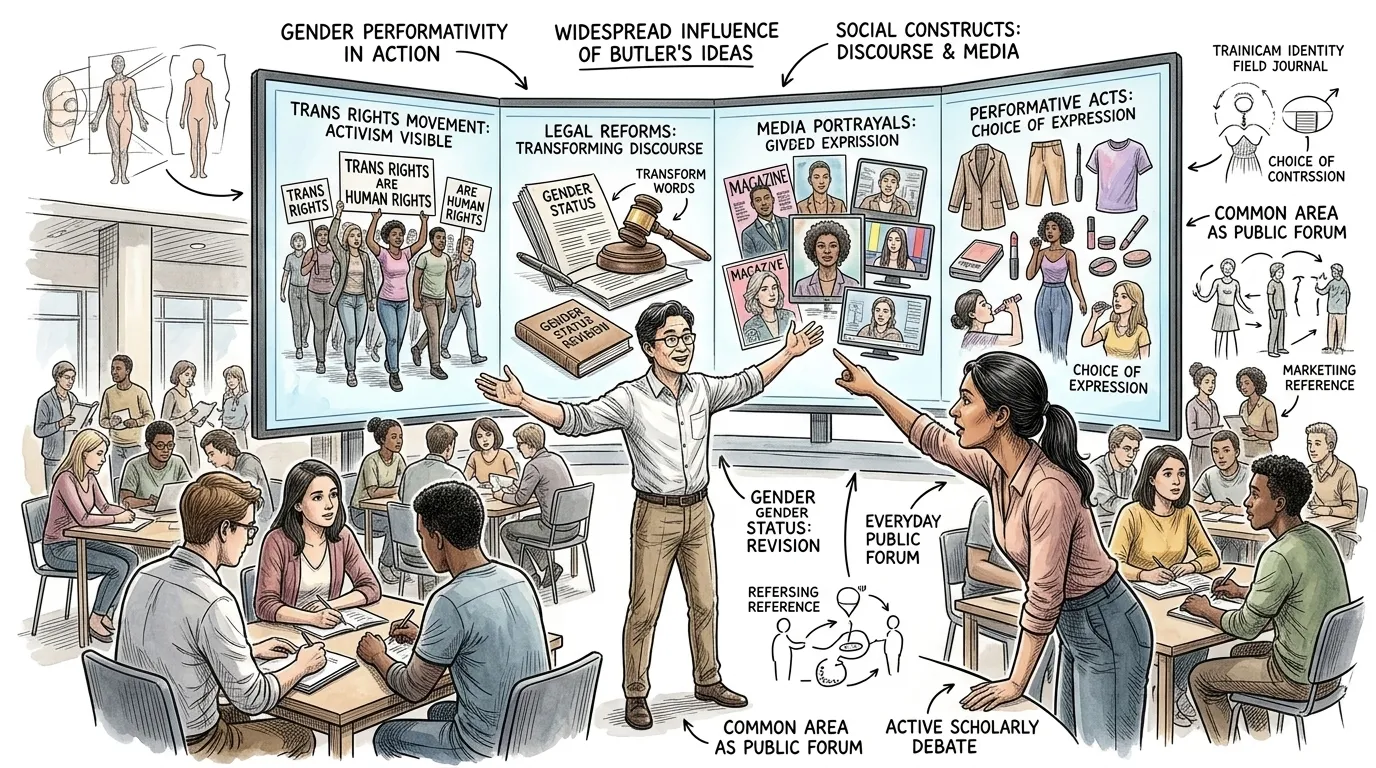
The influence of Butler's work extends far beyond academic circles, fundamentally reshaping public discourse. David gestures towards a series of four diverse scenes displayed on a large screen in a university common area, illustrating contemporary applications. "Her insights into performativity have profoundly impacted queer activism, challenging rigid social norms and advocating for self-determination in gender identity. This is reflected in movements for trans rights and non-binary recognition." Anya adds, "And it's not just about identity. It's transformed how we discuss social justice, law, and even how media portrays gender." She points to another scene. "Her work underscores how subtle, everyday acts reinforce gender, making us more critically aware of societal expectations, from dress codes to language." The philosophical concept has clear, tangible consequences.
"David explains, "Her insights have profoundly impacted queer activism, challenging rigid norms and advocating for self-determination." Anya adds, "It's transformed how we discuss social justice, law, and media portrayal. Her work makes us critically aware of societal expectations, from dress codes to language.""
Page 10
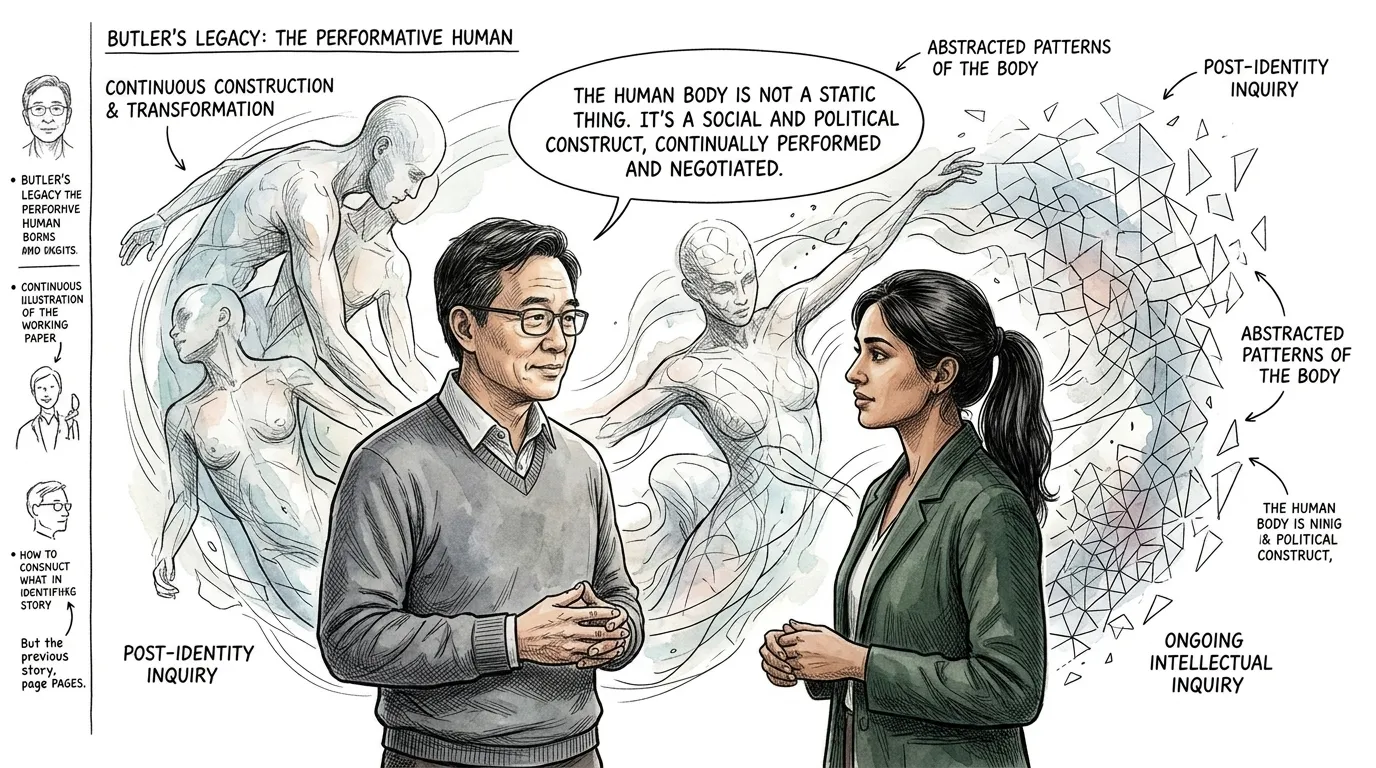
David concludes, reflecting on the lasting legacy of Judith Butler's critical inquiry. "Butler's work doesn't offer easy answers or prescribe a single way of being. Instead, it equips us with the tools for continuous questioning, inviting us to critically examine the forces that shape our identities and societies." Anya nods, her gaze thoughtful. "Her enduring contribution is perhaps this: to show that what seems most natural is often the most constructed, opening up profound possibilities for freedom and transformation." She pauses. "As the Roman playwright Terence once wrote, 'Homo sum, humani nihil a me alienum puto'—'I am human, and nothing human is alien to me.' Butler's philosophy extends this, compelling us to consider how we continually construct what it means to be 'human' in its diverse forms, and to embrace the radical potential of that ongoing construction." Her thought-provoking work continues to inspire new generations to critically engage with gender, power, and identity, fostering a more inclusive and understanding world.
"David concludes, "Butler's work equips us with tools for continuous questioning. Her enduring contribution: to show what seems natural is often constructed, opening possibilities for freedom." Anya adds, "As Terence wrote, 'Homo sum, humani nihil a me alienum puto' – 'I am human, and nothing human is alien to me.' Butler compels us to embrace the radical potential of constructing what it means to be 'human.'""
About this story
- Audience: general readers
Questions and answers
Read Wonder Philosophy on your phone
Wonder Philosophy is available on Android and iPhone and iPad. Get Wonder Philosophy on Google Play · Get Wonder Philosophy on the App Store.