Kapila
Explore Kapila's Samkhya philosophy, a dualistic system that distinguishes between Purusha (consciousness) and Prakriti (matter), offering insights into self-awareness and liberation from suffering. Understand the core concepts of Purusha and Prakriti and their implications for understanding the sel
Page 1
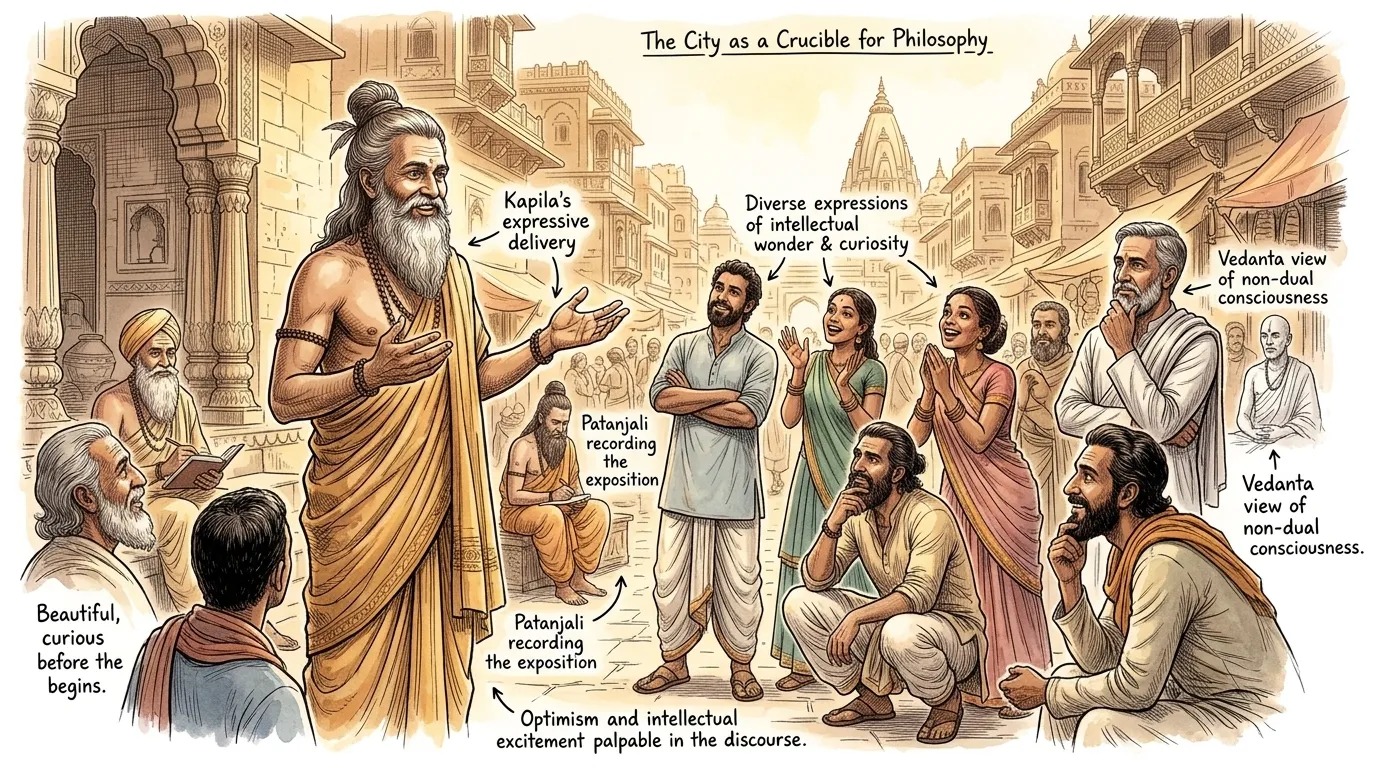
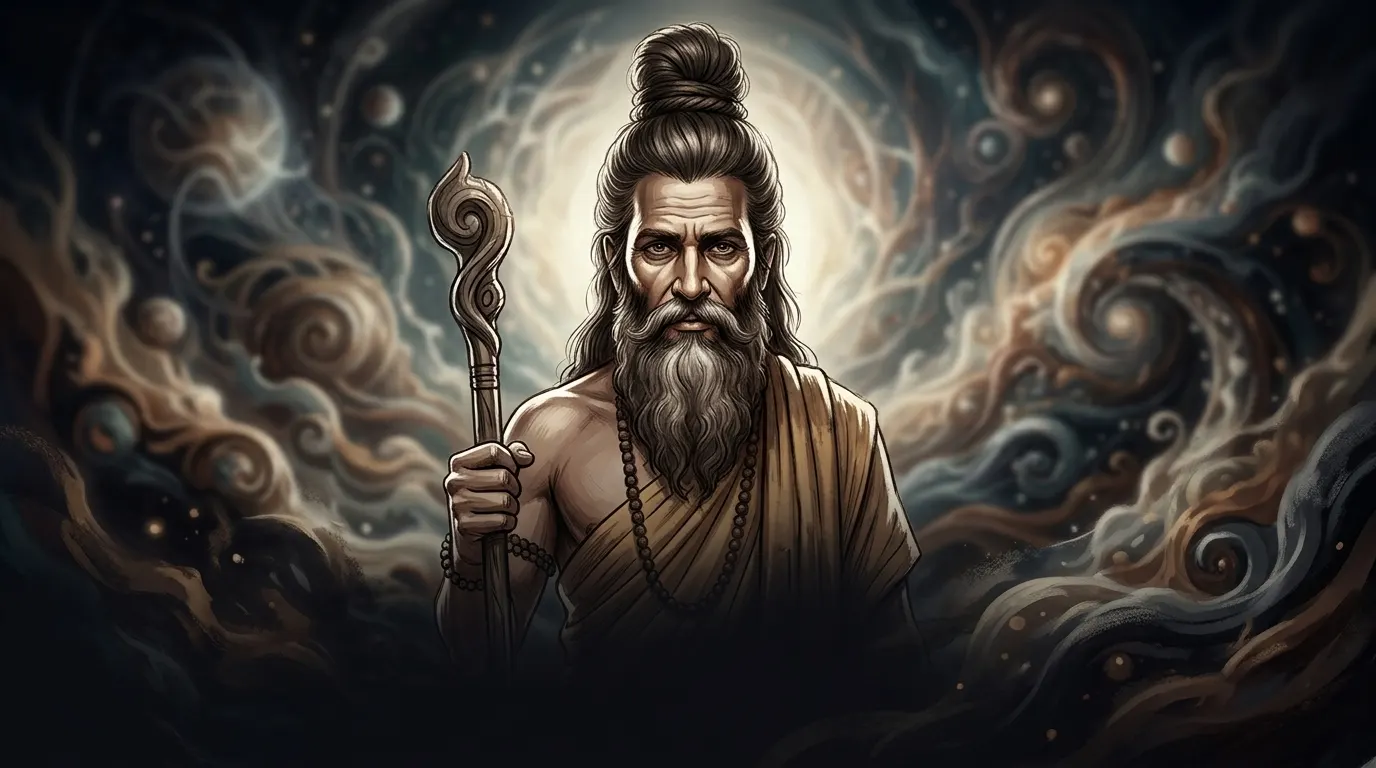
Amidst the ancient intellectual ferment of India, a profound system of thought emerged, attributed to the venerable sage Kapila. His Samkhya philosophy laid bare a dualistic understanding of existence, positing two ultimate, irreducible realities: Purusha and Prakriti. This radical distinction sought to explain the root of all suffering and delineate a clear path toward ultimate liberation.
"Kapila, addressing the gathered assembly, proclaimed, 'All suffering arises from a fundamental confusion. We mistake the ever-changing for the eternal, the material for pure consciousness.' His words echoed across the assembly, sparking deep contemplation among the seekers. 'To transcend sorrow, one must first discern these two distinct truths.'"
Philosophy Note: Kapila, an ancient Indian sage, is traditionally credited as the founder of the Samkhya school of Hindu philosophy, one of the oldest and most influential philosophical systems in India. Its core teaching is a radical dualism.
Page 2
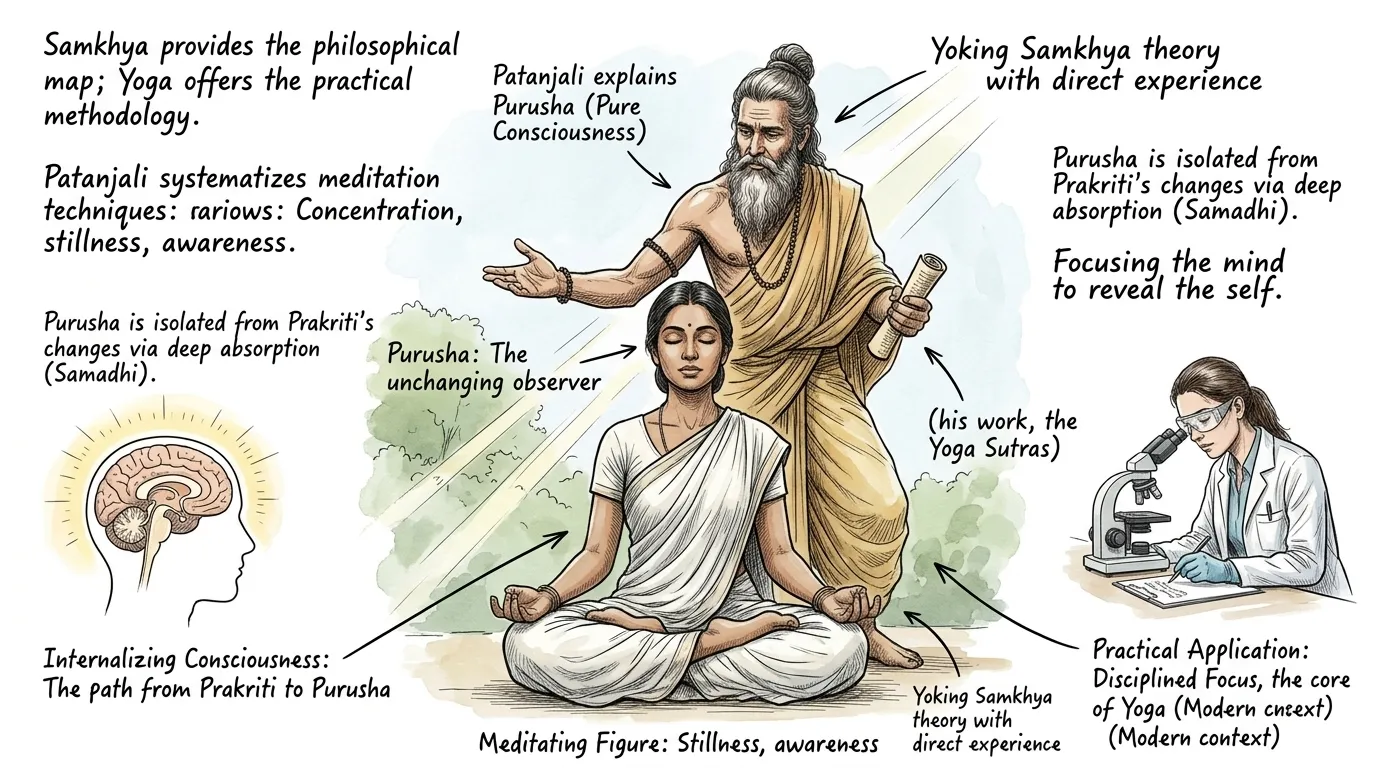
Kapila elucidated Purusha not as a creator god, but as pure consciousness itself, an eternal and unchangeable witness. It is the silent observer, untouched by the world's movements, desires, or sufferings. Patanjali, a later proponent, built upon this foundational concept, emphasizing Purusha's absolute independence.
"Patanjali, a disciple of Kapila's lineage, explained, 'Purusha is the light, the pure awareness. It observes without acting, without changing, without being affected. It is the ultimate subject, never an object.' He gestured to a seated figure, meditating with closed eyes. 'It is this pure 'I' that remains when all else falls away.'"
Philosophy Note: Purusha in Samkhya is the principle of consciousness, the soul or self. It is distinct from the material world (Prakriti) and is considered the spectator, pure and free from all qualities or modifications.
Page 3
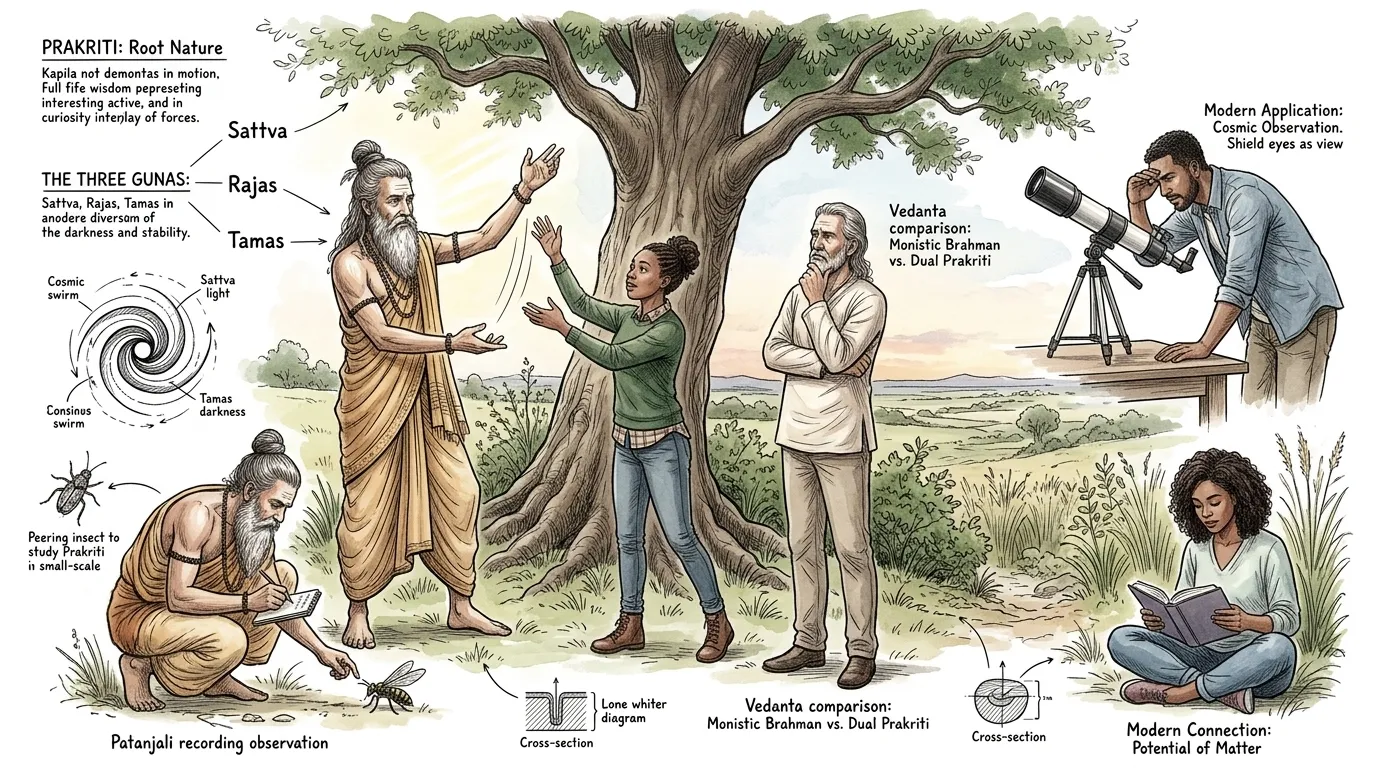
In contrast to Purusha, Kapila presented Prakriti as the primal substance of the universe, dynamic and ever-changing. It is the unmanifest root of all matter and mind, inherently composed of three 'Gunas' or fundamental qualities. From Prakriti, all material existence, from subtle thoughts to solid objects, unfolds.
"Kapila illustrated, 'Prakriti is the raw potential, the cosmic energy from which everything, seen and unseen, emerges. It is not static, but a dance of three inherent qualities: Sattva, Rajas, and Tamas.' He demonstrated with his hands, showing the interplay of these forces. 'This fundamental distinction—Purusha and Prakriti—is the knowledge that illuminates the path to freedom.'"
Philosophy Note: Prakriti is the material principle, the primal nature from which the entire universe evolves. It is active, constantly changing, and comprises three Gunas: Sattva (goodness/light), Rajas (passion/activity), and Tamas (darkness/inertia).
Page 4
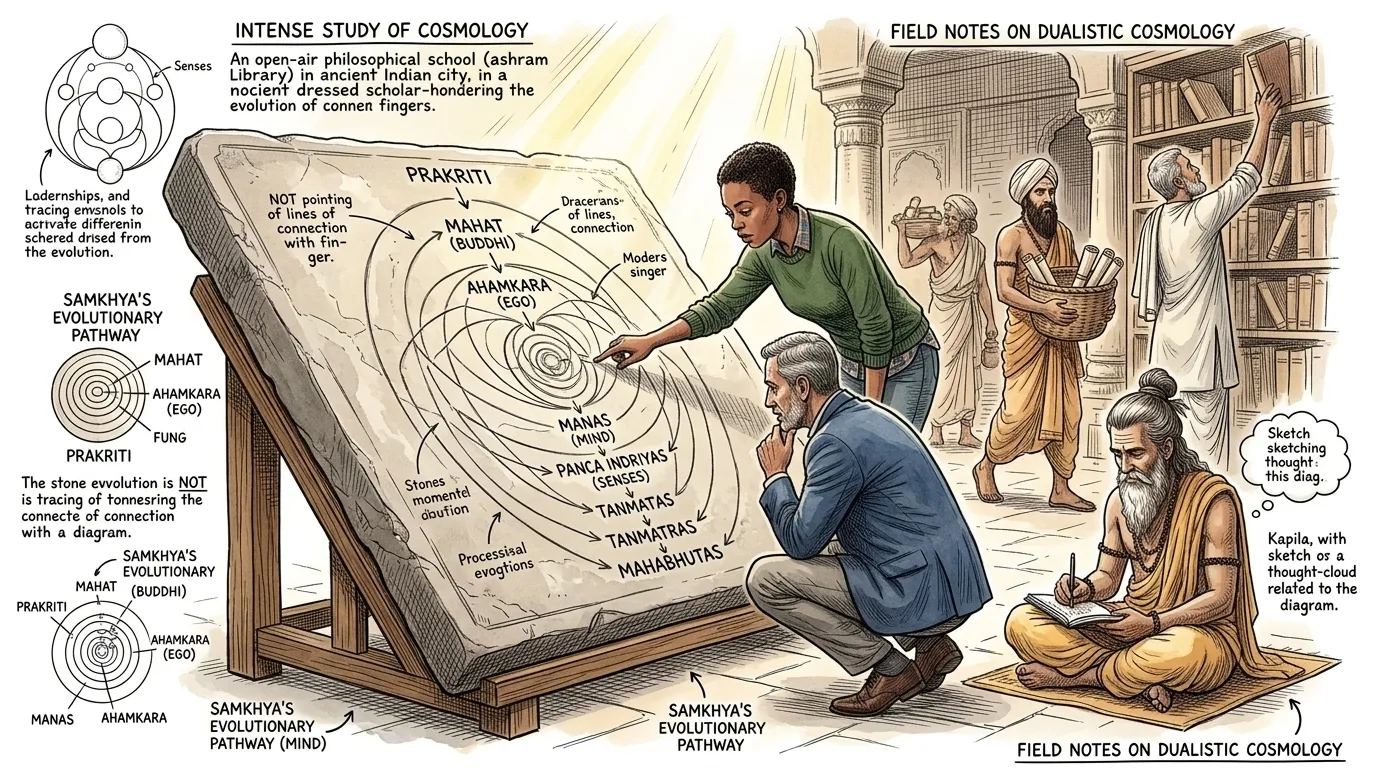
Kapila's Samkhya meticulously detailed how Prakriti, when disturbed from its primordial balance by the proximity of Purusha, begins to evolve. This evolution forms the entire manifested universe, including the intellect (Buddhi), ego (Ahamkara), mind (Manas), senses, and elements. The world we perceive, our thoughts, and our personalities are all products of Prakriti.
"An ancient Indian scholar, leaning over a diagram, explained, 'From Prakriti, the subtle elements arise first: intellect, then ego, then the mind and senses. Like a seed unfolding into a tree, each stage develops from the previous.' He traced the connections. 'Our very perception of 'self' is often tangled in these evolving aspects of Prakriti, not Purusha.'"
Philosophy Note: Samkhya describes a detailed cosmological evolution (tattvas) from Prakriti, through the subtle principles of intellect, ego, and mind, to the gross elements of the physical world.
Page 5
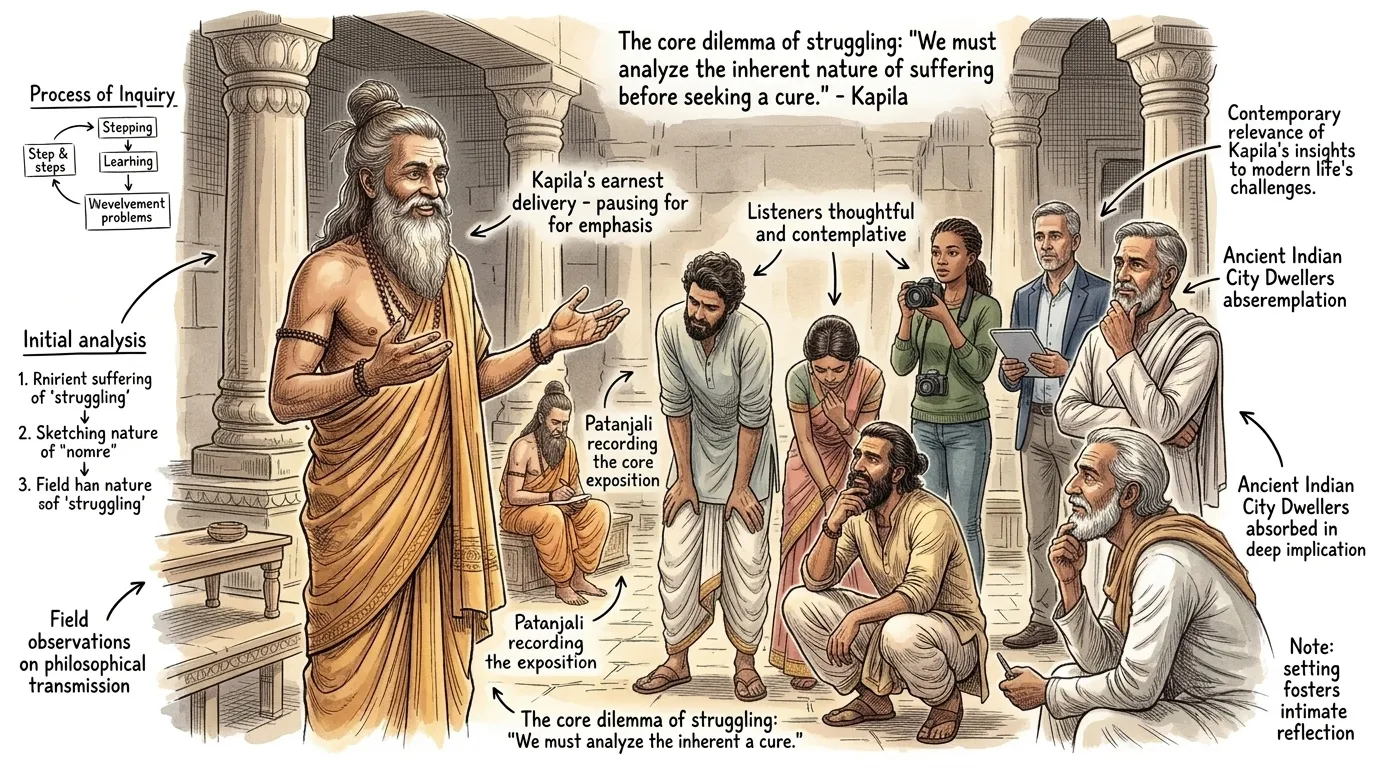
The central dilemma, according to Kapila, arises from the apparent union between Purusha and Prakriti. Though eternally separate, Purusha mistakenly identifies with the activities and modifications of Prakriti. This false identification—the 'seeing' of oneself in the material world and its suffering—is the root cause of all pain, attachment, and bondage.
"Kapila, addressing his listeners, stated clearly, 'Suffering is born when Purusha, though always pure, believes itself to be the experiencer of Prakriti's joys and sorrows. It's like watching a play and forgetting you are merely an observer.' He paused, letting the implication sink in. 'This illusion of 'I' as the doer, the sufferer, binds us.'"
Philosophy Note: The problem of suffering in Samkhya stems from Purusha's mistaken identification with the evolutes of Prakriti (mind, ego, senses), leading to the experience of pain and pleasure as one's own.
Page 6
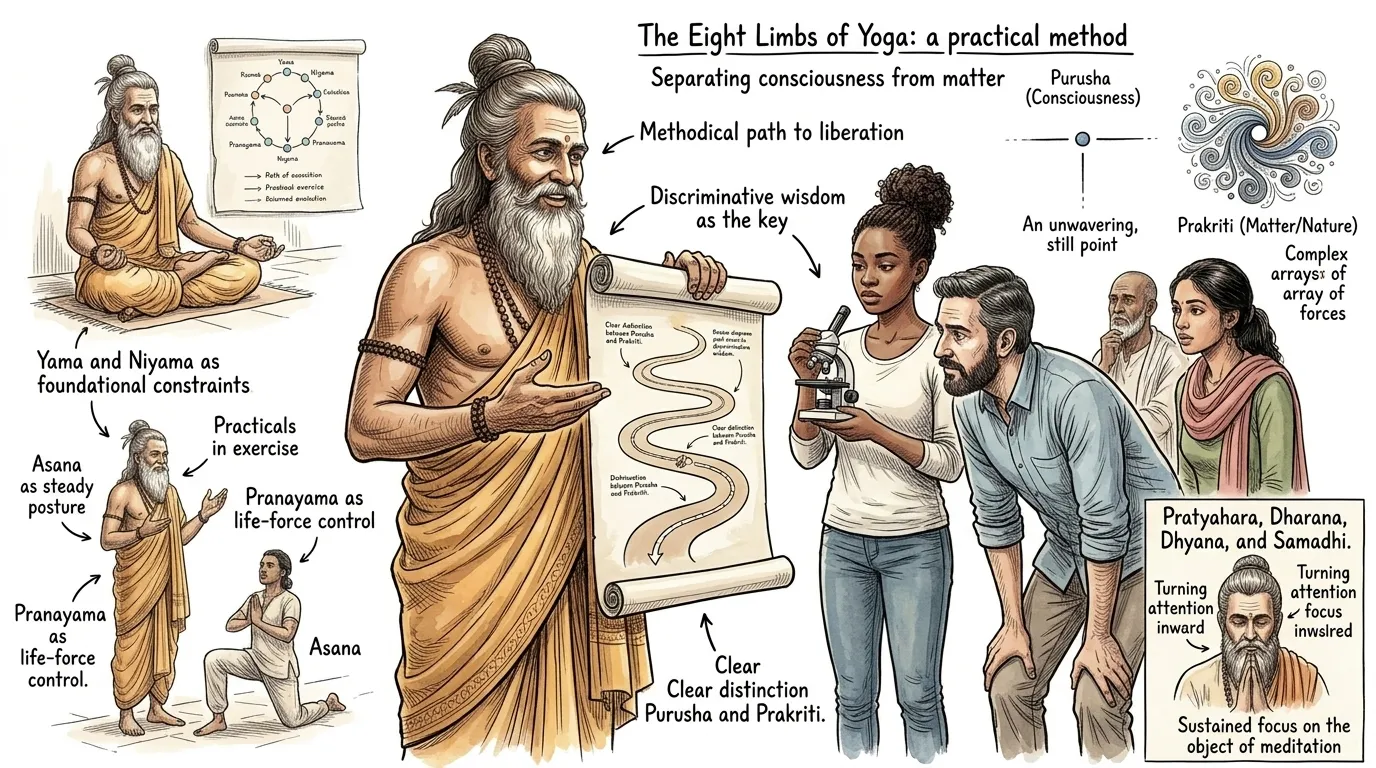
For Kapila, the path to liberation is not through ritual, devotion, or asceticism alone, but through 'Viveka-khyati'—discriminative wisdom. It is the profound, direct realization of the absolute difference between Purusha and Prakriti. This intellectual insight leads to detachment, as Purusha recognizes its pure, unfettered nature.
"Patanjali, speaking with quiet conviction, declared, 'The suffering ends not by changing Prakriti, but by realizing one's true nature as Purusha, separate from it. This 'discriminative wisdom' is the key.' He pointed to a diagram showing a path. 'As the ancient Greek philosopher Socrates once proclaimed, 'The unexamined life is not worth living.' This resonates deeply with Samkhya's emphasis on viveka, the discriminative wisdom to separate consciousness from matter, for true liberation.'"
Philosophy Note: Liberation (Kaivalya) in Samkhya is achieved through discriminative knowledge (viveka-khyati), the clear understanding that Purusha is distinct from Prakriti and its evolutes, leading to detachment and freedom.
Page 7
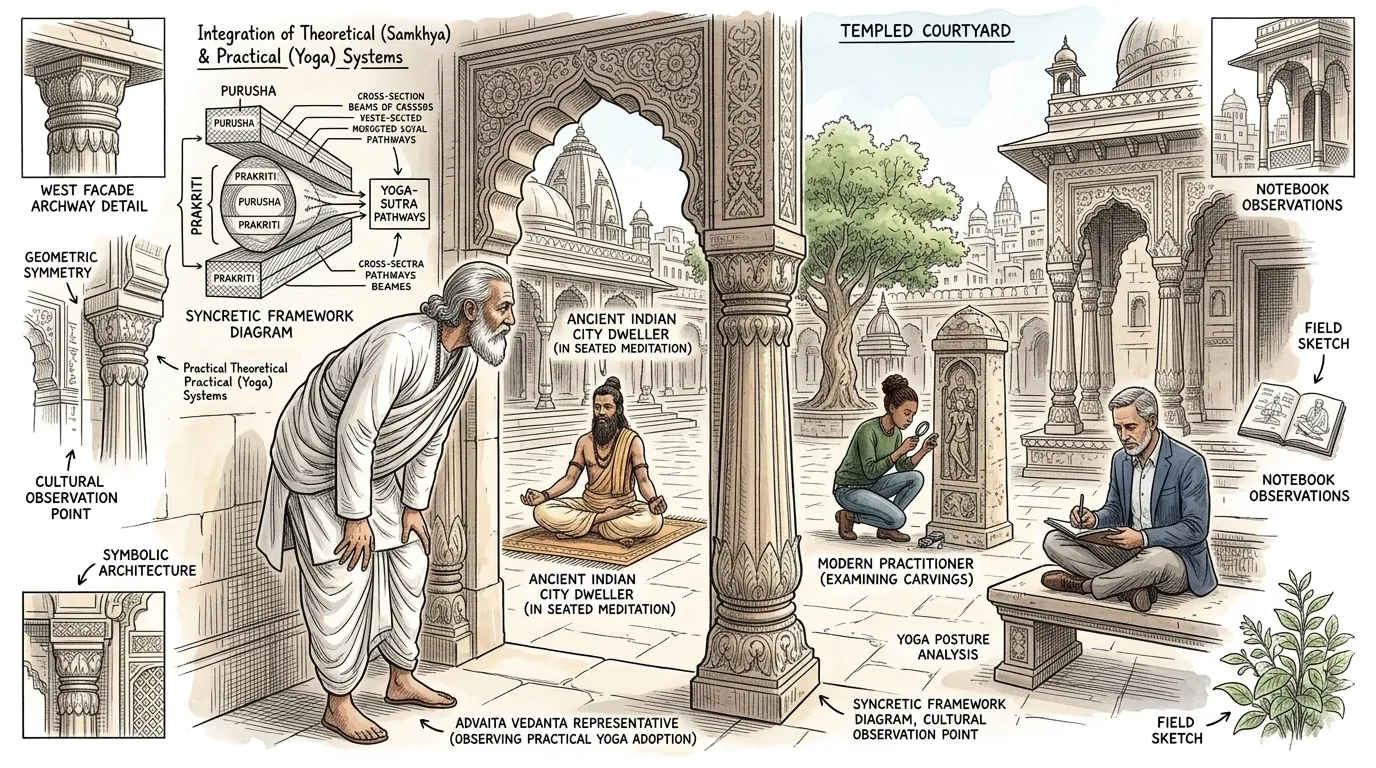
The philosophical insights of Samkhya found a powerful practical application in the Yoga school, particularly through Patanjali's Yoga Sutras. Yoga adopted Samkhya's metaphysics of Purusha and Prakriti, providing systematic methods—such as meditation and ethical practices—to achieve the discriminative knowledge necessary for liberation.
"An Advaita Vedanta representative, a figure dressed in simple, flowing white robes, observed thoughtfully, 'While Samkhya provides the theoretical map, Yoga offers the practical journey. It is through disciplined practice that the mind, an evolute of Prakriti, can be stilled enough to reflect the pure light of Purusha.' He nodded in acknowledgment. 'The synergy is undeniable.'"
Philosophy Note: Patanjali's Yoga system relies heavily on Samkhya's metaphysical framework, using its dualism to understand the nature of the self and the world, and providing a practical path to realize this understanding.
Page 8
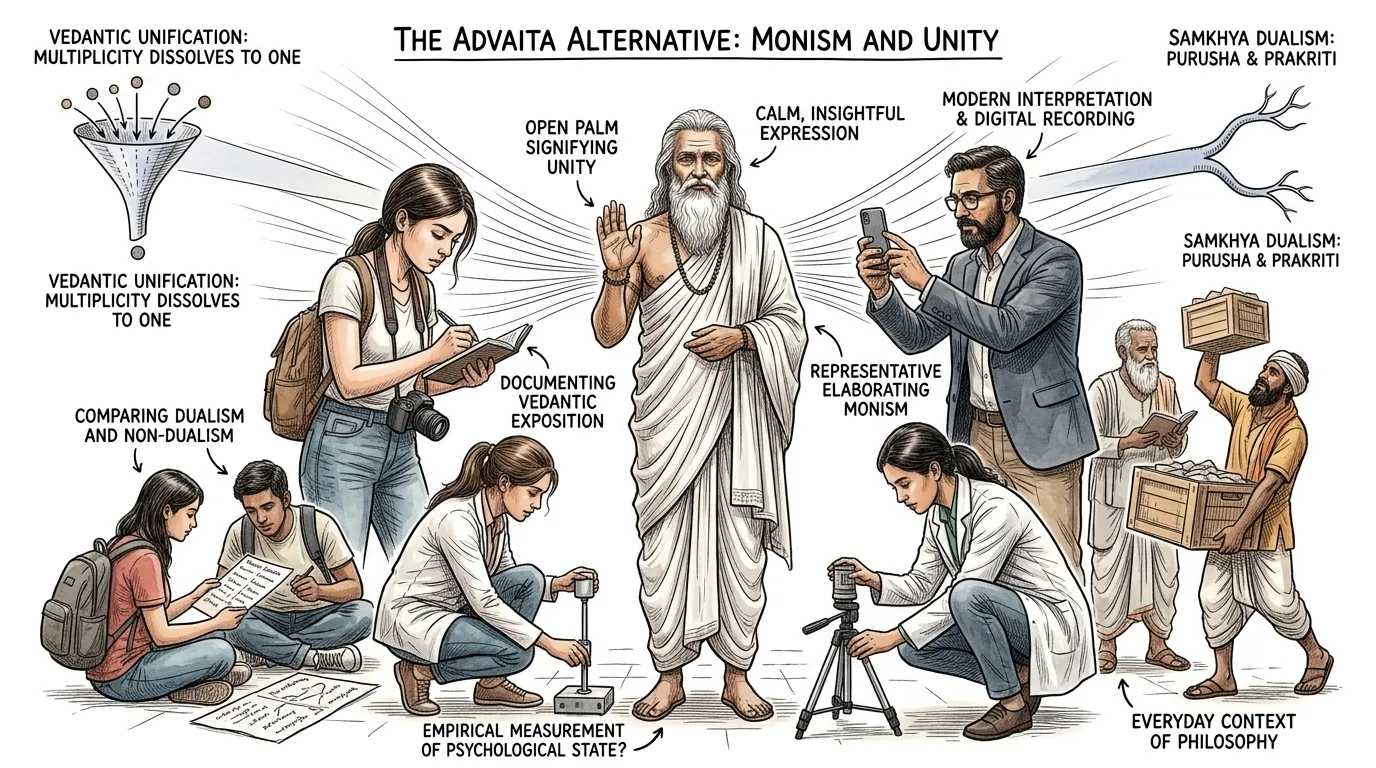
While Samkhya firmly upholds dualism, another major Indian philosophical school, Advaita Vedanta, proposes a radical monism. For Advaita, only Brahman (the ultimate reality, akin to Purusha but all-encompassing) is real, and the perceived world of Prakriti is ultimately an illusion (Maya). This presents a fundamental tension with Samkhya's distinct realities.
"The Advaita Vedanta representative elaborated, 'Where Samkhya posits two eternal realities, we see only one. Brahman is all. The distinctions, the world of forms—they are ultimately appearances, not fundamental truths.' He held up his hand, signifying unity. 'To truly overcome suffering, we dissolve the illusion of separation, recognizing the oneness.'"
Philosophy Note: Advaita Vedanta, contrasting with Samkhya, posits a non-dualistic reality where only Brahman is ultimately real, and the phenomenal world is an illusory superimposition (Maya).
Page 9
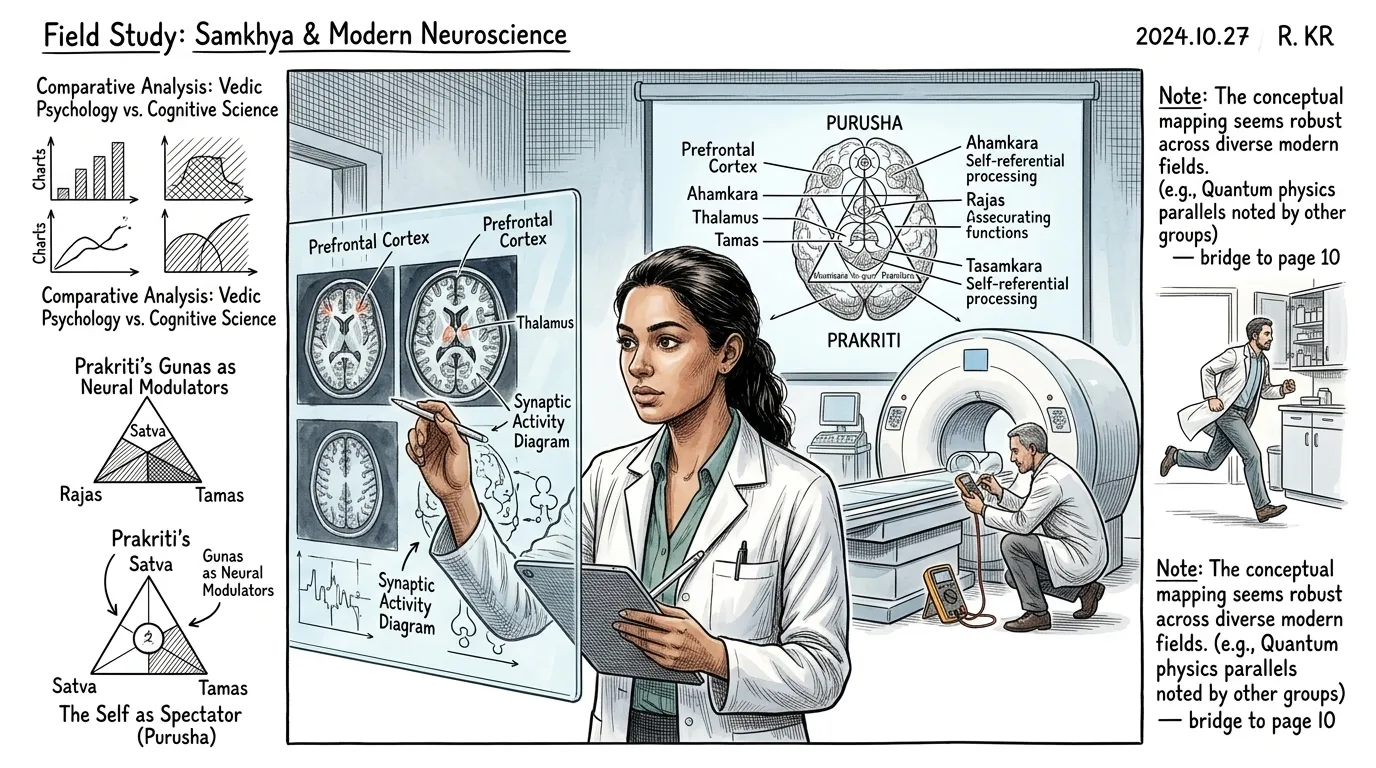
Despite philosophical debates, Kapila's clear distinction between Purusha (consciousness) and Prakriti (matter/mind) offers profound insights. It compels us to question what we truly are, providing a framework for understanding human consciousness as distinct from our psychological and physical experiences. This foundational knowledge remains a powerful tool.
"A modern neuroscientist, examining brain scans, mused, 'Kapila's insistence on a pure consciousness separate from brain activity resonates with some modern questions. If the brain is Prakriti, where is the Purusha?' She pointed to the 'knowledge' introduced earlier. 'The concept of Purusha's ultimate separateness provides a powerful lens through which to explore what consciousness truly is, beyond mere neural processes. It helps us avoid mistaking the 'map' of the mind for the 'traveler'.' "
Philosophy Note: Kapila's dualism continues to influence discussions on consciousness, mind-body problem, and the nature of self in both philosophical and scientific contexts, inviting deeper introspection.
Page 10
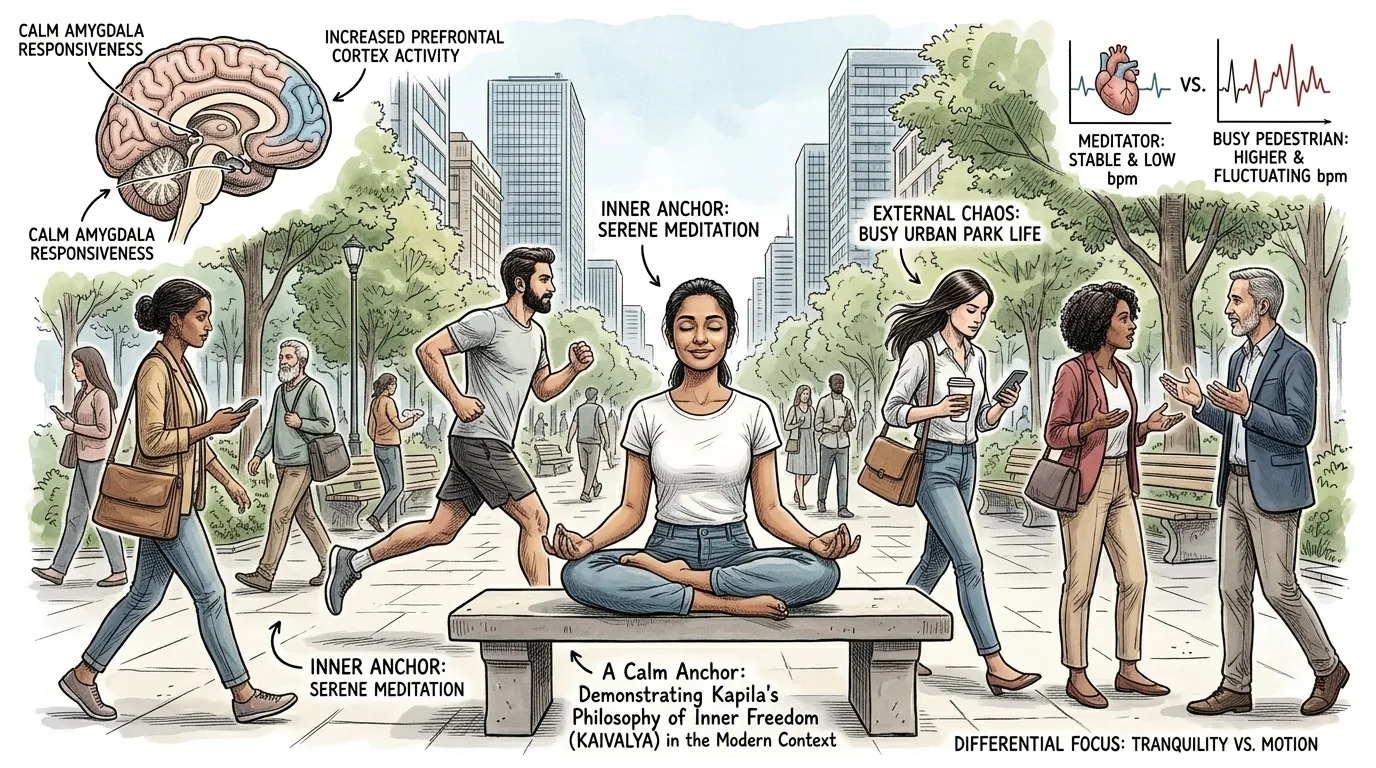
Kapila's Samkhya provides an invaluable framework for navigating the complexities of modern life. By understanding the distinction between our true conscious self (Purusha) and the ever-changing material and mental world (Prakriti), individuals can cultivate detachment from outcomes, reduce emotional reactivity, and gain a deeper sense of inner peace, even amidst external chaos. It encourages a shift from identifying with fleeting experiences to recognizing an enduring core.
"A modern meditator, serene amidst a busy urban park, explained, 'When I apply Kapila's teaching, I see my anxious thoughts and strong emotions as products of Prakriti, not my essential self. It allows me to observe them without getting swept away.' She smiled, finding calm. 'This wisdom isn't ancient lore; it's a practical tool for daily well-being, fostering a profound sense of inner freedom, even in the busiest city.'"
Philosophy Note: Kapila's Samkhya offers practical insights for modern individuals to cultivate detachment, manage emotions, achieve self-mastery, and find inner peace by recognizing the distinct nature of consciousness and matter.
About this story
- Audience: general readers
Questions and answers
Read Wonder Philosophy on your phone
Wonder Philosophy is available on Android and iPhone and iPad. Get Wonder Philosophy on Google Play · Get Wonder Philosophy on the App Store.