Luce Irigaray
Luce Irigaray — an illustrated philosophy story. 10 illustrated pages, free to read on Wonder Philosophy.

Page 1

Luce Irigaray stands as a towering figure in contemporary critical thought, renowned for her profound challenge to the foundational structures of Western philosophy, language, and psychoanalysis. Her work unearths the deeply embedded 'phallogocentrism' — the idea that logic and language are inherently male-centric — which she argues has systematically marginalized and misrepresented the feminine. Irigaray insists that true liberation requires not just equality within existing systems, but a radical re-thinking of identity and difference, particularly 'sexual difference,' to acknowledge an irreducible feminine subjectivity distinct from masculine norms. This forms the bedrock of her critique, urging us to recognize how our very modes of thought have historically constructed 'woman' as a mere reflection or lack, rather than a self-defined entity.
Philosophy Note: Luce Irigaray (born 1930) is a Belgian-born French feminist, philosopher, linguist, psycholinguist, psychoanalyst, and cultural theorist. She is a central figure in French feminism and continental philosophy, known for her exploration of 'sexual difference' and its implications for language, ethics, and metaphysics.
Page 2

To grasp Irigaray's radical project, we must first understand the historical problem she addresses: how Western philosophical and psychoanalytic traditions have systematically defined 'woman' not as an autonomous subject, but in relation to, or as a deviation from, a male norm. From ancient Greek philosophy, which often posited woman as an 'imperfect man,' through Freudian psychoanalysis, which famously described female sexuality in terms of 'penis envy' and 'lack,' the feminine has been cast as the 'other,' a secondary or negative entity. This perspective, Irigaray argues, permeates our language and symbolic order, making it difficult for women to articulate their own experience outside of pre-existing masculine frameworks. The very tools we use to understand ourselves are already gendered, inherently favoring one sex over the other.
Philosophy Note: Irigaray specifically challenges the Freudian and Lacanian psychoanalytic frameworks that define female sexuality and identity in terms of absence or castration, arguing that this contributes to women's exclusion from the symbolic order and their subjectification.
Page 3
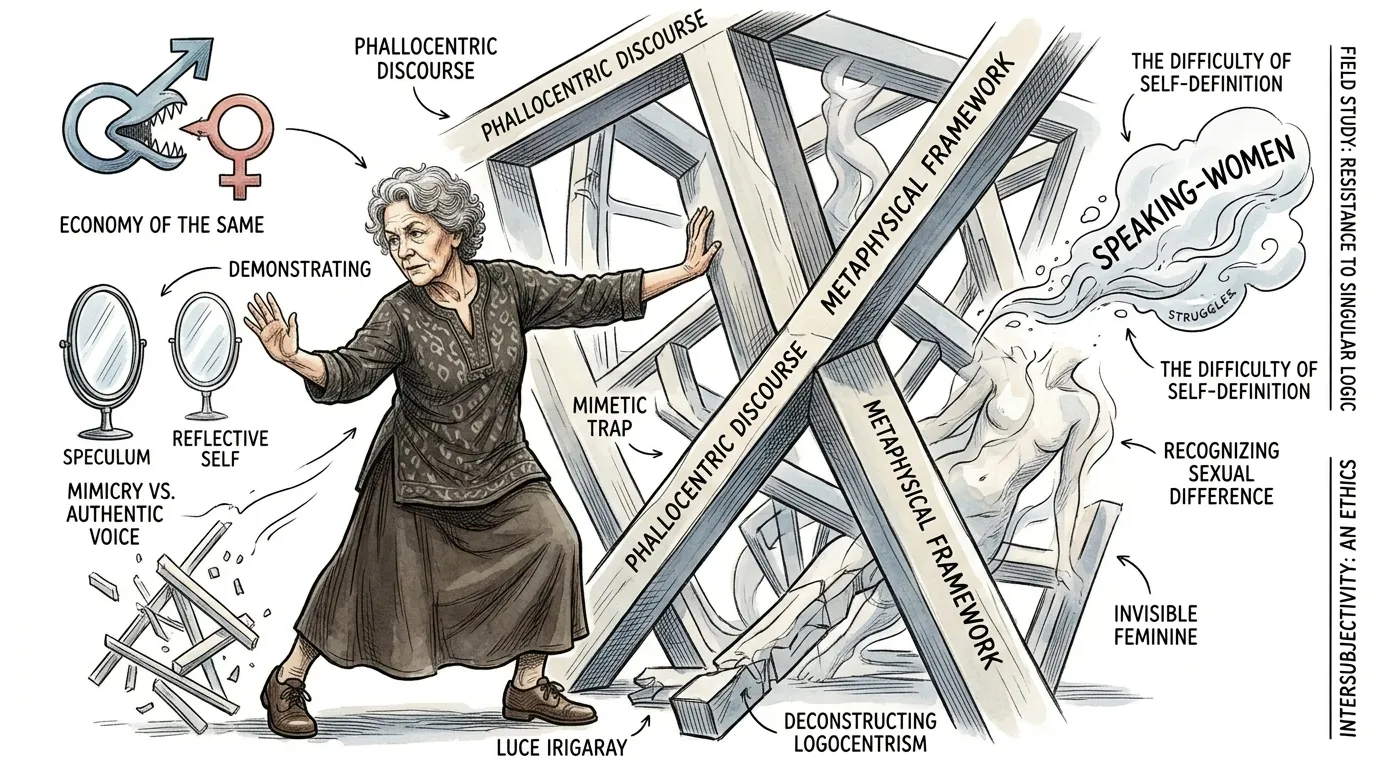
Irigaray refers to this pervasive system as the 'economy of the same,' a philosophical and cultural framework where difference, especially sexual difference, is ultimately subsumed into a singular, masculine norm. Anything that diverges from this norm is either assimilated, rendered invisible, or dismissed as irrational and Other. She critiques how Western thought, in its pursuit of universal truths and unified concepts, inadvertently erases the possibility of a truly distinct feminine subject. For Irigaray, this is not merely an oversight but a fundamental flaw, preventing an authentic understanding of human experience. It creates a linguistic and conceptual prison, where women cannot truly 'speak themselves' without recourse to a language already designed to objectify them. This makes the very act of self-definition a subversive act.
Philosophy Note: The 'economy of the same' describes how Western metaphysics reduces all 'otherness' to a reflection or variation of the masculine, preventing the recognition of an autonomous feminine subjectivity. This is a key concept in Irigaray's 'Speculum of the Other Woman' (1974).
Page 4
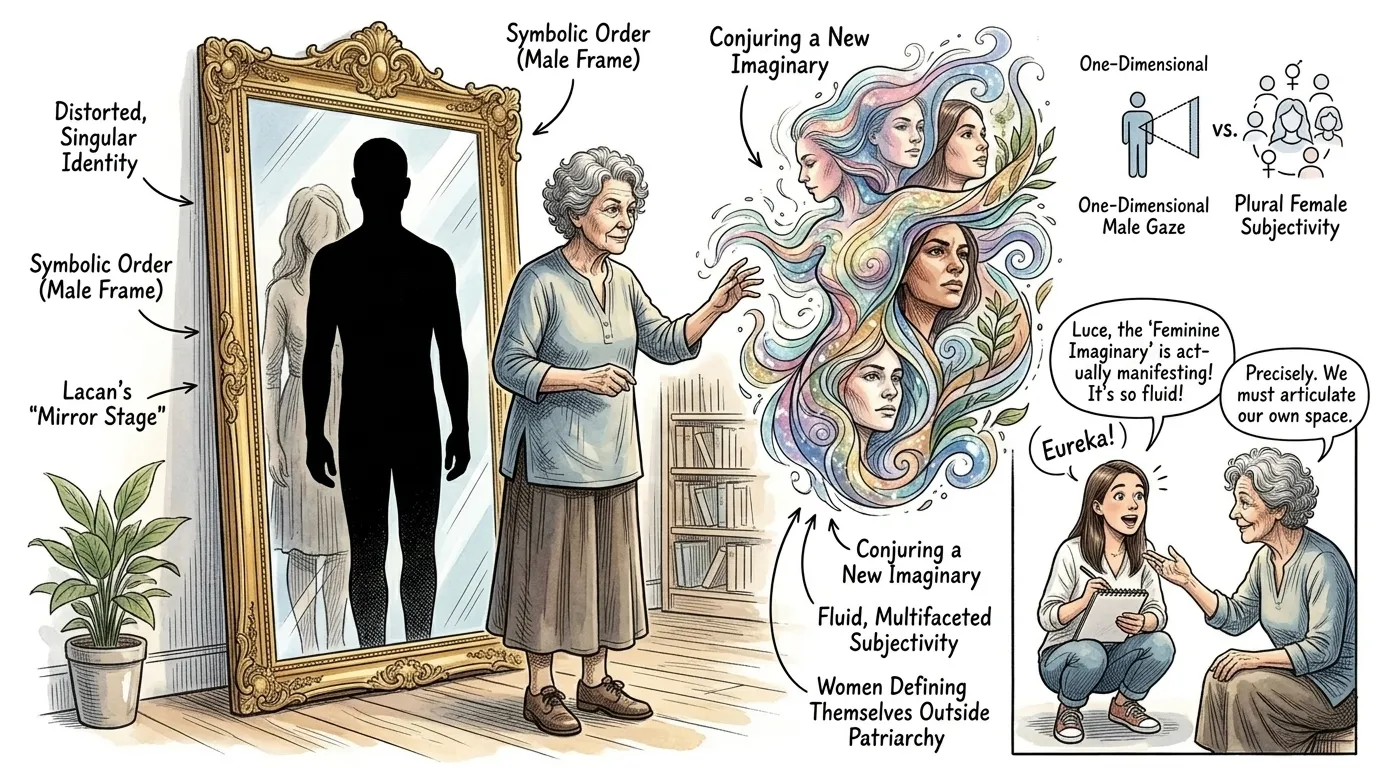
One of Irigaray's most trenchant critiques targets Jacques Lacan's 'mirror stage,' which describes how a child develops a sense of self through identification with an external image. For Irigaray, this mirror reflects a symbolic order already dominated by the phallus, leaving women no space to recognize themselves authentically. If a woman is always encountering an image of herself defined by male desire or lack, she can never truly construct her own identity. Instead, Irigaray envisions a 'feminine imaginary' — a symbolic realm where women can define themselves outside of patriarchal constructs. This is not a simple reversal, but an entirely different way of imagining subjectivity, rooted in the specific experiences and corporeality of women, moving beyond rigid binaries to embrace fluidity and multiplicity. It's a call to move beyond merely imitating masculine modes of being.
Philosophy Note: In 'Speculum of the Other Woman,' Irigaray uses the metaphor of the speculum (a medical instrument for viewing) to symbolize how Western philosophy has 'viewed' woman, often leading to a distorted or incomplete understanding of her. She proposes a different, more fluid 'feminine imaginary.'
Page 5

For Irigaray, the recognition of sexual difference is not merely an intellectual exercise, but the foundation for a profound ethical shift. If we truly acknowledge that there are two distinct, irreducible sexes, each with its own way of being, relating, and experiencing the world, then our interactions must change. This leads to her 'ethics of sexual difference,' an ethics rooted in respecting and fostering the unique subjectivity of the other, rather than trying to assimilate it into one's own. It demands a new way of engaging with the world, where difference is celebrated as a source of richness and mutual growth, rather than feared as a threat to sameness. This requires both men and women to undergo a transformation, recognizing their own sexed subjectivity and valuing the other in their distinctness, fostering a truly reciprocal intersubjectivity.
Philosophy Note: Irigaray argues that a truly ethical relationship between the sexes can only emerge when sexual difference is recognized as fundamental and irreducible, moving beyond a model where one sex is defined by the other. This demands a new cultural and symbolic order.
Page 6

Irigaray's ideas extend deeply into the realm of language. She argues that conventional language, being 'phallogocentric,' inherently struggles to express feminine experience. It privileges linear logic, singular meaning, and fixed identities, which she contrasts with a more fluid, multiple, and 'proximate' feminine subjectivity. For Irigaray, the female body, particularly its autoeroticism and non-linear pleasure (jouissance), offers a paradigm for a different kind of language—one that resists singular definition, embraces multiplicity, and flows without fixed boundaries. This is not about creating a secret 'women's language,' but about destabilizing existing linguistic structures to allow for new forms of expression. It's a call to write and speak from the body, from a place that has historically been silenced or defined by others, creating what she termed a 'parler femme' or 'speaking woman.'
Philosophy Note: Irigaray explores how the female body itself, with its multiple erogenous zones and non-linear experience of pleasure (jouissance), could inspire a new kind of language and discourse that resists patriarchal logic and fixed definitions. This is articulated in works like 'This Sex Which Is Not One'.
Page 7
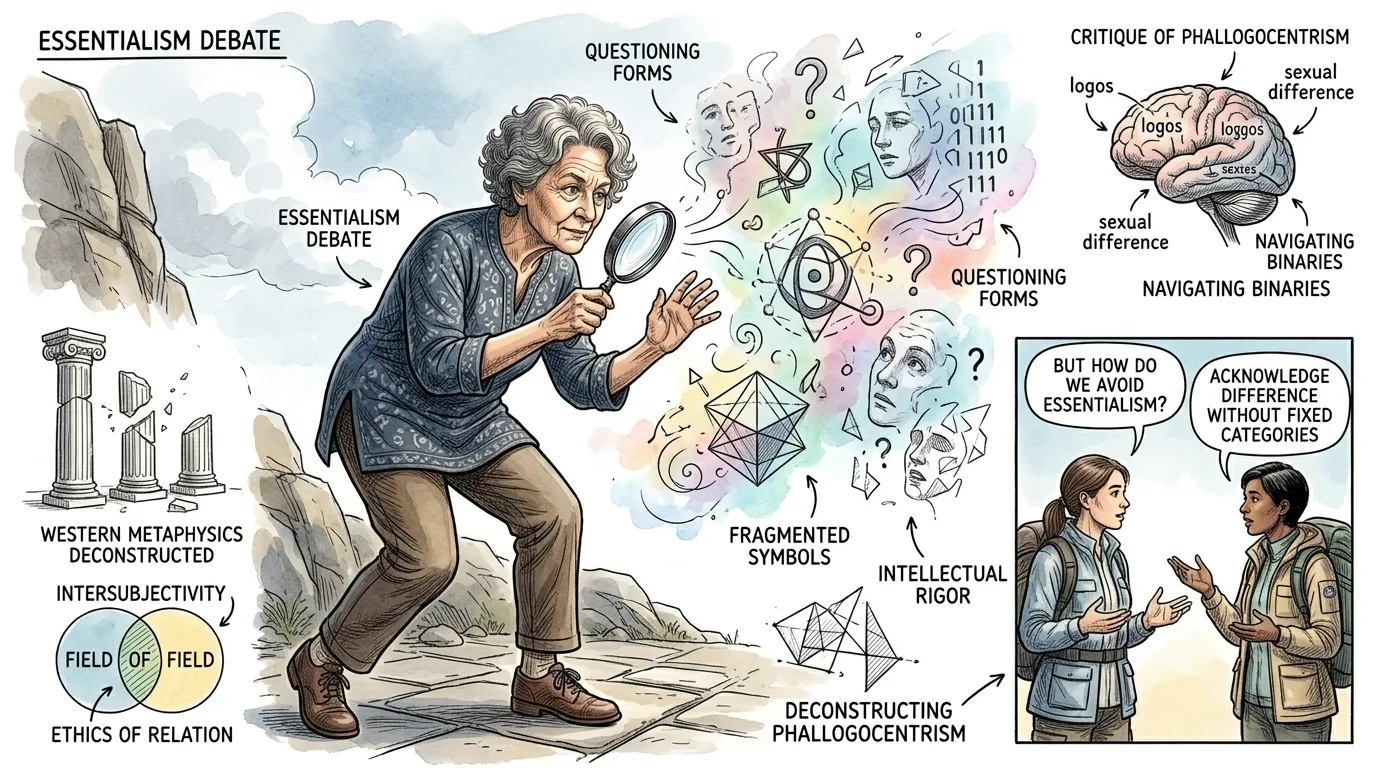
Irigaray's powerful ideas have not been without their critics. A primary point of contention revolves around the accusation of 'essentialism.' Critics, particularly other feminist theorists, question whether her emphasis on 'sexual difference' risks re-inscribing traditional, biologically deterministic notions of 'woman' and 'man,' thereby reinforcing the very binaries she seeks to deconstruct. If a 'feminine imaginary' or 'feminine language' is rooted in the female body, does it imply a fixed, universal essence of womanhood that overlooks cultural, historical, and individual variations? This tension highlights a core debate within feminism: how to acknowledge difference without falling into reductive categories. Furthermore, some find her work highly theoretical and difficult to translate into concrete political action, questioning its practical application in real-world struggles for gender equality.
Philosophy Note: The critique of essentialism is a common challenge to theories that emphasize inherent differences between sexes. Philosophers like Judith Butler, for instance, argue that gender is a performative construct rather than a natural essence, offering a different approach to understanding identity.
Page 8

Despite the critiques, Irigaray's work remains profoundly influential, continuing to shape contemporary thought on gender, identity, and power. Her insistence on questioning the unspoken assumptions embedded in language and logic opened new avenues for critical theory. She forced thinkers to confront how deeply gender informs our understanding of reality, ethics, and even our own bodies. Her call for an 'ethics of sexual difference' challenges us to imagine relationships and societies where genuine difference is not only tolerated but embraced as a source of mutual enrichment, moving beyond assimilation or hierarchy. While her language can be complex, the core message — that we must create space for a truly autonomous feminine subjectivity — resonates deeply in ongoing discussions about inclusivity, diverse representation, and the deconstruction of traditional power structures in a world striving for greater understanding.
Philosophy Note: Irigaray's work laid groundwork for later feminist theorists like Judith Butler, even while they diverged. Her critique of 'phallogocentrism' remains a vital tool for analyzing power dynamics in language and culture, influencing critical discourse in gender studies, literary theory, and philosophy.
Page 9

The philosophical insights of Luce Irigaray, while complex, have a tangible impact on how we understand and navigate our daily lives and relationships. By highlighting the subtle ways language and established thought patterns shape our perceptions, she encourages a heightened awareness of implicit biases. Her work challenges us to listen differently, to seek out voices and experiences that have been historically silenced or misinterpreted. In conversations, this means recognizing that 'understanding' may not always mean 'reducing to the same,' but rather cultivating a profound respect for another's distinct perspective, even if it resists easy categorization. This active engagement with difference can transform personal interactions, professional dynamics, and broader societal dialogues, moving them beyond simplistic binaries towards a more nuanced and genuinely inclusive exchange.
Philosophy Note: Irigaray's call to recognize and value 'sexual difference' implies a shift in our everyday ethical interactions, encouraging active listening and a rejection of the 'economy of the same' in interpersonal communication and social structures.
Page 10

Luce Irigaray's legacy is an ongoing invitation to reconsider the very foundations of our thought and culture. Her work inspires us to question whose experiences are centered and whose are marginalized, fostering a critical awareness essential for building more equitable societies. It's a reminder that genuine progress isn't just about integrating women into existing male-defined structures, but about transforming those structures to accommodate and celebrate a plurality of subjectivities. The project of 'sexual difference' is thus a project of universal significance, urging all individuals, regardless of gender, to reflect on their own positionality and to cultivate an ethics that values irreducible difference. In a world increasingly grappling with questions of identity, diversity, and belonging, Irigaray's insights remain a vital resource for imagining a future where multiplicity flourishes without falling into oppressive hierarchies.
Philosophy Note: Irigaray's work is a call to continuous self-reflection and societal transformation. It pushes us to move beyond superficial inclusion to a fundamental restructuring of thought and culture that honors the richness of human diversity, starting with sexual difference.
About this story
- Audience: general readers
Questions and answers
Read Wonder Philosophy on your phone
Wonder Philosophy is available on Android and iPhone and iPad. Get Wonder Philosophy on Google Play · Get Wonder Philosophy on the App Store.