Martin Heidegger
Martin Heidegger — an illustrated philosophy story. 10 illustrated pages, free to read on Wonder Philosophy.

Page 1

At the turn of the 20th century, Western philosophy had largely settled into familiar patterns, exploring knowledge, ethics, and aesthetics within established metaphysical frameworks. Yet, beneath this intellectual landscape, a fundamental question—the very meaning of 'Being'—had been quietly forgotten, reduced to an unexamined background assumption. Martin Heidegger emerged from this tradition with a radical call to reawaken this primal inquiry, challenging millennia of philosophical thought. His magnum opus, 'Being and Time,' published in 1927, proposed that human existence, or 'Dasein,' is uniquely characterized by its relationship to Being and its inherent temporality, profoundly reshaping how we understand ourselves and our place in the world.
Philosophy Note: Freiburg University, Germany, 1920s: Heidegger reintroduces the question of Being, challenging traditional metaphysics.
Page 2
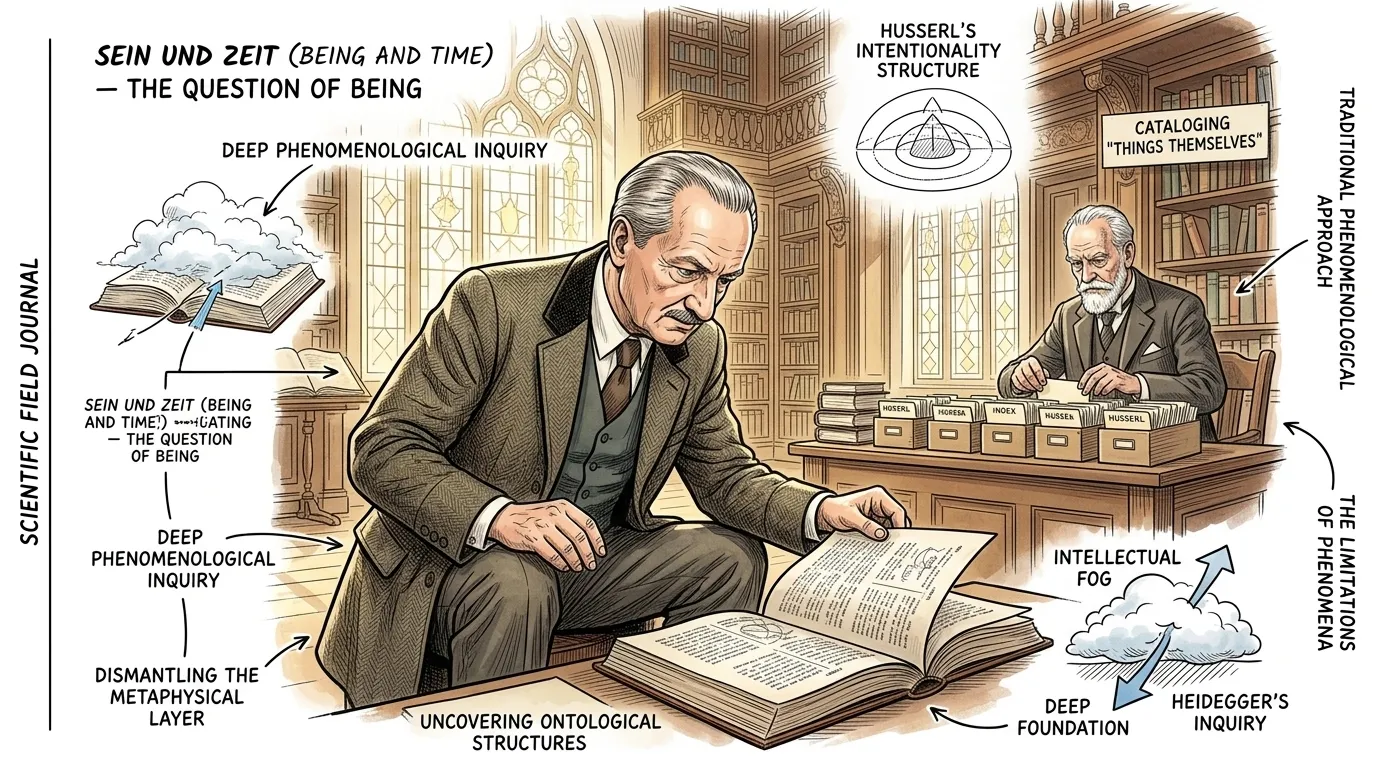
Heidegger's philosophical journey began under Edmund Husserl, the founder of phenomenology, who emphasized returning to 'the things themselves' and describing phenomena as they are experienced. While initially inspired, Heidegger soon found Husserl's approach insufficient. He believed Husserl, and Western philosophy generally, had neglected the most fundamental question: not 'what is a being?' but 'what is Being itself?' This 'forgetfulness of Being' was, for Heidegger, the central malaise of Western thought, leading to an impoverished understanding of human existence. He sought to dismantle centuries of metaphysical assumptions to clear a path for this forgotten question, arguing that human beings are not just another 'thing' in the world, but the very site where Being can reveal itself.
Philosophy Note: Early influences: Edmund Husserl's phenomenology provided a starting point, but Heidegger sought a deeper inquiry into Being itself.
Page 3
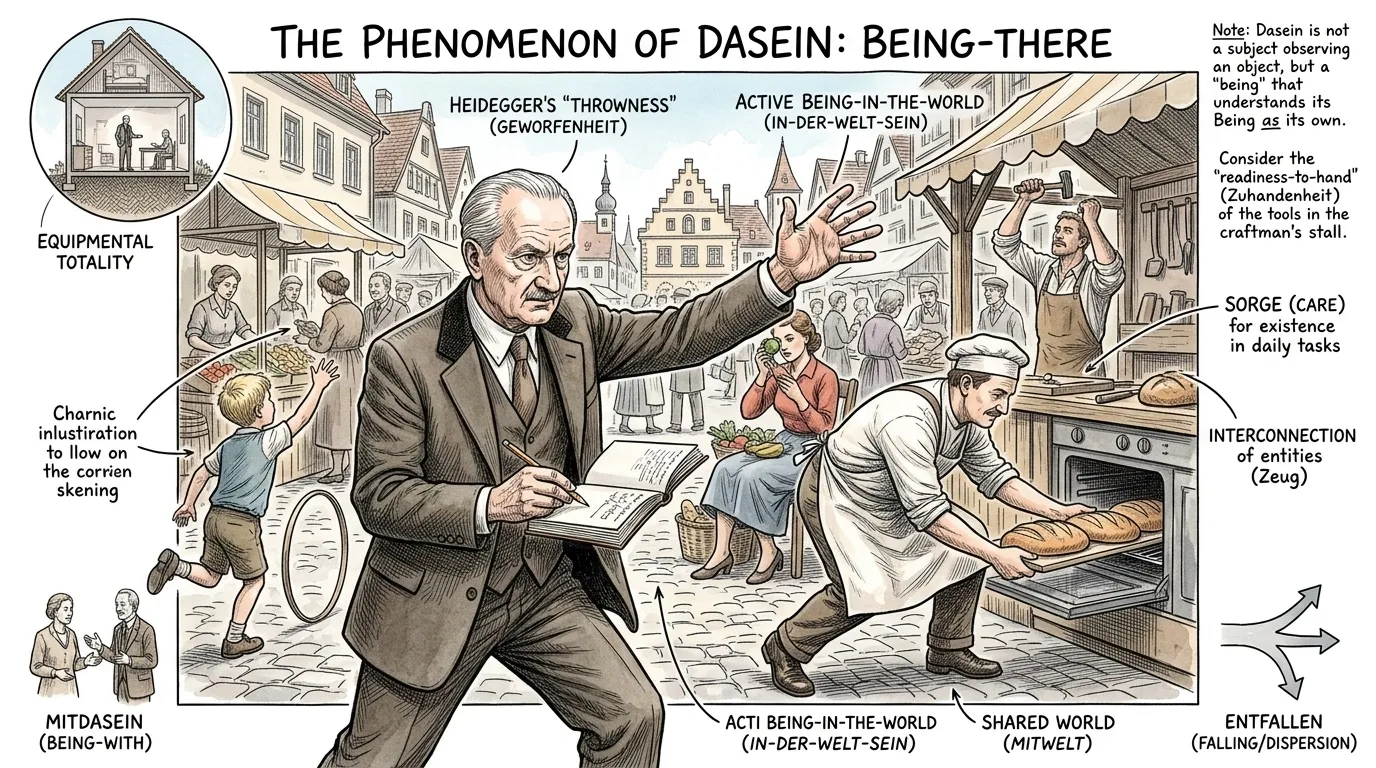
To address the question of Being, Heidegger first examined human existence, which he termed 'Dasein' – 'Being-there.' Dasein is not merely a human subject or consciousness; it is an entity whose very Being is an issue for it. Unlike objects, Dasein cares about its own existence and projects itself into possibilities. Crucially, Dasein is always 'Being-in-the-world.' This is not like a bottle of water 'in' a room, but a fundamental, engaged relationship. Our existence is inextricably linked to the world we inhabit, and our understanding arises from this practical engagement rather than detached observation. We are thrown into a world of shared meanings and possibilities, always already involved.
Philosophy Note: Dasein (Being-there): Human existence, defined by its inherent care for its own Being and its active engagement with the world.
Page 4
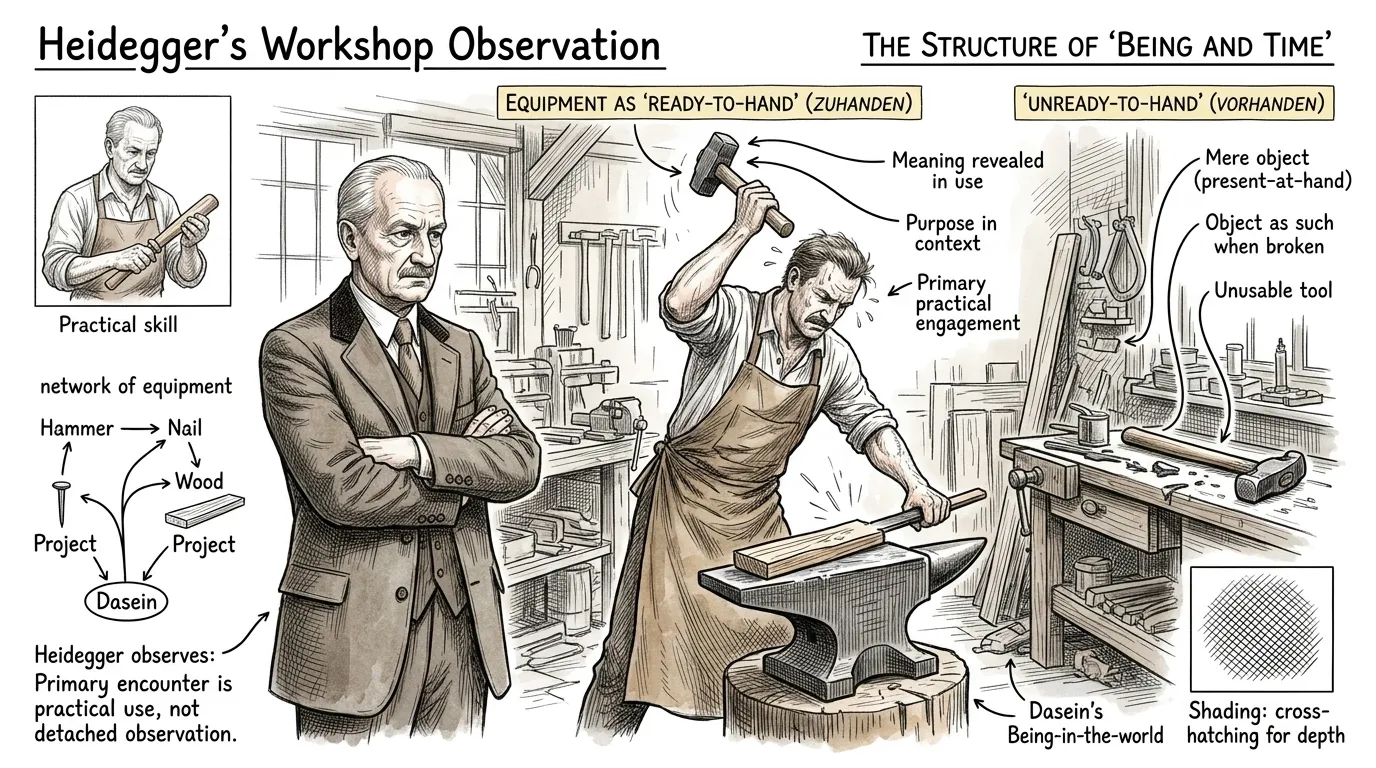
For Dasein, the world is primarily encountered through 'equipment.' Consider a hammer: we don't first perceive it as an object with properties, but as something 'ready-to-hand' – a tool for hammering. Its meaning is revealed in its use and its place within a larger network of tasks, purposes, and other equipment. Only when the hammer breaks, or is 'unready-to-hand,' does it stand out as a mere object ('present-at-hand'). This distinction highlights that our primary mode of being in the world is practical engagement, driven by purposes and projects, rather than theoretical contemplation. We are always enacting our understanding of the world through our practical activities.
Philosophy Note: Readiness-to-Hand: Our primary encounter with the world is through 'equipment' defined by its use and context, not as detached objects.
Page 5
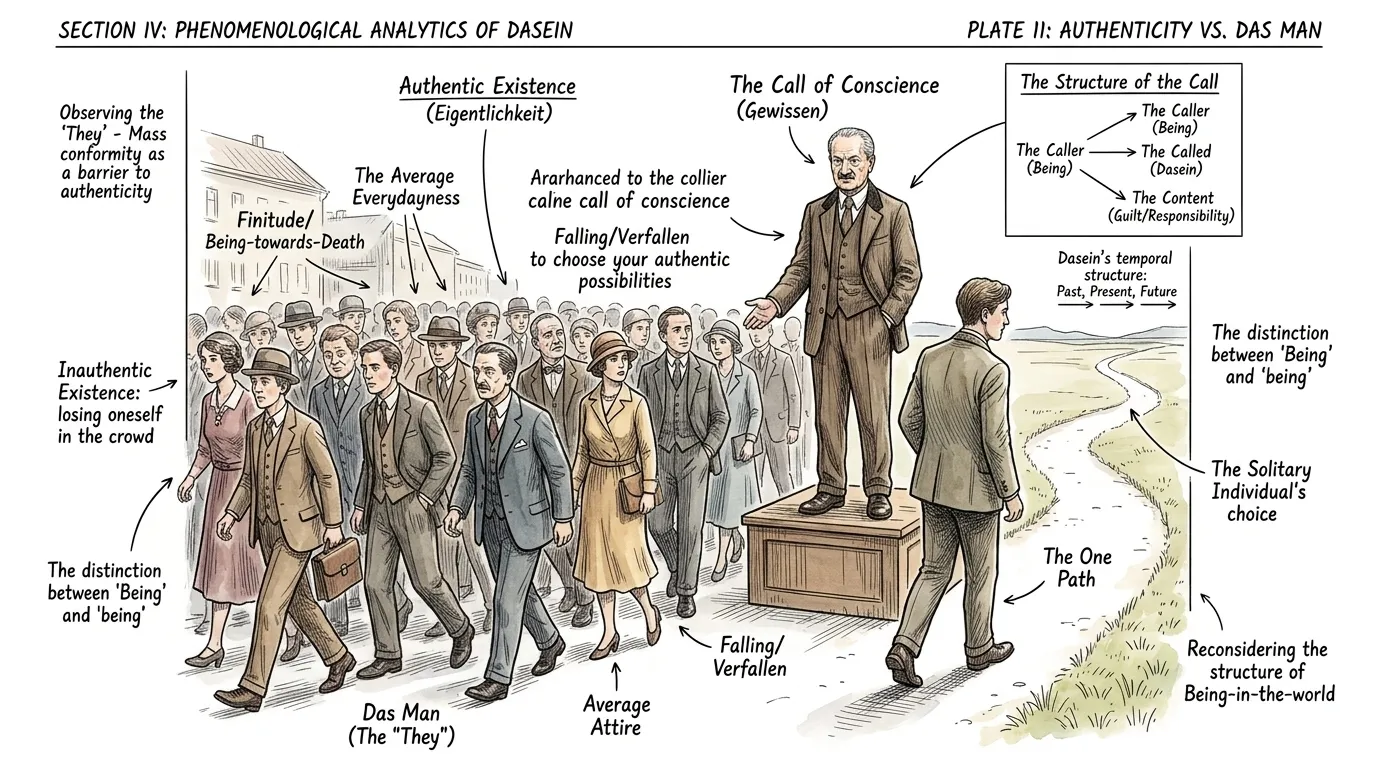
Heidegger distinguished between 'authentic' and 'inauthentic' modes of Dasein. Inauthenticity is the 'fallenness' into 'Das Man' – the 'they.' We conform to common expectations, speak what 'one says,' and act as 'one acts,' avoiding the burden of genuine selfhood. This allows usin to drift along in average everydayness, escaping the profound freedom and responsibility of our own existence. Authenticity, however, is not a state to be achieved but a way of Being that involves confronting our finitude, particularly our own death. The 'call of conscience' summons Dasein out of its immersion in the 'they' to choose its own possibilities, acknowledging its ultimate isolation and freedom in the face of death.
Philosophy Note: Das Man ('the they'): The inauthentic mode of Dasein, conforming to societal norms. Authenticity: Confronting one's finitude and choosing one's own possibilities.
Page 6
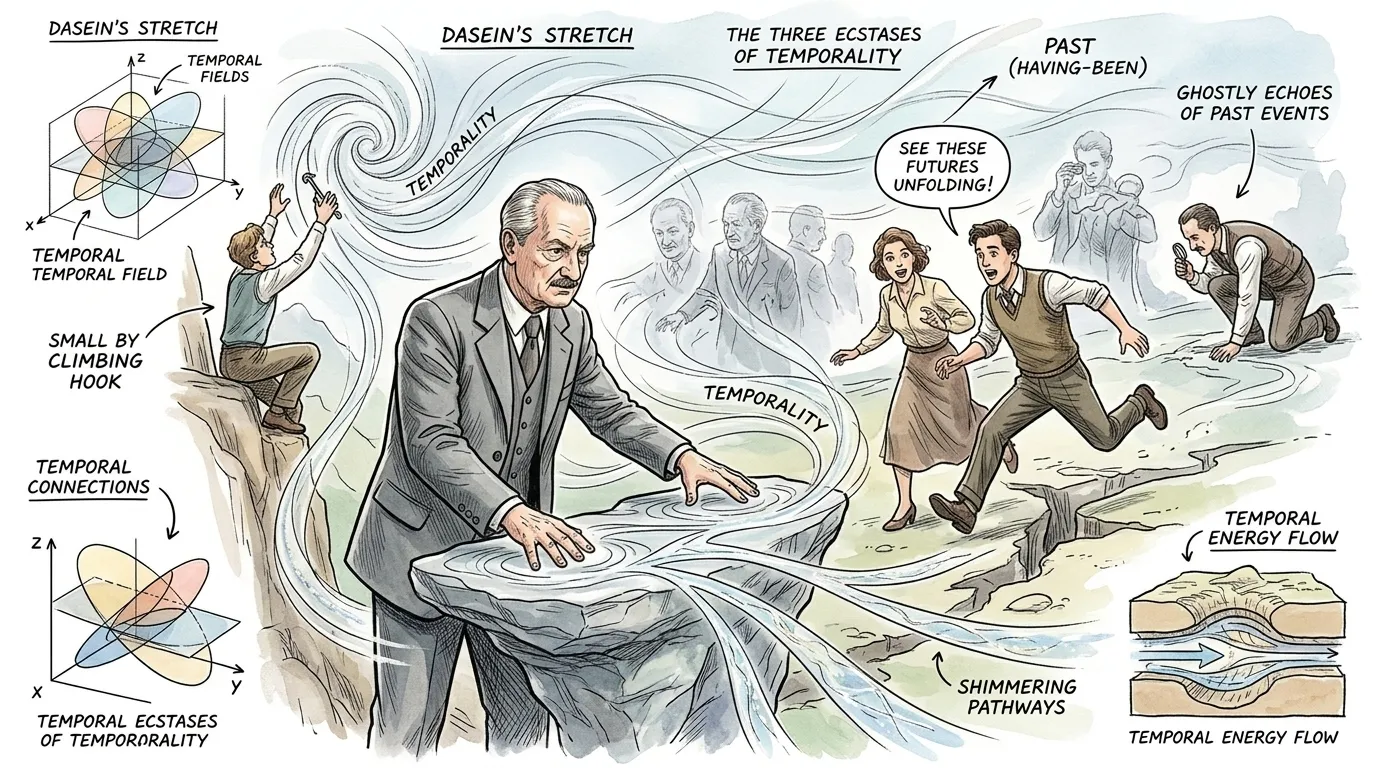
Central to Heidegger's understanding of Dasein is temporality. Dasein's Being is fundamentally temporal; it is always ahead of itself, projecting into possibilities ('futurity'), while also being shaped by its past ('having-been'). This ongoing process of stretching between past and future constitutes Dasein's present engagement with the world. For Heidegger, time is not merely a sequence of 'nows' but the very structure of Dasein's existence, the 'horizon' within which Being can be understood. Only through recognizing its own finite temporality – its being-toward-death – can Dasein truly understand the meaning of Being and achieve authentic existence.
Philosophy Note: Temporality: Dasein's fundamental structure, constantly stretching between past (having-been), present (engagement), and future (projecting possibilities).
Page 7
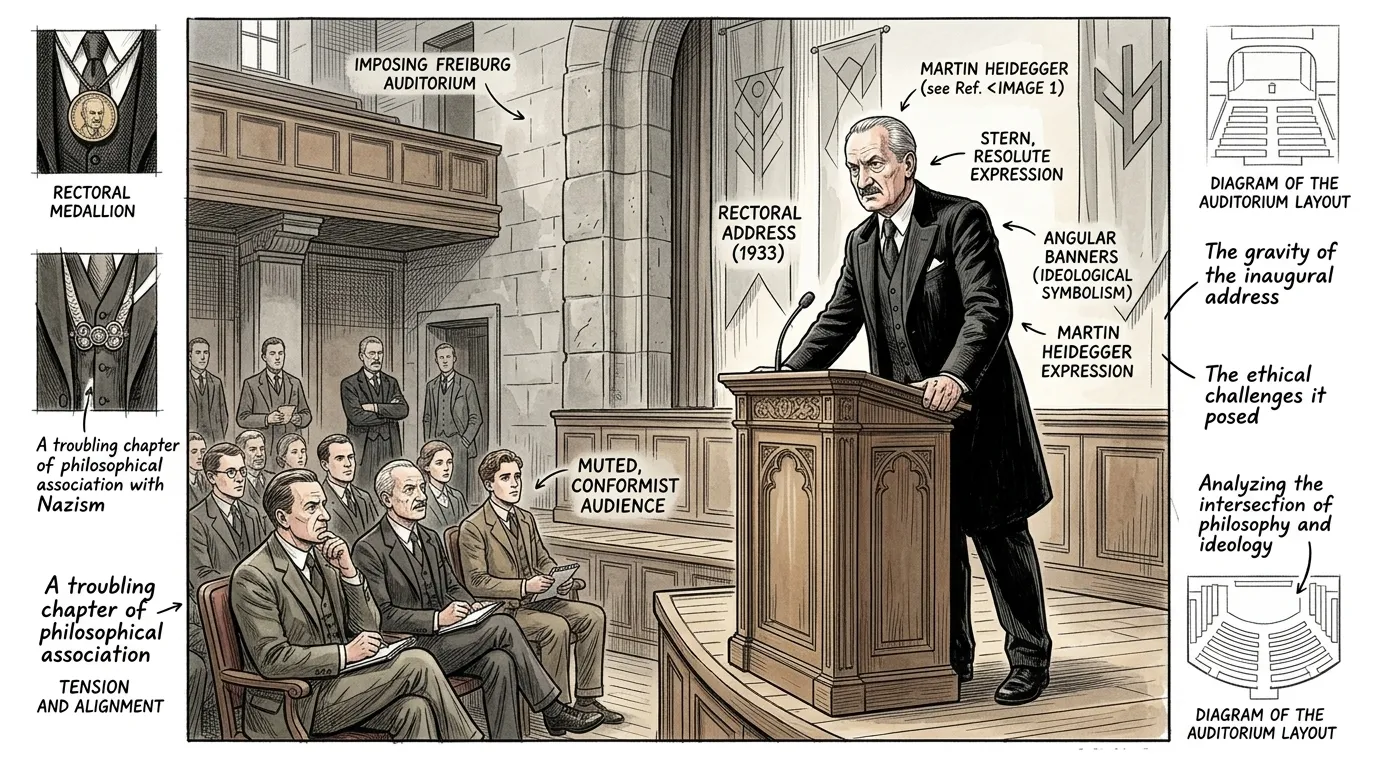
No discussion of Martin Heidegger can ignore the profound and troubling chapter of his association with Nazism. In 1933, he joined the Nazi Party and became Rector of Freiburg University, delivering an infamous inaugural address. His public writings and speeches during this period contained direct endorsements of the regime's ideology, speaking of 'the inner truth and greatness' of the movement. This involvement remains an indelible stain on his legacy, raising critical questions about the relationship between philosophy and political action, and whether his ideas can be entirely separated from his personal ethical failures. Emmanuel Levinas, a prominent critic, often highlighted the ethical vacuum in Heidegger's philosophy that, for him, paved the way for such political allegiances.
Philosophy Note: 1933: Heidegger's controversial appointment as Rector of Freiburg University and his public alignment with the Nazi Party. Emmanuel Levinas later critiqued the ethical implications of his philosophy.
Page 8
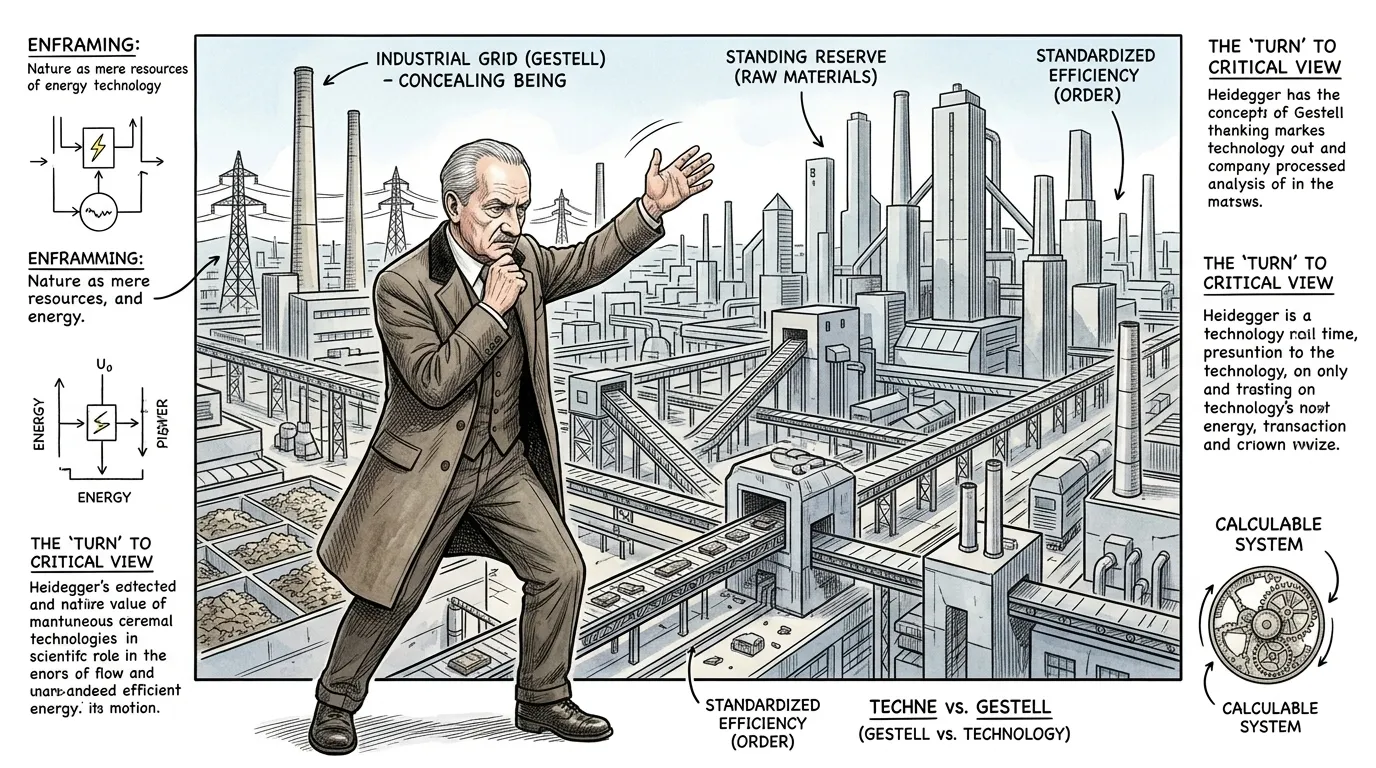
Following 'Being and Time' and his brief Rectorate, Heidegger's thought underwent a significant shift, often referred to as 'The Turn' (Die Kehre). He began to critique Western metaphysics as inherently flawed, arguing it had led humanity down a path of 'forgetfulness of Being,' culminating in the modern technological age. For Heidegger, technology is not merely a set of tools but a way of 'enframing' (Gestell) the world, reducing everything – nature, humans, art – to a standing reserve, a resource to be exploited and controlled. This enframing conceals Being, turning the world into a calculable, manageable system, threatening genuine human dwelling and our relationship to the sacred.
Philosophy Note: The Turn (Die Kehre): Heidegger's later thought shifted to a radical critique of Western metaphysics and modern technology as 'enframing' (Gestell), reducing all existence to a calculable resource.
Page 9
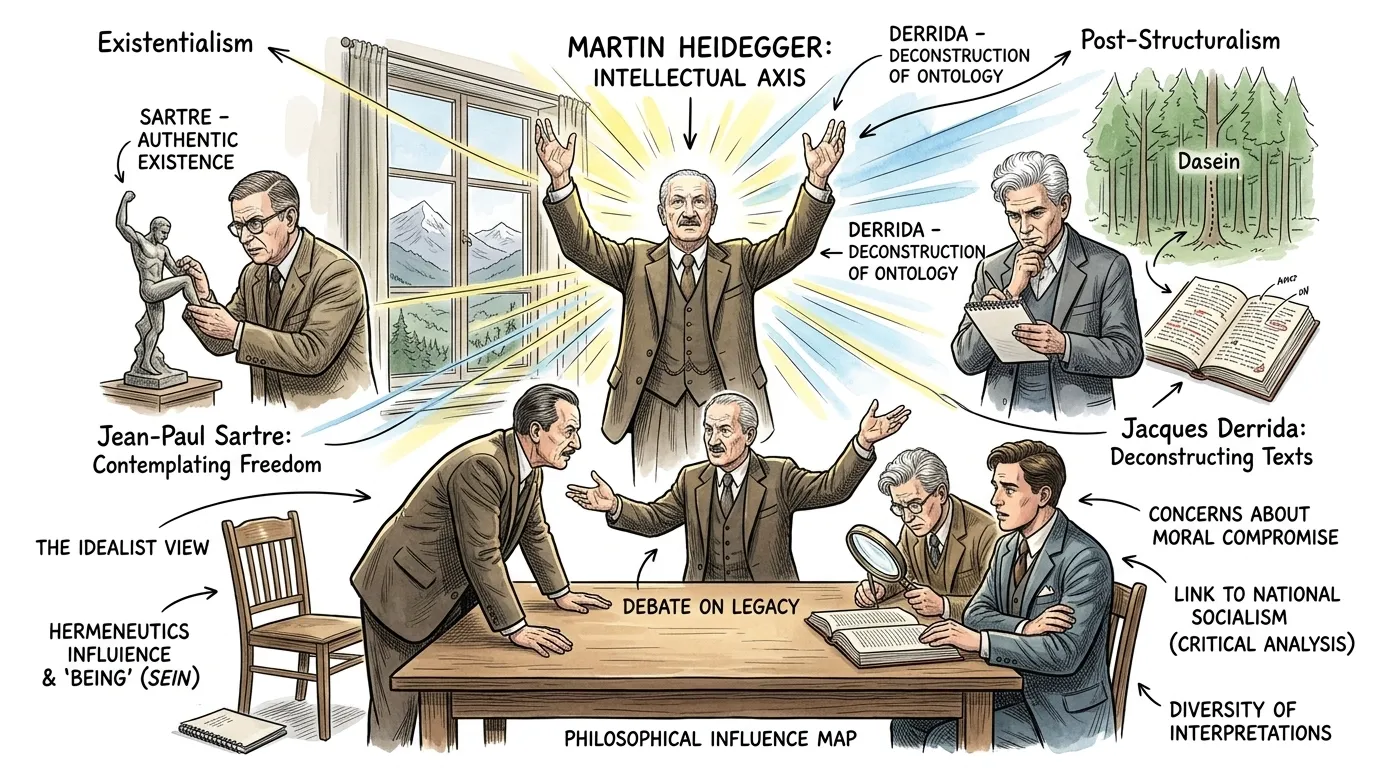
Despite the undeniable ethical shadow cast by his political actions, Heidegger's early philosophy, particularly 'Being and Time,' exerted an immense and transformative influence on 20th-century thought. He profoundly shaped existentialism (Sartre, Camus), hermeneutics (Gadamer), post-structuralism (Derrida, Foucault), and critical theory. His ideas on Dasein, temporality, and 'Being-in-the-world' provided new tools for understanding human subjectivity, language, and our relationship to history. The debate continues: how should one approach a philosophy so intellectually potent yet stained by such moral compromise? His legacy forces us to confront the complex relationship between thought, action, and historical accountability, a 'real world quote' challenge that intellectual history perpetually grapples with, much like the idea from the Roman poet Horace, 'Though you drive out nature with a pitchfork, she'll soon find her way back.' The inherent human tendency towards certain behaviors, for good or ill, resurfaces through generations.
Philosophy Note: Heidegger's profound influence on existentialism, hermeneutics, post-structuralism, and critical theory. His work continues to be debated for its intellectual power versus his controversial political affiliations.
Page 10
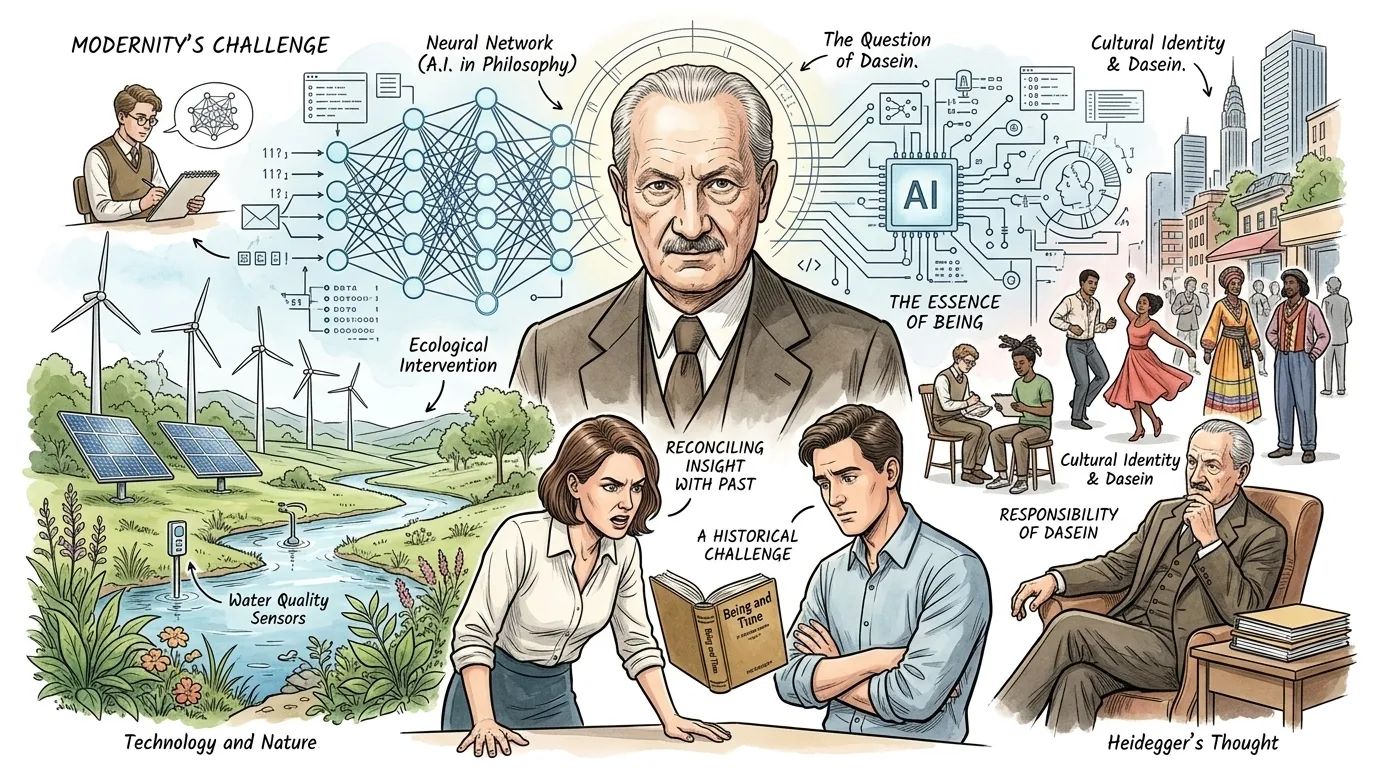
Today, Heidegger's ideas remain profoundly relevant for understanding contemporary challenges. His critique of technology offers a lens through which to analyze artificial intelligence, ecological crises, and the commodification of existence. His insights into authenticity and Dasein's temporal structure continue to inform discussions on identity, mental health, and the search for meaning in a rapidly changing world. Yet, the question of his Nazi past ensures that his philosophy cannot be simply absorbed without critical engagement. We are compelled to ask: Can profound intellectual insights arise from morally compromised origins? How do we separate the brilliance of thought from the failings of the thinker? Heidegger's work, therefore, stands as both a monumental achievement in Western philosophy and a perpetual ethical challenge, compelling us to critically examine the foundations of our own Being and our responsibilities within history.
Philosophy Note: Modern relevance: Critique of technology, environmentalism, identity. Enduring ethical challenge: Reconciling his philosophy with his Nazi past, and the question of intellectual responsibility.
About this story
- Audience: general readers
Questions and answers
Read Wonder Philosophy on your phone
Wonder Philosophy is available on Android and iPhone and iPad. Get Wonder Philosophy on Google Play · Get Wonder Philosophy on the App Store.