Mozi
Mozi — an illustrated philosophy story. 10 illustrated pages, free to read on Wonder Philosophy.

Page 1

Why should we care about a philosopher from ancient China? Mozi, living over 2400 years ago, grappled with problems that still haunt us today: inequality, violence, and the search for a just society. His solution? Universal love and practical benefit for all.
Philosophy Note: Mozi (墨子, c. 470 – c. 391 BC) founded Mohism, a school of thought that rivaled Confucianism in ancient China.
Page 2
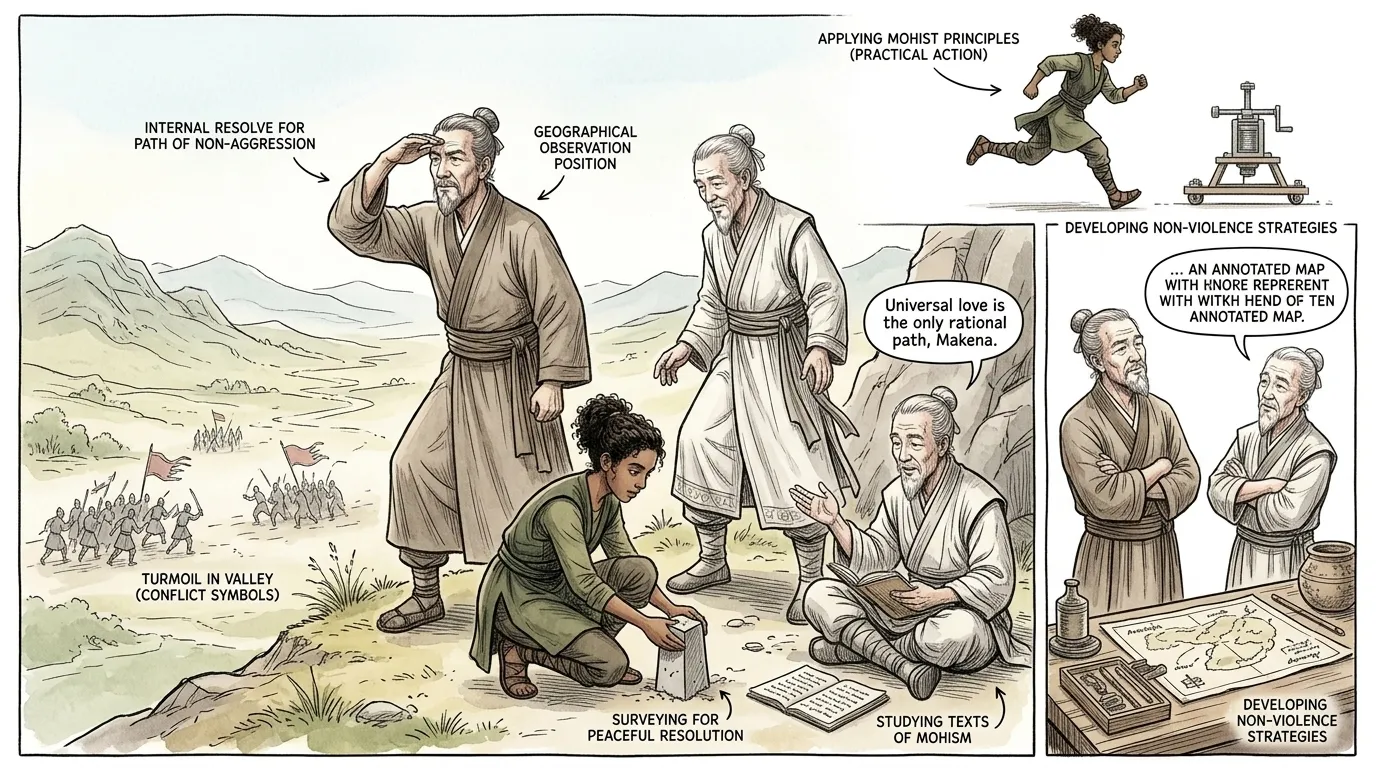
Born during the tumultuous Warring States period, Mozi witnessed constant conflict and widespread suffering. He challenged the dominant Confucian ideology, which he saw as too focused on ritual and social hierarchy. Mozi sought a more egalitarian and pragmatic path.
Philosophy Note: The Warring States period (475-221 BC) was marked by incessant warfare and political fragmentation in ancient China.
Page 3

In present-day Beijing, Pavel struggled with school and a sense of injustice. He saw kids being picked on for being different and didn't know how to help. He found himself seeking a mentor to better understand how the world was unfair. Pavel sought wisdom from the sage who could give him something that even his parents couldn't provide.
Philosophy Note: Mohism advocated for meritocracy, believing that positions should be awarded based on ability, not birth.
Page 4

"Imagine a world where everyone loves each other equally," Camila says, smiling warmly. "Mozi called this 'jian ai,' universal love. Not just loving your family and friends, but extending that care to everyone, even strangers." Pavel frowned: "That sounds impossible."
""It's about treating others as you would want to be treated," Camila replied, "and it's not just some nice idea. Mozi thought it was the most practical way to create peace and prosperity.""
Philosophy Note: Jian ai (兼爱) translates to 'universal love' or 'inclusive care,' the central tenet of Mohist ethics.
Page 5

"Mozi argued that we should do what benefits everyone," Camila explains. "If everyone loves each other, there would be less conflict, less theft, less harm. Everyone would be better off. This idea that we have to work towards the benefit of the population is critical." Pavel was still skeptical.
""But how do you get people to actually do it?" he asked."
Philosophy Note: Mozi emphasized 'utility' (用; yòng) as the standard for judging actions and policies.
Page 6

"Mozi also fought against fatalism," Camila continues. "Some people believed that everything was predetermined, so there was no point in trying to improve things. Mozi said that was nonsense! We have the power to change our lives and our society." Pavel tilted his head.
""And he hated waste," Camila added, "He thought wasting resources was like stealing from everyone.""
Philosophy Note: Mozi criticized elaborate rituals and extravagant funerals, viewing them as unproductive uses of resources.
Page 7

"But what about family?" Pavel asks. "Isn't it natural to love your family more than strangers?" Camila nodded. "That's the biggest criticism of Mozi. People said universal love is unrealistic and goes against human nature."
""Zhuangzi, another great philosopher, even argued that Mozi's ideas were too demanding and impractical. Finding a balance is key.""
Philosophy Note: Zhuangzi (莊子, c. 369 – c. 286 BC) was a Daoist philosopher who critiqued Mohism for its perceived rigidity.
Page 8

Pavel thought about Mozi's ideas and how they could be used today. He remembered something he had read on his phone: "As Helen Keller said, '"The best and most beautiful things in the world cannot be seen or even touched - they must be felt with the heart.' This is how we can understand the idea of Mozi and universal love."
"He added, "Maybe we can't love everyone equally, but we can still try to be more compassionate and help those in need.""
Philosophy Note: Mozi's emphasis on impartiality is relevant to modern debates about social justice and global ethics.
Page 9

"Exactly!" Camila exclaims. "Mozi's ideas aren't just ancient history. They're a challenge to build a more just and equitable world, one action at a time." Pavel smiled. He finally understood.
Philosophy Note: Mohist consequentialism is a form of ethical utilitarianism; actions are right if they produce the best overall consequences.
Page 10

As Pavel walked home, he thought about what he could do to put Mozi's ideas into practice. Even small acts of kindness and compassion could create a ripple effect, making the world a little better, one person at a time. If he did that, then the sage was able to truly change the boy's life.
Philosophy Note: Mozi's legacy continues to inspire efforts to promote universal values and create a more compassionate society.
About this story
- Audience: general readers
Questions and answers
Read Wonder Philosophy on your phone
Wonder Philosophy is available on Android and iPhone and iPad. Get Wonder Philosophy on Google Play · Get Wonder Philosophy on the App Store.