Philo of Alexandria
Philo of Alexandria — an illustrated philosophy story. 10 illustrated pages, free to read on Wonder Philosophy.
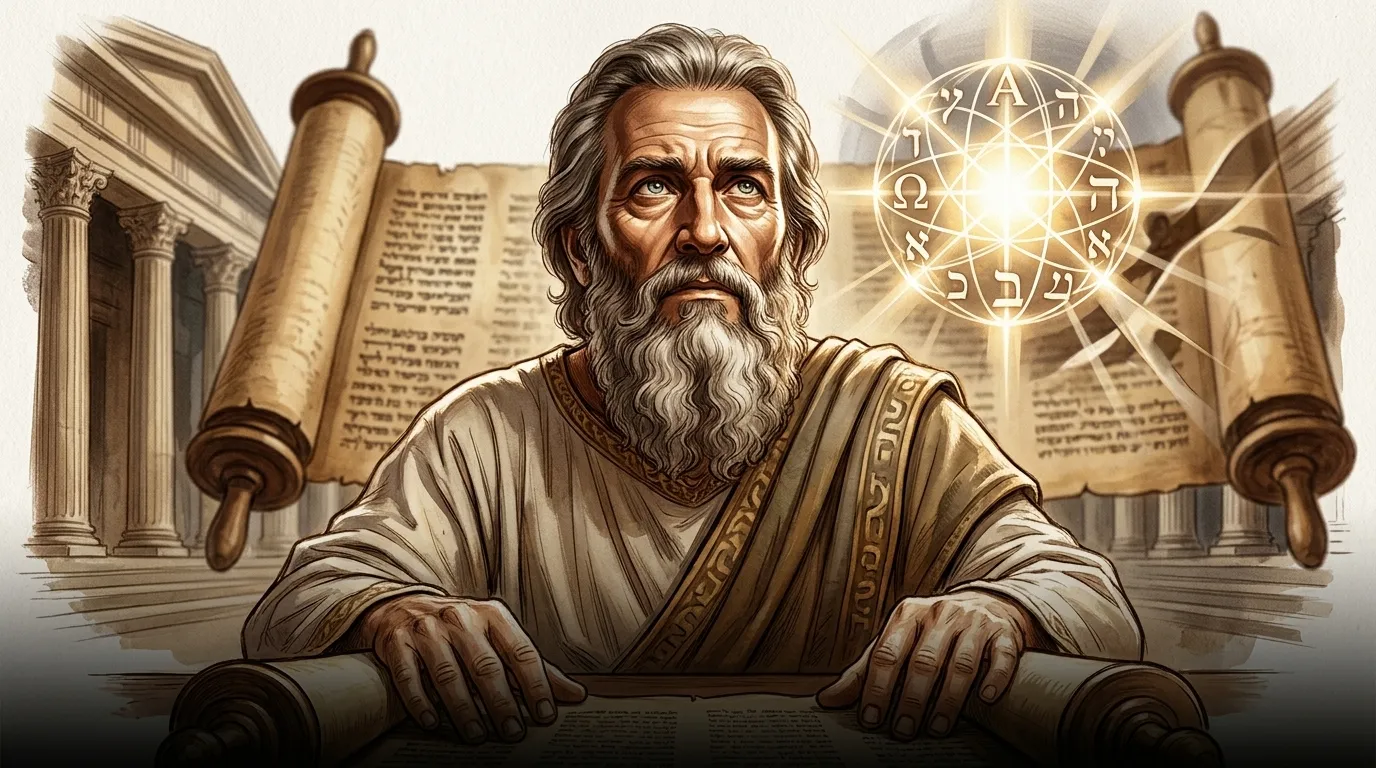
Page 1
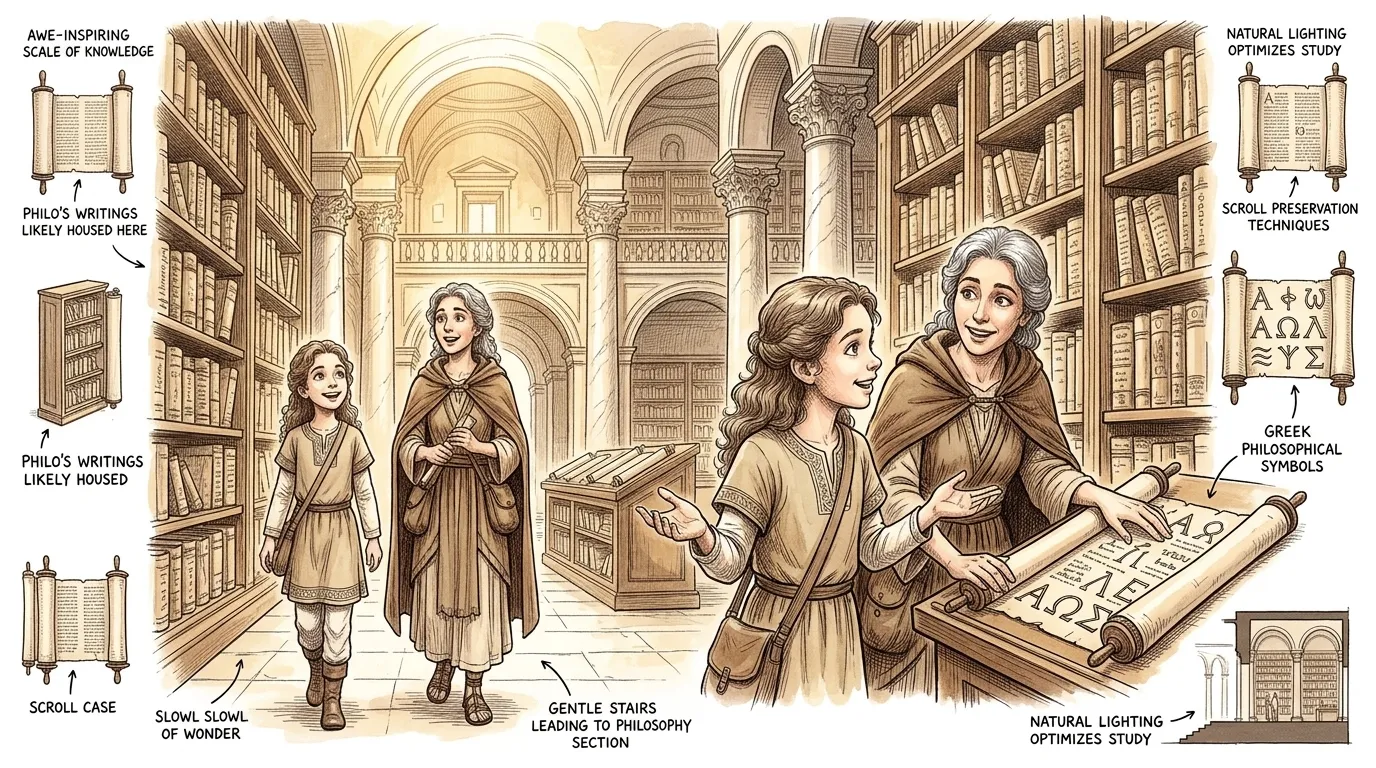
Makena and Lian walked slowly through the hushed halls of the Grand Library, their eyes wide with wonder at the towering shelves of ancient scrolls. The air hummed with the quiet wisdom of centuries, a peaceful contrast to the bustling city outside. Makena turned to Lian, a thoughtful expression on her face, realizing how many different ways people had tried to understand the world.
"'It's amazing, isn't it, Lian?' Makena whispered, gesturing to the rows of texts. 'So many different stories, so many different ideas about what is true and important.' Lian nodded, her gaze fixed on a scroll depicting Greek symbols. 'And sometimes, these ideas seem so different, almost like they can't belong together at all!'"
Philosophy Note: The Library of Alexandria, a center of learning in the ancient world, symbolizes the convergence of diverse intellectual traditions.
Page 2
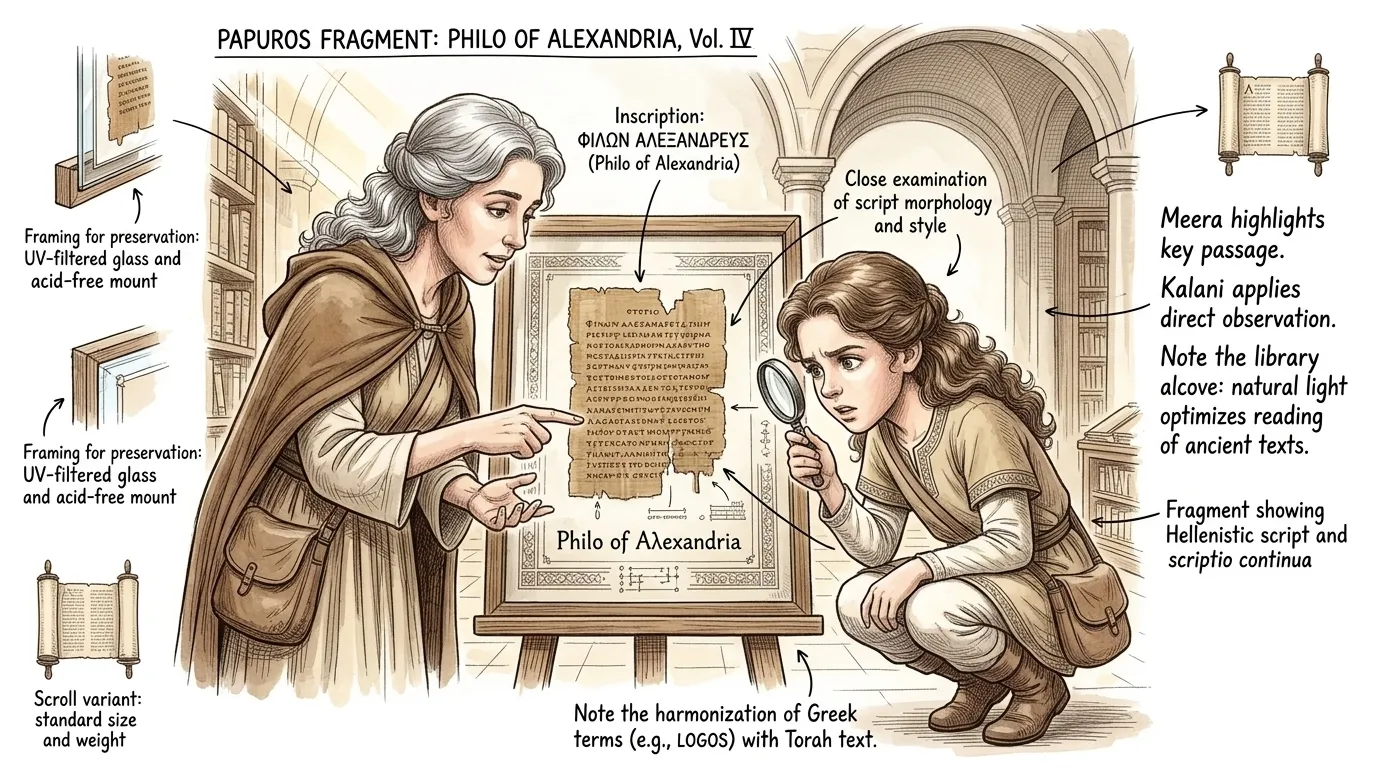
As they moved deeper into a quieter alcove, Lian pointed to a beautifully preserved papyrus fragment mounted behind glass, its Greek script elegant and precise. The accompanying inscription clearly named 'Philo of Alexandria,' catching Makena's attention. She read aloud, explaining that Philo was a thinker who lived right here, in ancient Alexandria, facing the challenge of bridging vastly different worlds of thought.
"'Look, Makena! 'Philo of Alexandria,' right here!' Lian exclaimed, her finger tracing the Greek letters. 'The description says he tried to make sense of Greek philosophy and Jewish scripture at the same time.' Makena leaned closer, her brow furrowed in concentration. 'That sounds incredibly difficult! How could he connect something like strict logic with ancient religious texts?'"
Philosophy Note: Philo (c. 20 BCE – c. 50 CE) was a Hellenistic Jewish philosopher who lived in Alexandria, Egypt. He is known for his efforts to synthesize Greek philosophy and Jewish religious thought.
Page 3
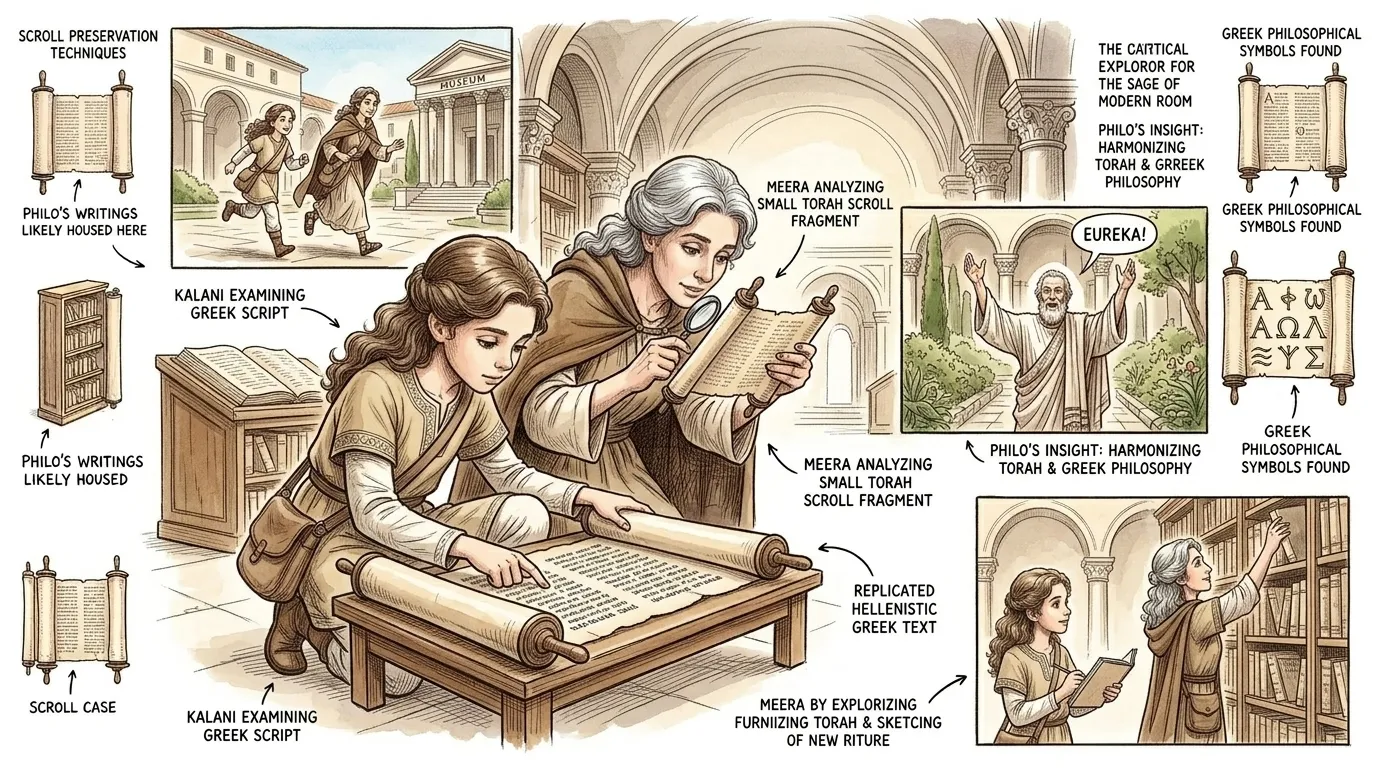
Makena carefully unrolled a replica scroll she found nearby, explaining that it discussed a core Greek philosophical idea: the 'Logos.' This concept referred to a universal divine reason, the underlying principle that ordered the cosmos. Lian found another scroll containing passages from the Torah, the foundational scriptures of Judaism, which described God creating the world through divine word and wisdom.
"'This scroll talks about the 'Logos,' Lian,' Makena explained, pointing to a Greek word. 'It's a huge idea in Greek philosophy – it means the rational principle that makes the universe orderly and understandable.' Lian picked up a different, smaller scroll. 'And this one, from the Torah, talks about God's powerful 'word' that created everything. They sound similar, but how could Philo really bring them together?'"
Philosophy Note: The Greek concept of 'Logos' (Λόγος) encompassed reason, word, and divine principle, particularly prominent in Stoic and Platonic thought.
Page 4
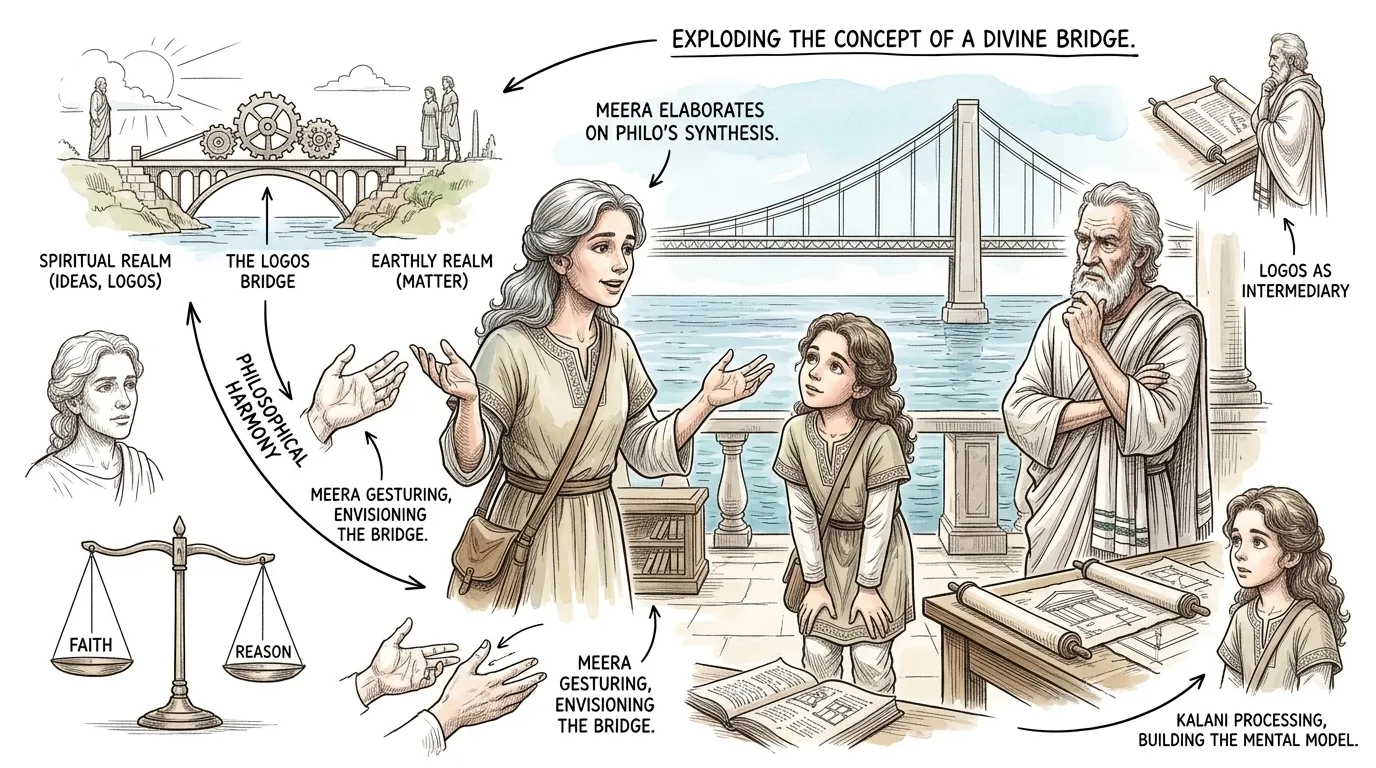
Lian, having read more about Philo, started to grasp his profound solution. Philo proposed that the Greek philosophical 'Logos' was actually the divine 'Word' and 'Wisdom' described in Jewish scripture, acting as a direct intermediary. This powerful concept allowed Philo to reconcile the transcendent, unknowable God of Judaism with the Greek philosophical need for a rational connection to the material world. It was a bold step, linking two distinct traditions through a single, encompassing idea.
"'Philo saw the Logos as God's very first creation,' Lian explained, gesturing expansively. 'Not God himself, but like an archangel, or God's instrument! He believed this Logos was how an all-powerful, unseen God could interact with and create the physical world we see around us.' Makena nodded slowly, picturing it. 'So, it's like a divine bridge between the spiritual and the earthly, making sense of how creation happened for both Greek thinkers and Jewish believers.'"
Philosophy Note: For Philo, the Logos was an incorporeal, divine principle, the 'first-born of God,' acting as the instrument through which God created and governed the universe. This concept proved influential in early Christian theology.
Page 5
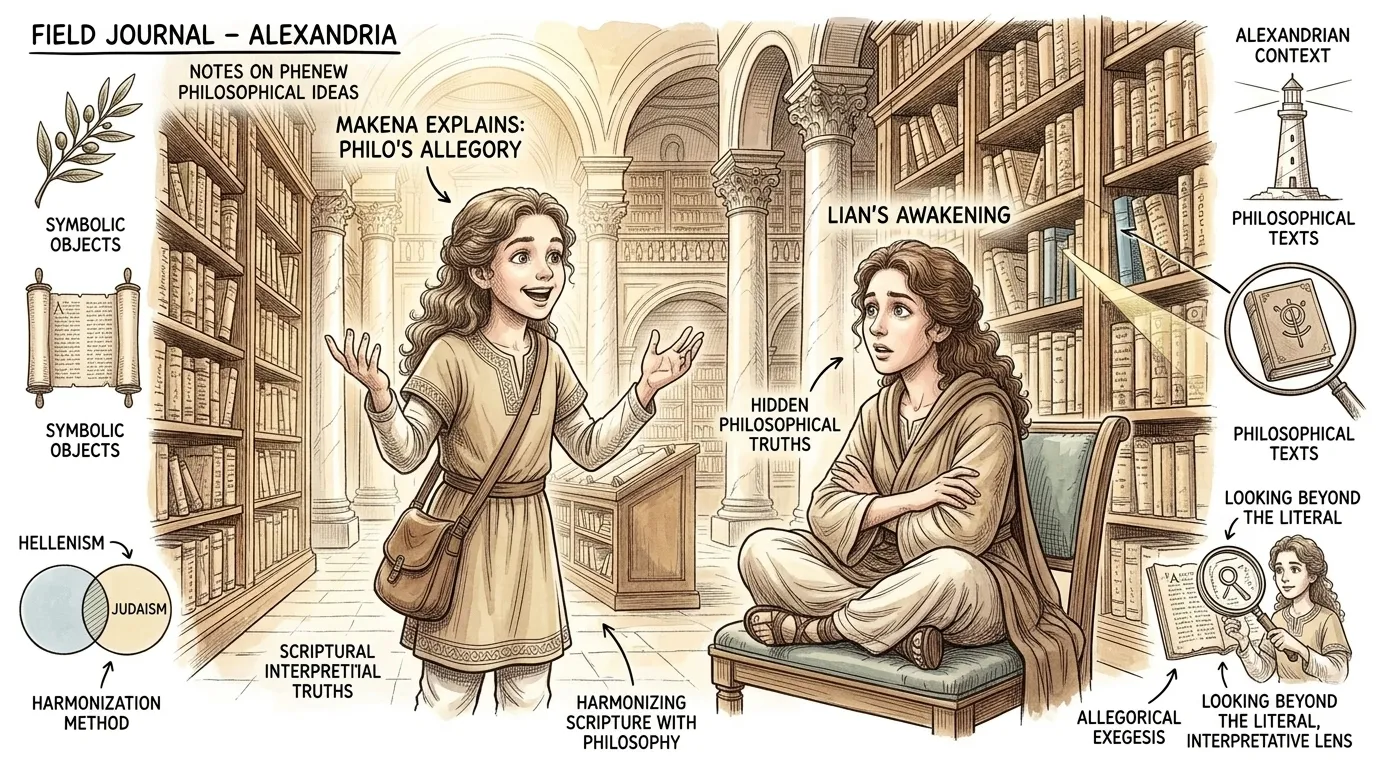
Makena then recounted how Philo didn't just find a philosophical link, but also developed a sophisticated method of allegorical interpretation for Jewish scriptures. He believed that many biblical narratives, while true on a literal level, also contained deeper, hidden philosophical and ethical truths, waiting to be uncovered by the discerning mind. This approach allowed him to show how ancient texts were not just historical records, but repositories of profound wisdom that aligned with reason.
"'And that's not all!' Makena added, her voice full of excitement. 'Philo believed that many stories in the Torah weren't just simple tales. He thought they were allegories, meaning they had secret, deeper philosophical meanings hidden within them!' Lian's eyes widened. 'So, like, the story of creation wasn't just about seven days, but also about the unfolding of reason and divine order in the universe?'"
Philosophy Note: Allegorical interpretation, common in Greek philosophical traditions for epic poems, was employed by Philo to reveal deeper, often Platonic or Stoic, meanings within Jewish scripture.
Page 6
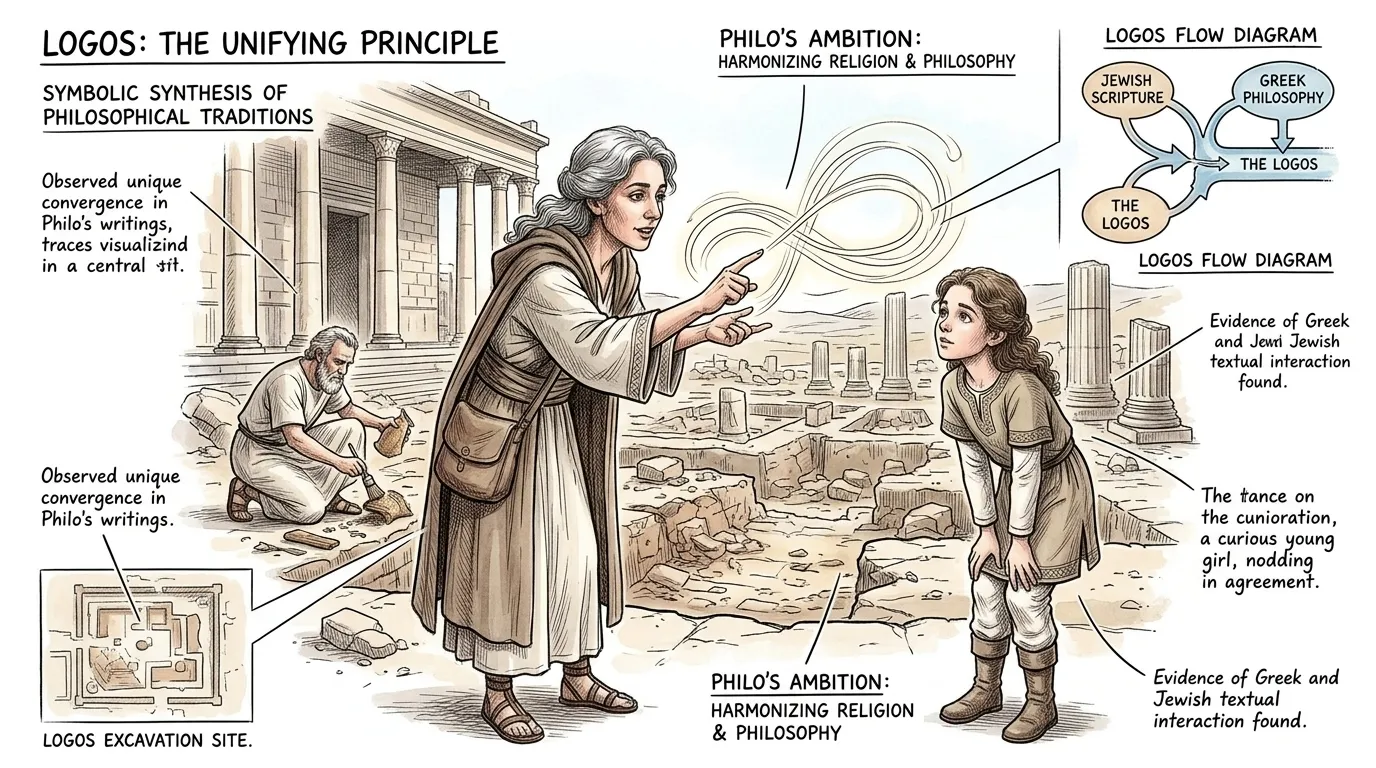
Lian summarized Philo's ambition perfectly: he wasn't trying to replace one tradition with another, but to demonstrate their inherent unity. For Philo, both Greek philosophy and Jewish scripture ultimately revealed aspects of the same universal truth, with the Logos serving as the unifying principle and allegorical interpretation as the key to unlocking these shared insights. His approach suggested that reason and revelation were not at odds, but complementary paths to understanding the divine. It was a truly harmonizing vision, seeking to find common ground.
"'So, he saw both Greek philosophy and Jewish scripture as telling parts of the same big story,' Lian concluded, tracing lines in the air. 'The Logos was the central thread, the divine reason present in both, and allegory was the way to see it clearly!' Makena nodded. 'It's like he believed there was one universal truth, and different cultures had found different ways to describe it, but Philo showed how they could all fit together.'"
Philosophy Note: Philo's syncretic project aimed to show the essential compatibility and ultimate unity of philosophical reason and revealed religion, a hallmark of Hellenistic Judaism.
Page 7
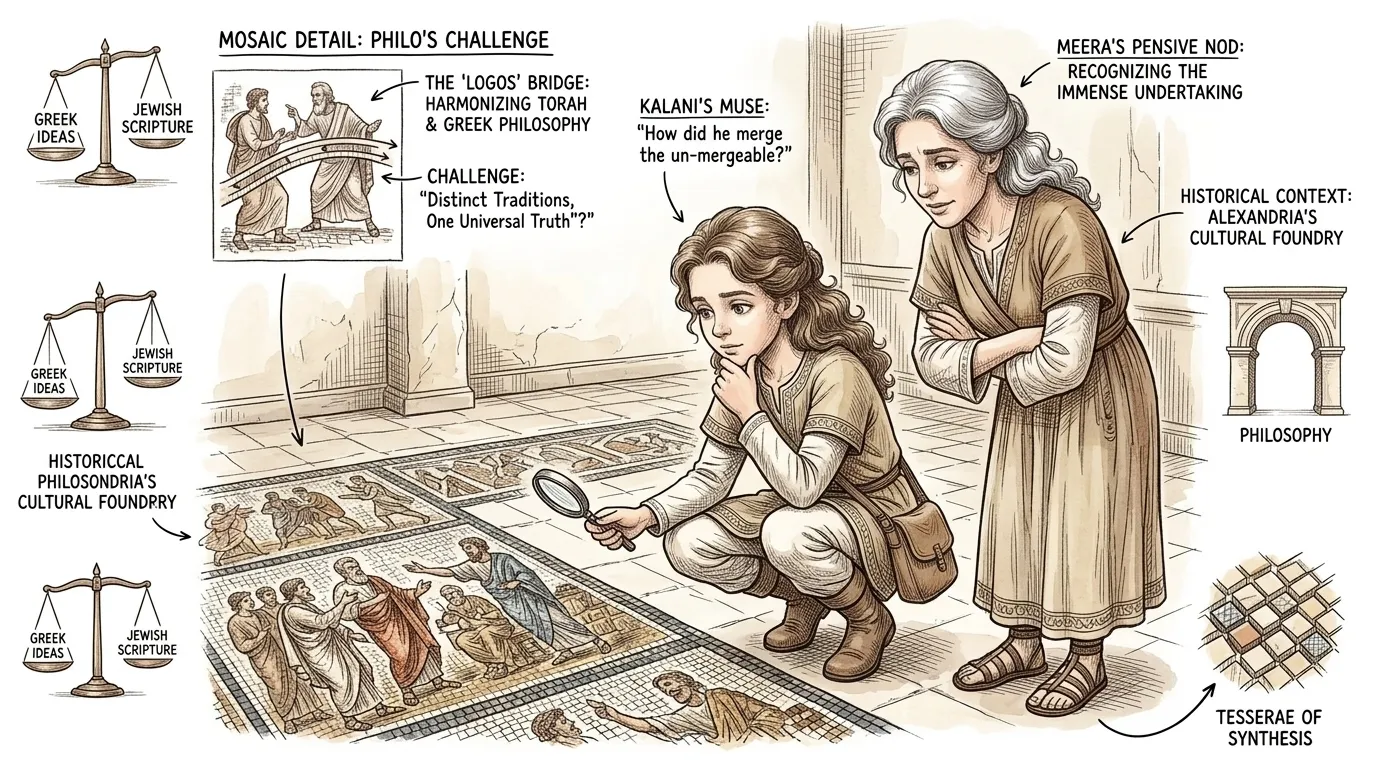
Makena pondered the immense challenge Philo faced in his time. Reconciling such distinct traditions wasn't easy, and his methods weren't without their critics. Some Jewish thinkers worried he was Hellenizing their faith too much, losing its unique identity in the process. At the same time, many Greek philosophers might have seen his appeals to ancient scripture as less rigorous than pure rational inquiry. It was a balancing act, constantly walking a tightrope between two powerful cultural forces, trying to find common ground.
"'It must have been a very lonely intellectual path,' Makena mused, looking at an ancient mosaic depicting philosophical debate. 'Imagine trying to convince people from two very different worlds that their deepest beliefs actually align!' Lian agreed. 'Some might have thought he was changing the meaning of their sacred texts too much, while others might not have accepted religious texts as philosophical proof at all.'"
Philosophy Note: Philo's work faced skepticism from both Jewish traditionalists, wary of Greek influence, and some Greek philosophers, who prioritized pure reason over scriptural interpretation.
Page 8
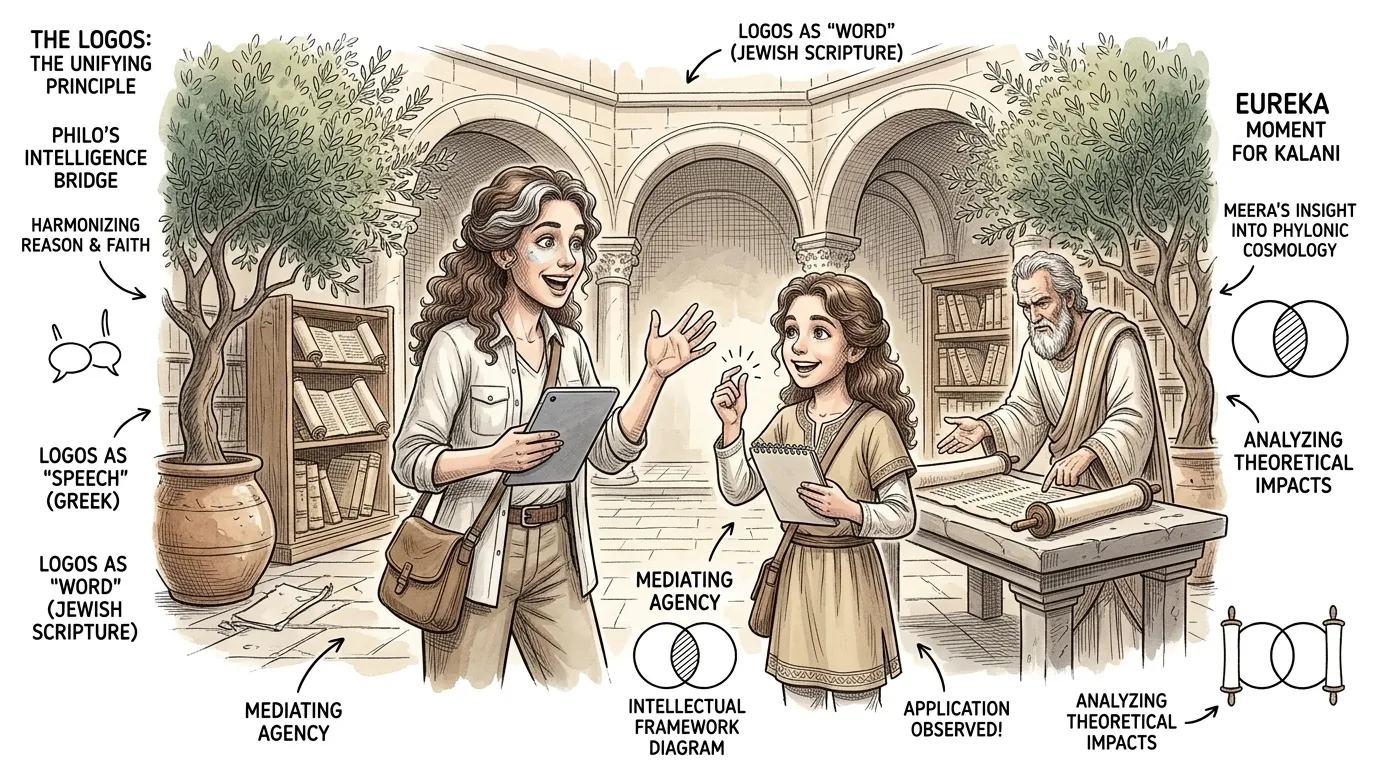
Lian suddenly made the connection to their earlier discovery of the 'Logos' concept, realizing its profound application. She explained how Philo's use of Logos, that fundamental principle of reason and divine wisdom, became the very key to bridging seemingly disparate ideas. This intellectual tool, learned on Page 3, helped him to articulate a coherent worldview where faith and reason could coexist, offering a powerful example for future generations struggling with similar questions. It was a remarkable demonstration of how philosophical concepts, when applied thoughtfully, could unlock new understandings and foster dialogue.
"'But that's where the 'Logos' idea, the one we found earlier, truly shines!' Lian exclaimed, her face lighting up. 'Philo used that Greek concept of divine reason to explain how the spiritual world could be connected to our physical world and our understanding of God in Jewish scripture!' Makena snapped her fingers. 'Yes! It was his crucial tool to show that different ways of thinking weren't against each other, but could actually explain each other. He built a bridge with that idea!'"
Philosophy Note: Philo's use of the Logos concept provided a powerful framework for later philosophical and theological syntheses, particularly in early Christian thought, by demonstrating a way to connect divine transcendence with worldly immanence.
Page 9
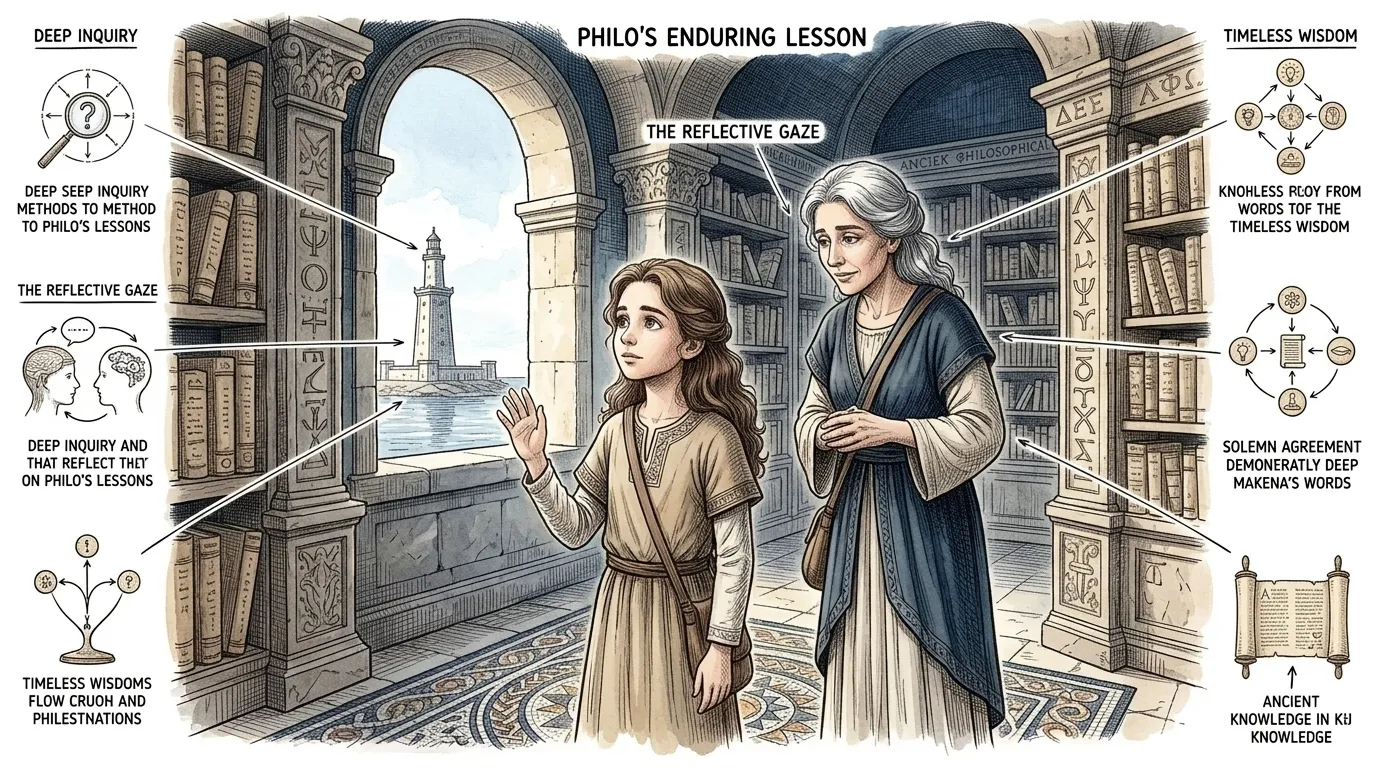
Makena reflected on Philo's enduring lesson: the importance of deep inquiry into one's own beliefs and the beliefs of others. It was a message that resonated through the centuries, reminding them that true understanding often requires looking beyond the surface and bravely seeking common threads amidst differences. She recalled a timeless piece of wisdom that encapsulated Philo's intellectual courage, a challenge to all who seek meaning.
"'Philo's life truly showed the value of asking big questions, even uncomfortable ones,' Makena mused, her voice soft. 'He examined everything with immense depth, didn't he? It reminds me of what the ancient philosopher Socrates wisely said: 'The unexamined life is not worth living.'' Lian nodded in agreement. 'He certainly made us think about how important it is to truly understand why we believe what we do, and how others believe what they do.'"
Philosophy Note: Socrates (c. 470–399 BCE), a foundational figure of Western philosophy, emphasized critical self-reflection and intellectual inquiry, encapsulated in his famous dictum.
Page 10
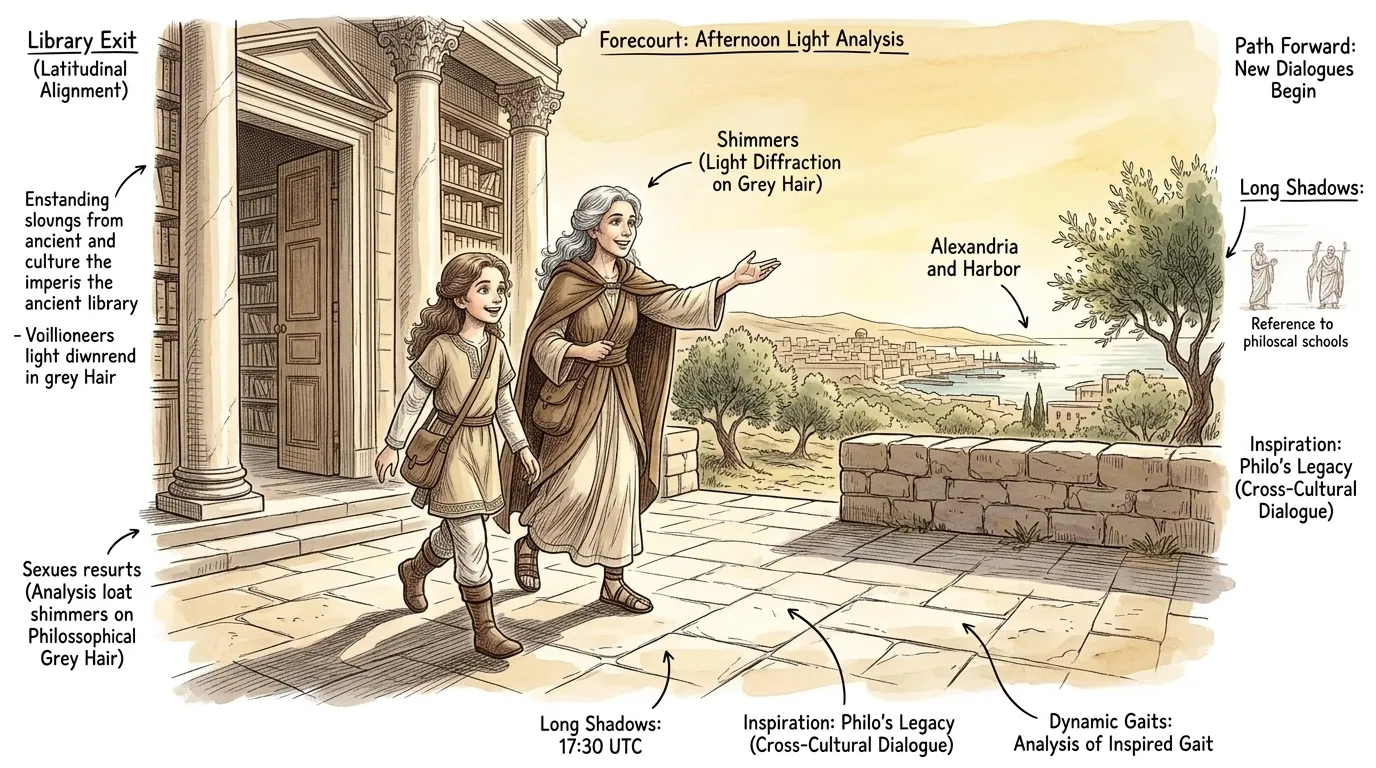
As Makena and Lian finally emerged from the grand halls of the library, the afternoon sun casting long shadows, they carried with them a new appreciation for Philo's profound work. Lian emphasized that his true legacy wasn't just his specific interpretations, but his pioneering spirit in fostering dialogue between diverse worldviews. His journey invited them all to approach different traditions not as separate entities, but as potentially interconnected paths toward shared truths, encouraging understanding and building bridges where others might see only divisions. They stepped out, feeling inspired by the timeless pursuit of harmony.
"'Philo taught us that the goal isn't just to pick one way of thinking, but to understand how different ways can illuminate each other,' Lian summarized, her silver hair shimmering in the light. 'He showed that seeking harmony between ideas is a courageous and incredibly valuable journey.' Makena smiled, looking back at the library entrance. 'Yes, his work reminds us that when we face different perspectives, we should always try to build bridges, not walls, between them. That's a lesson for any time, any place.'"
Philosophy Note: Philo's enduring impact lies in his intellectual courage to bridge philosophical and religious traditions, laying groundwork for future cross-cultural and interfaith dialogue, a vital endeavor in both ancient and modern times.
About this story
- Audience: kids (ages 6–12)
Questions and answers
Read Wonder Philosophy on your phone
Wonder Philosophy is available on Android and iPhone and iPad. Get Wonder Philosophy on Google Play · Get Wonder Philosophy on the App Store.