Pyrrho
Pyrrho — an illustrated philosophy story. 10 illustrated pages, free to read on Wonder Philosophy.

Page 1

In a world saturated with information and opinions, the ancient wisdom of Pyrrho offers a vital counterpoint. His philosophy, advocating for a suspension of judgment, challenges our deeply ingrained need for certainty. But why, in our modern age of scientific advancement and technological innovation, should we consider the teachings of a philosopher who questioned the very possibility of knowledge?
Philosophy Note: Pyrrho of Elis (c. 360 – c. 270 BCE): Founder of Pyrrhonism, a school of skeptical philosophy.
Page 2

Pyrrho, an enigmatic figure from ancient Greece, lived a life that mirrored his philosophical beliefs. He journeyed extensively, accompanying Alexander the Great to India. It was there, amidst diverse cultures and beliefs, that his skepticism deepened. He observed the contradictions and inconsistencies in human understanding, leading him to question the very foundations of knowledge.
Philosophy Note: Alexander the Great's expedition to India (326 BCE) exposed Pyrrho to diverse philosophical traditions.
Page 3
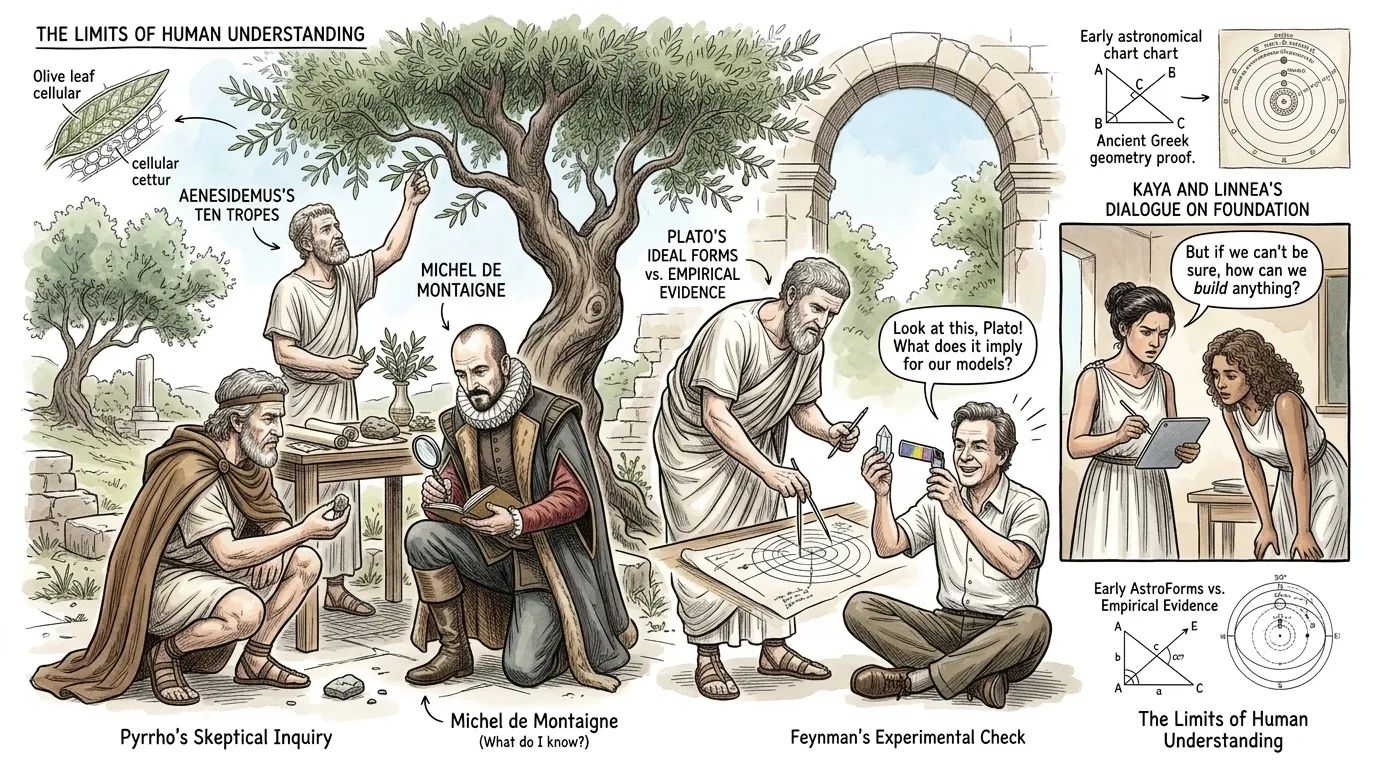
Upon his return to Greece, Pyrrho began to articulate his philosophy of skepticism, later known as Pyrrhonism. He argued that because our senses and reasoning are unreliable, we cannot attain certain knowledge about the true nature of reality. Therefore, the wisest course of action is to suspend judgment – to neither affirm nor deny anything definitively.
"Kaya asks Linnea, 'But if we can't know anything for sure, what's the point of even trying to learn?'"
Philosophy Note: Pyrrhonism: A philosophical school emphasizing skepticism and suspension of judgment (epoché).
Page 4
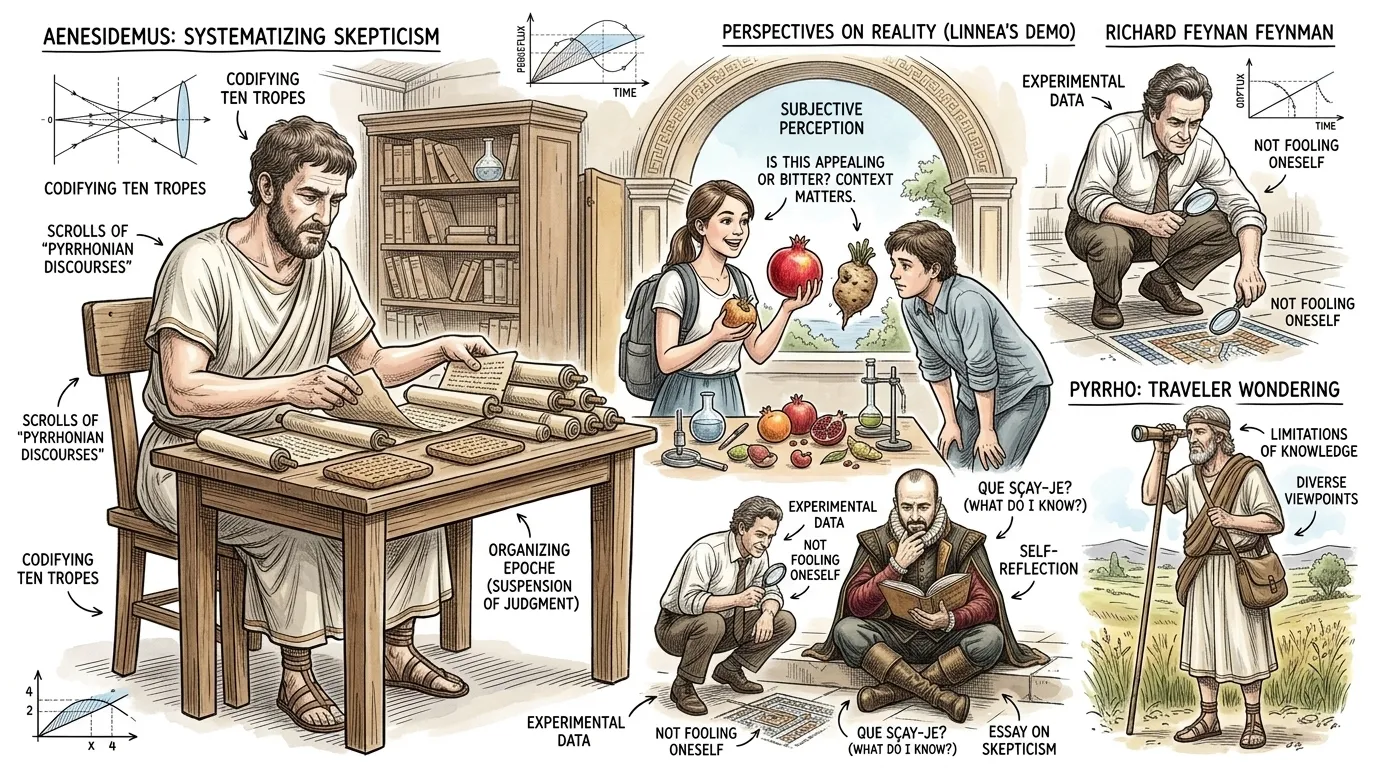
While Pyrrho left no writings, his student Aenesidemus systematized his teachings, outlining ten 'modes' or arguments for suspending judgment. These modes highlight the subjective nature of perception, the influence of culture and custom, and the limitations of human reasoning. They demonstrated that for every claim, an equally valid counter-claim could be made.
"Linnea explains, 'Think of it like this: what tastes delicious to one person might taste awful to another. It's not that one person is right and the other is wrong; it's just a matter of perspective.'"
Philosophy Note: Aenesidemus (1st century BCE): Greek philosopher who systematized Pyrrhonism and developed the ten modes of skepticism.
Page 5

The ultimate goal of Pyrrhonism is not simply to doubt everything, but to achieve ataraxia – a state of tranquility and freedom from disturbance. By recognizing the limitations of our knowledge and suspending judgment, we can avoid the anxiety and distress that come from clinging to beliefs that may be false.
Philosophy Note: Ataraxia: A state of tranquility and freedom from disturbance, the ultimate goal of Pyrrhonism.
Page 6

Pyrrhonism has often been misunderstood as advocating for complete inaction or intellectual paralysis. However, Pyrrho himself was not inactive. He lived a normal life, followed social customs, and responded to his environment. Pyrrhonism is not about denying the evidence of our senses, but about recognizing that our interpretations of that evidence are fallible.
"Kaya says, 'So, it's not about pretending we don't see things, but about not jumping to conclusions?'"
Philosophy Note: Pyrrhonism distinguishes between appearance (what seems to be) and reality (what truly is), acknowledging the former while suspending judgment about the latter.
Page 7

Pyrrho's skepticism stands in stark contrast to the rationalism of Plato, who believed in the power of reason to uncover eternal, unchanging truths. While Plato sought to transcend the world of appearances to grasp the Forms, Pyrrho embraced the uncertainty of the everyday, finding tranquility in accepting the limits of human understanding.
"Linnea remarks, 'It's like Plato was trying to climb a ladder to heaven, while Pyrrho was content to sit in his garden.'"
Philosophy Note: Plato (c. 428/427 or 424/423 – 348/347 BCE): Classical Greek philosopher who founded the Academy in Athens and developed the theory of Forms.
Page 8

Centuries later, Michel de Montaigne, a French Renaissance essayist, echoed Pyrrho's skepticism in his famous question, 'What do I know?' Montaigne explored the limitations of human reason and the subjectivity of experience, advocating for a spirit of open-minded inquiry and a willingness to question established beliefs.
"Linnea reads from a book, "Montaigne wrote, 'The greater part of the world's troubles are due to semantic problems.' Maybe if we all embraced a little Pyrrhonism, we'd argue less and listen more.""
Philosophy Note: Michel de Montaigne (1533-1592): French Renaissance essayist known for his exploration of skepticism and self-reflection.
Page 9

Richard Feynman, the Nobel Prize-winning physicist, emphasized the importance of intellectual honesty and critical thinking. He urged scientists to avoid fooling themselves – to be skeptical of their own assumptions and to rigorously test their hypotheses. This spirit of intellectual humility resonates with Pyrrho's call for suspending judgment.
"Kaya nods, saying, 'It's like Feynman said, 'The first principle is that you must not fool yourself – and you are the easiest person to fool.' That means we should always be ready to doubt our own ideas.'"
Philosophy Note: Richard Feynman (1918-1988): Nobel Prize-winning physicist known for his emphasis on intellectual honesty and critical thinking.
Page 10

In a world bombarded with conflicting information and polarized opinions, Pyrrho's skepticism offers a valuable tool for navigating uncertainty and cultivating intellectual humility. By embracing doubt, we can become more open-minded, more tolerant, and more resilient in the face of adversity. The wisdom of Pyrrho, born in ancient Greece, continues to resonate in our modern world, reminding us of the importance of questioning everything, including ourselves.
Philosophy Note: Pyrrho's emphasis on ataraxia remains a relevant guide for navigating the anxieties of the modern world.
About this story
- Audience: general readers
Questions and answers
Read Wonder Philosophy on your phone
Wonder Philosophy is available on Android and iPhone and iPad. Get Wonder Philosophy on Google Play · Get Wonder Philosophy on the App Store.