Shankara
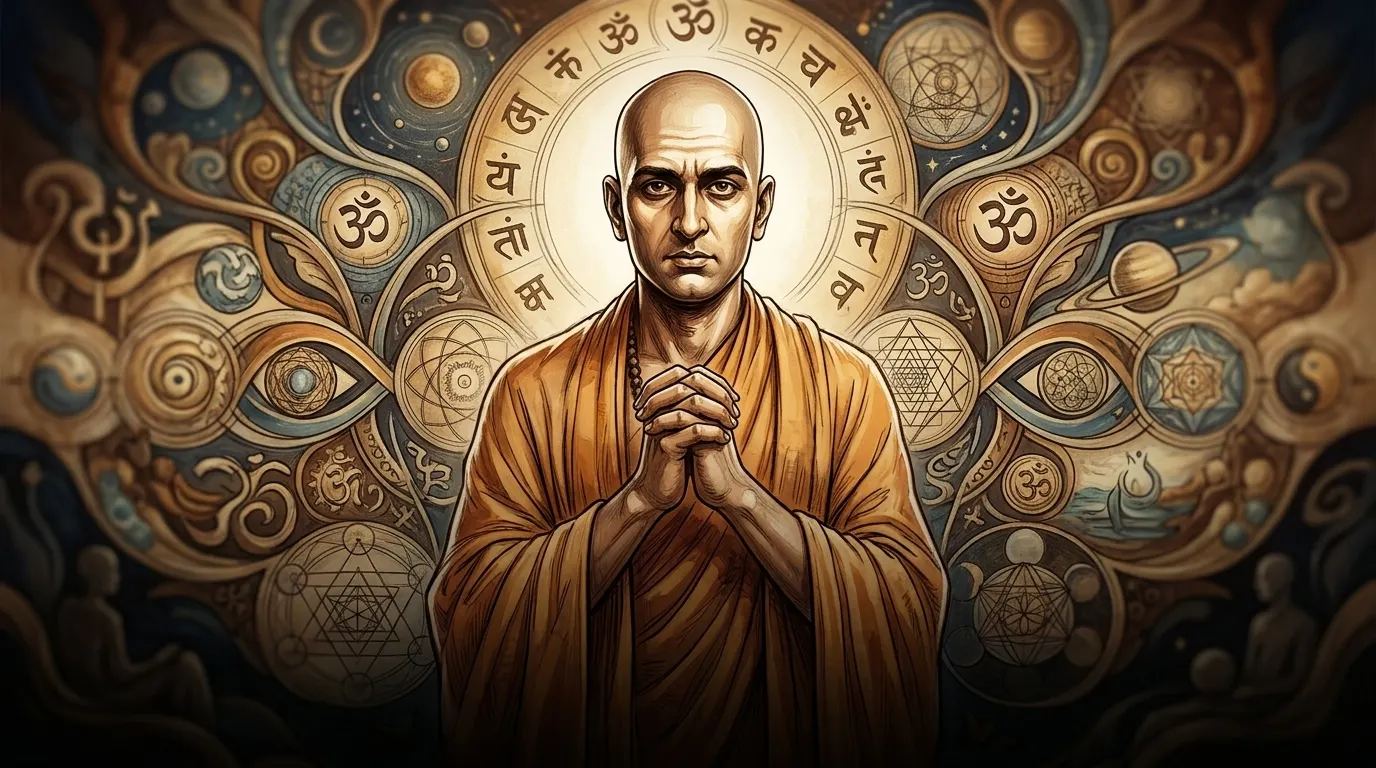
Explore Shankara's Advaita Vedanta, revealing the unity of Atman and Brahman and the illusion of individual self. Discover how this philosophy promotes empathy and inner peace by transcending perceived divisions.
Page 1
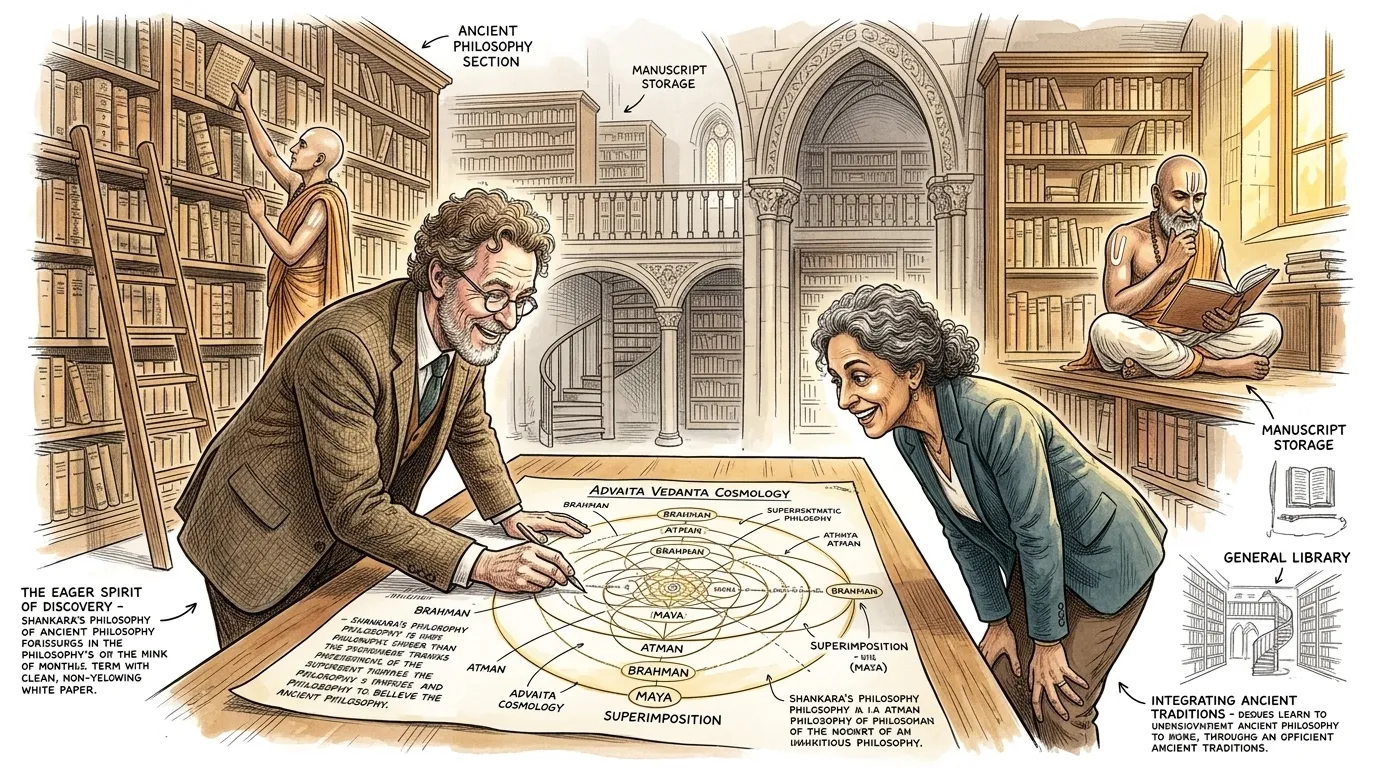
In the quiet grandeur of the university's ancient philosophy library, Dr. Aris Thorne and Dr. Lena Petrova stood before a large, illuminated diagram. Its intricate lines depicted a profound truth challenging our everyday perceptions of reality. They were delving into the core of Adi Shankara's revolutionary philosophy: Advaita Vedanta.
"'It proposes that the seemingly separate world, with all its distinct objects and individual selves, is fundamentally one indivisible reality,' Dr. Thorne explained, tracing a line on the diagram. 'All diversity, all multiplicity, is ultimately an appearance of this singular, ultimate truth.' Dr. Petrova nodded slowly, her gaze fixed on the central point of the diagram. 'So, the grand question Shankara poses is: is everything we perceive truly real, or is it an elaborate cosmic play?'"
Philosophy Note: Adi Shankara (788-820 CE), an influential Indian philosopher, consolidated Advaita Vedanta, a school of Hindu philosophy asserting the oneness of the individual self (Atman) with the ultimate reality (Brahman).
Page 2
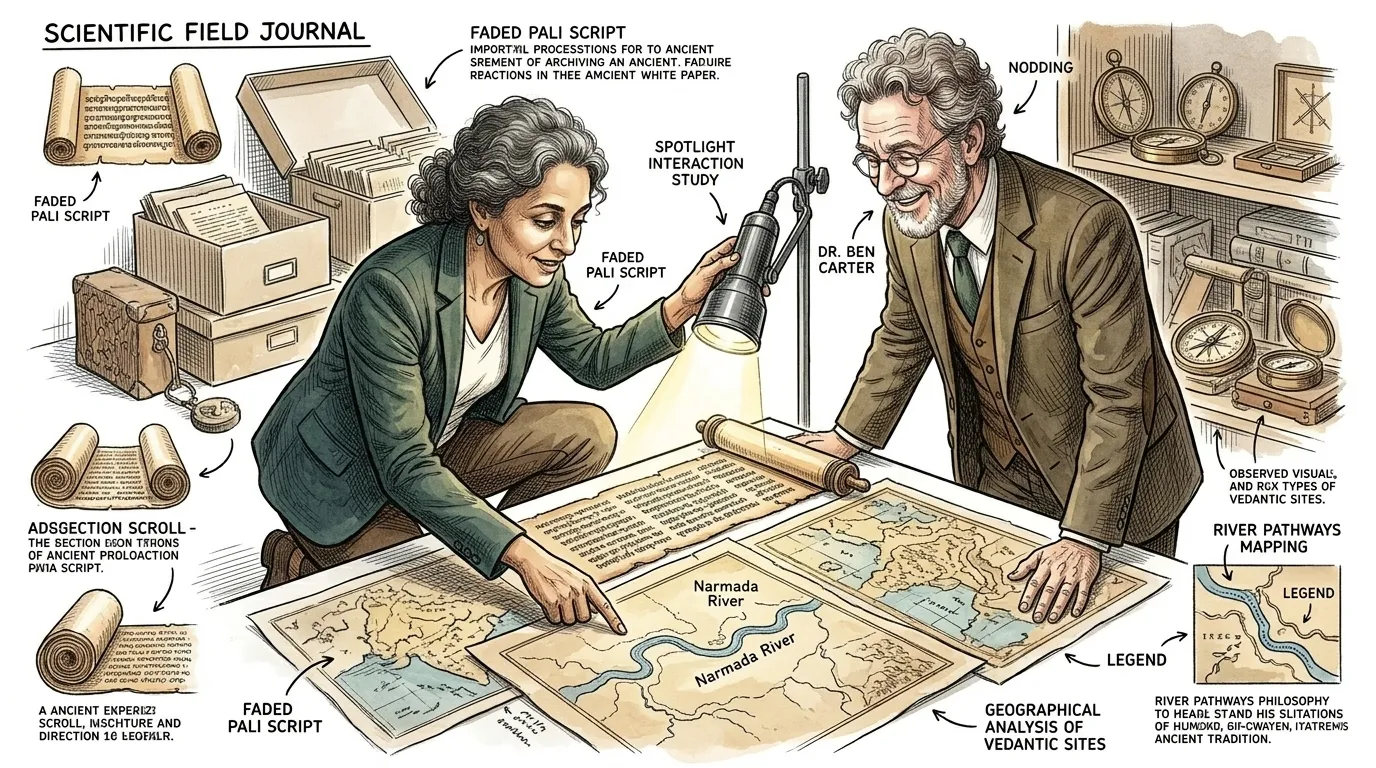
The scholars moved to a display of historical maps, pinpointing the geographical and intellectual landscape of Shankara's time. Dr. Petrova carefully adjusted a spotlight on an ancient scroll, its faded script hinting at centuries of philosophical debate.
"'Shankara emerged in 8th century India, a period ripe with diverse philosophical schools and interpretations of Vedic texts,' Dr. Petrova remarked, her finger tracing a river on the map. 'He wasn't just presenting a new idea; he was consolidating and rigorously defining Advaita, which means 'non-duality,' against a backdrop of complex spiritual traditions.' Dr. Thorne added, 'His genius lay in synthesizing various threads of thought into a coherent, logically robust system that profoundly reshaped Indian philosophy and challenged dualistic understandings of existence.'"
Philosophy Note: Shankara travelled across India, engaging in debates and establishing monasteries, effectively revitalizing and systemizing the Advaita Vedanta philosophy, making it a cornerstone of Hindu thought.
Page 3
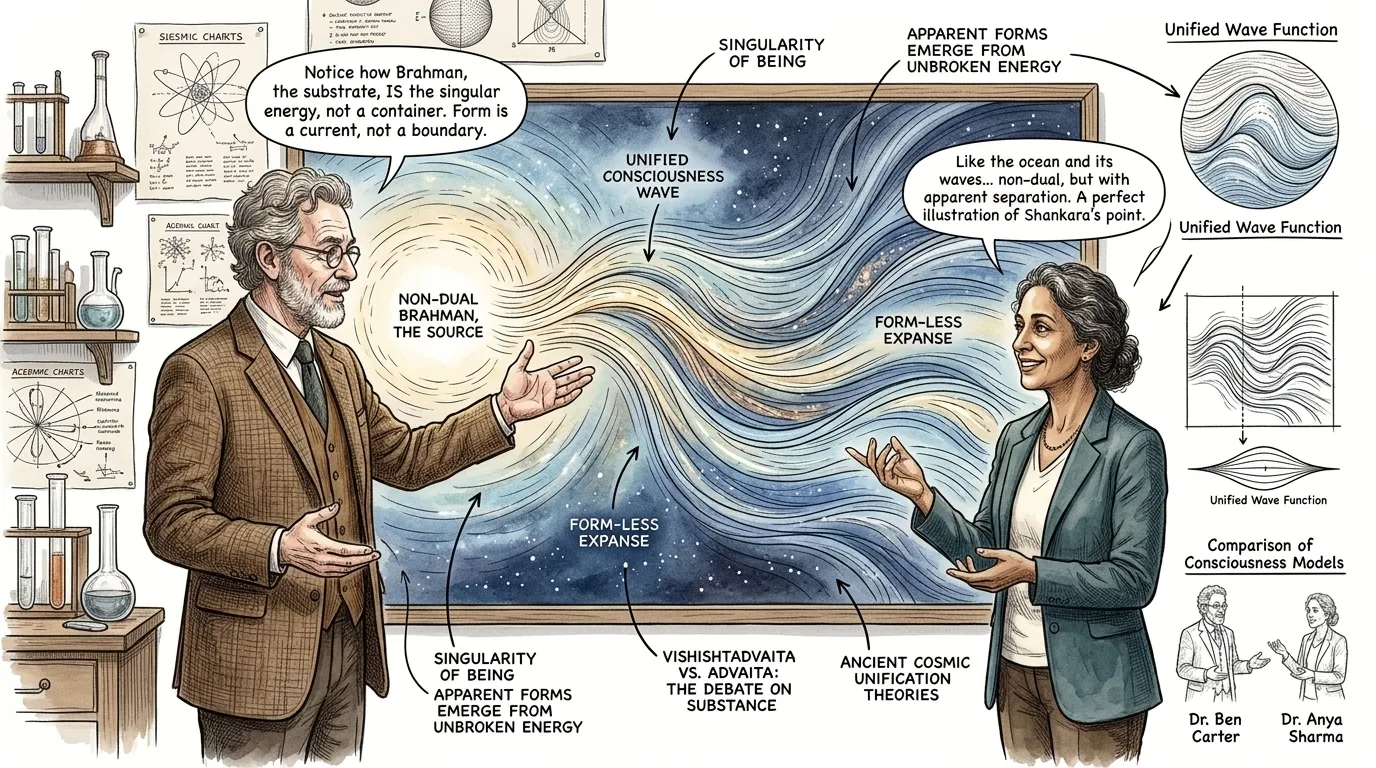
Their discussion led them to a large, intricate illustration of the cosmos, not as a collection of separate objects, but as a single, flowing energy. The depiction resonated with Shankara's most fundamental claim about the nature of existence.
"'For Shankara, the ultimate reality is Brahman – a singular, all-pervading consciousness that is beyond all attributes, distinctions, and forms,' Dr. Thorne explained, gesturing to the boundless cosmic art. 'It is pure being, pure consciousness, pure bliss, and the source of everything, yet it remains untainted by anything that emerges from it.' Dr. Petrova chimed in, 'Think of it as the ocean. The waves, foam, and ripples appear distinct, but they are all just water, fundamentally one and the same. Brahman is that underlying 'water' of existence.'"
Philosophy Note: In Advaita Vedanta, Brahman is not a personal God but the impersonal, absolute, and undifferentiated reality that is the ground of all existence. It is ultimately unknowable through the senses or intellect alone.
Page 4
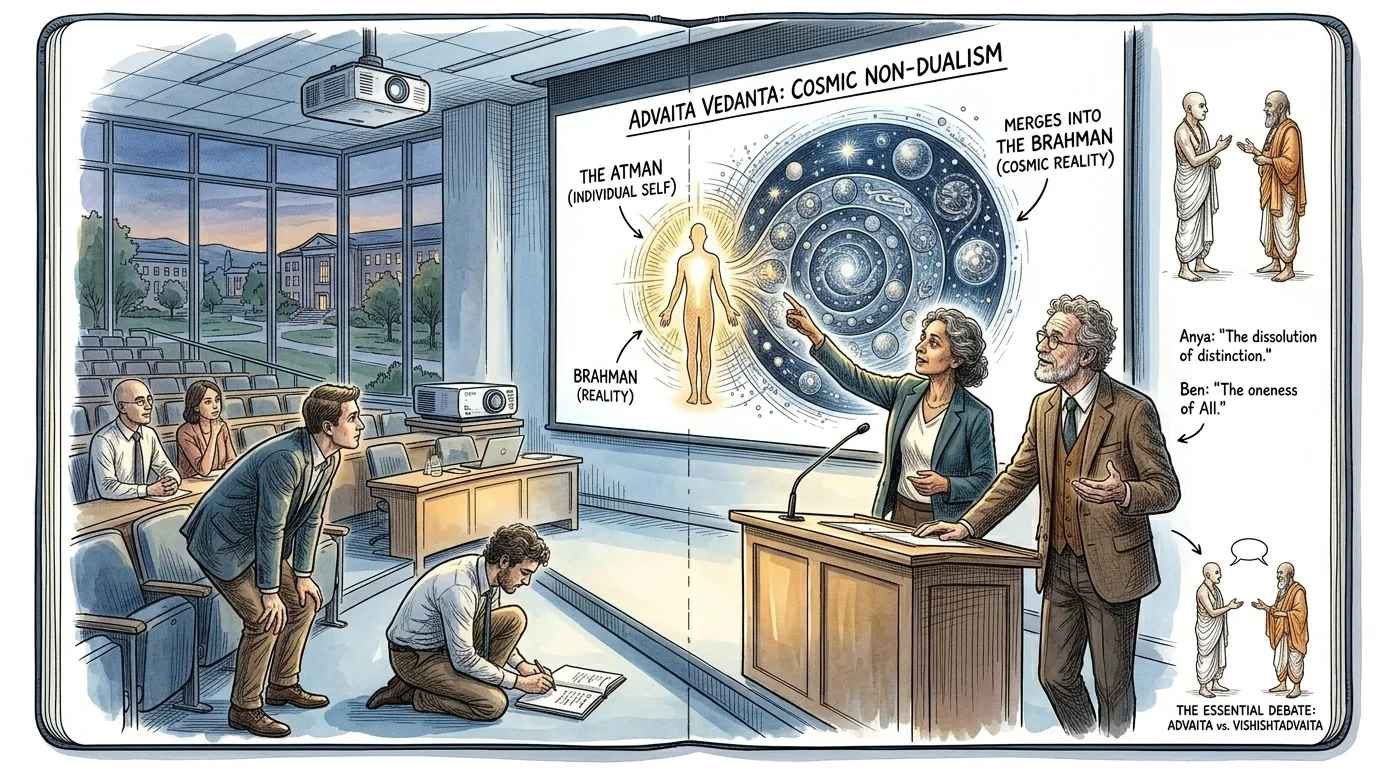
From the cosmic scale, their attention shifted to the individual. They moved to a diagram contrasting the apparent individuality of beings with the deeper, underlying unity Shankara articulated. This was the most liberating, yet often misunderstood, aspect of his teaching.
"'The radical claim of Advaita is 'Tat Tvam Asi' – 'Thou Art That',' Dr. Petrova stated, pointing to an illustration of a single human figure dissolving into a cosmic pattern. 'It means our individual self, or Atman, is not separate from Brahman. It is Brahman itself, not a part, but entirely identical.' Dr. Thorne elaborated, 'Our sense of being a distinct 'me' is a temporary, limited perspective, like a drop of water believing it's separate from the ocean, when in truth, it is the ocean.'"
Philosophy Note: 'Tat Tvam Asi' is one of the Mahavakyas (Great Sayings) from the Chandogya Upanishad, central to Advaita Vedanta, signifying the identity of the individual soul with the Absolute.
Page 5
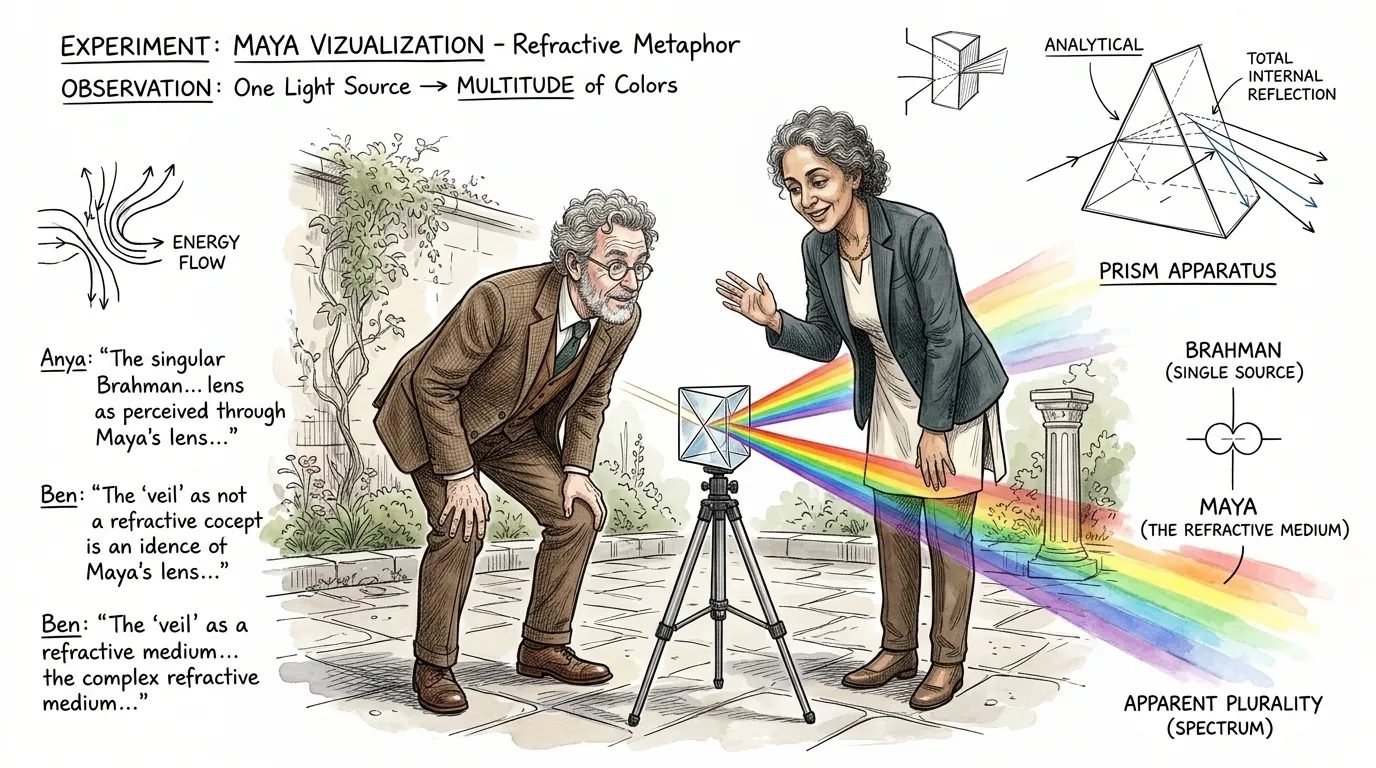
The concept of Brahman and Atman naturally led to the perplexing idea of Maya. Dr. Thorne and Dr. Petrova studied a visual metaphor showing how a single source of light could create a multitude of colors, each seemingly distinct, yet all derived from the same origin. This helped explain how a unified reality could appear as a diverse world.
"'If everything is Brahman, why do we experience such a diverse, seemingly real world of separate things?' Dr. Thorne mused, looking at the vibrant, prismatic display. 'Shankara introduces Maya – the inexplicable power that makes the one Brahman appear as many. It's not that the world is unreal, but that its perceived independent reality is illusory.' Dr. Petrova clarified, 'It's like a magician's trick; the audience sees distinct objects, but they are all part of one performance. The world is an appearance, a 'superimposition' on Brahman, rather than a separate creation.'"
Philosophy Note: Maya is not simply 'illusion' in the Western sense but a cosmic principle that veils the true nature of reality (Brahman) and projects a world of names and forms (nama-rupa), making it seem real and distinct.
Page 6
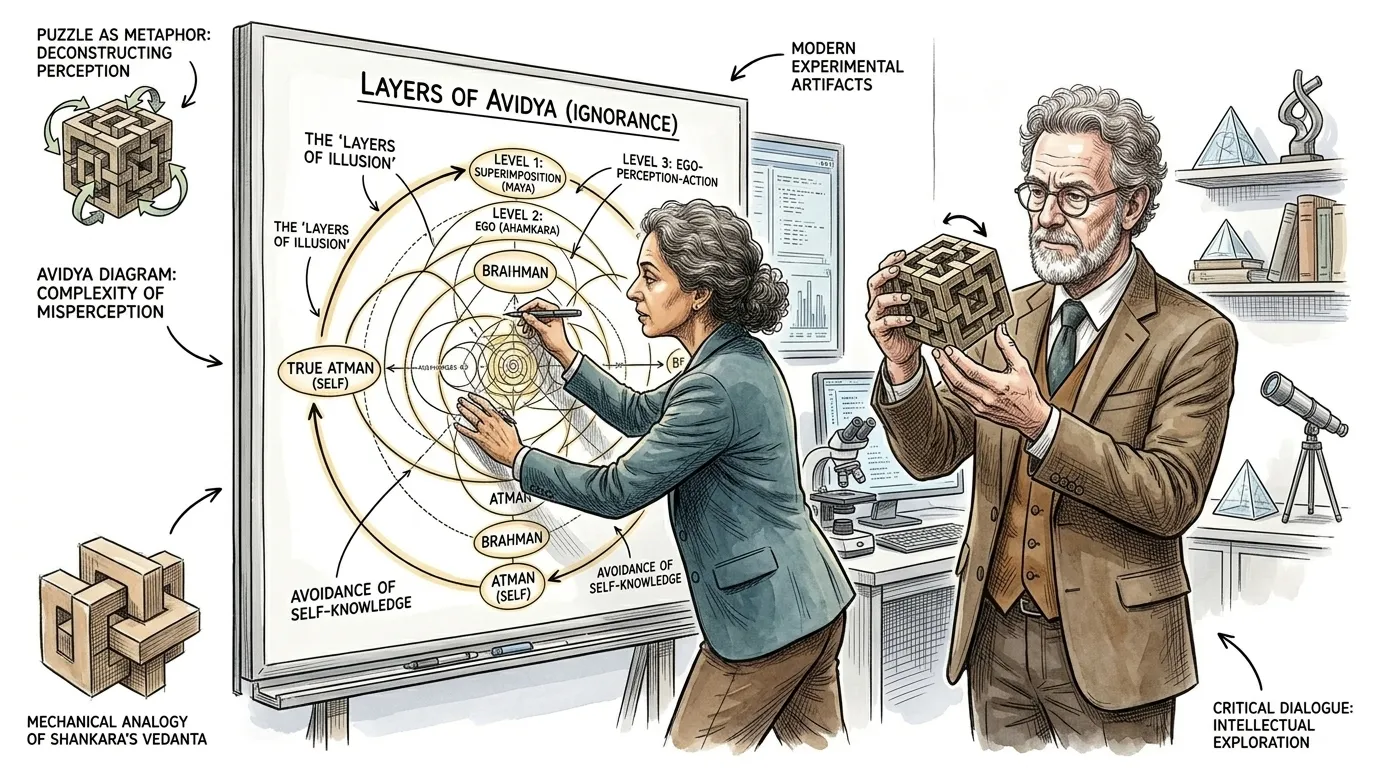
Understanding Maya led them to discuss Avidya, the ignorance that binds individuals to the cycle of suffering. They examined a complex diagram illustrating the layers of misperception that prevent realization of the true self. On a nearby table, a small, ancient metal puzzle box sat, its intricate interlocking parts hinting at hidden mechanisms.
"'The root of our suffering, according to Shankara, is Avidya – not merely a lack of knowledge, but a fundamental ignorance of our true, non-dual nature,' Dr. Petrova explained, tracing the 'layers of illusion' on the diagram. 'It's this ignorance that makes us identify with the body, mind, and the fleeting world, leading to desires and attachments.' Dr. Thorne picked up the small, ancient metal puzzle box, turning it over in his hands. 'Indeed. The goal is Moksha, liberation, achieved by directly realizing 'Aham Brahmasmi' – 'I am Brahman' – transcending this Avidya. This realization doesn't change reality; it changes our perception of it, much like understanding this box requires seeing beyond its surface complexity.'"
Philosophy Note: Avidya (ignorance) is a key concept in Advaita, referring to the spiritual ignorance that prevents individuals from realizing the true nature of Atman as Brahman, thus perpetuating the cycle of rebirth (samsara).
Page 7
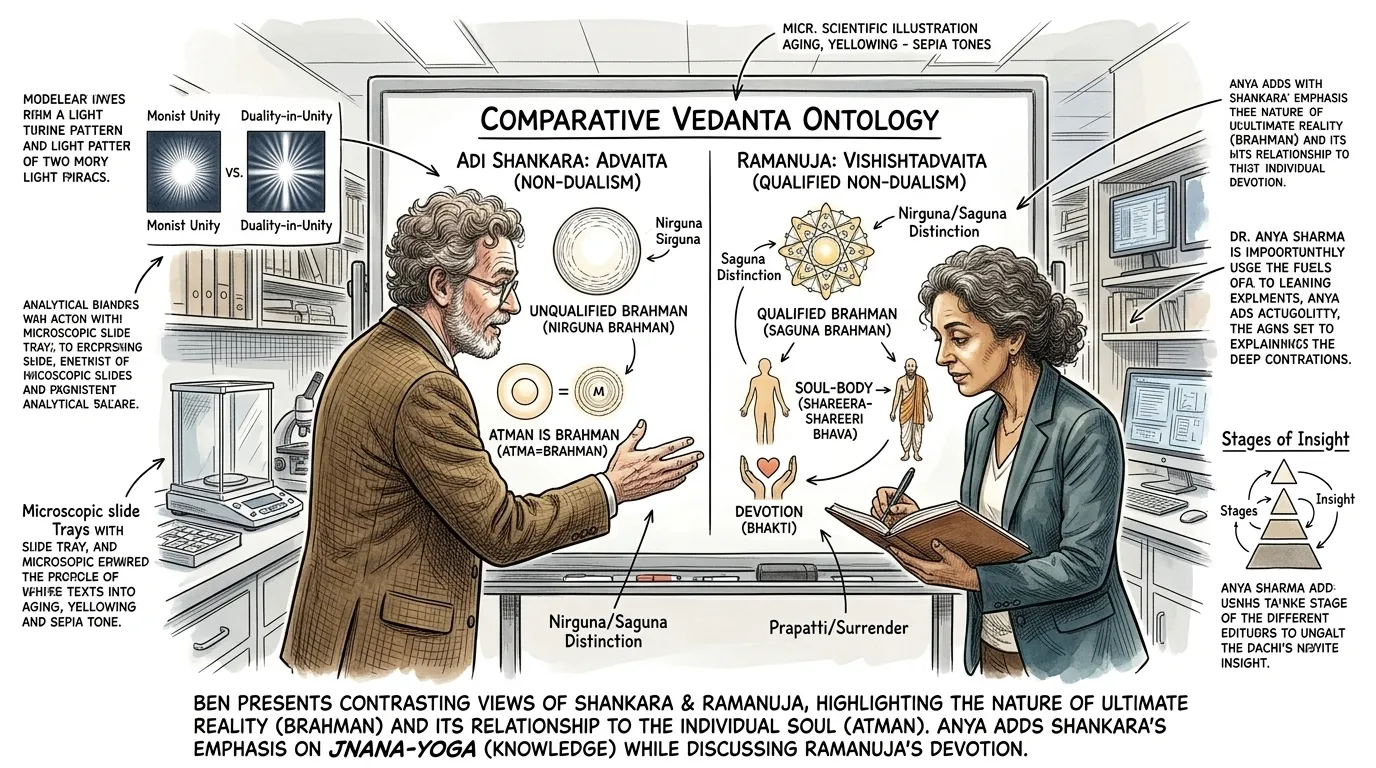
Shankara's radical non-dualism did not go unchallenged. Centuries later, another great philosopher, Ramanuja, presented a powerful counter-argument. Dr. Thorne and Dr. Petrova now stood before a split display, clearly contrasting the two monumental schools of thought.
"'While Shankara posits an unqualified non-dualism, where Brahman is utterly without attributes, Ramanuja offered Vishishtadvaita, or 'qualified non-dualism',' Dr. Thorne explained, gesturing to the two halves of the display. 'Ramanuja argued that Brahman does possess attributes and distinctions, containing individual souls and matter as its modes or parts, yet remaining unified.' Dr. Petrova added, 'He saw Shankara's view as reducing the richness of reality and the personal relationship with a divine being. For Ramanuja, souls are eternally distinct, though inseparable from Brahman, like rays of light from the sun.'"
Philosophy Note: Ramanuja (1017–1137 CE) was a central figure in the Bhakti movement, whose Vishishtadvaita philosophy asserted that Brahman is a personal God with infinite auspicious qualities, and individual souls are distinct but inseparable parts of this divine whole.
Page 8
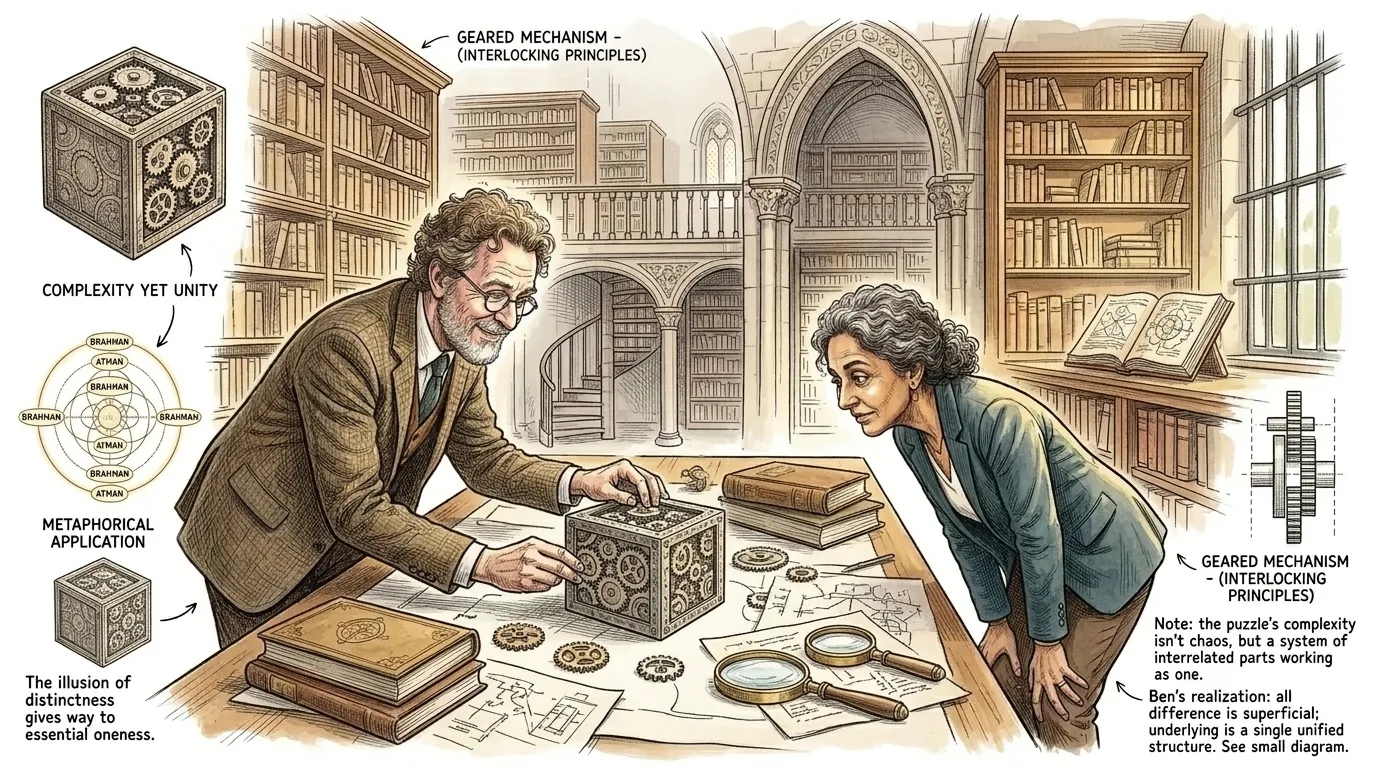
As they contemplated the profound implications of Advaita, the conversation naturally turned to how these ancient ideas resonate today. Dr. Thorne again picked up the ancient puzzle box they had discussed earlier, its complex mechanism now seeming less daunting through the lens of non-duality. The challenge was to see the underlying unity.
"'It reminds me of something Carl Sagan once observed: 'We are a way for the cosmos to know itself',' Dr. Thorne mused, carefully turning the puzzle box, its intricate gears now making more sense. 'Shankara would say that's precisely the Atman-Brahman identity. The individual consciousness is the universe becoming aware of its own singular nature.' Dr. Petrova agreed, 'Indeed, once you grasp the idea that the apparent divisions are not ultimate, many seemingly complex problems, like this box, reveal their simpler, unified solution. The true challenge is shifting our perception from fragmentation to wholeness, just as this box unlocks when its many parts are seen as one system.'"
Philosophy Note: The 'Setup and Payoff' of the puzzle box symbolizes how Advaita's emphasis on unity can simplify seemingly complex problems by revealing their fundamental interconnectedness, an echo of Carl Sagan's cosmic perspective.
Page 9
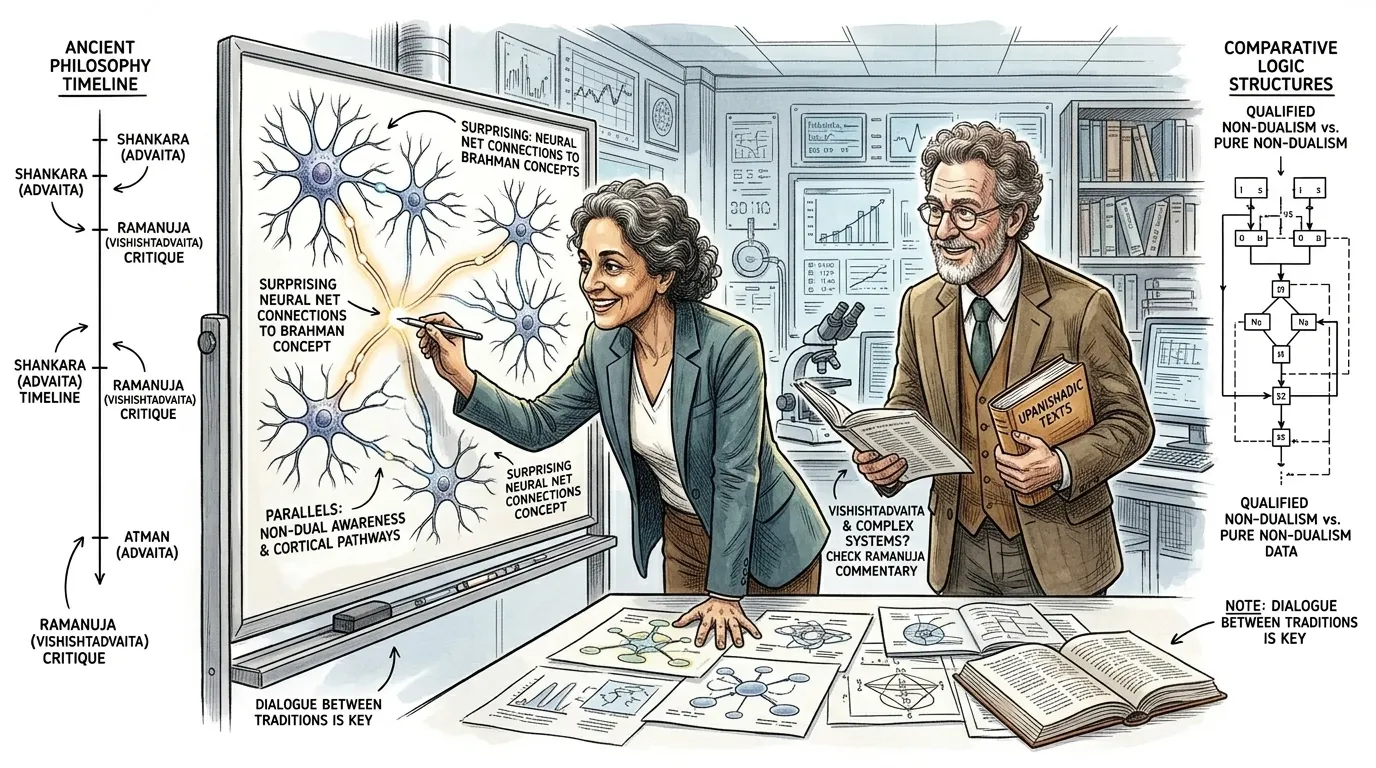
Shankara's ideas, though ancient, continue to echo in contemporary discussions of consciousness, psychology, and even physics. Dr. Thorne and Dr. Petrova reviewed modern scientific diagrams and philosophical texts, drawing connections across millennia.
"'The core tenet of Advaita, that consciousness is primary and non-dual, finds surprising parallels in certain theories of quantum physics and neuroscience,' Dr. Petrova pointed out, highlighting a complex diagram of neural networks. 'Some contemporary thinkers explore how our subjective experience might be more fundamental than objective matter, echoing Shankara's insistence on Brahman as the sole reality.' Dr. Thorne added, 'And in psychology, the understanding that the ego is a constructed self, distinct from a deeper, universal awareness, directly resonates with the Atman-Brahman identity, offering pathways for mindfulness and self-transcendence.'"
Philosophy Note: Shankara's non-dualistic perspective continues to influence discussions on the nature of consciousness, identity, and reality, finding surprising resonance in scientific theories and modern philosophical inquiry.
Page 10
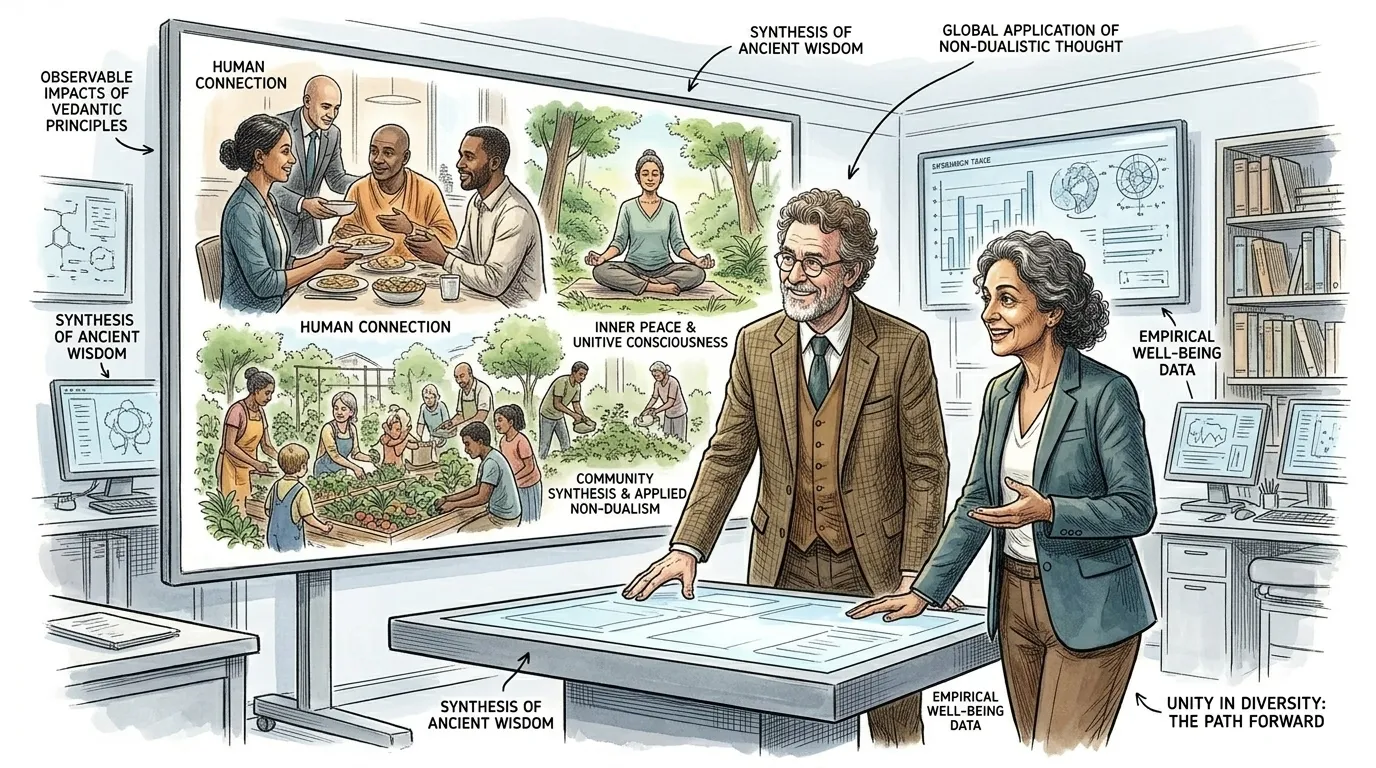
The profound insights of Shankara extend far beyond academic discourse, influencing practical aspects of life, ethics, and personal well-being. Dr. Thorne and Dr. Petrova observed a montage of scenes, each reflecting the enduring human impact of non-dualistic thought.
"'Ultimately, Shankara's philosophy offers a powerful framework for personal transformation and ethical living,' Dr. Thorne summarized, looking at the diverse scenes of human interaction. 'If we perceive all beings as manifestations of the one Brahman, it fosters deep empathy and a sense of interconnectedness, dissolving boundaries that lead to conflict.' Dr. Petrova concluded, 'This understanding can liberate individuals from the anxieties of the ego, promoting a profound sense of peace and purpose, knowing that our true nature is boundless and eternal. It is a timeless wisdom that continues to resonate across cultures, urging us to look beyond superficial differences to find the fundamental unity within all existence.'"
Philosophy Note: Shankara's philosophy of Advaita Vedanta fosters a worldview rooted in unity, encouraging empathy, ethical conduct, and liberation from suffering by realizing the universal self, a legacy that continues to inspire seekers of truth worldwide.
About this story
- Audience: general readers
Questions and answers
Read Wonder Philosophy on your phone
Wonder Philosophy is available on Android and iPhone and iPad. Get Wonder Philosophy on Google Play · Get Wonder Philosophy on the App Store.