Thomas Kuhn
Thomas Kuhn — an illustrated philosophy story. 10 illustrated pages, free to read on Wonder Philosophy.
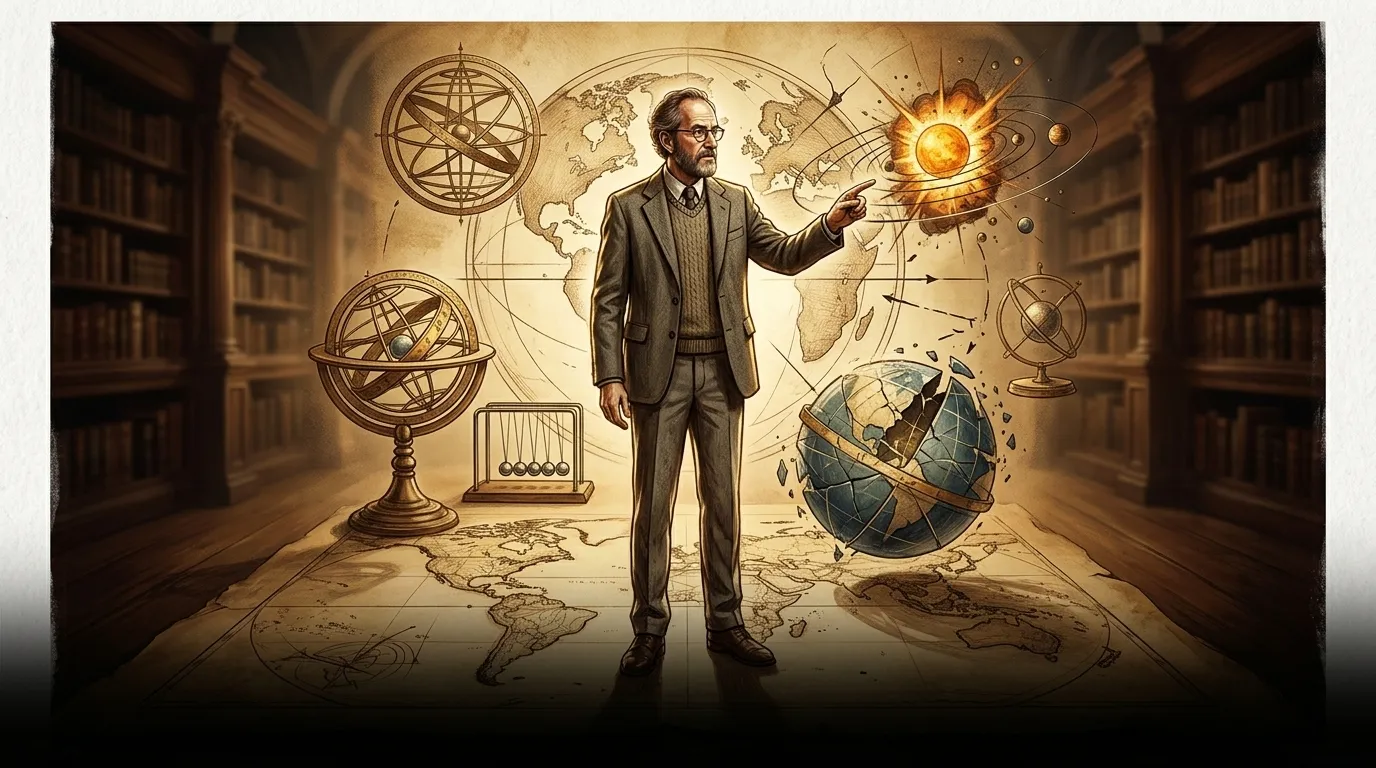
Page 1
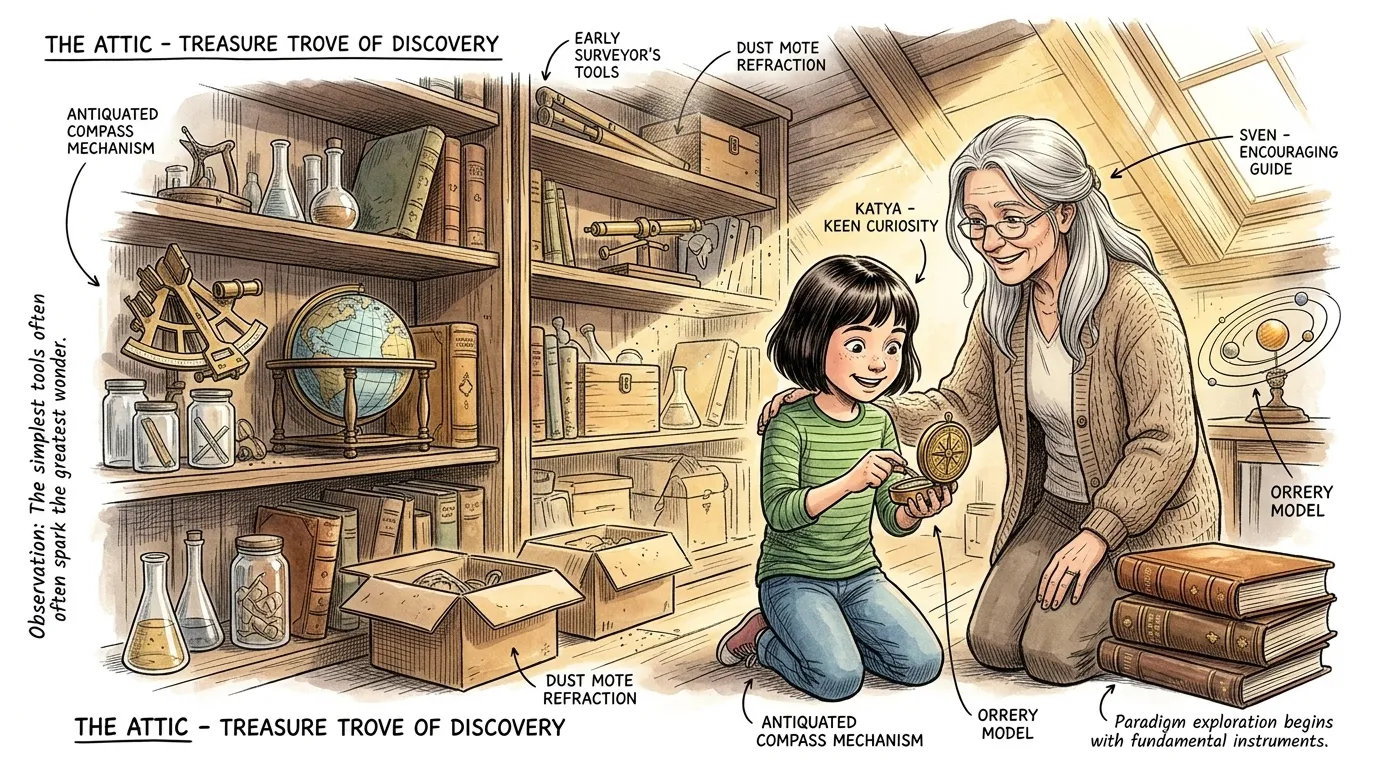
Katya and Sven were exploring the dusty attic, a treasure trove of forgotten things. Katya picked up an old, ornate compass, its needle stuck fast.
"'Sven,' Katya asked, turning the compass in her hand, 'why did people believe so many different things long ago, when we know the truth now?' Sven smiled softly, looking at the old items. 'Ah, Katya, that's a wonderful question. Sometimes, everyone shares a way of understanding the world, a whole set of rules, until something new comes along and completely changes everything.'"
Philosophy Note: Thomas Kuhn's central idea concerns 'paradigm shifts' — revolutionary changes in scientific understanding that are not merely cumulative but involve a complete overhaul of prevailing theories and methods.
Page 2
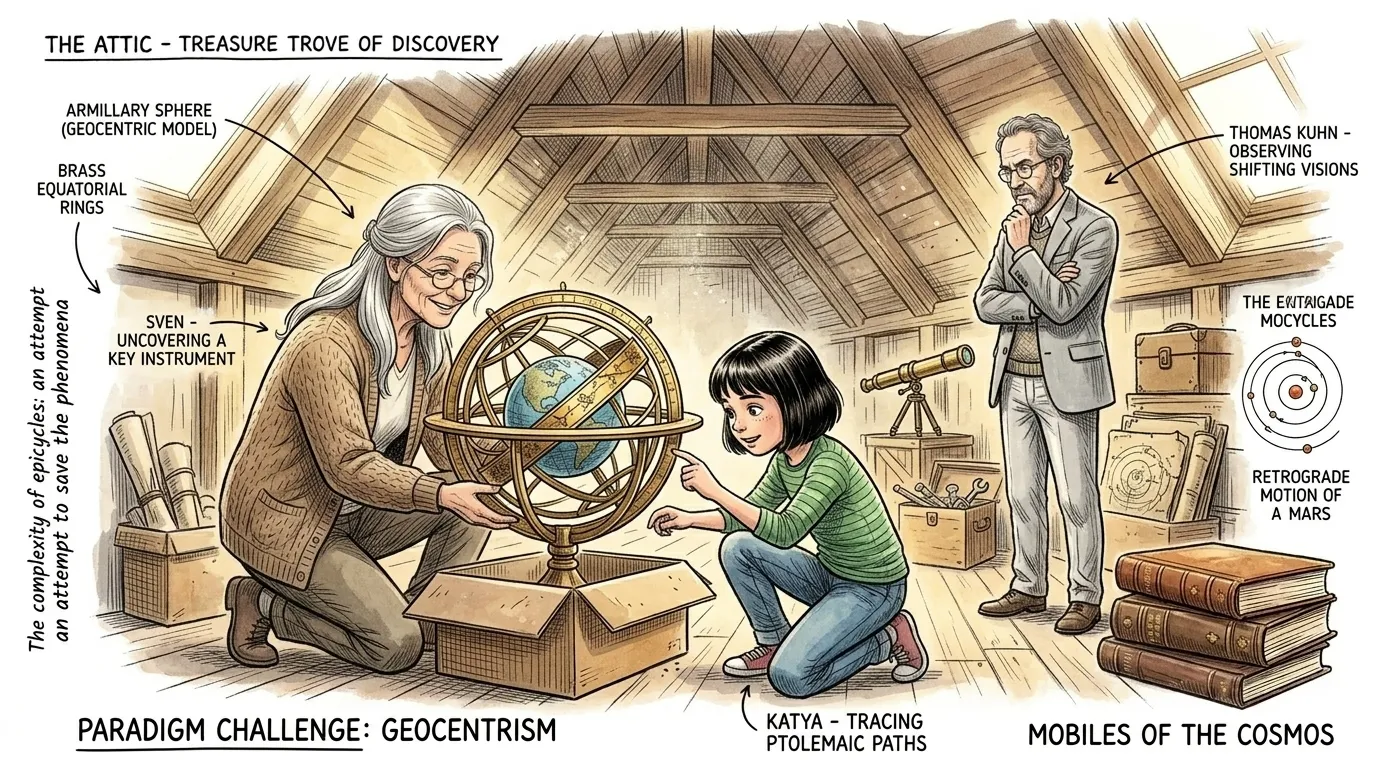
Sven carefully uncovered a large, intricate model, its brass rings and spheres depicting the Earth at the center, surrounded by the Sun, Moon, and stars.
"'Look at this, Katya,' Sven said, her voice hushed. 'This is an ancient armillary sphere. For thousands of years, people believed the Earth was the unmoving center of everything, and all the heavenly bodies orbited around us.' Katya carefully traced the paths of the brass rings. 'But we know that's not true anymore, don't we?'"
Philosophy Note: This armillary sphere represents the geocentric model of the universe, a dominant scientific 'paradigm' for centuries, championed by thinkers like Ptolemy, which placed Earth at the center of the cosmos.
Page 3
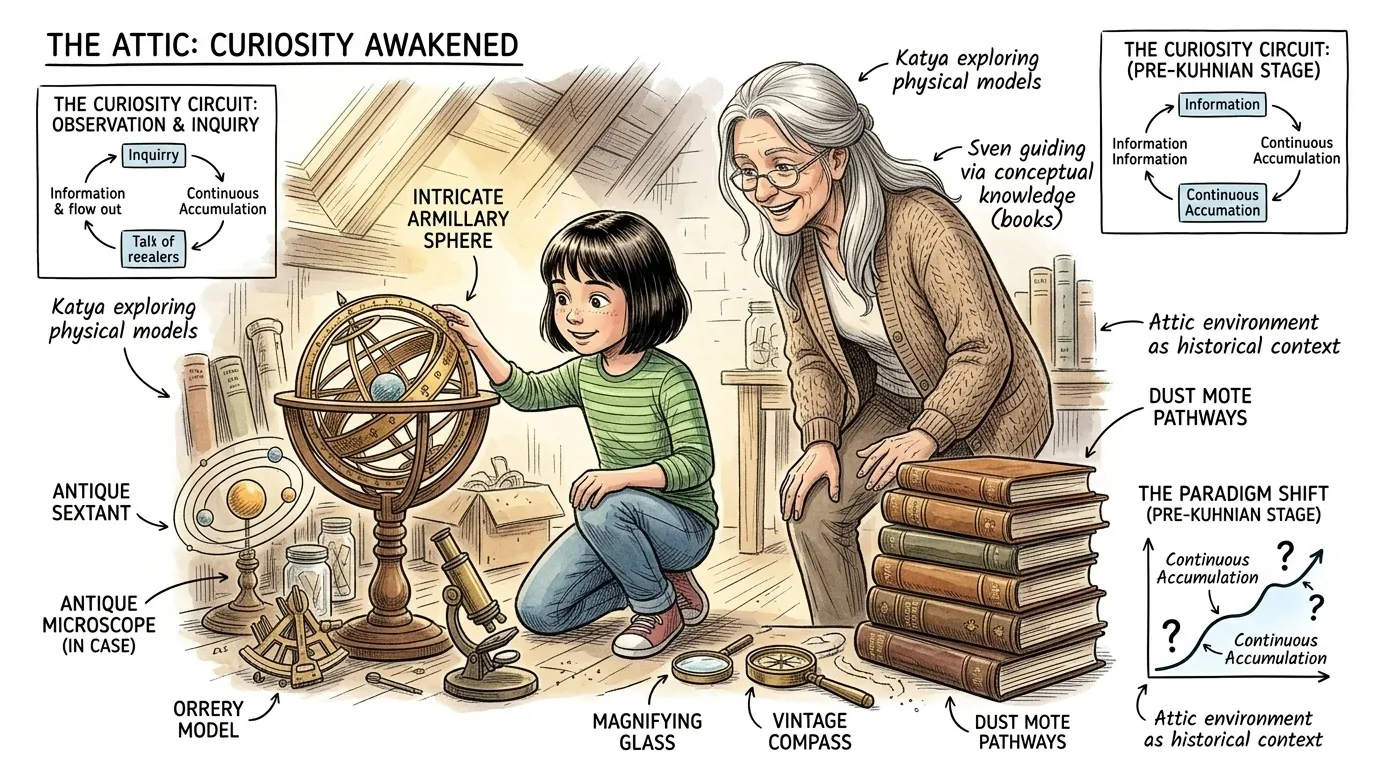
Katya looked from the old model to a stack of books. 'Why did it take so long for people to change their minds?' she wondered aloud.
"'That's a brilliant question, Katya,' Sven replied. 'And it's exactly what a brilliant thinker named Thomas Kuhn studied. He showed us that science doesn't just grow steadily, adding one discovery after another. Sometimes, it takes a sudden, revolutionary leap. It's not always easy for people, even very smart scientists, to let go of what they've always believed.'"
Philosophy Note: Thomas Kuhn (1922–1996), an American philosopher of science, challenged the traditional view of scientific progress as linear and cumulative, proposing that it instead proceeds through periods of 'normal science' punctuated by 'scientific revolutions' or 'paradigm shifts'.
Page 4
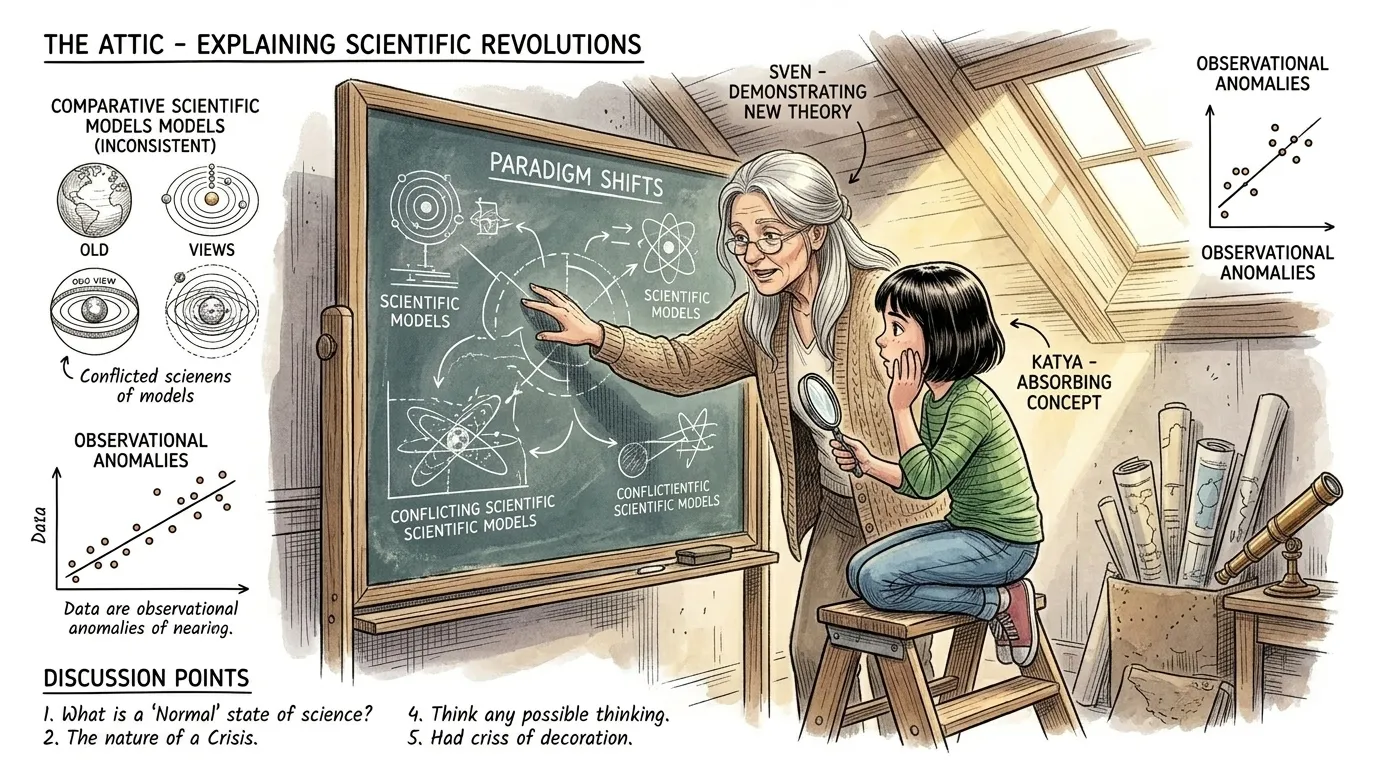
Sven led Katya to a large, faded chalkboard standing against the wall, covered with equations and diagrams.
"'Kuhn called these shared understandings a 'paradigm',' Sven explained, pointing to a complex drawing. 'Think of it like a giant rulebook that everyone in a field, like science, agrees to follow. It tells them what questions to ask, what tools to use, and even what answers seem reasonable. Before Copernicus, that armillary sphere we saw was part of the 'rulebook' for understanding the cosmos.'"
Philosophy Note: A 'paradigm' in Kuhn's theory is a shared set of assumptions, methods, and values that define a scientific discipline at a given time. It acts as a framework for 'normal science'.
Page 5
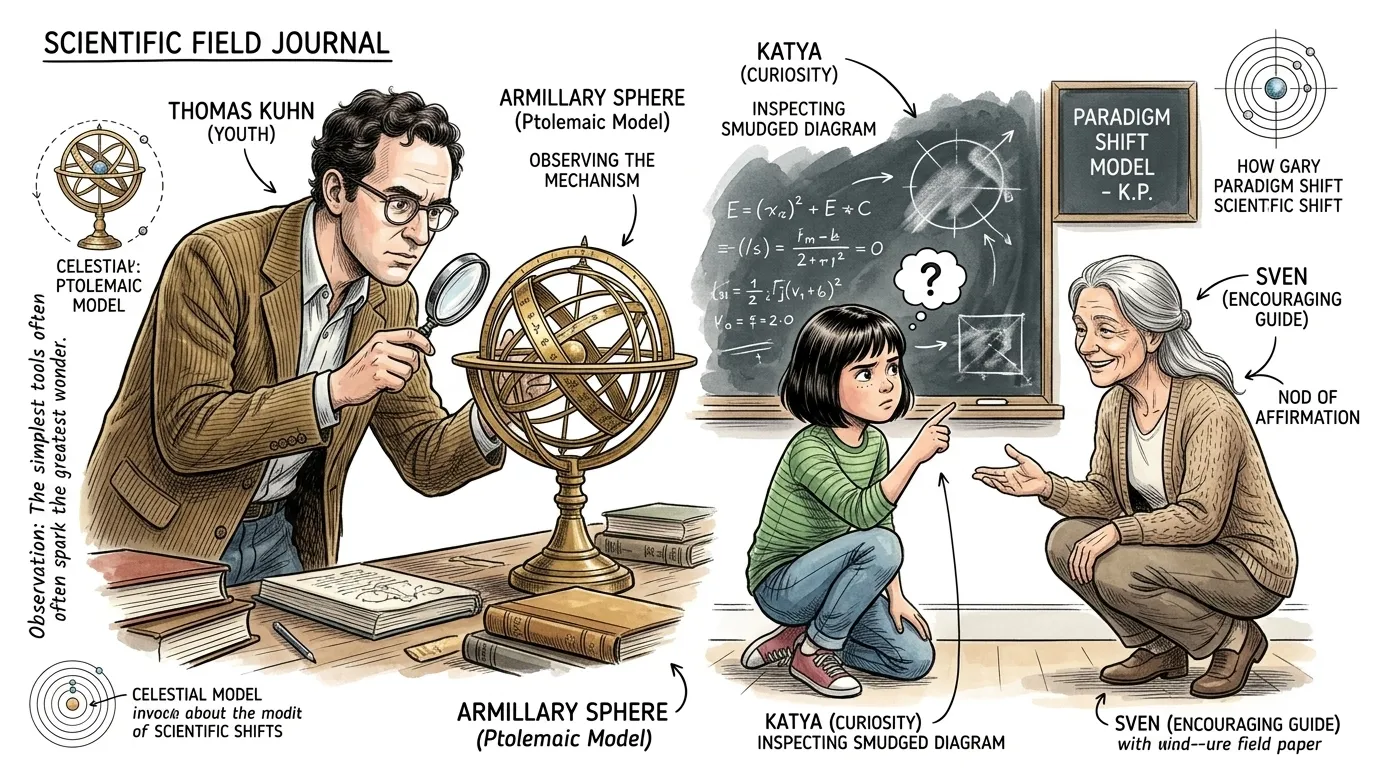
Katya looked at the chalkboard, then back at the armillary sphere.
"'So, everyone just works inside that rulebook, like a game?' Katya asked. 'Exactly!' Sven affirmed. 'Kuhn called that 'normal science' – solving puzzles that fit within the current rules. But sometimes, something unexpected happens. Things don't quite fit the rulebook, like an observation that doesn't make sense with the Earth-centered model. He called those 'anomalies'.' Katya pointed to a small, smudged diagram on the corner of the chalkboard. 'Like this weird drawing?'"
Philosophy Note: 'Normal science' operates within a paradigm, solving 'puzzles' it defines. 'Anomalies' are observations or experimental results that contradict or cannot be explained by the prevailing paradigm, eventually leading to a crisis.
Page 6
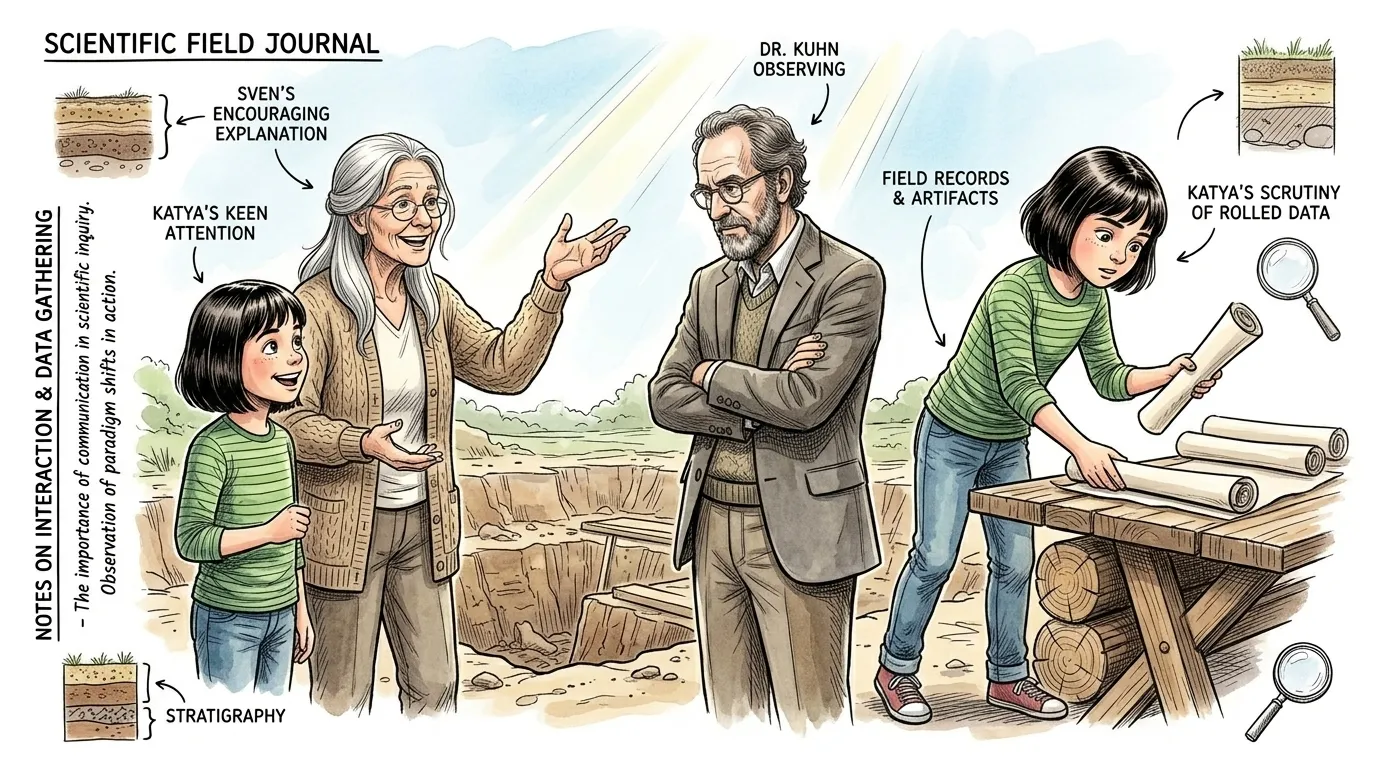
Sven nodded. 'Yes, just like that. If enough anomalies build up, they create a 'crisis' in the old rulebook. People start to doubt it.'
"'And then what happens?' Katya asked eagerly. 'Then,' Sven explained with a dramatic flourish, 'a 'scientific revolution' occurs! Someone bravely suggests a completely new rulebook, a new paradigm, that can explain all the old things and the new anomalies. It's like throwing out an old map for a brand-new one that shows the world much more accurately!' Katya picked up a blank, rolled-up scroll nearby. 'So they get a new scroll to draw the new map on?'"
Philosophy Note: A 'scientific revolution' or 'paradigm shift' is the process by which a new paradigm replaces an old one, fundamentally altering the basic concepts, experimental practices, and theoretical frameworks of a scientific discipline. This is a non-cumulative process.
Page 7
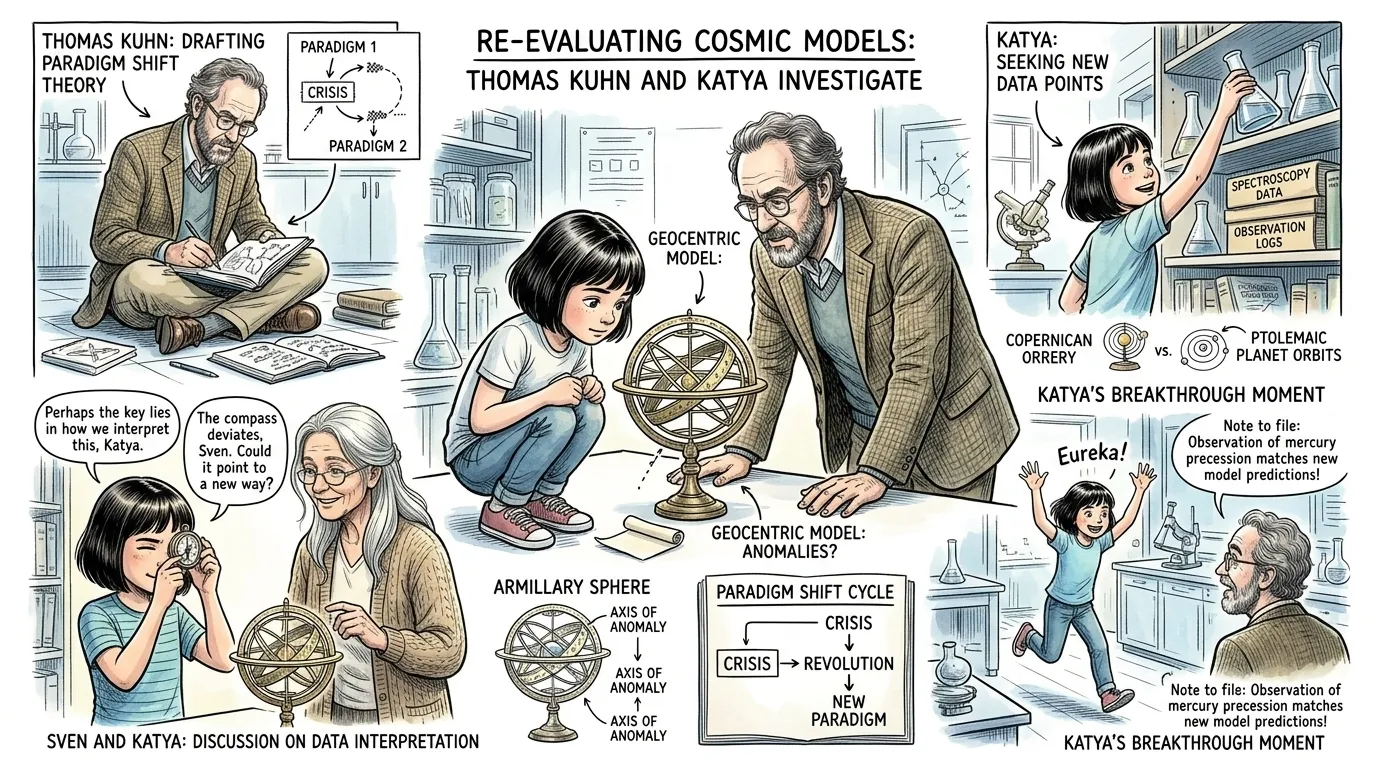
Katya looked from the blank scroll to the armillary sphere, then back to Sven.
"'It must have been really hard for people to accept the new rulebook, even if it was better,' Katya mused. 'It certainly was,' Sven agreed, nodding slowly. 'Kuhn emphasized that changing a paradigm isn't just about facts; it's also about beliefs, habits, and even the power of those who created the old rules. As the Roman philosopher Seneca once said, 'Every new beginning comes from some other beginning's end.' It's about letting go of what you knew to make space for what's next.'"
Philosophy Note: Kuhn highlighted that paradigm shifts are not purely rational or objective events. They involve social, psychological, and institutional factors, as practitioners often resist new ideas that challenge their established worldview and expertise.
Page 8
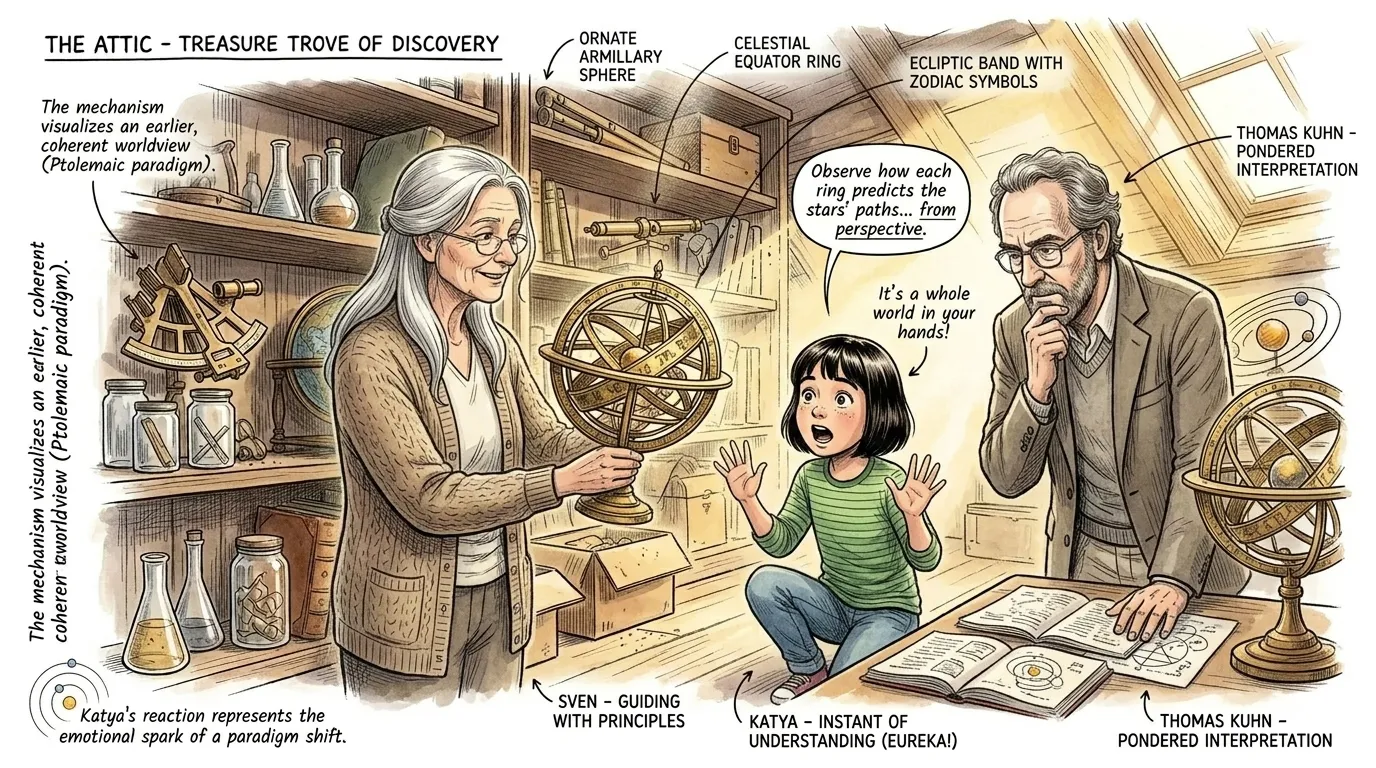
Sven picked up the armillary sphere and held it gently, turning it to catch the light.
"'Remember this old armillary sphere, Katya?' Sven said, a knowing look in her eye. 'It perfectly shows a paradigm that once ruled. People truly believed it was a correct model of the universe. But when astronomers like Copernicus and Galileo found things that didn't fit, it led to a new rulebook, the heliocentric paradigm, where the Sun is at the center.' Katya gasped softly. 'So, the whole universe changed for them, not just a small piece!'"
Philosophy Note: The shift from the geocentric (Earth-centered) model to the heliocentric (Sun-centered) model of the universe is one of the most famous examples of a 'paradigm shift' in the history of science, marking a fundamental change in humanity's understanding of its place in the cosmos.
Page 9
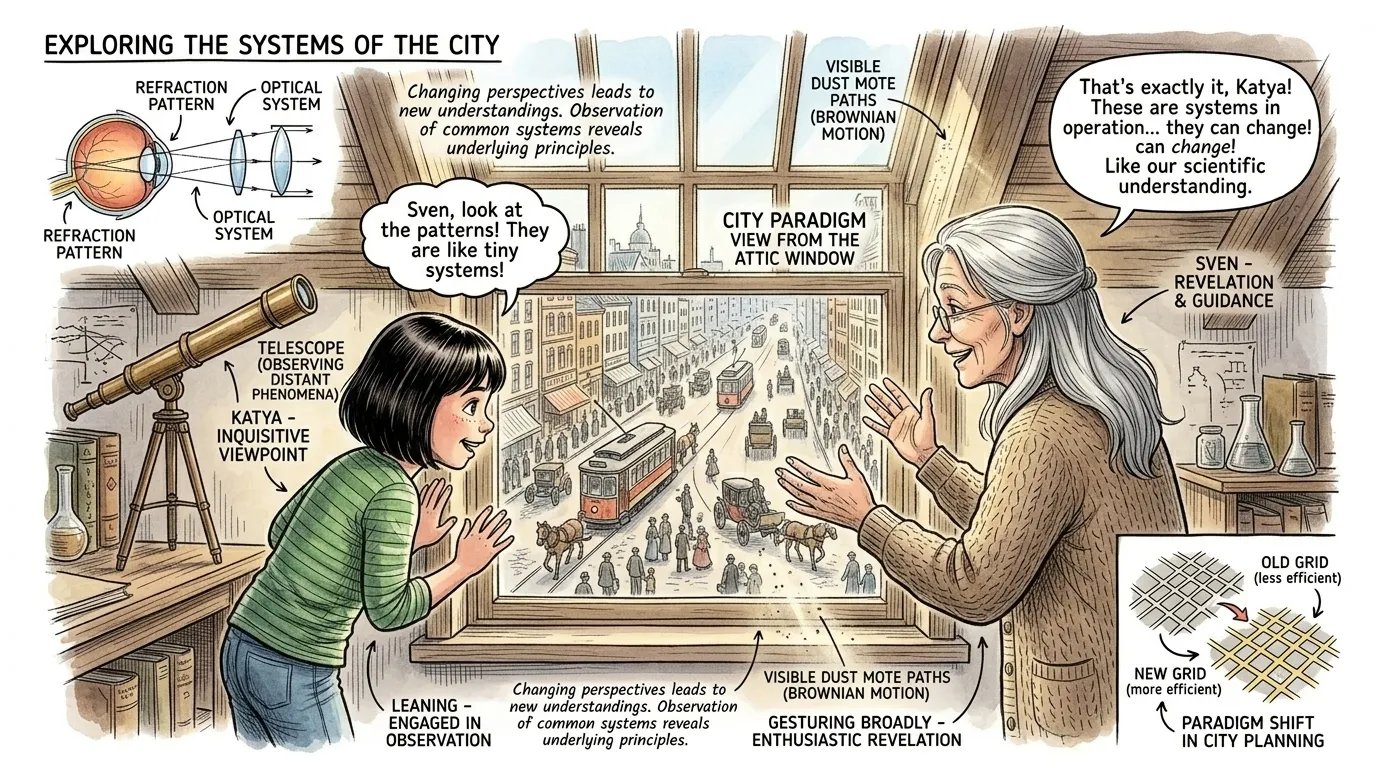
Katya and Sven moved to a large window overlooking the bustling city street below, watching people go about their day.
"'Does this 'paradigm shift' only happen in science, Sven?' Katya asked, peering down at the cars and people. 'Not at all!' Sven replied, gesturing towards the street. 'Kuhn's ideas help us understand changes everywhere. Think about fashion trends, how opinions about art or music change, or even how society's understanding of right and wrong can shift over generations. It's like everyone suddenly agrees on a new 'rulebook' for how to live or what to value.'"
Philosophy Note: Kuhn's concept of paradigm shifts has been applied far beyond the natural sciences, influencing fields like social sciences, economics, history, and even cultural studies to describe major changes in prevailing worldviews or frameworks.
Page 10
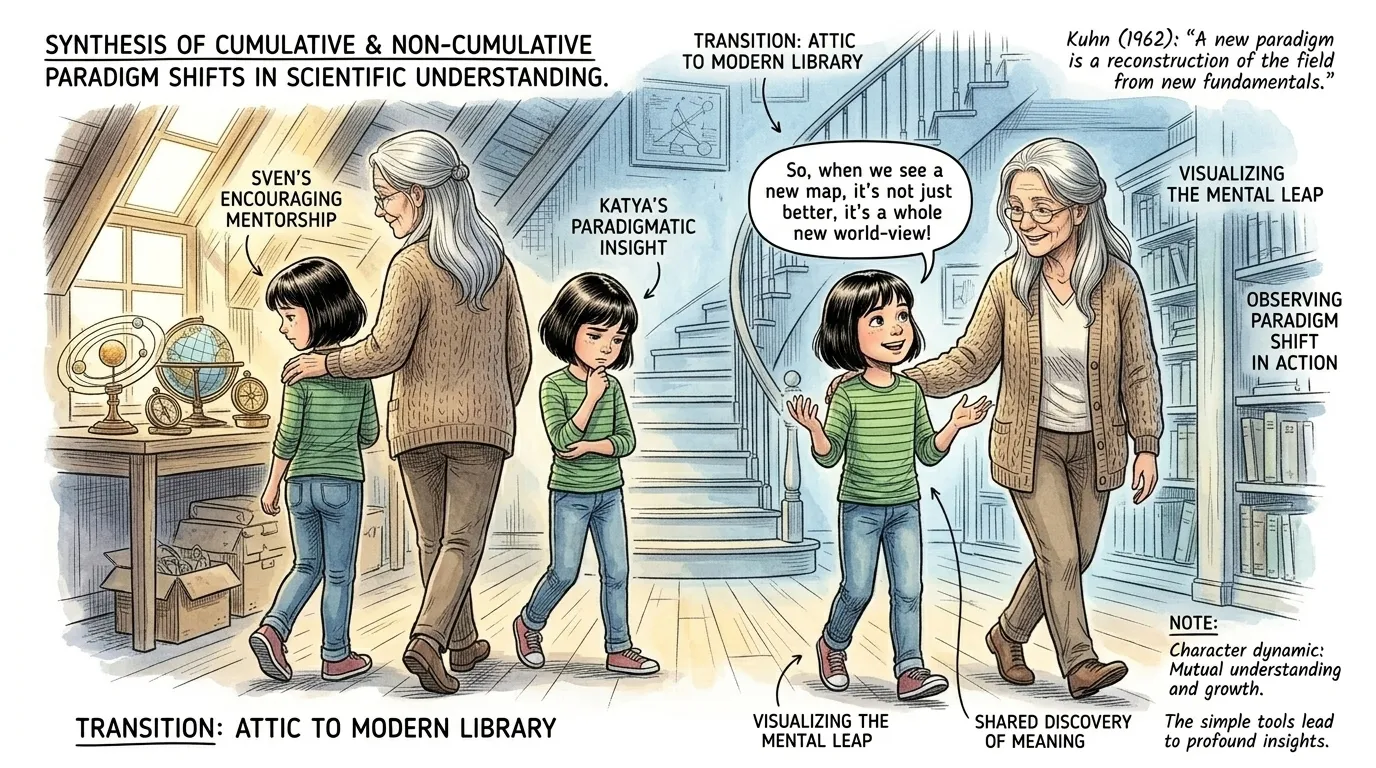
Sven put an arm around Katya's shoulder as they turned from the window, leaving the dusty attic behind.
"'So, what does Thomas Kuhn teach us, Katya?' Sven asked gently. Katya thought for a moment. 'That sometimes, the old rules need to be completely changed for new, better ones. And it can be hard, but it's how we learn and grow!' Sven smiled, 'Precisely. Understanding paradigm shifts helps us appreciate how knowledge truly develops and encourages us to be open-minded, ready to question what we take for granted, and always curious about the next big idea.'"
Philosophy Note: Kuhn's work remains foundational in philosophy of science and epistemology, challenging linear models of progress and highlighting the human and revolutionary aspects of knowledge evolution. It encourages critical examination of current 'paradigms'.
About this story
- Audience: general readers
Questions and answers
Read Wonder Philosophy on your phone
Wonder Philosophy is available on Android and iPhone and iPad. Get Wonder Philosophy on Google Play · Get Wonder Philosophy on the App Store.