Abhinavagupta
Explore Abhinavagupta's teachings on recognizing the inherent unity of consciousness and overcoming the illusion of separation. Discover how this philosophy can lead to self-realization and a deeper understanding of identity.

Page 1
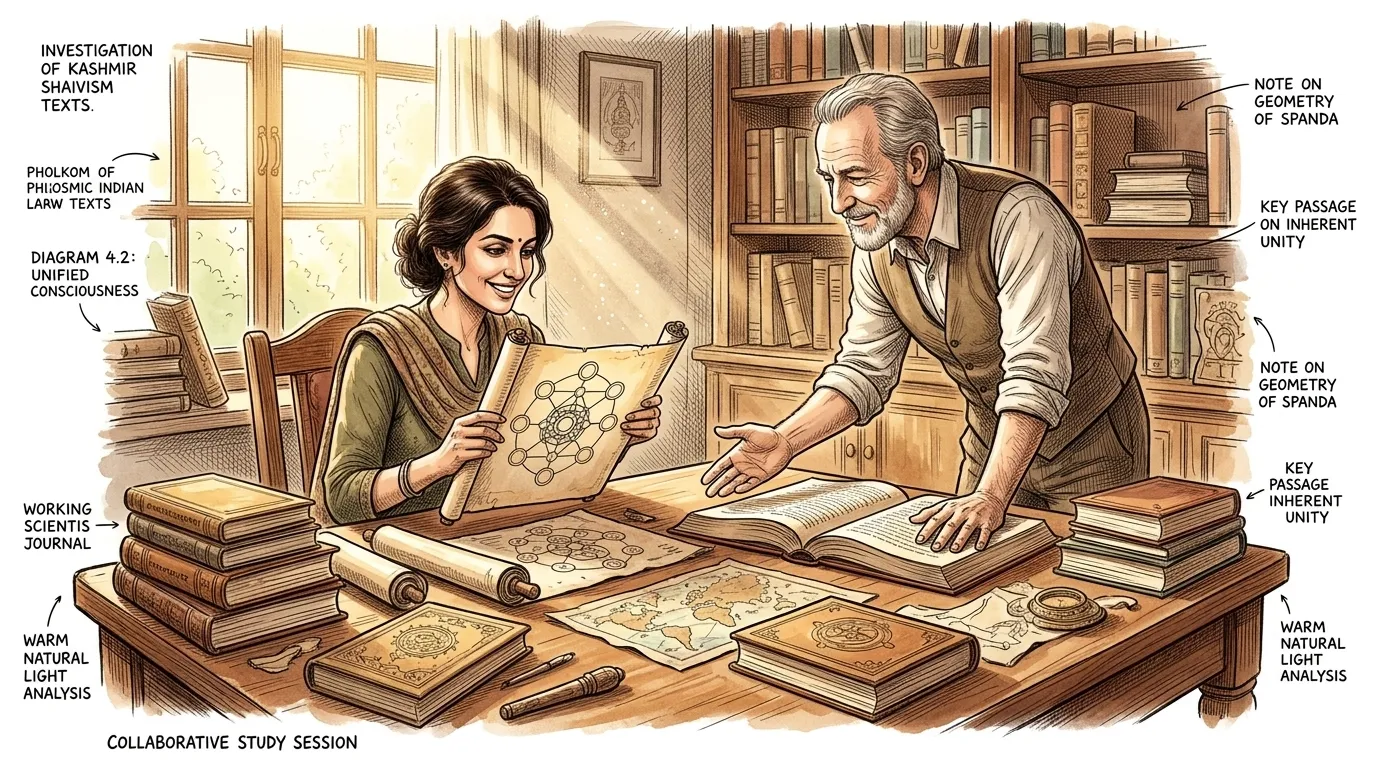
At the heart of Kashmiri Shaivism lies the profound philosophy of Abhinavagupta, a tenth-century master whose insights into consciousness continue to resonate. He proposed that the ultimate reality is a single, divine consciousness, and our individual selves are not separate from it. The journey of life, then, is a process of 'recognition'—realizing this inherent unity within ourselves.
Philosophy Note: Abhinavagupta (c. 950–1015 CE) was a pivotal philosopher, mystic, and aesthetician of Kashmir Shaivism. His work synthesized various philosophical strands into a comprehensive system of non-dual reality and spiritual liberation.
Page 2
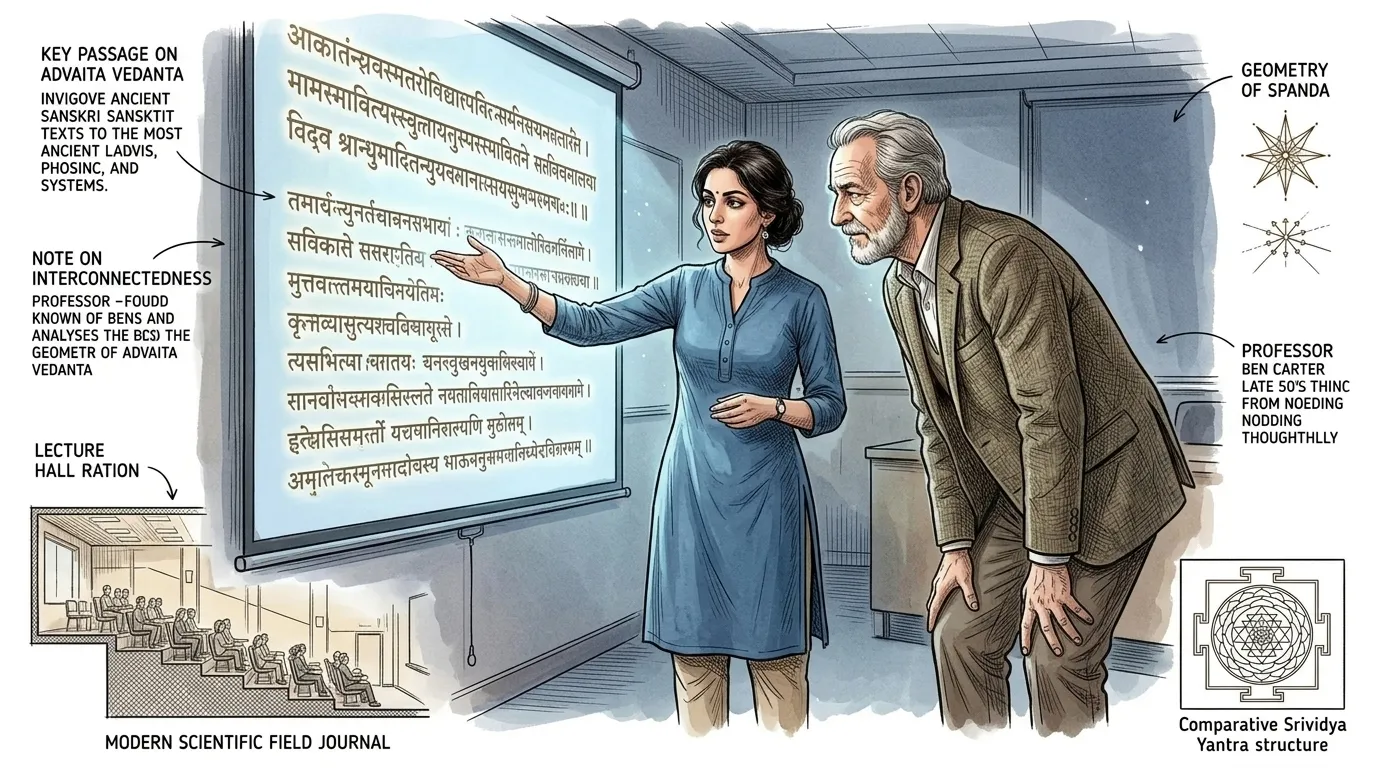
For centuries, the human mind has grappled with the apparent division between self and world, spirit and matter. Dr. Anya Sharma explains how Abhinavagupta addressed this fundamental problem. Professor Ben Carter adds that our everyday experience reinforces this sense of separation, making his non-dual vision profoundly challenging yet ultimately liberating.
"'Abhinavagupta's work tackles the very core of our existence,' Dr. Sharma states, gesturing towards a projection of ancient texts. 'He asserts that our suffering stems from our misperception of duality, believing we are separate from the divine.' Professor Carter nods, adding, 'Indeed, his philosophy doesn't seek to create unity, but to recognize an already existing, ever-present unity, often obscured by our own conceptual frameworks. That recognition is key.'"
Philosophy Note: Abhinavagupta's philosophical system, particularly the Pratyabhijñā school, teaches that liberation (moksha) is not achieved through external rituals or actions, but through an internal shift in understanding.
Page 3
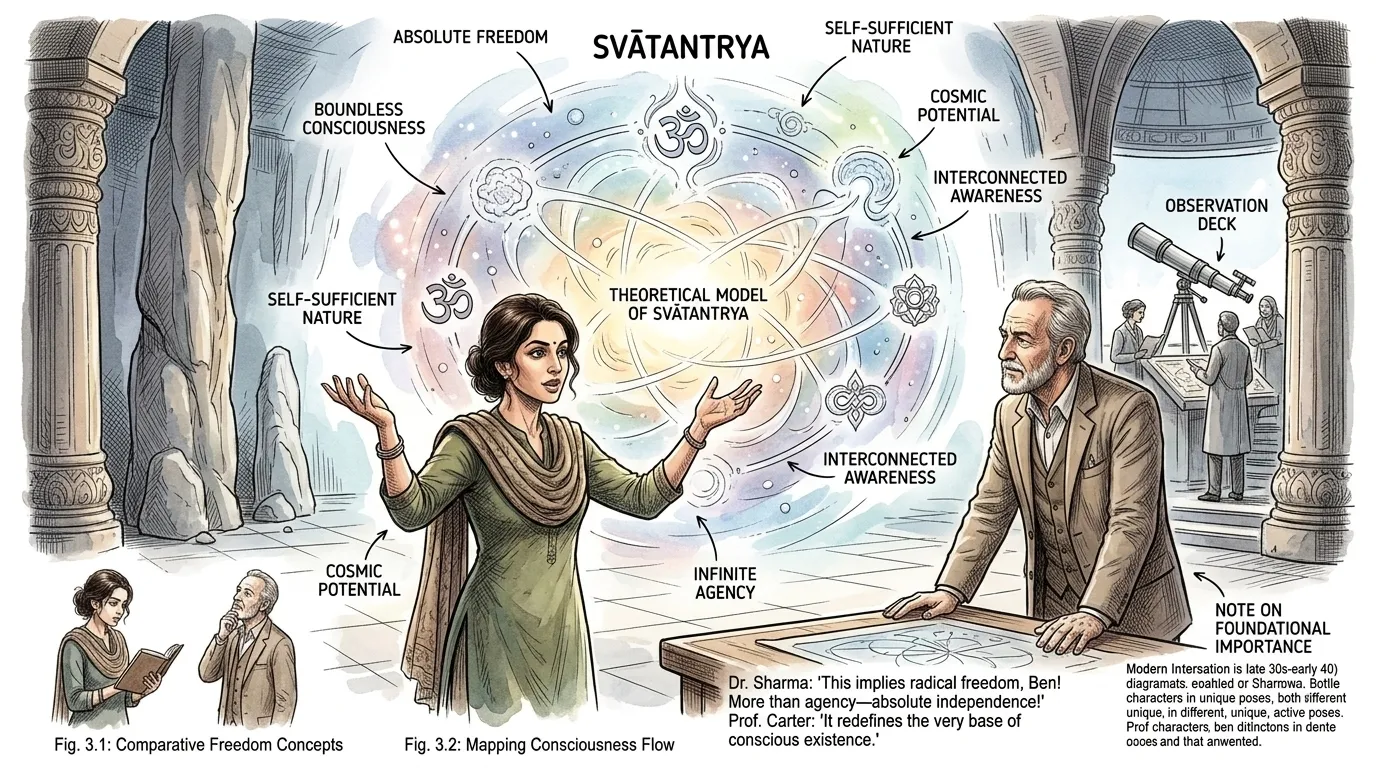
One of Abhinavagupta's most powerful ideas is 'Svātantrya,' the inherent freedom and absolute sovereignty of consciousness itself. Dr. Sharma notes this isn't just a concept but a living truth that fundamentally reshapes our understanding of agency. Professor Carter emphasizes that grasping this idea is crucial for understanding the path to recognition.
"'Svātantrya is perhaps Abhinavagupta's most radical assertion,' Dr. Sharma explains, her voice gaining intensity. 'It means consciousness is not bound, but is inherently free, acting as the sole cause of everything, including its own apparent limitation.' Professor Carter adds thoughtfully, 'This 'sovereignty of consciousness' is the foundational knowledge we need; it's the lens through which we begin to see Pratyabhijñā not as something external to achieve, but as an awakening to our intrinsic nature.'"
Philosophy Note: Svātantrya, meaning 'self-sufficiency' or 'absolute freedom,' is a core tenet of Kashmir Shaivism, positing that the ultimate reality (Śiva) is completely independent and acts through its own will (icchā-śakti).
Page 4
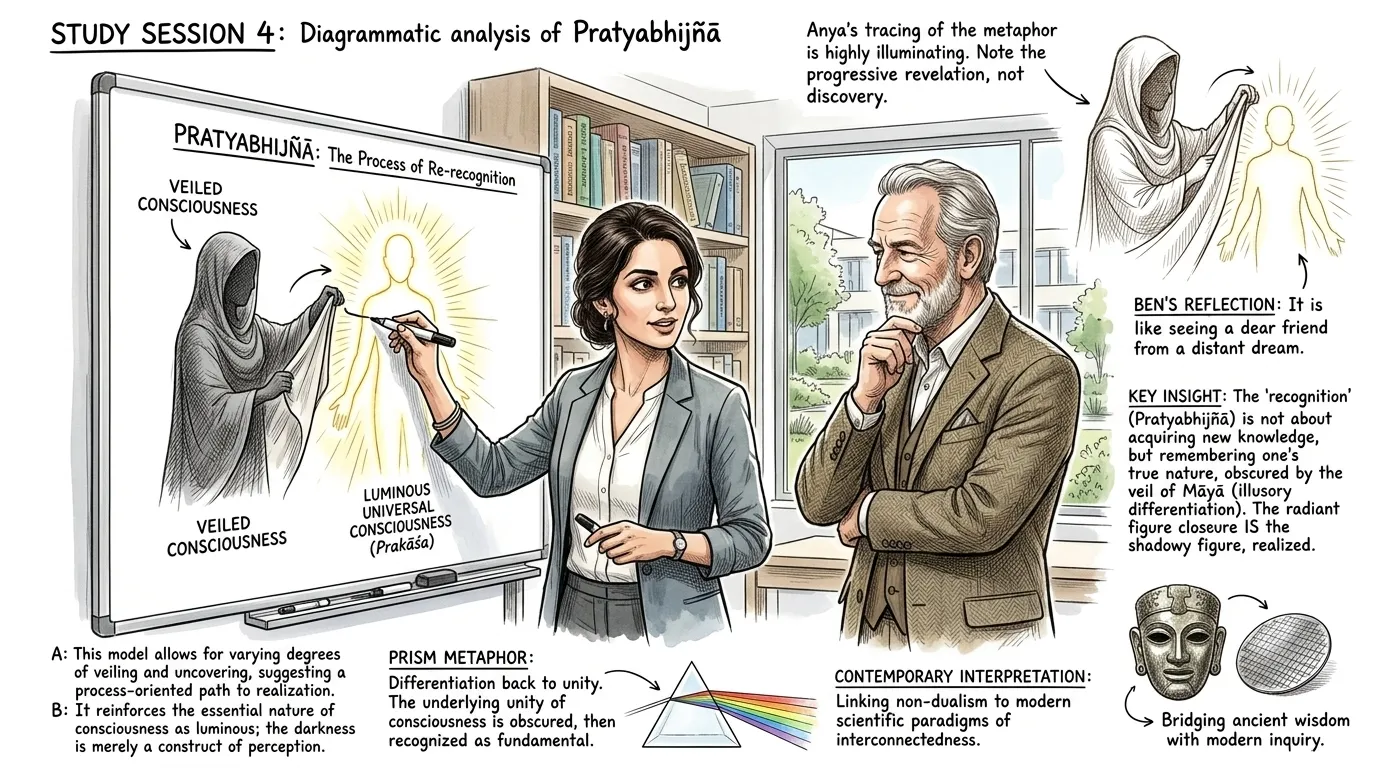
Abhinavagupta's central teaching, Pratyabhijñā, is not about acquiring new knowledge, but about 're-cognition'—unveiling what is already present. Dr. Sharma articulates how this process involves transcending limiting conceptual frameworks. Professor Carter highlights that it is a direct apprehension, akin to suddenly recognizing a familiar face.
"'Pratyabhijñā isn't intellectual assent to an idea,' Dr. Sharma clarifies, tracing a diagram on a whiteboard that shows a veiled figure slowly unveiling its true radiant form. 'It's a direct, intuitive insight into one's own identity as the universal consciousness.' Professor Carter continues, 'It's like seeing an old friend after many years, and in that moment, realizing you knew them all along. The identity was always there, just forgotten or obscured by time and context.'"
Philosophy Note: Pratyabhijñā, or 'recognition,' is the central spiritual practice in Abhinavagupta's system, emphasizing the direct realization of one's identity with the supreme consciousness (Śiva).
Page 5
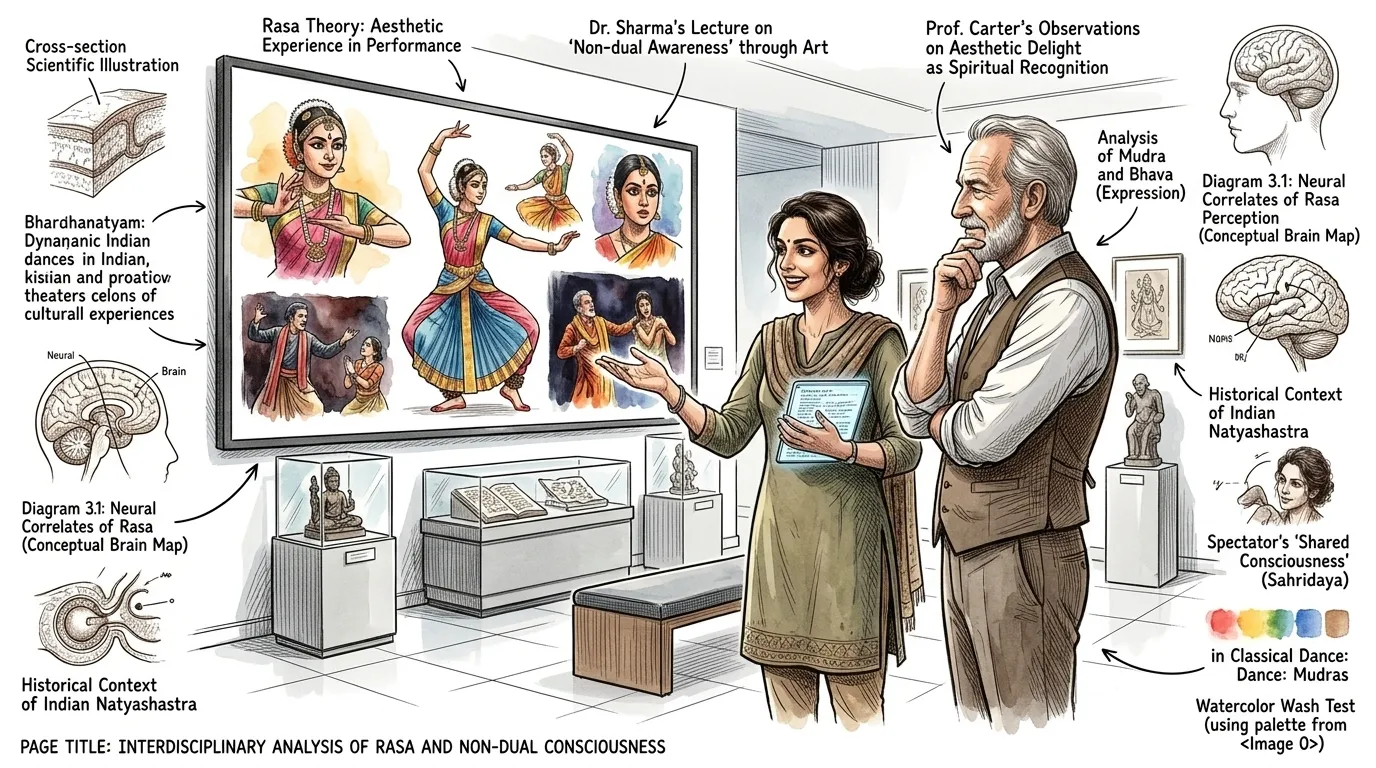
Beyond liberation, Abhinavagupta also revolutionized aesthetic theory with his nuanced understanding of 'Rasa.' Dr. Sharma explains that Rasa is not merely emotion, but a profound, universal delight experienced in art. Professor Carter connects this aesthetic experience directly to the state of non-dual recognition.
"'Abhinavagupta took the ancient concept of Rasa, aesthetic flavor, and elevated it,' Dr. Sharma says, pointing to images of classical Indian dance and drama on a screen. 'He argued that the experience of Rasa in art leads to a profound, pure delight—a moment free from personal ego and worldly concerns.' Professor Carter adds, 'This deep, impersonal joy, free from mental distractions, becomes a miniature, temporary experience of the very non-dual consciousness that Pratyabhijñā seeks to reveal. Art, for him, is a direct pathway to spirit.'"
Philosophy Note: Rasa theory, as elaborated by Abhinavagupta in his commentary on Bharata's Natyashastra, describes how art evokes universal aesthetic experiences (rasa) which are akin to the bliss of ultimate reality.
Page 6
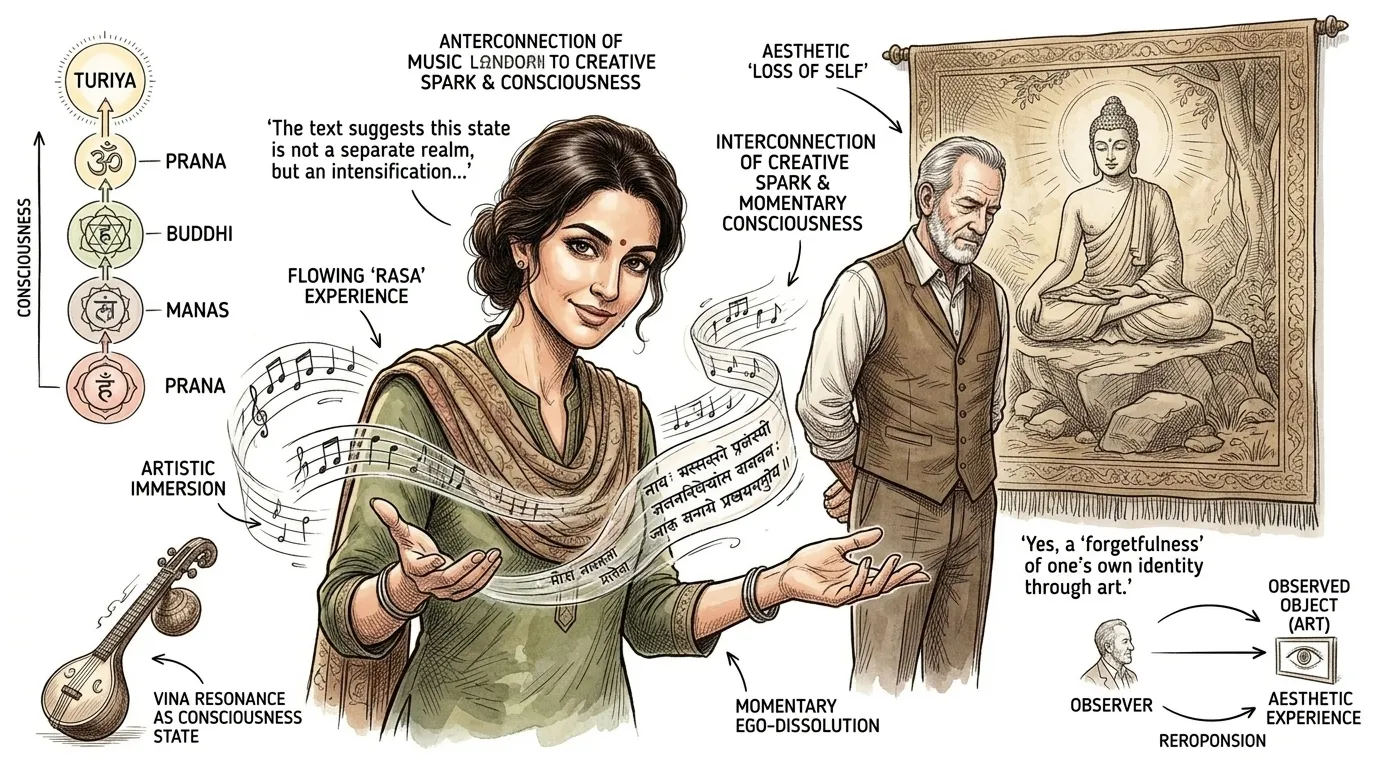
Abhinavagupta argued that Rasa is not subjective feeling, but a universal, impersonal relish of beauty. Dr. Sharma illustrates how the art spectator transcends individual limitations to experience pure consciousness. Professor Carter notes this process mirrors the journey of self-recognition.
"'When we truly engage with art, whether music or poetry,' Dr. Sharma explains, looking directly at the viewer, 'our individual consciousness expands, momentarily shedding its limiting definitions. We become one with the experience.' Professor Carter nods, adding, 'This momentary 'loss of self' in aesthetic absorption is a direct foretaste of Pratyabhijñā. As the great poet Rumi once said, 'The wound is the place where the Light enters you.' This is precisely how art can open us, allowing that universal light to enter and be recognized.'"
Philosophy Note: Abhinavagupta posited that the experience of rasa involves a process of 'sādhāraṇīkaraṇa' (universalization), where the aesthetic emotion transcends personal limitations to become a universal experience.
Page 7
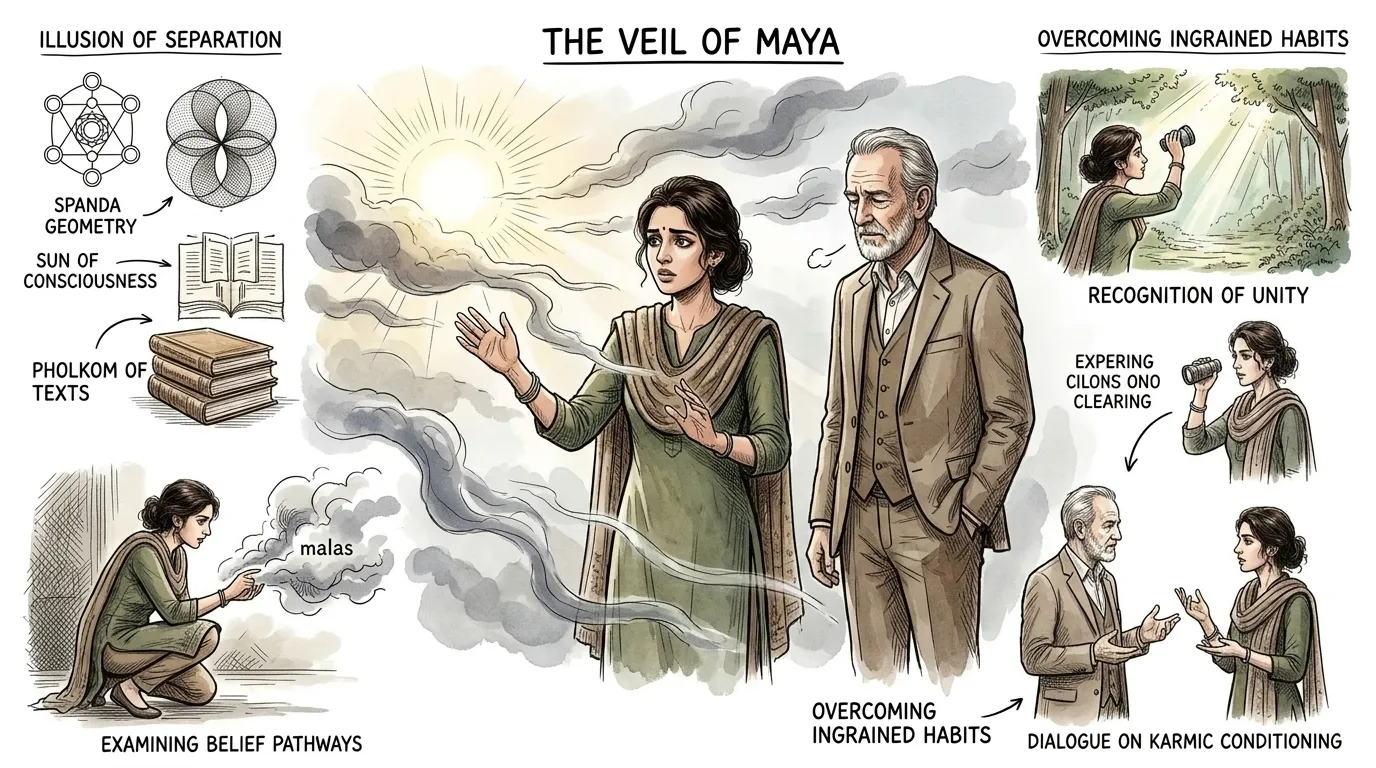
Despite the inherent freedom of Svātantrya and the path of Rasa, the mind often erects powerful obstacles to recognition. Dr. Sharma points out that our conditioning and attachments create a veil of illusion. Professor Carter elaborates on how these limitations prevent us from realizing our true, unified nature.
"'The greatest challenge to Pratyabhijñā is our deeply ingrained habit of dualistic thought,' Dr. Sharma explains, looking concerned. 'We constantly identify with our ego, our thoughts, our roles, creating a persistent sense of 'me' versus 'not-me.' Professor Carter sighs, 'These 'malas' or impurities, as the tradition calls them—our limiting beliefs and attachments—act like thick clouds, obscuring the sun of consciousness. Overcoming them isn't easy; it requires profound internal work.'"
Philosophy Note: Abhinavagupta identified 'malas' (impurities or veils) that obscure the true nature of consciousness, including āṇava-mala (sense of limited agency), māyīya-mala (perception of difference), and kārma-mala (impact of actions).
Page 8
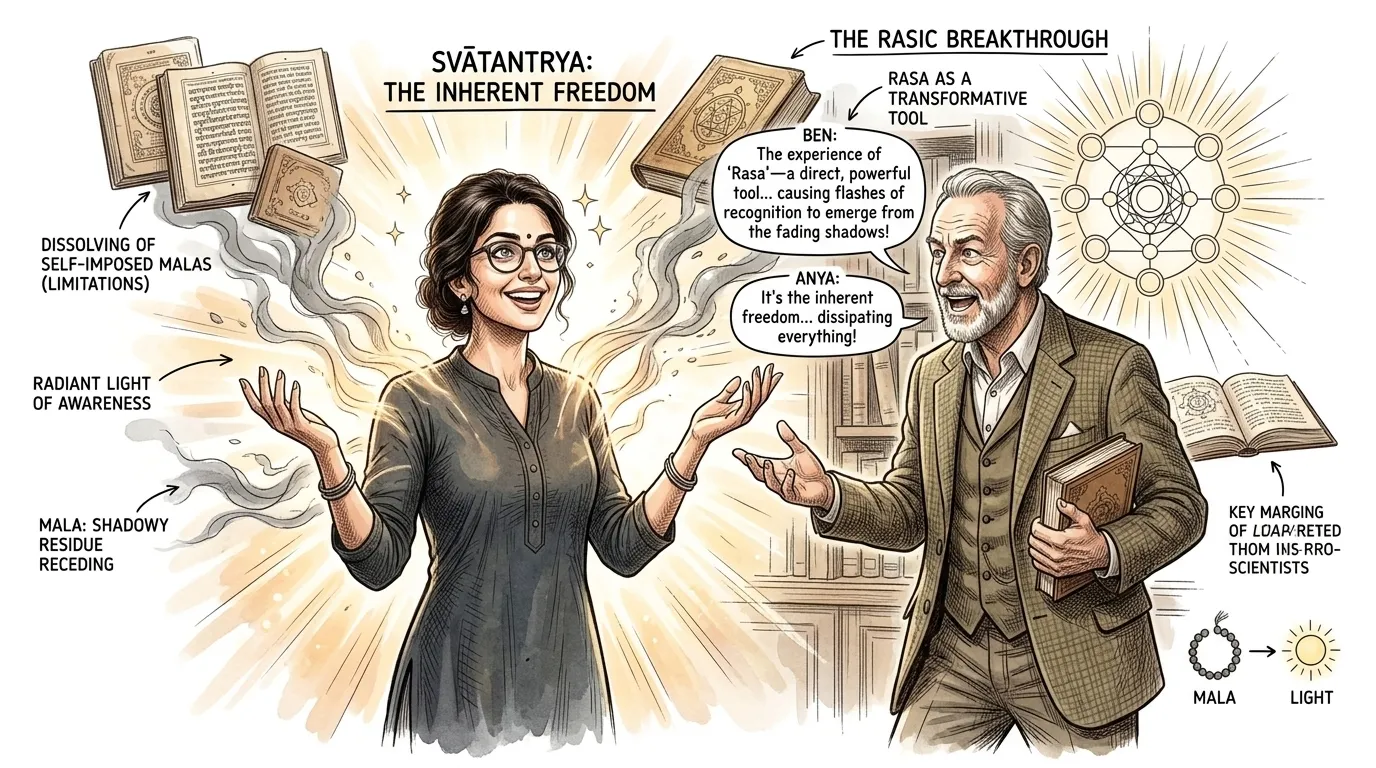
To overcome these obstacles, Abhinavagupta's philosophy offers a powerful synthesis. Dr. Sharma explains how understanding Svātantrya illuminates the mind's true freedom. Professor Carter then shows how the intense, non-dual experience of Rasa can serve as a direct tool for Pratyabhijñā, dissolving the illusion of separation.
"'This is where our earlier discussion about Svātantrya becomes crucial,' Dr. Sharma states, her eyes lighting up. 'Knowing that consciousness is inherently free, we realize our limitations are self-imposed, not fundamental.' Professor Carter adds, 'And this is the payoff: the profound, ego-transcending experience of Rasa, whether through art or deep meditation, acts as a direct, powerful method. It temporarily suspends the 'me' and 'mine,' allowing the spontaneous recognition of Svātantrya—that absolute, free consciousness—to flash through. It's a direct experience of the non-dual truth we sought.'"
Philosophy Note: By integrating the concept of Svātantrya with Rasa theory, Abhinavagupta provided a practical framework: aesthetic experiences offer glimpses of the absolute freedom of consciousness, facilitating the ultimate 'recognition' (Pratyabhijñā).
Page 9
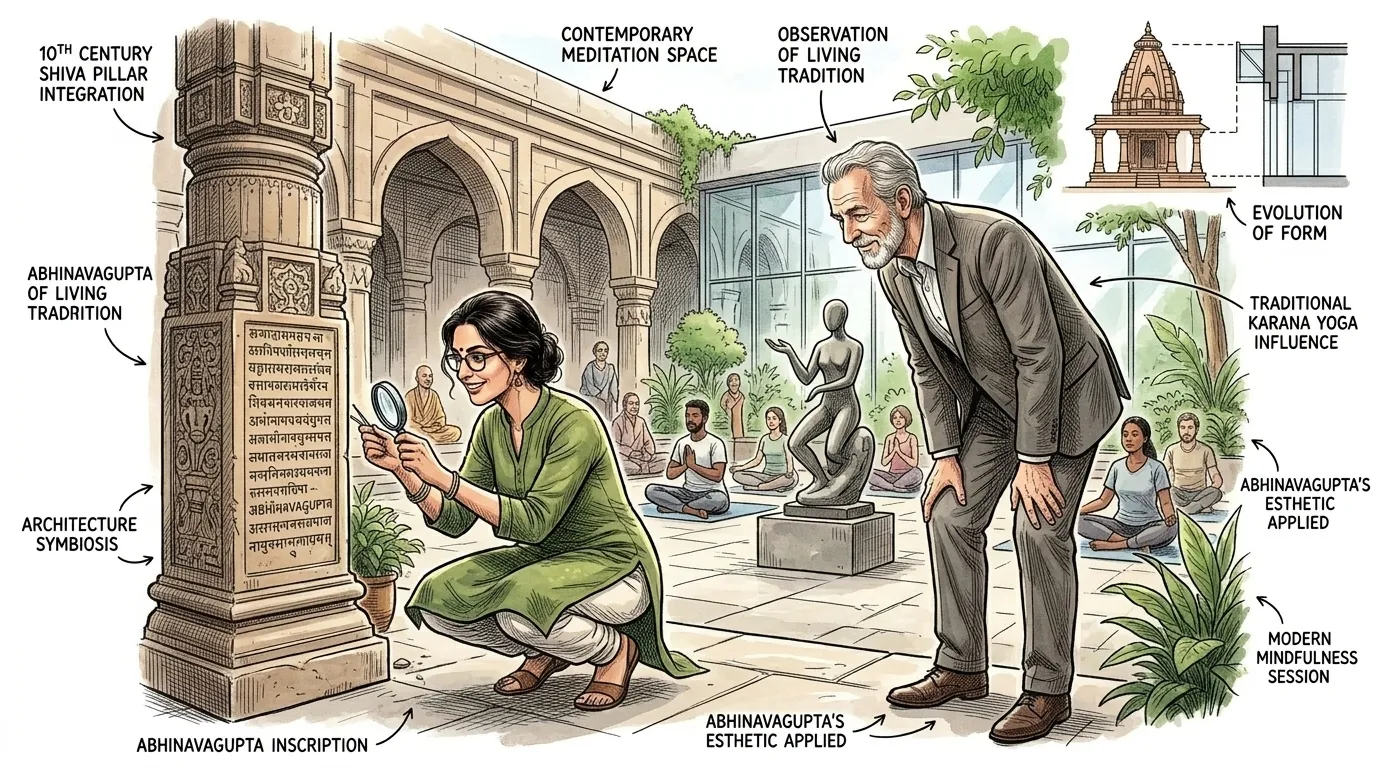
Abhinavagupta's monumental work left an indelible mark on Indian philosophy, aesthetics, and spirituality. His sophisticated synthesis continues to influence contemporary thought, bridging the gap between artistic expression and spiritual realization. Dr. Sharma affirms his enduring relevance for modern seekers. Professor Carter notes his profound impact on various traditions.
"'Abhinavagupta's legacy isn't just academic; it's a living tradition,' Dr. Sharma explains, looking around a vibrant, modern meditation center. 'His ideas challenge us to look beyond superficial divisions and recognize the deeper unity.' Professor Carter agrees, 'His synthesis profoundly shaped not only Kashmir Shaivism but also influenced later traditions like Tantra and the broader understanding of Indian aesthetics, demonstrating that the path to liberation isn't just asceticism, but can also be found in the beauty of the world itself.'"
Philosophy Note: Abhinavagupta's influence extended through centuries, impacting various schools of Indian philosophy, Tantric practices, and the theoretical underpinnings of classical Indian arts, continuing to inspire non-dualistic thought.
Page 10

Abhinavagupta's teachings offer a powerful framework for navigating the complexities of modern life, promoting a unified worldview over divisive thinking. Dr. Sharma reflects on how his philosophy encourages holistic well-being and genuine connection. Professor Carter concludes that recognizing our inherent freedom and interconnectedness remains as vital today as it was a thousand years ago.
"'In a world often fragmented by division and conflict, Abhinavagupta's non-dual vision offers a profound antidote,' Dr. Sharma says, her voice resonating with conviction. 'It reminds us that our true nature is one of boundless consciousness, not limited ego.' Professor Carter concludes, 'Ultimately, his message of 'recognition' is a timeless call to wisdom: to see ourselves, others, and the world not as separate entities, but as expressions of a single, vibrant, and utterly free consciousness. That insight is humanity's enduring quest.'"
Philosophy Note: The principles of non-duality and recognition found in Abhinavagupta's philosophy provide a foundation for contemporary discussions on consciousness, well-being, social harmony, and the integration of spiritual and aesthetic experiences.
About this story
- Audience: general readers
Questions and answers
Read Wonder Philosophy on your phone
Wonder Philosophy is available on Android and iPhone and iPad. Get Wonder Philosophy on Google Play · Get Wonder Philosophy on the App Store.