Alfred North Whitehead
Alfred North Whitehead — an illustrated philosophy story. 10 illustrated pages, free to read on Wonder Philosophy.

Page 1
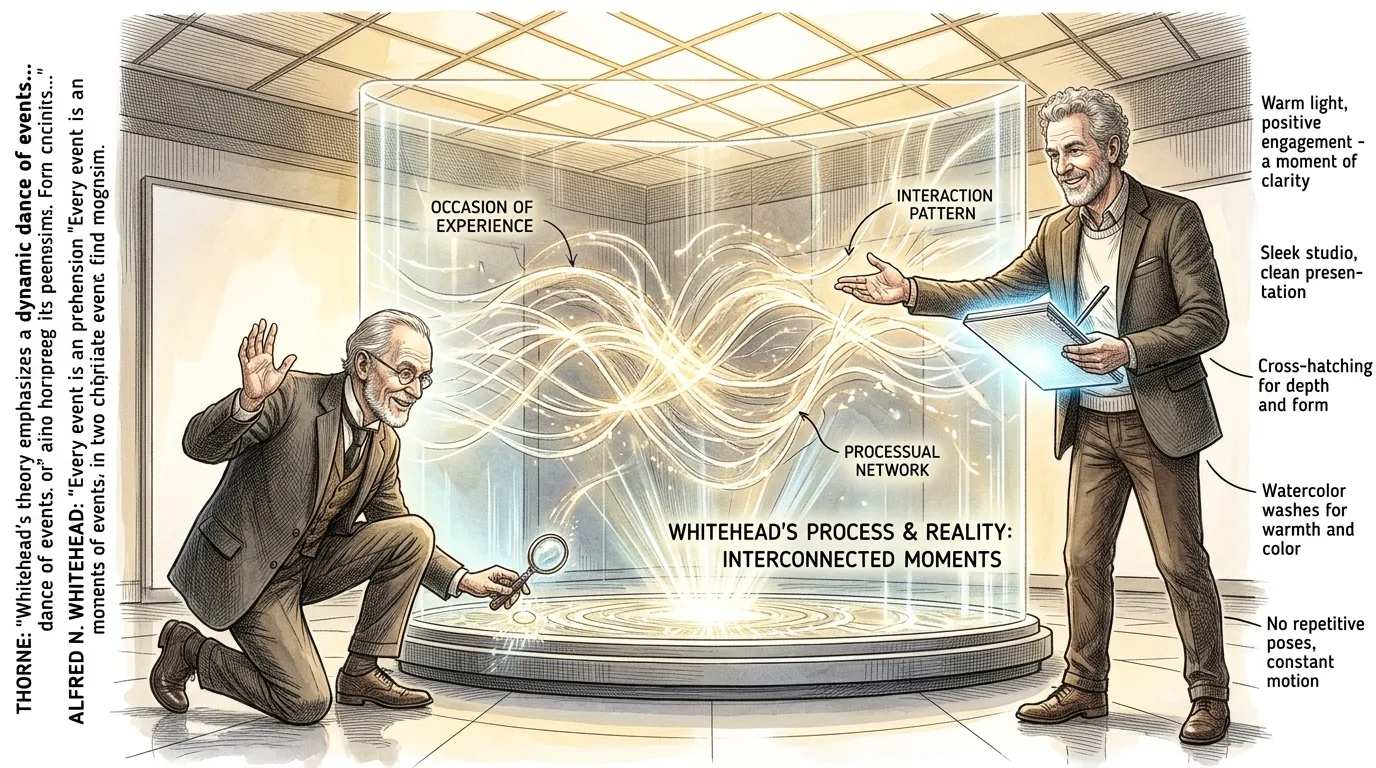
Dr. Aris Thorne stands before a holographic projection shimmering with intricate, flowing patterns, each representing a moment of interconnected existence, as he begins to introduce a profound challenge to our understanding of reality. "For centuries, philosophy grappled with the idea of static, unchanging substances, believing the world was built from fixed bricks, but Alfred North Whitehead dared us to see something entirely different," Dr. Thorne explains, gesturing towards the dynamic display. "He proposed a universe not of things, but of processes, a continuous dance of unfolding events where everything is in the act of becoming, forever shaping and being shaped by its surroundings, constantly weaving the fabric of existence anew."
""For centuries, philosophy grappled with the idea of static, unchanging substances, believing the world was built from fixed bricks, but Alfred North Whitehead dared us to see something entirely different," Dr. Thorne explains, gesturing towards the dynamic display. "He proposed a universe not of things, but of processes, a continuous dance of unfolding events where everything is in the act of becoming, forever shaping and being shaped by its surroundings, constantly weaving the fabric of existence anew.""
Philosophy Note: Alfred North Whitehead (1861-1947): English mathematician and philosopher. Process Philosophy: A metaphysical system emphasizing change, dynamism, and interrelation as fundamental to reality.
Page 2
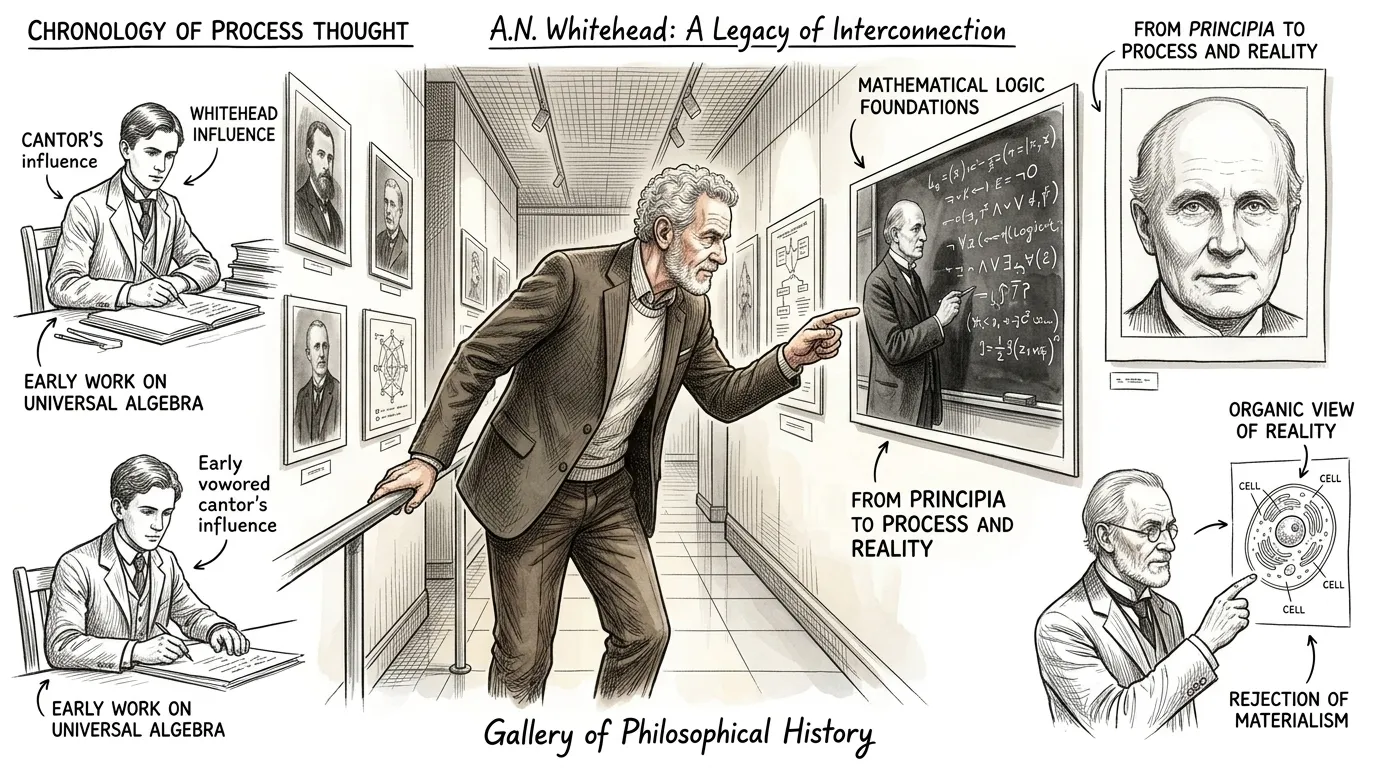
Dr. Thorne walks past historical photographs of Cambridge, emphasizing how Whitehead's early work was rooted in logic and mathematics, culminating in his monumental collaboration with Bertrand Russell, 'Principia Mathematica,' which established a rigorous foundation for modern logical thought. "Yet, even as a master of precision and abstraction, Whitehead found himself increasingly dissatisfied with how classical science and philosophy fractured reality," Dr. Thorne elaborates, pointing to an archival image of Whitehead at a blackboard. "He argued passionately against what he termed the 'bifurcation of nature,' the mistaken belief that the world is fundamentally split into a realm of objective, inert matter and a separate, subjective realm of conscious experience, leaving no coherent place for value, purpose, or genuine interconnectedness in the physical world itself."
""Yet, even as a master of precision and abstraction, Whitehead found himself increasingly dissatisfied with how classical science and philosophy fractured reality," Dr. Thorne elaborates, pointing to an archival image of Whitehead at a blackboard. "He argued passionately against what he termed the 'bifurcation of nature,' the mistaken belief that the world is fundamentally split into a realm of objective, inert matter and a separate, subjective realm of conscious experience, leaving no coherent place for value, purpose, or genuine interconnectedness in the physical world itself.""
Philosophy Note: Principia Mathematica (1910-1913): Groundbreaking work on mathematical logic. Bifurcation of Nature: Whitehead's critique of the mind-matter dualism prevalent in scientific and philosophical thought.
Page 3
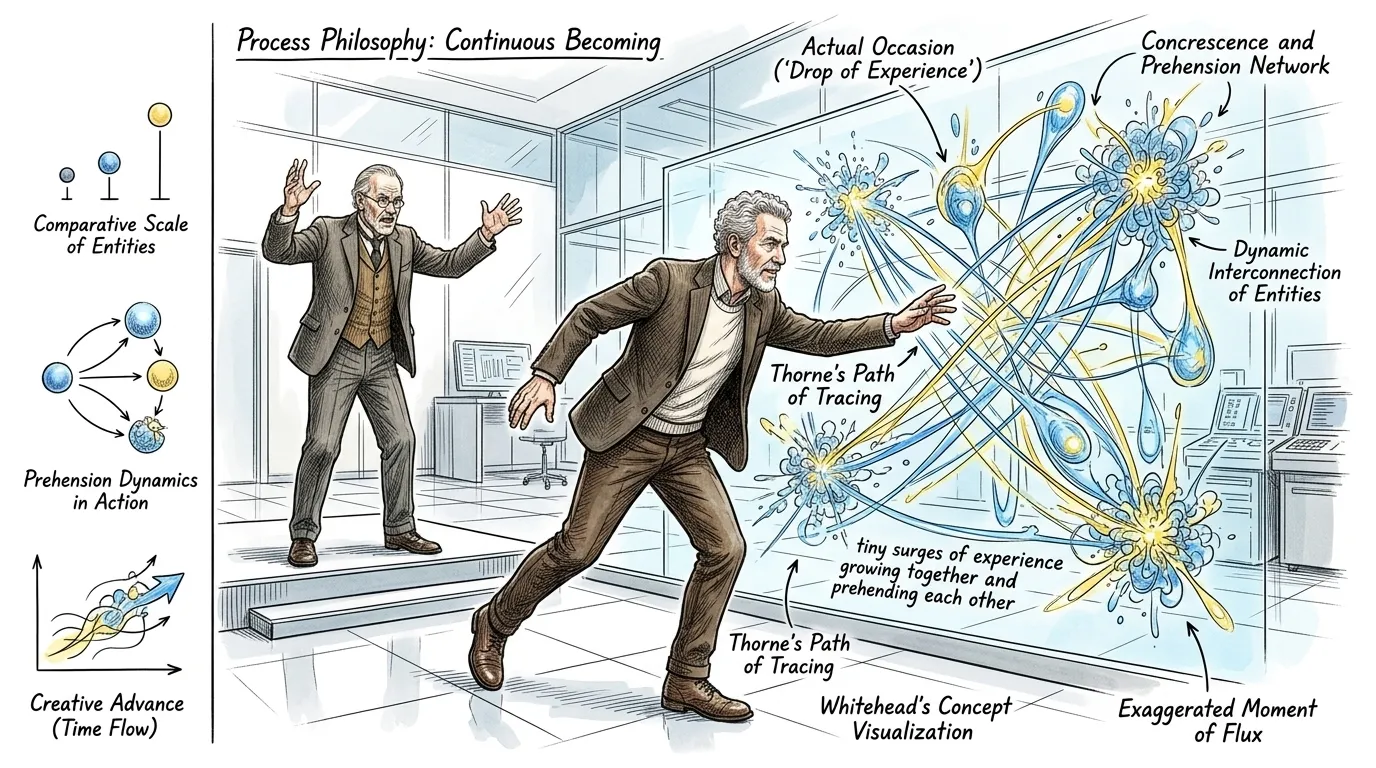
Dr. Thorne walks towards a complex diagram showing an evolving process, explaining how Whitehead sought to mend this fractured worldview by rejecting static entities in favor of fundamental, dynamic units he called 'actual occasions' or 'actual entities.' "These are not objects in the traditional sense, but rather fleeting, highly complex moments of experience, the ultimate building blocks of reality, each a tiny surge of creative energy that brings something new into being," Dr. Thorne clarifies, tracing a path on the diagram. "Every actual occasion is a unique 'drop of experience,' an instance of 'concrescence,' meaning 'growing together,' where it grasps or 'prehends' aspects of the past and other entities, synthesizing them into a novel, unified, subjective present, however simple or complex it may be, before perishing and becoming an object for future occasions."
""These are not objects in the traditional sense, but rather fleeting, highly complex moments of experience, the ultimate building blocks of reality, each a tiny surge of creative energy that brings something new into being," Dr. Thorne clarifies, tracing a path on the diagram. "Every actual occasion is a unique 'drop of experience,' an instance of 'concrescence,' meaning 'growing together,' where it grasps or 'prehends' aspects of the past and other entities, synthesizing them into a novel, unified, subjective present, however simple or complex it may be, before perishing and becoming an object for future occasions.""
Philosophy Note: Actual Occasions (or Actual Entities): Whitehead's fundamental units of reality, dynamic momentary events of experience. Concrescence: The process by which an actual occasion becomes a determinate, unified entity. Prehension: The way an actual occasion grasps and integrates data from other actual occasions.
Page 4
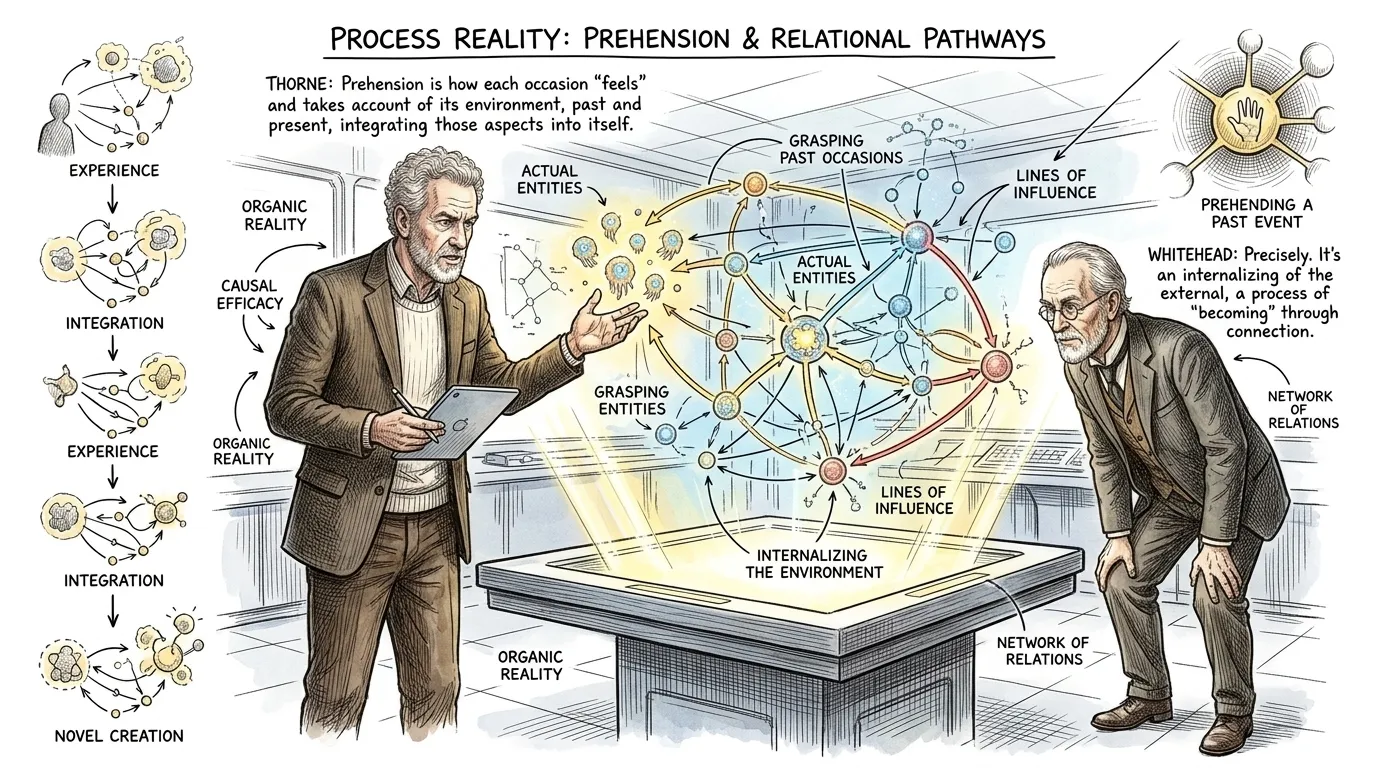
Dr. Thorne demonstrates the concept of 'prehension' using an animated holographic model showing various entities radiating lines of influence, illustrating that everything in Whitehead's universe is intrinsically relational. "Crucially, 'prehension' describes how every actual occasion actively 'feels' or 'grabs' aspects of other actual occasions, both past and present, integrating them into its own unique becoming," Dr. Thorne explains, the holographic model responding to his gestures by highlighting pathways of influence. "This means nothing exists in isolation; rather, everything is profoundly interconnected, a vast 'organism' where each part contributes to and is shaped by the whole, even a simple electron or a complex human thought, continually influencing and being influenced, creating a dense web of shared experience across the cosmos."
""Crucially, 'prehension' describes how every actual occasion actively 'feels' or 'grabs' aspects of other actual occasions, both past and present, integrating them into its own unique becoming," Dr. Thorne explains, the holographic model responding to his gestures by highlighting pathways of influence. "This means nothing exists in isolation; rather, everything is profoundly interconnected, a vast 'organism' where each part contributes to and is shaped by the whole, even a simple electron or a complex human thought, continually influencing and being influenced, creating a dense web of shared experience across the cosmos.""
Philosophy Note: Prehension: The fundamental activity by which actual occasions apprehend other actual occasions. Organismic Philosophy: Whitehead's view of the universe as a dynamic, interconnected organism rather than a collection of inert substances.
Page 5
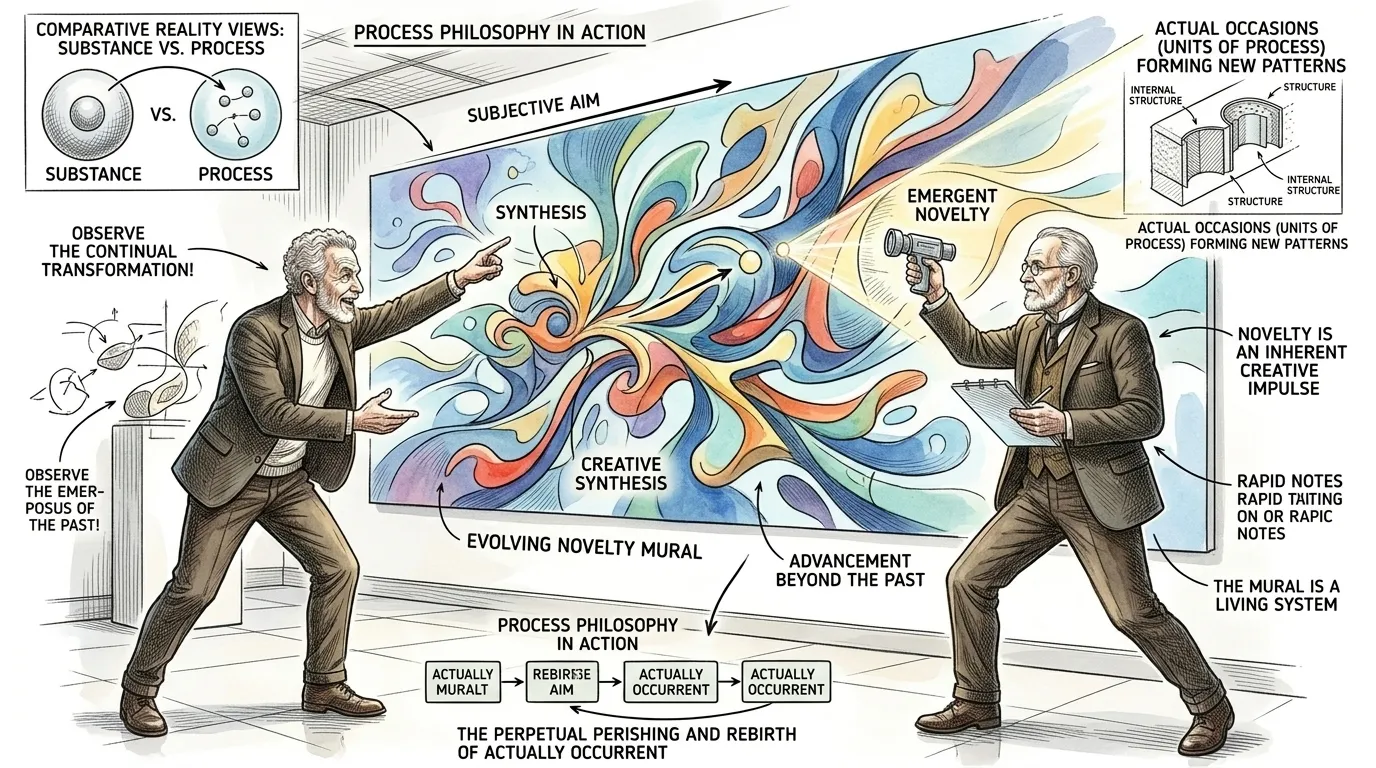
Dr. Thorne points to an evolving digital mural that illustrates the concept of 'novelty' inherent in every actual occasion, emphasizing that this is not merely a passive reception of data but an active, creative synthesis. "Every new actual occasion doesn't just copy the past; it creatively synthesizes its prehensions into something genuinely new, however subtle, guided by what Whitehead called a 'subjective aim' towards its own completion," Dr. Thorne explains, the digital mural showing abstract forms constantly reconfiguring. "This inherent 'creativity' is not just a human trait but a fundamental principle woven into the very fabric of the universe, ensuring that reality is always in flux, always producing novelty, perpetually advancing beyond its immediate past, thereby avoiding a sterile, deterministic existence and giving rise to genuine freedom and emergent properties at all levels."
""Every new actual occasion doesn't just copy the past; it creatively synthesizes its prehensions into something genuinely new, however subtle, guided by what Whitehead called a 'subjective aim' towards its own completion," Dr. Thorne explains, the digital mural showing abstract forms constantly reconfiguring. "This inherent 'creativity' is not just a human trait but a fundamental principle woven into the very fabric of the universe, ensuring that reality is always in flux, always producing novelty, perpetually advancing beyond its immediate past, thereby avoiding a sterile, deterministic existence and giving rise to genuine freedom and emergent properties at all levels.""
Philosophy Note: Subjective Aim: The internal drive of an actual occasion towards its own unique completion and satisfaction. Creativity: For Whitehead, a fundamental metaphysical principle describing the urge for the universe to produce novelty and transcend the given.
Page 6
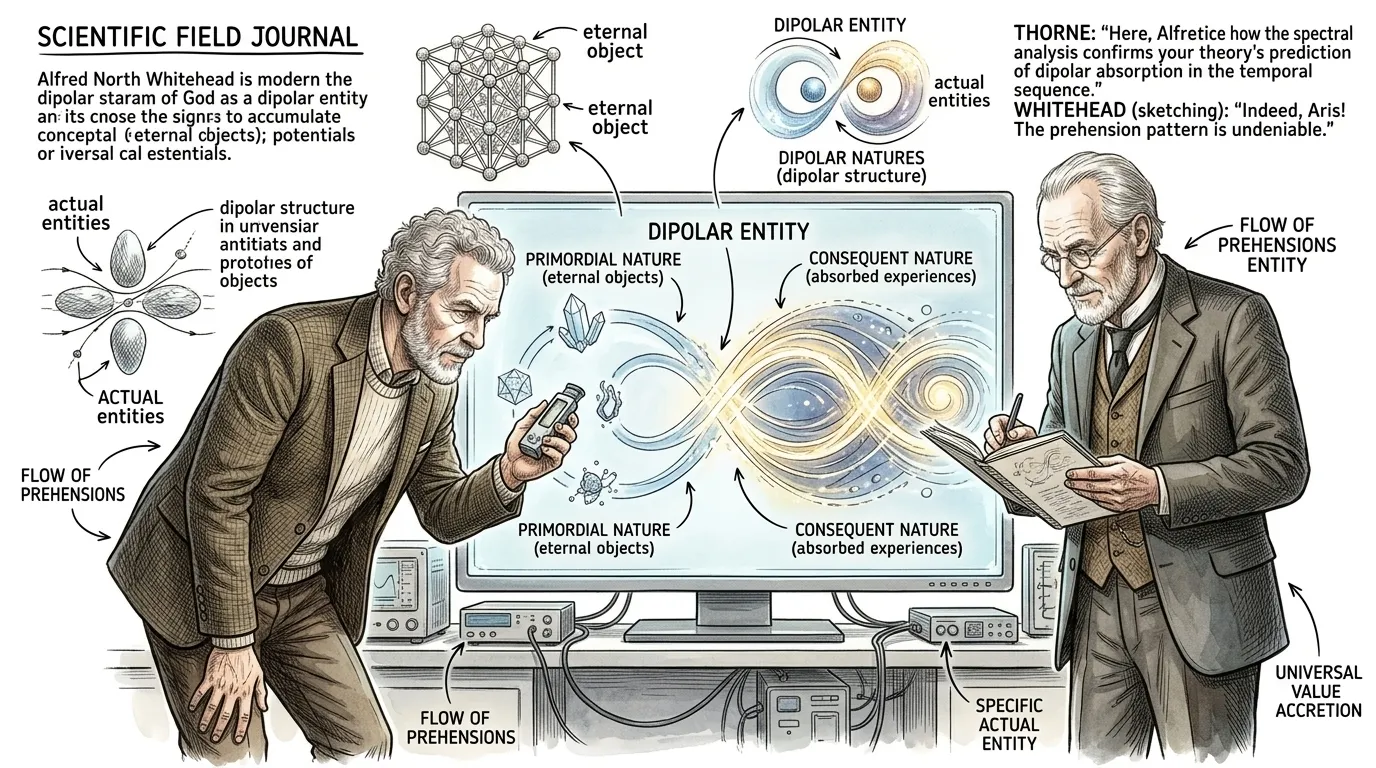
Dr. Thorne clarifies how Whitehead's metaphysics integrates the concept of God not as an external creator, but as the 'Eminent Actual Occasion,' foundational to both order and novelty within the universe itself. "Whitehead's God, often misunderstood, is not a supernatural deity intervening from outside, but an internal, dipolar entity, both 'primordial' and 'consequent,' providing the initial aims that guide concrescence towards greater complexity and beauty," Dr. Thorne explains, a diagram showing interconnected cycles. "This 'primordial nature' offers a realm of 'eternal objects' – pure potentials and forms – for actual occasions to prehend, while the 'consequent nature' of God grows by absorbing and 'feeling' every completed actual occasion, thereby preserving all attained value and suffering within itself, continuously evolving in response to the world's becoming, and thus acting as the ultimate ground for order and the lure for novel value within the cosmos."
""Whitehead's God, often misunderstood, is not a supernatural deity intervening from outside, but an internal, dipolar entity, both 'primordial' and 'consequent,' providing the initial aims that guide concrescence towards greater complexity and beauty," Dr. Thorne explains, a diagram showing interconnected cycles. "This 'primordial nature' offers a realm of 'eternal objects' – pure potentials and forms – for actual occasions to prehend, while the 'consequent nature' of God grows by absorbing and 'feeling' every completed actual occasion, thereby preserving all attained value and suffering within itself, continuously evolving in response to the world's becoming, and thus acting as the ultimate ground for order and the lure for novel value within the cosmos.""
Philosophy Note: Primordial Nature of God: The conceptual valuation of all eternal objects, providing initial aims for actual occasions. Consequent Nature of God: The ever-growing experience of the universe, absorbing and feeling all actualized values. Eternal Objects: Pure potentials or forms that can be exemplified in actual occasions.
Page 7
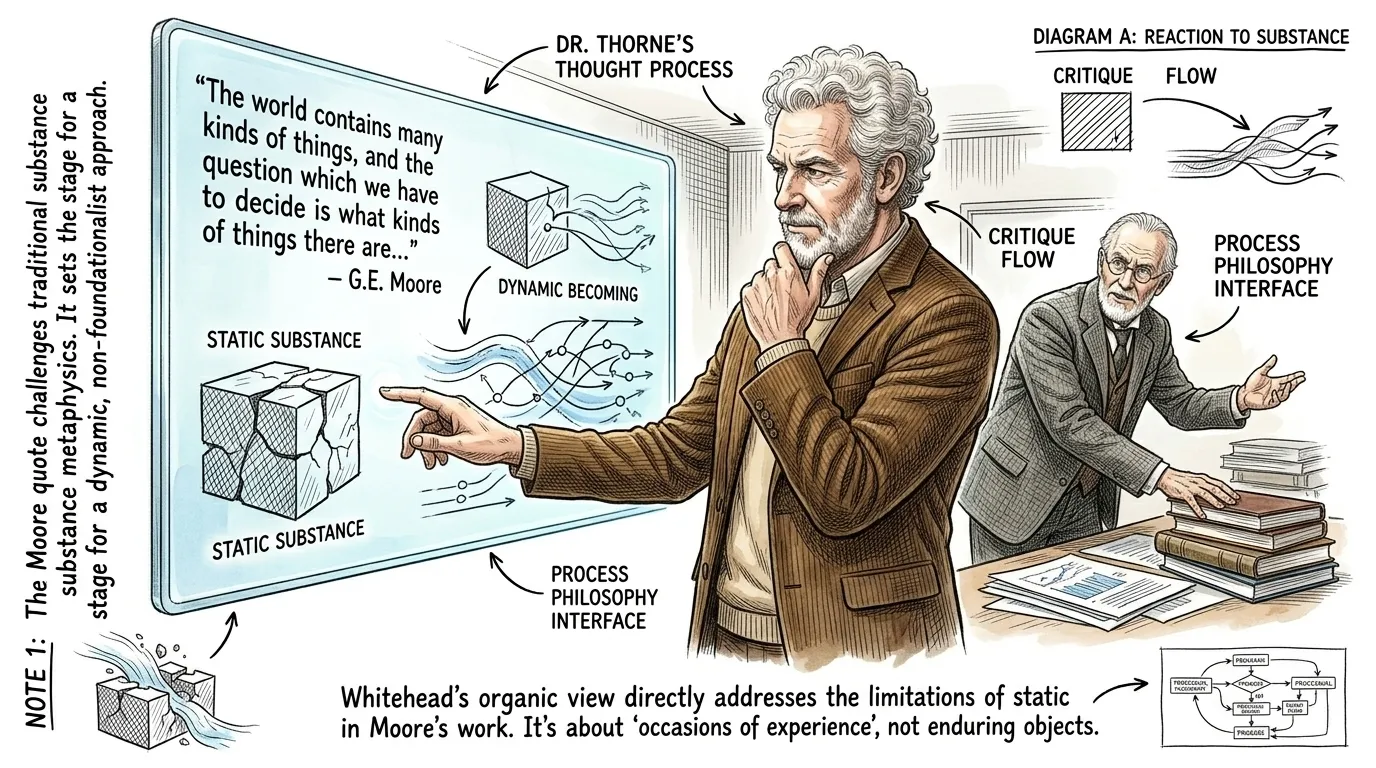
Dr. Thorne gestures toward a screen displaying various philosophical critiques, acknowledging that Whitehead's intricate process philosophy, while revolutionary, poses significant conceptual challenges, particularly in moving beyond our ingrained habits of thinking in terms of static substances. "While the explanatory power of 'actual occasions' and 'prehension' offers a richer, more integrated account of reality, the sheer dynamism of Whitehead's system demands a fundamental shift in our intuition, challenging centuries of philosophical and scientific thought that prefers stable, quantifiable categories," Dr. Thorne muses, touching the screen displaying a quote from G.E. Moore. "As the philosopher G.E. Moore once noted about similar foundational shifts, 'What kind of an answer is that to the question 'What is reality?' – an answer that says, 'It's a continuous becoming, a series of drops of experience, always perishing?' It forces us to reconsider the very nature of existence, shifting our focus from enduring 'whatness' to dynamic 'how-ness'." This intellectual demand for continuous re-evaluation can make the philosophy seem abstract or overly complex at first glance.
""While the explanatory power of 'actual occasions' and 'prehension' offers a richer, more integrated account of reality, the sheer dynamism of Whitehead's system demands a fundamental shift in our intuition, challenging centuries of philosophical and scientific thought that prefers stable, quantifiable categories," Dr. Thorne muses, touching the screen displaying a quote from G.E. Moore. "As the philosopher G.E. Moore once noted about similar foundational shifts, 'What kind of an answer is that to the question 'What is reality?' – an answer that says, 'It's a continuous becoming, a series of drops of experience, always perishing?' It forces us to reconsider the very nature of existence, shifting our focus from enduring 'whatness' to dynamic 'how-ness'." This intellectual demand for continuous re-evaluation can make the philosophy seem abstract or overly complex at first glance."
Philosophy Note: G. E. Moore (1873-1958): Influential British philosopher known for his work in ethics and epistemology. His critical yet rigorous approach represented the analytical tradition Whitehead sought to transcend. Substance Philosophy: Traditional metaphysical view emphasizing underlying, unchanging substances.
Page 8
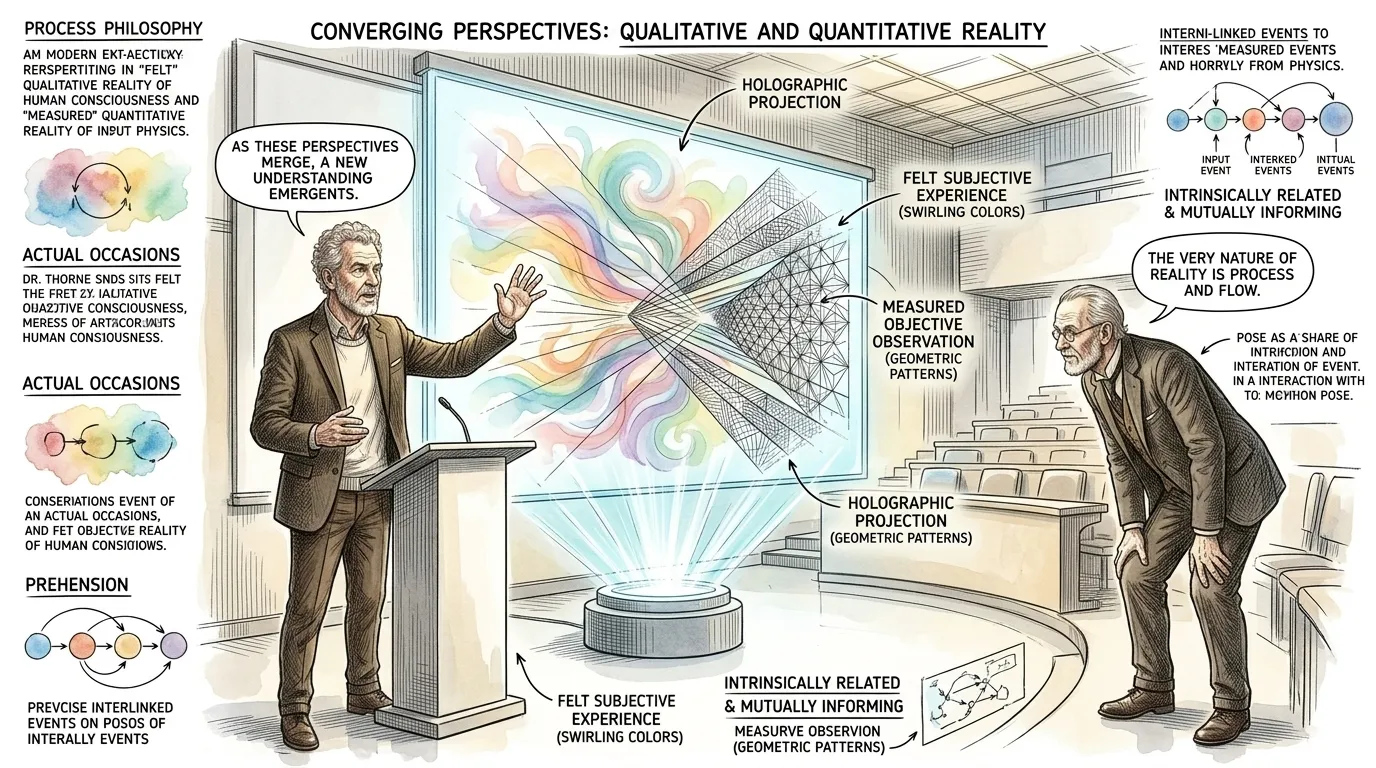
Dr. Thorne continues, explaining that Whitehead's process philosophy directly confronts the modern tension between subjective experience and objective scientific observation, providing a framework where both are integral and dynamically related. "The persistent philosophical tension between the 'felt' qualitative reality of our consciousness and the 'measured' quantitative reality of physics often leaves us with an incomplete picture, where one seems to deny the validity of the other, but Whitehead's concept of 'actual occasions,' which we explored earlier, offers a powerful reconciliation," Dr. Thorne elaborates, gesturing to a visual representation of how different perspectives converge. "By seeing all entities, from quantum events to human minds, as 'actual occasions' undergoing 'concrescence' through 'prehension,' he posits that subjectivity, feeling, and value are not merely epiphenomena but intrinsic to the very nature of reality at every level, making the universe a dynamic whole where experience and observation are two sides of the same continually evolving coin, deeply intertwined and mutually informing, rather than opposed."
""The persistent philosophical tension between the 'felt' qualitative reality of our consciousness and the 'measured' quantitative reality of physics often leaves us with an incomplete picture, where one seems to deny the validity of the other, but Whitehead's concept of 'actual occasions,' which we explored earlier, offers a powerful reconciliation," Dr. Thorne elaborates, gesturing to a visual representation of how different perspectives converge. "By seeing all entities, from quantum events to human minds, as 'actual occasions' undergoing 'concrescence' through 'prehension,' he posits that subjectivity, feeling, and value are not merely epiphenomena but intrinsic to the very nature of reality at every level, making the universe a dynamic whole where experience and observation are two sides of the same continually evolving coin, deeply intertwined and mutually informing, rather than opposed.""
Philosophy Note: Reconciliation of Mind and Matter: Whitehead's process philosophy aims to overcome the dualistic separation of subjective experience and objective reality by integrating both into the fundamental nature of actual occasions.
Page 9
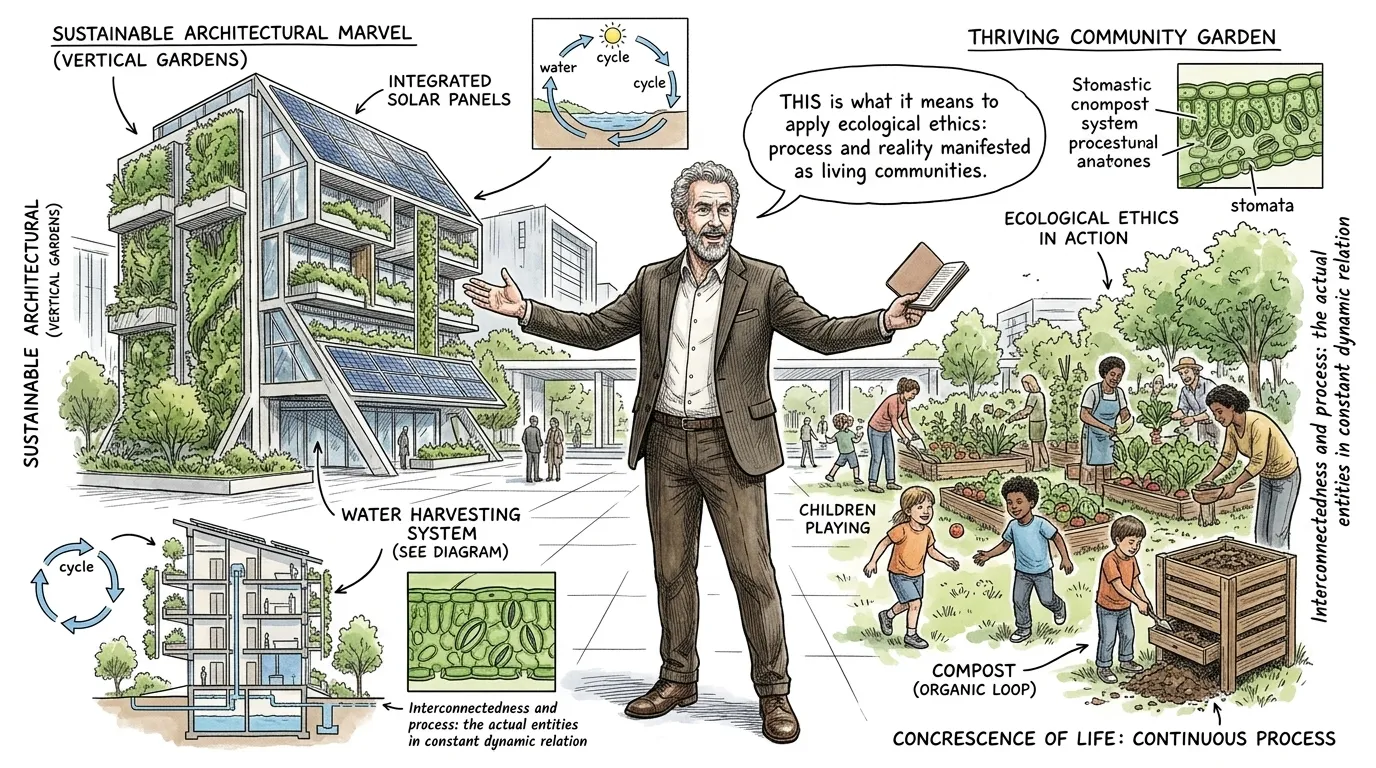
Dr. Thorne presents a montage of modern applications, illustrating how Whitehead's philosophy, though complex, offers profound insights for contemporary thought, far beyond its initial academic reception, influencing fields as diverse as environmental ethics, systems theory, and even spirituality. "Whitehead's emphasis on interconnectedness, the dynamic nature of all entities, and the intrinsic value of every 'actual occasion' provides a powerful philosophical foundation for ecological thinking, recognizing that harming any part of the intricate web of life diminishes the whole," Dr. Thorne observes, gesturing to scenes of sustainable architecture and community gardens. "His work encourages us to see ourselves not as isolated individuals manipulating a passive environment, but as participant-organisms within a grand, evolving cosmos, where our actions, through their 'prehension' by future occasions, hold profound ethical and spiritual implications for the ongoing 'concrescence' of reality, fostering a deep sense of responsibility and reverence for life's continuous becoming."
""Whitehead's emphasis on interconnectedness, the dynamic nature of all entities, and the intrinsic value of every 'actual occasion' provides a powerful philosophical foundation for ecological thinking, recognizing that harming any part of the intricate web of life diminishes the whole," Dr. Thorne observes, gesturing to scenes of sustainable architecture and community gardens. "His work encourages us to see ourselves not as isolated individuals manipulating a passive environment, but as participant-organisms within a grand, evolving cosmos, where our actions, through their 'prehension' by future occasions, hold profound ethical and spiritual implications for the ongoing 'concrescence' of reality, fostering a deep sense of responsibility and reverence for life's continuous becoming.""
Philosophy Note: Ecological Ethics: Whitehead's process philosophy provides a framework for understanding the intrinsic value and interconnectedness of all life. Systems Theory: The dynamic, relational view of reality resonates with principles of systems thinking and complexity science.
Page 10
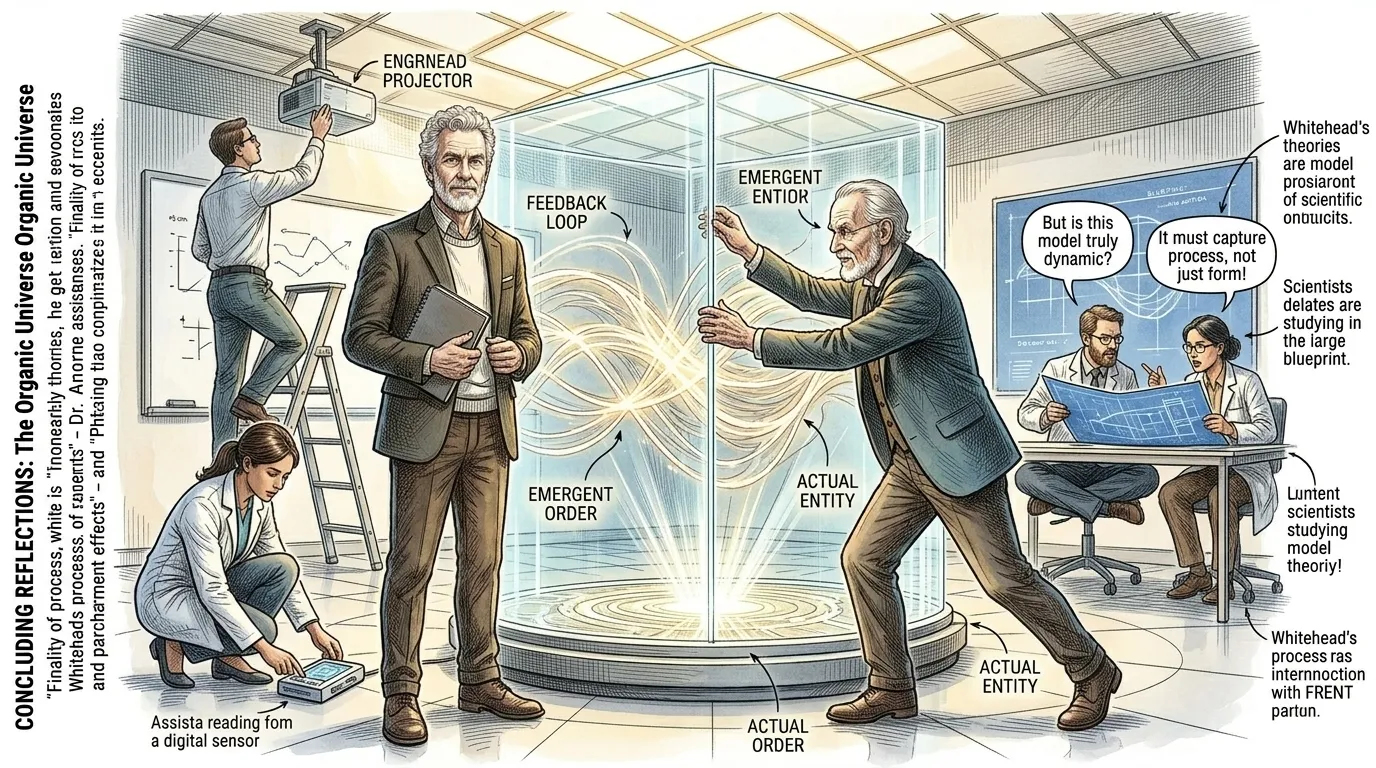
Dr. Thorne reflects on the ultimate legacy of Alfred North Whitehead, whose ideas continue to challenge and inspire those seeking a more integrated and dynamic understanding of the universe, bridging science, philosophy, and spirituality. "Whitehead's vision of a process-oriented reality offers a profound antidote to mechanistic reductionism, inviting us to embrace a world where novelty, value, and interconnectedness are not exceptions but the very essence of existence," Dr. Thorne concludes, his gaze thoughtful as he looks directly at the audience. "He reminds us that reality is not a static picture to be observed, but an active, dynamic symphony in which we are all vital participants, continuously shaping and being shaped by the ongoing 'concrescence' of the cosmos, urging us to engage with the world with a deeper sense of wonder, ethical responsibility, and an appreciation for the creative advance into novelty that defines all life and the universe itself."
""Whitehead's vision of a process-oriented reality offers a profound antidote to mechanistic reductionism, inviting us to embrace a world where novelty, value, and interconnectedness are not exceptions but the very essence of existence," Dr. Thorne concludes, his gaze thoughtful as he looks directly at the audience. "He reminds us that reality is not a static picture to be observed, but an active, dynamic symphony in which we are all vital participants, continuously shaping and being shaped by the ongoing 'concrescence' of the cosmos, urging us to engage with the world with a deeper sense of wonder, ethical responsibility, and an appreciation for the creative advance into novelty that defines all life and the universe itself.""
Philosophy Note: Holistic Worldview: Whitehead's philosophy promotes a comprehensive view of reality that transcends traditional disciplinary boundaries, fostering an integrated understanding of existence.
About this story
- Audience: general readers
Questions and answers
Read Wonder Philosophy on your phone
Wonder Philosophy is available on Android and iPhone and iPad. Get Wonder Philosophy on Google Play · Get Wonder Philosophy on the App Store.