Anaximenes
Anaximenes — an illustrated philosophy story. 10 illustrated pages, free to read on Wonder Philosophy.

Page 1
![Anaximenes [c. 585 – c. 528 BC] of Miletus proposed that air is the fundamental substance of the universe. While this might seem simplistic today, it was a…](https://thewonderbooks.com/images/stories/anaximenes/illustrations/anaximenes_page_01_v1775184415693.webp "Anaximenes [c. 585 – c. 528 BC] of Miletus proposed that air is the fundamental substance of the universe. While this might seem simplistic today, it was a…")
Anaximenes [c. 585 – c. 528 BC] of Miletus proposed that air is the fundamental substance of the universe. While this might seem simplistic today, it was a crucial step in shifting from mythological explanations to rational, observable principles. His idea emphasizes a dynamic, changing cosmos where a single substance can transform into everything we see.
Philosophy Note: Anaximenes's theory marked a departure from supernatural explanations, seeking material causes for natural phenomena.
Page 2
![Anaximenes belonged to the Milesian school, a group of pre-Socratic philosophers from Miletus [a city in ancient Ionia].](https://thewonderbooks.com/images/stories/anaximenes/illustrations/anaximenes_page_02_v1775184441834.webp "Anaximenes belonged to the Milesian school, a group of pre-Socratic philosophers from Miletus [a city in ancient Ionia].")
Anaximenes belonged to the Milesian school, a group of pre-Socratic philosophers from Miletus [a city in ancient Ionia]. These thinkers, including Thales and Anaximander, were among the first to ask, 'What is the basic stuff of reality?' They sought a single, unifying principle to explain the world's diversity.
"'It's amazing to think they were trying to figure out the whole universe so long ago,' Omar said, adjusting his backpack. 'What was life like back then?' Nalini asked, tugging on Omar's sleeve. 'No internet, no science class, just thinking and watching!'"
Philosophy Note: The Milesian school sought to identify a fundamental substance (arche) from which all things originate.
Page 3
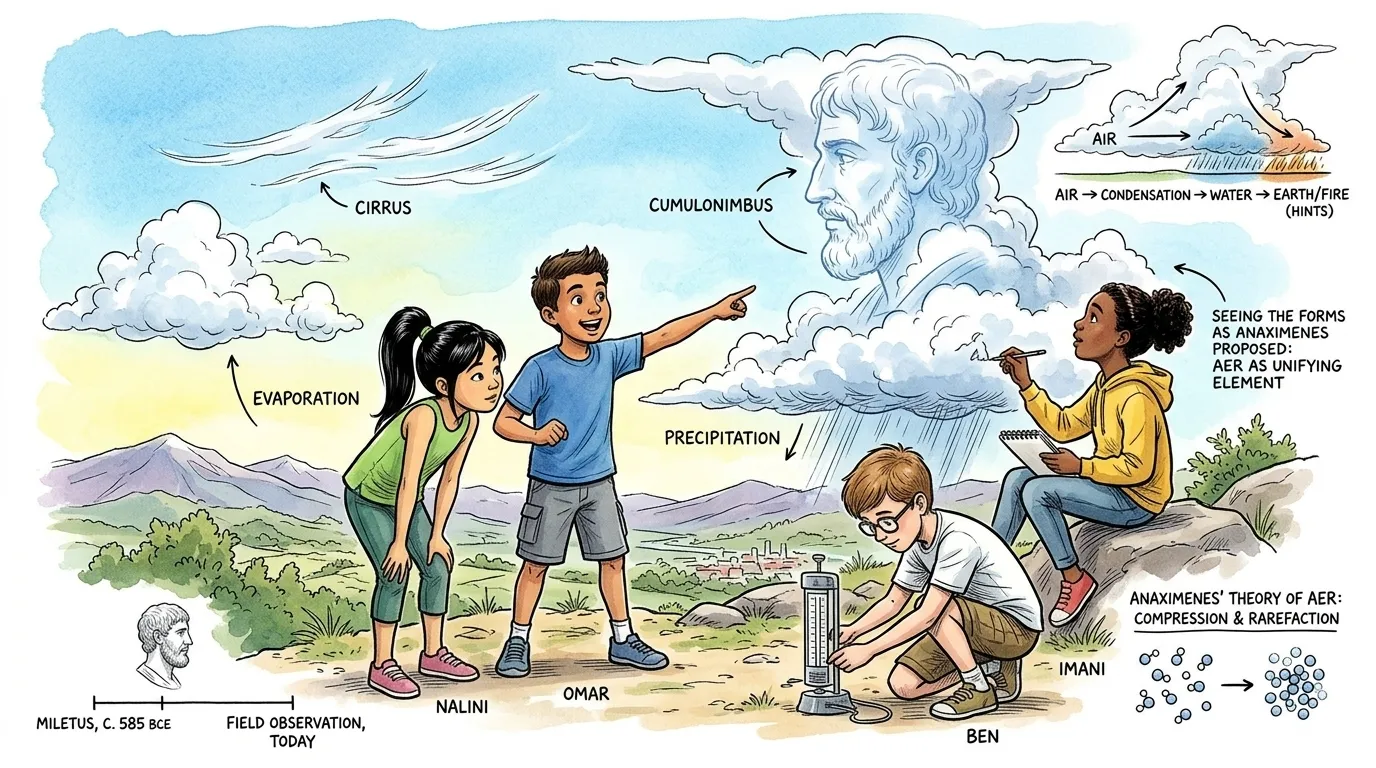
Anaximenes chose air as this fundamental substance, or 'arche'. He believed air could transform into other elements through condensation and rarefaction. When air becomes more dense, it turns into water and then earth; when it becomes more sparse, it turns into fire. This dynamic view set him apart from his predecessors.
"Omar pointed to the clouds, 'See how air changes? Sometimes it's wispy, sometimes it's heavy with rain.' Nalini tilted her head. 'So everything is just... different kinds of air?' Omar smiled. 'That's what Anaximenes thought. Cool, right?'"
Philosophy Note: The concept of 'arche' is central to understanding these early philosophers' quest for a fundamental principle.
Page 4
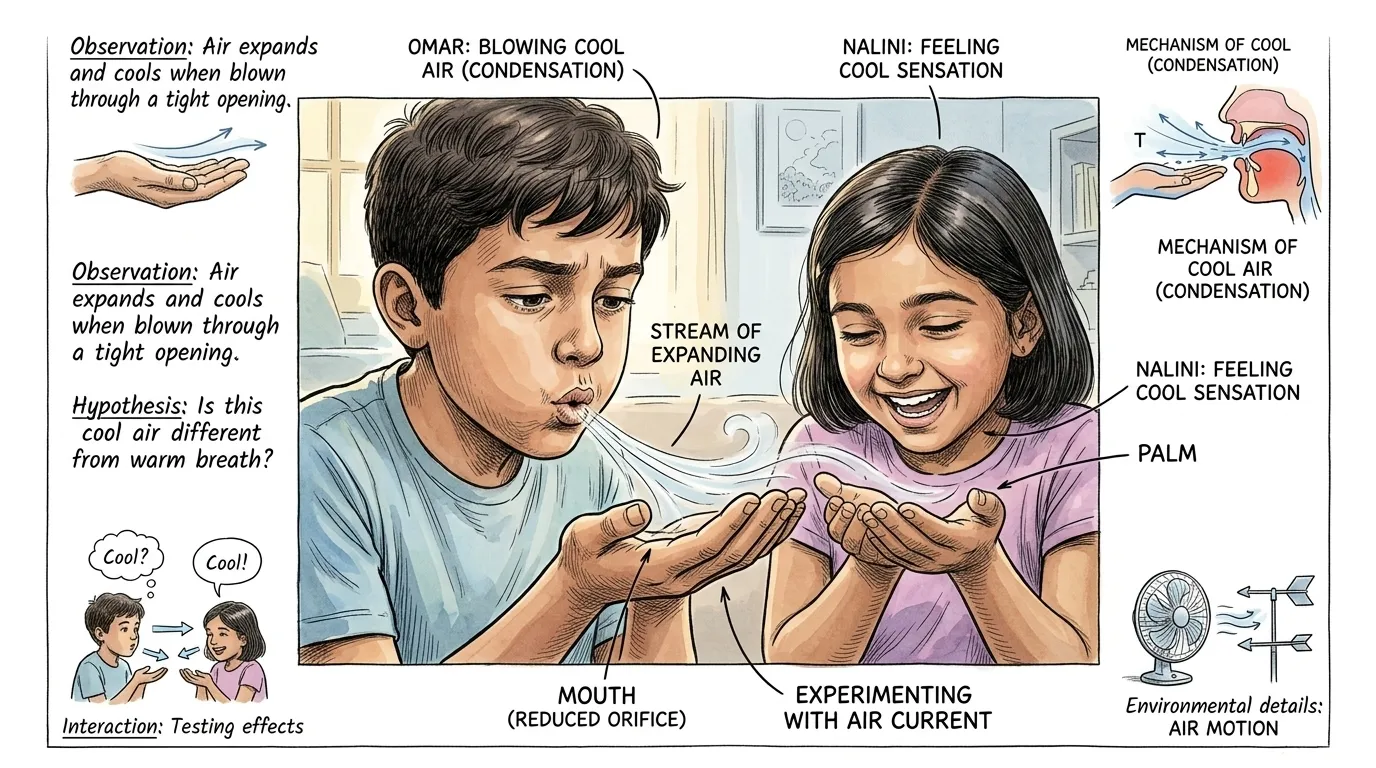
The processes of condensation and rarefaction are key to Anaximenes's theory. Condensation is when air is compressed, becoming cooler and denser, eventually forming solids. Rarefaction is when air expands, becoming hotter and less dense, transforming into fire. He used these processes to explain the changes observed in the natural world.
"'Imagine blowing on your hand,' Omar explained. 'If you purse your lips, the air is condensed, and it feels cool. But if you open your mouth wide, the air is rarefied, and it feels warm.' Nalini tried it, giggling. 'It works!'"
Philosophy Note: Condensation and rarefaction are physical processes used to explain the transformation of air into other elements.
Page 5
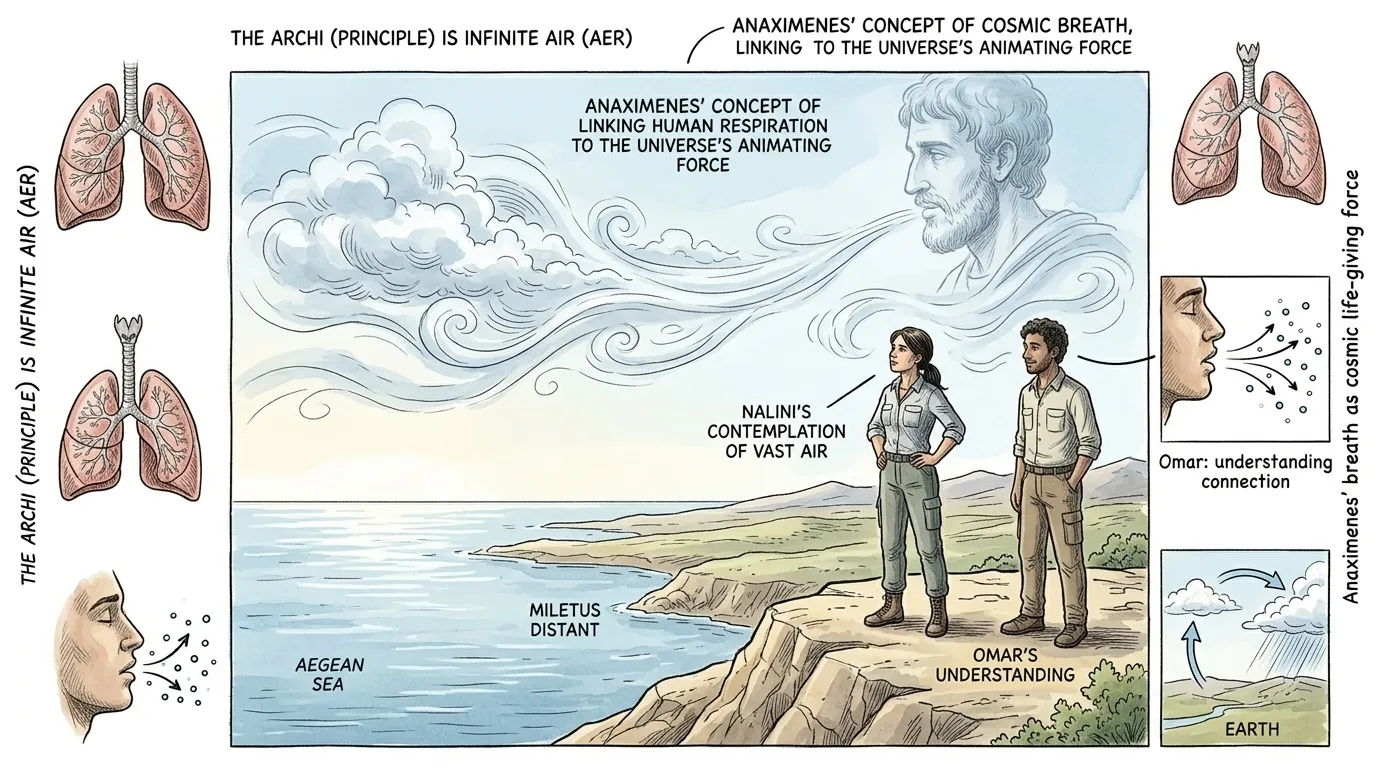
Anaximenes also likened air to the human soul, suggesting that just as breath sustains life, air sustains the cosmos. This analogy emphasizes the vital and dynamic nature of air. It is not just a passive element, but an active force that animates and structures the universe.
"Nalini looked thoughtful. 'So, the whole world breathes like we do?' Omar nodded. 'That's kind of how Anaximenes saw it. Everything connected, everything alive, through air.'"
Philosophy Note: Anaximenes's concept of air as the 'breath of the world' highlights the interconnectedness of all things.
Page 6

While Anaximenes's theory was innovative, it faced criticism. His mechanism for transformation lacked detail, and later philosophers proposed more complex models. However, his focus on observation and natural processes paved the way for scientific inquiry. It also influenced medical theories about respiration.
"'He wasn't perfect,' Omar conceded. 'But he got people thinking about how the world works in a new way.' Nalini nodded. 'Even if he didn't get everything right, he started us on the path to understanding.'"
Philosophy Note: Anaximenes's theories were not without flaws but spurred further scientific thought.
Page 7
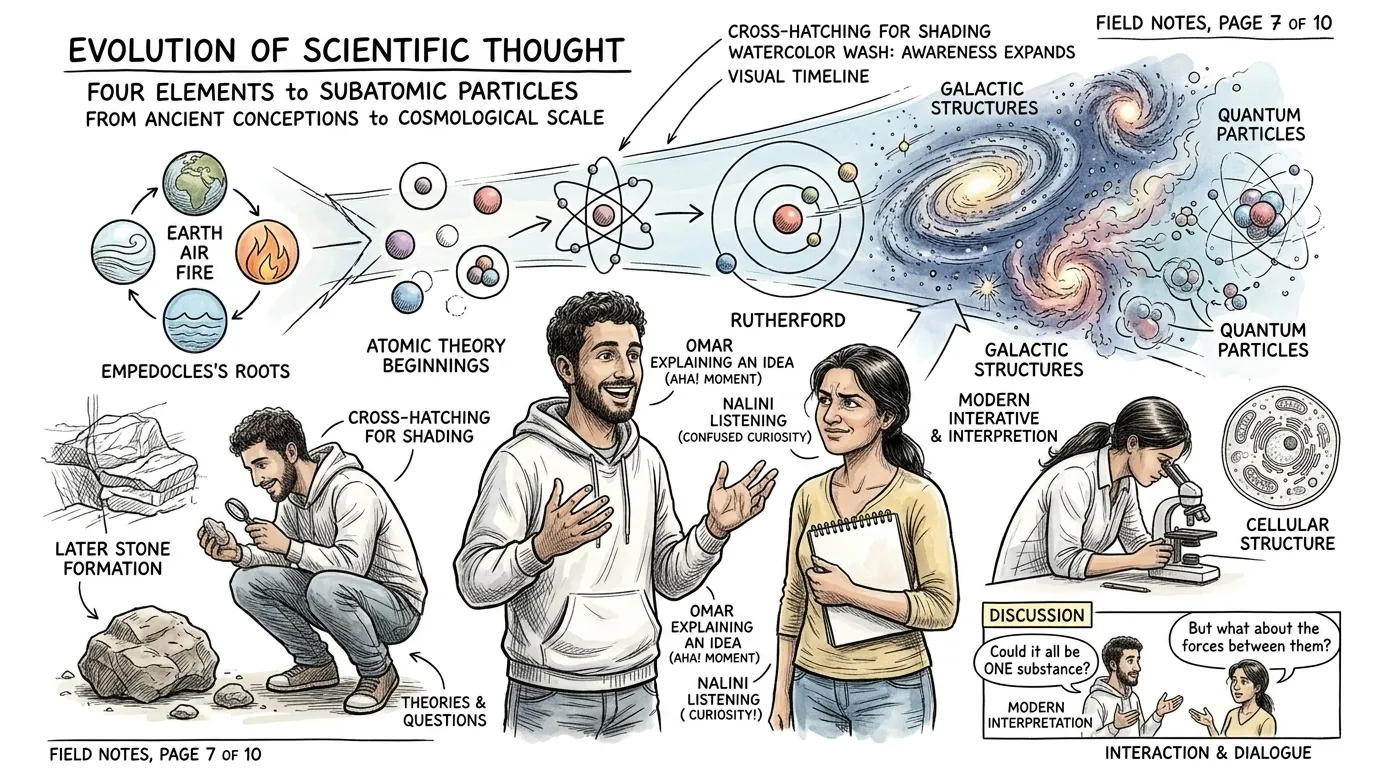
The quest for a single, unifying substance continued after Anaximenes. Empedocles proposed four elements: earth, air, fire, and water. Later, atomic theory revolutionized our understanding of matter, showing that elements are composed of atoms. Despite these advances, the underlying question remains: what are the fundamental building blocks of reality?
"Omar said, 'It reminds me of what Albert Einstein said: "The most incomprehensible thing about the world is that it is comprehensible." He meant even though it's complex, we can still understand it if we keep asking questions.' Nalini scrunched up her nose. 'So, it's okay to be confused, as long as we don't give up?'"
Philosophy Note: The search for a unified theory of everything continues in modern physics.
Page 8
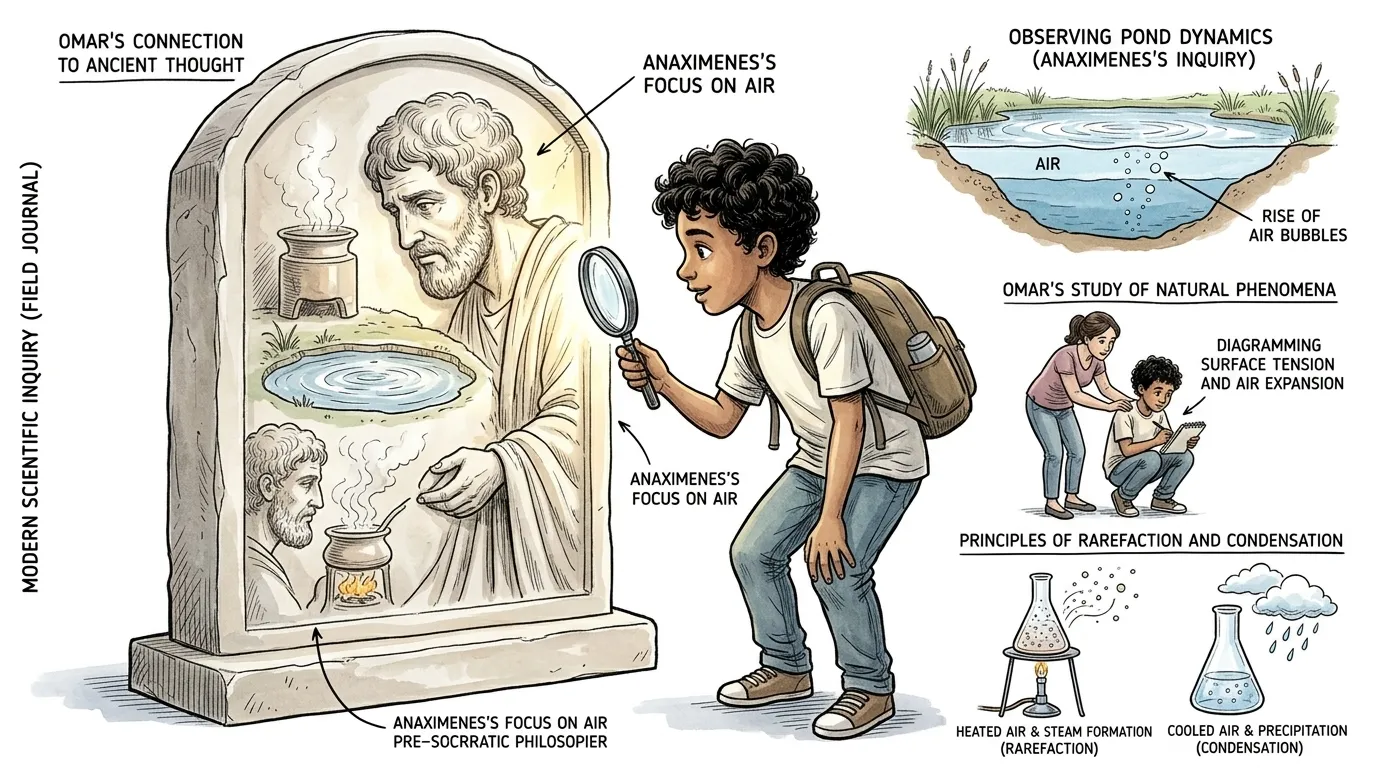
Anaximenes's emphasis on observation and rational explanation remains relevant today. His dynamic view of matter foreshadows our understanding of phase transitions and the interconnectedness of natural processes. Although air is not the single substance, the idea of a fundamental, transformable element helped lay the groundwork for scientific thought.
"'Anaximenes may not have had all the answers,' Omar said, 'but he asked the right questions. And that's what matters most.'"
Philosophy Note: The emphasis on observation and rational explanation are at the core of all scientific inquiry.
Page 9
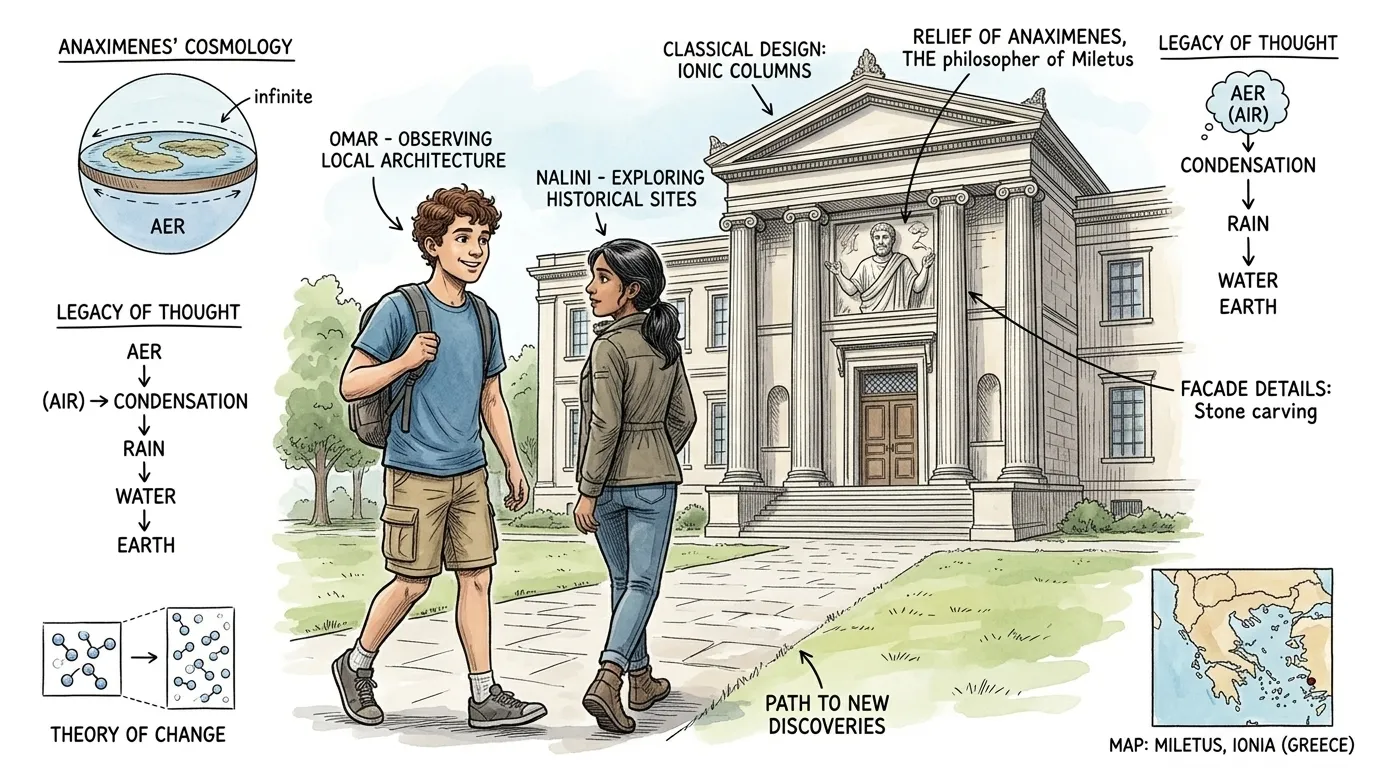
Anaximenes's legacy lies in his contribution to the shift from mythological to scientific thinking. He exemplifies the spirit of inquiry that drives our quest to understand the universe. His ideas remind us that even seemingly simple observations can lead to profound insights.
"As they left the museum, Nalini asked, 'So, even though he was wrong about some things, he still helped us get to where we are today?' Omar smiled. 'Absolutely. Every step forward builds on the steps that came before.'"
Philosophy Note: Anaximenes embodies the spirit of inquiry that continues to drive scientific progress.
Page 10
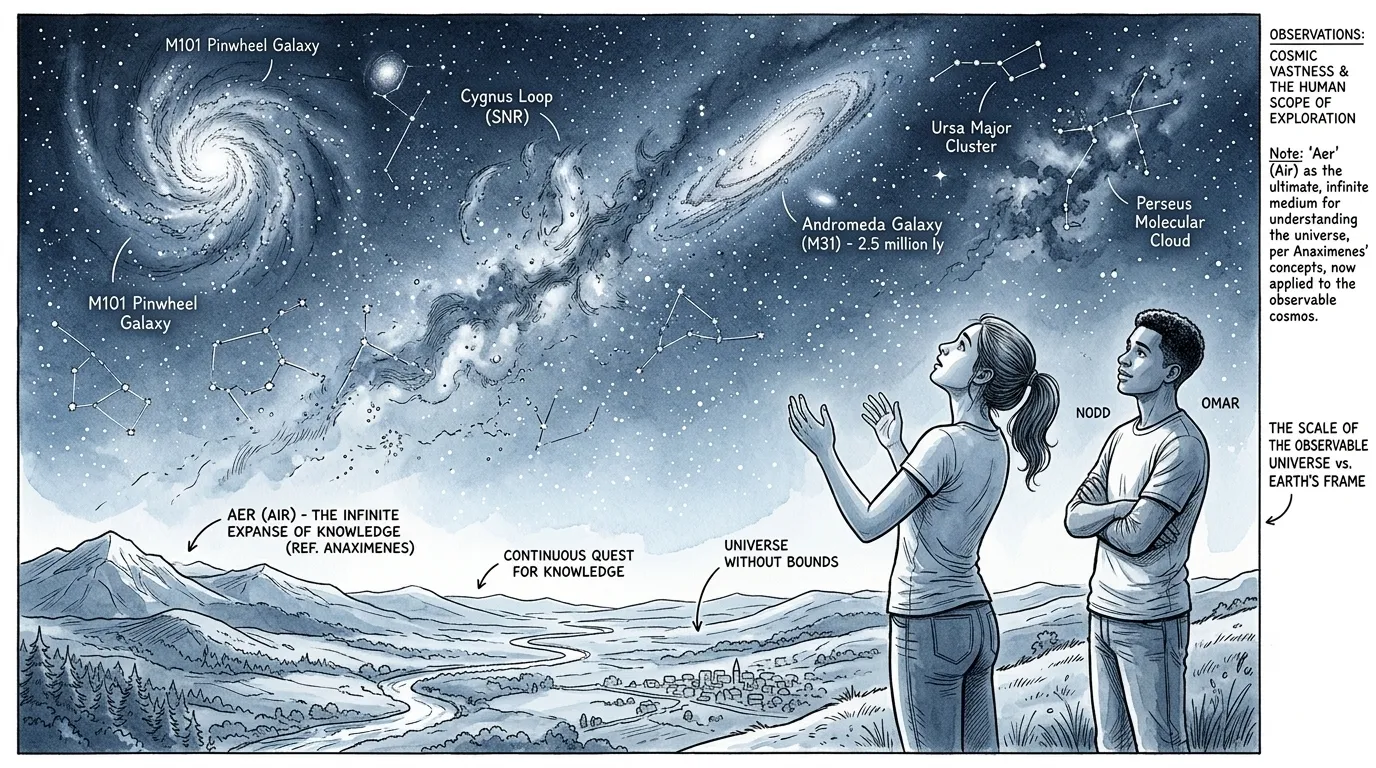
The questions Anaximenes posed are still asked by scientists. What is the nature of reality? What are the fundamental constituents of the universe? Although science has moved beyond the idea of a single element like air, the pursuit of simpler, more elegant explanations continues.
"Nalini glanced at the sky. 'There's still so much to learn!' Omar nodded. 'That's the best part. The journey never ends.'"
Philosophy Note: The questions posed by early philosophers continue to inspire scientists today.
About this story
- Audience: general readers
Questions and answers
Read Wonder Philosophy on your phone
Wonder Philosophy is available on Android and iPhone and iPad. Get Wonder Philosophy on Google Play · Get Wonder Philosophy on the App Store.