Boethius
Boethius — an illustrated philosophy story. 10 illustrated pages, free to read on Wonder Philosophy.

Page 1

In a world gripped by uncertainty, where fortunes shift like desert sands, the wisdom of Boethius, a 6th-century Roman philosopher, offers a timeless beacon. His most famous work, The Consolation of Philosophy, written while imprisoned and facing execution, grapples with questions of justice, suffering, and the nature of happiness. Even today, as we navigate personal and global crises, Boethius's insights into the transient nature of earthly goods and the enduring power of reason provide solace and perspective.
Philosophy Note: Boethius (c. 480-524 AD) was a Roman philosopher, theologian, and statesman.
Page 2

Born into a noble Roman family, Anicius Manlius Severinus Boethius rose to become a trusted advisor to Theodoric the Great, the Ostrogothic King of Italy. He dedicated himself to preserving classical knowledge, translating the works of Plato and Aristotle into Latin, making them accessible to future generations in the West. However, his commitment to justice and his defense of a wrongly accused senator led to his imprisonment on charges of treason. It was during this dark period that Boethius penned his masterpiece.
Philosophy Note: Theodoric the Great ruled the Ostrogothic Kingdom from 493 to 526 AD.
Page 3

In The Consolation of Philosophy, Boethius doesn't simply rage against his fate. Instead, he engages in a dialogue with Lady Philosophy, a personification of philosophical wisdom. She gently guides him to understand the true source of happiness lies not in fleeting worldly possessions or power, but in virtue and the pursuit of eternal truths. Lady Philosophy reminds Boethius, and us, that external circumstances cannot diminish inner strength and wisdom.
Philosophy Note: Personification is a literary device where abstract concepts are given human qualities.
Page 4
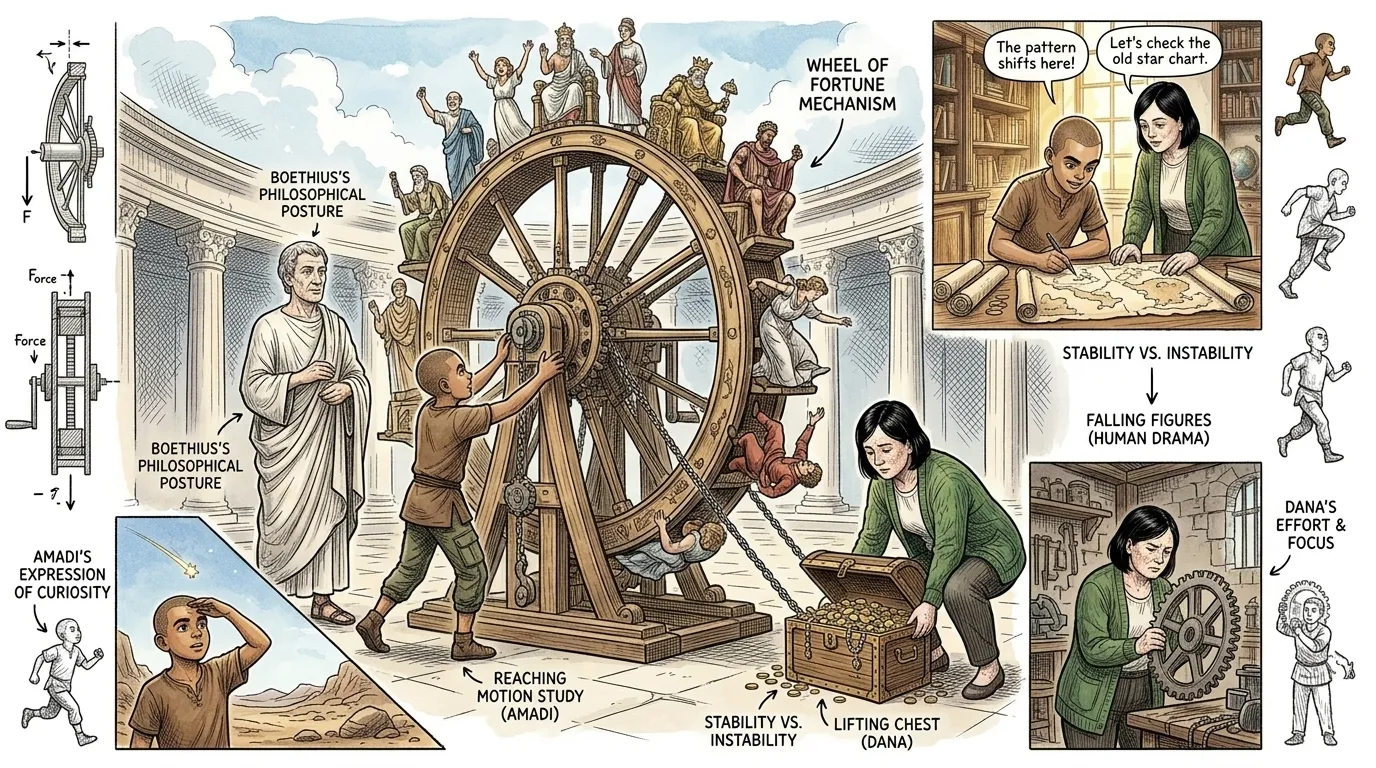
A central concept in Boethius's philosophy is the 'Wheel of Fortune.' He argues that earthly fortune is inherently unstable, constantly turning and bringing both joy and sorrow. Attaching our happiness to external things like wealth, status, or power is a recipe for disappointment because these things are inevitably taken away. True happiness, according to Boethius, comes from within, from cultivating virtue and aligning ourselves with the divine order.
Philosophy Note: Boethius drew inspiration from Neoplatonism, a philosophical school that emphasized the spiritual and the eternal.
Page 5

Boethius challenges the notion that we have complete control over our lives. External events, he argues, are often beyond our influence. However, we do have control over our internal response to these events. By cultivating wisdom, reason, and virtue, we can maintain our inner peace even amidst external chaos. This Stoic perspective emphasizes the importance of accepting what we cannot change and focusing on what we can: our thoughts and actions.
Philosophy Note: Stoicism is a philosophy emphasizing virtue, reason, and acceptance of fate.
Page 6

One of the most complex arguments in The Consolation deals with the apparent conflict between divine providence (God's all-knowing plan) and human free will. If God knows everything that will happen, does that mean our choices are predetermined? Boethius argues that God's knowledge is different from human knowledge; God sees all of time at once, but this doesn't cause our choices. We still retain the freedom to choose good or evil, and are therefore responsible for our actions.
Philosophy Note: Divine Providence refers to God's all-knowing and all-powerful guidance of the universe.
Page 7
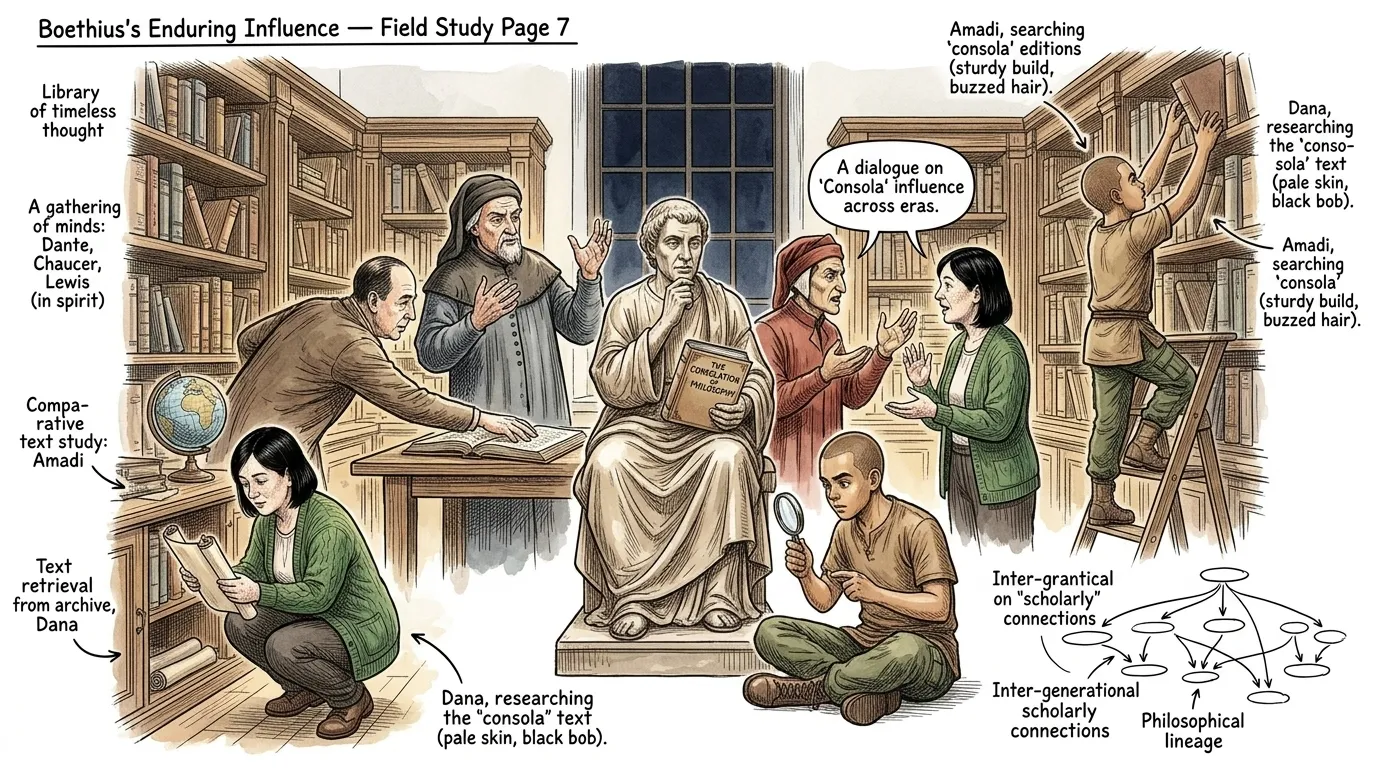
Boethius's arguments have faced criticism over the centuries. Some philosophers question his reconciliation of divine providence and free will, finding it logically inconsistent. Others challenge his emphasis on inner virtue, arguing that it can lead to passivity in the face of injustice. Despite these criticisms, The Consolation of Philosophy remains a deeply influential work, read and admired by thinkers, theologians, and artists throughout history. Its themes of resilience, hope, and the pursuit of wisdom continue to resonate with readers seeking meaning in a troubled world.
Philosophy Note: Figures like Chaucer, Dante, and C.S. Lewis were deeply influenced by Boethius's work.
Page 8

In our own age of rapid change and uncertainty, Boethius's message is as relevant as ever. When faced with setbacks, disappointments, or injustice, we can find consolation in remembering that external circumstances do not define our worth or our happiness. By focusing on cultivating inner virtue, pursuing knowledge, and accepting what we cannot control, we can navigate life's challenges with greater resilience and find lasting peace. As Amadi, a young student facing a difficult personal situation, recently remarked, remembering the words of Marcus Aurelius, "You have power over your mind - not outside events. Realize this, and you will find strength.'"
Philosophy Note: Marcus Aurelius (121-180 AD) was a Roman emperor and Stoic philosopher.
Page 9

Boethius's legacy extends beyond personal consolation. His work played a crucial role in preserving classical learning and transmitting it to the Middle Ages. His translations of Aristotle's logical works laid the foundation for medieval scholasticism. He reminds us of the enduring importance of reason, dialogue, and the pursuit of truth as essential tools for navigating the complexities of human existence. We remember the wisdom of Boethius, not just for how it speaks to our own difficulties, but for how it instructs us in the proper use of thought, logic, and the pursuit of virtue, today, tomorrow, and the days to come.
Philosophy Note: Scholasticism was a medieval philosophical and theological system that emphasized reason and logic.
Page 10

Even in the face of death, Boethius turned to philosophy to find meaning and solace. His example serves as a powerful reminder that true happiness is not dependent on external circumstances, but on the cultivation of inner virtue and the pursuit of knowledge. As we navigate the uncertainties of life, let us draw inspiration from Boethius's enduring wisdom, finding strength in reason, hope in virtue, and consolation in the pursuit of truth.
Philosophy Note: Boethius was executed in 524 AD, but his work continues to inspire millions.
About this story
- Audience: kids (ages 6–12)
Questions and answers
Read Wonder Philosophy on your phone
Wonder Philosophy is available on Android and iPhone and iPad. Get Wonder Philosophy on Google Play · Get Wonder Philosophy on the App Store.