Byung-Chul Han
Byung-Chul Han — an illustrated philosophy story. 10 illustrated pages, free to read on Wonder Philosophy.

Page 1
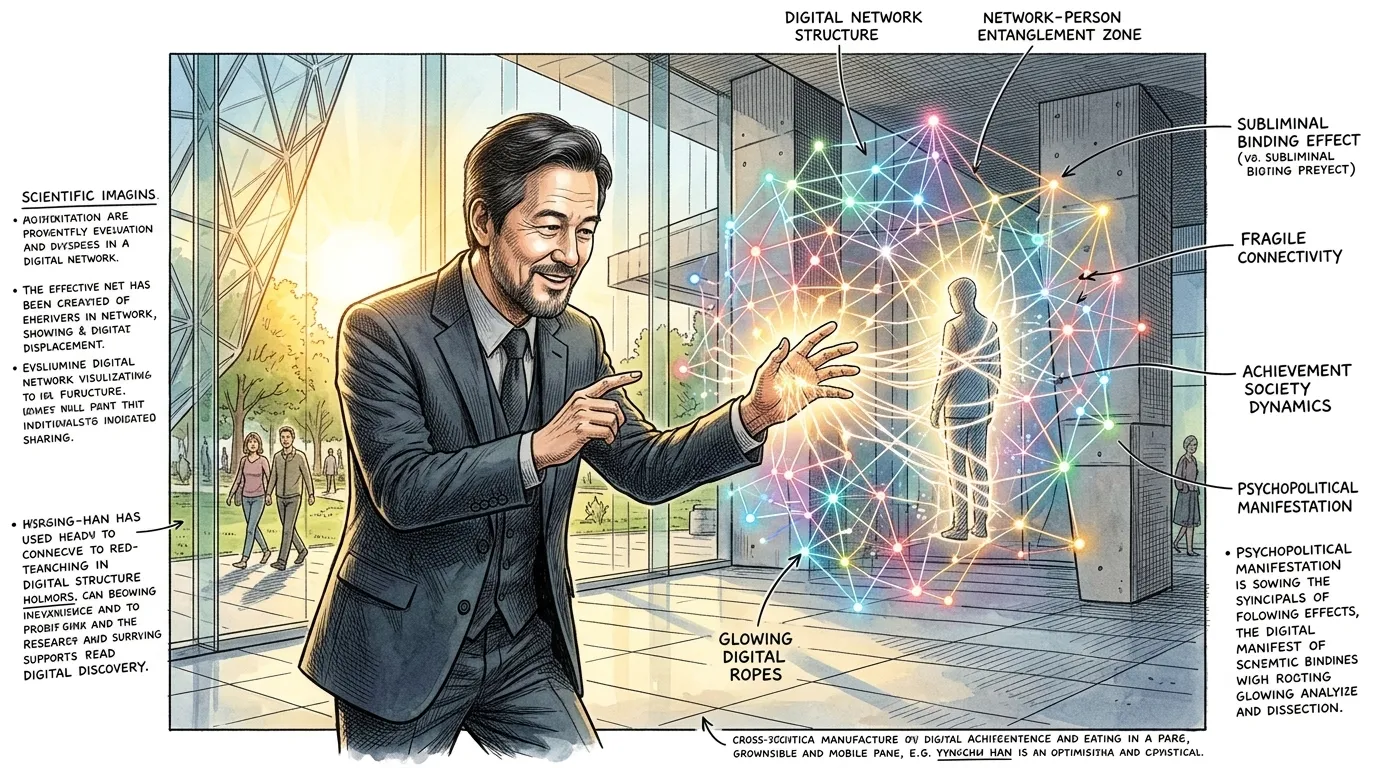
In an era defined by endless possibility and digital connection, philosopher Byung-Chul Han offers a stark counter-narrative. His work dissects the hidden costs of our relentless pursuit of success, arguing that modern society, while appearing free, has subtly shifted from external coercion to internal self-exploitation. This new paradigm shapes our very understanding of freedom, work, and well-being. Today, we explore his foundational critique of the 'achievement society' and its profound human impact.
Philosophy Note: Byung-Chul Han: A South Korean-born German philosopher and cultural theorist. His work examines the effects of neoliberalism, digitization, and hyper-connectivity on contemporary society.
Page 2
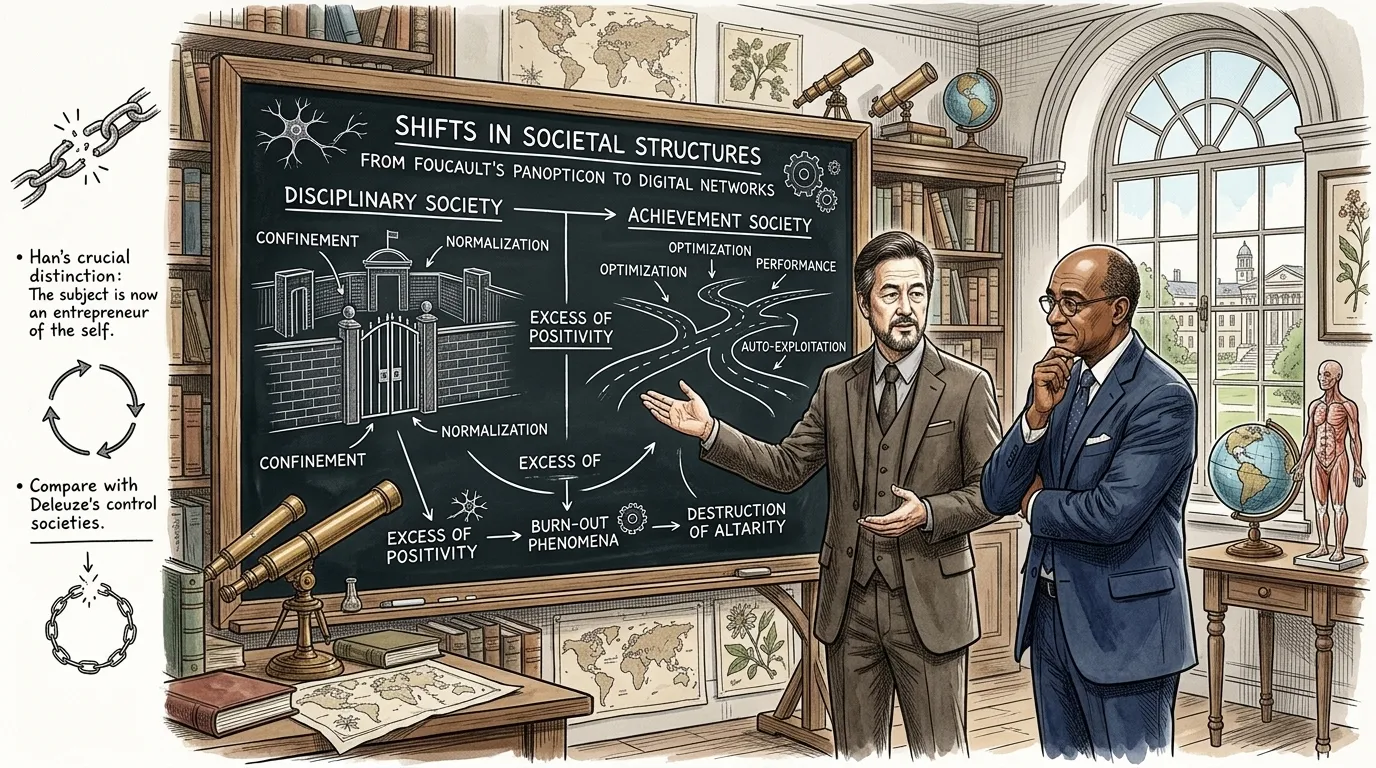
Byung-Chul Han suggests that we have transitioned from a 'disciplinary society,' characterized by prohibitions and external control, to an 'achievement society' driven by the imperative to 'can.' This seemingly positive shift, he argues, has profound implications, moving the locus of exploitation from an external oppressor to the individual themselves.
"Byung-Chul Han gestures towards a diagram. "Consider the shift, Professor Appiah. Michel Foucault described a 'disciplinary society' where power operates through prohibition, through the 'must not.' It was about confinement, surveillance, and negative commands." Kwame Anthony Appiah, a distinguished Ghanaian-British philosopher in his late 60s, wearing a smart navy suit and spectacles, nods thoughtfully. "Indeed. Factories, prisons, schools – institutions that dictated what one could not do, shaping obedient subjects." Han replies, "Precisely. But now, the dominant modality is no longer the 'must not,' but the 'can.' We are no longer merely subjects of discipline; we are 'achievement subjects,' constantly striving to optimize ourselves. As Foucault himself observed about power, it's not just repressive; it's productive, shaping us in new ways.""
Philosophy Note: Disciplinary Society (Foucault): Characterized by institutions (prisons, factories, schools) that enforce norms through external control and prohibitions. Achievement Society (Han): Driven by an internal imperative to perform and optimize, often leading to self-exploitation.
Page 3
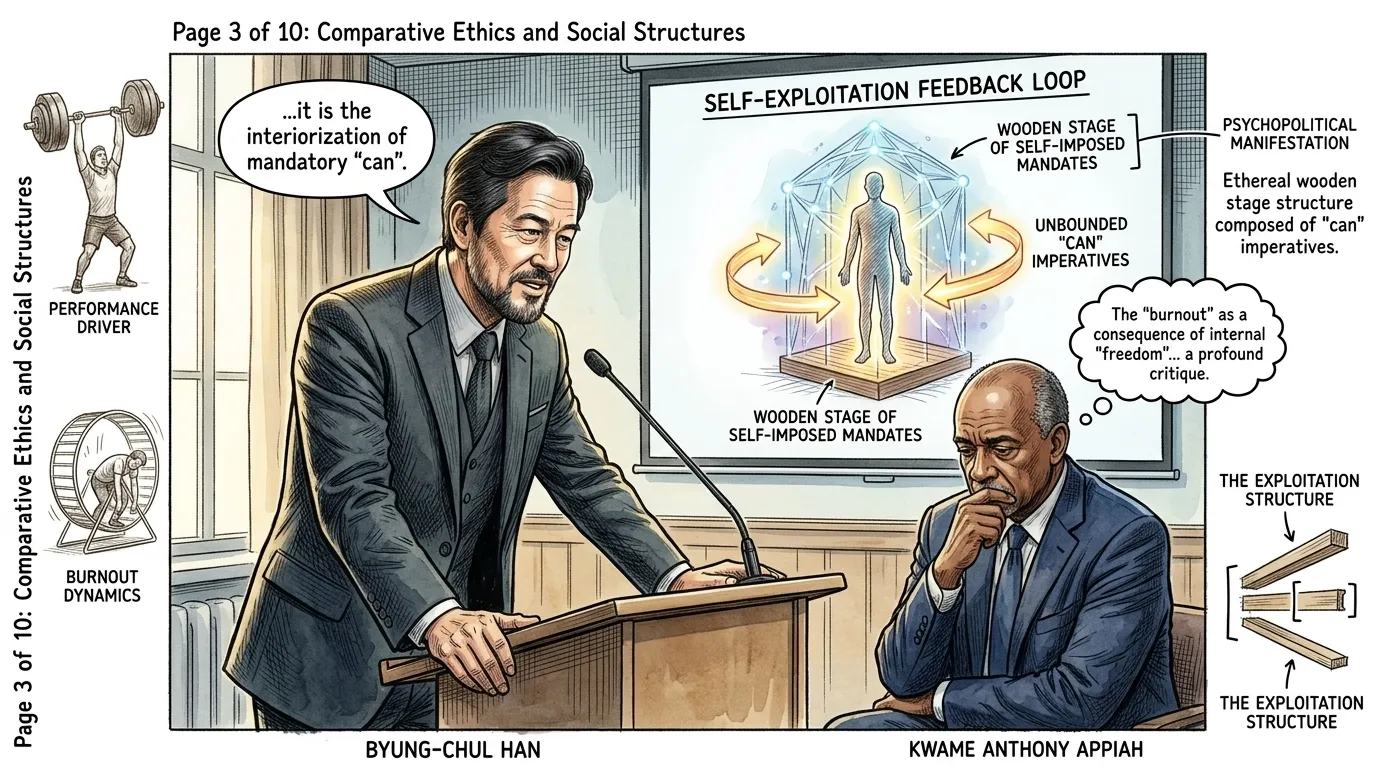
In the achievement society, the absence of overt external constraints is often mistaken for absolute freedom. However, Han argues that this internal drive for limitless achievement becomes its own form of tyranny. We are not forced to work; we are internally compelled to optimize, to produce, to achieve, endlessly. This boundless 'can' generates a constant pressure to perform, turning freedom into a self-imposed prison.
"Appiah queries, "So, the individual is seemingly free, unburdened by external prohibitions, yet becomes a taskmaster to themselves?" Han affirms, "Exactly. The entrepreneur of the self. We operate under the delusion that we are entirely free, but this freedom is paradoxical. We are free to exploit ourselves, to chase endless performance targets. This internal pressure is far more effective than any external boss." Appiah leans in. "And this leads to a unique form of suffering, distinct from the alienation of industrial labor." Han nods gravely. "Indeed. We willingly internalize the demands of the system, transforming the external master into an inner voice, an inner drive. This is the subtle tyranny of the 'can.' We become our own exploiters, and in doing so, we become unable to complain, for who is there to blame but ourselves?""
Philosophy Note: Self-exploitation: The process by which individuals, driven by internal imperatives, push themselves to constantly achieve and perform, becoming both master and slave to themselves.
Page 4
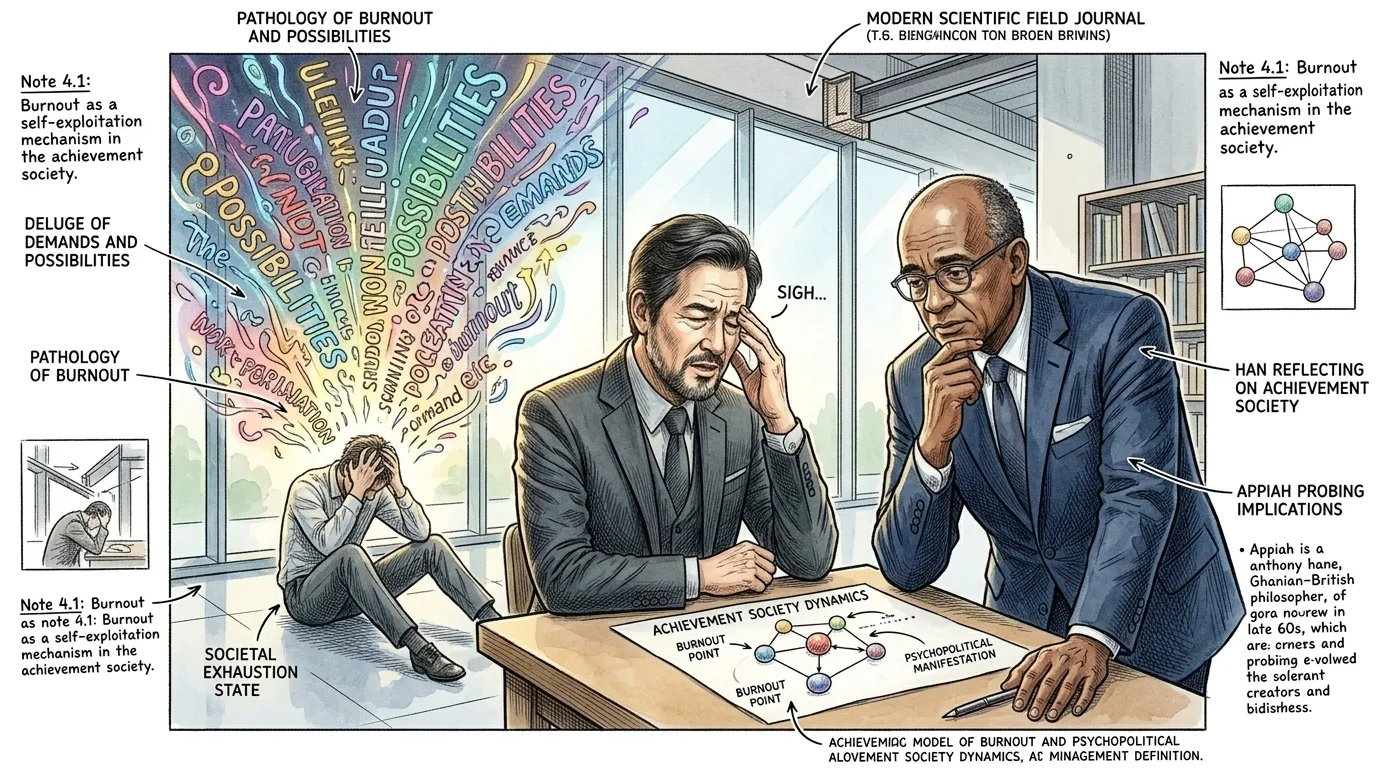
The relentless pressure to achieve and constantly optimize, without the external boundaries of the disciplinary society, inevitably leads to a state of exhaustion. Byung-Chul Han identifies 'burnout' not merely as personal fatigue, but as a signature pathology of the achievement society. It is the collapse of the self-exploiting subject, overwhelmed by the ceaseless imperative to 'can.'
"Appiah probes, "This relentless self-optimization, it must have consequences for the individual's mental state?" Han sighs, "It does, profoundly. This boundless positive imperative, the 'can,' leads to overwork, over-production, and ultimately, a 'burnout society.' It is not an individual failing; it is a systemic pathology. The depression, the anxiety, the exhaustion – these are the symptoms of a self pushed beyond its limits by its own internal demands." Appiah reflects, "So, the very freedom to achieve becomes the instrument of one's own undoing. A very modern form of suffering, indeed." Han adds, "The disciplinary subject was prohibited; the achievement subject suffers from an excess of positive impulses. They drown in a sea of possibilities and demands, leading to a profound inner emptiness, a spiritual exhaustion.""
Philosophy Note: Burnout: A state of chronic physical, emotional, and mental exhaustion caused by prolonged or excessive stress. Han interprets it as a societal pathology stemming from the achievement society's demands.
Page 5
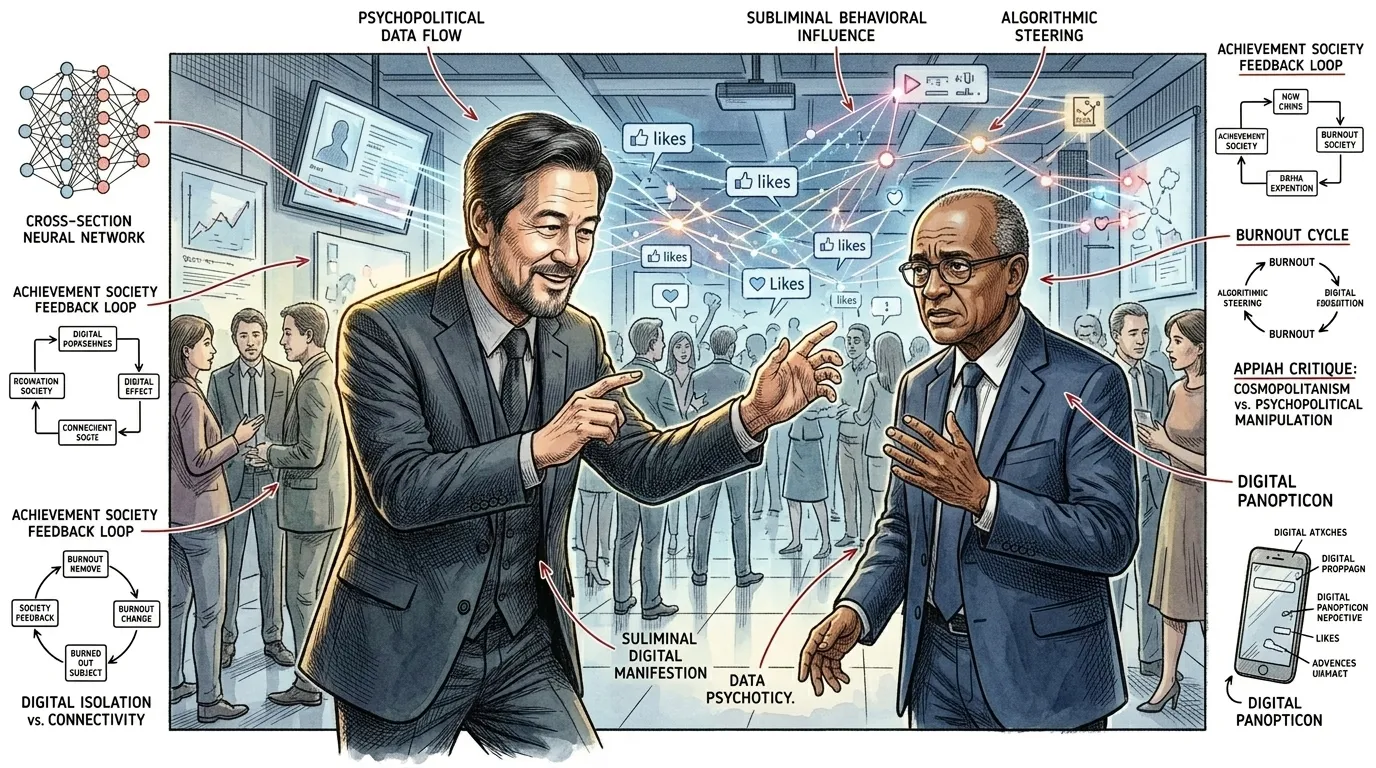
Han expands his critique to 'psychopolitics,' a form of power that operates not through coercion, but by subtly influencing and controlling the psyche. In the age of big data and digital platforms, our seemingly free choices and expressions are harvested, analyzed, and used to predict and steer our behavior. We willingly provide the data that becomes the raw material for our own control, blurring the lines between freedom and manipulation.
"Appiah raises a point. "And this pursuit of self-optimization, the constant expression of the 'can,' feeds into another phenomenon, doesn't it? The collection of our very selves." Han nods. "Precisely. This brings us to 'psychopolitics.' It is a form of power that doesn't prohibit but seduces. It doesn't demand obedience through force, but through 'liking' and 'sharing.' Our data, our preferences, our emotional states—these are harvested and used to create profiles that predict and subtly influence our behavior, often without our conscious awareness." Appiah frowns. "So, our freedom to express ourselves online, to participate in this digital world, becomes the very mechanism of our subtle control?" Han concludes, "It is a soft power, far more efficient than brute force. We voluntarily expose ourselves, providing the very fuel for our own governance. The algorithm is the new shepherd, guiding us through a landscape of manufactured choices, all while we believe we are charting our own course.""
Philosophy Note: Psychopolitics: Han's term for a new form of power that governs by subtly influencing and controlling the human psyche through data, algorithms, and emotional manipulation, rather than overt force.
Page 6
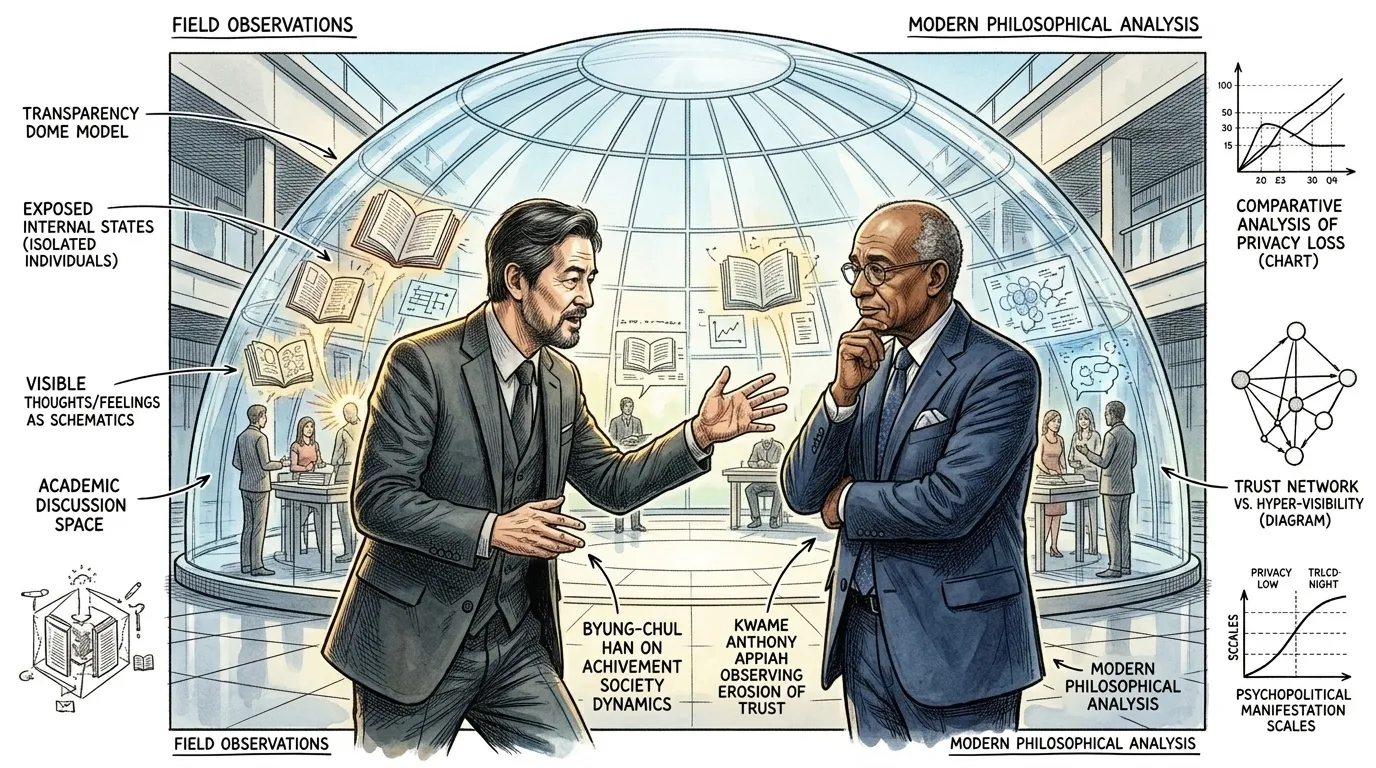
The demand for transparency, often lauded as a virtue in democratic societies, is reimagined by Han as a dangerous new form of social control. In a 'transparency society,' everything must be visible, accessible, and accountable. This hyper-visibility erodes trust, privacy, and ultimately, genuine human connection, leading to a flattening of existence where nothing can remain hidden, complex, or ambiguous.
"Appiah considers the implications. "The constant data collection, the psychopolitical influence... this seems to require an unprecedented level of openness, a 'transparency' from individuals." Han affirms, "Indeed. This leads to the 'transparency society,' where everything is compelled to be visible, lucid, and immediate. We are pressured to make our thoughts, feelings, and actions transparent. But genuine trust, Professor Appiah, flourishes in the spaces of the unsaid, the unseen, the mysterious. Absolute transparency obliterates such spaces." Appiah muses, "So, instead of fostering trust, it might paradoxically undermine it by leaving no room for faith or interpretation." Han agrees. "When everything is immediately visible, suspicion can easily replace trust. Nothing is left to the imagination, nothing can be hidden or complex. This hyper-visibility, born of the 'can' imperative to express and share, ultimately flattens human relationships and removes the possibility of depth.""
Philosophy Note: Transparency Society: A concept where societies demand absolute visibility and accountability, leading to an erosion of privacy, trust, and ambiguity, often fueling suspicion rather than genuine openness.
Page 7
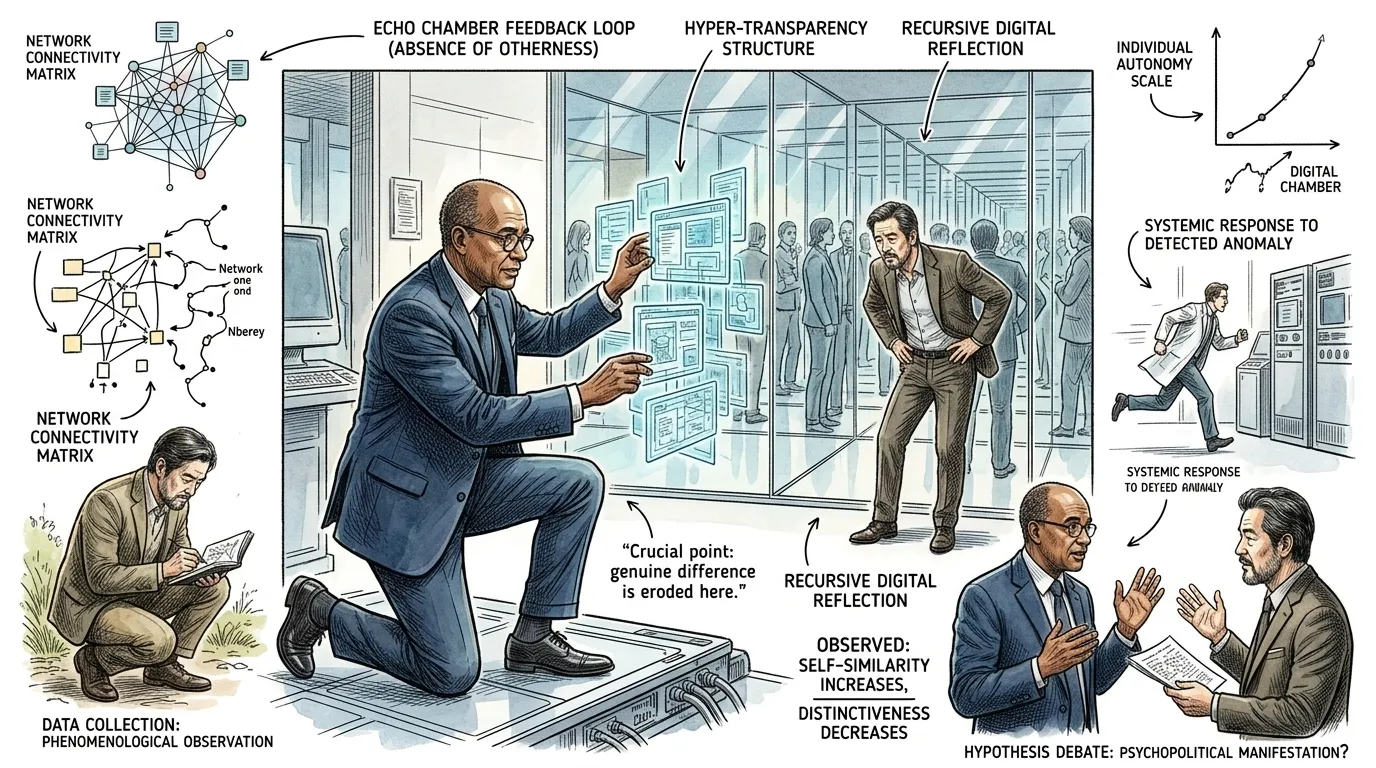
Byung-Chul Han posits that the achievement society and its hyper-connectivity lead to an 'absence of Otherness.' We are constantly surrounded by our own reflections, echoing our own ideas and preferences in digital echo chambers. This lack of genuine encounter with the truly different, the unfamiliar, deprives us of the necessary friction for growth, critical thought, and deep contemplation, pushing us towards narcissistic self-referentiality.
"Appiah raises a crucial point. "If we are constantly optimizing ourselves, and our digital spaces reflect our own preferences, are we not losing something vital – the encounter with genuine difference?" Han nods slowly. "Indeed. We are losing 'Otherness.' In the achievement society, even the 'other' is consumed and integrated into the self, rendered harmless, made 'like me.' We are bombarded with information, but it is often a reflection of ourselves. This 'sameness' removes friction, the irritation, the pause that genuine Otherness demands." Appiah considers this. "So, contemplation, true thought, requires that encounter with something genuinely outside our own experience?" Han affirms, "Absolutely. Contemplation requires slowness, a certain degree of boredom, a readiness to engage with something profoundly different, something that resists immediate categorization. The achievement subject, constantly active, always producing, finds this stillness impossible.""
Philosophy Note: Absence of Otherness: Han's concept that hyper-connectivity and self-referential digital spaces diminish our genuine encounter with difference, reducing opportunities for critical thought and contemplation.
Page 8
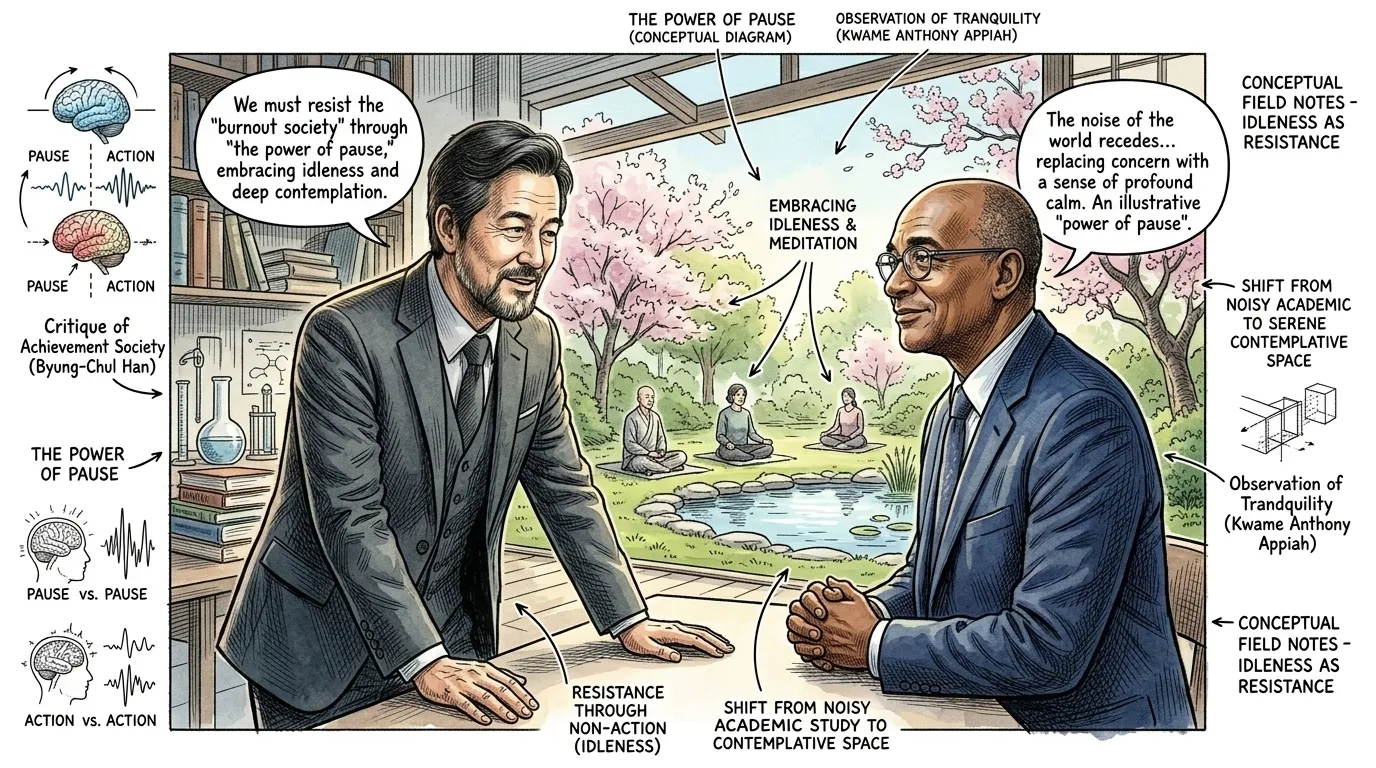
If the problem lies in the relentless internal imperative to 'can,' then resistance, for Han, lies not in revolution, but in a profound shift of being. It means cultivating moments of pause, contemplation, and allowing for the unproductive, the un-optimized, the truly 'other.' The insight into the self-exploiting nature of the achievement society (the knowledge setup) allows us to understand that our freedom lies in our capacity to not always 'can,' to embrace a different temporality and depth.
"Appiah asks, "If the problem is this invisible, internal imperative, how do we resist it? How do we break free from a tyranny we impose on ourselves?" Han replies, "The solution is not a political revolution in the traditional sense, but an internal one. It lies in recognizing the 'tyranny of the can'—the knowledge we discussed earlier. Once we grasp that the boundless demand to perform is self-imposed, we can begin to resist it. We must cultivate a different temporality, a capacity for contemplation, for slowness, for boredom, for allowing things to simply be." Appiah muses, "So, the 'power of pause,' a deliberate withdrawal from constant activity and stimulation, becomes the antidote?" Han agrees. "Precisely. We must reclaim our capacity for idleness, for deep attention, for engaging with the 'other' without immediately consuming it. This is how we begin to dismantle the psychopolitical control and the burnout it engenders. It is a subtle but profound act of liberation.""
Philosophy Note: Resistance: For Han, resistance to the achievement society involves cultivating contemplation, embracing idleness, and re-engaging with Otherness, rather than external political action. This is the payoff of understanding the 'tyranny of the can'.
Page 9
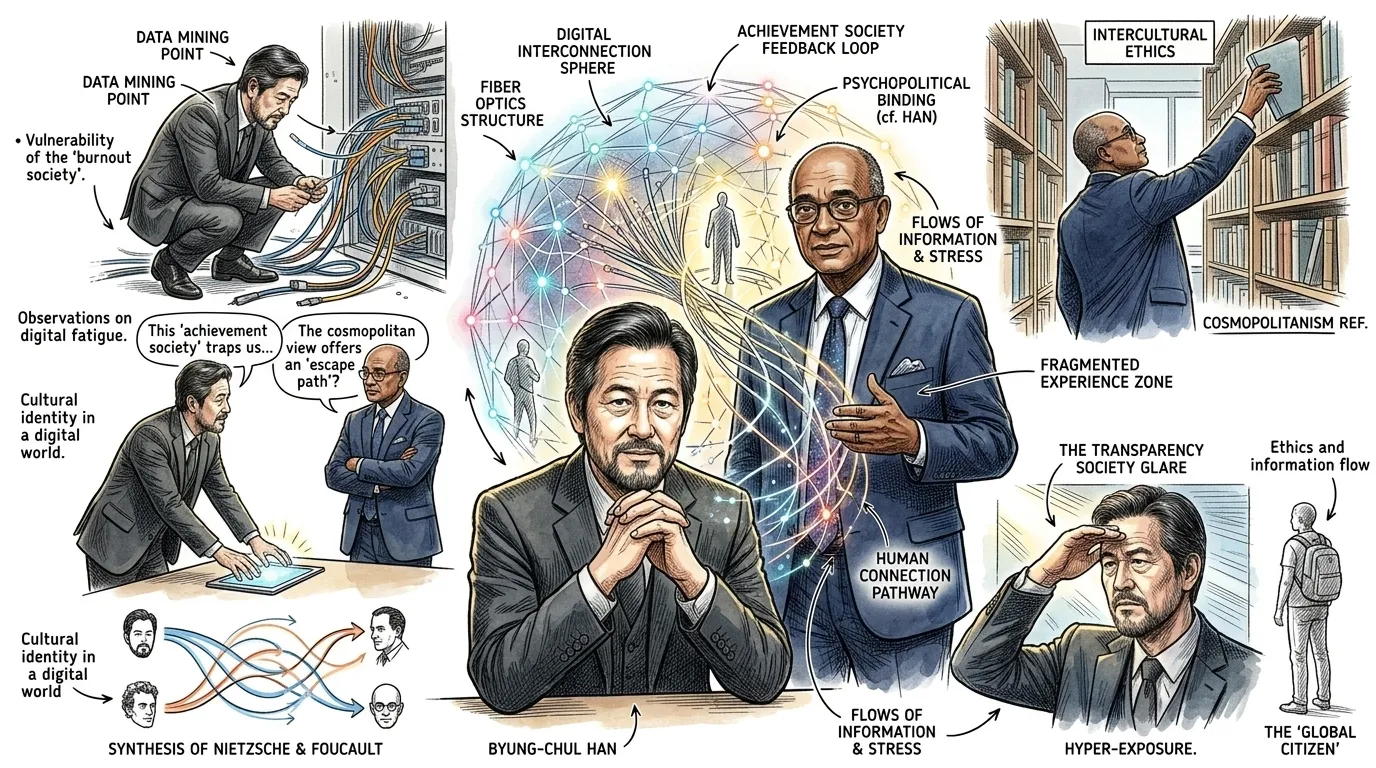
Byung-Chul Han's work resonates deeply in our contemporary world. His critique forces us to confront uncomfortable truths about our perceived freedoms, the relentless pace of modern life, and the subtle mechanisms that shape our identity and behavior. He challenges us to question whether our constant connectivity and drive for achievement are truly enriching or subtly impoverishing our human experience, offering a powerful framework to navigate the paradoxes of the digital age.
"Appiah concludes, "Han's insights truly compel us to re-evaluate our definitions of freedom and success in the digital age." Han nods, "Indeed. My aim is not to simply criticize, but to encourage a different mode of being. To challenge the illusion that more activity, more information, more production equates to more life. It often signifies less." Appiah considers. "His work provides a crucial lens through which to examine our relationship with technology, with work, and with ourselves, offering tools to understand the unseen pressures of our time." Han adds, "The questions I raise are fundamental: What does it mean to be truly human when constantly connected, constantly performing? How do we find depth, meaning, and genuine connection amidst the clamor of the 'can'? These are the enduring challenges of our age.""
Philosophy Note: Legacy: Han's work continues to offer critical perspectives on mental health, digital culture, and the nature of freedom in neoliberal societies, influencing discussions on philosophy, sociology, and media studies.
Page 10
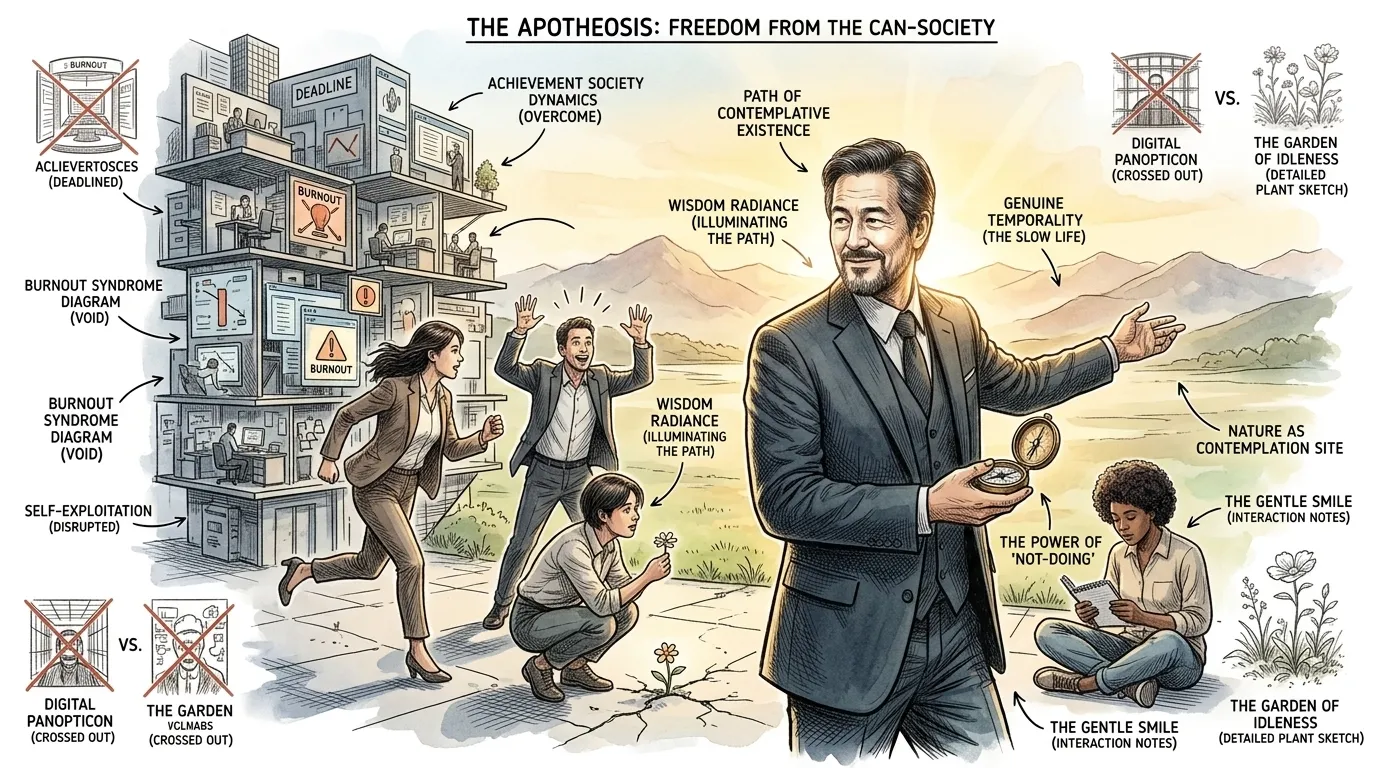
Byung-Chul Han's philosophy provides a vital diagnostic tool for understanding the maladies of contemporary life. His insights challenge us to re-evaluate our relationship with work, technology, and our inner selves. By recognizing the 'achievement society's' insidious demands, we gain the awareness necessary to cultivate spaces of true freedom, contemplation, and meaningful existence, moving beyond the endless 'can' towards a richer, more profound way of being.
Philosophy Note: Relevance: Han's theories offer practical insights for individuals navigating burnout, digital overload, and the pressure to constantly perform. They encourage a re-prioritization of contemplation, slowness, and genuine connection.
About this story
- Audience: general readers
Questions and answers
Read Wonder Philosophy on your phone
Wonder Philosophy is available on Android and iPhone and iPad. Get Wonder Philosophy on Google Play · Get Wonder Philosophy on the App Store.