Cornel West
Cornel West — an illustrated philosophy story. 8 illustrated pages, free to read on Wonder Philosophy.

Page 1

The vast amphitheater buzzes, not with anticipation for a political rally, but for an intellectual intervention. On a large screen, the image of Cornel West, vibrant and impassioned, commands attention. Two distinguished scholars, Dr. Anya Sharma and Dr. Ben Carter, stand before a curated exhibition, ready to illuminate the profound impact of his work.
""Good evening," Dr. Anya Sharma begins, gesturing towards the screen. "We confront complex realities in our world, demanding not just analysis, but moral courage. Tonight, we explore the thought of Cornel West, a philosopher who embodies the fusion of deep intellectual rigor with an unyielding commitment to justice." Dr. Ben Carter adds, "Indeed. West's work, often termed 'prophetic pragmatism,' calls us to critically examine power structures and cultivate compassion, refusing to separate intellectual pursuit from lived struggle.""
Philosophy Note: Cornel West: An American philosopher, activist, and public intellectual, born 1953. His work primarily focuses on race, gender, and class in American society, drawing from existentialism, pragmatism, and critical theory. 'Prophetic Pragmatism' is his unique intellectual framework, emphasizing moral critique and action.
Page 2

Dr. Sharma guides the audience through the foundational influences shaping West's philosophy. Dr. Carter provides crucial historical context, emphasizing how West synthesizes seemingly disparate intellectual traditions into a coherent and potent critical framework.
""To understand West's prophetic edge," Dr. Sharma explains, "we must first grasp his intellectual heritage. He draws deeply from existentialism, particularly its emphasis on radical freedom and responsibility, and the anguish of choice in a world devoid of inherent meaning. Figures like Kierkegaard, Nietzsche, and Sartre resonate throughout his calls for authentic living." Dr. Carter elaborates, "Precisely. But West also anchors this existential angst in American pragmatism, especially the tradition of Ralph Waldo Emerson, William James, and John Dewey. This grounds his thought in democratic ideals, social experimentation, and a commitment to practical, lived consequences, rather than abstract theorizing. It's this unique synthesis that sets him apart.""
Philosophy Note: Existentialism: A philosophical movement emphasizing individual existence, freedom, and responsibility. Pragmatism: An American philosophical tradition focusing on practical consequences and the instrumental nature of knowledge. West's innovation lies in integrating these, demanding that individual moral choices translate into social action.
Page 3

West's critique extends beyond mere policy; he diagnoses a spiritual and moral crisis at the heart of modern American society. Dr. Sharma and Dr. Carter discuss how he attributes this to a pervasive nihilism and the suffocating influence of market culture.
""West argues that the great crisis of modern America isn't just economic or political," Dr. Sharma states, her voice somber. "It's a profound spiritual decrepitude, a nihilism that undermines genuine human connection and purpose. He sees this manifesting as an addiction to superficial pleasures and a deep-seated fear of acknowledging suffering." Dr. Carter nods, adding, "And a significant driver of this is what he terms 'market culture.' This isn't just about economics; it's a way of life that elevates profit and consumption above all else, turning everything—from education to human relationships—into commodities. It fosters a sense of isolation and meaninglessness, even amidst material abundance. This systematic devaluation of human dignity is the 'spiritual catastrophe' he continually warns against.""
Philosophy Note: Nihilism: The belief that life is without objective meaning, purpose, or intrinsic value. Market Culture: A societal framework where economic values and market forces predominantly shape social relations, ethics, and individual identity, often leading to the commodification of human experience.
Page 4

Central to West's philosophy is the concept of 'prophetic witness' – a call to speak truth to power, even at great personal cost. Dr. Sharma and Dr. Carter discuss the courage and critical insight required to uphold this demanding moral stance.
""If West diagnoses a crisis, his remedy is 'prophetic witness'," Dr. Sharma articulates, her gaze unwavering. "It demands that individuals and communities speak truth to power, expose injustice, and articulate alternatives rooted in love and justice. This isn't just academic critique; it's a lived commitment, often requiring profound personal sacrifice, much like the biblical prophets he frequently references." Dr. Carter expands, "Indeed, he often quotes Antonio Gramsci, who once said, 'The old world is dying, and the new world struggles to be born: now is the time of monsters.' West sees prophetic witness as our only defense against these 'monsters'—the insidious forces of oppression and spiritual decay. It requires a relentless questioning of dominant narratives and an unflinching solidarity with the marginalized, resisting the temptation of comfortable assimilation.""
Philosophy Note: Prophetic Witness: A concept drawn from religious traditions, adapted by West to signify an ethical stance involving bold, principled critique of injustice and oppressive power structures, driven by love and a vision for a more just future. Antonio Gramsci (1891–1937): Italian Marxist philosopher and politician, whose work focused on hegemony and power structures.
Page 5

West rigorously examines the historical and structural underpinnings of oppression, particularly the intertwining forces of race and class. Dr. Sharma and Dr. Carter delve into his 'genealogical' approach to understanding power dynamics.
""West's critique is never abstract," Dr. Sharma asserts. "He offers a 'genealogy' of power, meticulously tracing how race, class, and gender have been constructed and deployed to maintain hierarchies within the American empire. He insists on understanding these dynamics as historically specific and profoundly material, shaping lived realities." Dr. Carter clarifies, "He's particularly sharp on how 'whiteness' was historically forged as a social construct, not a biological one, to divide and conquer labor movements, thereby upholding capitalist power. This historical analysis reveals how racial subjugation is inextricably linked to economic exploitation, demanding not just civil rights reform, but systemic transformation. He shows us how these structures are inherited, often unconsciously, in our institutions and even our individual psychologies.""
Philosophy Note: Genealogy of Power: A method, inspired by Michel Foucault, that traces the historical origins and transformations of concepts, practices, and institutions to reveal how power operates and shapes social reality. West applies this to race and class.
Page 6

Beyond critique, Cornel West offers a profound call for radical love and justice as the ultimate expressions of prophetic action. Dr. Sharma and Dr. Carter discuss how he defines these terms, not as sentimental ideals, but as demanding moral practices.
""For West, love isn't just a feeling; it's a verb, a demanding ethical practice," Dr. Sharma explains, her voice reflecting conviction. "It's about recognizing the humanity in every person, especially the most downtrodden, and acting in solidarity with them. This radical love, or 'agonal love' as he sometimes calls it, involves struggle and confronting suffering head-on." Dr. Carter agrees, adding, "And justice isn't just about legal fairness. It's about ensuring that all individuals have the opportunities and resources to flourish, to realize their full potential, free from oppression. West contends that without love, justice becomes cold and bureaucratic; without justice, love risks being mere sentimentality. They are inextricably linked, forming the core of his vision for a truly democratic and humane society, challenging us to build a better world, one act of compassion at a time.""
Philosophy Note: Radical Love: A concept emphasizing active, self-sacrificing solidarity with others, particularly the oppressed, as a foundational ethical and political practice. Agonal Love: A term West uses to describe love that involves struggle, confrontation, and a willingness to suffer for justice, rather than a sentimental or passive affection.
Page 7

Cornel West's chosen path as a public intellectual and his active political engagement have often placed him at the center of controversy. Dr. Sharma and Dr. Carter discuss the tensions and criticisms inherent in such a role, comparing his approach to other critical thinkers.
""West's decision to remain deeply embedded in public discourse and political organizing, rather than confined to the academy, is both his strength and a source of tension," Dr. Sharma notes thoughtfully. "He consciously chooses the role of the 'prophetic agitator,' which inevitably invites scrutiny and disagreement, even from allies." Dr. Carter expands, "Indeed. While figures like Angela Davis and bell hooks also bridge academia and activism, West's particular brand of uncompromising critique, often directed at political leaders he once supported, has led to accusations of being too harsh or even divisive. Yet, for West, this is precisely the point: true prophetic witness cannot be co-opted or diluted by political expediency. It's a constant struggle to maintain integrity while engaging directly with power, a tightrope walk between academic rigor and grassroots organizing, a challenge few can sustain with his consistent fervor.""
Philosophy Note: Public Intellectual: An academic or thinker who engages extensively with public discourse and social issues beyond specialized academic circles. Angela Davis (born 1944) and bell hooks (1952–2021): Prominent American critical thinkers and activists whose work, like West's, intersects race, class, and gender studies with radical social critique.
Page 8
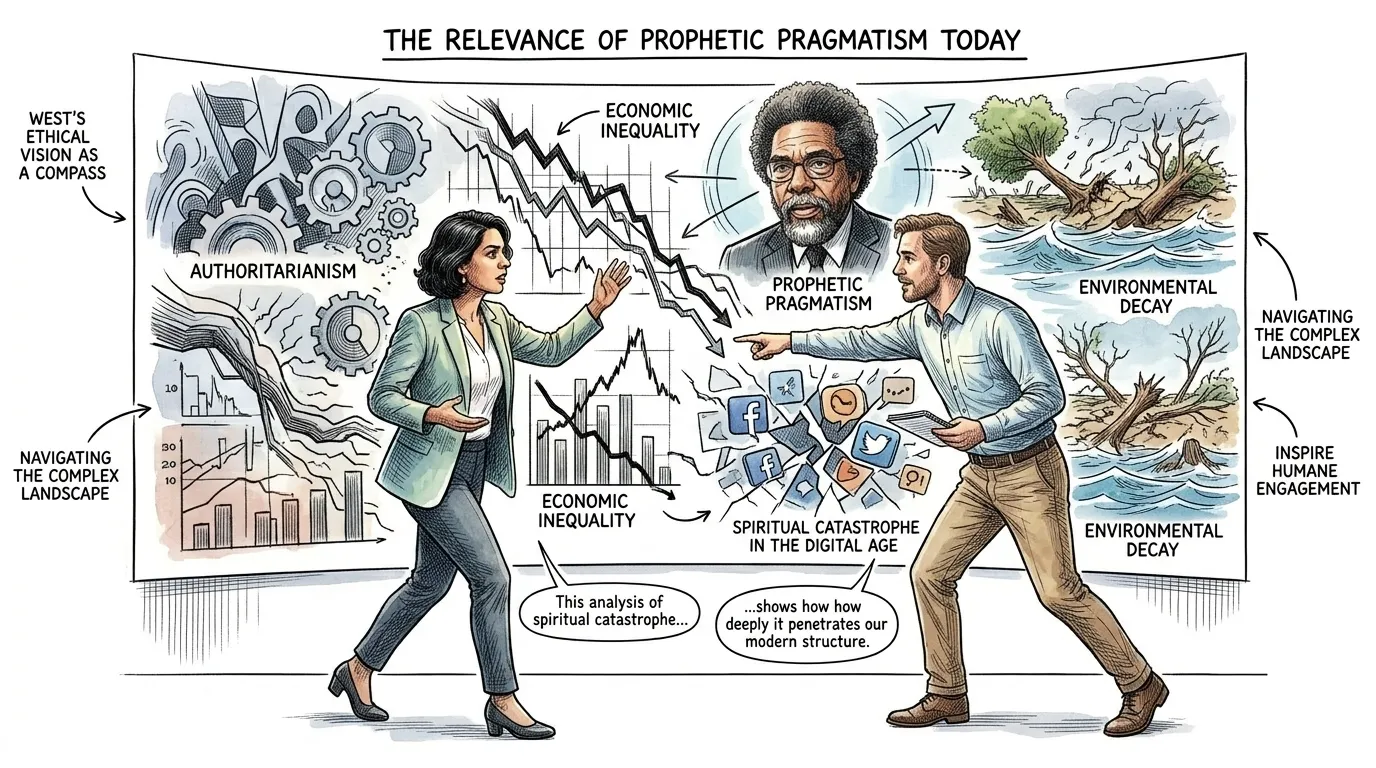
West's framework of prophetic pragmatism remains acutely relevant in understanding and addressing today's pressing global challenges. Dr. Sharma and Dr. Carter illustrate how his insights provide a crucial lens for navigating complex social and political landscapes.
""West's prophetic pragmatism offers vital tools for dissecting the crises of our time, from pervasive inequality to the erosion of democratic norms," Dr. Sharma states, her voice firm. "Consider the rise of global authoritarianism. His analysis of spiritual decrepitude and market culture helps us understand the despair that fuels such movements, recognizing that economic hardship often masks deeper existential anxieties and a hunger for meaning." Dr. Carter adds, "And that 'spiritual catastrophe' we discussed earlier? It's manifesting in stark ways now, from environmental apathy to social media's corrosive effects on genuine dialogue. West would argue we must reclaim civic courage and ethical engagement, resisting the pull of cynical detachment. His call for radical love and justice isn't just aspirational; it's a practical imperative for navigating this volatile present and building a more humane future.""
Philosophy Note: Authoritarianism: A form of government characterized by strong central power and limited political freedoms. Economic Disparity: The unequal distribution of income or wealth across a population. West's work connects these societal issues to deeper spiritual and moral failings.
About this story
- Audience: general readers
Questions and answers
Read Wonder Philosophy on your phone
Wonder Philosophy is available on Android and iPhone and iPad. Get Wonder Philosophy on Google Play · Get Wonder Philosophy on the App Store.