Edmund Husserl
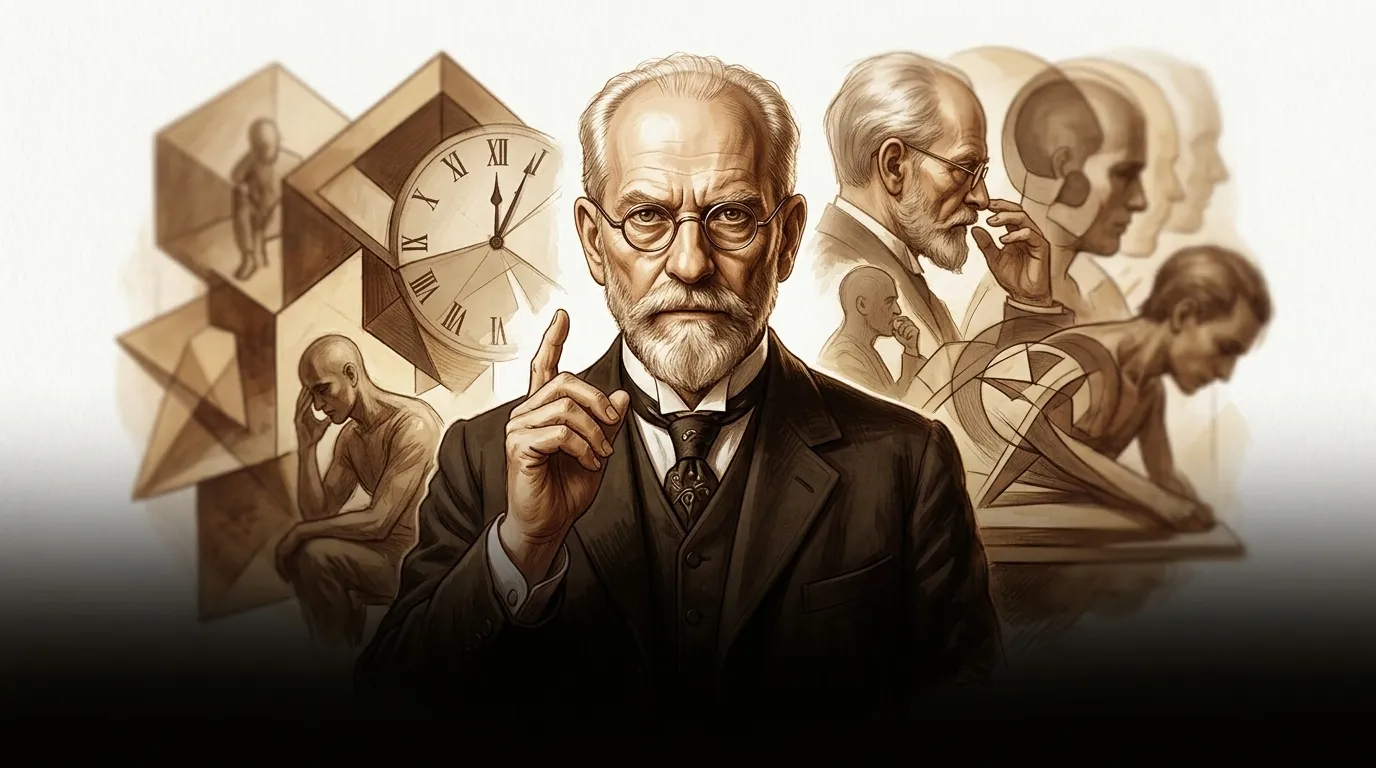
Edmund Husserl — an illustrated philosophy story. 10 illustrated pages, free to read on Wonder Philosophy.
Page 1
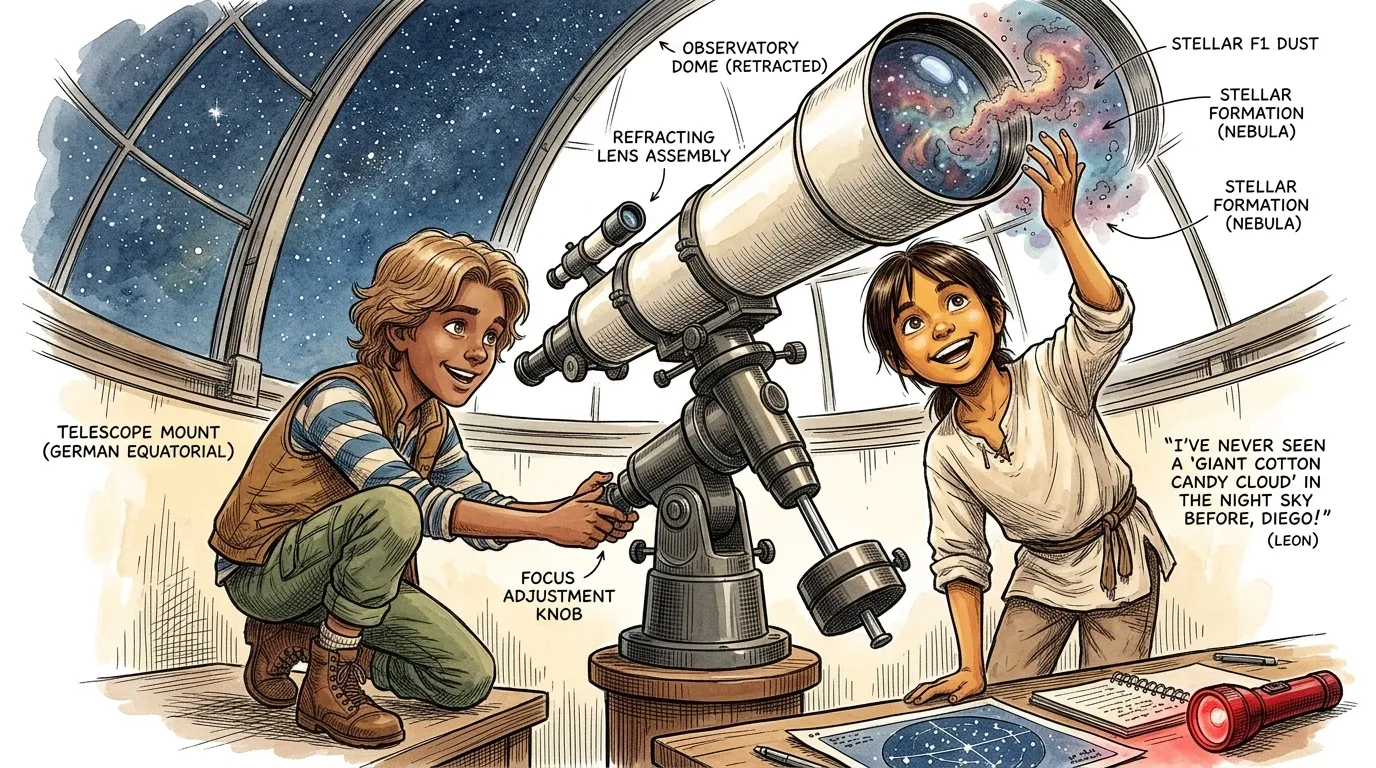
Deep in the old observatory, its glass dome open to the night, Diego spotted something unusual through the powerful telescope. Leon, his older brother, adjusted the focus and peered in, his eyes wide with surprise. They both saw a swirling, shimmering nebula, but Diego described it as a 'giant cotton candy cloud,' while Leon called it a 'cosmic dust storm.'
"'Wow, Leon! It looks like a huge, sweet cloud, ready to eat!' Diego exclaimed, pointing at the eyepiece. Leon chuckled, 'No, Diego, it's a massive cloud of gas and dust, floating in space. It's real, even if it looks like candy to you.'"
Philosophy Note: Edmund Husserl (1859-1938) was a German philosopher, often called the 'father of phenomenology.' He sought to understand how we experience the world, focusing on consciousness itself. His work greatly influenced existentialism and critical theory.
Page 2
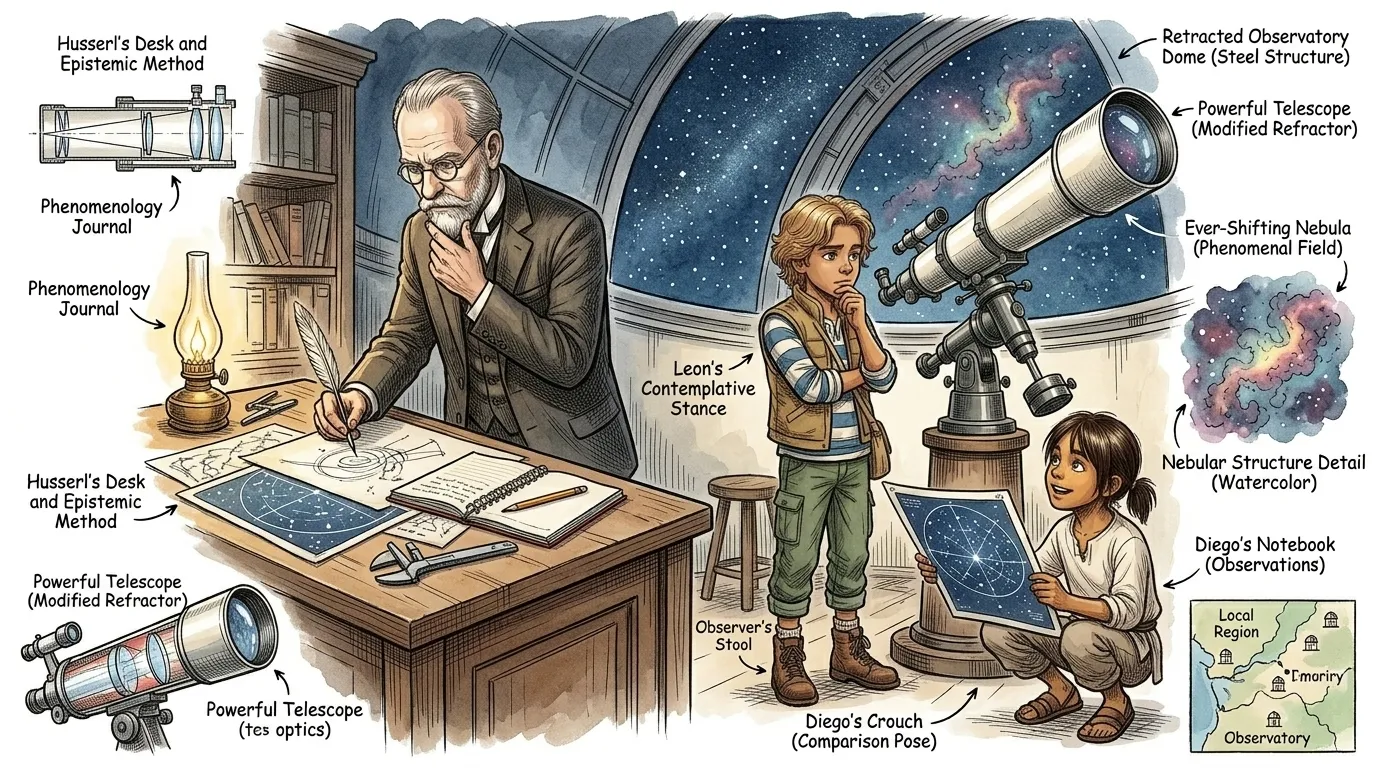
The brothers spent hours observing the night sky. Each time they looked, the nebula seemed to shift, appearing slightly different, even though it was the same distant object. Diego pointed out how the stars seemed to twinkle more when he squinted, while Leon insisted they were constant.
"'It's so strange,' Leon mused, turning from the telescope. 'We're looking at the same thing, but we see it in our own ways. It makes you wonder, is it really a cotton candy cloud or a dust storm, or is it just... how we experience it?' Diego nodded, 'My teacher once told us about a thinker named Edmund Husserl. He said we should pay attention to how things show up for us, not just what we think they are.'"
Philosophy Note: Husserl's phenomenology encourages us to 'go back to the things themselves' – to describe and analyze our direct experience, rather than relying on pre-conceived theories about reality.
Page 3
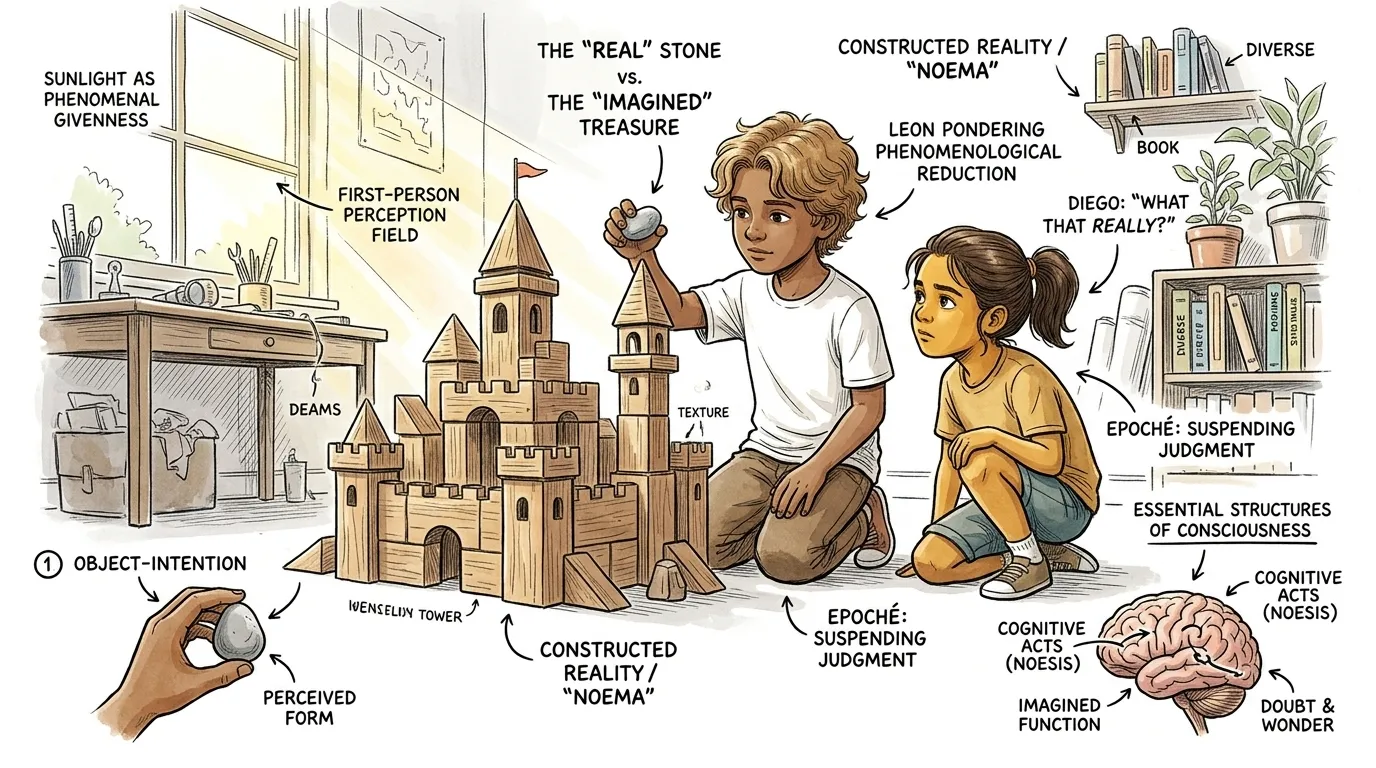
The next day, the brothers were building a grand castle out of old wooden blocks. Leon placed a small, smooth grey stone on top, declaring it the king's crown. But Diego, thinking of the nebula, felt uneasy.
"'That stone is just a stone, Leon,' Diego said, carefully. 'But you're saying it's a crown. How can we tell what something really is versus what we imagine it to be?' Leon paused, holding the stone. 'That's a good question, little brother. Husserl called it 'bracketing.' He said we should try to set aside our usual assumptions – like 'this is just a stone' or 'this is a crown' – and just look at the object as it appears to us, without judging it yet.'"
Philosophy Note: The 'phenomenological reduction' or 'bracketing' (epoché) is Husserl's method of suspending judgment about the existence or nature of the external world, to focus purely on the structures of our experience.
Page 4
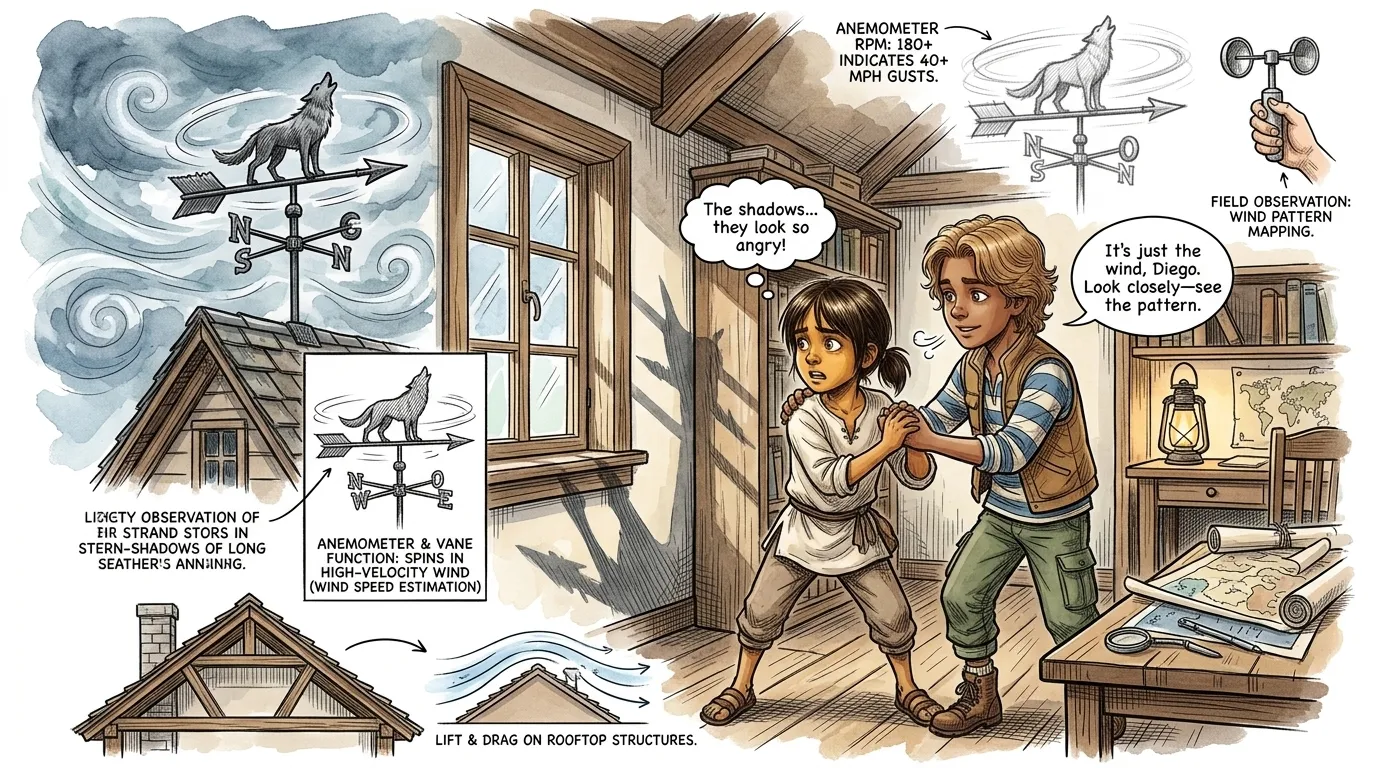
As they continued to play, the wind outside began to howl, and an old, rickety weather vane on the roof started spinning wildly. It seemed like a menacing, creaking creature. Diego felt scared.
"'It sounds like a monster trying to get in!' Diego whispered, clutching Leon's arm. Leon, remembering Husserl's idea, took a deep breath. 'Wait, Diego. Let's try to 'bracket' that idea. Let's just listen to the sound and watch the movement without saying 'monster.' What do you hear? What do you see?'"
Philosophy Note: Husserl argued that by bracketing our natural attitudes and assumptions, we could gain a clearer understanding of the essential structures of our consciousness and how objects appear to us.
Page 5
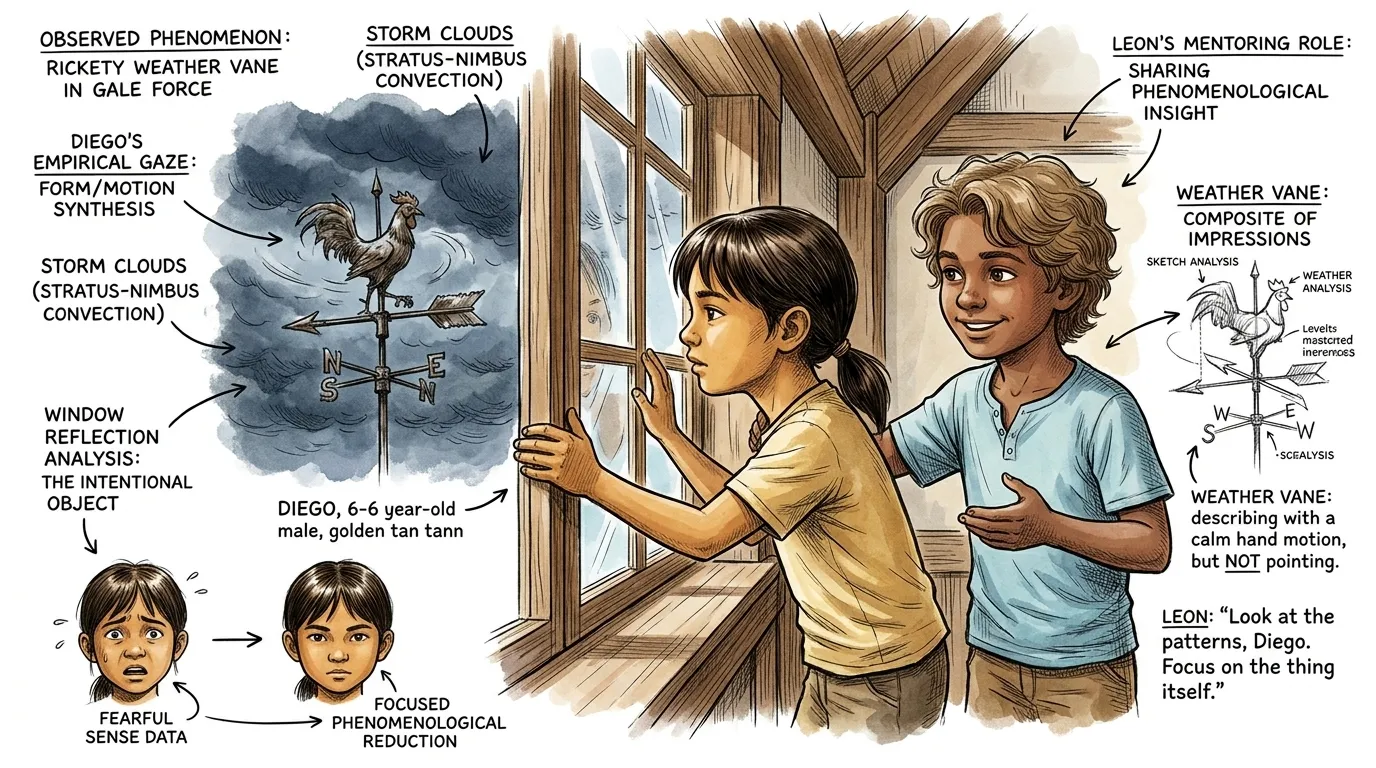
Diego, trying hard, focused only on the distinct sounds: the squeak of metal, the rush of wind, the rattle of the old roof. He saw the weather vane as just a collection of shapes and movements. The fear began to recede as the 'monster' faded.
"'I hear creaking metal and whooshing air, and I see a rooster shape spinning,' Diego reported, his voice steadier. 'It's not a monster anymore! It's just... the weather vane doing its thing.' Leon smiled. 'Exactly! We looked at the phenomenon – how it appeared and sounded – without letting our old ideas about 'monsters' get in the way. As the philosopher Immanuel Kant once said, 'Experience without theory is blind, but theory without experience is mere intellectual play.' And Husserl would add, we need to carefully examine that raw experience first!'"
Philosophy Note: This process of focusing on the 'things themselves' (phenomena) without preconceived notions is central to phenomenology, allowing for a deeper understanding of the essence of experience. Immanuel Kant (1724-1804) was a German philosopher whose work on how human understanding structures experience was a significant precursor to Husserl's phenomenology.
Page 6
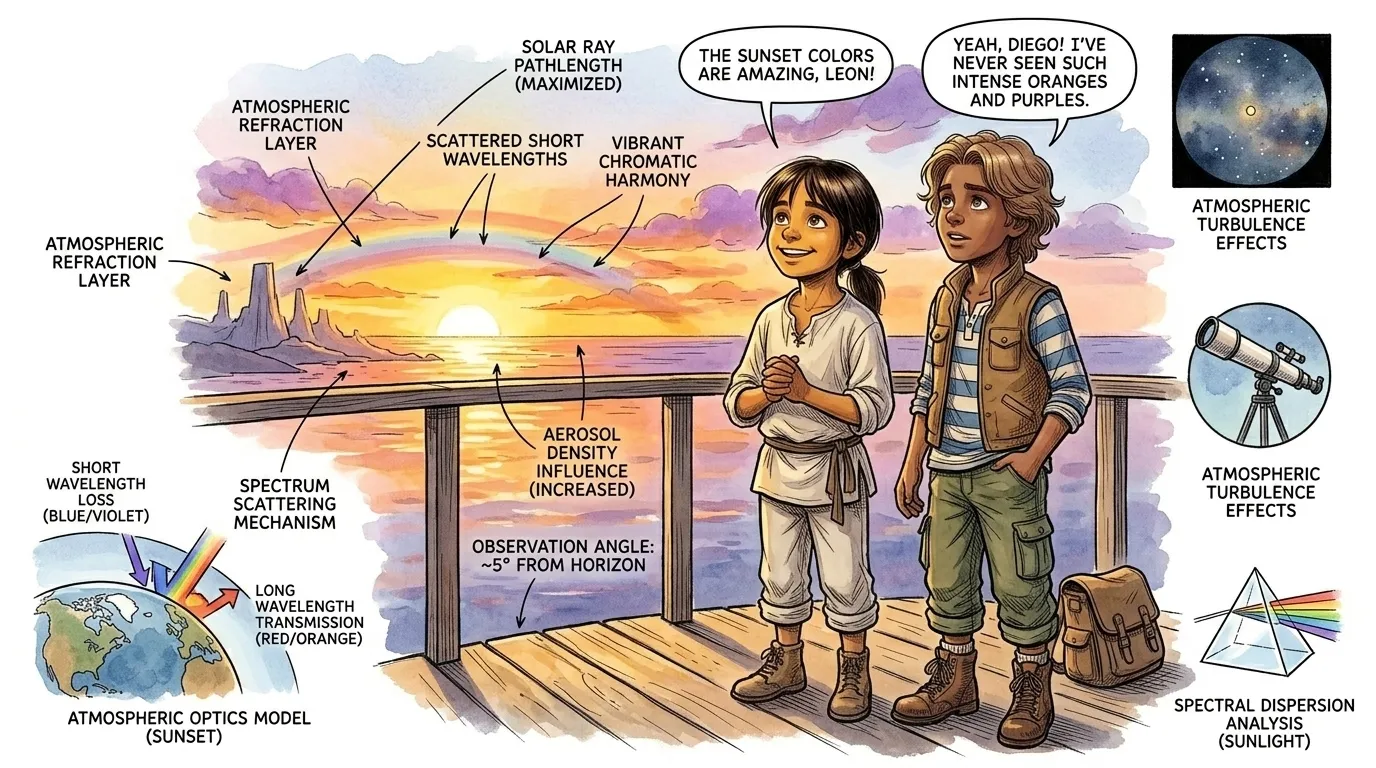
Later, the wind died down, and the sun began to set, painting the sky in vibrant hues. Diego saw 'liquid gold and purple,' while Leon described 'infrared wavelengths and atmospheric scattering.' They both understood that their different descriptions didn't make one wrong, just different ways of experiencing the same thing.
"'It's like our nebula,' Diego said, looking at the sky. 'We can both see it, but we each have our own unique way of experiencing it. And that's okay!' Leon nodded, 'That's exactly what Husserl wanted us to understand. Our experience is always our experience. He wanted us to pay close attention to that subjective experience to understand how we build our world.'"
Philosophy Note: Husserl emphasized that all consciousness is 'intentional' – it is always consciousness of something. He sought to analyze the structure of this 'of-ness' and how objects present themselves to our awareness.
Page 7
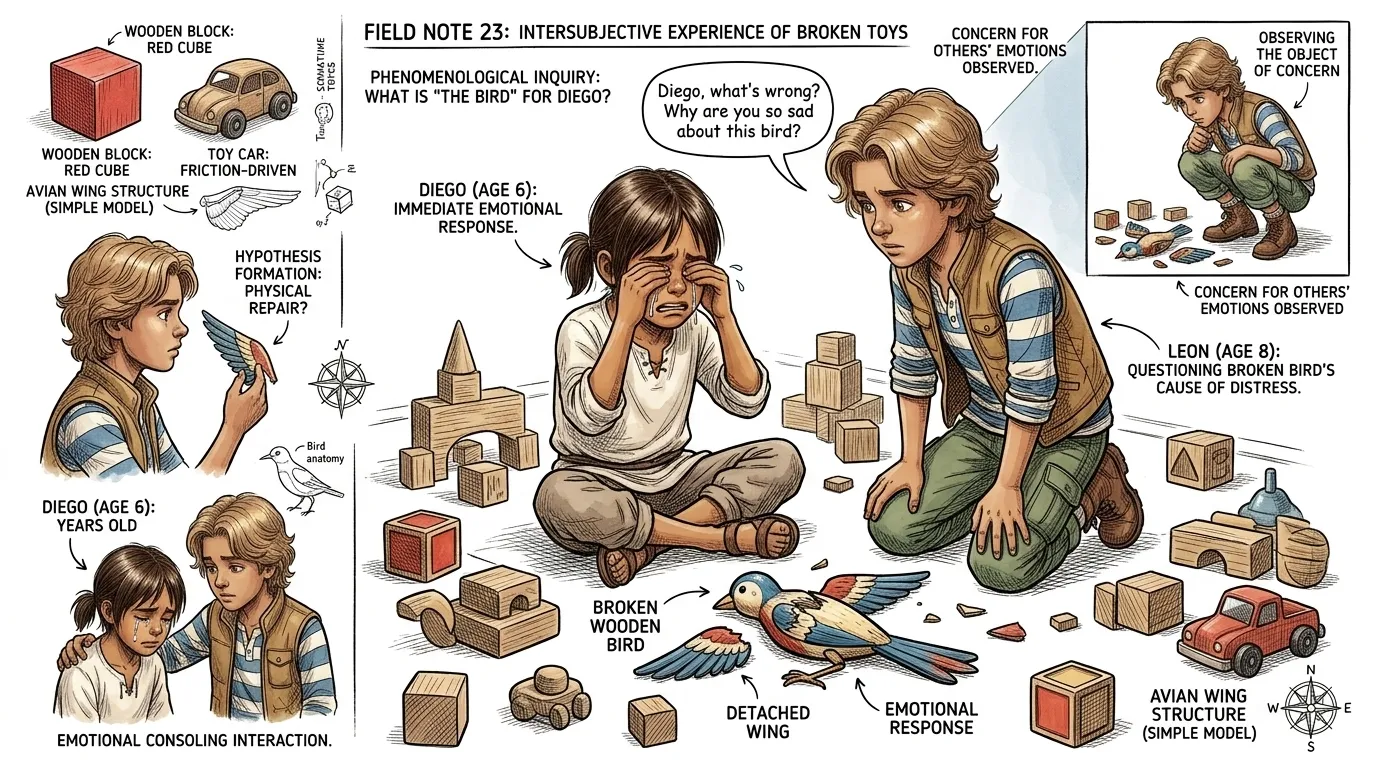
That evening, while packing up their blocks, Diego bumped a small, painted wooden bird, and its wing broke off. He felt terrible and started to cry. Leon initially felt annoyed, thinking it was just an accident.
"'It's just a toy, Diego, it can be fixed,' Leon said, trying to comfort him, but then he paused. 'Wait. Let me try that 'bracketing' thing. I need to set aside my idea of 'it's just a toy' and think about how this appears to you.' Leon knelt. 'Tell me how you're experiencing this, little brother.'"
Philosophy Note: Phenomenology is not just about understanding our own experiences but can also be applied to understanding others. By attempting to 'bracket' our own biases, we can better grasp how the world appears from another's perspective, fostering empathy.
Page 8
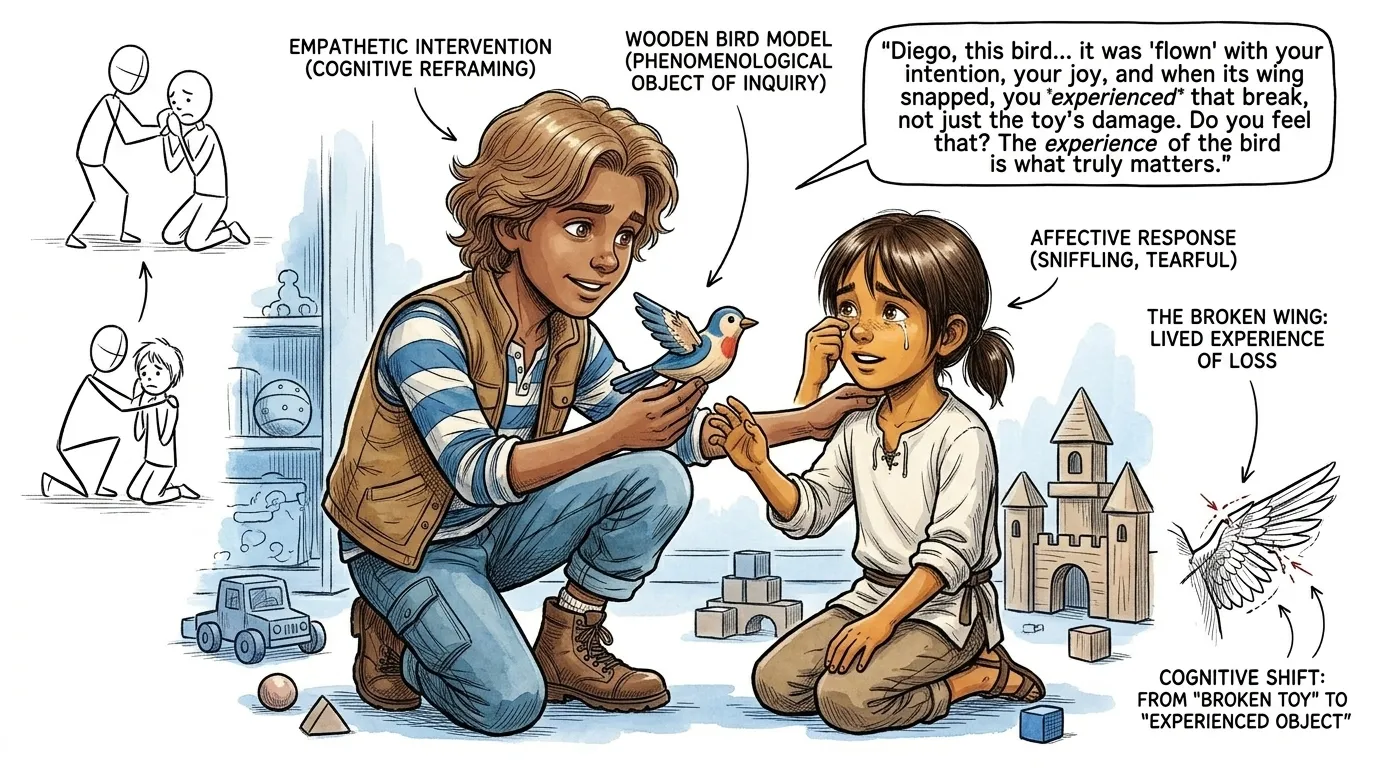
Diego explained how he felt the bird was a tiny friend, and its broken wing felt like a hurt. By focusing on Diego's pure experience, Leon suddenly understood the depth of his brother's sadness. He no longer saw 'just a toy' but the experience of loss as it manifested for Diego. This 'bracketing' knowledge, discovered on Page 3, helped him resolve the situation.
"'I get it now, Diego,' Leon said softly, putting an arm around his brother. 'It's not just a toy to you; it's a friend. It's really sad when a friend gets hurt.' He picked up the broken bird. 'Let's see if we can give our little friend a new wing, together.' Diego sniffled, 'You really see it, Leon!'"
Philosophy Note: By applying the phenomenological method – setting aside his own assumptions and focusing on Diego's direct experience – Leon achieved a deeper, empathetic understanding, demonstrating the practical power of Husserl's ideas in everyday human interaction.
Page 9
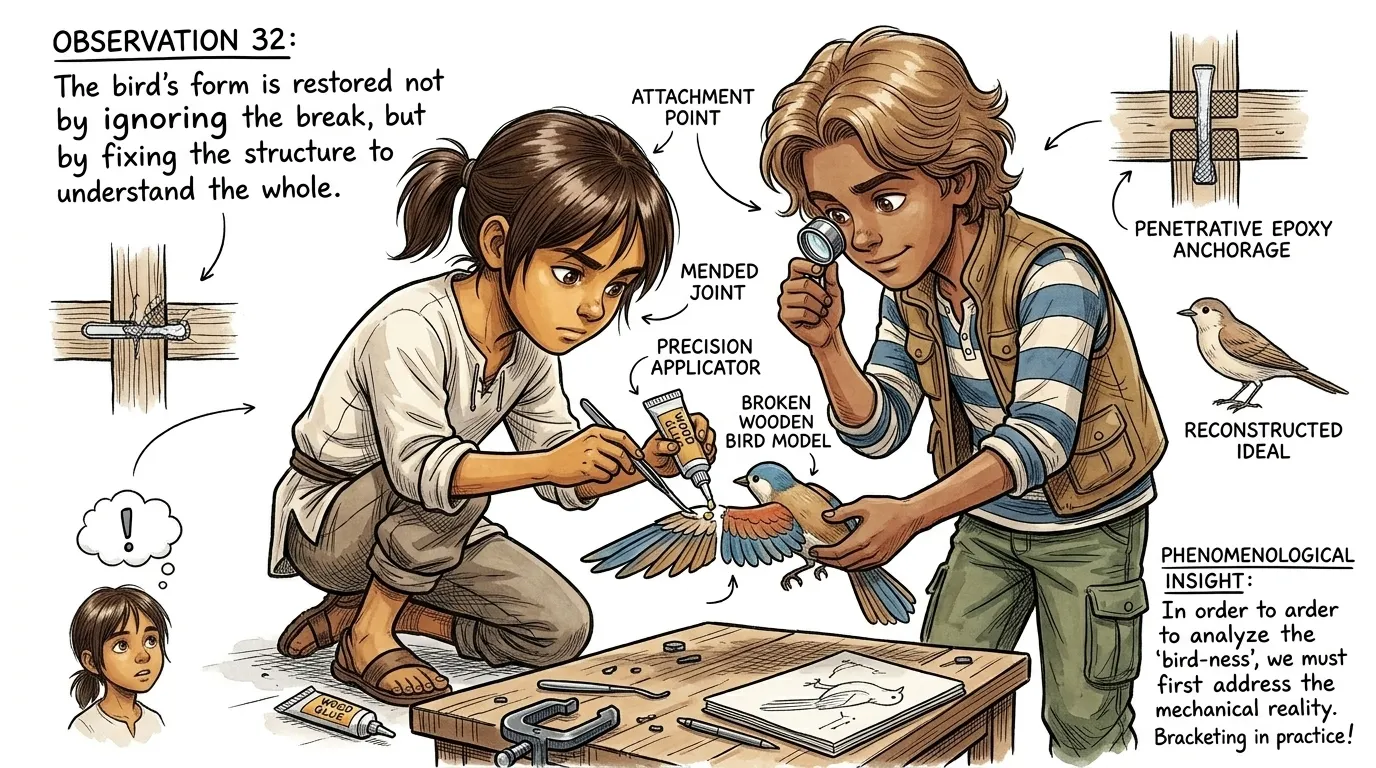
Diego and Leon carefully mended the bird's wing, gluing it back into place. As they worked, they realized how often people misunderstand each other because they don't take the time to truly observe how things appear to another person.
"'It's not just for broken toys, is it?' Diego observed, smoothing the glue on the tiny wing. 'We can use this 'bracketing' for everything! For understanding why someone is mad, or why they like a certain game.' Leon nodded, 'Exactly! Husserl's ideas help us look beyond just what something is on the surface, to truly grasp how it presents itself in experience. It helps us find clarity.'"
Philosophy Note: Husserl's phenomenology continues to be highly influential in fields like psychology, sociology, and ethics, offering a powerful framework for understanding subjective experience, intersubjectivity, and the foundations of knowledge.
Page 10
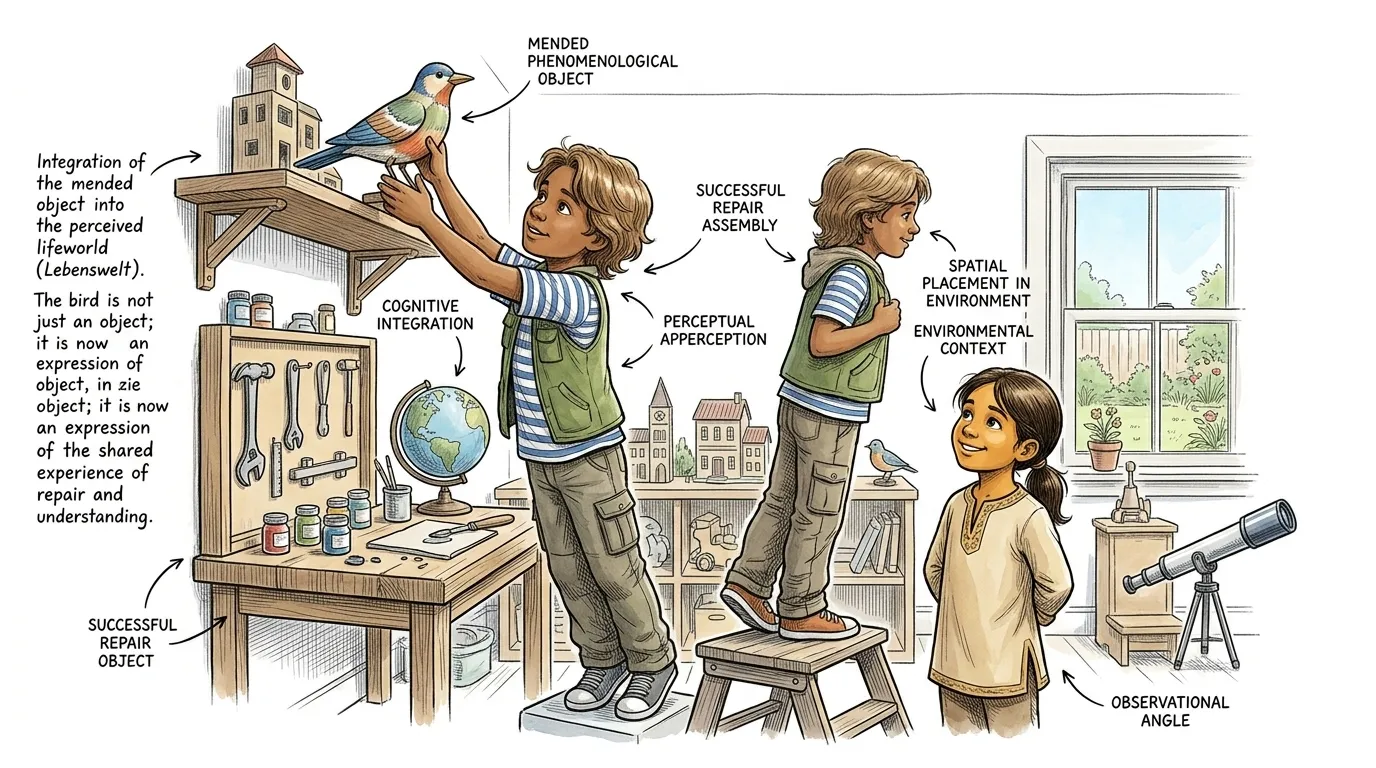
From a twinkling nebula to a broken toy, the brothers learned that the world isn't just 'out there' but also 'in here,' in how we consciously experience it. Edmund Husserl's work, initially complex, had taught them a profound lesson: to truly understand anything, one must first understand how it appears, vividly and directly, to consciousness.
"Leon carefully put the mended bird on a shelf. 'So, Edmund Husserl helped us realize that our own unique way of seeing and feeling is super important, not just what everyone else says is true.' Diego smiled, looking up at the repaired bird. 'It means we can always look closer, and understand more. Like a super-seeing power for our minds!'"
Philosophy Note: Husserl's focus on the subjective experience, intentionality, and the method of phenomenological reduction laid the groundwork for entire philosophical movements, including existentialism, and continues to inform discussions on consciousness, reality, and human understanding.
About this story
- Audience: kids (ages 6–12)
Read Wonder Philosophy on your phone
Wonder Philosophy is available on Android and iPhone and iPad. Get Wonder Philosophy on Google Play · Get Wonder Philosophy on the App Store.