Aristotle
Aristotle — an illustrated philosophy story. 10 illustrated pages, free to read on Wonder Philosophy.

Page 1
![Why does Aristotle matter today? Born in 384 BC[1], his ideas still shape how we think about ethics, politics, science, and even how we tell stories.](https://thewonderbooks.com/images/stories/aristotle/illustrations/aristotle_page_01_v1775180546605.webp "Why does Aristotle matter today? Born in 384 BC[1], his ideas still shape how we think about ethics, politics, science, and even how we tell stories.")
Why does Aristotle matter today? Born in 384 BC[1], his ideas still shape how we think about ethics, politics, science, and even how we tell stories. From the concept of virtue to the structure of a well-made argument, Aristotle's influence is everywhere.
"Yuki, explaining the course syllabus, says, "We'll start with Aristotle because understanding him is like understanding the foundation of Western thought. His ideas about logic, ethics, and politics are still discussed and debated today.""
Philosophy Note: [1] 384 BC: Aristotle's birth year.
Page 2
![After studying with Plato[2] for twenty years, Aristotle founded his own school, the Lyceum[3], in Athens. Here, he developed his own philosophical system…](https://thewonderbooks.com/images/stories/aristotle/illustrations/aristotle_page_02_v1775180573558.webp "After studying with Plato[2] for twenty years, Aristotle founded his own school, the Lyceum[3], in Athens. Here, he developed his own philosophical system…")
After studying with Plato[2] for twenty years, Aristotle founded his own school, the Lyceum[3], in Athens. Here, he developed his own philosophical system, often differing from Plato's idealism. His followers, known as the Peripatetics, explored knowledge through observation and empirical study.
"Nalini asks, "What's a Peripatetic?" Yuki smiles. "It means 'to walk about.' Aristotle often taught while walking, encouraging his students to learn through discussion and observation.""
Philosophy Note: [2] Plato: Influential philosopher and teacher of Aristotle. [3] Lyceum: Aristotle's school in Athens.
Page 3
![Aristotle revolutionized logic by developing a system of syllogisms[4] and categories[5]. He sought to classify and understand the world through careful…](https://thewonderbooks.com/images/stories/aristotle/illustrations/aristotle_page_03_v1775180601941.webp "Aristotle revolutionized logic by developing a system of syllogisms[4] and categories[5]. He sought to classify and understand the world through careful…")
Aristotle revolutionized logic by developing a system of syllogisms[4] and categories[5]. He sought to classify and understand the world through careful definition and reasoning. This structured approach laid the groundwork for scientific inquiry.
"Yuki explains, "Aristotle wanted to understand the structure of reality. He developed categories like substance, quantity, quality, and relation to organize our thoughts and observations." Nalini replies, "So, he was like a super-organized thinker?""
Philosophy Note: [4] Syllogisms: Logical arguments with premises leading to a conclusion. [5] Categories: Fundamental classes of being.
Page 4
![Aristotle's ethical theory, outlined in Nicomachean Ethics[6], centers on the concept of eudaimonia[7], often translated as 'flourishing' or 'living well.' He…](https://thewonderbooks.com/images/stories/aristotle/illustrations/aristotle_page_04_v1775180637992.webp "Aristotle's ethical theory, outlined in Nicomachean Ethics[6], centers on the concept of eudaimonia[7], often translated as 'flourishing' or 'living well.' He…")
Aristotle's ethical theory, outlined in Nicomachean Ethics[6], centers on the concept of eudaimonia[7], often translated as 'flourishing' or 'living well.' He believed that achieving eudaimonia requires cultivating virtues, which are character traits that lie between two extremes.
"Yuki states, "Aristotle believed that virtue is the golden mean between two vices. For example, courage is the mean between recklessness and cowardice. Finding that balance is key to a good life.""
Philosophy Note: [6] Nicomachean Ethics: Aristotle's major work on ethics. [7] Eudaimonia: Flourishing, living well, or happiness.
Page 5
![Aristotle saw humans as inherently political animals, best suited to living in a polis[8], or city-state. He argued that the purpose of government is to promote…](https://thewonderbooks.com/images/stories/aristotle/illustrations/aristotle_page_05_v1775180662947.webp "Aristotle saw humans as inherently political animals, best suited to living in a polis[8], or city-state. He argued that the purpose of government is to promote…")
Aristotle saw humans as inherently political animals, best suited to living in a polis[8], or city-state. He argued that the purpose of government is to promote the common good and help citizens achieve eudaimonia. He studied different forms of government, from monarchy to democracy, evaluating their strengths and weaknesses.
"Yuki explains, "For Aristotle, the polis was more than just a place to live. It was a community where people could develop their virtues and live a good life together. He thought the best government was one that served the interests of all citizens, not just a select few.""
Philosophy Note: [8] Polis: Greek city-state.
Page 6
![Aristotle also made significant contributions to the study of rhetoric[9], the art of persuasion. He identified three key elements of effective communication…](https://thewonderbooks.com/images/stories/aristotle/illustrations/aristotle_page_06_v1775180699356.webp "Aristotle also made significant contributions to the study of rhetoric[9], the art of persuasion. He identified three key elements of effective communication…")
Aristotle also made significant contributions to the study of rhetoric[9], the art of persuasion. He identified three key elements of effective communication: ethos (credibility), pathos (emotion), and logos (logic). He argued that rhetoric is essential for public discourse and political decision-making.
"Yuki says, "Aristotle understood that persuasion isn't just about logic. It's about connecting with your audience on an emotional level and establishing your credibility. Ethos, pathos, and logos – they're still the foundation of effective communication today.""
Philosophy Note: [9] Rhetoric: The art of persuasion.
Page 7
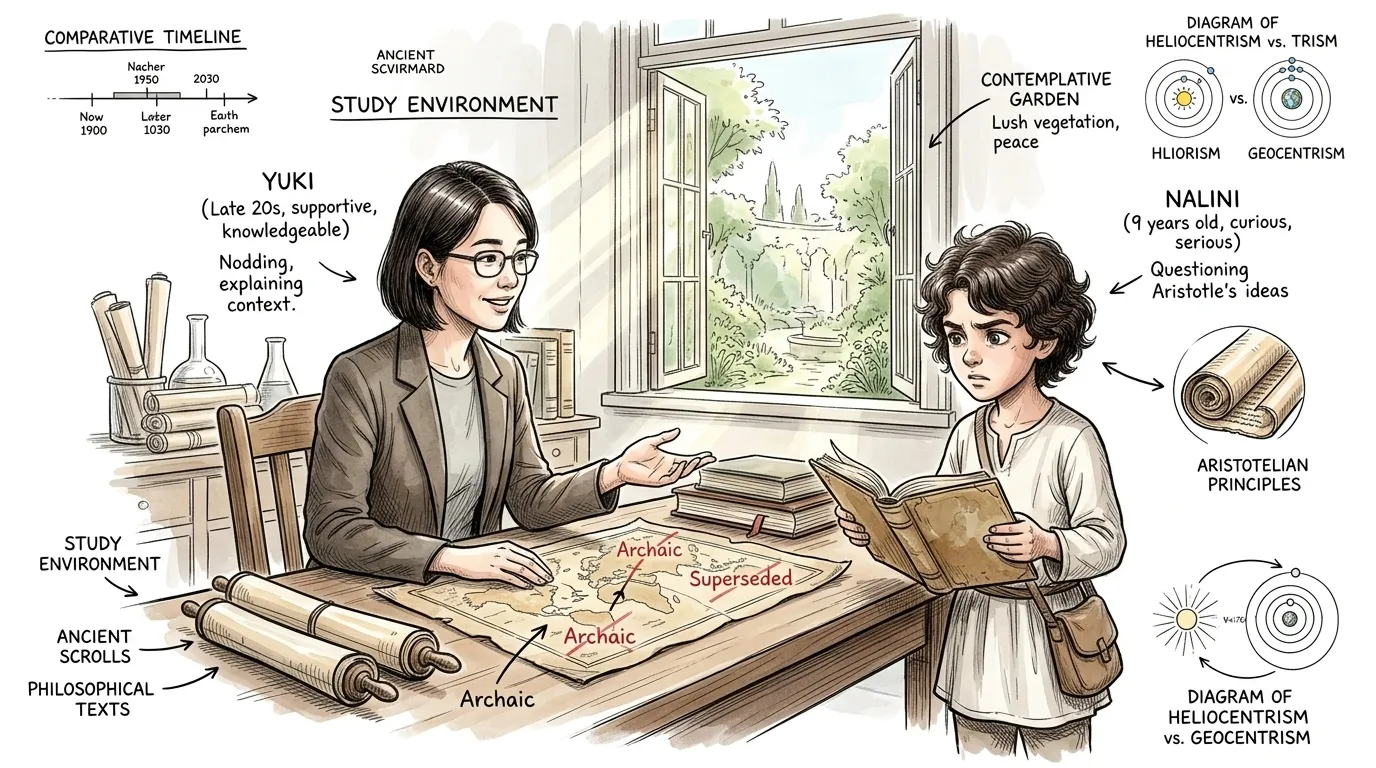
Aristotle's ideas have faced challenges and criticisms throughout history. Some argue that his emphasis on virtue ethics is too subjective or culturally relative. Others question his views on slavery and the role of women in society. Despite these criticisms, his work remains a cornerstone of Western philosophy.
"Nalini asks, "But didn't Aristotle have some outdated ideas?" Yuki nods. "Yes, his views on certain topics, like slavery, are definitely problematic from a modern perspective. But it's important to understand him in his historical context and see what we can still learn from him.""
Philosophy Note: Aristotle's views on slavery and women are considered outdated and ethically problematic by modern standards.
Page 8
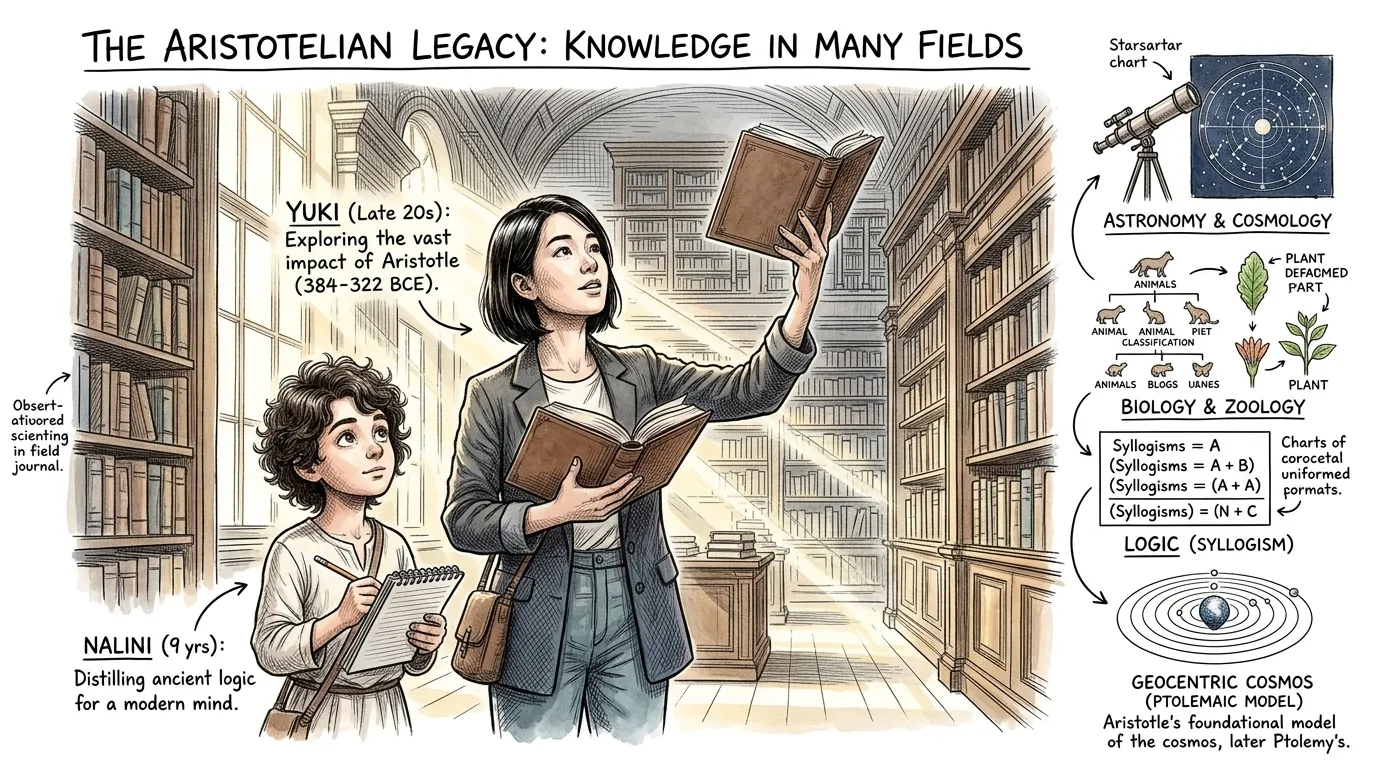
Aristotle's influence extends far beyond philosophy. His ideas have shaped fields like biology, political science, and literary theory. His emphasis on observation, reason, and the pursuit of excellence continues to inspire thinkers and leaders today.
"Yuki concludes, "Even now, centuries later, Aristotle's framework helps us think critically about ourselves, our communities, and our place in the world. As Aristotle himself said, 'The ultimate value of life depends upon awareness and the power of contemplation rather than upon mere survival.' He said that because he believed thinking and understanding were the highest forms of living well. Don't you think he was right?""
Philosophy Note: Aristotle's emphasis on reason, observation, and virtue continues to inspire thinkers today.
Page 9
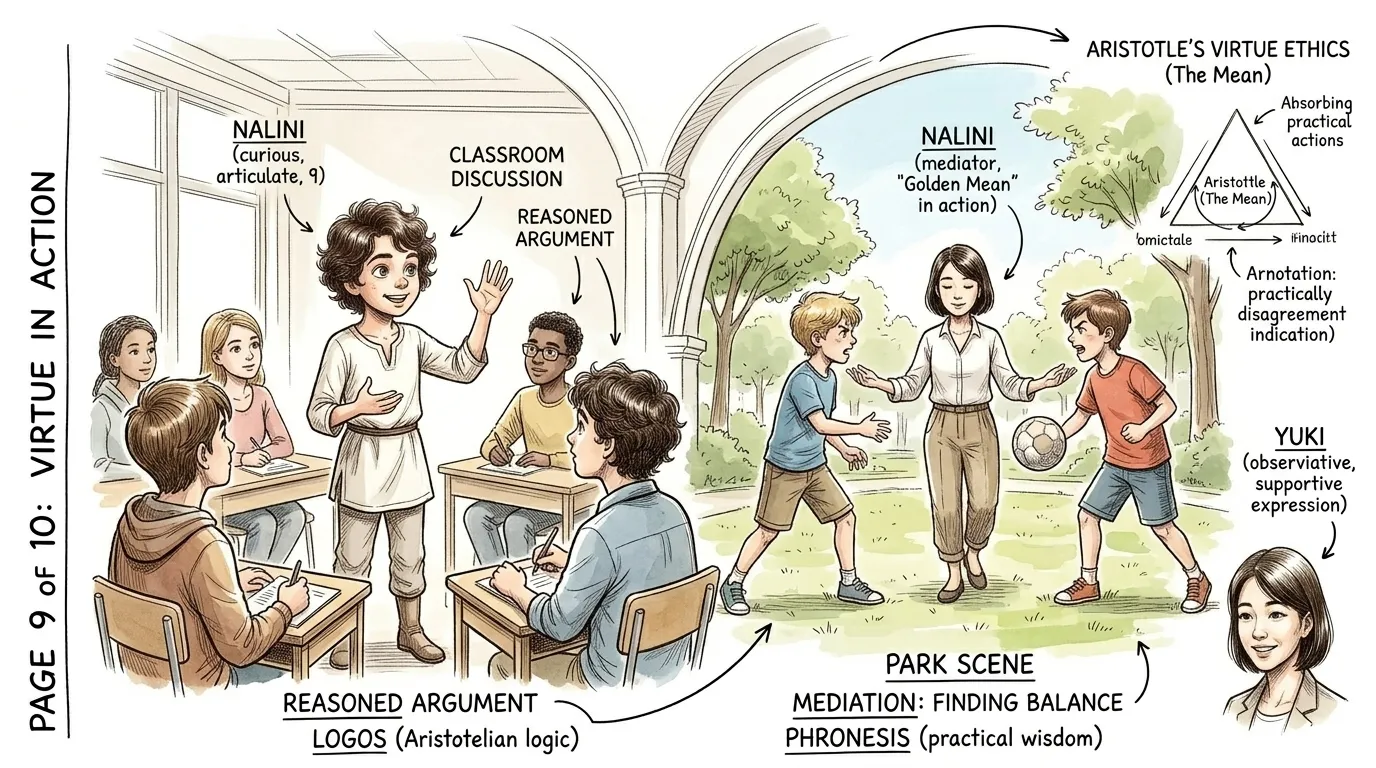
In modern classrooms, his concepts of logic underpin critical thinking skills. The 'golden mean' is a guide for balanced decision-making, and his political theories inspire debates on governance and ethics. His influence is timeless.
"Linnea thought to herself, 'Aristotle's logic isn't just in textbooks; it helps me argue my point in class.' Nalini added, 'And finding the middle ground? That's how I solve problems with my friends.'"
Philosophy Note: Aristotle's logic underpins modern critical thinking skills.
Page 10
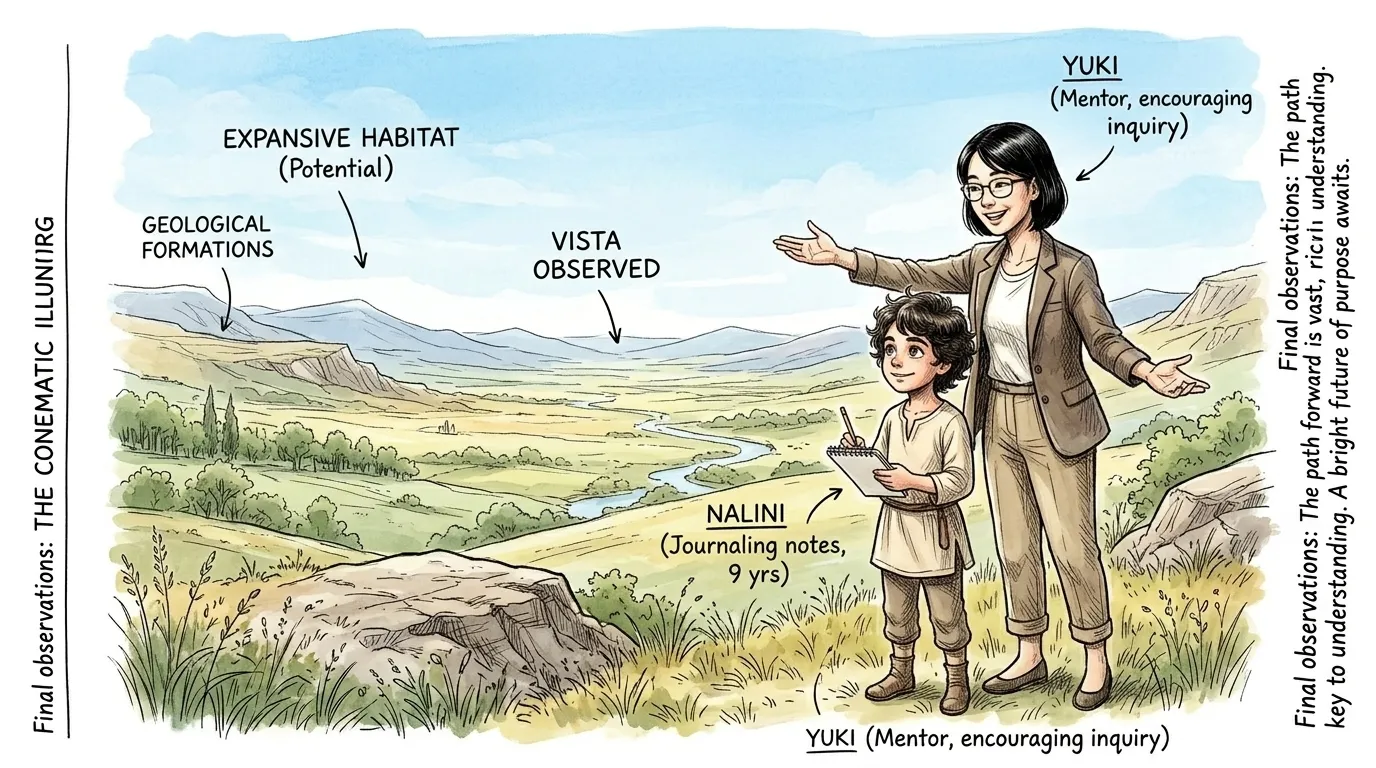
Aristotle's work invites us to reflect on our choices, our communities, and our potential. He leaves a lasting imprint, urging us to seek knowledge, cultivate virtue, and strive for a life of purpose and meaning.
"Yuki says, "Aristotle's legacy isn't just about what he taught, but how he taught us to think. Question, observe, reason – that's the enduring value of his philosophy.""
Philosophy Note: Aristotle's enduring legacy is a call to seek knowledge and live a life of purpose.
About this story
- Audience: kids (ages 6–12)
Questions and answers
Read Wonder Philosophy on your phone
Wonder Philosophy is available on Android and iPhone and iPad. Get Wonder Philosophy on Google Play · Get Wonder Philosophy on the App Store.