Anaximander
Anaximander — an illustrated philosophy story. 10 illustrated pages, free to read on Wonder Philosophy.
Page 1
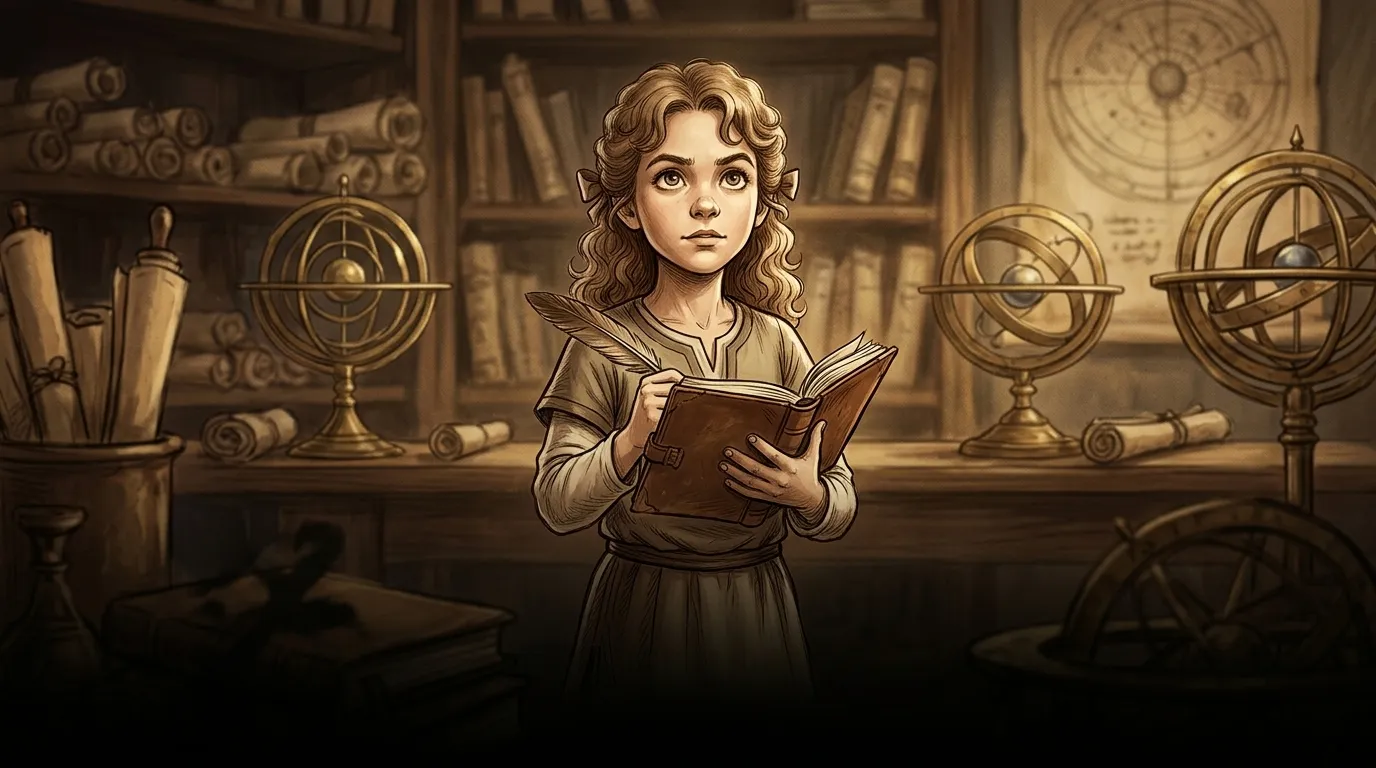
![Anaximander [610-546 BCE] dared to ask: What is the basic stuff of the universe? Not just what things are made of, but what underlies all of existence.](https://thewonderbooks.com/images/stories/anaximander/illustrations/anaximander_page_01_v1775183995954.webp "Anaximander [610-546 BCE] dared to ask: What is the basic stuff of the universe? Not just what things are made of, but what underlies all of existence.")
Anaximander [610-546 BCE] dared to ask: What is the basic stuff of the universe? Not just what things are made of, but what underlies all of existence. It's a question that still drives science and philosophy today. Without Anaximander's revolutionary idea, our understanding of the cosmos might never have begun. Vera brings Sven to an archeological dig site where a very old pottery shard has been uncovered.
""Look, Sven," Vera said, pointing to the piece of pottery. "This little shard might not seem like much, but it represents one of humanity's first attempts to understand everything.""
Philosophy Note: Anaximander: A pre-Socratic Greek philosopher from Miletus, considered one of the founders of Western philosophy and science.
Page 2
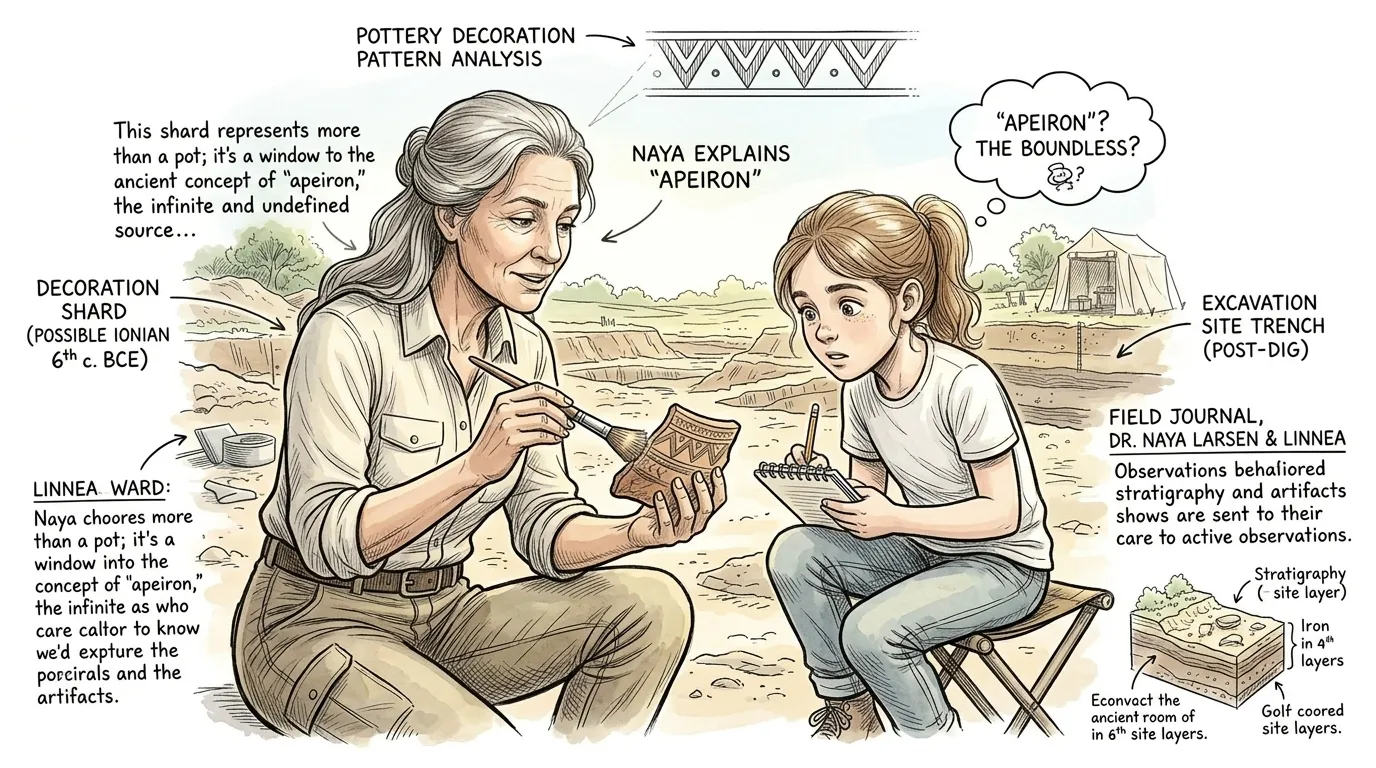
Before Anaximander, many believed the world was made of simple, observable things like water or fire. He broke from that tradition, arguing that the fundamental substance, which he called apeiron [ἄπειρον], was something boundless and undefined. This was a radical departure, proposing an invisible, eternal principle as the source of everything.
""Anaximander believed everything came from something he called the 'apeiron', which means 'the boundless,'" Vera explains, dusting off the shard. "He thought the world couldn't come from something simple like water because eventually water would be used up.""
Philosophy Note: Apeiron: Greek for 'boundless' or 'infinite,' referring to Anaximander's concept of the fundamental substance of the universe.
Page 3
![Anaximander, unlike his teacher Thales [c. 624 – c. 546 BCE], didn't think the basic substance could be water. He reasoned that if everything came from water…](https://thewonderbooks.com/images/stories/anaximander/illustrations/anaximander_page_03_v1775184064112.webp "Anaximander, unlike his teacher Thales [c. 624 – c. 546 BCE], didn't think the basic substance could be water. He reasoned that if everything came from water…")
Anaximander, unlike his teacher Thales [c. 624 – c. 546 BCE], didn't think the basic substance could be water. He reasoned that if everything came from water, everything would eventually become water. There wouldn't be any fire, earth, or air. So, he looked for something that could be the source of all opposites.
"Sven tilted his head. "But why can't everything come from water?" Vera smiled. "That's exactly what Anaximander thought too! He figured, if everything was water, wouldn't everything just... turn into water? What about fire and rocks?""
Philosophy Note: Thales of Miletus: An earlier philosopher who proposed that water was the fundamental substance of the universe.
Page 4
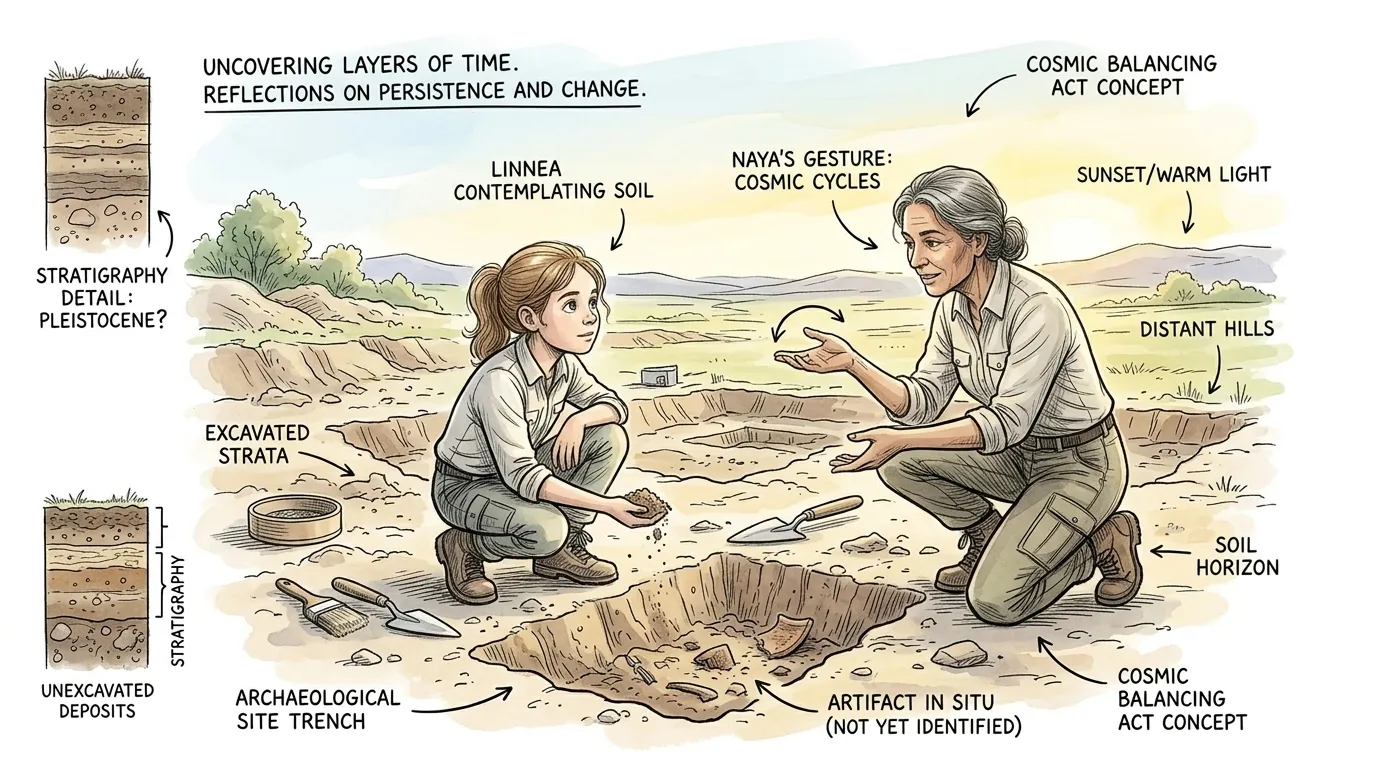
Anaximander proposed that the apeiron was a source of constant creation and destruction. Hot and cold, wet and dry – these opposites emerge from the boundless, struggle against each other, and then return to it. This cyclical process maintains a balance in the cosmos.
""So, everything comes from the apeiron," Sven muses, picking up a handful of dirt. "And then... goes back?" Vera nods. "He believed it was a constant cycle of things being created and destroyed, hot fighting cold, wet fighting dry. Like a cosmic balancing act!""
Philosophy Note: Cosmic Balance: Anaximander's view of the universe as a dynamic system constantly seeking equilibrium.
Page 5
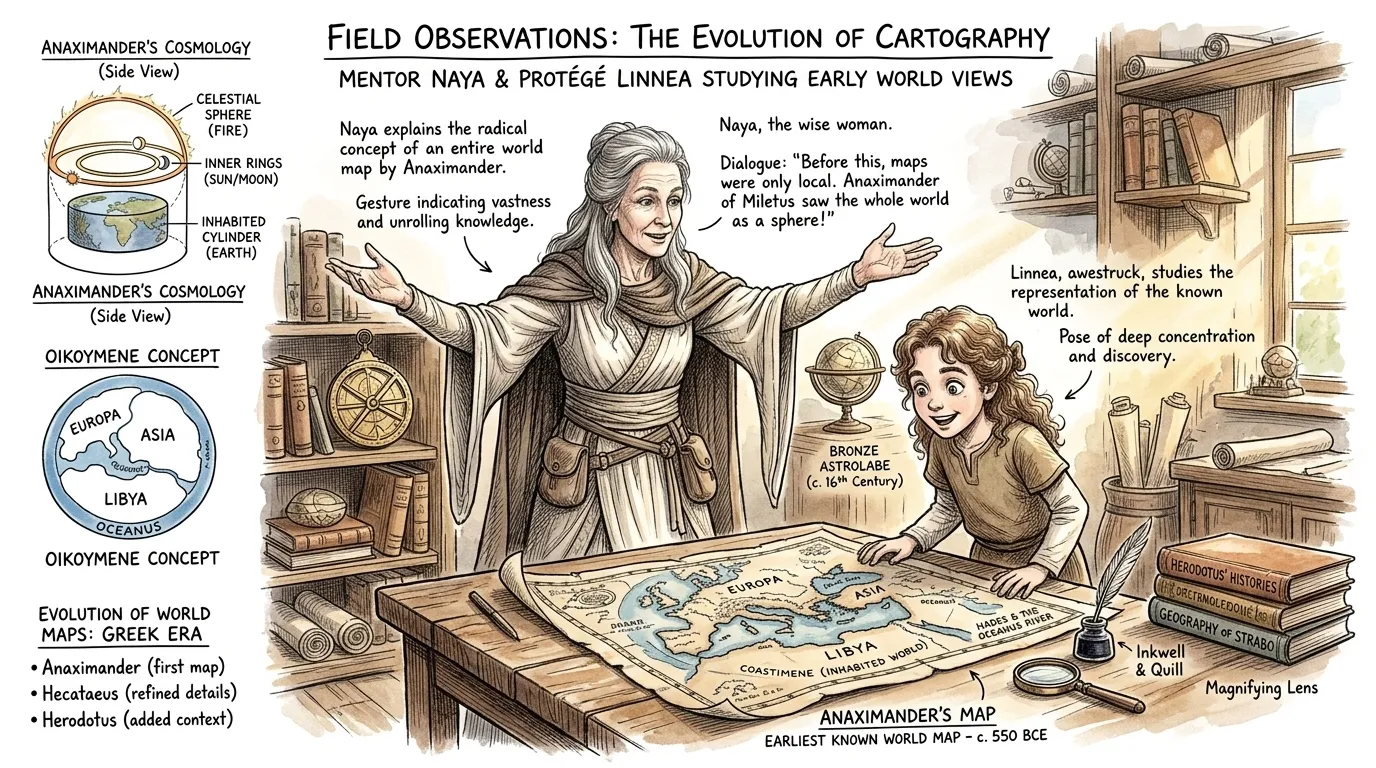
Beyond abstract philosophy, Anaximander was also a practical thinker. He is credited with creating one of the first maps of the known world. This shows his interest in understanding not just the fundamental nature of reality, but also its physical layout.
"Vera tells Sven. "Anaximander wasn't just about big ideas, he also made maps! One of the first maps of the world. He wanted to understand the real world, not just think about it.""
Philosophy Note: Cartography: The science of mapmaking, in which Anaximander was a pioneer.
Page 6
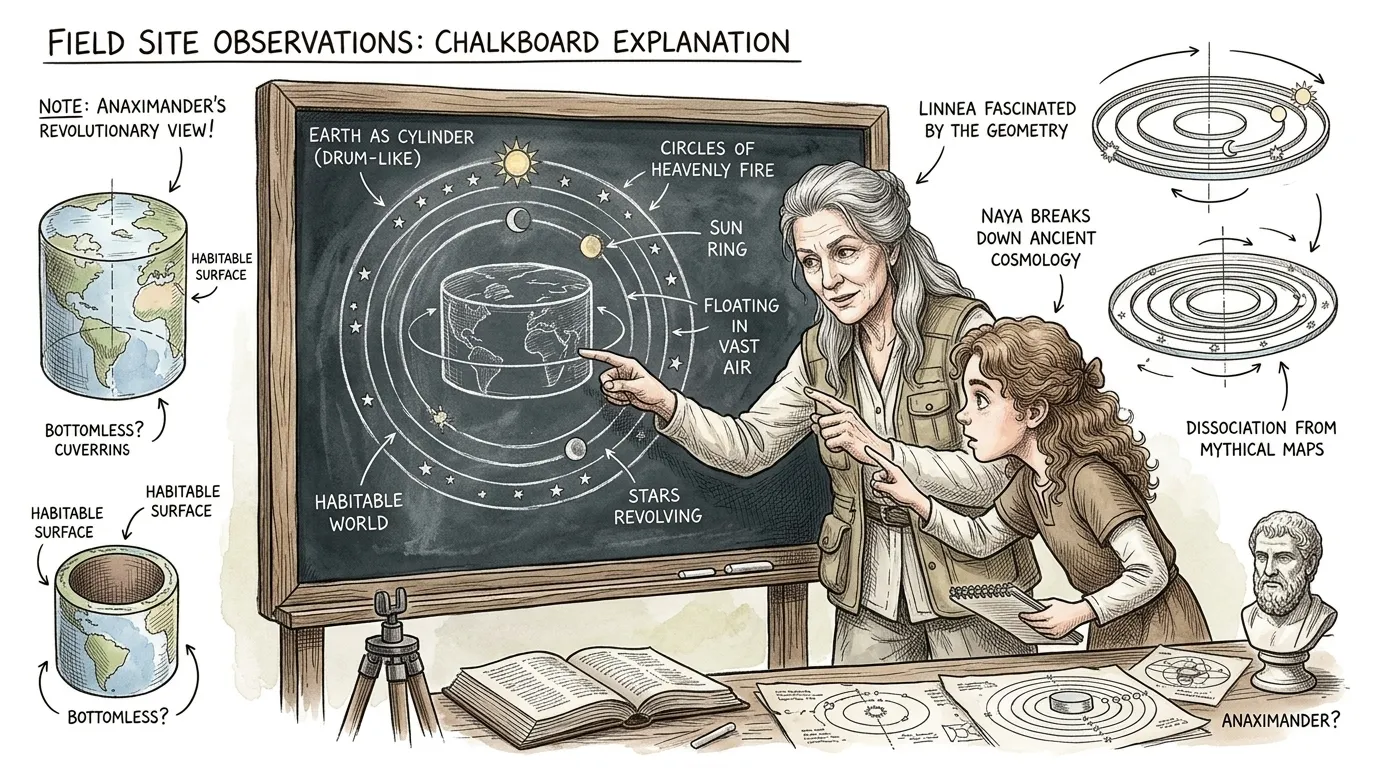
Anaximander imagined the Earth as a cylinder suspended in space, with humans living on its flat surface. He also proposed that celestial bodies revolved around the Earth, offering an early model of a cosmos with a structured order. Although incorrect by modern standards, it was a crucial step toward scientific understanding.
"Vera continues, pointing to a diagram. "He thought the Earth was like a cylinder, floating in space! And the sun and moon went around us. Not quite right, but it was the first try!""
Philosophy Note: Cosmology: The study of the origin, evolution, and eventual fate of the universe.
Page 7
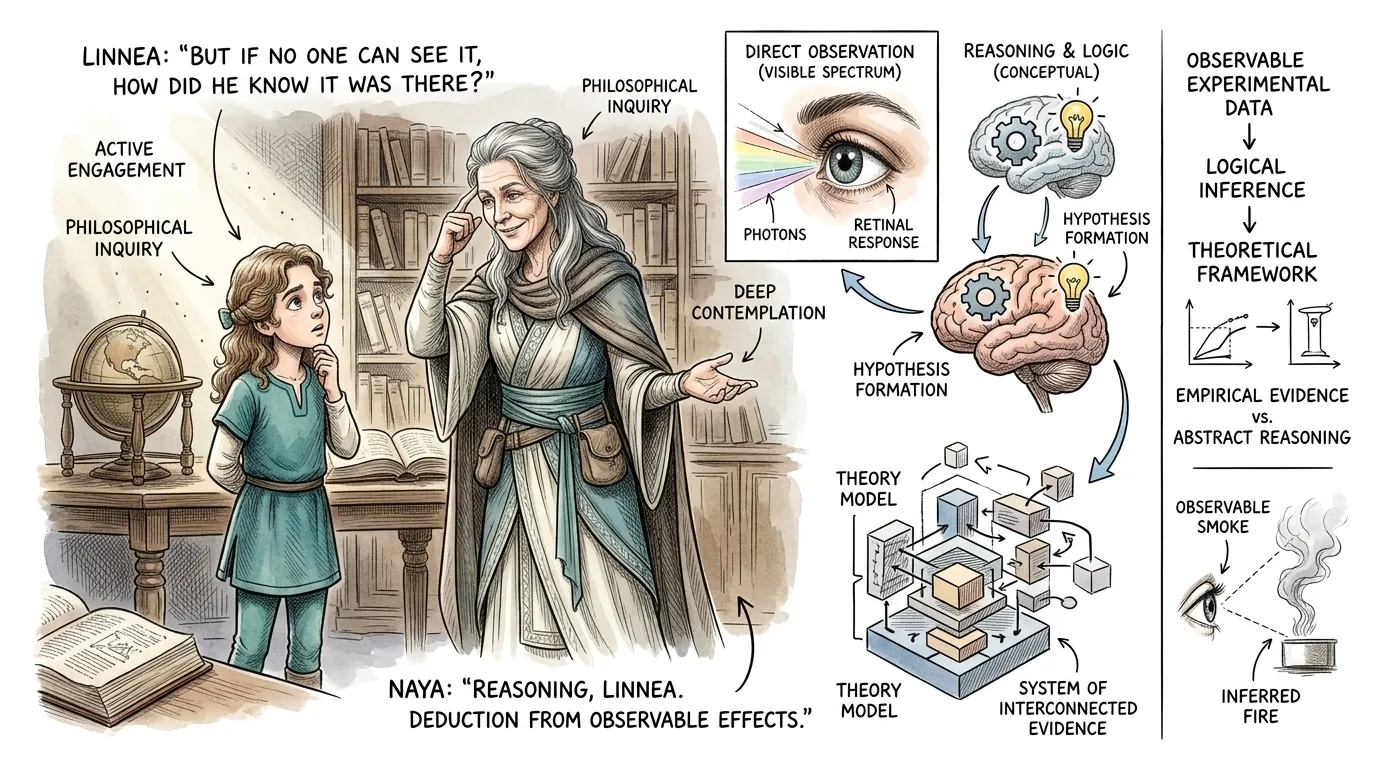
One challenge with Anaximander's ideas is the lack of direct evidence for the apeiron. His conclusions were based on reasoning and observation, rather than empirical testing. This raises a fundamental question in philosophy and science: how do we know what is real when we can't directly see or measure it?
"Sven asked, "But if no one can see it, how did he know it was there?" Vera nods thoughtfully. "That's the big question, isn't it? He used logic and what he saw around him to figure it out. Not like science today, with tests and experiments.""
Philosophy Note: Epistemology: The branch of philosophy concerned with the nature and scope of knowledge.
Page 8
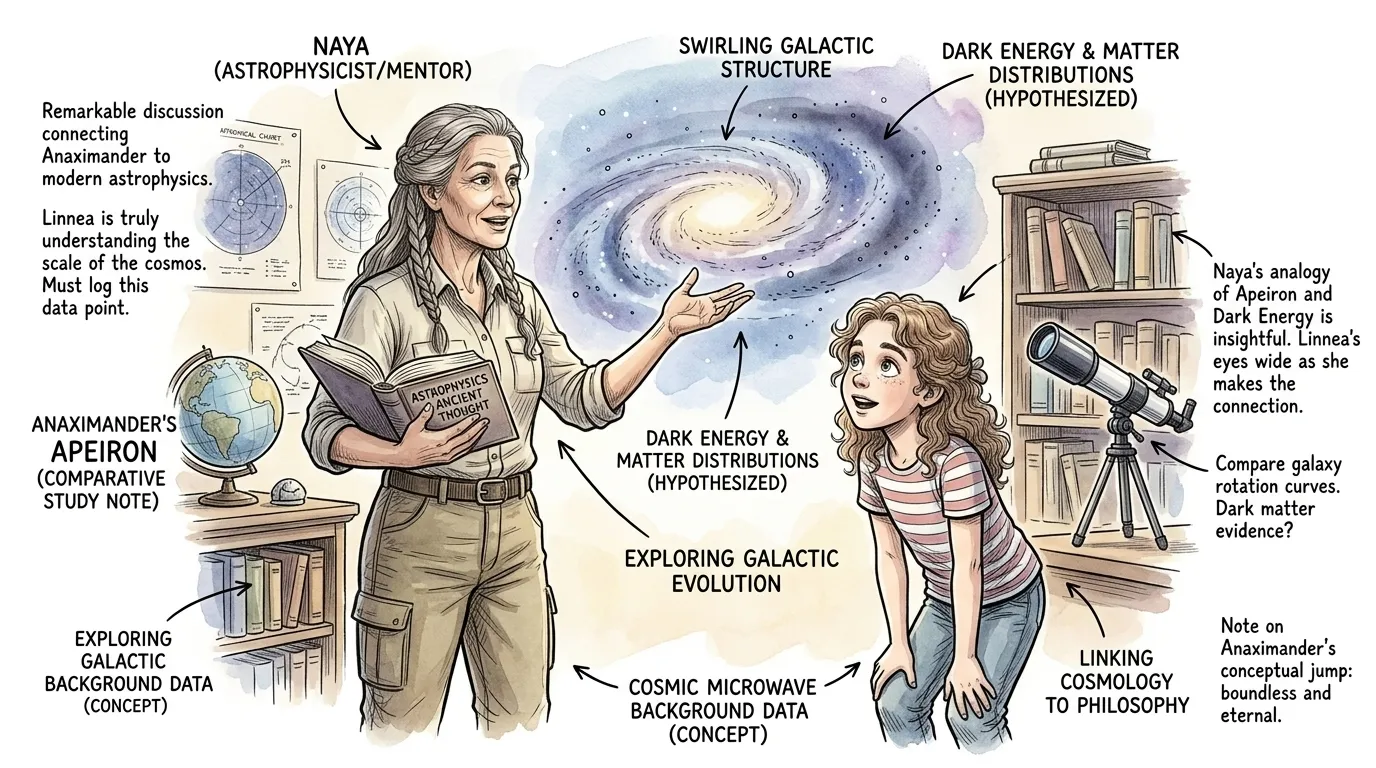
Anaximander's concept of an underlying, unseen reality resonates with modern physics. Ideas like dark matter and dark energy propose invisible substances that influence the universe. His emphasis on balance and cyclical processes also foreshadows ecological thinking.
""Even today, scientists look for things they can't see," Vera explains. "Dark matter, dark energy... things that might be like Anaximander's apeiron. As Isaac Newton said, 'If I have seen further it is by standing on the shoulders of giants.' Anaximander was one of those giants.""
Philosophy Note: Isaac Newton: Famous scientist whose quote emphasizes building upon the work of predecessors.
Page 9
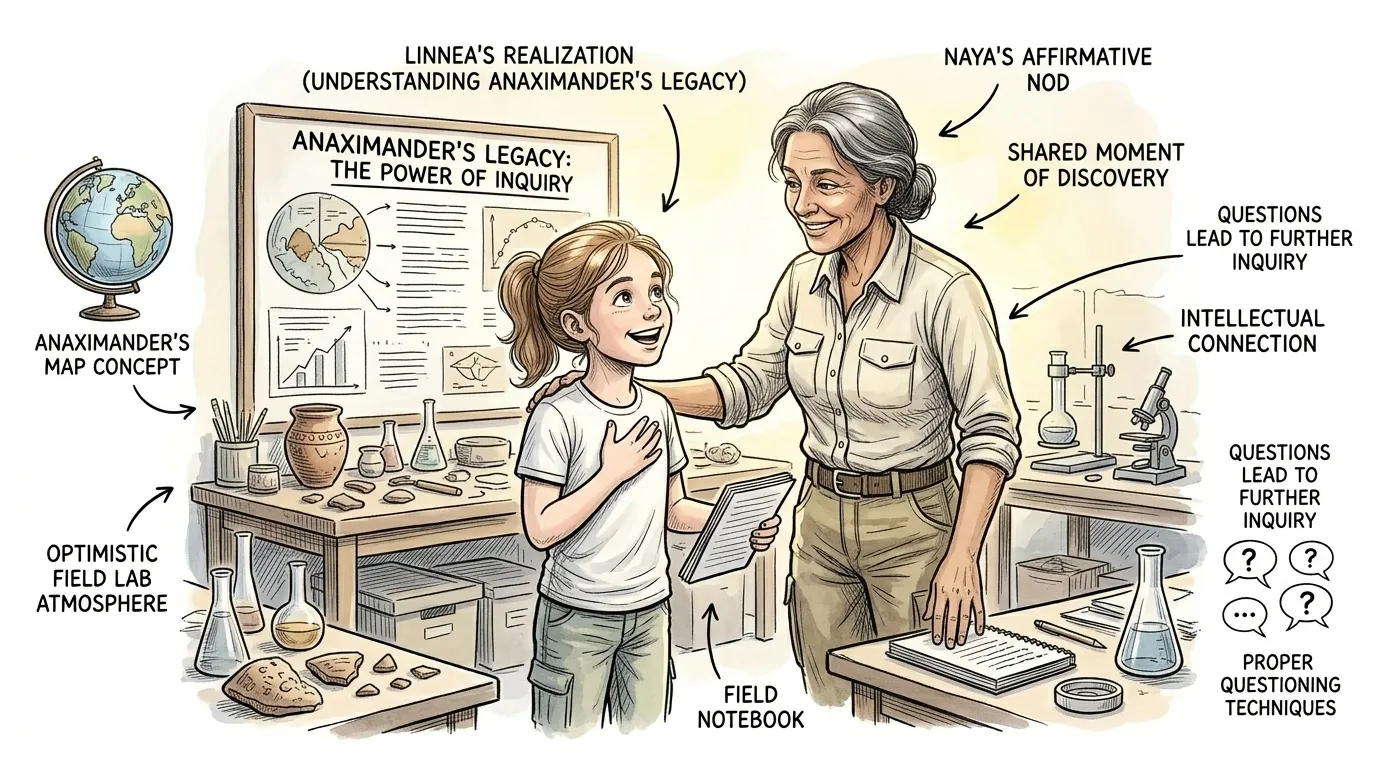
Anaximander's legacy lies in his willingness to question assumptions and propose bold new ideas. He challenged the status quo and pushed humanity toward deeper understanding. The search for the fundamental nature of reality continues, inspired by his pioneering spirit.
"Sven smiled, "So, even though he didn't have all the answers, he asked the right questions?" Vera nodded. "Exactly! And that's sometimes the most important thing of all.""
Philosophy Note: Critical Thinking: The ability to analyze information objectively and make reasoned judgments, a skill championed by Anaximander.
Page 10
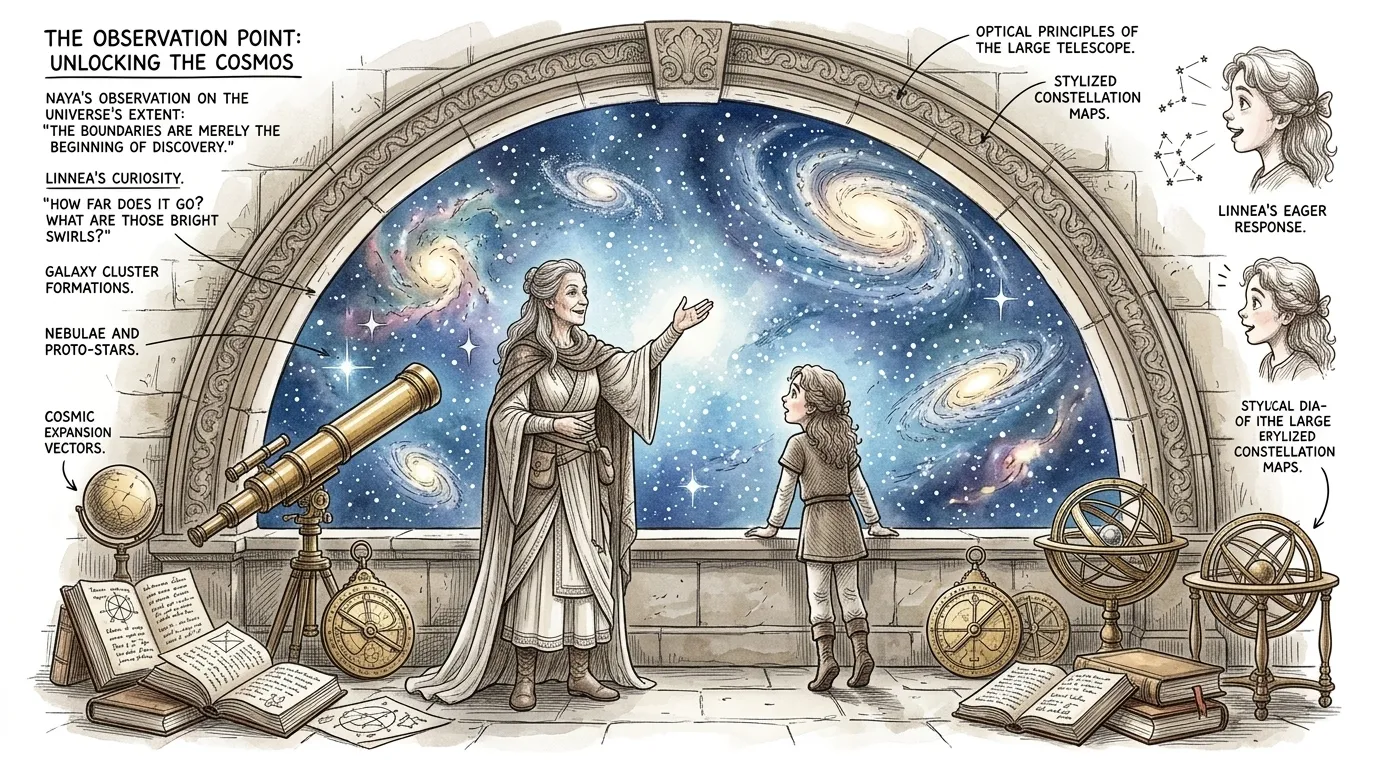
Anaximander shows us that understanding the universe begins with daring to imagine the unseen. By embracing the boundless and questioning everything, we can unlock new levels of insight and discovery, revealing the infinite potential within ourselves.
"Vera says to Sven. "Now it is your turn to ask big questions Sven, who knows what you will discover!""
Philosophy Note: Philosophical Inquiry: The ongoing pursuit of knowledge and understanding through questioning and critical analysis.
About this story
- Audience: kids (ages 6–12)
Questions and answers
Read Wonder Philosophy on your phone
Wonder Philosophy is available on Android and iPhone and iPad. Get Wonder Philosophy on Google Play · Get Wonder Philosophy on the App Store.