Albert Camus
Albert Camus — an illustrated philosophy story. 10 illustrated pages, free to read on Wonder Philosophy.

Page 1

The vastness of human existence often confronts us with a profound silence, leaving us to question life's inherent meaning. In the mid-20th century, a philosopher named Albert Camus articulated this unsettling experience, naming it 'the Absurd.' He explored the inherent conflict between humanity's yearning for meaning and the universe's indifferent lack of it. This tension, Camus argued, is not a problem to be solved, but a fundamental condition to be faced head-on.
Philosophy Note: Albert Camus (1913-1960), French philosopher and writer, Nobel Prize laureate. Core Idea: The Absurd, the conflict between human desire for meaning and the universe's indifference. Context: Post-World War II intellectual landscape in France.
Page 2
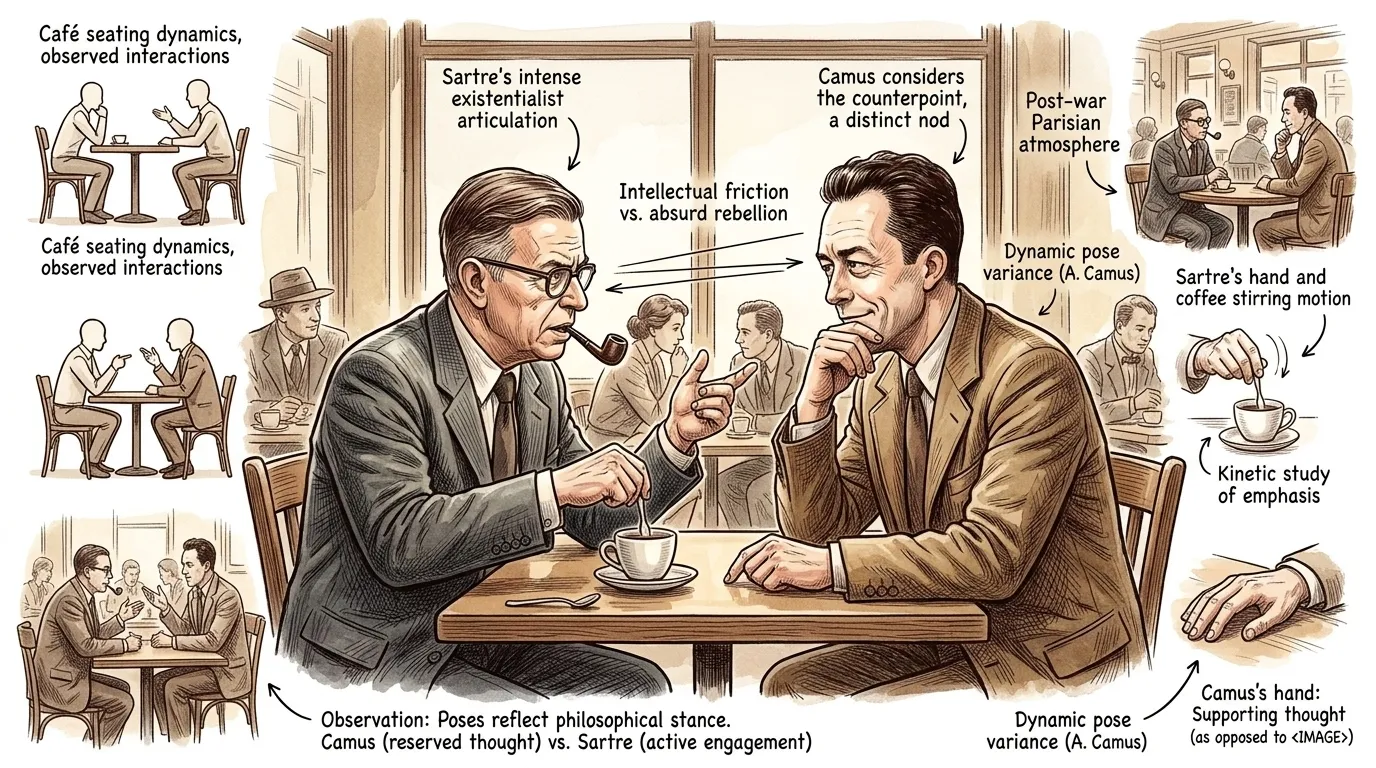
The café buzzed with the murmur of ideas, a common stage for philosophical debate in post-war Paris. Albert Camus sat opposite his intellectual contemporary, Jean-Paul Sartre, both deeply engaged in the era's urgent questions of meaning. Their expressions revealed the gravity of their reflections, as if bearing the weight of an era's despair.
"'Albert, the silence of the world truly is deafening when one seeks ultimate purpose,' Sartre mused, stirring his coffee. 'For many, this recognition of life's inherent meaninglessness, this 'Absurd' as you call it, leads directly to despair.' Camus nodded slowly, his gaze distant. 'Indeed, Jean-Paul, the confrontation with this cosmic indifference, the collision between our rational demands and the world's unreason, is the starting point for all genuine inquiry. But despair is not the only path.'"
Philosophy Note: Jean-Paul Sartre (1905-1980), a leading figure of existentialism, contemporary and often critic of Camus. The 'Absurd' refers to the fundamental disharmony between humanity's search for meaning and the universe's lack of it.
Page 3
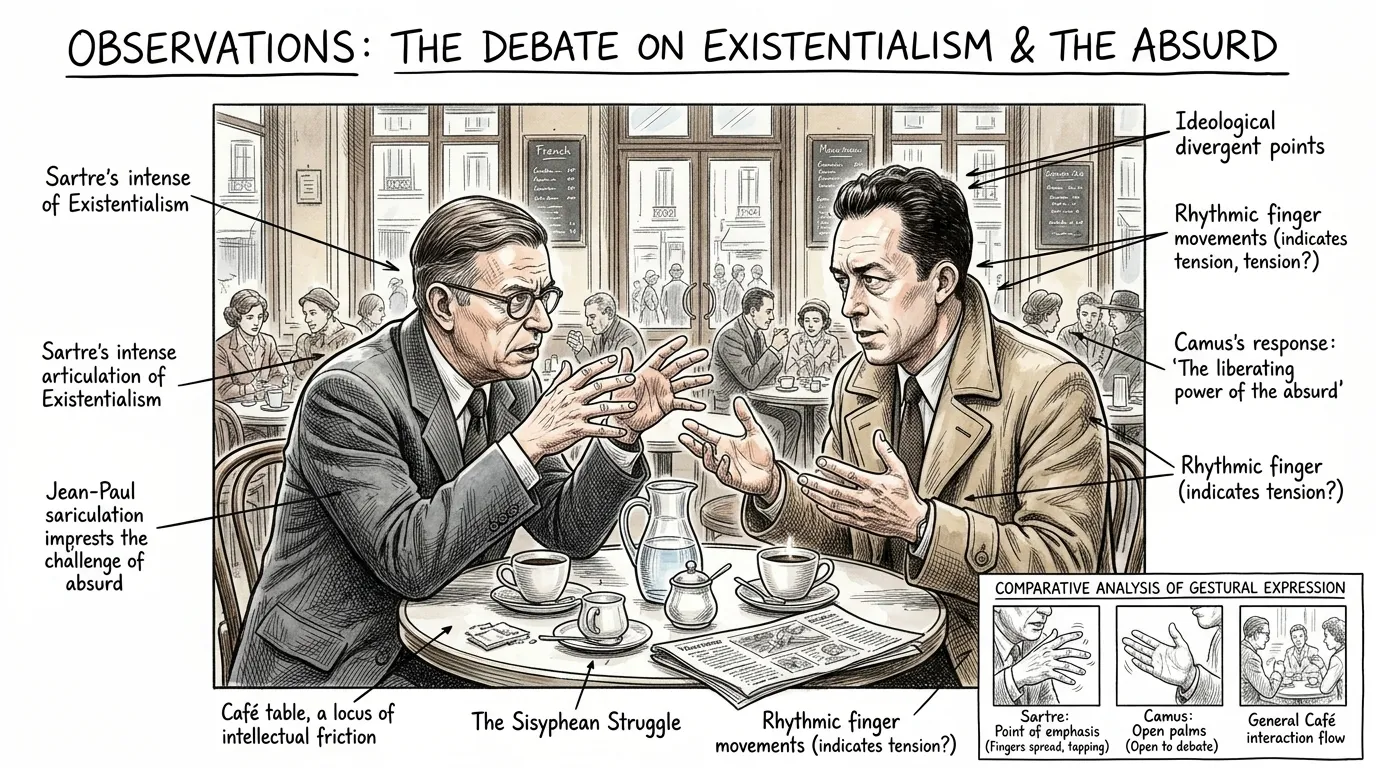
The conversation deepened, exploring the human drive to impose order and significance on a chaotic world. They delved into the philosophical implications of refusing to accept any transcendent meaning. This struggle, Camus emphasized, becomes the foundation for genuine freedom.
"'But is it not our very consciousness, our capacity to ask 'why,' that makes this situation so agonizing?' Sartre pressed, tapping his fingers on the table. 'We crave narrative, a grand design.' Camus responded, 'Precisely. Our minds demand coherence, yet the universe offers only silence. This recognition itself, however bleak, liberates us. It reveals the true starting point for living. It is the raw material, the fundamental truth we must first acknowledge to move beyond it.'"
Philosophy Note: Camus's early works like 'The Myth of Sisyphus' (1942) and 'The Stranger' (1942) articulated the concept of the Absurd. This recognition of the absurd is the foundational 'knowledge' for navigating existence.
Page 4
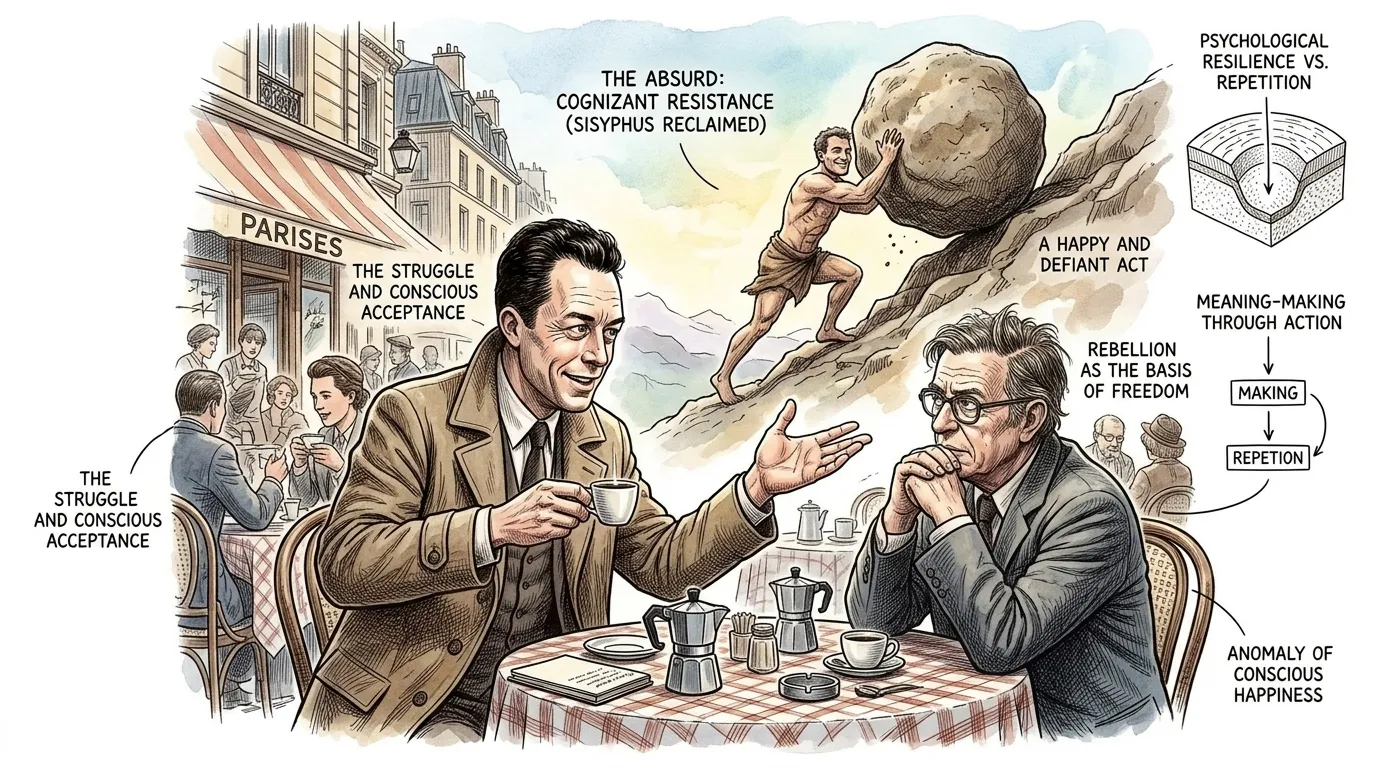
Camus found a powerful metaphor for the Absurd in the ancient Greek myth of Sisyphus, condemned to eternally roll a boulder up a hill, only for it to fall back down. This ceaseless, futile labor mirrors the human condition, yet Camus found a radical path forward within it. He proposed that Sisyphus finds meaning not in the task's outcome, but in his conscious defiance.
"'Think of Sisyphus,' Camus proposed, his voice gaining conviction, 'condemned to an eternally meaningless task. His punishment is endless, yet it is precisely in his conscious awareness of this futility that true rebellion begins. As I wrote in 'The Myth of Sisyphus,' 'The struggle itself toward the heights is enough to fill a man's heart. One must imagine Sisyphus happy.' This is the core of our response to the absurd.' Sartre listened intently, a thoughtful expression on his face."
Philosophy Note: Camus reimagined Sisyphus, suggesting that by consciously acknowledging the futility of his task, Sisyphus transcends it, achieving a form of freedom and happiness in his defiance. This is not about finding meaning, but creating it through revolt.
Page 5
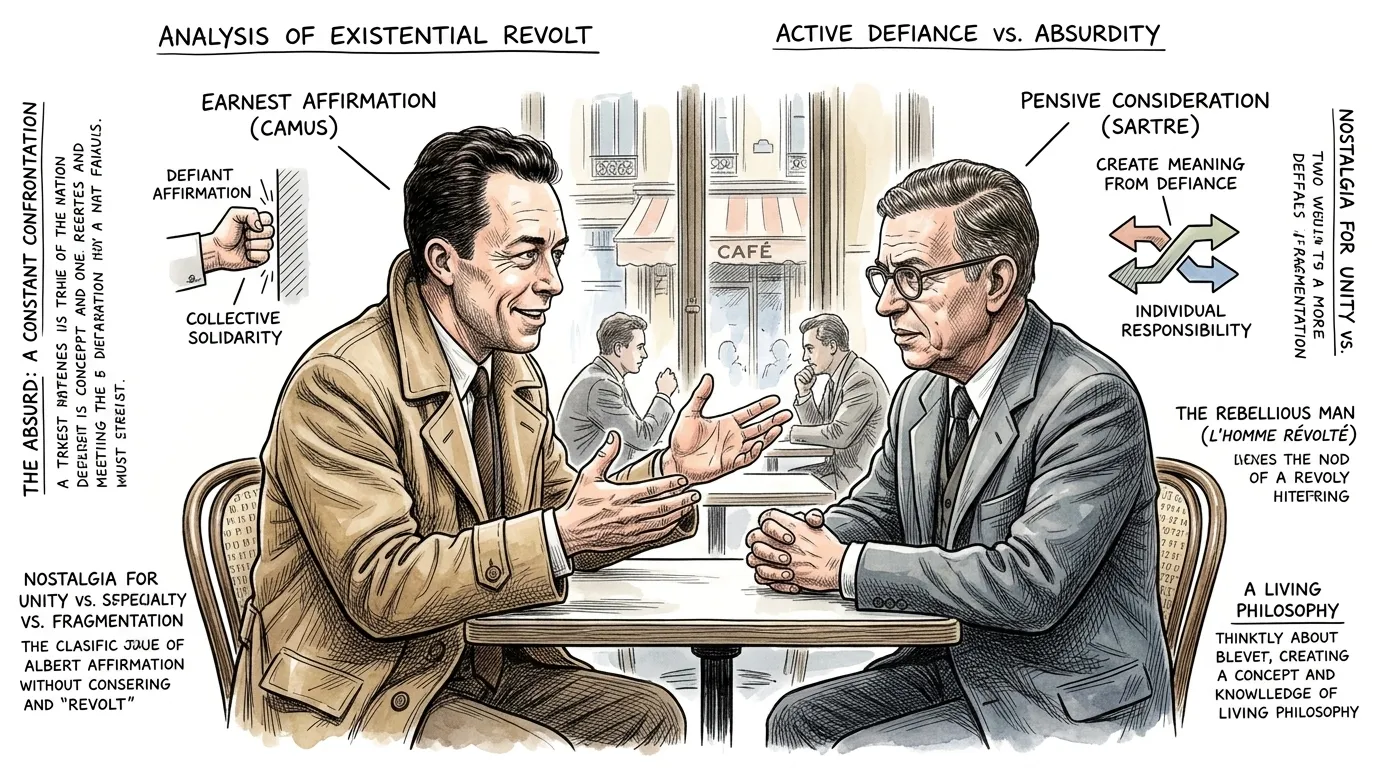
Camus's philosophy moved beyond mere recognition of the Absurd to embrace an active 'revolt.' This revolt is not a violent revolution, but a constant, defiant stance against the world's unreason and the inevitability of death. It is an affirmation of life, freedom, and passion within the boundaries of meaninglessness.
"'Revolt, then, is our answer to the absurd,' Camus elaborated, leaning forward slightly. 'It's not about finding a meaning the universe denies, but creating meaning through our actions, our freedom, our engagement. It means living life to its fullest, passionately, with no illusion of eternal reward or ultimate purpose.' Sartre nodded, considering this. 'So, our very consciousness becomes a tool for active defiance rather than passive despair?'"
Philosophy Note: Camus's concept of 'revolt' (révolte) is a philosophical and ethical stance of defiance against the absurd, not a political one. It advocates for living intensely and creating value in the face of meaninglessness.
Page 6

While initial revolt is individual, Camus also explored how it could extend to collective action, emphasizing solidarity in the face of shared human suffering. This perspective grounded his moral and political engagements, particularly his critique of ideologies that justified violence for a future utopia.
"'This individual revolt naturally extends to solidarity,' Camus explained, 'because we recognize our shared human condition. It leads to a refusal of all forms of oppression, of any ideology that sacrifices present lives for a distant, hypothetical future.' Sartre interjected, 'But isn't revolutionary action sometimes necessary to achieve justice?' Camus replied, 'Revolution, yes, but not if it denies the very humanity it claims to serve. Our revolt must always honor human limits.'"
Philosophy Note: Camus's ethical philosophy extended personal revolt into a call for collective solidarity against injustice. He was critical of totalitarian ideologies, differentiating his 'rebellion' from the violent aspects of certain revolutionary movements.
Page 7
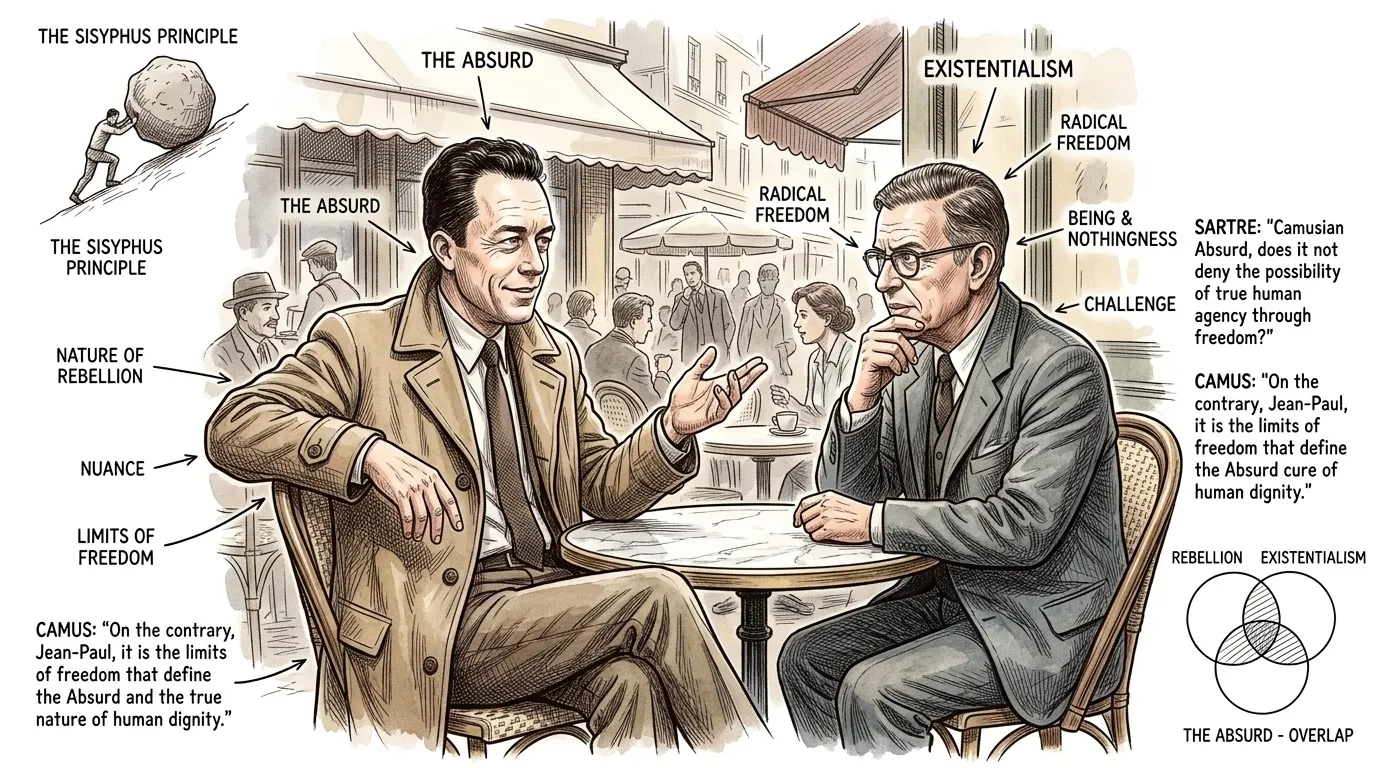
Despite their public association, Camus famously rejected the label of 'existentialist,' particularly as defined by Sartre. Their philosophical paths diverged significantly on the nature of freedom and the construction of meaning. These distinctions were crucial for understanding the nuances of post-war European thought.
"'Many, of course, align your philosophy with existentialism,' Sartre noted, a hint of challenge in his voice. 'But you've always resisted the direct label.' Camus affirmed, 'My focus is on the Absurd, the initial confrontation with meaninglessness, not on the creation of meaning ex nihilo through radical freedom alone. As I've always said, 'I continue to believe that I am not an existentialist.' My inquiry begins with the limits, not the boundless possibilities, of our freedom.'"
Philosophy Note: Camus's rejection of existentialism stemmed from his emphasis on the given absurd condition and the limits of human freedom, rather than Sartre's focus on absolute freedom and radical self-creation. The quote 'I continue to believe that I am not an existentialist' is historically attributed to Camus.
Page 8
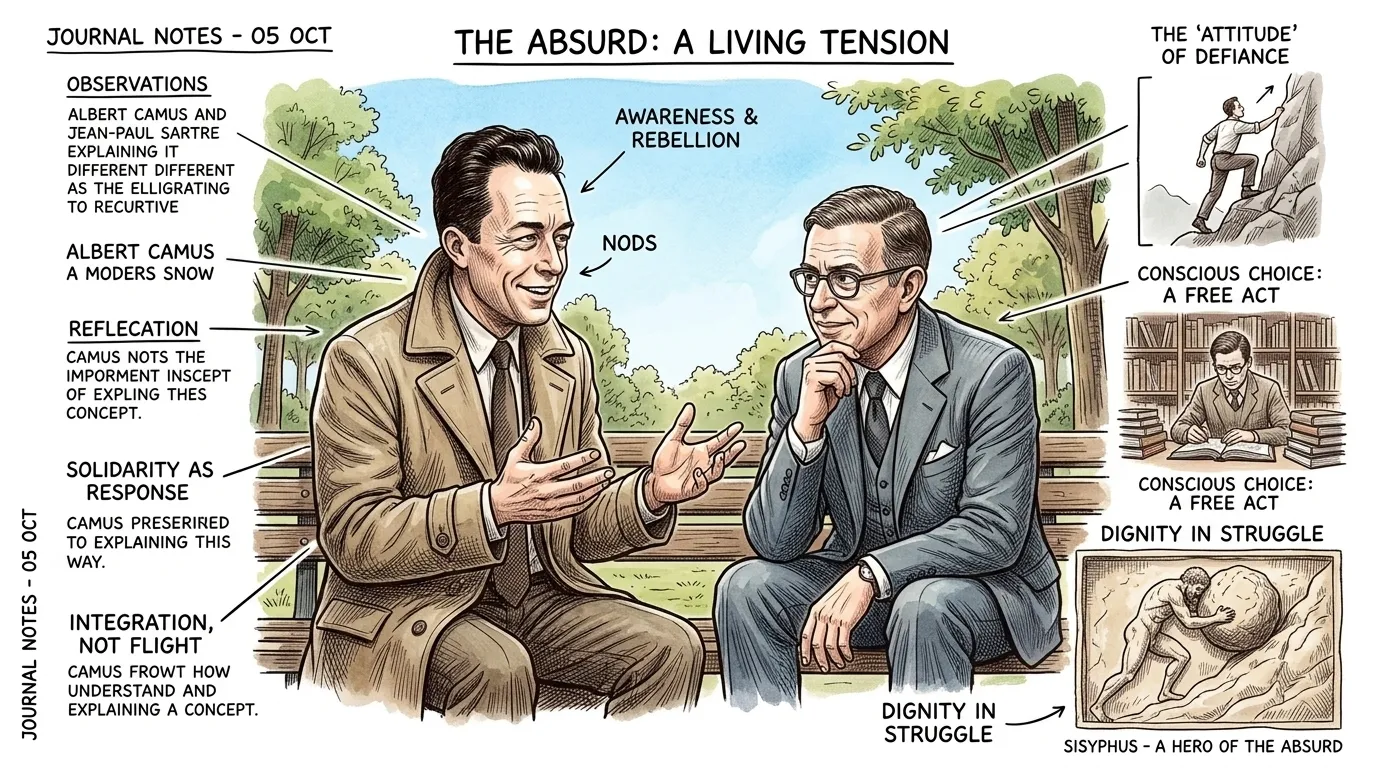
The core 'knowledge' that Camus offered wasn't a solution to life's ultimate questions, but a transformative perspective on how to live within them. His work empowers individuals to find dignity and purpose not by escaping the absurd, but by consciously embracing its inherent struggle. This is the profound 'payoff' of confronting meaninglessness directly.
"'So, the 'solution' to the Absurd is not an answer, but an attitude?' Sartre inquired, now more reflective than challenging. Camus confirmed, 'Precisely. It is to live in defiance, in solidarity, and with an acute awareness of our limited time. The power isn't in finding a universal meaning, but in creating our own, however fleeting, through our conscious choices. This is where dignity lies, the triumph over nihilism without recourse to false hope. It is, as I often pondered, the true meaning of 'The struggle itself toward the heights is enough to fill a man's heart.'"
Philosophy Note: Camus's enduring legacy lies in offering a path to live meaningfully and ethically without relying on transcendent justifications. His concept of 'revolt' provides the framework for this active engagement with life.
Page 9

Camus's philosophy resonates deeply in the contemporary world, where individuals grapple with consumerism, global crises, and the search for authentic purpose. His ideas provide a framework for navigating alienation and finding personal and collective meaning in an increasingly complex and often indifferent global society. From personal resilience to social activism, the 'Absurd' and 'Revolt' continue to inspire.
"''The purpose of a writer is to keep civilization from destroying itself,'' Camus once famously stated. This powerful sentiment encapsulates the lasting relevance of his work today,' a modern-day philosopher observes, addressing a group of students. 'His call for rebellion isn't just about personal defiance; it's about holding onto ethical action in a world that often feels absurdly indifferent to human suffering. It's about building solidarity, just as he and Sartre discussed years ago, in the face of shared challenges.'"
Philosophy Note: Camus's insights are particularly relevant in an age of existential doubt, offering ethical frameworks for individual authenticity, collective action against injustice, and the pursuit of meaning through lived experience rather than external validation. The quote is a paraphrase of a well-known Camus sentiment.
Page 10

Albert Camus's exploration of the Absurd remains a foundational element of modern critical philosophy, challenging us to confront life's fundamental questions without illusion. He teaches that within the recognition of meaninglessness, lies the profound freedom to choose our response, to embrace our human condition, and to find joy in the very struggle of existence. His legacy is an enduring call to conscious, passionate engagement with the world.
"''In the depth of winter, I finally learned that within me lay an invincible summer,' a voice, calm and reflective, echoes across the final scene. This profound realization, often attributed to Camus himself, captures the essence of his philosophy: that even in the bleakest confrontation with the absurd, an inner strength, a capacity for joy and defiance, remains. His work continues to guide us toward an honest, passionate, and ultimately joyful engagement with life's inevitable challenges."
Philosophy Note: Camus's philosophy culminates in a message of hope and resilience, arguing that recognizing the absurd does not lead to nihilism but to an invigorated appreciation for life, freedom, and the power of conscious human action. The quote 'In the depth of winter, I finally learned that within me lay an invincible summer' is a famous reflection attributed to Camus.
About this story
- Audience: general readers
Questions and answers
Read Wonder Philosophy on your phone
Wonder Philosophy is available on Android and iPhone and iPad. Get Wonder Philosophy on Google Play · Get Wonder Philosophy on the App Store.