Alfred North Whitehead
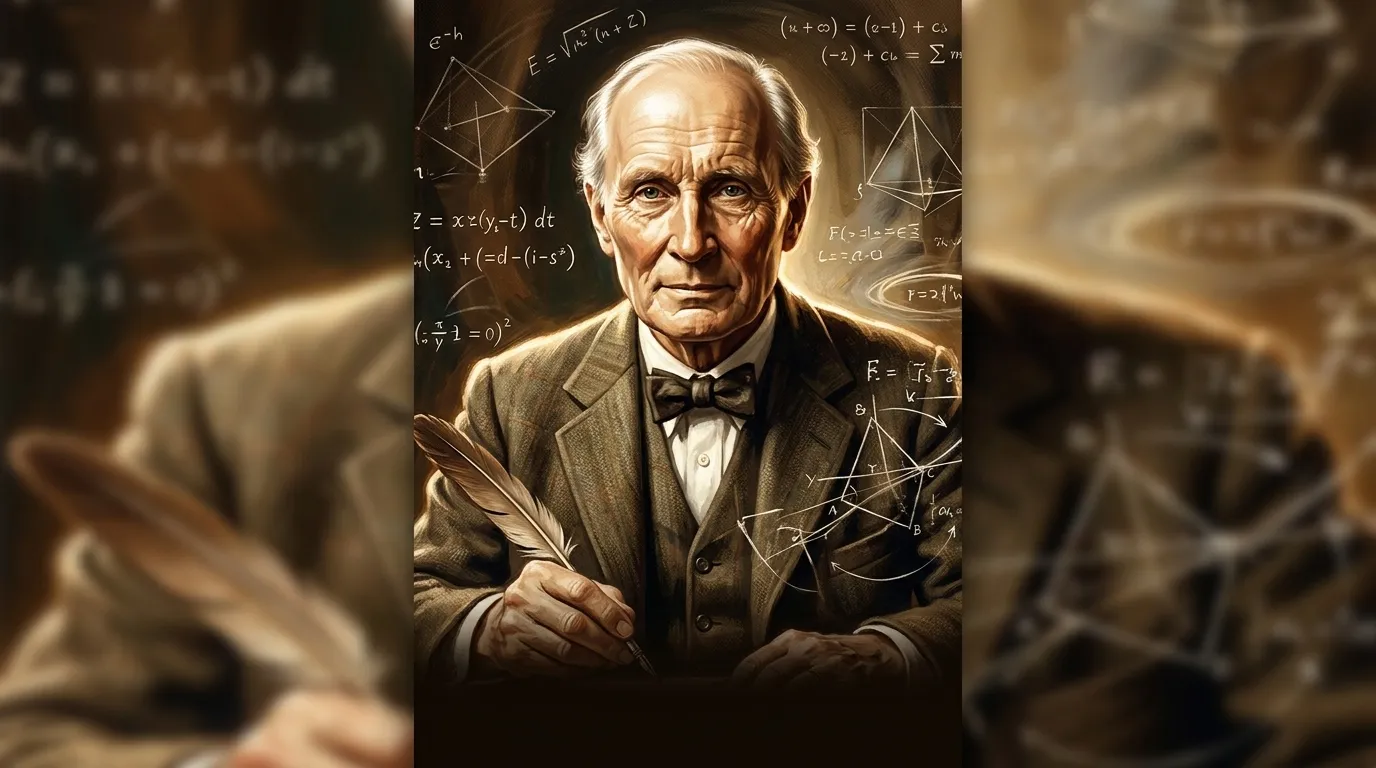
Alfred North Whitehead — an illustrated philosophy story. 10 illustrated pages, free to read on Wonder Philosophy.
Page 1

Kaya and Riku stood at the entrance of the Grand Hall of Ideas, a place dedicated to groundbreaking thinkers. Above them, a shimmering holographic display cycled through images of changing landscapes and swirling galaxies. "Wow, look at that!" Riku exclaimed, pointing upwards with wide eyes.
""It makes you think about how everything is always moving, doesn't it?" Kaya pondered, stepping closer to a large interactive screen that glowed softly. "Today, we're exploring a philosopher named Alfred North Whitehead, who saw the whole world as one continuous flow, not just separate things.""
Philosophy Note: Alfred North Whitehead (1861–1947) was a British mathematician and philosopher. He is best known for 'process philosophy,' which radically redefines reality as a dynamic succession of interconnected events rather than static substances.
Page 2

They moved to a section showing Whitehead's early work, filled with complex mathematical symbols. "He started out working on huge, difficult math problems, like trying to map out all of logic," Kaya explained, tracing a finger over a projection of an old book.
""So he was super smart!" Riku piped up, trying to mimic the symbols with his fingers. "But why did he change to thinking about 'flowing reality'? Was he bored with numbers?" Kaya smiled. "Not bored, Riku. He realized that numbers alone couldn't capture the richness of actual living experience, how things truly unfold.""
Philosophy Note: Whitehead co-authored 'Principia Mathematica' (1910–1913) with Bertrand Russell, a foundational text in mathematical logic. His later shift to process philosophy was partly a response to the limitations of purely logical or scientific frameworks in explaining lived experience and the dynamic nature of existence.
Page 3

At another display, a narrator's voice explained: 'Whitehead saw reality not as static objects, but as a continuous series of 'actual occasions'—momentary, unfolding events.' Kaya pointed to a diagram showing tiny, interconnected sparks.
""Think of a single note in a song, or a flicker of light from a firefly!" Kaya suggested. "Each one is an 'actual occasion'—it happens, it feels, it connects, and then it's gone, making way for the next. This understanding, that everything is an event, not a thing, is what makes his ideas so useful for understanding constant change." Riku nodded, his eyes wide with understanding."
Philosophy Note: Central to Whitehead's process philosophy is the concept of 'actual occasions' or 'actual entities'—the fundamental, irreducible elements of reality. These are not static objects but dynamic, self-creating, and perishing events, each integrating aspects of its past and contributing to the future.
Page 4

A video played, showing ripples spreading across a pond. "This idea means that nothing exists purely by itself," Kaya explained, mimicking the ripples with her hands. "Every event is always connected to, and influenced by, other events."
""Like how my throw affects the water, and then the water affects the next ripple, and it just keeps going?" Riku asked, watching the screen intently. "Exactly!" Kaya affirmed. "Whitehead argued that to understand anything, we have to understand its relationships and its history—where it came from, what it's touching, and what it's becoming.""
Philosophy Note: Whitehead emphasized the relational nature of reality, stating that 'every actual occasion is a prehension of every other actual occasion.' This means that each event incorporates and is influenced by all other events in its past, forming a deeply interconnected cosmos.
Page 5

They arrived at a display that highlighted a surprising connection. "Whitehead was thinking about these ideas around the same time Albert Einstein was developing his theory of relativity!" Kaya pointed to side-by-side images of the two thinkers.
""So, like, space and time aren't just empty containers, but they change depending on who's looking?" Riku guessed, recalling a previous exhibit. "That's a great way to put it for Einstein," Kaya replied. "Whitehead took it further, suggesting that even our sense of ourselves is constantly being created and recreated in each moment, shaped by all that came before. It's a very dynamic way to understand existence.""
Philosophy Note: Albert Einstein's theory of relativity (early 20th century) profoundly influenced modern thought, positing that space and time are not absolute but relative to the observer's motion. Whitehead's process philosophy, while developed independently, shares a similar rejection of static, absolute frameworks, instead emphasizing dynamic, relational events in a universe of continuous becoming.
Page 6

Riku paused by a tranquil water feature where tiny streams converged and diverged. "It's like this water," he observed, watching the currents. "It's never the same, always becoming something new."
""Exactly, Riku!" Kaya agreed, stepping closer. "Whitehead's philosophy invites us to see the world not as a collection of fixed 'beings,' but as a continuous 'becoming.' Everything is a creative advance into novelty. It's about how things happen, how they emerge, and how they contribute to what comes next. It's a very hopeful way of looking at change.""
Philosophy Note: The concept of 'becoming' (or 'creative advance into novelty') is fundamental to process philosophy. It suggests that reality is not static but constantly in the process of creating itself, with each 'actual occasion' emerging from its past and contributing something new to the future, embodying a dynamic and open-ended universe.
Page 7

Kaya picked up a smooth, heavy stone from a display. "Most people think this stone is just a thing that exists, unchanging, right?" she asked, holding it up. "But Whitehead would say even the stone is a pattern of events, a slow-motion flow."
""That's a bit hard to picture!" Riku admitted, frowning. "It feels so solid!" Kaya nodded. "It challenges our usual way of thinking, doesn't it? As Bertrand Russell, Whitehead's co-author, once said, 'What we learn in childhood is that the world consists of separate things.' Whitehead shows us that even what seems separate is deeply interconnected and always in motion. It's about seeing the dance, not just the dancers.""
Philosophy Note: One of the challenges of process philosophy is overcoming our ingrained habits of thought that perceive reality as composed of static, independent 'substances' or 'things.' Whitehead argues that even seemingly inanimate objects are better understood as enduring patterns of 'actual occasions' or events. Bertrand Russell (1872–1970) was a close collaborator and intellectual foil to Whitehead, initially sharing a logical-analytic approach before Whitehead diverged into process philosophy.
Page 8

They stood before a vast, immersive screen displaying a vibrant, complex ecosystem, where every organism was depicted as a continuous, energetic process. "So if everything is a flow, how do we understand the 'big' things, like a forest, or even ourselves?" Riku asked, gazing at the intertwining life on screen.
""Whitehead called them 'societies' of events," Kaya explained, pointing to various parts of the ecosystem. "A forest isn't a fixed 'thing' but a stable pattern of countless interacting 'actual occasions'—each tree, each leaf, each tiny creature, all flowing together. Understanding this helps us see how our own actions ripple outwards, just like the water from the earlier exhibit, influencing the future.""
Philosophy Note: Whitehead's concept of 'societies' explains how complex, enduring entities (like an organism, a society, or even a rock) can emerge from the continuous flow of 'actual occasions.' These societies are stable patterns of events that maintain their identity over time, demonstrating how a universe of constant becoming can still have recognizable structures.
Page 9
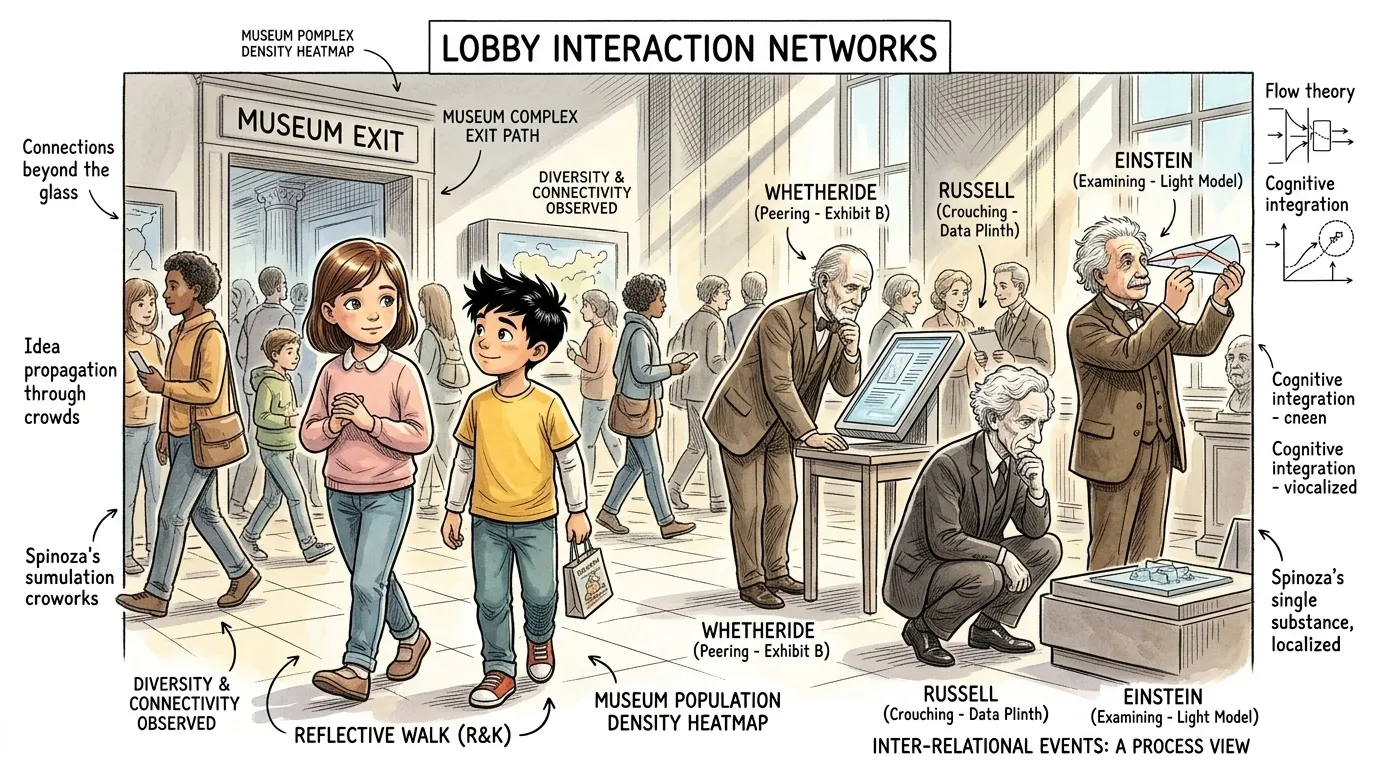
Walking out of the exhibit, Kaya looked at the bustling museum lobby, filled with people hurrying in different directions. "Whitehead's ideas might seem complex, but they offer a powerful lens for our fast-changing world," she mused.
""It makes me think about how everyone is connected, even if they don't know it," Riku added thoughtfully. "And how every little thing we do is part of a bigger flow." Kaya smiled. "Precisely. It helps us appreciate that identity isn't fixed, but constantly evolving, and that our choices, big or small, are 'actual occasions' shaping the future. It's a philosophy that empowers us to be mindful participants in the ongoing creation of reality.""
Philosophy Note: Whitehead's process philosophy has found increasing relevance in contemporary thought, influencing fields from ecology and quantum physics to theology and management. It provides a framework for understanding dynamic systems, interconnectedness, and the ethical implications of our participation in a continuously evolving reality.
Page 10

As they stepped outside into the setting sun, the city skyline shimmered with a thousand lights, each a tiny flicker. Riku took a deep breath of the evening air, feeling the breeze on his face. "So, the whole world is just one big, amazing unfolding story?" he asked.
""Yes, Riku, a story where every moment, every being, every tiny event is both a product of the past and a creative step into the unknown future," Kaya confirmed, looking out at the vast urban landscape. "Whitehead teaches us that there are no isolated incidents, only a grand, interwoven tapestry of becoming. And we are all part of its beautiful, continuous making.""
Philosophy Note: Whitehead's vision of reality as a 'creative advance into novelty' emphasizes the dynamic, emergent, and interconnected nature of the universe. This perspective encourages a holistic understanding of existence, where every event contributes to the ongoing evolution of the cosmos, reminding us of our intrinsic participation in the unfolding of reality.
About this story
- Audience: general readers
Questions and answers
Read Wonder Philosophy on your phone
Wonder Philosophy is available on Android and iPhone and iPad. Get Wonder Philosophy on Google Play · Get Wonder Philosophy on the App Store.