Achille Mbembe
Achille Mbembe — an illustrated philosophy story. 10 illustrated pages, free to read on Wonder Philosophy.

Page 1
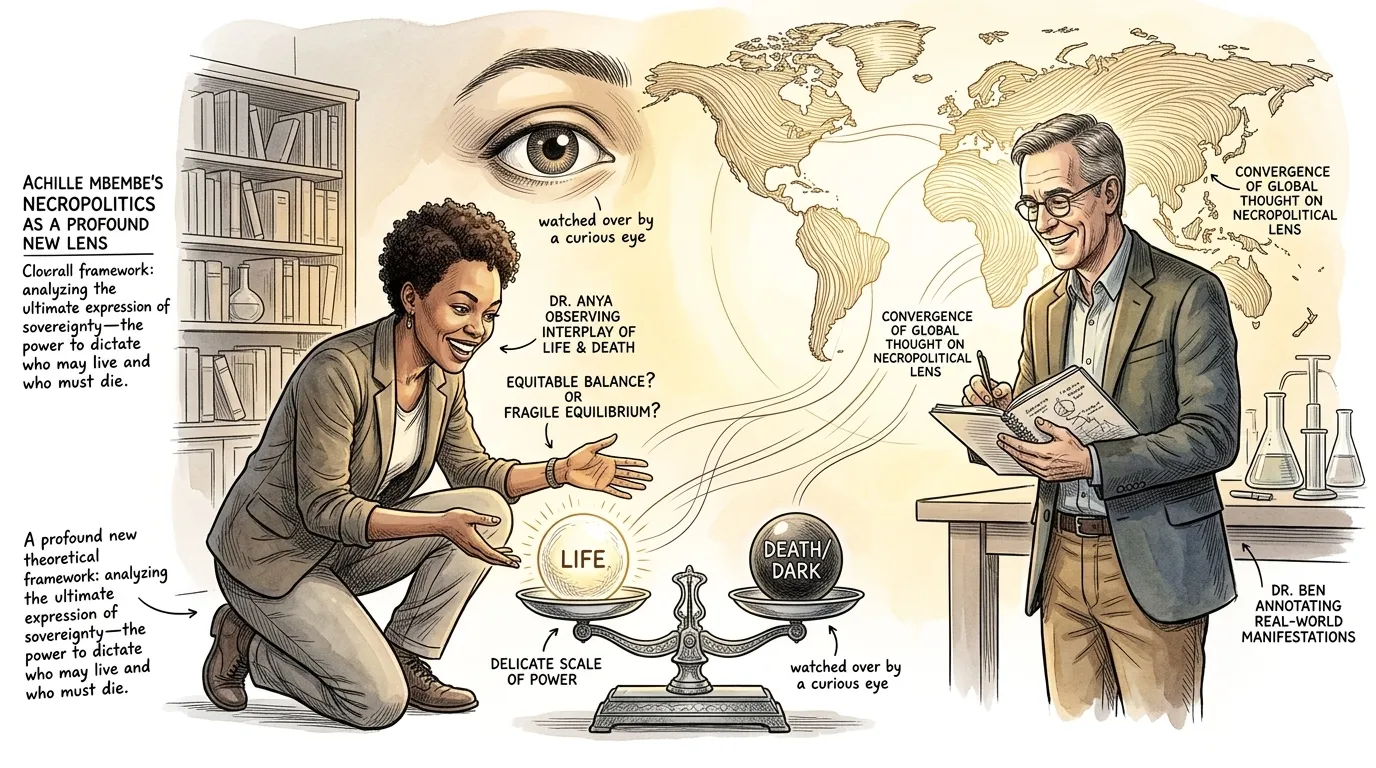
At the convergence of global thought, the Cameroonian philosopher Achille Mbembe introduced a profound concept that reshaped our understanding of power. His idea, 'Necropolitics,' forces us to examine the ultimate stakes of sovereignty, revealing how power extends beyond merely governing life to actively dictating who may live and who may die, or be condemned to a 'social death.' It is a crucial lens through which to analyze the world's most pressing human challenges today.
Philosophy Note: Achille Mbembe, Philosopher. Necropolitics. The power to define who matters enough to live, and who can be left to die.
Page 2
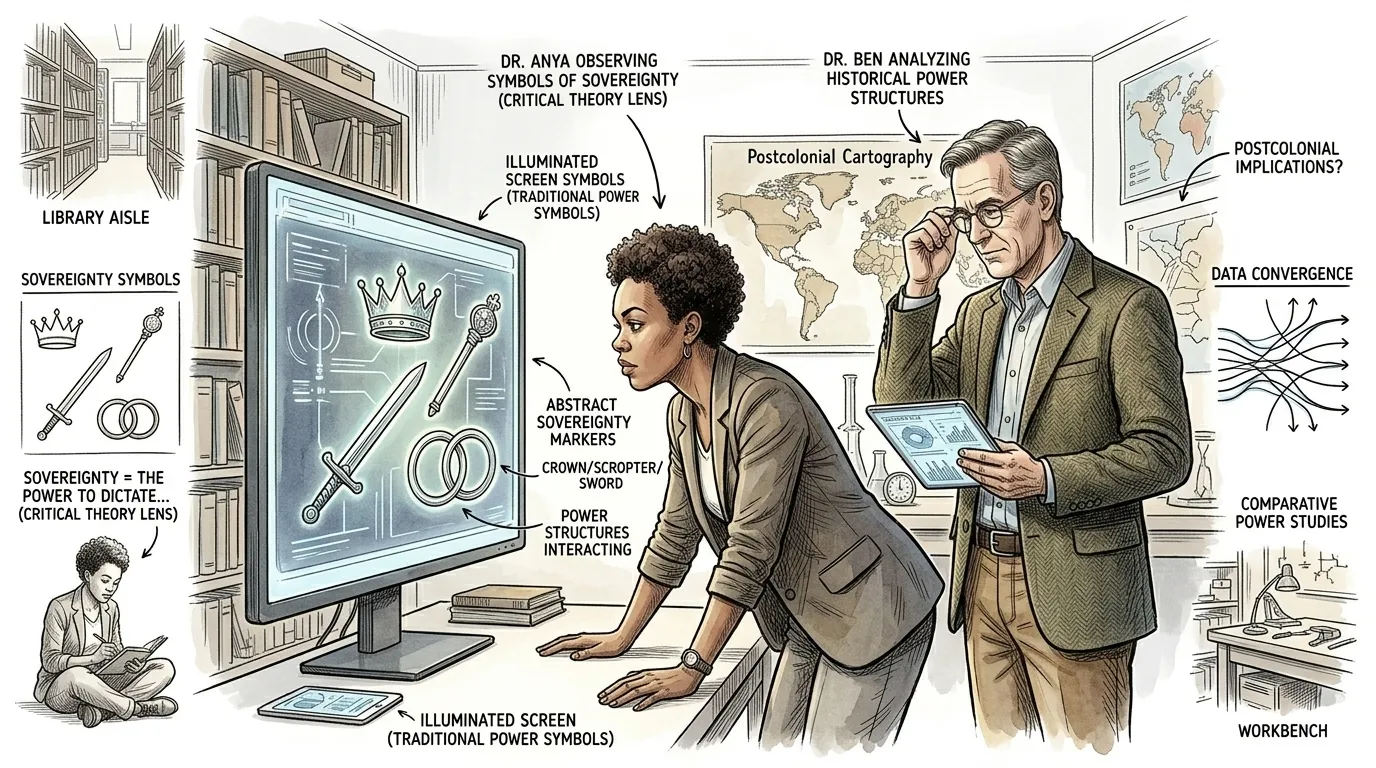
Dr. Anya turned to Dr. Ben, her expression pensive. "Traditional concepts of sovereignty often focus on the state's monopoly over legitimate violence, the right to kill," she observed, gesturing towards the screen. "But Mbembe pushes further, suggesting this view doesn't fully capture the nuances of power, especially in postcolonial contexts." Dr. Ben nodded, adjusting his glasses. "Indeed, Mbembe saw that Foucault's 'biopolitics'—the management of life, health, and populations—while crucial, didn't account for the active production of death-worlds or the systemic abandonment of certain lives. He identified a critical gap where sovereign power exercises control not just over life, but over death itself."
""Traditional concepts of sovereignty often focus on the state's monopoly over legitimate violence, the right to kill," Dr. Anya observed, gesturing towards the screen. "But Mbembe pushes further, suggesting this view doesn't fully capture the nuances of power, especially in postcolonial contexts." Dr. Ben nodded, adjusting his glasses. "Indeed, Mbembe saw that Foucault's 'biopolitics'—the management of life, health, and populations—while crucial, didn't account for the active production of death-worlds or the systemic abandonment of certain lives. He identified a critical gap where sovereign power exercises control not just over life, but over death itself.""
Philosophy Note: Historical Problem: Sovereign power's focus on the 'right to kill' missed the broader 'right to let die.' Dr. Ben introduces 'Biopolitics vs. Necropolitics' as a core distinction.
Page 3
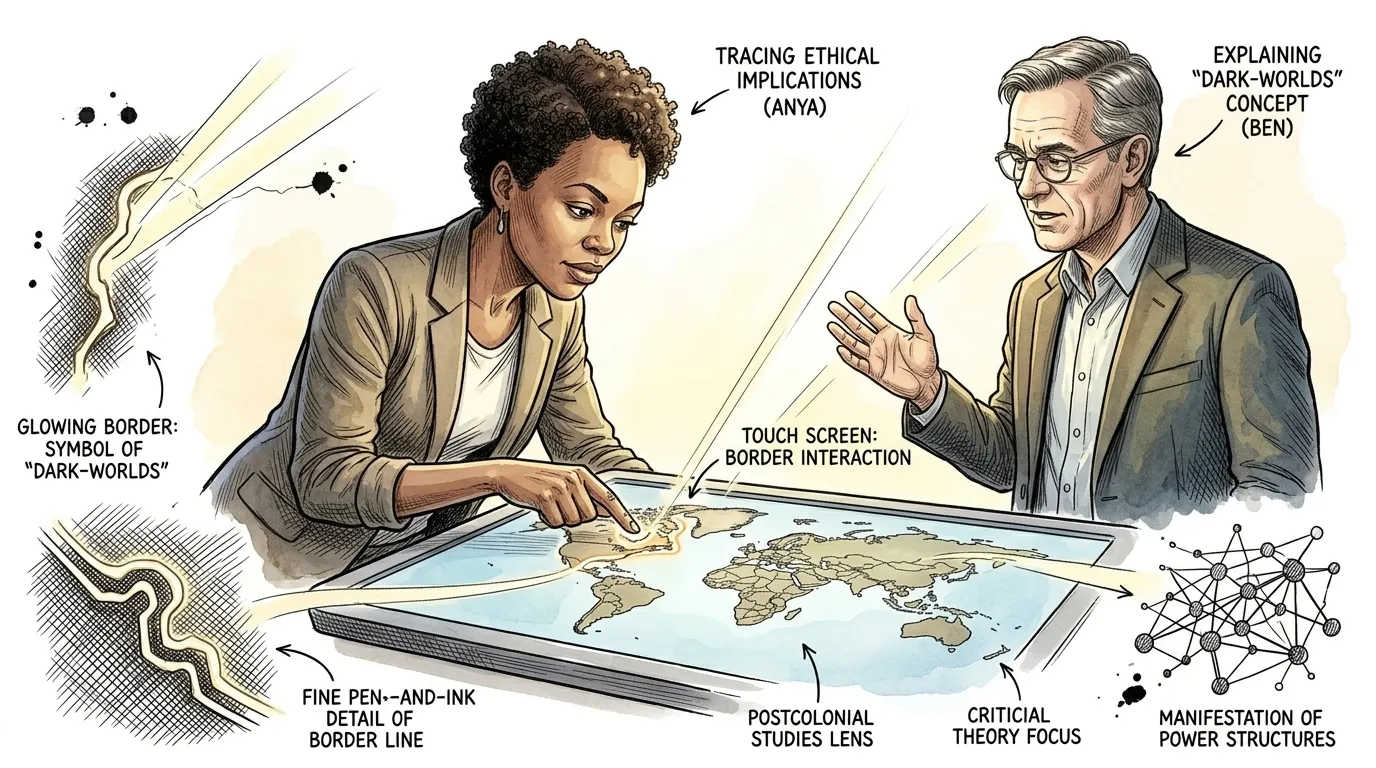
Dr. Anya leaned closer to the screen, tracing a border line with her finger. "So, Mbembe suggests that beyond simply managing populations for their productive capacities, as in biopolitics, contemporary power actively creates conditions where some lives are deemed expendable, existing in zones of 'social death,'" she mused. Dr. Ben affirmed, "Precisely. Consider regions where war, extreme poverty, or state neglect combine to form what he calls 'death-worlds,' places where the very fabric of life is systematically dismantled, and populations exist in a state of suspended vitality. It's a fundamental shift from making live to letting die, or even making die, through indirect means."
""So, Mbembe suggests that beyond simply managing populations for their productive capacities, as in biopolitics, contemporary power actively creates conditions where some lives are deemed expendable, existing in zones of 'social death,'" Dr. Anya mused. Dr. Ben affirmed, "Precisely. Consider regions where war, extreme poverty, or state neglect combine to form what he calls 'death-worlds,' places where the very fabric of life is systematically dismantled, and populations exist in a state of suspended vitality. It's a fundamental shift from making live to letting die, or even making die, through indirect means.""
Philosophy Note: Mbembe extends Foucault, arguing that sovereign power not only 'makes live' but also actively 'lets die' through the creation of 'death-worlds.'
Page 4
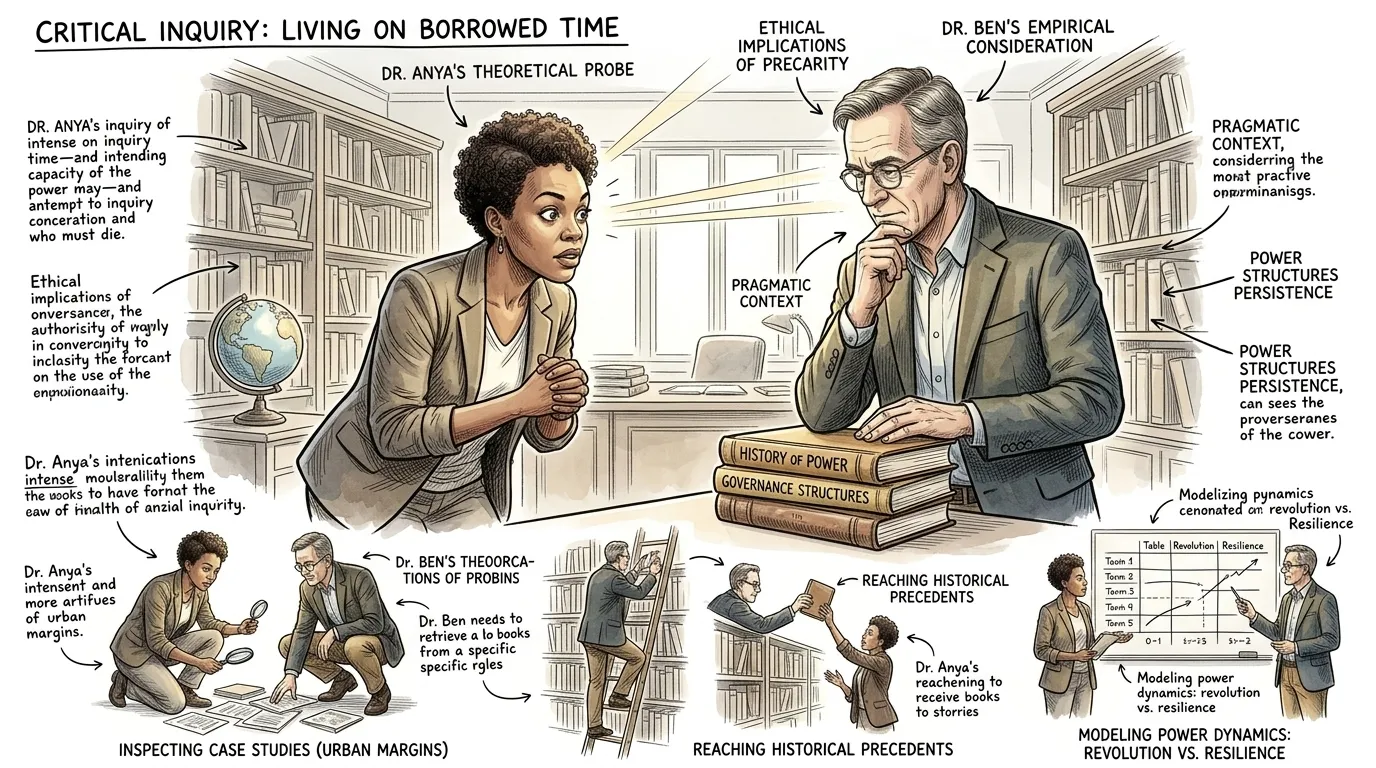
"What does it mean, then, for individuals to live under this necropolitical power?" Dr. Anya asked, looking directly at Dr. Ben. "How does it manifest in daily existence?" Dr. Ben responded with a thoughtful pause. "Mbembe argues that individuals within these 'death-worlds' often exist in a state he describes as 'living on borrowed time.' They are stripped of legal protections, subjected to pervasive surveillance, and their lives are rendered perpetually precarious. As the poet William Butler Yeats once said, 'Things fall apart; the centre cannot hold.' This perfectly captures the disintegration of social and legal order when lives are deemed disposable, a state that becomes not an exception, but the norm."
""What does it mean, then, for individuals to live under this necropolitical power?" Dr. Anya asked, looking directly at Dr. Ben. "How does it manifest in daily existence?" Dr. Ben responded with a thoughtful pause. "Mbembe argues that individuals within these 'death-worlds' often exist in a state he describes as 'living on borrowed time.' They are stripped of legal protections, subjected to pervasive surveillance, and their lives are rendered perpetually precarious. As the poet William Butler Yeats once said, 'Things fall apart; the centre cannot hold.' This perfectly captures the disintegration of social and legal order when lives are deemed disposable, a state that becomes not an exception, but the norm.""
Philosophy Note: Mbembe quotes 'living on borrowed time.' Dr. Ben references William Butler Yeats: 'Things fall apart; the centre cannot hold' (from 'The Second Coming'), connecting it to the precarity of life under necropolitical rule.
Page 5
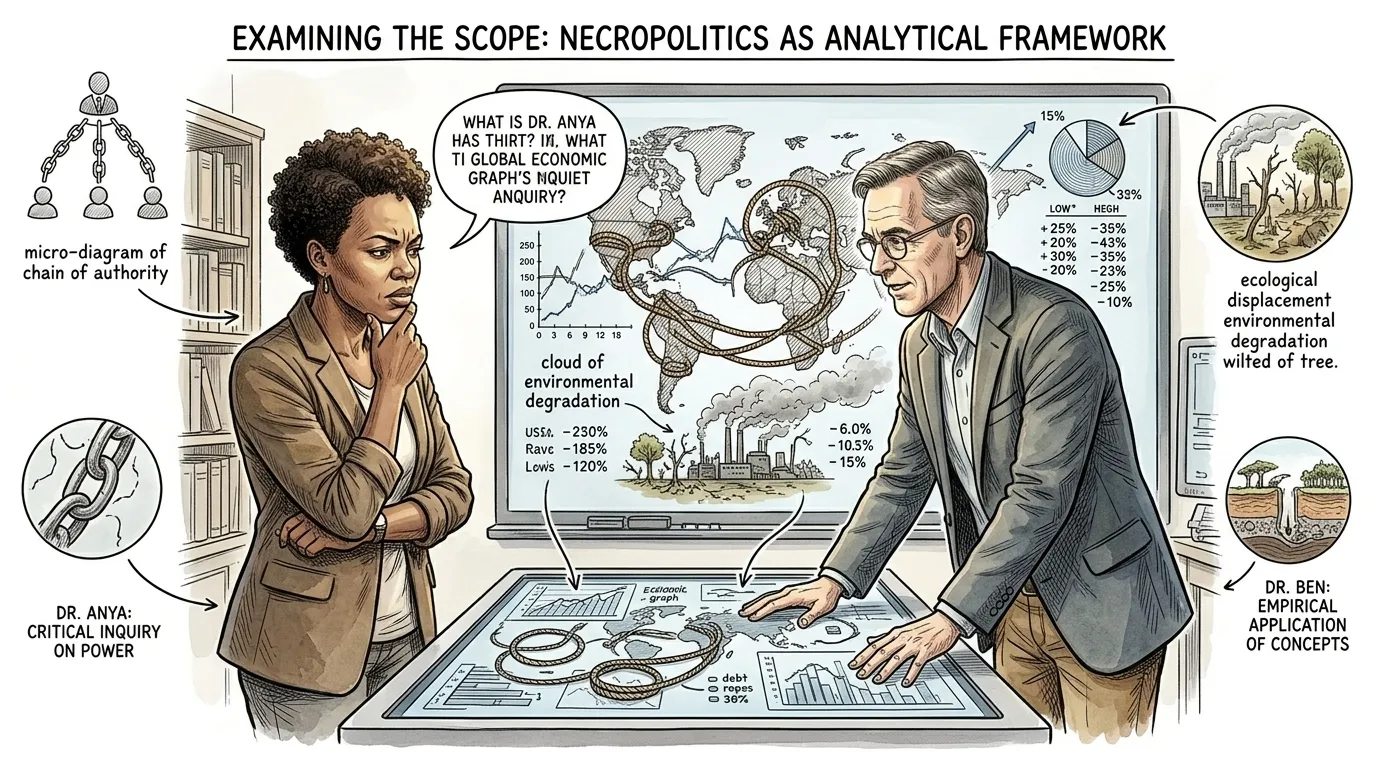
"So, Mbembe's necropolitics isn't solely about direct, lethal violence, is it?" Dr. Anya inquired, her brow furrowed. Dr. Ben clarified, "Absolutely not. It extends far beyond the explicit act of killing, encompassing the systemic weaponization of economic policies, debt, and environmental degradation. These are indirect forms of power that structurally expose certain populations to slower forms of death or prolonged suffering. Think of structural adjustment programs that dismantle public health systems or the deliberate inaction on climate change, disproportionately affecting vulnerable communities. It's about how policies can tacitly sanction widespread suffering."
""So, Mbembe's necropolitics isn't solely about direct, lethal violence, is it?" Dr. Anya inquired, her brow furrowed. Dr. Ben clarified, "Absolutely not. It extends far beyond the explicit act of killing, encompassing the systemic weaponization of economic policies, debt, and environmental degradation. These are indirect forms of power that structurally expose certain populations to slower forms of death or prolonged suffering. Think of structural adjustment programs that dismantle public health systems or the deliberate inaction on climate change, disproportionately affecting vulnerable communities. It's about how policies can tacitly sanction widespread suffering.""
Philosophy Note: Necropolitics encompasses economic policies, debt, and environmental degradation, exposing populations to slow forms of death beyond direct violence.
Page 6
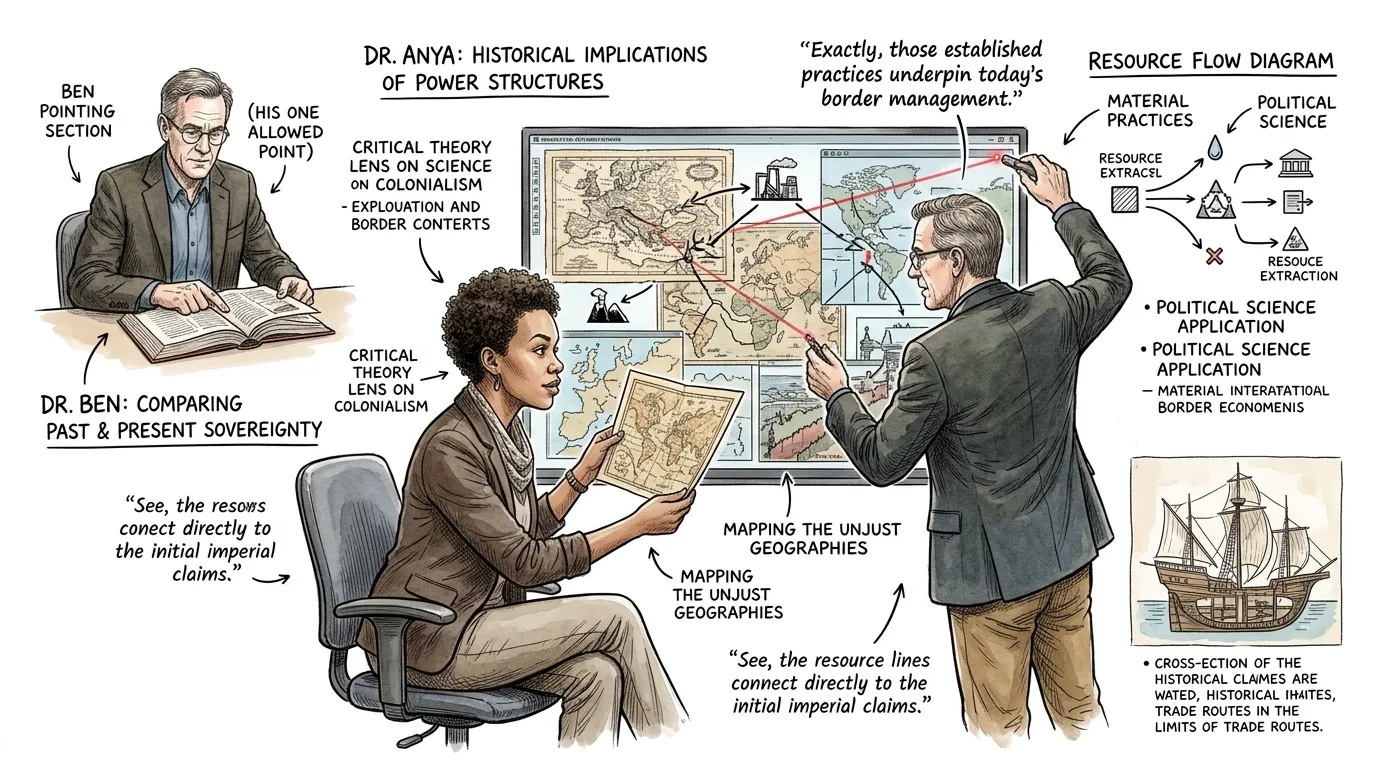
Dr. Anya considered the vastness of the concept. "It seems Mbembe grounds this in historical practices, too," she remarked. "The legacies of colonialism must be central." Dr. Ben affirmed, "Indeed. Mbembe meticulously traces how the techniques of dehumanization, resource extraction, and the management of 'superfluous' populations perfected during colonialism find new, insidious expressions in contemporary border regimes, global economic inequalities, and urban segregation. The 'colony,' for Mbembe, isn't just a historical place but a persistent paradigm, a zone where sovereign power continues to operate with lethal impunity in various forms globally. It highlights the enduring impact of past violences."
""It seems Mbembe grounds this in historical practices, too," Dr. Anya remarked. "The legacies of colonialism must be central." Dr. Ben affirmed, "Indeed. Mbembe meticulously traces how the techniques of dehumanization, resource extraction, and the management of 'superfluous' populations perfected during colonialism find new, insidious expressions in contemporary border regimes, global economic inequalities, and urban segregation. The 'colony,' for Mbembe, isn't just a historical place but a persistent paradigm, a zone where sovereign power continues to operate with lethal impunity in various forms globally. It highlights the enduring impact of past violences.""
Philosophy Note: Mbembe connects necropolitics to colonial legacies, showing how practices of dehumanization and control persist in modern border regimes and global inequalities.
Page 7
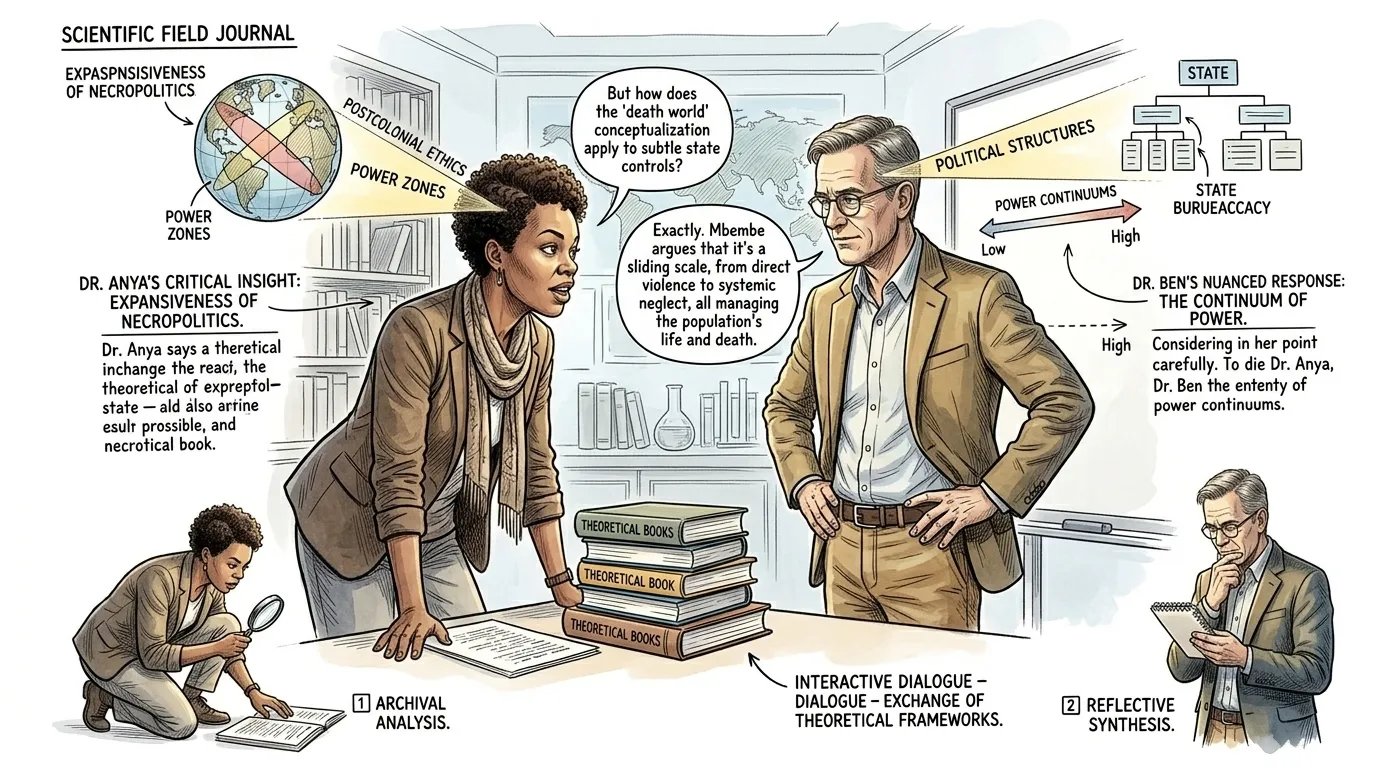
"Some critics might argue that 'necropolitics' is too expansive, potentially diluting the specific horror of direct violence by applying it to broader systemic issues," Dr. Anya proposed, her voice thoughtful. "How does Mbembe address such a critique?" Dr. Ben considered her point carefully. "It's a valid concern. Mbembe isn't intending to diminish direct violence, but rather to broaden our understanding of how power operates, even silently, in producing death-worlds. He encourages us to see the continuum between explicit force and the more insidious, everyday forms of lethal governance. He asks us to confront the fact that 'to govern is to decide who will live and who will die,' as he might suggest, challenging simplistic notions of state responsibility."
""Some critics might argue that 'necropolitics' is too expansive, potentially diluting the specific horror of direct violence by applying it to broader systemic issues," Dr. Anya proposed, her voice thoughtful. "How does Mbembe address such a critique?" Dr. Ben considered her point carefully. "It's a valid concern. Mbembe isn't intending to diminish direct violence, but rather to broaden our understanding of how power operates, even silently, in producing death-worlds. He encourages us to see the continuum between explicit force and the more insidious, everyday forms of lethal governance. He asks us to confront the fact that 'to govern is to decide who will live and who will die,' as he might suggest, challenging simplistic notions of state responsibility.""
Philosophy Note: Critics suggest 'necropolitics' is too broad. Mbembe aims to show the continuum of power, from explicit violence to insidious systemic governance that decides who lives and who dies.
Page 8
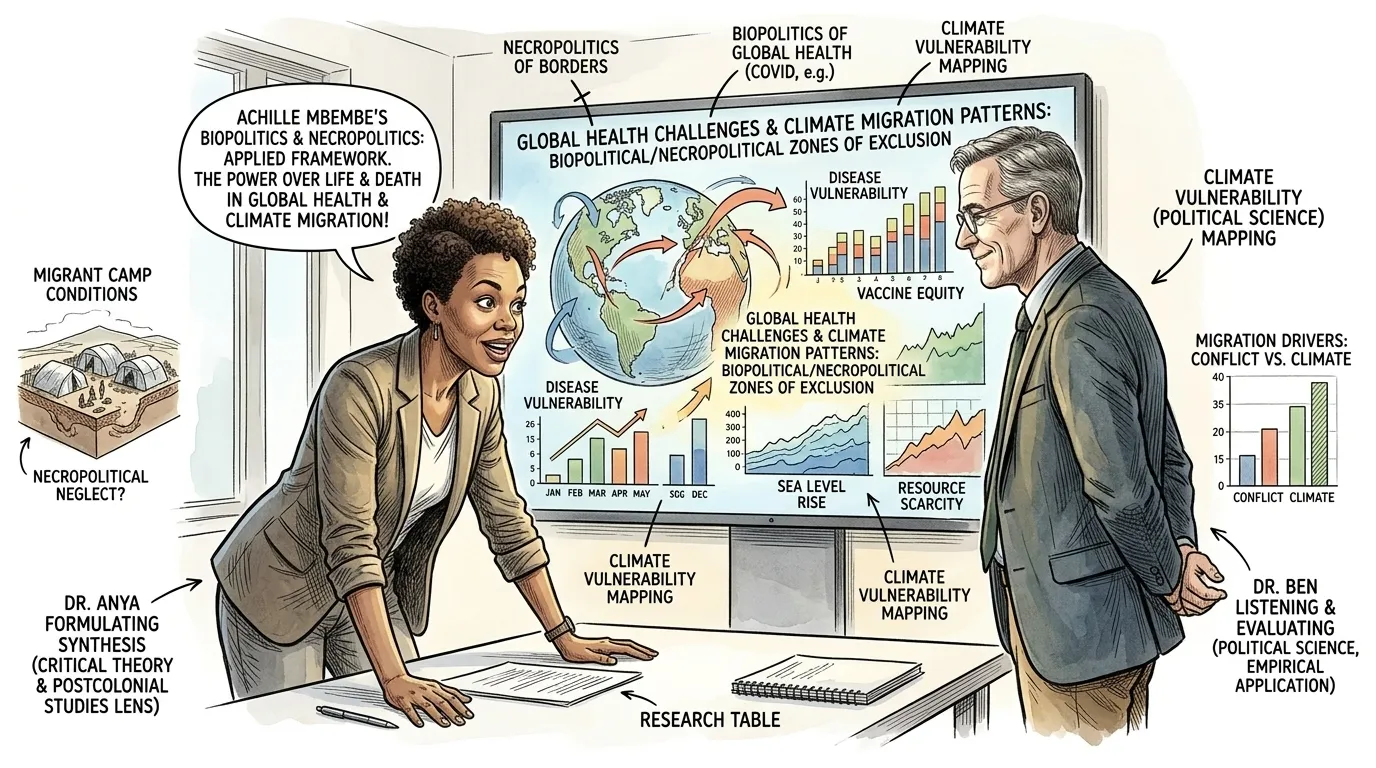
"With our understanding of Mbembe's distinction between biopolitics and necropolitics, how can we apply it to, say, contemporary global health crises or climate migration?" Dr. Anya asked, challenging Dr. Ben. "Remember what we discussed about Mbembe's distinction between biopolitics and necropolitics?" Dr. Ben prompted. Dr. Anya's eyes widened. "Ah, yes! We see biopolitical efforts to 'manage' populations through vaccines or aid, but often these very efforts inadvertently produce necropolitical outcomes for those deemed 'disposable.' Border closures, intellectual property restrictions on medicines, or ignoring climate refugees aren't just failures of policy; they are active decisions to 'let die' for some, while 'making live' for others. Mbembe's lens helps us see the intent and consequence behind these actions."
""With our understanding of Mbembe's distinction between biopolitics and necropolitics, how can we apply it to, say, contemporary global health crises or climate migration?" Dr. Anya asked, challenging Dr. Ben. "Remember what we discussed about Mbembe's distinction between biopolitics and necropolitics?" Dr. Ben prompted. Dr. Anya's eyes widened. "Ah, yes! We see biopolitical efforts to 'manage' populations through vaccines or aid, but often these very efforts inadvertently produce necropolitical outcomes for those deemed 'disposable.' Border closures, intellectual property restrictions on medicines, or ignoring climate refugees aren't just failures of policy; they are active decisions to 'let die' for some, while 'making live' for others. Mbembe's lens helps us see the intent and consequence behind these actions.""
Philosophy Note: The conceptual tool of 'biopolitics vs. necropolitics' is applied to analyze global health inequities and climate migration, revealing the active decisions behind 'letting die'.
Page 9
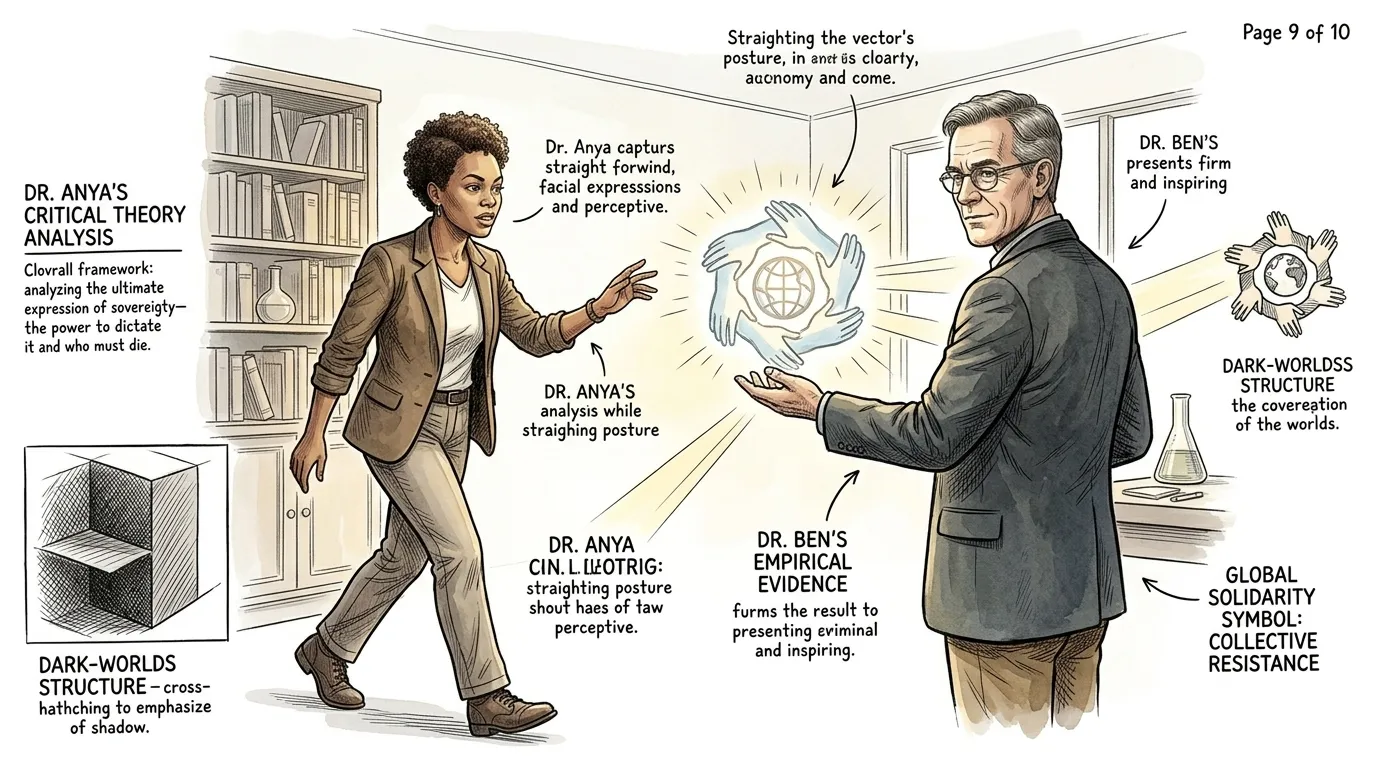
Dr. Anya straightened, a sense of gravity settling on her face. "Mbembe's framework forces us to confront uncomfortable truths about global power and who truly benefits," she stated. Dr. Ben added, "It's not merely about naming a problem; it's about recognizing the profound ethical implications for solidarity and resistance. As the great philosopher Nelson Mandela once proclaimed, 'It always seems impossible until it's done.' This sentiment, applied to necropolitics, inspires us not to accept the normalization of 'death-worlds' but to find ways to resist and redefine the very conditions of life and dignity for all. It demands a re-evaluation of ethical responsibility."
""Mbembe's framework forces us to confront uncomfortable truths about global power and who truly benefits," Dr. Anya stated. Dr. Ben added, "It's not merely about naming a problem; it's about recognizing the profound ethical implications for solidarity and resistance. As the great philosopher Nelson Mandela once proclaimed, 'It always seems impossible until it's done.' This sentiment, applied to necropolitics, inspires us not to accept the normalization of 'death-worlds' but to find ways to resist and redefine the very conditions of life and dignity for all. It demands a re-evaluation of ethical responsibility.""
Philosophy Note: Dr. Ben quotes Nelson Mandela: 'It always seems impossible until it's done,' linking Mbembe's critique to the imperative for global solidarity and resistance against necropolitical forces.
Page 10
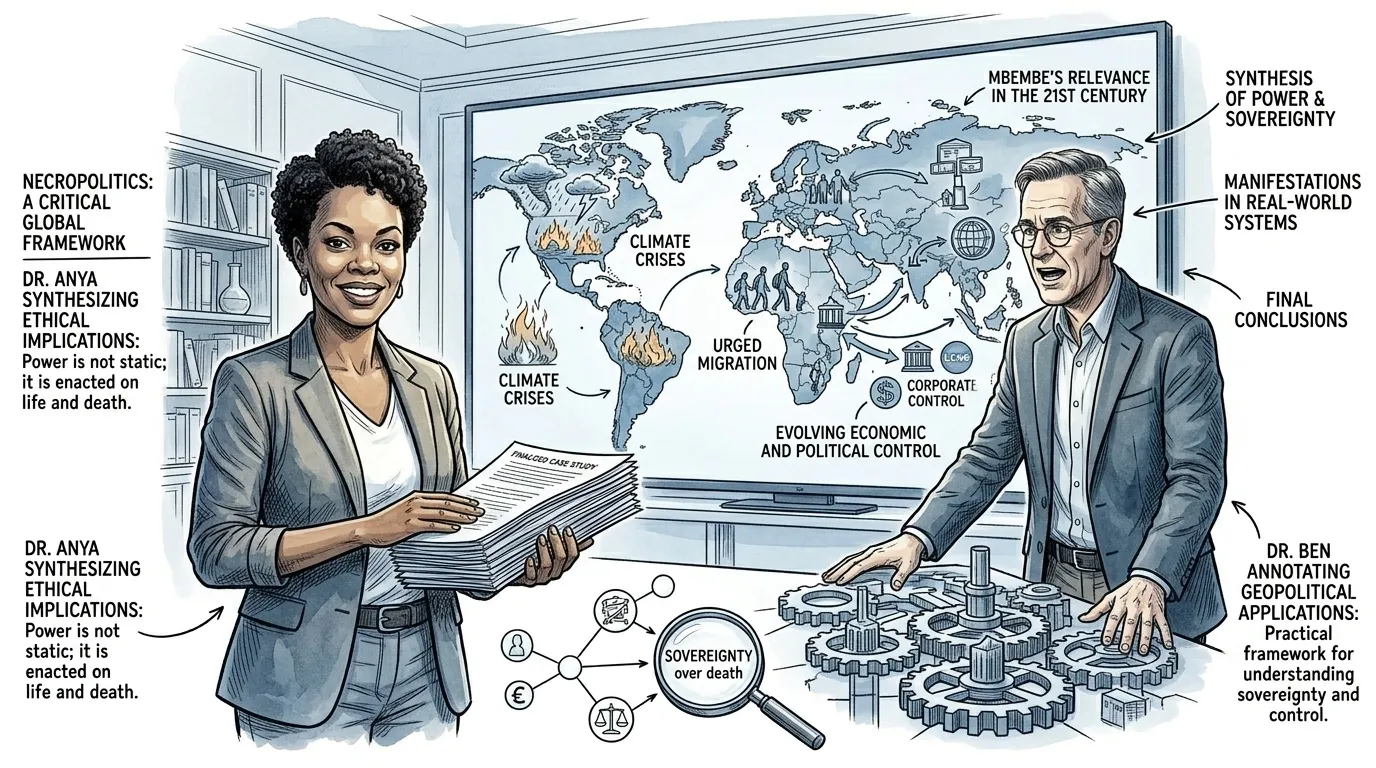
Dr. Anya summarized their discussion with conviction. "Achille Mbembe's work fundamentally challenges simplistic narratives of progress and development, urging us to examine whose lives are prioritized and whose are deemed disposable in the global order." Dr. Ben concluded, his voice resonating with authority, "Indeed. His framework remains an indispensable analytical tool for navigating our complex world, a world increasingly defined by climate crises, forced migration, and evolving forms of economic and political control. Necropolitics compels us to confront the ethical core of power, ensuring we never look away from the quiet, insidious violences that shape human existence."
""Achille Mbembe's work fundamentally challenges simplistic narratives of progress and development, urging us to examine whose lives are prioritized and whose are deemed disposable in the global order." Dr. Ben concluded, his voice resonating with authority, "Indeed. His framework remains an indispensable analytical tool for navigating our complex world, a world increasingly defined by climate crises, forced migration, and evolving forms of economic and political control. Necropolitics compels us to confront the ethical core of power, ensuring we never look away from the quiet, insidious violences that shape human existence.""
Philosophy Note: Mbembe's necropolitics remains crucial for analyzing complex 21st-century challenges, urging ethical scrutiny of power and its impact on human existence.
About this story
- Audience: general readers
Questions and answers
Read Wonder Philosophy on your phone
Wonder Philosophy is available on Android and iPhone and iPad. Get Wonder Philosophy on Google Play · Get Wonder Philosophy on the App Store.