William James
William James — an illustrated philosophy story. 8 illustrated pages, free to read on Wonder Philosophy.

Page 1
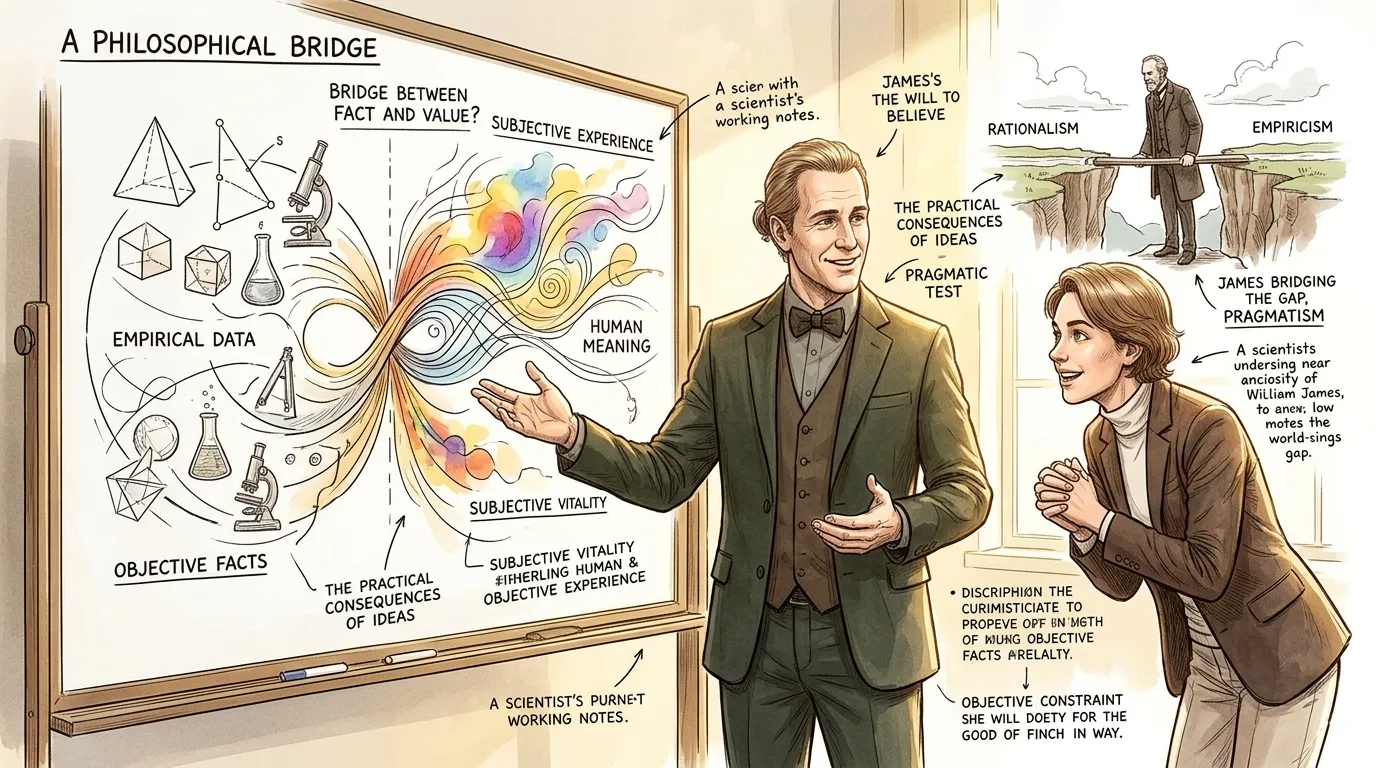
In the late 19th century, as scientific inquiry reshaped understanding, William James emerged as a pivotal voice, seeking to bridge the chasm between objective fact and subjective human experience. His philosophy recognized that our beliefs are not merely passive reflections of reality, but active instruments, shaped by our needs and the consequences they produce in our lives.
""William James challenges us to see truth not as a static, external fact, but as something dynamic, evolving from our interaction with the world," Dr. Alistair Finch observed, gesturing towards a complex diagram. "He asks us: what practical difference does an idea make?"
Dr. Lena Petrova added, "His work, particularly in Pragmatism and The Will to Believe, anchors human agency at the heart of our intellectual and moral lives. It's a radical shift from detached observation to engaged participation.""
Philosophy Note: William James (1842-1910) – American Philosopher & Psychologist. Key Ideas: Pragmatism, The Will to Believe, Radical Empiricism. Era: Late 19th - Early 20th Century.
Page 2
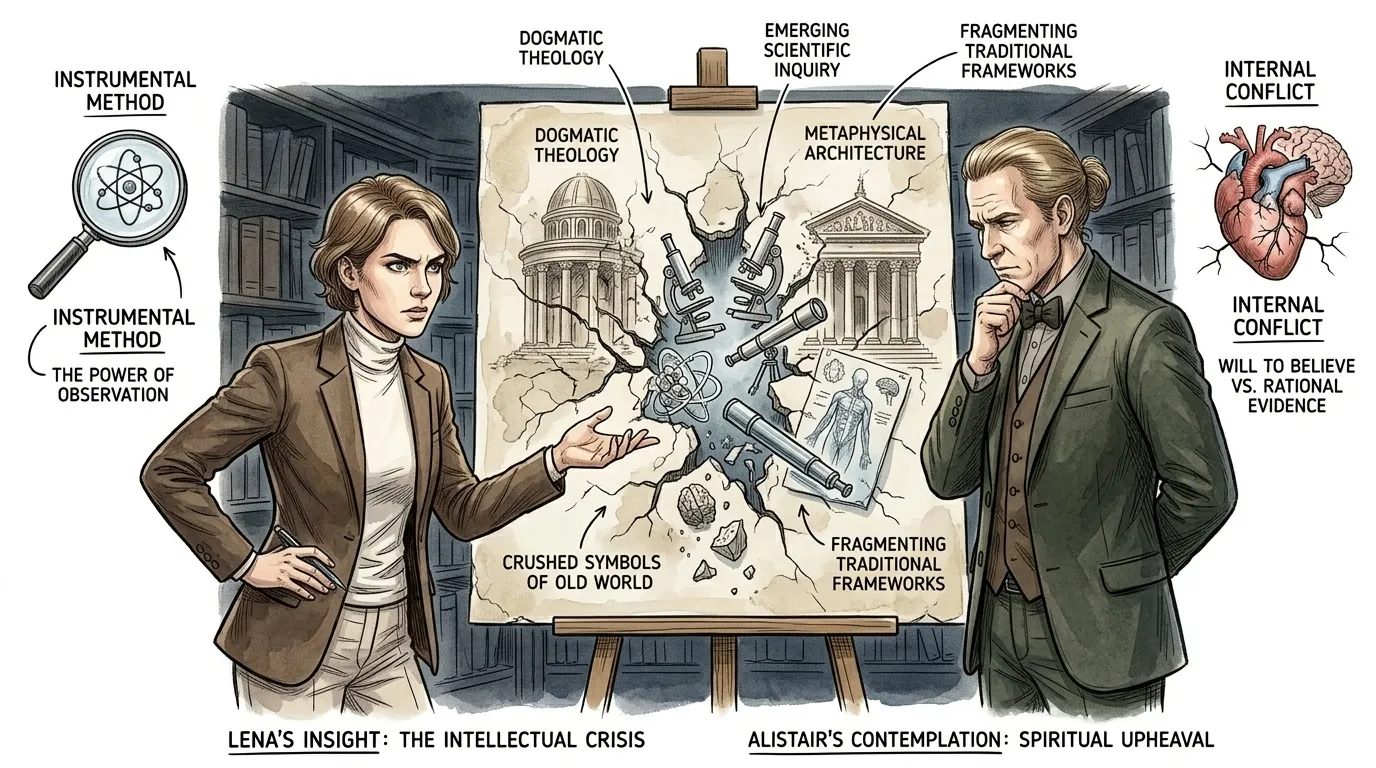
The late 19th century witnessed profound upheaval, as scientific discoveries in biology, physics, and psychology began to dismantle traditional religious and metaphysical frameworks. This created a deep intellectual and spiritual void, leaving many to question the very foundations of moral truth and human purpose.
""Imagine a world where everything you thought was bedrock truth suddenly cracks under the weight of new evidence," Dr. Petrova described, gesturing towards a historical rendering. "Science offered empirical facts, but often at the cost of meaning, purpose, and the sense of individual freedom."
Dr. Finch nodded. "It left people searching for a way to maintain belief in moral values or free will without resorting to blind faith or intellectual dishonesty. James saw this intellectual crisis as an opportunity to rethink truth itself.""
Philosophy Note: Late 19th Century: Scientific advancements (Darwinism, nascent psychology) challenged religious dogma and absolute philosophical truths, sparking widespread intellectual and spiritual crisis.
Page 3
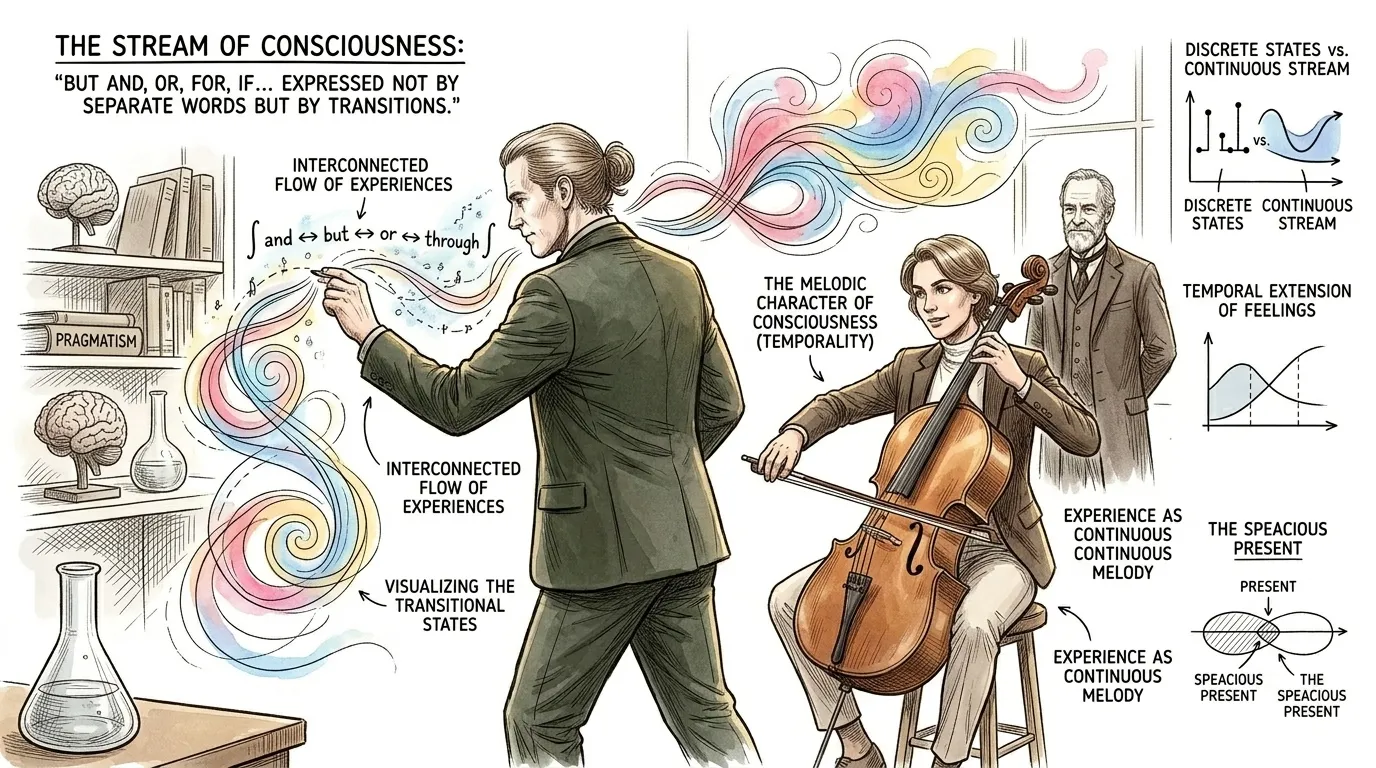
James's 'Radical Empiricism' proposed a foundational shift: that experience itself, not just isolated sensations, constitutes the ultimate reality. This includes the 'relations' between things – the feelings of 'and,' 'but,' or 'through' – as much as the things themselves, forming a continuous, flowing tapestry of consciousness.
""It's a crucial departure from thinking of experience as a series of disconnected snapshots," Dr. Finch explained, tracing an invisible line in the air. "James insisted that the transitions, the connections, the felt continuities between our perceptions are just as real as the perceptions themselves."
Dr. Petrova clarified, "Think of listening to a melody. It's not just individual notes; it's the flow between them, the rising and falling, the whole, that makes it meaningful. Radical Empiricism champions this unbroken stream of pure experience, where consciousness and the world are intrinsically interwoven.""
Philosophy Note: Radical Empiricism: William James's doctrine that experience, in its entirety (including relations and connections), is the ultimate constituent of reality. It challenges the subject-object divide.
Page 4
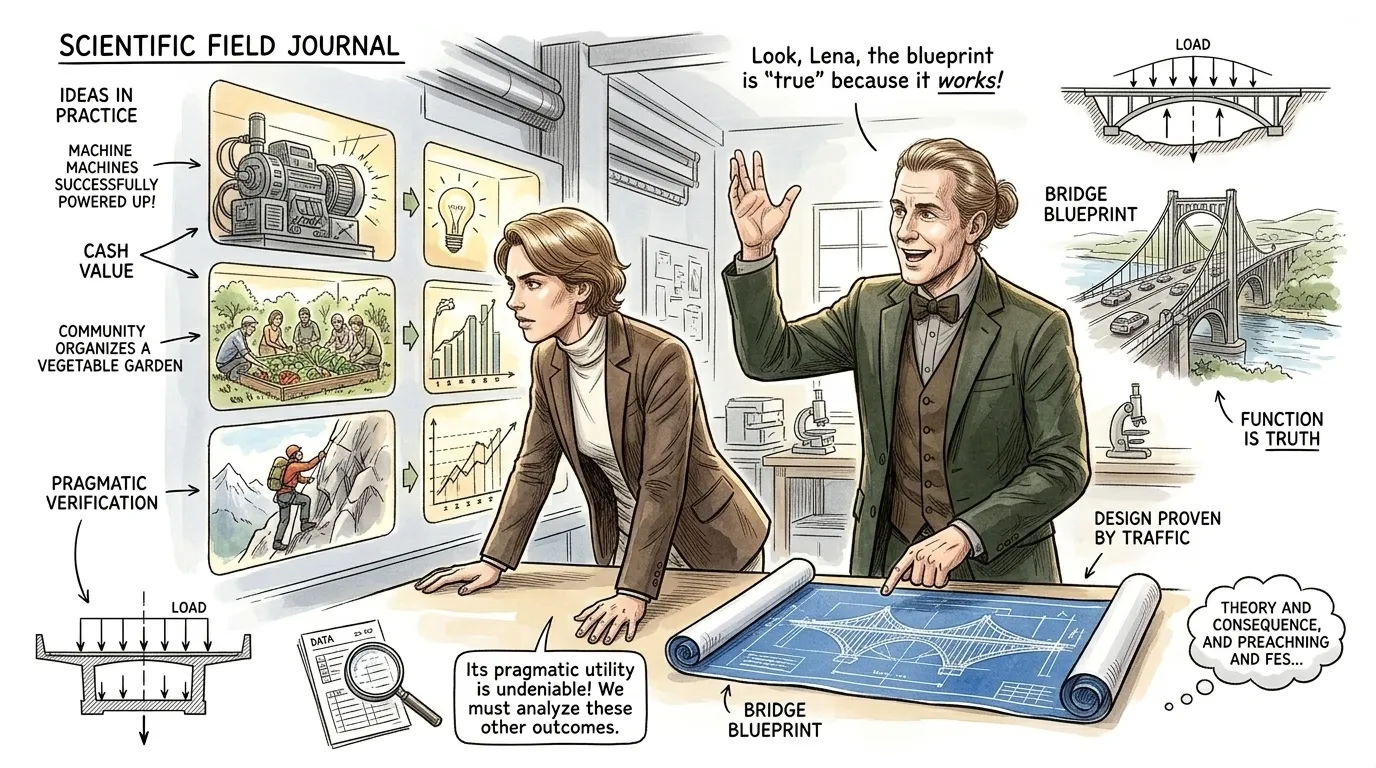
For William James, the truth of an idea is not a fixed, abstract property, but rather something determined by its 'cash value' – its practical consequences and its usefulness in guiding action and solving problems. If an idea helps us navigate the world effectively, if it 'works,' then for us, it is true.
""Pragmatism asks us to judge ideas by their fruits," Dr. Petrova stated, observing a series of vignettes. "It's less about a perfect correspondence to an external reality, and more about how an idea functions within our lived experience. Does it make a difference that truly matters?"
Dr. Finch elaborated, "Consider a bridge design. Its 'truth' isn't just in its blueprints, but in whether it safely carries traffic. James extends this to all ideas, arguing that beliefs are tools. The best tool is the truest tool because it successfully serves its purpose.""
Philosophy Note: Pragmatism: A philosophical tradition (James, Peirce, Dewey) asserting that the meaning and truth of concepts are found in their practical consequences. An idea is 'true' if it 'works' in the world.
Page 5
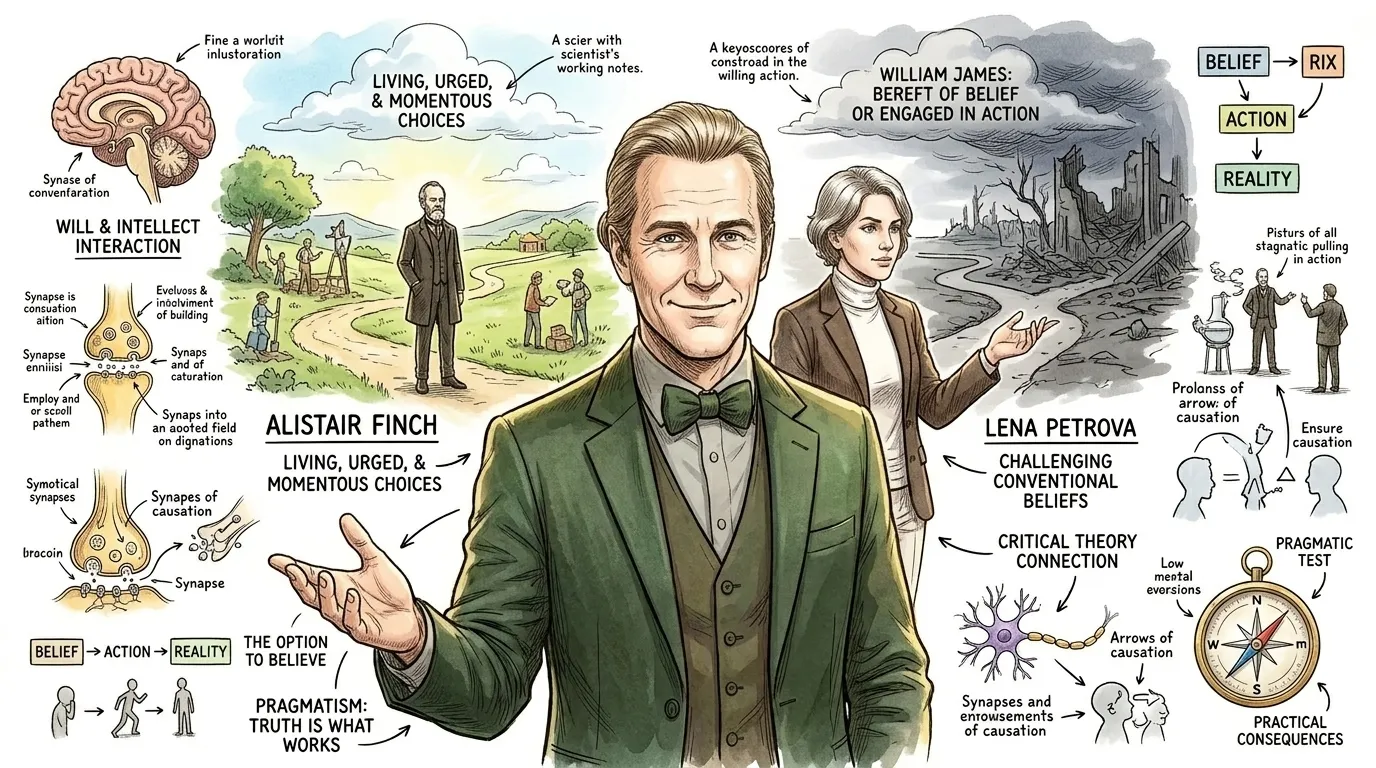
One of James's most challenging concepts is 'The Will to Believe,' which posits that in certain critical situations – when a choice is 'living, forced, and momentous' and objective evidence is inconclusive – our passionate nature can legitimately decide our belief. This choice, he argued, might even help create the reality it asserts.
""This isn't about blind faith in any arbitrary idea," Dr. Finch emphasized, looking directly at the viewer. "James carefully defined the conditions: the choice must be 'living' – genuinely appealing to you; 'forced' – no possibility of remaining neutral; and 'momentous' – with significant, unique stakes."
Dr. Petrova added, "He also said, 'Our acts, our turning-places, where we stand or fall, are made by our own will.' This illustrates how, in such moments, our decision to believe can be a moral act, shaping both ourselves and the world around us. It's about proactive engagement rather than passive waiting for proof.""
Philosophy Note: The Will to Believe: James's argument that in specific scenarios (living, forced, momentous options with insufficient evidence), our will can legitimately influence belief, which may in turn help create the believed reality.
Page 6
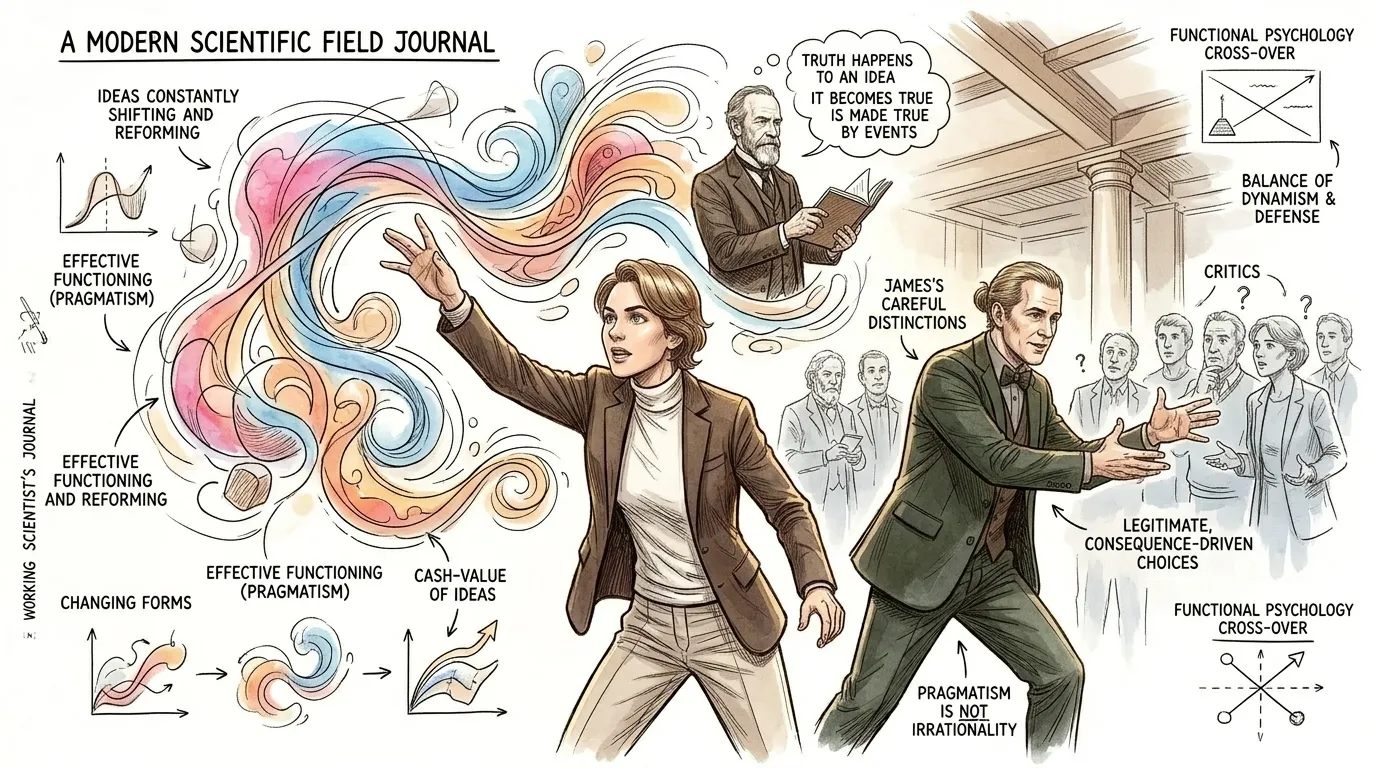
James's insistence on the 'cash value' of ideas – what tangible difference they make in practice – provoked both fascination and significant critique. While he championed the practical utility of beliefs, his pragmatism was often misconstrued as promoting sheer relativism or wishful thinking, blurring the lines of intellectual rigor.
""For James, truth wasn't a static label; it was something an idea became through its effective functioning," Dr. Petrova clarified, pointing to a visual representation of ideas in flux. "He wanted to know, what specific good does this belief produce? What problems does it solve?"
Dr. Finch addressed the counter-arguments: "Critics feared this approach would open the floodgates to irrationality, that any belief could be justified if it simply felt good. But James was careful: it wasn't about believing anything you wanted, but about legitimate, consequence-driven choices where traditional evidence was absent.""
Philosophy Note: Cash Value: James's term for the practical efficacy and tangible consequences of a belief or idea. Criticism often focused on concerns about relativism, subjectivism, and intellectual rigor.
Page 7
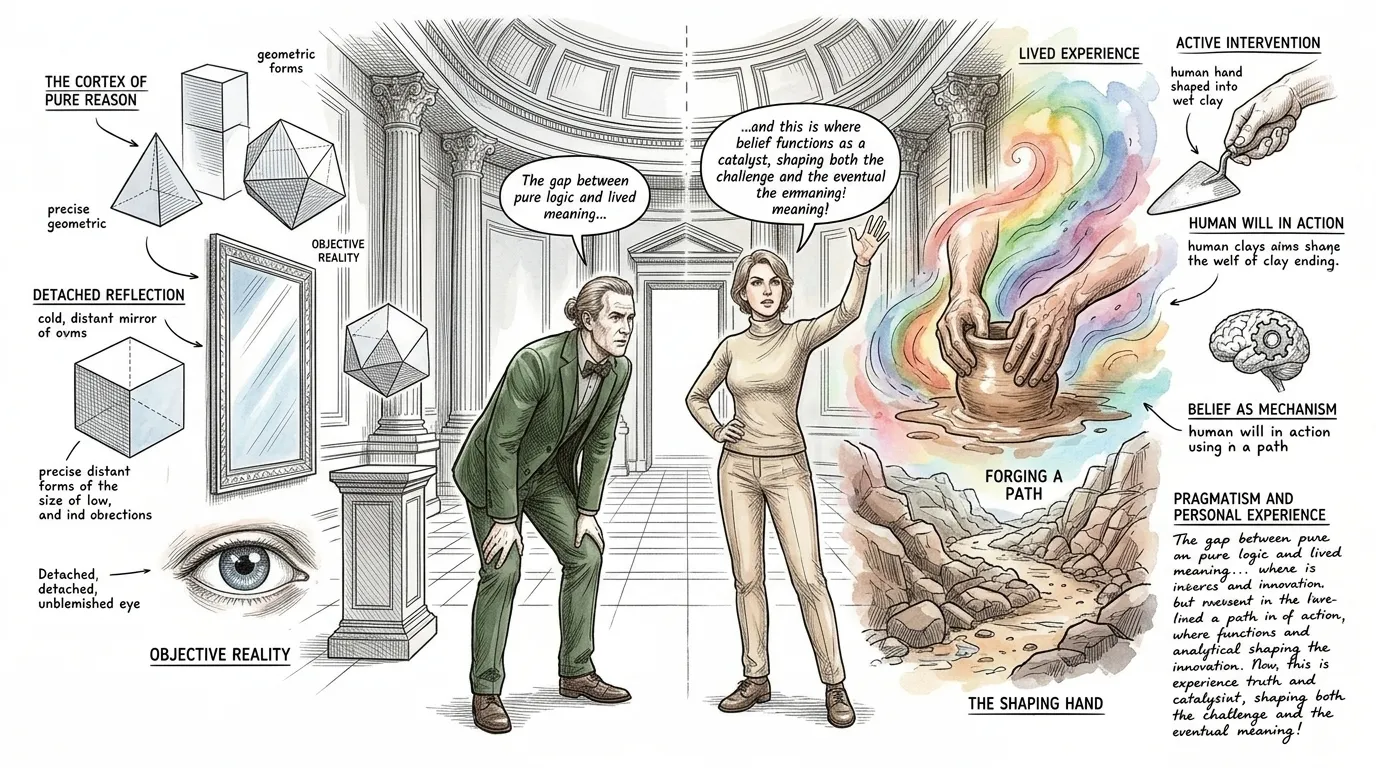
The core tension in James's work lies in its challenge to the prevailing notion of objective truth – a truth independent of human experience or will. He invited us to consider that while some truths are clearly external and verifiable, others, particularly moral or existential ones, might derive their validity from the active, consequence-driven choices we make.
""Traditional philosophy often seeks truth as a perfect mirror of an external, unchanging reality," Dr. Finch explained, looking at a visual contrast. "James, however, asks if that's always possible or even desirable for the truths that matter most to how we live our lives."
Dr. Petrova interjected, "He didn't deny objective facts. But he recognized that for certain propositions – like whether life has meaning, or if we can overcome a personal challenge – the belief itself can be the catalyst. This choice isn't about denying facts, but about shaping our reality through our deepest convictions.""
Philosophy Note: Tension: James navigated the challenging relationship between 'objective truth' (correspondence to external reality) and 'lived truth' (beliefs validated by their practical and existential consequences for human flourishing).
Page 8
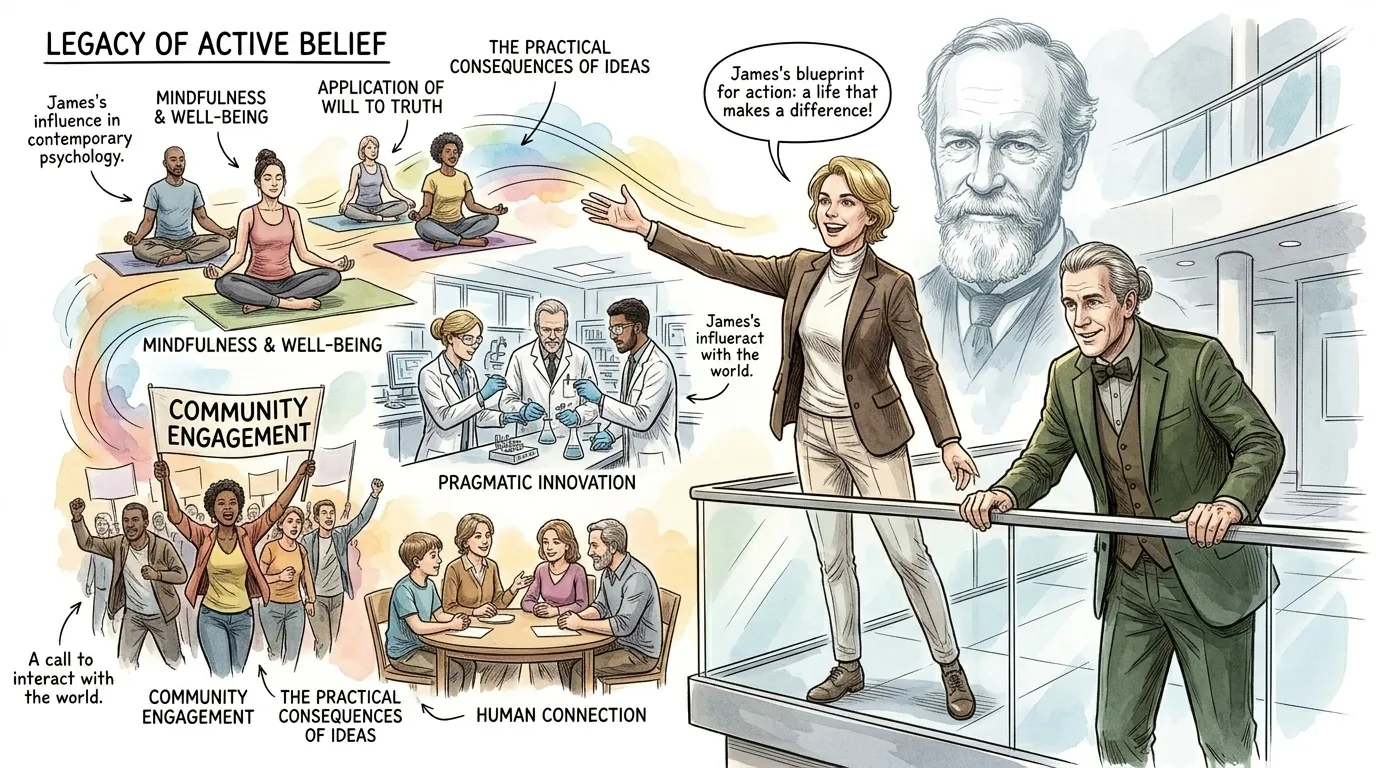
William James's insights continue to resonate profoundly, offering powerful frameworks for navigating uncertainty and fostering agency in contemporary life. His philosophy reminds us that our beliefs are not just intellectual positions, but active forces that shape our reality, both individually and collectively, driving innovation, resilience, and personal growth.
""James provides a crucial lens for so many modern challenges," Dr. Petrova summarized, as a montage of contemporary scenes appeared. "His 'Will to Believe' isn't just theory; it's a blueprint for action. Believing in a better future, for instance, isn't wishful thinking; it's the necessary precursor to building it."
Dr. Finch concluded, "From mental health to social reform, from scientific exploration to personal relationships, his pragmatism empowers us to ask: 'What belief allows us to act most effectively, to live most fully, and to achieve the consequences we truly desire?' His legacy is in challenging us to engage with the world, not merely observe it.""
Philosophy Note: Modern Applications: Mental health, social activism, scientific method, personal relationships, education. James's philosophy promotes active engagement, belief-driven action, and consequence-based evaluation in diverse fields.
About this story
- Audience: general readers
Questions and answers
Read Wonder Philosophy on your phone
Wonder Philosophy is available on Android and iPhone and iPad. Get Wonder Philosophy on Google Play · Get Wonder Philosophy on the App Store.