Zeno of Citium
Zeno of Citium — an illustrated philosophy story. 10 illustrated pages, free to read on Wonder Philosophy.

Page 1

In a world obsessed with fleeting trends and instant gratification, the teachings of Zeno of Citium, the founder of Stoicism, offer a timeless path to inner peace and resilience. But what exactly did Zeno preach, and why does it still resonate with people today?
Philosophy Note: Stoicism, founded in the early 3rd century BC, emphasizes virtue, reason, and living in accordance with nature.
Page 2
![Zeno's journey to philosophy was an unexpected one. Born in Citium [2] on the island of Cyprus, he was initially a merchant.](https://thewonderbooks.com/images/stories/zeno_of_citium/illustrations/zeno_of_citium_page_02_v1775187673040.webp "Zeno's journey to philosophy was an unexpected one. Born in Citium [2] on the island of Cyprus, he was initially a merchant.")
Zeno's journey to philosophy was an unexpected one. Born in Citium [2] on the island of Cyprus, he was initially a merchant. A shipwreck changed his life's course, leading him to Athens, the intellectual heart of the ancient world.
"Alina, a young student with a thirst for ancient wisdom, sat across from Hugo, her mentor. "So, Zeno wasn't always a philosopher?" she asked."
Philosophy Note: Citium was an ancient city-state in Cyprus, known for its maritime trade.
Page 3
![In Athens, Zeno was exposed to various philosophical schools, including the Cynics [3], known for their unconventional lifestyle and rejection of societal…](https://thewonderbooks.com/images/stories/zeno_of_citium/illustrations/zeno_of_citium_page_03_v1775187705143.webp "In Athens, Zeno was exposed to various philosophical schools, including the Cynics [3], known for their unconventional lifestyle and rejection of societal…")
In Athens, Zeno was exposed to various philosophical schools, including the Cynics [3], known for their unconventional lifestyle and rejection of societal norms, and the Academy, Plato's school [4]. He studied with Crates of Thebes, a prominent Cynic, and later with philosophers from the Academic tradition.
"Hugo smiled. "Indeed. He learned from many, but ultimately forged his own unique path. He absorbed ideas from Cynics like Crates, who lived a life of radical simplicity.""
Philosophy Note: The Cynics advocated for a life of virtue in accordance with nature, rejecting material possessions and social conventions.
Page 4
![Around 300 BC, Zeno established his own school of philosophy, gathering his followers at the Stoa Poikile, or 'Painted Porch,' in the Athenian Agora [5].](https://thewonderbooks.com/images/stories/zeno_of_citium/illustrations/zeno_of_citium_page_04_v1775187747513.webp "Around 300 BC, Zeno established his own school of philosophy, gathering his followers at the Stoa Poikile, or 'Painted Porch,' in the Athenian Agora [5].")
Around 300 BC, Zeno established his own school of philosophy, gathering his followers at the Stoa Poikile, or 'Painted Porch,' in the Athenian Agora [5]. This location gave the movement its name: Stoicism. Zeno's teachings emphasized living in accordance with nature, accepting what we cannot control, and focusing on virtue as the sole good.
"Alina pondered, "So, the name 'Stoicism' comes from a porch? It seems almost accidental.""
Philosophy Note: The Athenian Agora was the center of public life in ancient Athens.
Page 5

A cornerstone of Stoic philosophy is the dichotomy of control: recognizing what lies within our power (our thoughts, judgments, and actions) and what does not (external events, other people's opinions). Zeno believed that true freedom and happiness come from focusing on the former and accepting the latter.
"Hugo nodded. "It's about understanding what we truly have agency over. As Epictetus [6], a later Stoic, said, 'We are disturbed not by things, but by the views we take of them.'""
Philosophy Note: Epictetus was a Stoic philosopher who lived in the 1st and 2nd centuries AD.
Page 6
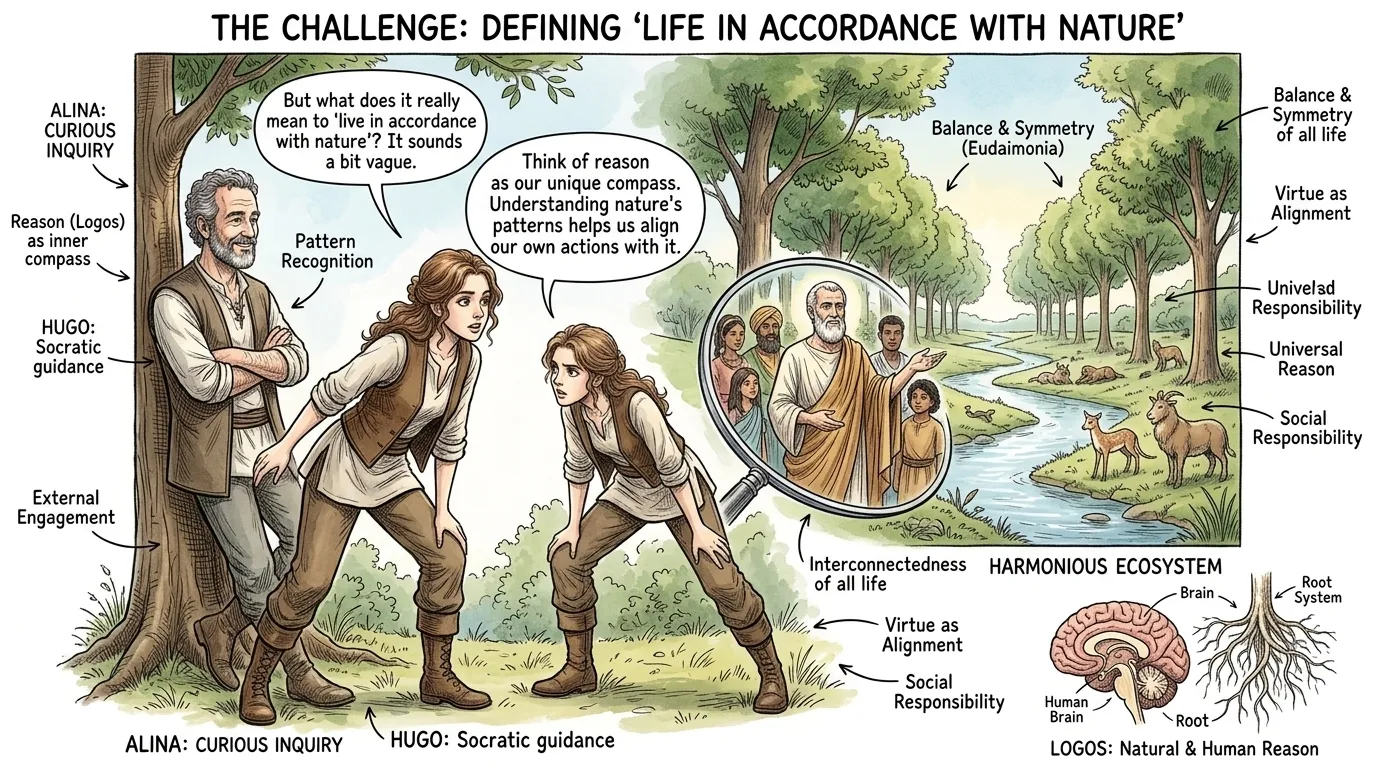
For Zeno and the Stoics, living in accordance with nature meant understanding the natural order of the universe and accepting our place within it. It meant cultivating reason, virtue, and social responsibility, recognizing that we are all interconnected.
"Alina asked, "But what does it really mean to 'live in accordance with nature'? It sounds a bit vague.""
Philosophy Note: Living in accordance with nature involves understanding the natural order and accepting our place within it.
Page 7
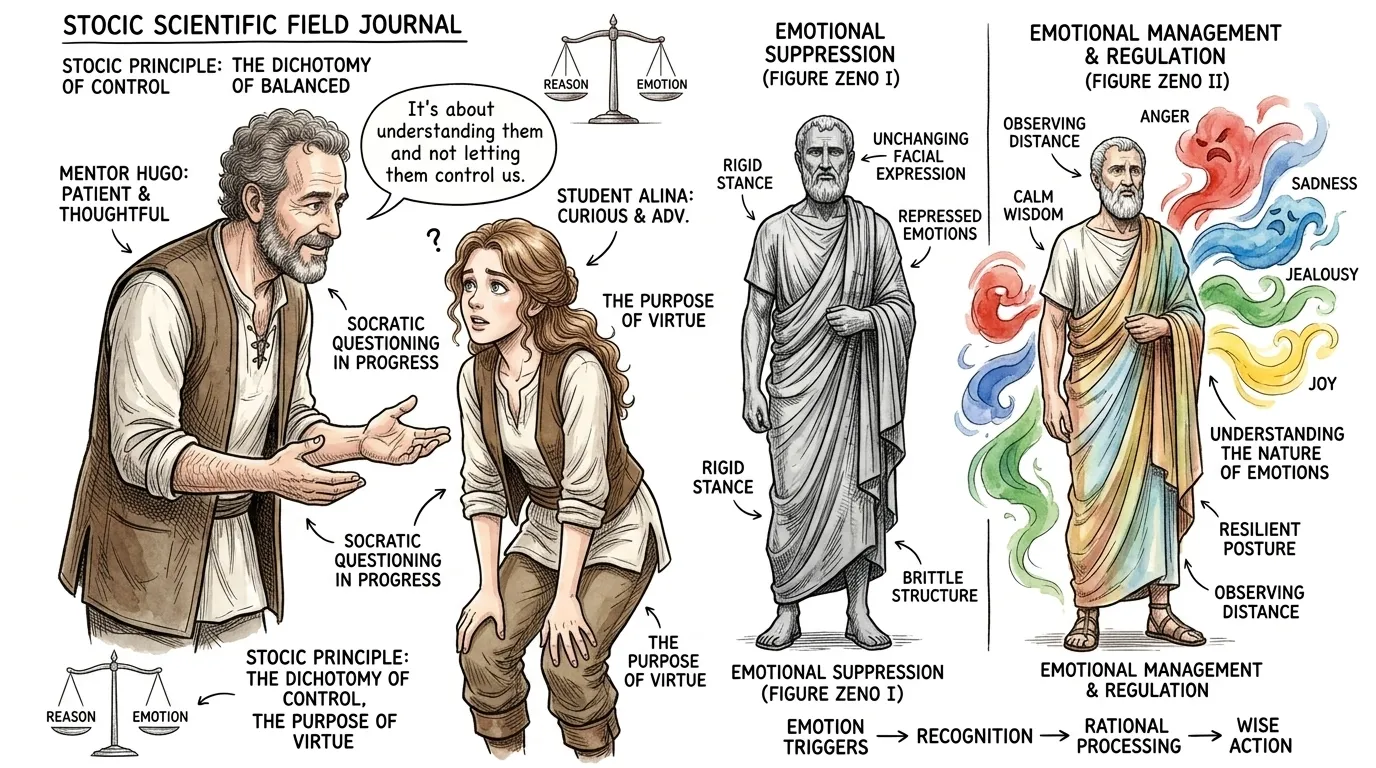
Stoicism has faced criticisms throughout history, with some arguing that its emphasis on acceptance can lead to passivity or indifference. Others have misinterpreted it as advocating for emotional suppression, which is not the case. Stoicism encourages managing emotions, not eliminating them.
"Hugo clarified, "It's a common misconception that Stoicism is about suppressing emotions. It's about understanding them and not letting them control us.""
Philosophy Note: Stoicism aims at emotional regulation, not emotional suppression.
Page 8

In today's fast-paced and uncertain world, Stoicism offers a practical philosophy for navigating challenges, building resilience, and finding meaning. Its principles have been embraced by individuals from all walks of life, from entrepreneurs to athletes to military leaders.
"Alina considered, "So, Zeno's teachings are still relevant today? Even in a world so different from ancient Greece?""
Philosophy Note: Stoic principles provide practical tools for navigating modern life's challenges.
Page 9
![Zeno of Citium's legacy extends far beyond the Painted Porch where he first taught. His ideas, refined and expanded by later Stoics like Seneca [7] and Marcus…](https://thewonderbooks.com/images/stories/zeno_of_citium/illustrations/zeno_of_citium_page_09_v1775187911513.webp "Zeno of Citium's legacy extends far beyond the Painted Porch where he first taught. His ideas, refined and expanded by later Stoics like Seneca [7] and Marcus…")
Zeno of Citium's legacy extends far beyond the Painted Porch where he first taught. His ideas, refined and expanded by later Stoics like Seneca [7] and Marcus Aurelius [8], continue to inspire and empower individuals seeking wisdom and tranquility in a chaotic world.
"Hugo smiled. "Indeed. Zeno's wisdom, passed down through generations, offers a timeless guide for living a virtuous and fulfilling life. Remember, 'The happiness of your life depends upon the quality of your thoughts,' as Marcus Aurelius said. He was a Roman emperor who practiced Stoicism, and his words still ring true today.""
Philosophy Note: Seneca and Marcus Aurelius were prominent Stoic philosophers who further developed and popularized Stoic thought.
Page 10

Zeno of Citium's teachings offer a powerful framework for living a virtuous, resilient, and meaningful life. By focusing on what we can control, accepting what we cannot, and living in accordance with nature, we can find inner peace and navigate the challenges of life with greater wisdom and fortitude.
Philosophy Note: Zeno's legacy continues to inspire individuals seeking inner peace and resilience.
About this story
- Audience: general readers
Questions and answers
Read Wonder Philosophy on your phone
Wonder Philosophy is available on Android and iPhone and iPad. Get Wonder Philosophy on Google Play · Get Wonder Philosophy on the App Store.