Thales
Thales — an illustrated philosophy story. 10 illustrated pages, free to read on Wonder Philosophy.
Page 1
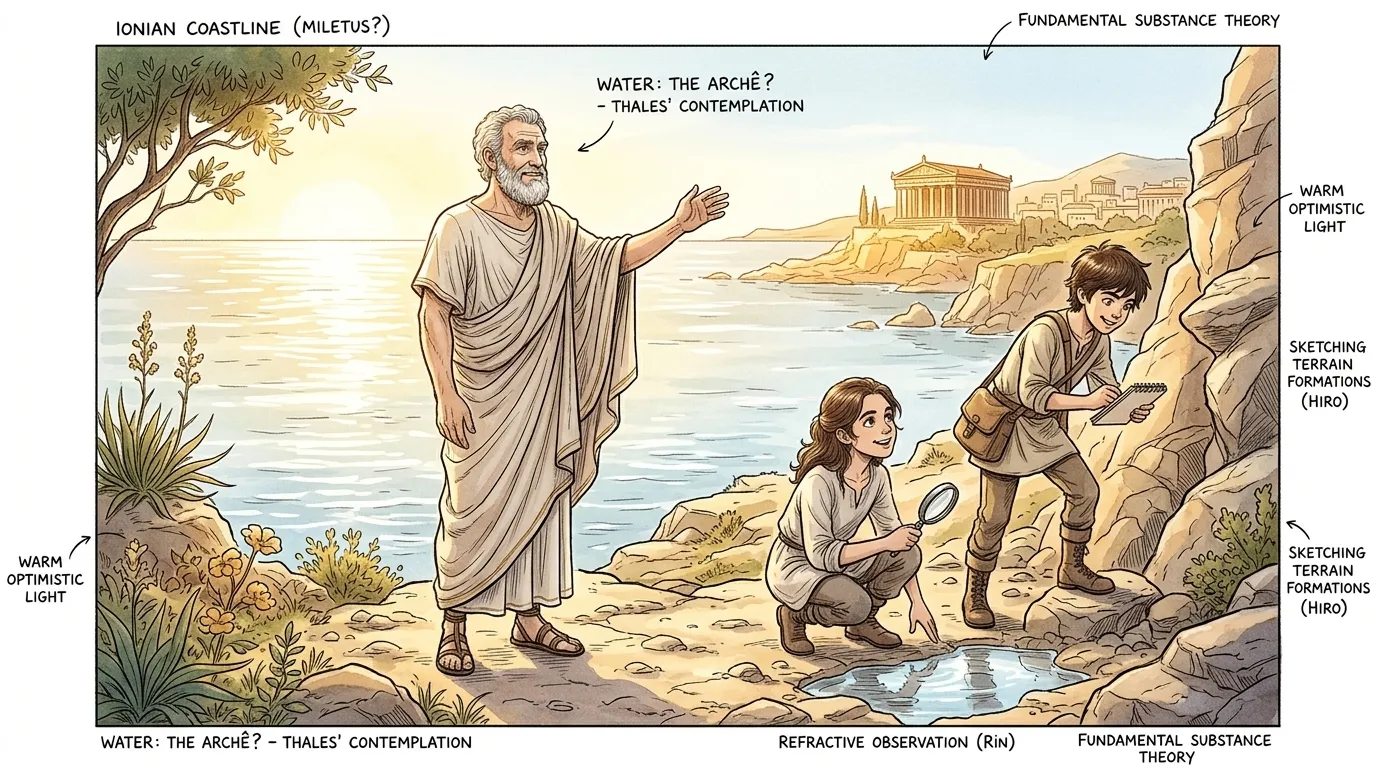
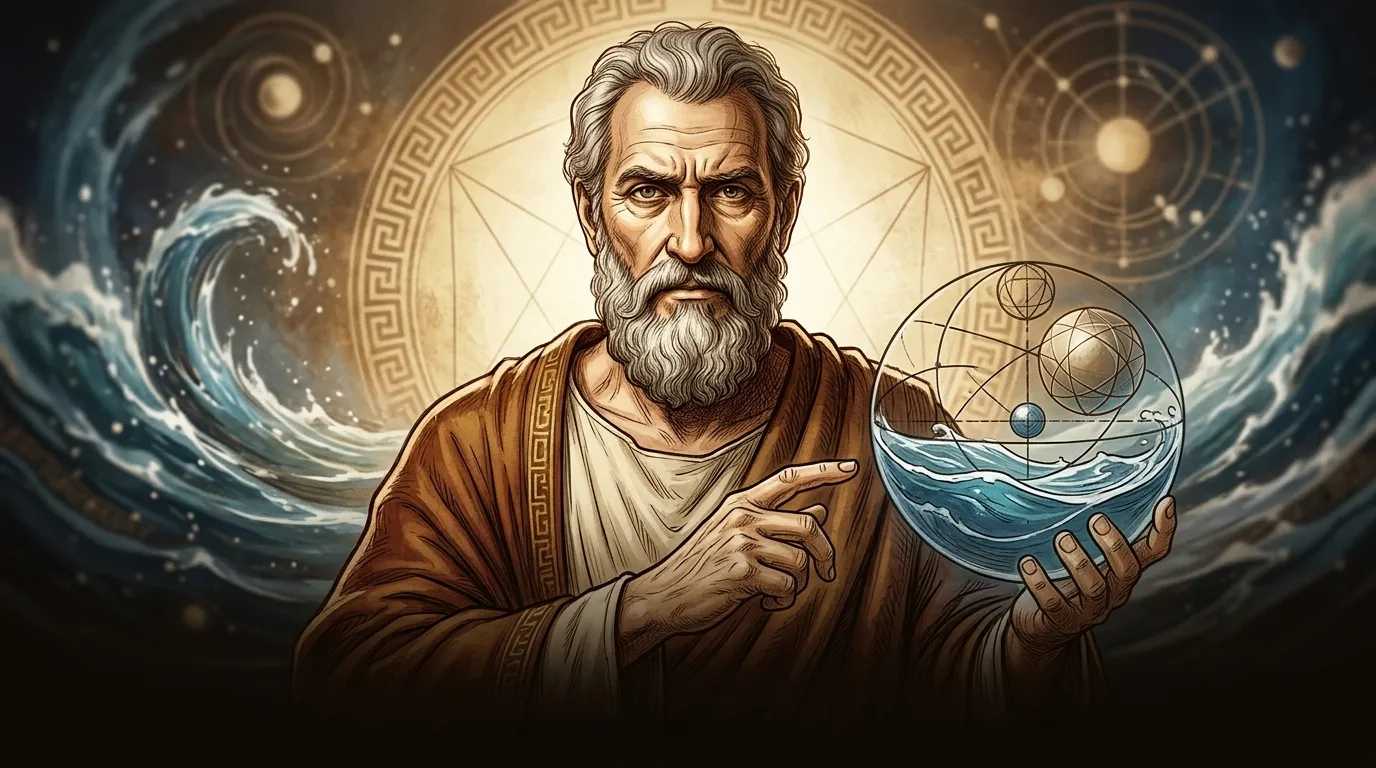
Why does Thales, a man who lived over 2600 years ago, still matter? Because he represents the very beginning of Western philosophical and scientific thought. He dared to ask, "What is the fundamental substance of reality?" and attempted to answer it with reason, not myth. His answer, though perhaps not correct, set the stage for all that followed.
Philosophy Note: Thales of Miletus [c. 624/623 – c. 548/545 BC]: pre-Socratic Greek philosopher, mathematician, and astronomer. He is regarded as the first individual in Western civilization known to have entertained and engaged in scientific philosophy.
Page 2
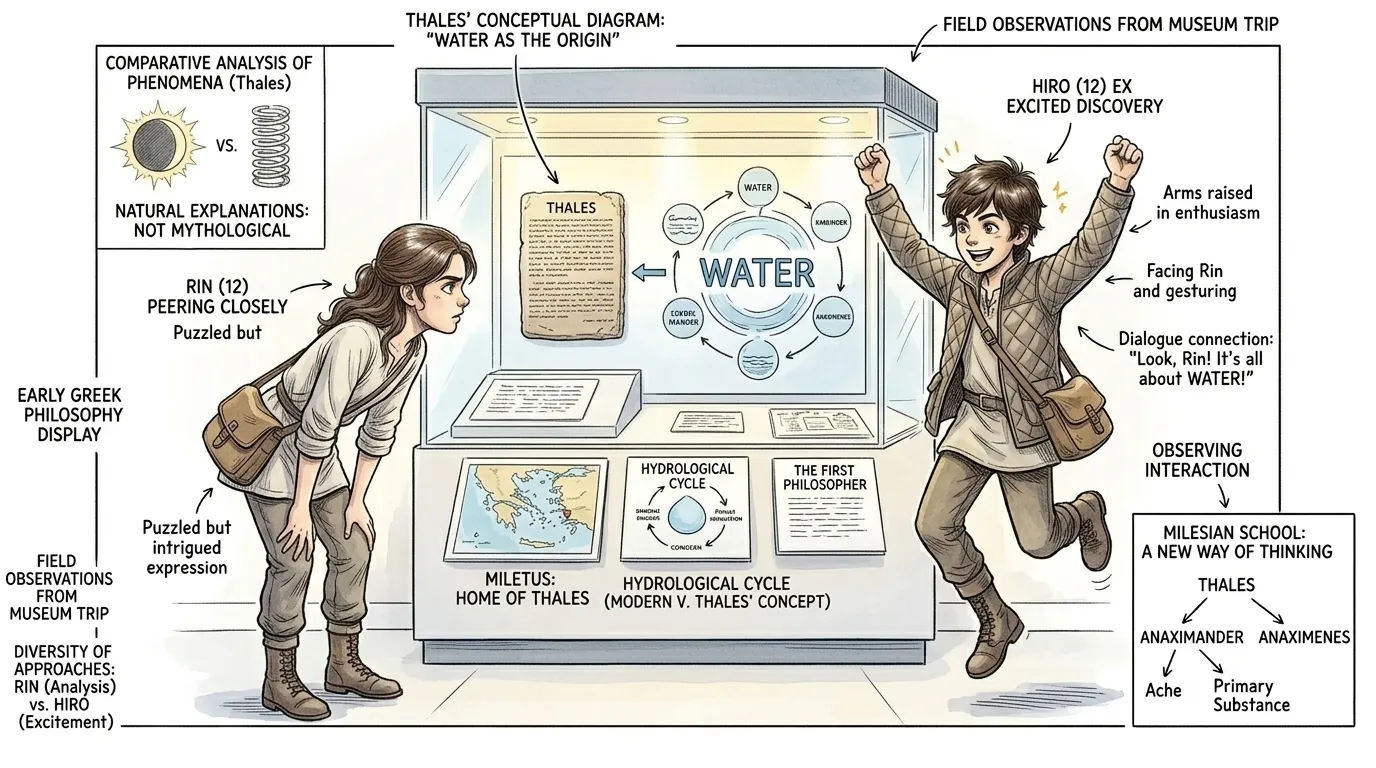
Rin and Hiro are visiting a museum exhibit about early Greek philosophers. Rin stops in front of a display dedicated to Thales, a puzzled look on her face. Hiro, ever the enthusiastic one, bounces over to join her.
""Water?" Rin asks, tilting her head. "He thought everything was made of water? That sounds... strange."
"But that's what makes him so cool!" Hiro exclaims. "He was trying to find a single, unifying explanation for everything. A first principle!""
Philosophy Note: Miletus: An ancient Greek city on the western coast of Anatolia, near the mouth of the Maeander River. It was a center of philosophy and science in the 6th century BC.
Page 3
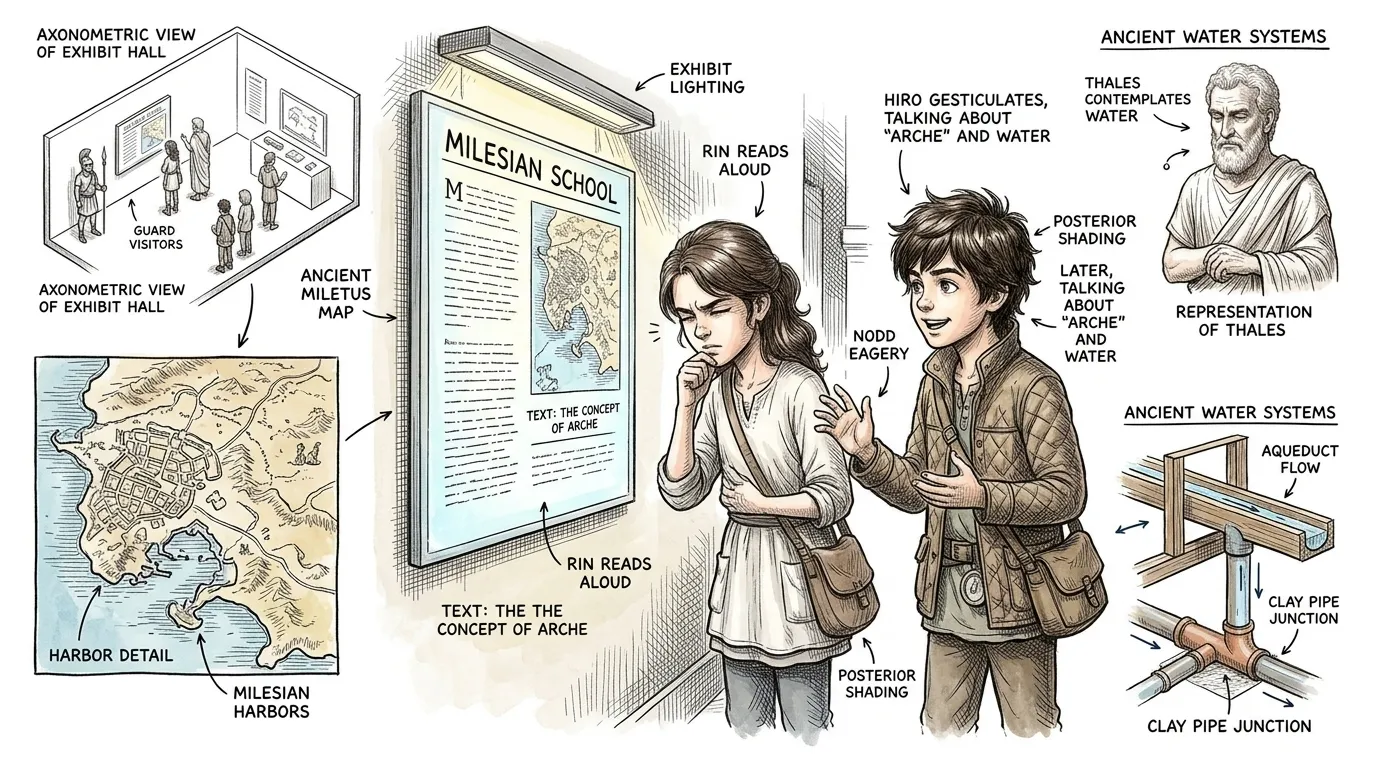
Rin squints at the information panel. She reads aloud, her voice thoughtful. Hiro nods along, remembering what he learned in class.
""It says here that Thales was the founder of the Milesian school of thought," Rin says. "They were all about finding natural explanations for things, instead of relying on mythology."
"Exactly!" Hiro replies. "They were looking for arche, the underlying principle of everything. Thales thought it was water, Anaximander thought it was the apeiron [unlimited], and Anaximenes thought it was air.""
Philosophy Note: Arche [ἀρχή]: A Greek word meaning "beginning", "origin", or "principle". Pre-Socratic philosophers used the term to refer to the fundamental substance or principle from which everything else is derived.
Page 4

Rin and Hiro move to another part of the exhibit, which delves deeper into Thales' reasoning. A holographic display shows a reenactment of Thales explaining his theory.
""Okay, so why water?" Rin asks, studying the holographic Thales. "It seems like a weird choice."
The holographic Thales responds, "Consider that water is essential for life. It can be solid, liquid, or gas. It's everywhere – in the rain, the rivers, the sea. Perhaps it is the fundamental element from which all things originate.""
Philosophy Note: The Milesian School: A school of thought in ancient Greece, founded in the 6th century BC. Its main figures were Thales, Anaximander, and Anaximenes, all from the city of Miletus.
Page 5
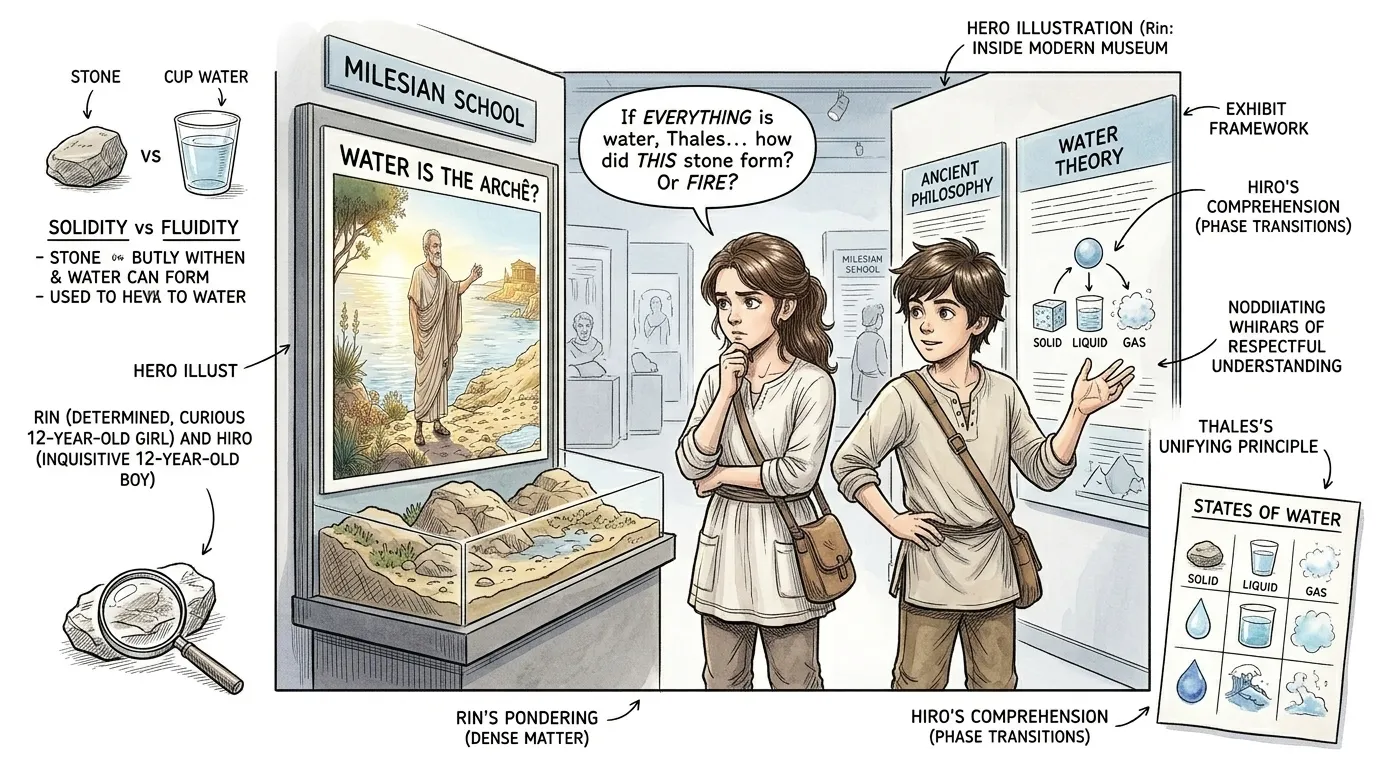
Rin and Hiro step back from the exhibit, considering Thales' argument. While his reasoning might seem simple now, it was revolutionary for its time.
""It's easy to criticize Thales now," Hiro says, "but he was one of the first to try and explain the world without resorting to gods and myths."
Rin nods. "True. He started the ball rolling. But what about things that don't seem like they have water in them, like rocks or fire?""
Philosophy Note: Mythopoeic Thought: A way of thinking that relies on myths and legends to explain the world, common before the rise of philosophical and scientific reasoning.
Page 6
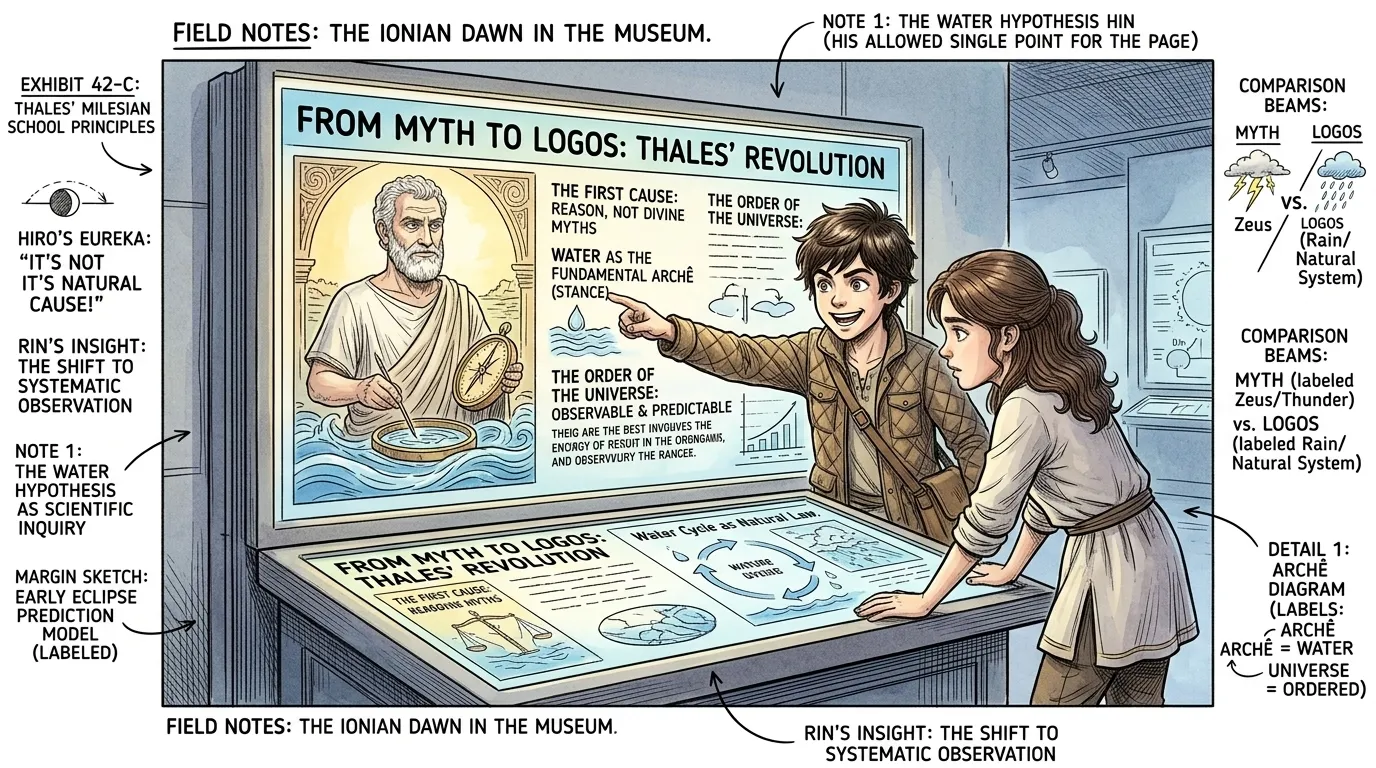
Hiro points to another information panel, which discusses the importance of Thales' approach, even if his specific conclusion was incorrect.
""Look," Hiro says, "it says here that Thales' real contribution wasn't the answer he gave, but the question he asked. He showed that the universe is understandable, and that we can use reason to figure it out.""
Philosophy Note: Rationalism: A philosophical movement emphasizing the importance of reason as the primary source of knowledge.
Page 7
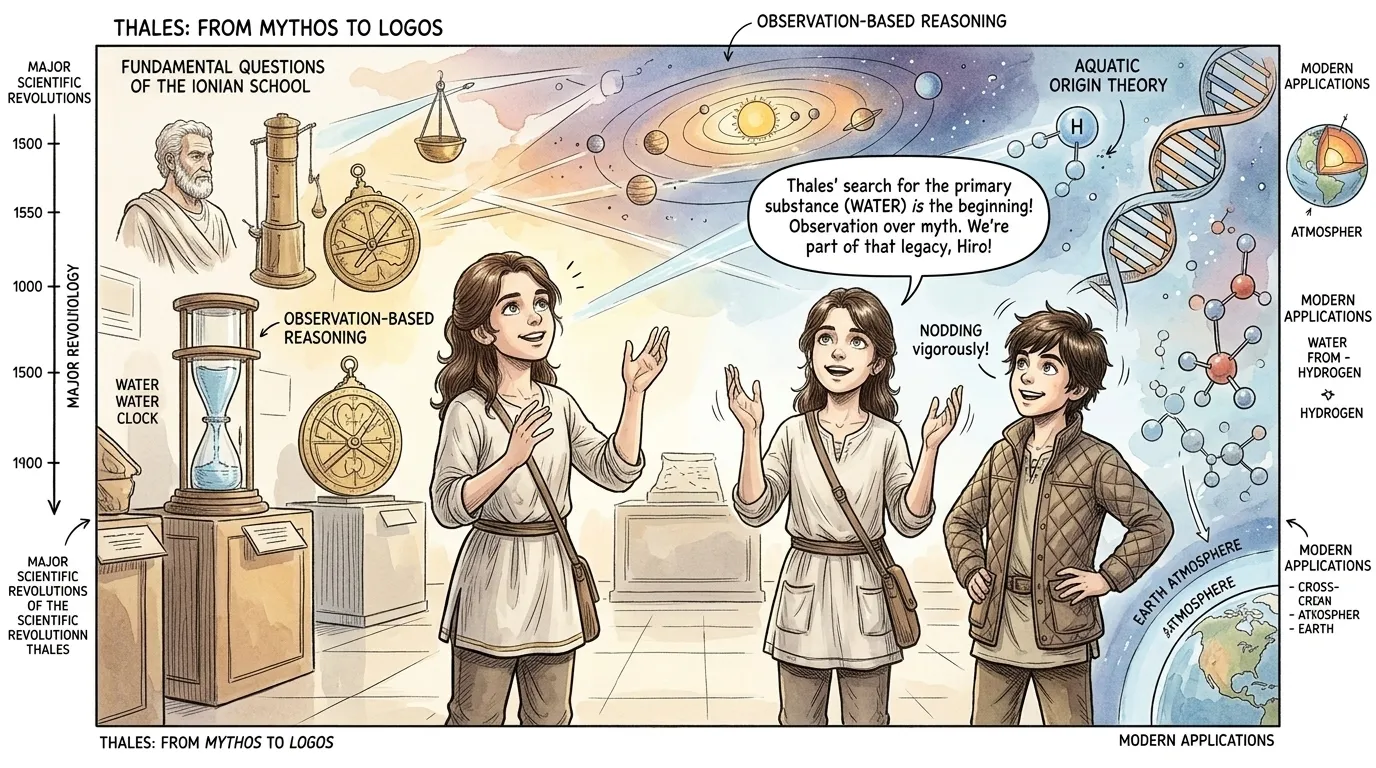
Rin considers the implications of Thales' approach. She connects it to modern scientific inquiry and the ongoing quest to understand the universe.
""So, he was like the first scientist," Rin says. "He started the tradition of looking for natural laws and explanations."
"Exactly!" Hiro replies. "He'd probably be amazed by what we've discovered since then, but he'd also recognize the same spirit of inquiry.""
Philosophy Note: Scientific Method: A systematic approach to acquiring knowledge, involving observation, experimentation, and the formulation of hypotheses.
Page 8
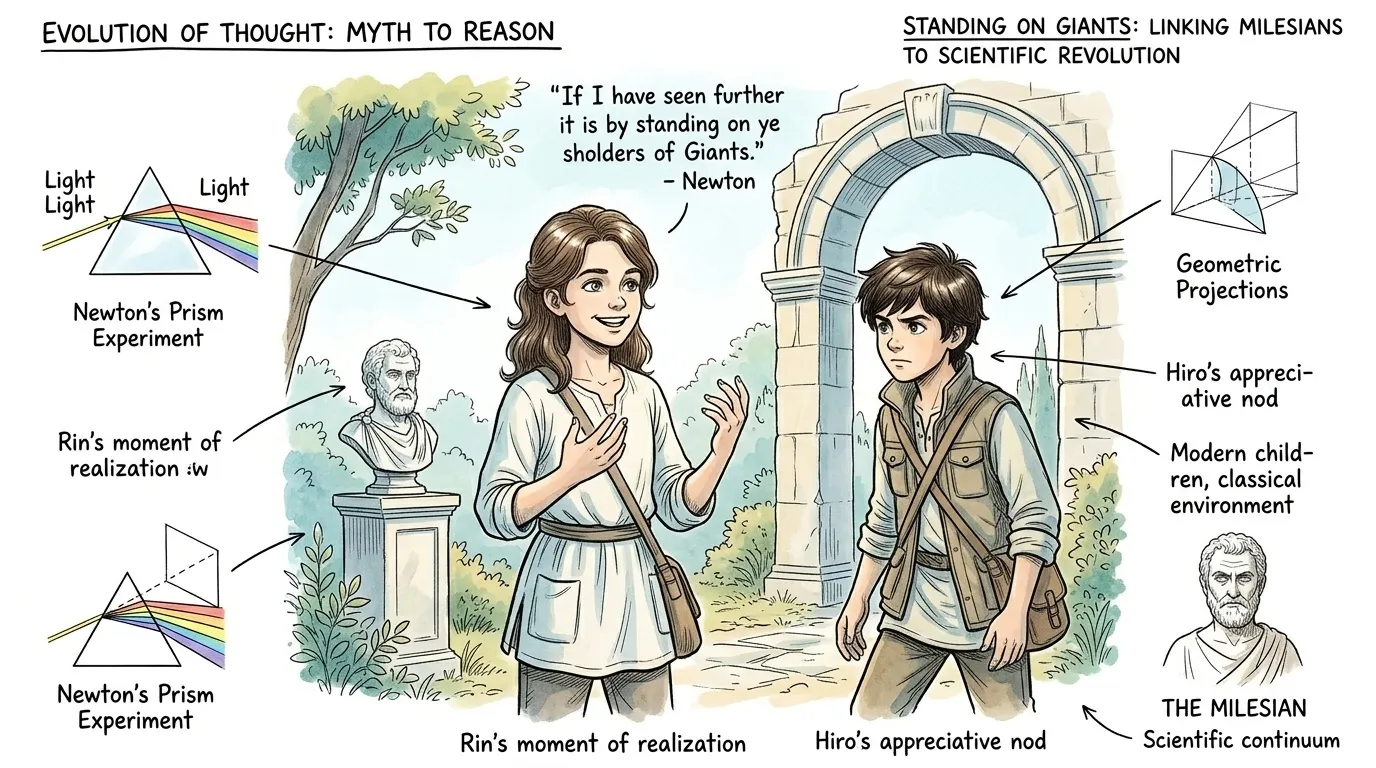
Rin smiles, finally understanding Thales' importance. She quotes a famous scientist, connecting it to the ancient philosopher's search for understanding.
""As Isaac Newton once said," Rin states, "'If I have seen further it is by standing on the shoulders of giants.' Thales was one of those giants. He gave us the courage to look for explanations, not just accept stories."
Hiro nods, "Without him, we might still be explaining everything with myths!""
Philosophy Note: Isaac Newton [1643-1727]: An English physicist, mathematician, astronomer, alchemist, theologian, and author widely recognised as one of the greatest mathematicians and physicists of all time and among the most influential scientists.
Page 9
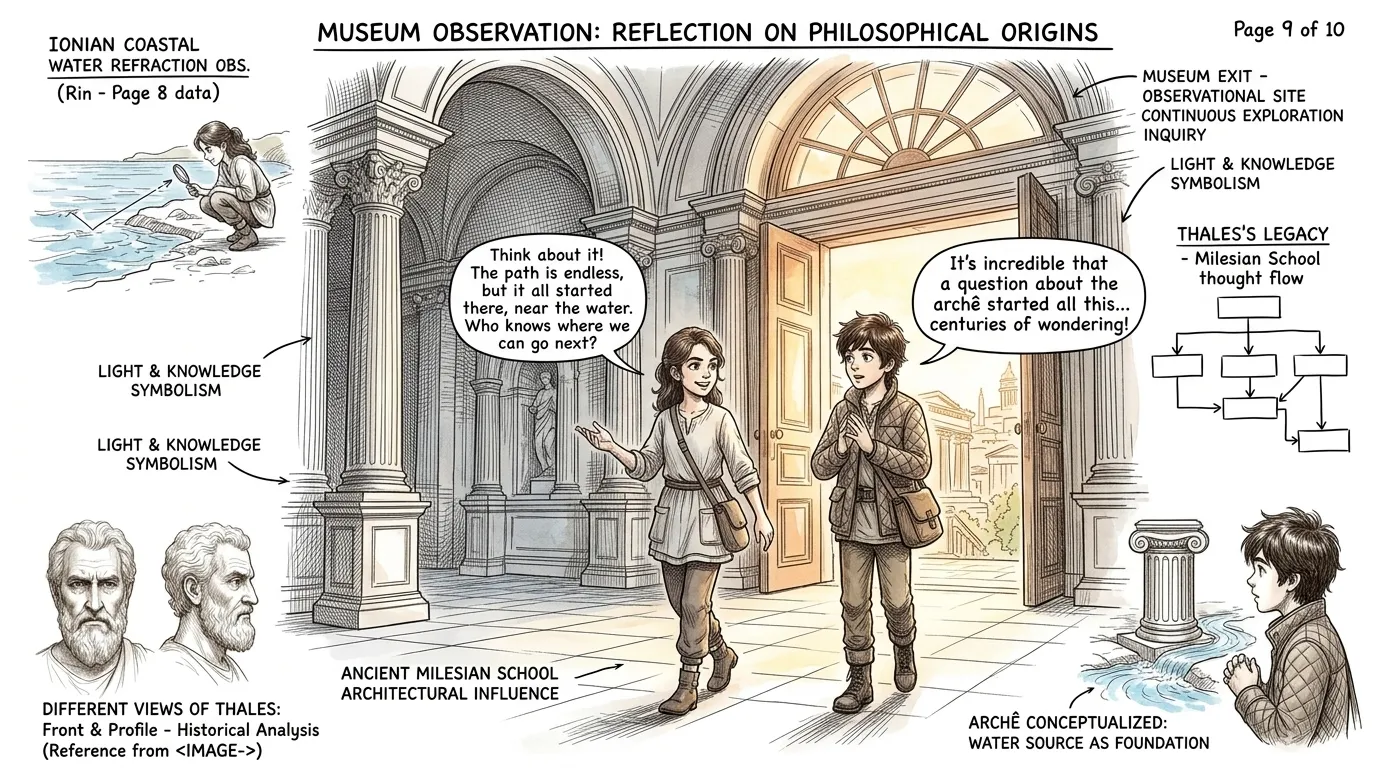
Rin and Hiro walk towards the exit of the exhibit, their minds buzzing with ideas. Thales' quest for understanding continues to inspire philosophers and scientists today.
""It's amazing to think that someone so long ago started us on this path," Hiro says.
Rin responds, "And the best part is, the quest for understanding is never really finished.""
Philosophy Note: Epistemology: The branch of philosophy concerned with the nature and scope of knowledge.
Page 10
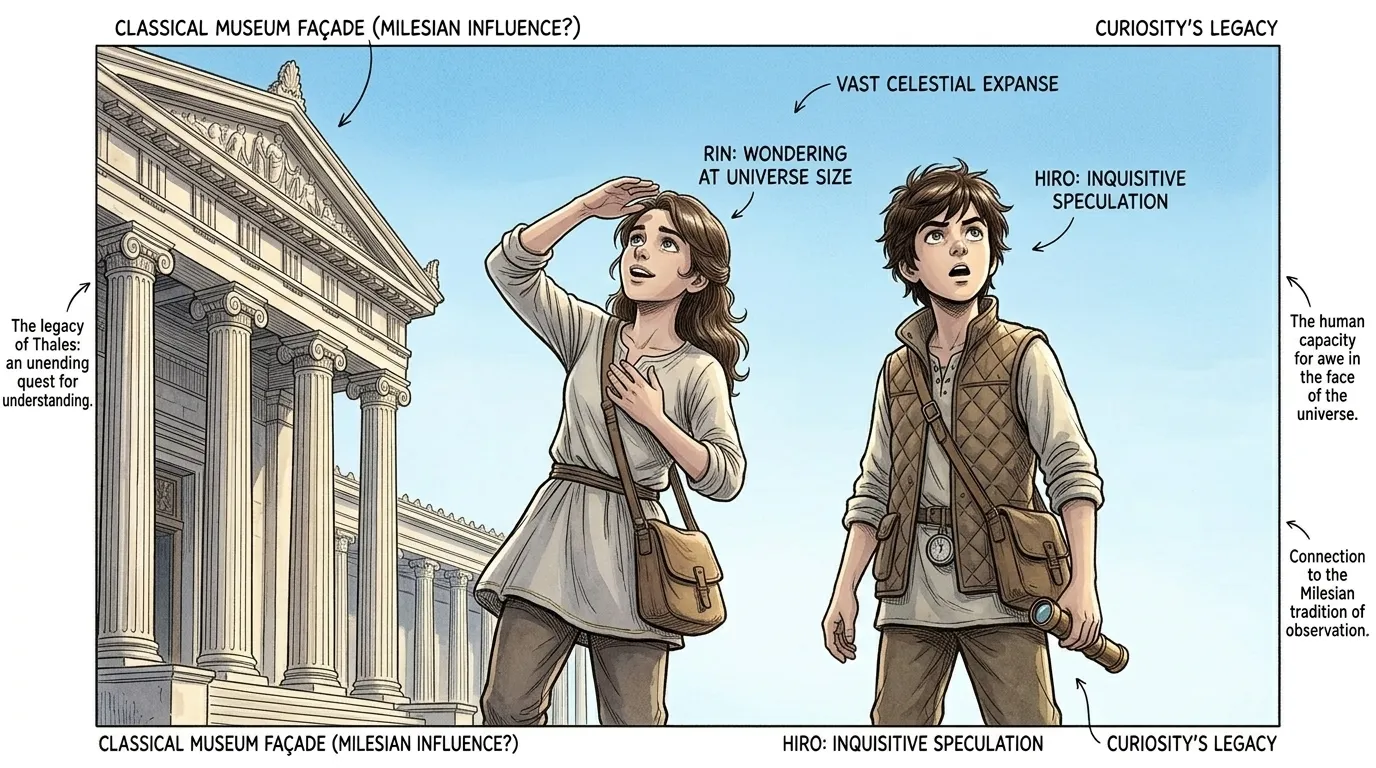
Leaving the museum, Rin and Hiro gaze up at the sky, contemplating the vastness of the universe and the enduring power of human curiosity, a legacy started by Thales so many centuries ago.
Philosophy Note: Cosmology: The study of the origin, evolution, and eventual fate of the universe.
About this story
- Audience: kids (ages 6–12)
Questions and answers
Read Wonder Philosophy on your phone
Wonder Philosophy is available on Android and iPhone and iPad. Get Wonder Philosophy on Google Play · Get Wonder Philosophy on the App Store.