Parmenides
Parmenides — an illustrated philosophy story. 10 illustrated pages, free to read on Wonder Philosophy.
Page 1
![Parmenides of Elea, a pre-Socratic Greek philosopher [fl. 5th century BCE], challenged the very foundations of understanding reality. His central idea?](https://thewonderbooks.com/images/stories/parmenides/illustrations/parmenides_page_01_v1775182051921.webp "Parmenides of Elea, a pre-Socratic Greek philosopher [fl. 5th century BCE], challenged the very foundations of understanding reality. His central idea?")
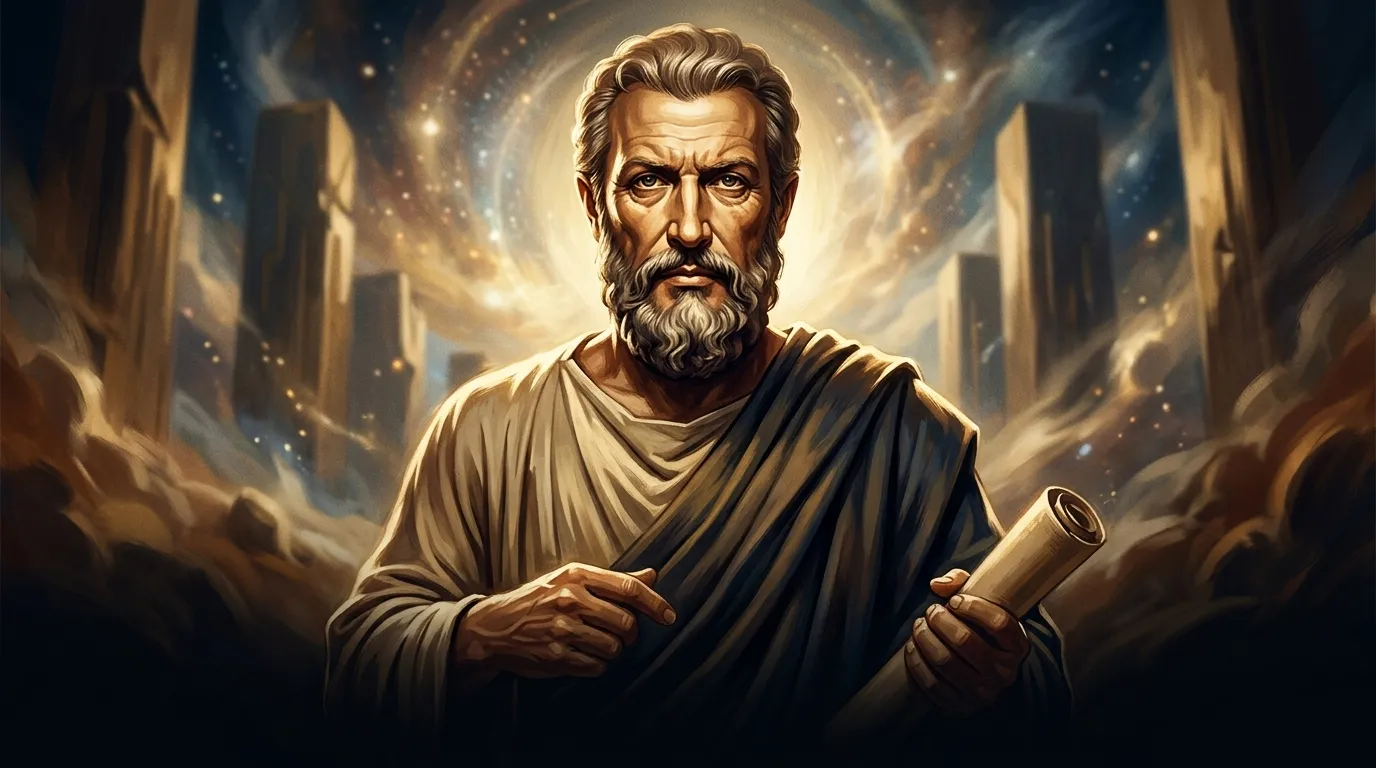
Parmenides of Elea, a pre-Socratic Greek philosopher [fl. 5th century BCE], challenged the very foundations of understanding reality. His central idea? That 'what is' simply is, unchanging and indivisible. This radical claim forced a complete rethinking of existence and how we perceive the world around us. Even today, Parmenides's ideas resonate, pushing us to question our assumptions about change, illusion, and the true nature of being.
Philosophy Note: Parmenides was born in Elea, a Greek city in southern Italy. He is considered one of the most important and influential pre-Socratic philosophers.
Page 2
![Parmenides founded the Eleatic School [est. c. 5th century BCE], attracting thinkers who grappled with his revolutionary ideas.](https://thewonderbooks.com/images/stories/parmenides/illustrations/parmenides_page_02_v1775182081681.webp "Parmenides founded the Eleatic School [est. c. 5th century BCE], attracting thinkers who grappled with his revolutionary ideas.")
Parmenides founded the Eleatic School [est. c. 5th century BCE], attracting thinkers who grappled with his revolutionary ideas. Among them were Zeno of Elea and Melissus of Samos, who defended and expanded Parmenides's philosophy. The core problem? How to reconcile the seemingly constant change we observe in the world with Parmenides's assertion of an unchanging, unified reality. If everything 'is' and cannot 'not-be', then how do we account for birth, death, and transformation?
Philosophy Note: The Eleatic School challenged common-sense notions of reality and laid the groundwork for later developments in metaphysics and logic.
Page 3
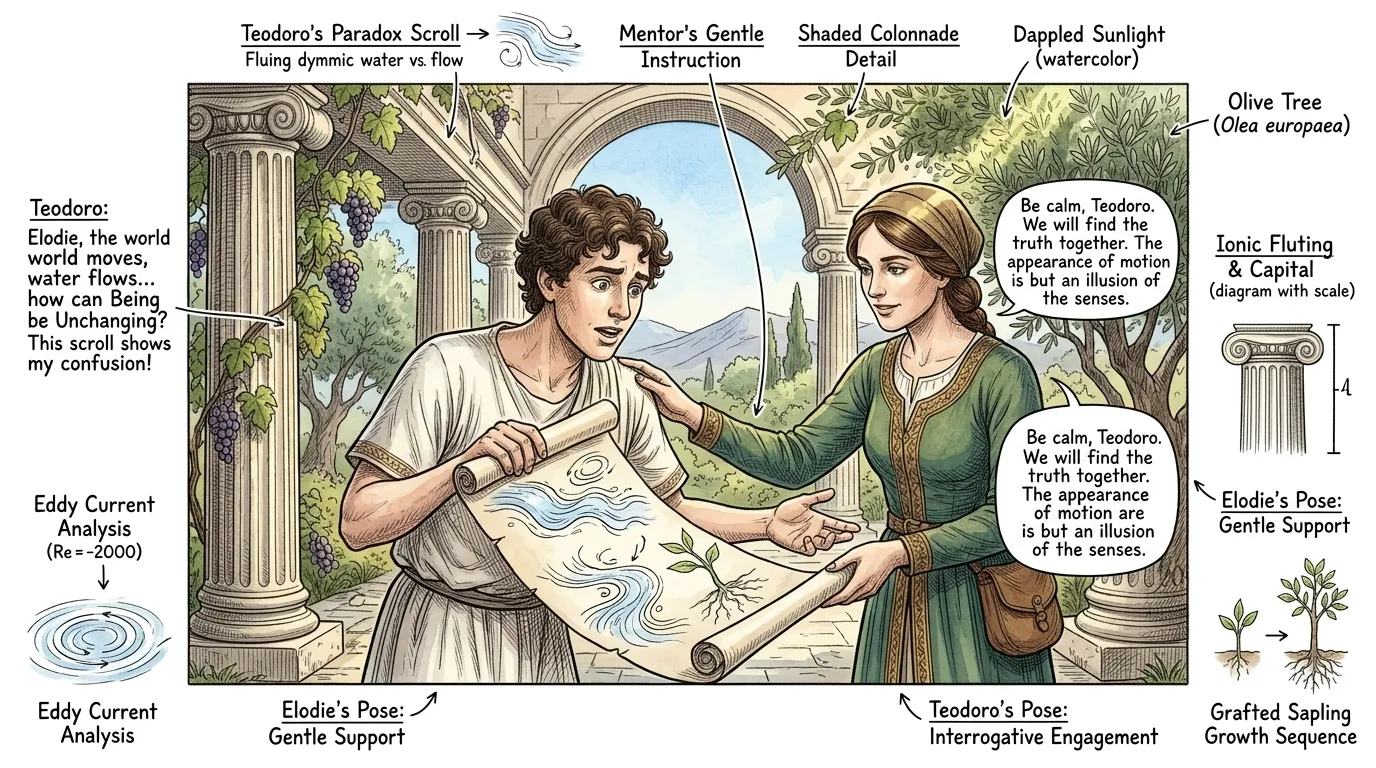
Teodoro, a bright student, approached his mentor, Elodie, with a perplexed look. "Elodie," he began, "I've been studying Parmenides, and I'm struggling. He claims that reality is one, unchanging, and indivisible. But I look around, and everything seems to be in constant flux! How can both be true?"
""It's a challenging idea, Teodoro," Elodie replied, her voice calm. "Parmenides argued that our senses deceive us. What we perceive as change is merely an illusion. True reality, according to him, is beyond the reach of our senses and intellect.""
Philosophy Note: Parmenides distinguished between 'the way of truth' (based on reason) and 'the way of opinion' (based on sensory experience).
Page 4
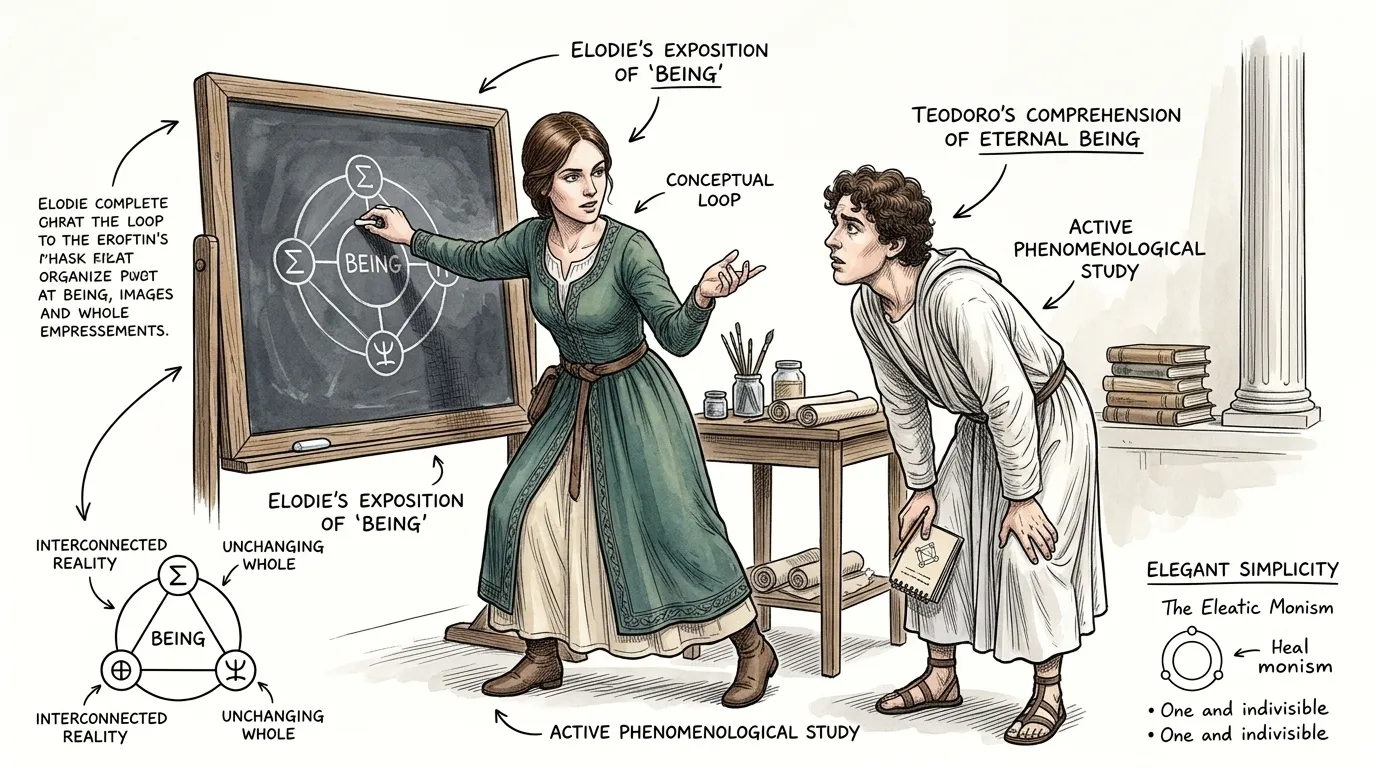
Elodie began to lay out Parmenides's core argument. "Parmenides started with a fundamental principle: 'Being is, and non-being is not.' From this seemingly simple statement, he deduced profound conclusions. If something 'is,' it cannot come from 'non-being,' because 'non-being' is nothing. Therefore, Being must be eternal, uncreated, and indestructible. It cannot change, because change would imply that it was once something else, which would mean it came from 'non-being'."
Philosophy Note: Parmenides's concept of Being is often interpreted as a single, unified, and unchanging reality.
Page 5
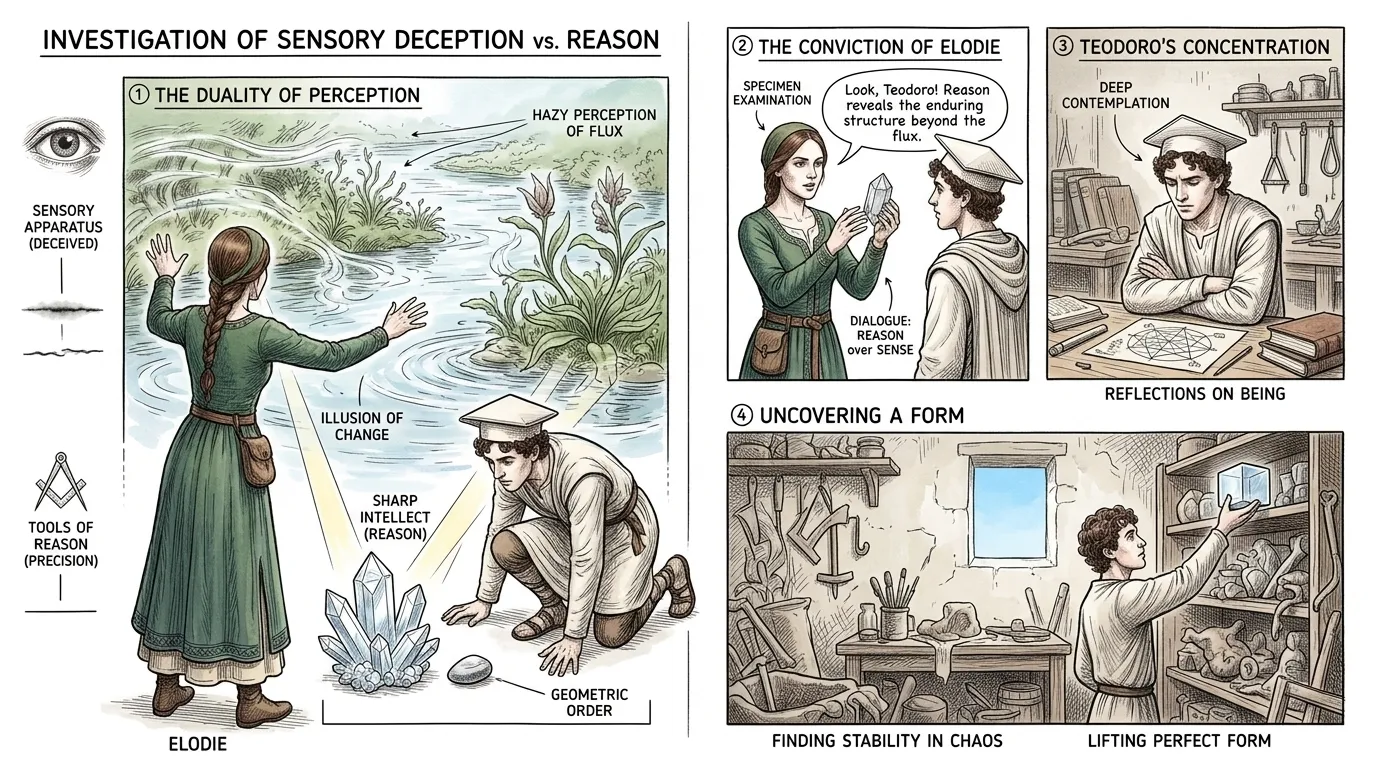
But what about the change we see all around us? Parmenides argued that our senses deceive us. The constant flux of the world – birth, death, growth, decay – is merely an illusion, a product of our limited perception. True reality lies beyond the reach of our senses, accessible only through reason and intellect. For Parmenides, trusting our senses leads us astray from the truth.
Philosophy Note: Parmenides's emphasis on reason over sensory experience had a profound impact on the development of Western philosophy.
Page 6
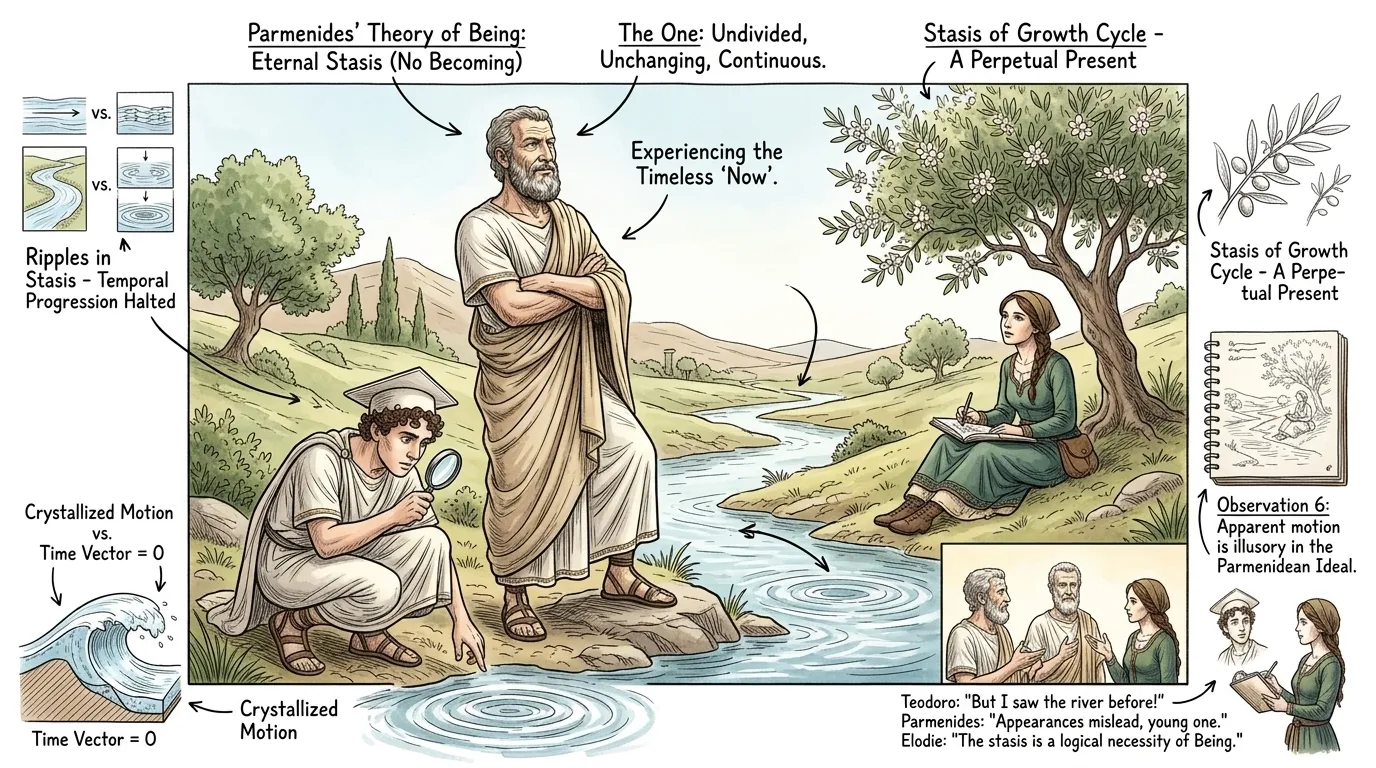
Imagine a world where nothing truly changes, where everything that exists simply is, eternally present and complete. No beginning, no end, no movement, no division. This is the Parmenidean universe. It's a radical departure from our everyday experience, a world where the familiar concepts of time and space lose their meaning. It challenges us to question the very nature of our reality.
Philosophy Note: Parmenides's philosophy raised fundamental questions about the relationship between thought and being.
Page 7
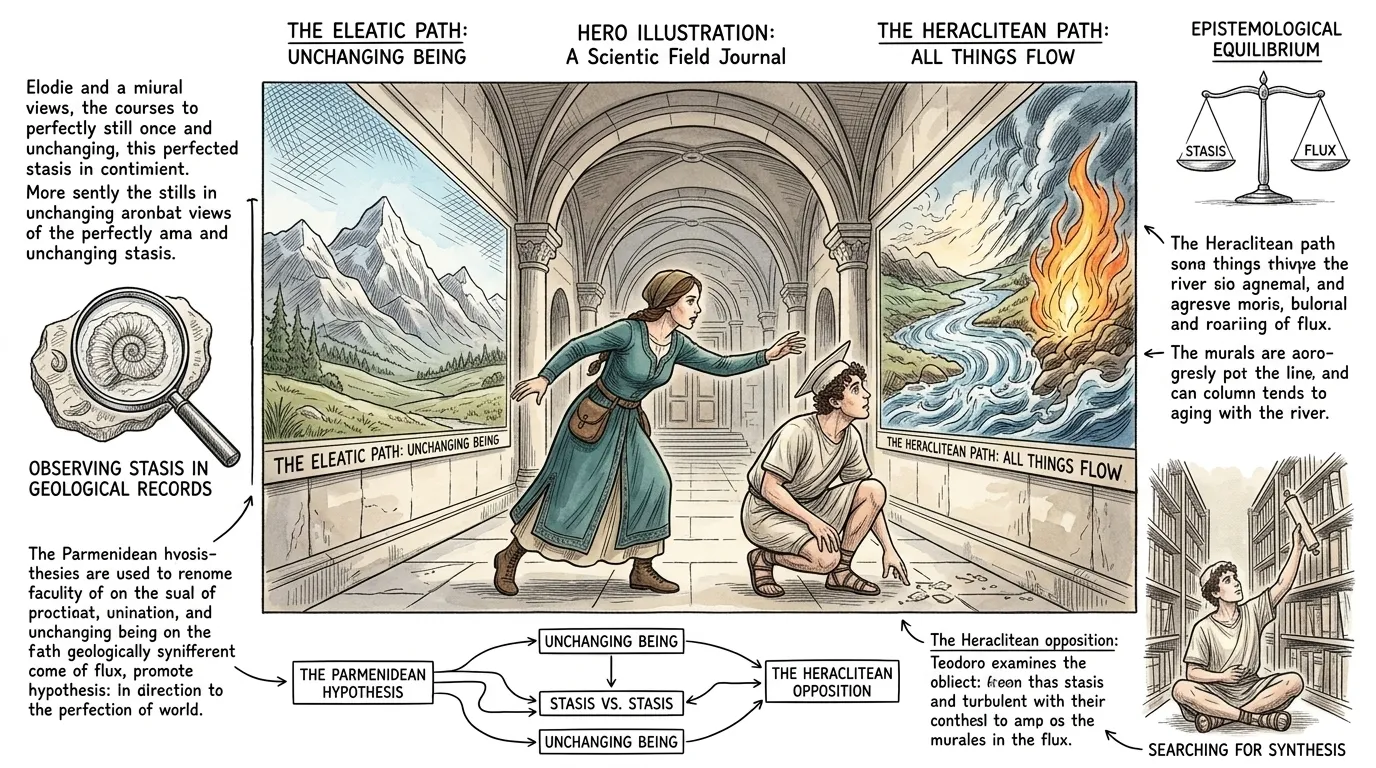
"But Parmenides wasn't the only one pondering these questions," Elodie continued, gesturing. "Think of Heraclitus [fl. c. 500 BCE], who famously said that you 'cannot step twice into the same river.' Heraclitus emphasized the constant flux and change of the world. For him, change was the fundamental reality, and stability was an illusion. Their contrasting views sparked debates that continue to echo through philosophy today."
"Teodoro nodded slowly. "So, Parmenides saw reality as one unchanging thing, while Heraclitus saw it as constant change. It's hard to imagine two more different viewpoints.""
Philosophy Note: The debate between Parmenides and Heraclitus represents a fundamental tension in philosophy between the search for permanence and the acceptance of change.
Page 8
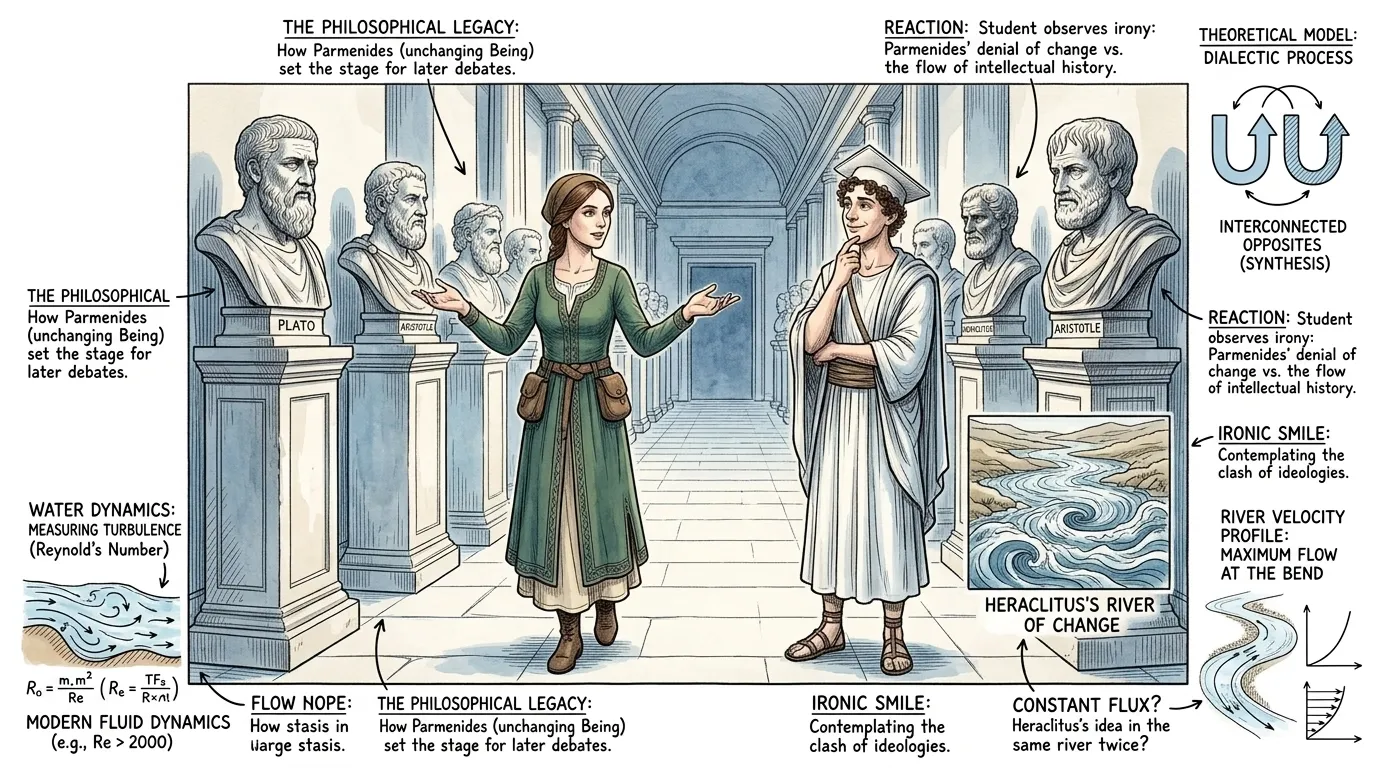
"Parmenides's legacy extends far beyond ancient Greece," Elodie explained. "His emphasis on logic and deductive reasoning influenced Plato and Aristotle, shaping the course of Western thought. And even in modern physics, his concept of a fundamental, unchanging reality resonates in theories about the underlying structure of the universe."
"Emilia suddenly spoke up. "It reminds me of something my mom always says: 'The only constant is change.' She says it's Heraclitus, but it's funny how Parmenides thought the opposite!""
Philosophy Note: Parmenides's ideas influenced the development of logic, metaphysics, and epistemology.
Page 9
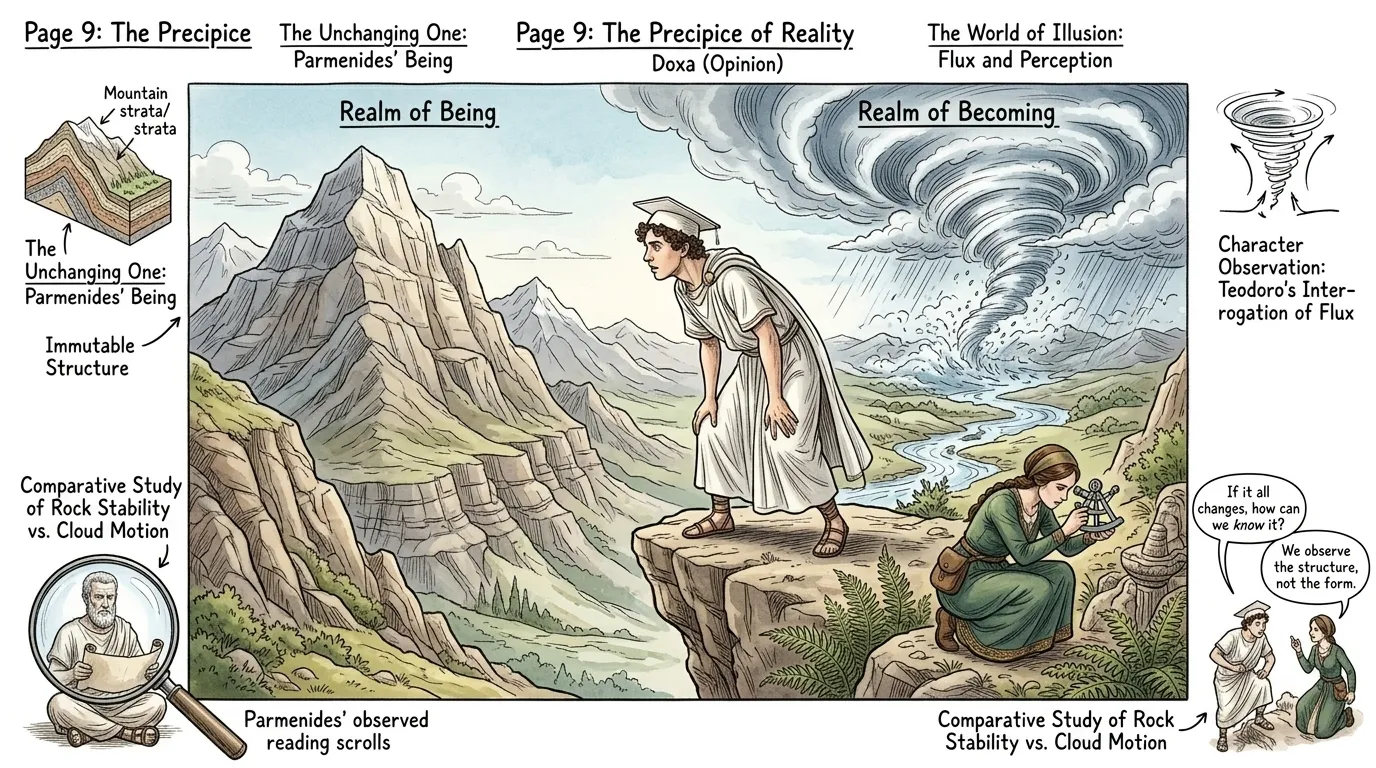
The question of whether reality is fundamentally unchanging or constantly changing remains a central theme in philosophy and science. Parmenides challenges us to question our assumptions, to examine the limits of our senses, and to seek a deeper understanding of the nature of being. He forces us to confront the possibility that what we perceive as reality may be just a shadow of a more profound and unchanging truth.
Philosophy Note: Parmenides's concept of Being continues to inspire debate and inquiry in contemporary philosophy and physics.
Page 10
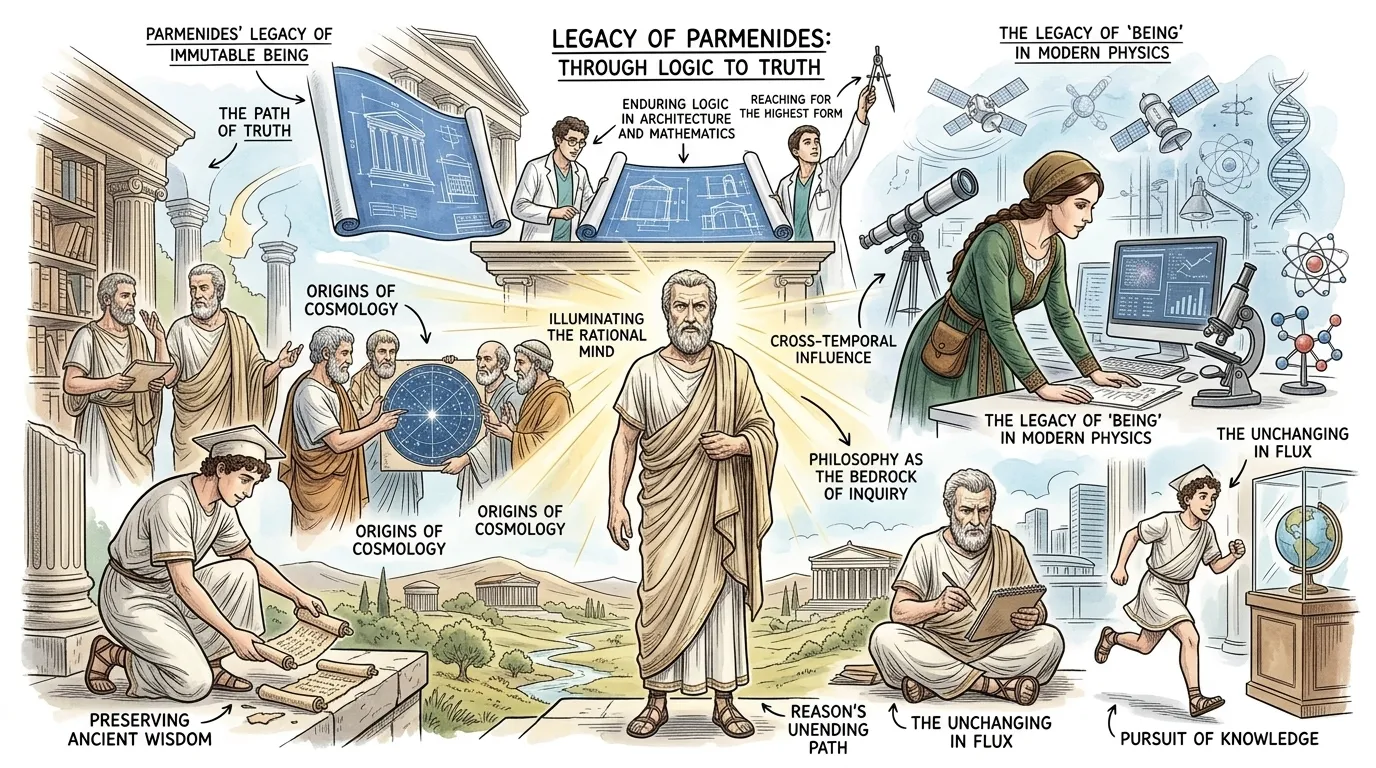
Parmenides's influence is undeniable. He challenged the prevailing views of his time, sparking debates that shaped the course of Western thought. His emphasis on reason and logic laid the groundwork for future philosophical and scientific advancements. By daring to question the very nature of reality, Parmenides left an enduring legacy that continues to inspire us to seek truth and understanding.
Philosophy Note: Parmenides's philosophy represents a pivotal moment in the history of Western thought.
About this story
- Audience: general readers
Questions and answers
Read Wonder Philosophy on your phone
Wonder Philosophy is available on Android and iPhone and iPad. Get Wonder Philosophy on Google Play · Get Wonder Philosophy on the App Store.