Maurice Merleau-Ponty
Maurice Merleau-Ponty — an illustrated philosophy story. 10 illustrated pages, free to read on Wonder Philosophy.
Page 1
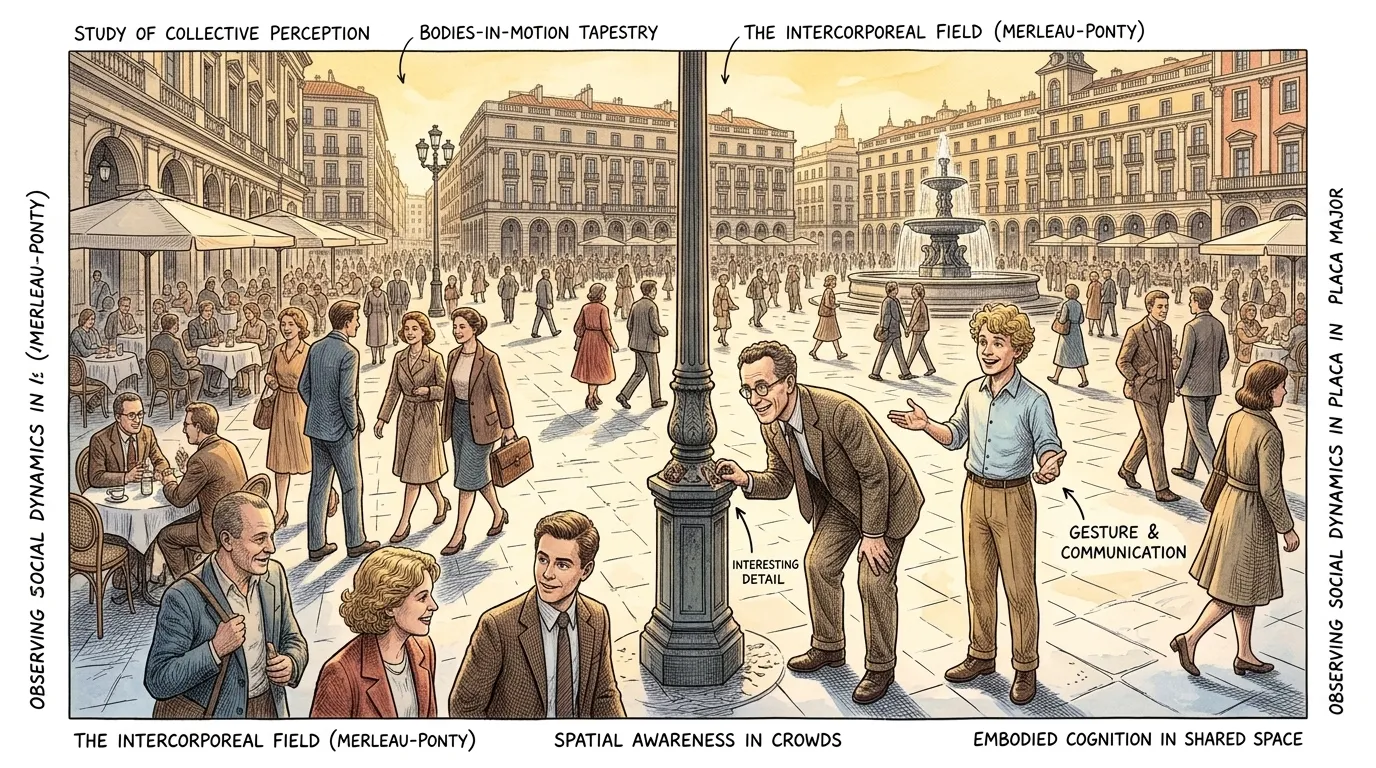
The vast city square hummed with life, a dynamic tapestry of movement and sound. Santiago and Theo stood, observing the intricate flow of people navigating the space, their expressions reflecting deep thought.
""Look at them, Santiago," Theo said, gesturing broadly. "Everyone moves with such purpose, yet they aren't consciously calculating every step. It's as if their bodies already know the way." Santiago nodded, eyes scanning the crowd. "Exactly, Theo. It's like their awareness isn't just in their heads, but in their very steps, their glances, the way they shift to avoid someone.""
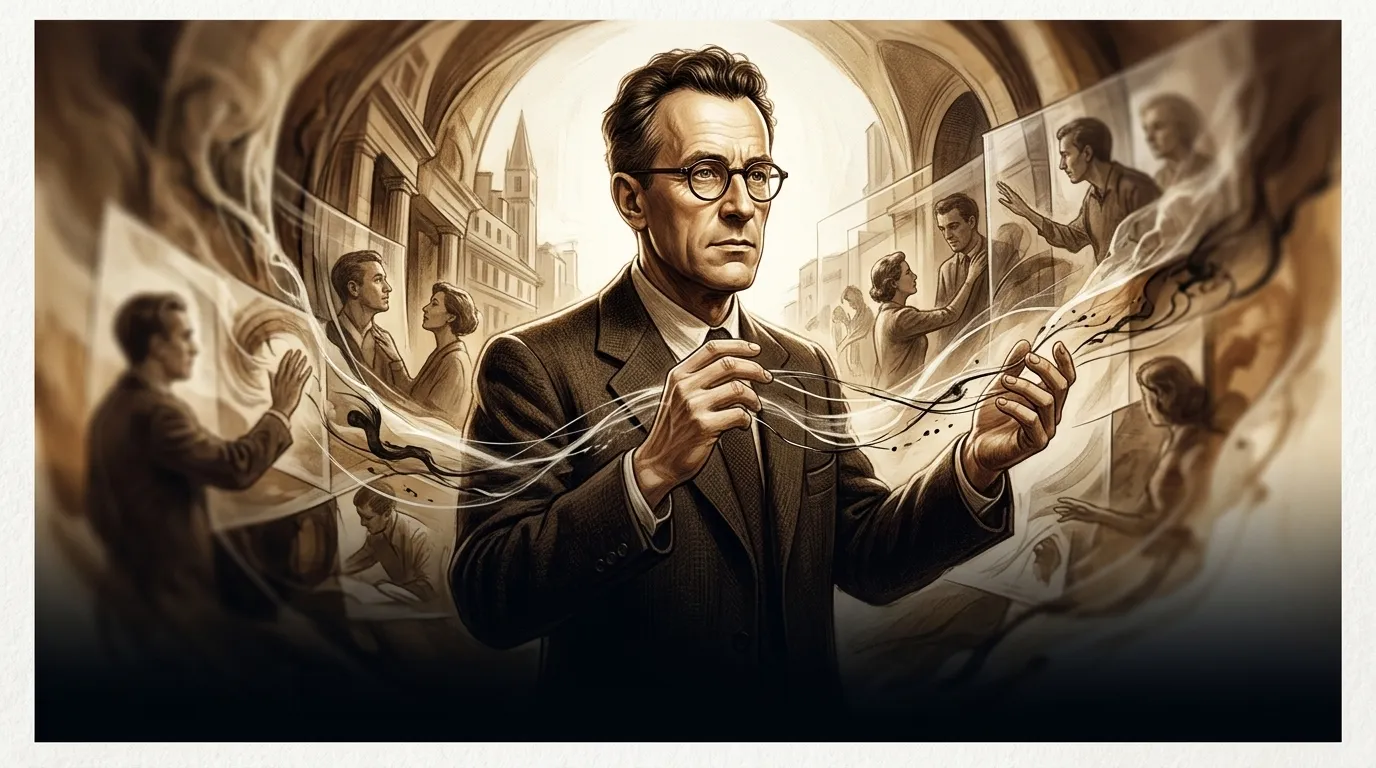
Philosophy Note: Maurice Merleau-Ponty (1908-1961) was a French philosopher who challenged traditional views of perception and the body, becoming a leading voice in phenomenology and existentialism.
Page 2
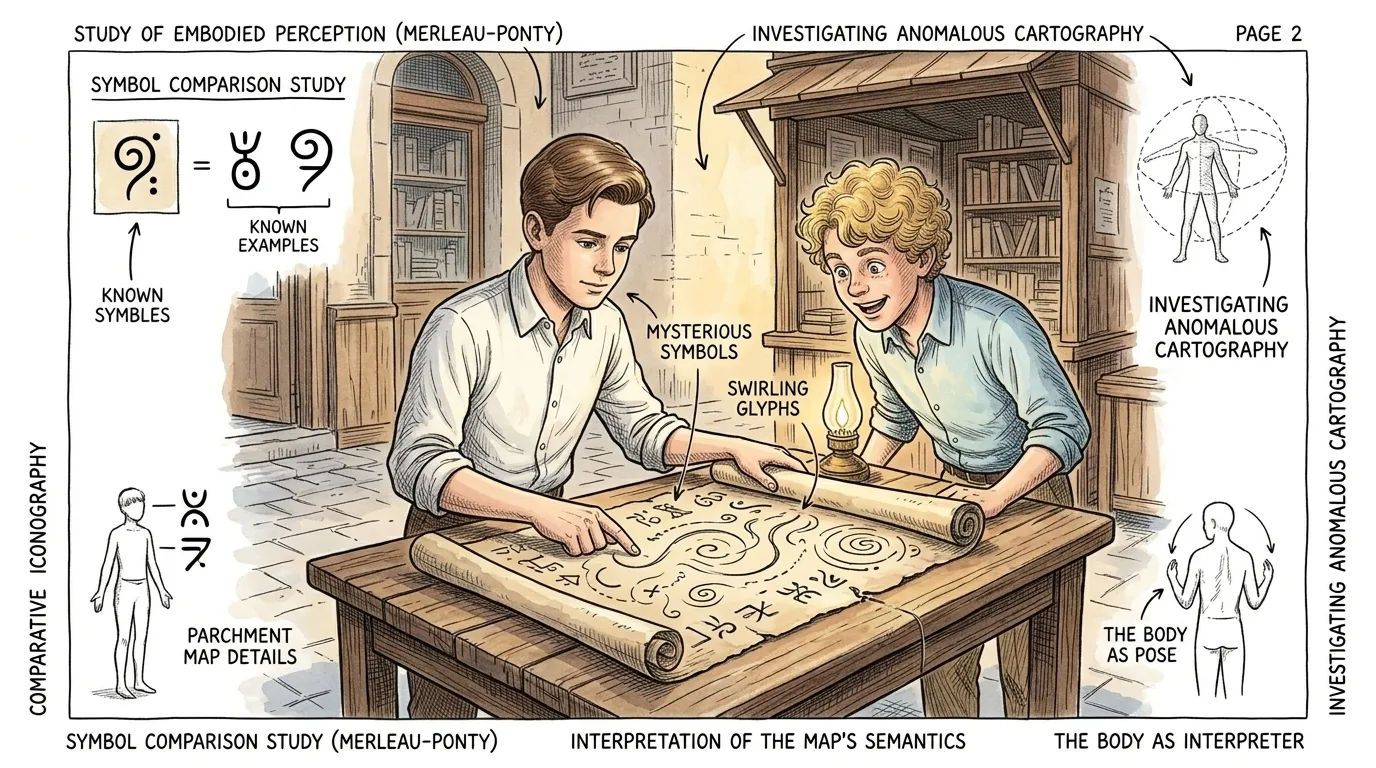
Later, in a quieter corner of the square near an old book stall, Santiago carefully unrolled an ancient, faded parchment. It wasn't a typical map, but a series of abstract symbols and swirling lines, seemingly depicting movements and sensations.
""This isn't a map of places, is it?" Theo asked, peering closer. "It looks more like instructions for a dance, or a way of feeling a journey." Santiago traced a finger along a curved line. "It's enigmatic. It doesn't tell you where to go, but how to be. Remember what the ancient Roman philosopher Seneca once wrote: 'Every new beginning comes from some other beginning's end.' This map feels like the end of thinking about journeys in the usual way, and the beginning of a different kind of understanding.""
Philosophy Note: Merleau-Ponty critiqued Cartesian dualism, which separates mind and body. He argued for the 'primacy of perception,' where our initial understanding of the world comes through our engaged, embodied experience, not just abstract thought.
Page 3
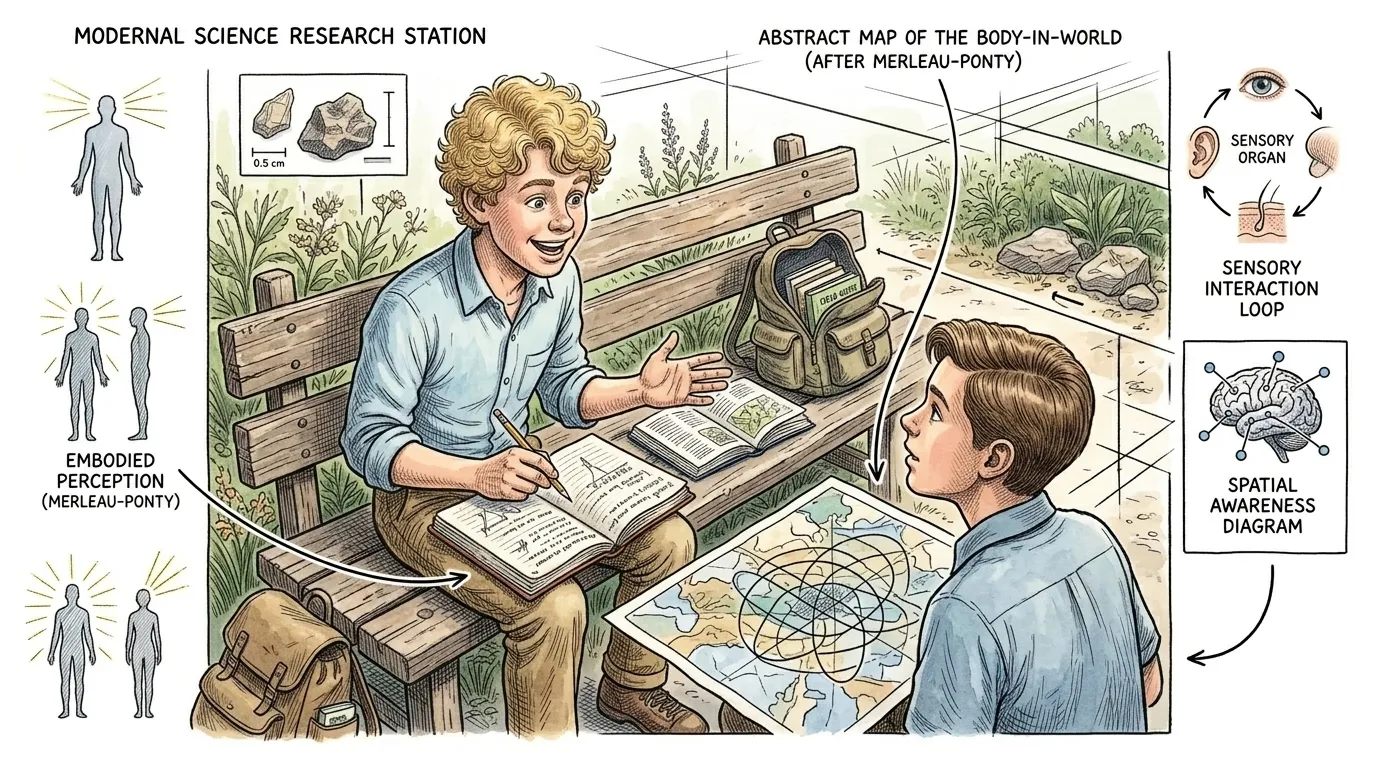
Theo opened his notebook, a dedicated student eager to connect their observation to historical thought. He had been researching the figures behind their current topic.
""This reminds me of Maurice Merleau-Ponty," Theo announced, tapping his notebook. "He was a French philosopher, a major figure in phenomenology and existentialism in the mid-20th century. He built on thinkers like Edmund Husserl but really focused on the body's role." Santiago looked up from the map. "So, he wasn't just talking about abstract ideas, but about how we physically experience the world?" Theo nodded. "Precisely. He believed our body isn't just a vessel; it's our primary way of being-in-the-world, shaping how we perceive and understand everything around us.""
Philosophy Note: Phenomenology, a philosophical movement, seeks to understand the structures of experience and consciousness. Merleau-Ponty's unique contribution was emphasizing the 'lived body' as the foundation of this experience.
Page 4
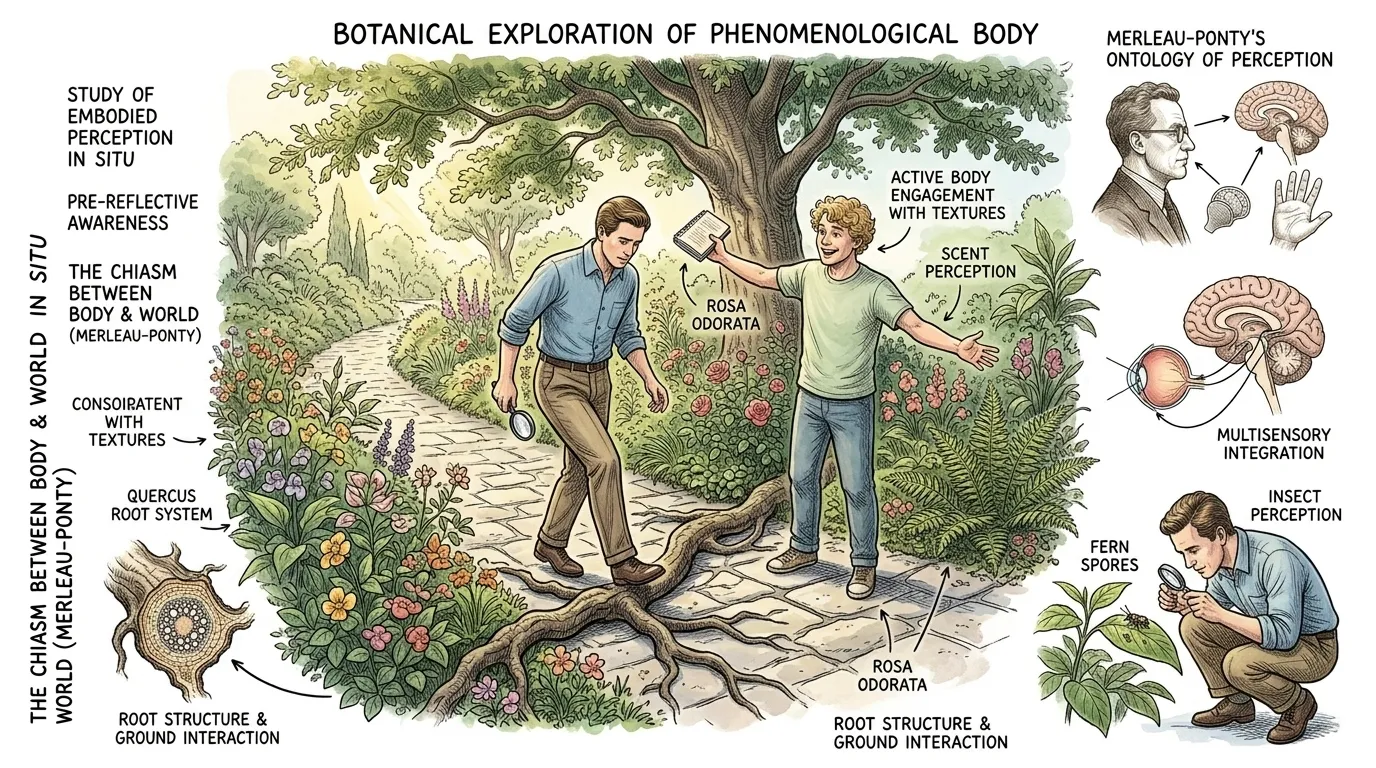
Theo closed his notebook, and they both returned their attention to the mysterious map. They began to explore a nearby, small botanical garden, trying to apply Merleau-Ponty's ideas to their surroundings and the map's abstract directions.
""Merleau-Ponty called it the 'primacy of perception'," Theo explained as they entered the garden. "It means our first contact with the world isn't intellectual thought, but an immediate, bodily engagement." Santiago carefully stepped over a gnarled root. "So, when I walk through this garden, my body is already anticipating the ground, the texture of the leaves, the scent of the flowers, even before my mind labels them?" Theo nodded enthusiastically. "Exactly! It's an active dialogue between your body and the world, not just your brain observing it.""
Philosophy Note: For Merleau-Ponty, perception is not merely a passive reception of sensory data, but an active, pre-reflective, and engaged interaction that makes sense of the world through our bodily orientation and capabilities.
Page 5
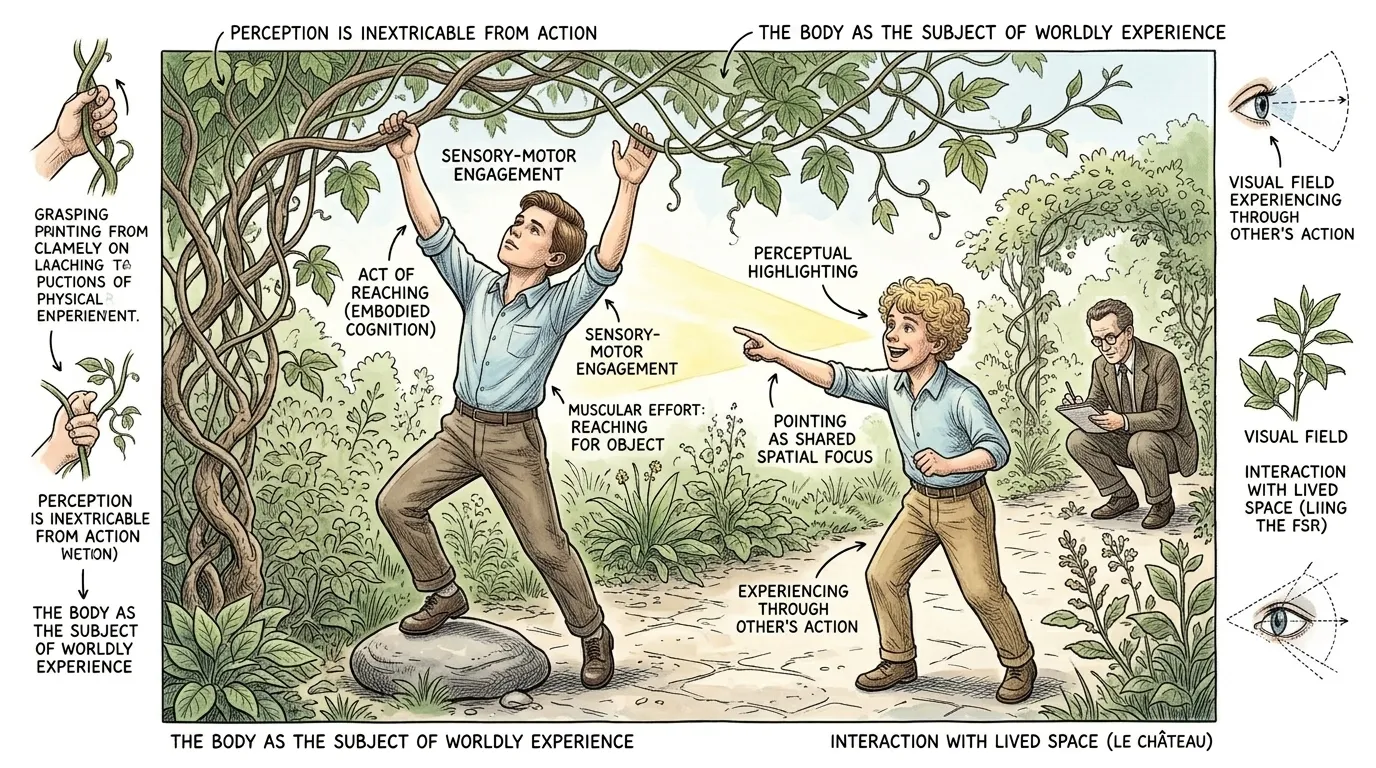
They stopped at a section of the garden where twisting vines created an almost labyrinthine path. The enigmatic map's abstract lines seemed to resonate with the physical challenge before them.
""He argued our body isn't just an object, like a rock or a tool," Theo continued, pointing to Santiago's arm. "It's the subject through which we experience everything. We don't just have a body; we are our body, our unique way of being in the world." Santiago stretched, his muscles engaging. "So, my body isn't just carrying my mind; it is my perspective? The way I reach for that vine, the way I balance on this stone – that's me perceiving and acting as one?" Theo beamed. "Precisely. Your body is your original expression of the world.""
Philosophy Note: The 'lived body' (corps propre) is central to Merleau-Ponty. It is not merely a biological entity but the source of our perception, action, and fundamental connection to the world, integrating mind and matter.
Page 6
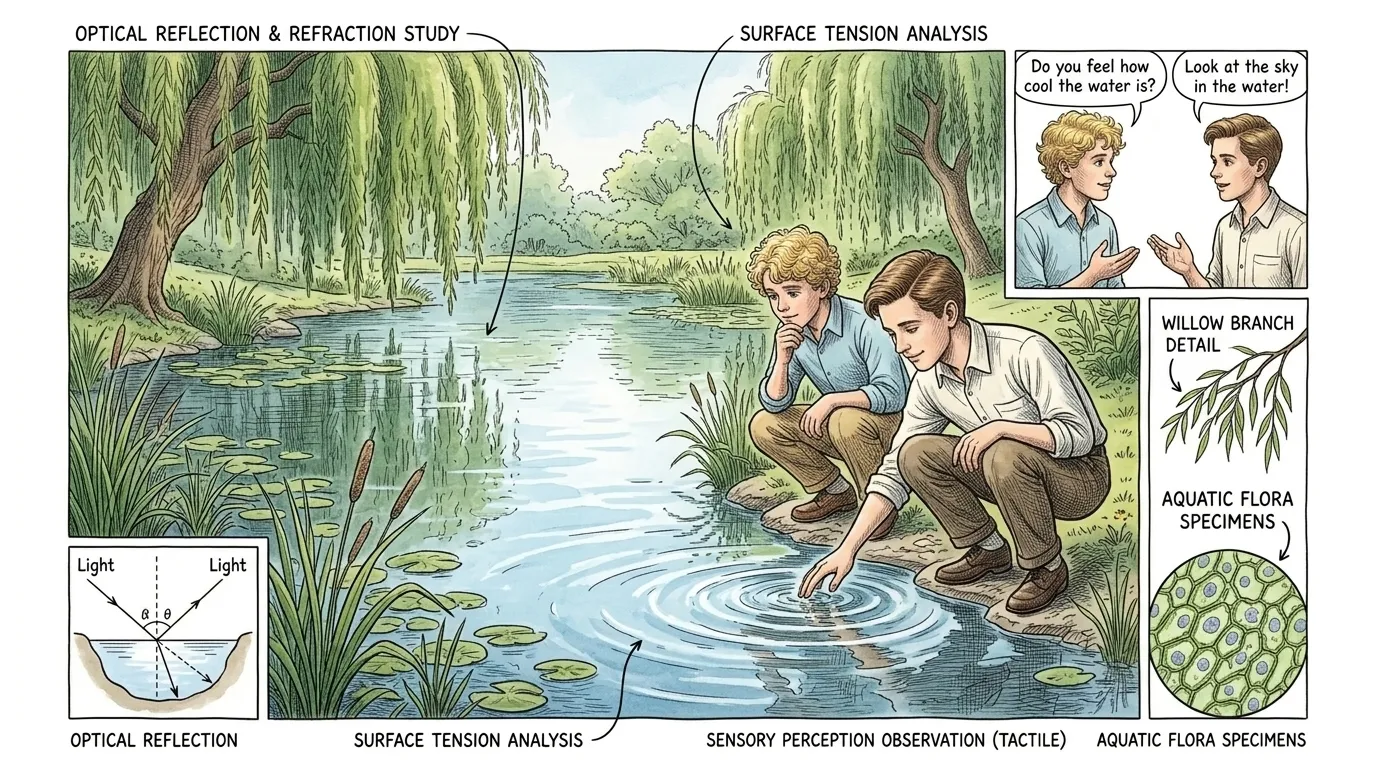
Deeper in the garden, they found a small pond reflecting the sky, surrounded by willow trees. The still surface offered a moment of quiet reflection, prompting them to consider Merleau-Ponty's profound idea of interconnectedness.
""Merleau-Ponty took this idea even further," Theo said softly, gazing at the reflections. "He used the phrase 'flesh of the world' to describe how deeply intertwined our bodies are with the environment. We're not separate observers; we're part of the same fabric." Santiago dipped his hand into the cool water. "So, the feeling of the water, the texture of the leaves, the warmth of the sun – these aren't just things out there; they're also part of my experience, and my body helps create that connection?" Theo nodded. "It's a continuous, reciprocal relationship.""
Philosophy Note: The 'flesh of the world' signifies a fundamental unity between the experiencing body and the perceived world. It posits that subject and object are not distinct but are inextricably linked through a shared, sensible medium.
Page 7
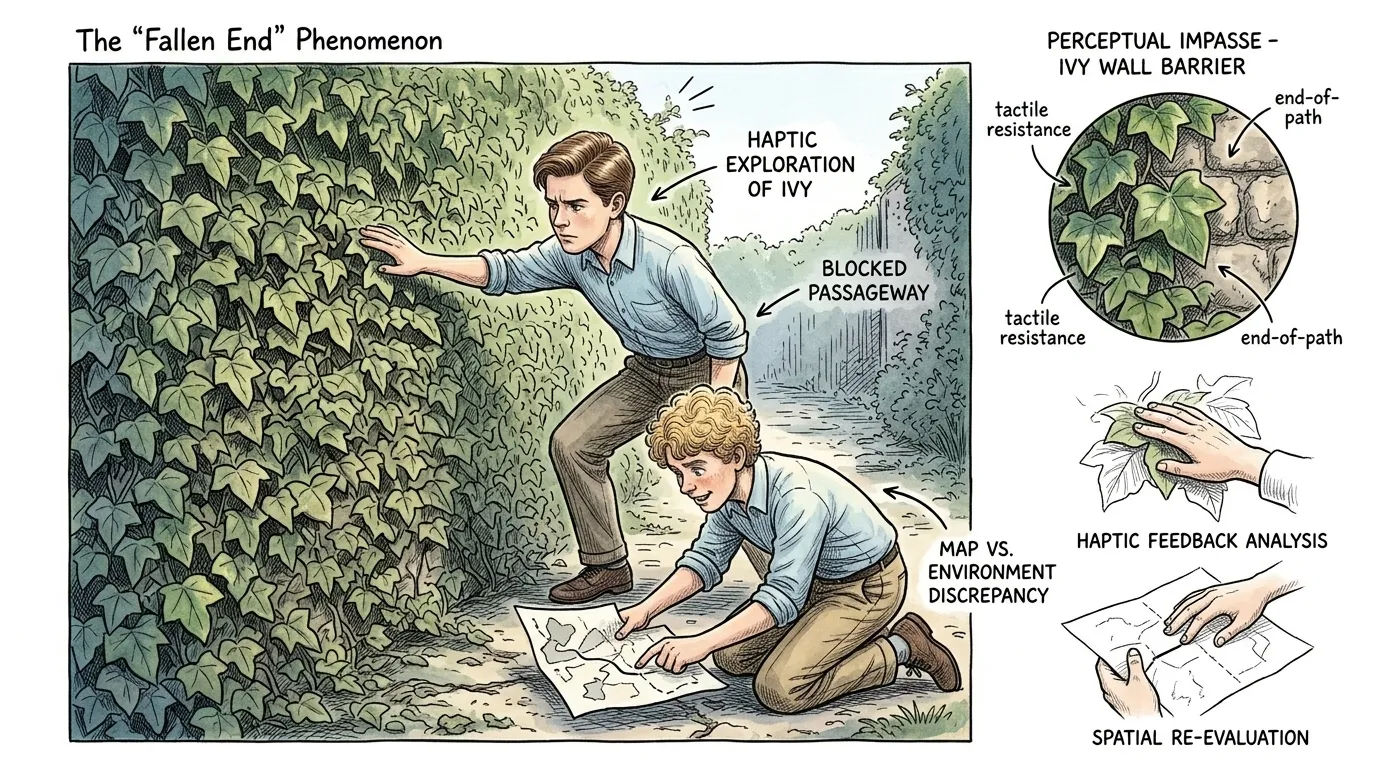
The map led them to a narrow, shadowed passage that seemed to end abruptly at a thick ivy-covered wall. It was a moment of intellectual and physical impasse, challenging their ingrained ways of thinking.
""This wall feels like a perfect example of what Merleau-Ponty was against," Santiago mused, running his hand over the rough leaves. "The idea that our mind can just intellectually grasp a solution without our body's involvement." Theo consulted the enigmatic map again. "Right. He rejected Descartes' idea that the mind is a separate, disembodied thinking substance. For Merleau-Ponty, we can't truly separate thinking from feeling, or perceiving from moving." Santiago sighed. "So, just standing here and thinking won't work. We need to engage with this 'dead end' differently.""
Philosophy Note: René Descartes famously proposed mind-body dualism, suggesting the mind is distinct from the body. Merleau-Ponty fundamentally opposed this, arguing that consciousness is always embodied and situated in the world, making mind and body inseparable.
Page 8
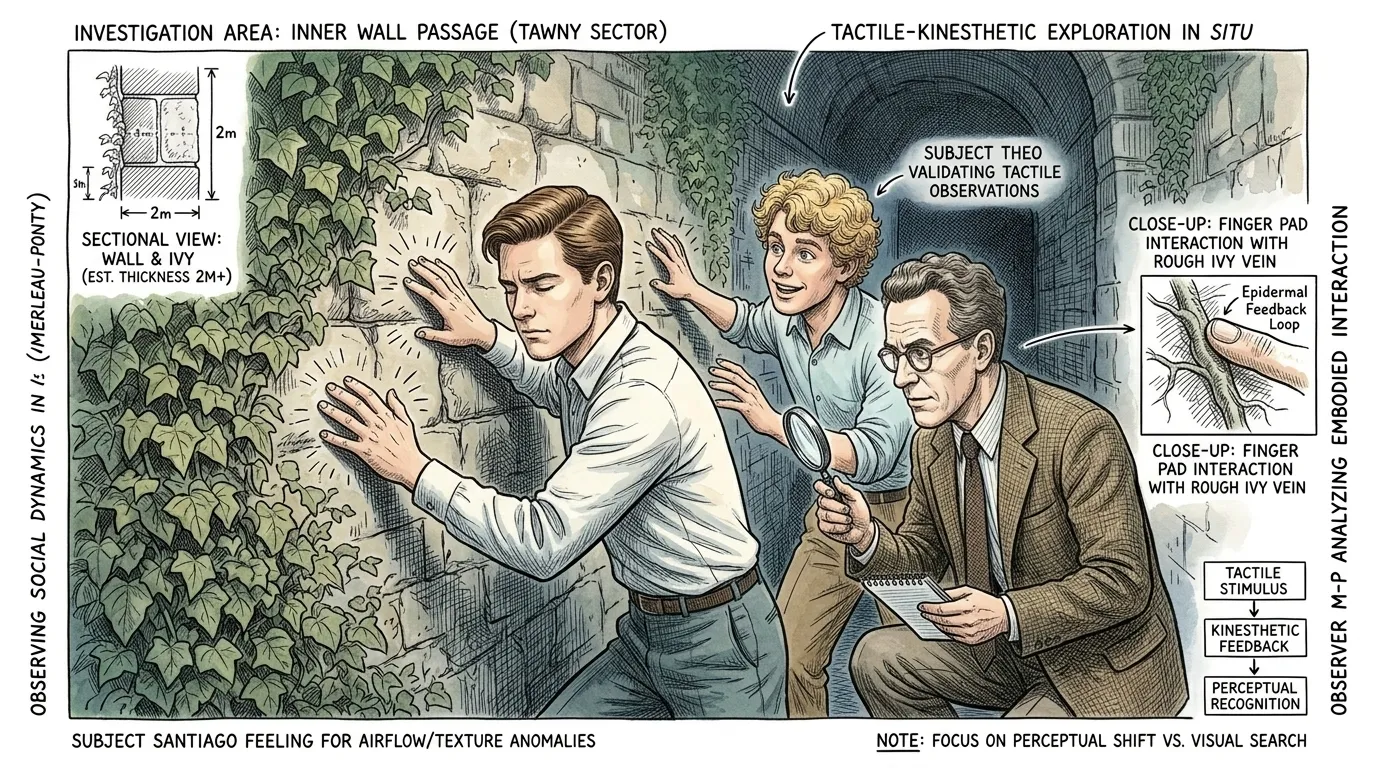
They stared at the ivy wall, the abstract lines of the map seeming to mock them. But then, Santiago remembered their earlier discussion about the map, and Merleau-Ponty's emphasis on feeling the way.
""Wait," Santiago said, a spark of realization in his eyes. "This isn't about a visible opening. Remember our first thoughts about this map? It's about sensations, not just lines. Merleau-Ponty teaches us that our freedom, unlike Sartre's more absolute version, is always situated and embodied. We have to feel our way through the world." He pressed his hands against the wall, not looking for a gap, but feeling for a difference in texture, a subtle change in the air flow. Theo joined him, moving his hands along the ivy. Suddenly, Santiago felt a slight give, a different resistance in the foliage."
Philosophy Note: Jean-Paul Sartre, another existentialist, emphasized radical freedom and choice. Merleau-Ponty, while acknowledging freedom, stressed its situatedness—our freedom is always exercised from within our embodied existence and specific context, leading to a profound sense of 'ambiguity' in life.
Page 9
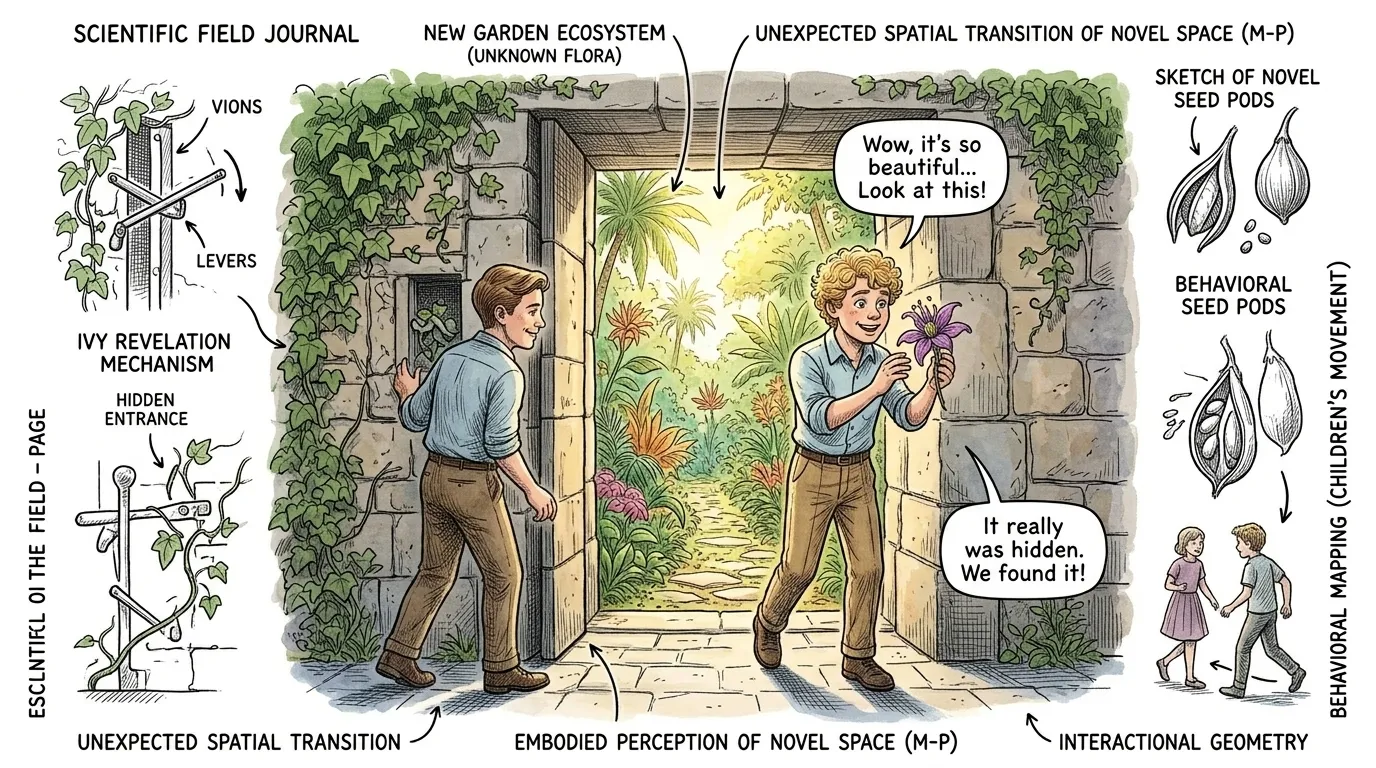
With a gentle push, a section of the ivy-covered wall gave way, revealing a hidden, narrow passage into a new, beautiful part of the garden. They stepped through, a sense of quiet triumph settling over them.
""We found it! Not by seeing, but by feeling," Theo exclaimed softly. "It's just like Merleau-Ponty's ideas influence modern fields!" Santiago looked back at the hidden entrance. "Indeed. Think of artificial intelligence: understanding how humans learn requires grasping embodied cognition – how our bodies are key to our intelligence. Or psychology, understanding how perception shapes our entire experience." Theo nodded. "It even affects art, how a painting isn't just colors on a canvas, but something that engages our entire visual and bodily experience.""
Philosophy Note: Merleau-Ponty's philosophy continues to influence diverse fields, including cognitive science (embodied cognition), psychology (perception-action loops), artificial intelligence (designing systems with embodied intelligence), and aesthetics (the bodily experience of art).
Page 10
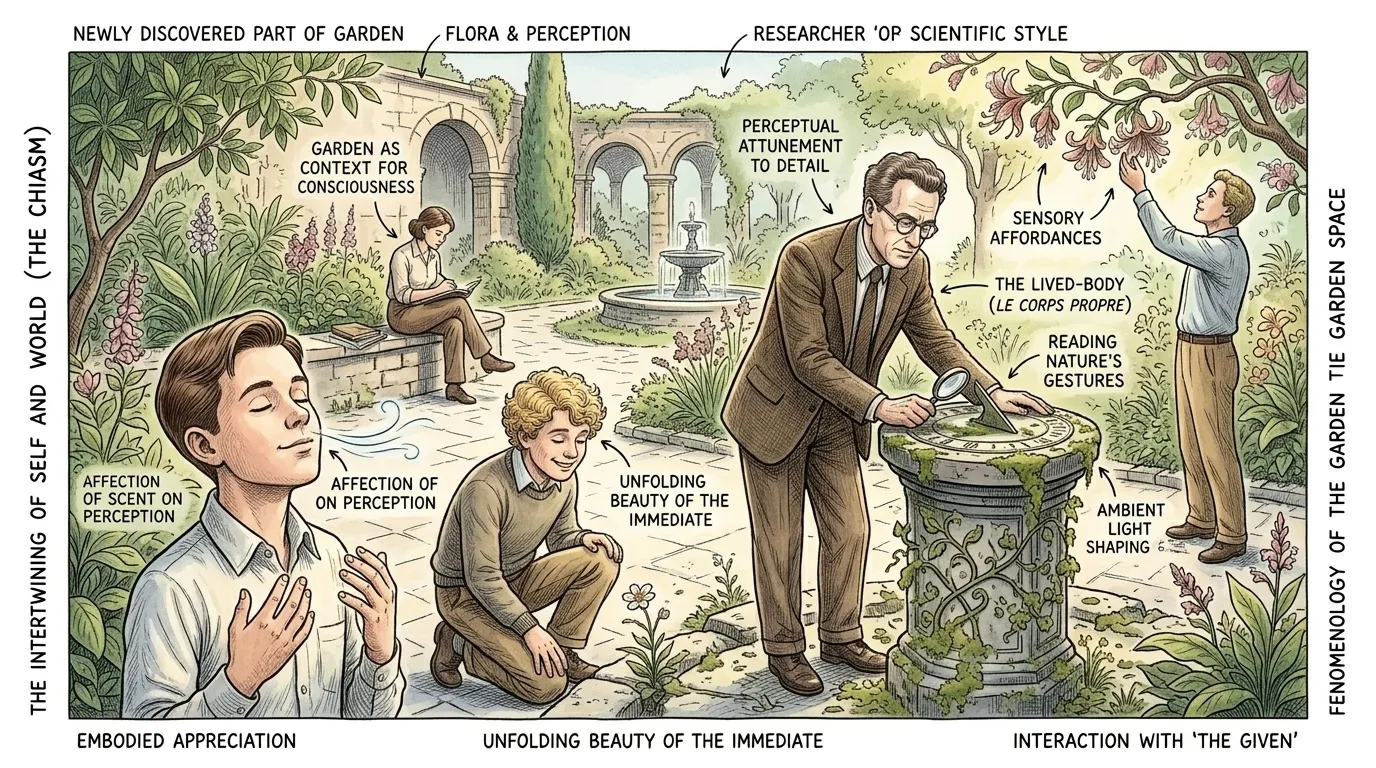
They spent time exploring the newly discovered part of the garden, appreciating its beauty with a new depth of understanding. The experience had not just led them to a new place, but to a new way of seeing and being.
""This whole experience with the map, and Merleau-Ponty, has changed how I look at things," Santiago admitted, taking a deep breath of the fragrant air. "It's not just about what I think, but how my whole body is present in the world." Theo smiled. "His work helps us appreciate the richness of our immediate, pre-reflective experience. It reminds us that true understanding isn't always abstract; often, it's about how we live our perceptions, every single moment." Santiago looked around, a thoughtful contentment on his face. "A profoundly useful idea, indeed.""
Philosophy Note: Merleau-Ponty's legacy is a call to return to the 'things themselves' through our embodied experience. It encourages a deeper, more nuanced engagement with the world, recognizing the inherent ambiguity and intersubjectivity of human existence.
About this story
- Audience: general readers
Questions and answers
Read Wonder Philosophy on your phone
Wonder Philosophy is available on Android and iPhone and iPad. Get Wonder Philosophy on Google Play · Get Wonder Philosophy on the App Store.