Marcus Aurelius
Marcus Aurelius — an illustrated philosophy story. 10 illustrated pages, free to read on Wonder Philosophy.

Page 1
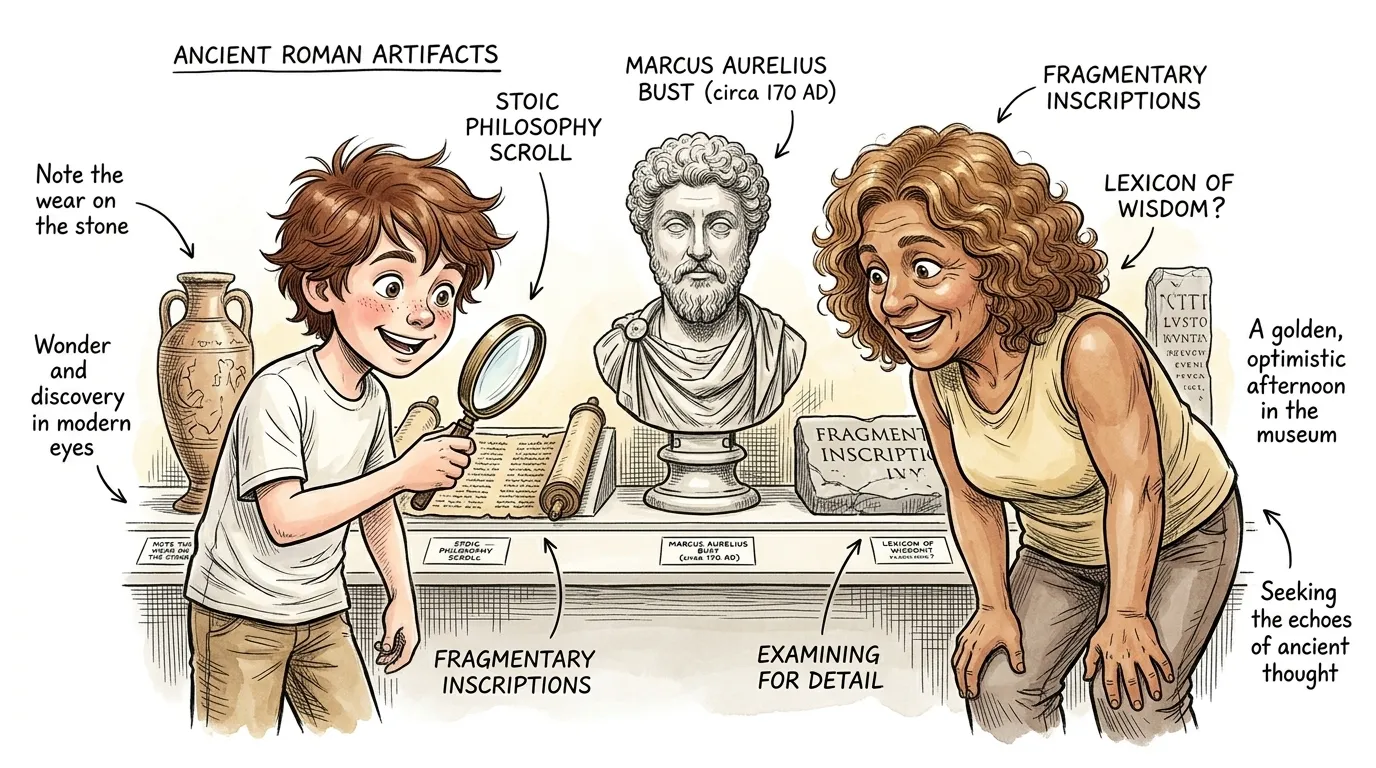
Priya and Anika stood before a grand display, their eyes wide with wonder at the ancient artifacts. In the center, a worn scroll hinted at wisdom from a distant past. They had come to learn about a powerful emperor who found strength not in armies, but in his own mind.
""Look, Anika!" Priya exclaimed, pointing at a bust of a serious-looking man. "This is Marcus Aurelius, the philosopher-emperor! They say he ruled a huge empire but spent his time thinking about how to be good." Anika leaned closer, her brow furrowed in curiosity. "How can an emperor have time for philosophy? Weren't there always wars and big decisions?""
Philosophy Note: Marcus Aurelius (121-180 AD) was a Roman Emperor from 161 to 180 AD. He is considered one of the 'Five Good Emperors' and a prominent Stoic philosopher. His personal reflections, known as Meditations, remain a foundational text in Stoic philosophy.
Page 2
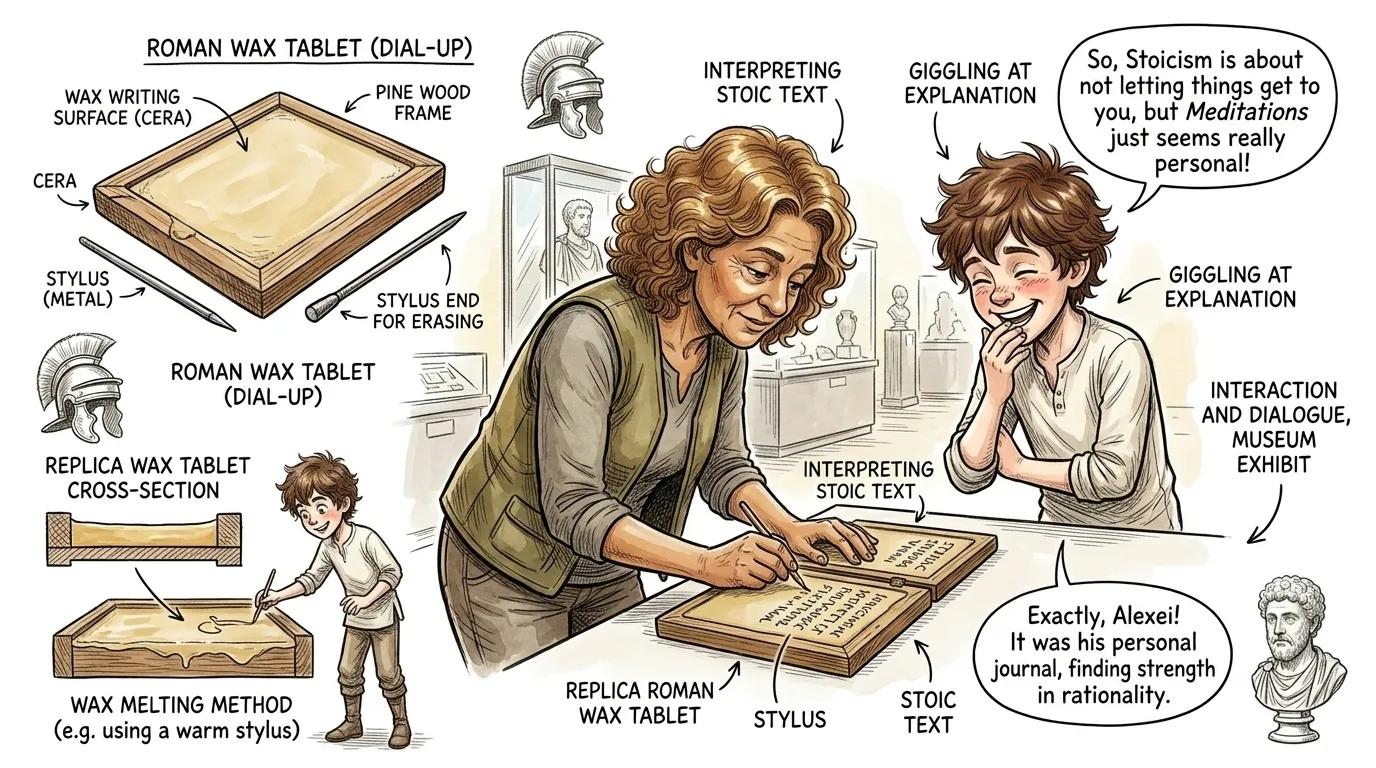
Anika carefully read a plaque next to a replica of a Roman writing tablet, its surface inscribed with ancient script. The words spoke of a way of thinking that could change how one faced the world.
""It says here that Marcus Aurelius followed something called Stoicism," Anika announced, tracing the letters with her finger. "It's about understanding what we can control and what we can't. Like, we can't control if it rains, but we can control if we bring an umbrella!" Priya giggled. "So, if a game isn't going my way, I can't control the game, but I can control... not throwing the controller?""
Philosophy Note: Stoicism is an ancient Greek school of philosophy founded in Athens by Zeno of Citium in the early 3rd century BC. It teaches the development of self-control and fortitude as a means of overcoming destructive emotions.
Page 3
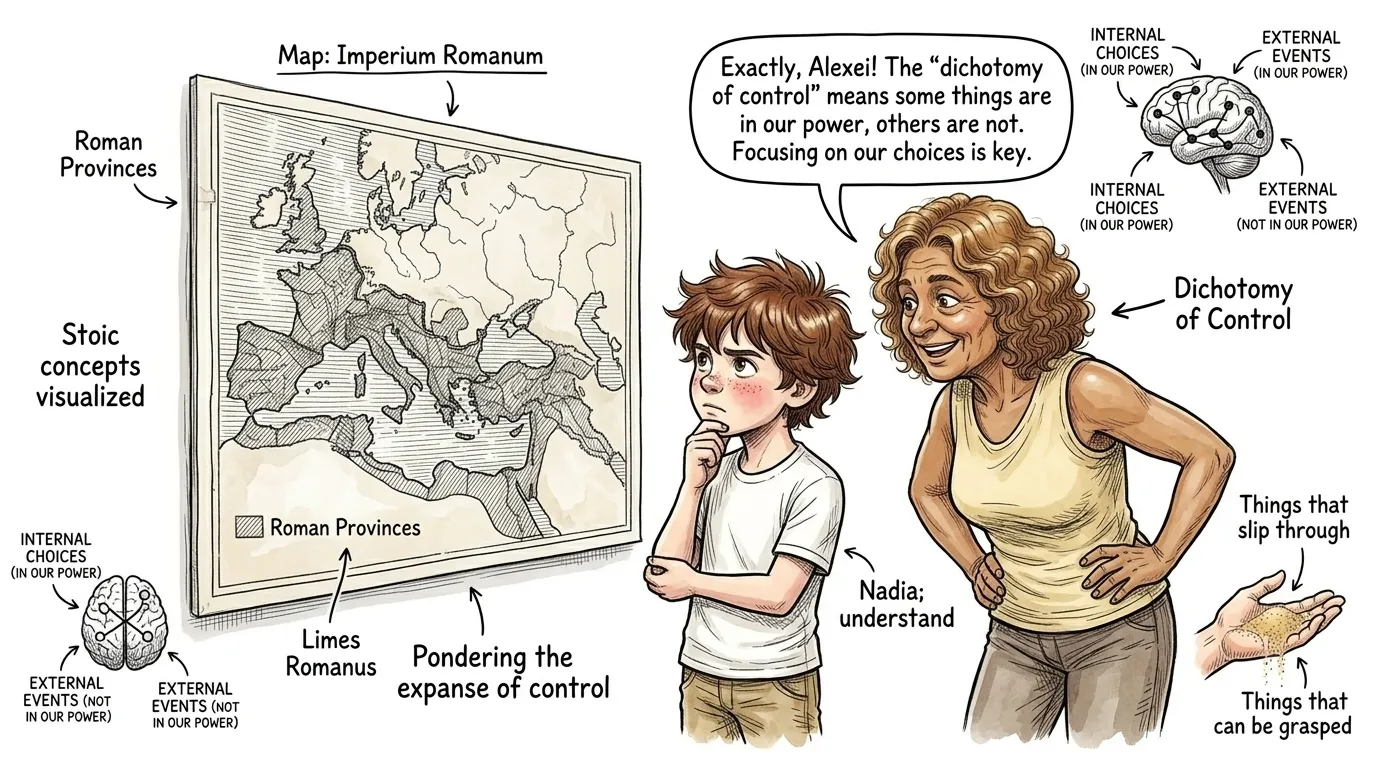
Priya nodded, a thoughtful expression on her face as she looked at a large, illustrated map of the Roman Empire. The idea of control was much bigger than she first thought. This ancient wisdom felt like a secret power.
""Exactly!" Anika confirmed, smiling. "Marcus Aurelius wrote about it in his book, Meditations. He said, 'You have power over your mind—not outside events. Realize this, and you will find strength.' He believed focusing on what we can't control just wastes our energy." Priya pondered this. "So, if I can't control if my friend shares her cookies, I should just focus on how I react to that, instead of getting upset?""
Philosophy Note: The 'dichotomy of control' is a core Stoic concept, distinguishing between things that are 'up to us' (our judgments, impulses, desires, aversions) and things that are 'not up to us' (body, property, reputation, external events). This quote is from Marcus Aurelius's Meditations.
Page 4
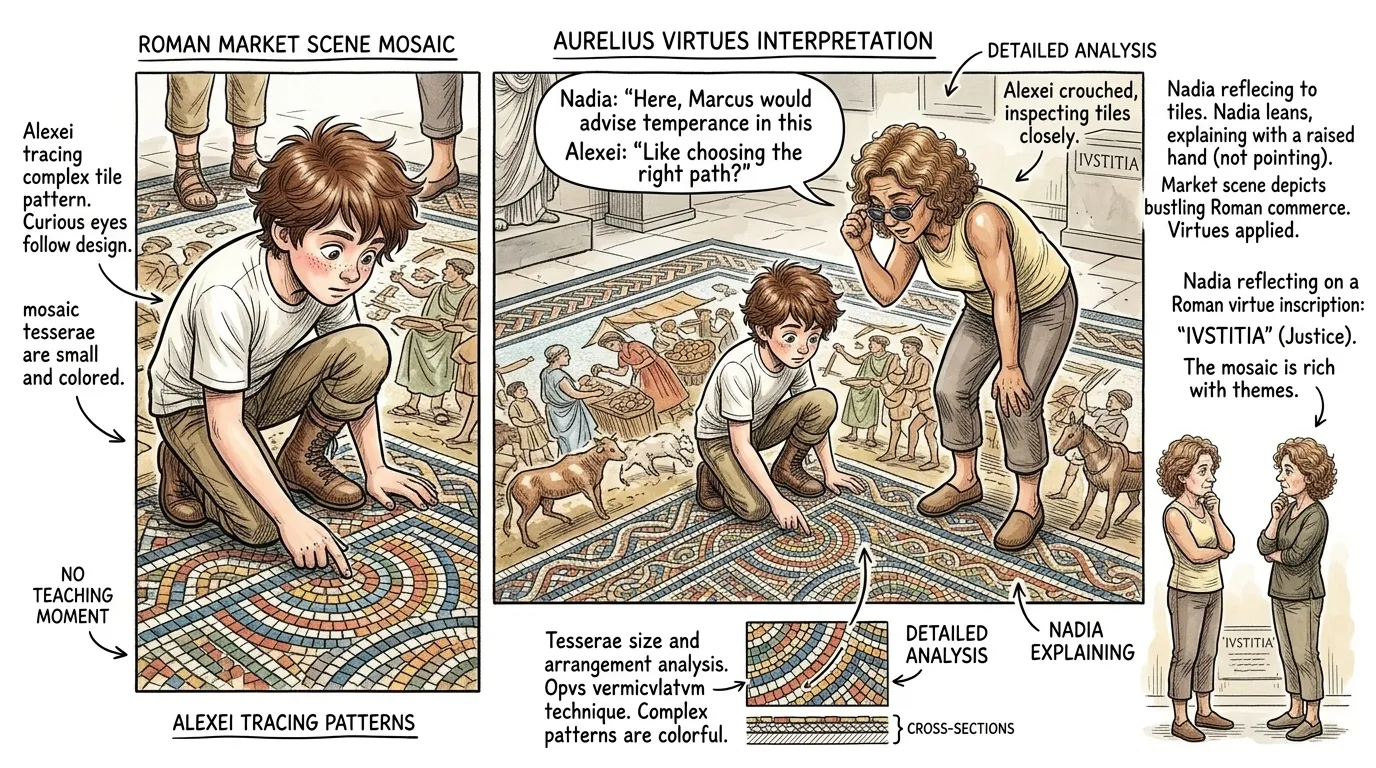
They moved to another exhibit, where a series of intricate mosaics depicted scenes of daily Roman life. Anika explained how Marcus Aurelius believed that choosing to act with reason and virtue was always within their power, no matter the circumstances.
""Marcus Aurelius thought that living a good life meant always trying to be wise, fair, brave, and self-controlled," Anika explained, pointing to a mosaic of a Roman market. "He called these virtues. He said that even when bad things happen, we can still choose how we respond, and try to respond with goodness." Priya traced the colorful tiles. "So, if someone is mean, I can't control them, but I can choose to be kind back, or just walk away bravely?""
Philosophy Note: The four cardinal virtues in Stoicism are Wisdom, Justice (fairness), Courage (fortitude), and Temperance (self-control). These virtues were seen as the only true good, leading to eudaimonia (flourishing or living well).
Page 5
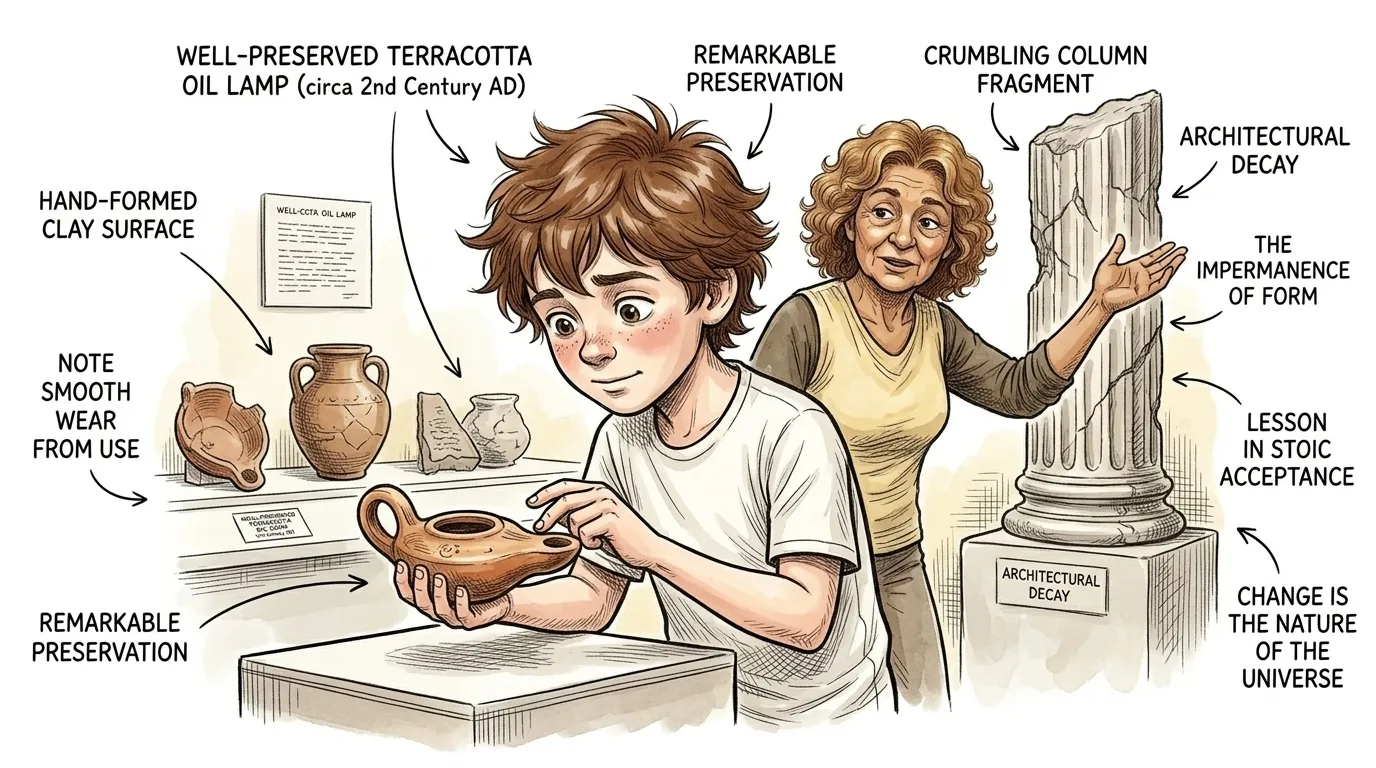
Priya found a small, clay oil lamp, remarkably preserved from ancient times. It made her think about how everything eventually changes and passes away. Anika reinforced this idea, explaining that the Stoics saw this natural cycle as something to accept, not to fear.
""Marcus Aurelius often thought about how everything changes and nothing lasts forever," Anika said, gesturing towards a crumbling column fragment. "He believed that once we accept that things are always changing, we don't get so sad when they do. It's like watching the seasons change; winter always comes, but so does spring." Priya carefully touched the smooth surface of the lamp. "So, if my favorite toy breaks, it's sad, but it's part of how things are. I shouldn't hold onto the sadness forever?""
Philosophy Note: A core tenet of Stoicism is the acceptance of impermanence (panta rhei, 'everything flows') and the transient nature of life and possessions. Marcus Aurelius frequently meditated on death and the cycle of existence to cultivate acceptance and detachment.
Page 6
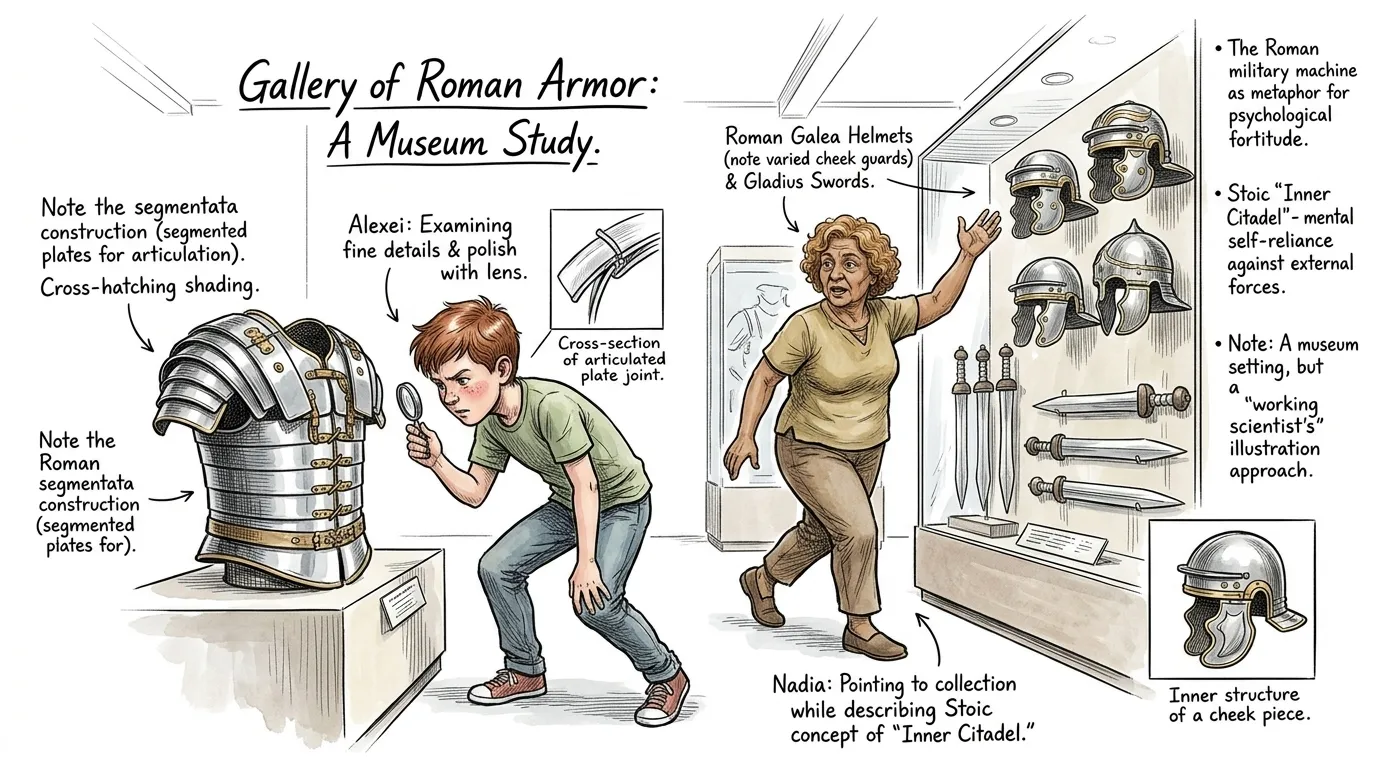
As they walked through a gallery showcasing ancient Roman armor and weapons, Priya thought about how Marcus Aurelius sought a different kind of defense. He wasn't just protecting his empire; he was protecting his peace of mind. He built an 'inner citadel' through his thinking.
""Even though Marcus Aurelius was a warrior and an emperor, he spent a lot of time strengthening his mind, not just his armies," Anika pointed out to Priya, indicating a large display of helmets and swords. "He wrote about creating an 'inner citadel'—a place in your mind that no one can conquer. It's where your thoughts and choices are safe, no matter what happens outside." Priya looked at a shining breastplate. "So, it's like having a secret fortress for your feelings, where you can always be calm, even if things around you are loud or difficult?""
Philosophy Note: The concept of the 'inner citadel' refers to the mind's ability to remain undisturbed and rational amidst external chaos. Marcus Aurelius emphasized that our true freedom lies in our capacity to control our inner judgments and reactions.
Page 7
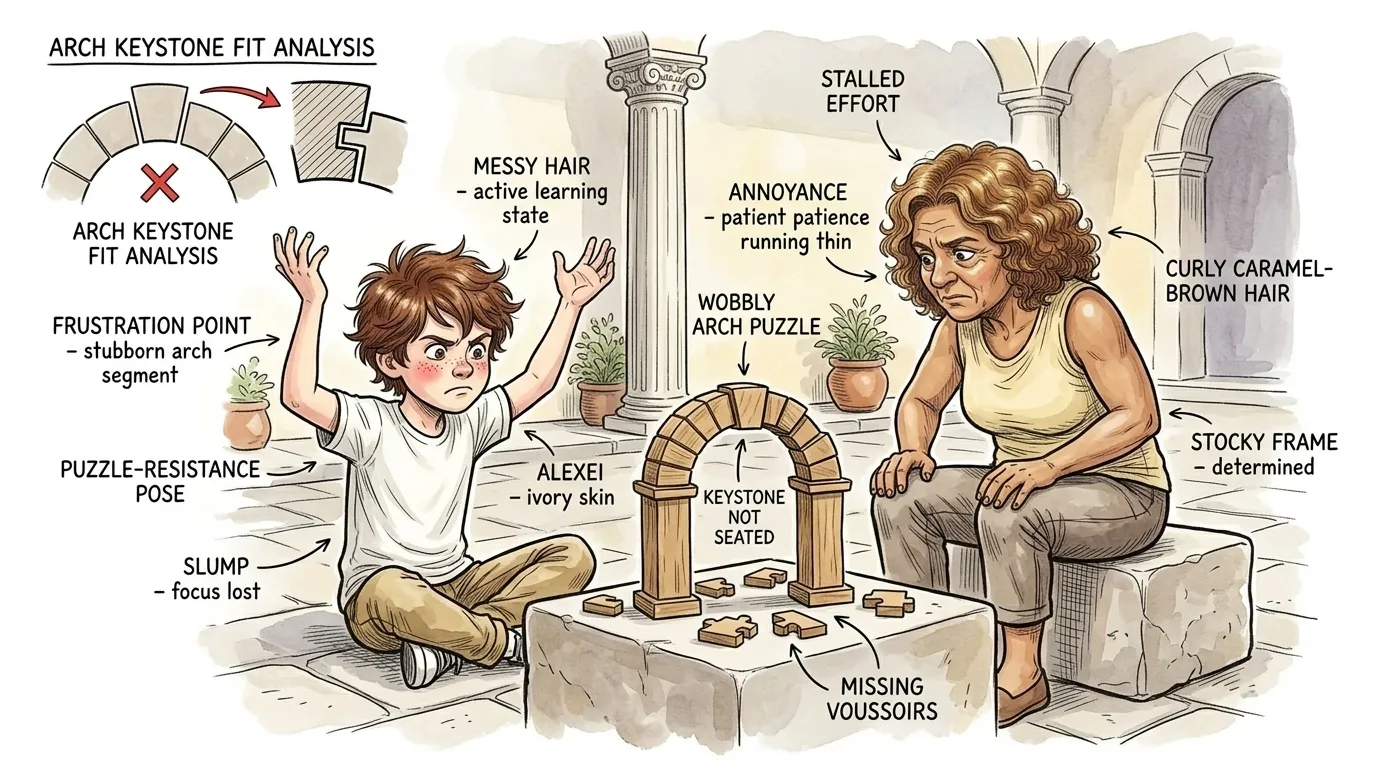
Priya and Anika found themselves in a courtyard, trying to put together a large, complex wooden puzzle depicting a Roman arch. It was trickier than it looked, and a few pieces stubbornly refused to fit. Frustration began to bubble.
""This puzzle is impossible!" Priya sighed, throwing her hands up. "I can't get this piece to fit, and now the whole arch is wobbly!" Anika frowned, her own efforts stalling. "It feels like no matter what I do, these pieces just won't cooperate. It's making me feel so annoyed!" Priya slumped, her initial enthusiasm replaced by growing irritation. "I wish I could just make it work, but I can't!""
Philosophy Note: Even seasoned Stoics faced challenges in applying their philosophy consistently. The difficulty lies in genuinely internalizing the principles and practicing them, especially when faced with frustration or adversity.
Page 8
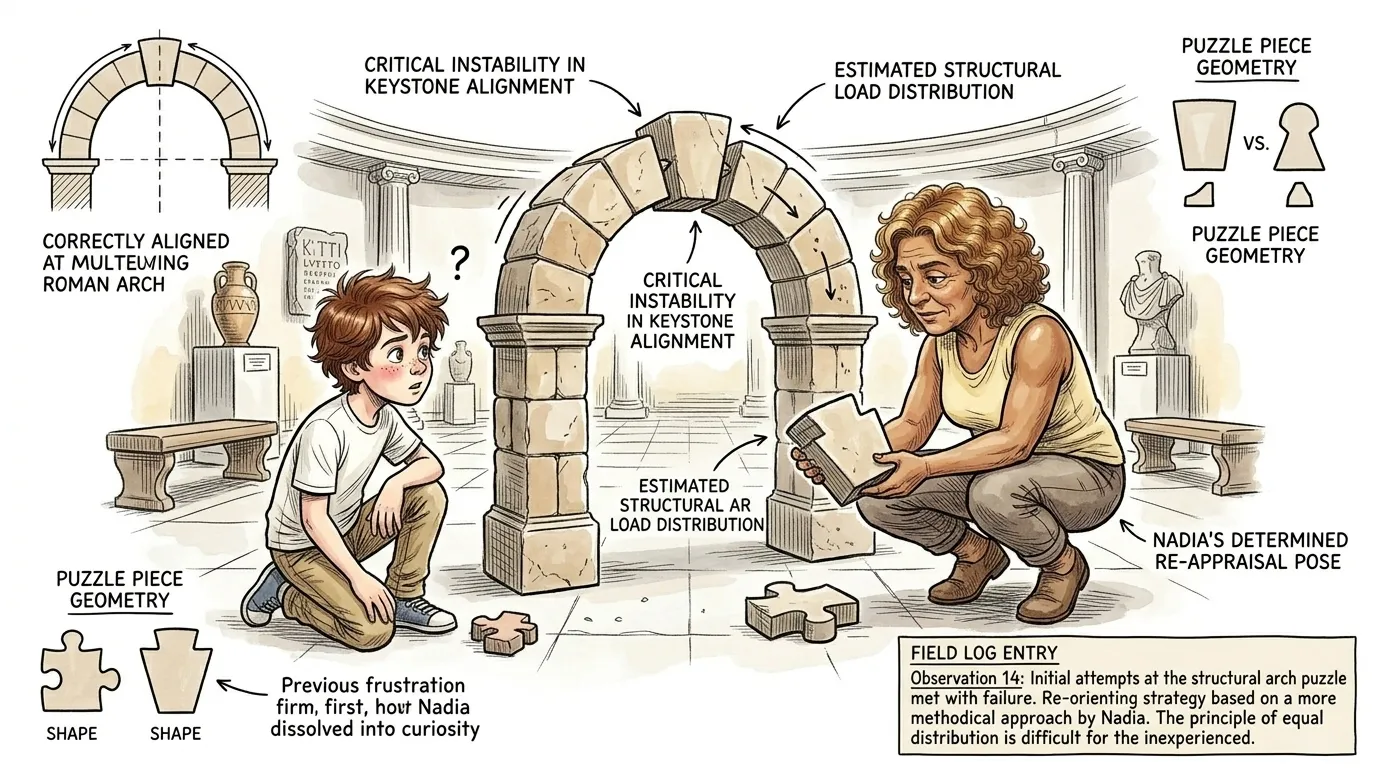
Just as Priya was about to give up, Anika remembered their lesson from the ancient philosopher. The puzzle pieces weren't cooperating, but their reactions were still their own. A quiet determination settled over them.
""Wait," Anika said, taking a deep breath and looking at the wobbly arch. "Remember what Marcus Aurelius said about what we can control? We can't make the pieces fit perfectly by magic, but we can control our patience and how we try to solve it." Priya looked at her friend, then back at the puzzle. "So, instead of being angry at the puzzle, I can just focus on trying different ways, calmly. Like using my reason." Anika nodded, picking up a piece thoughtfully. "Exactly. We can control our effort and our attitude, not the stubbornness of the wood.""
Philosophy Note: The practical application of Stoicism involves continually distinguishing between what is within our control (our judgments, attitudes, responses) and what is not. This distinction allows for a more rational and resilient approach to life's challenges.
Page 9
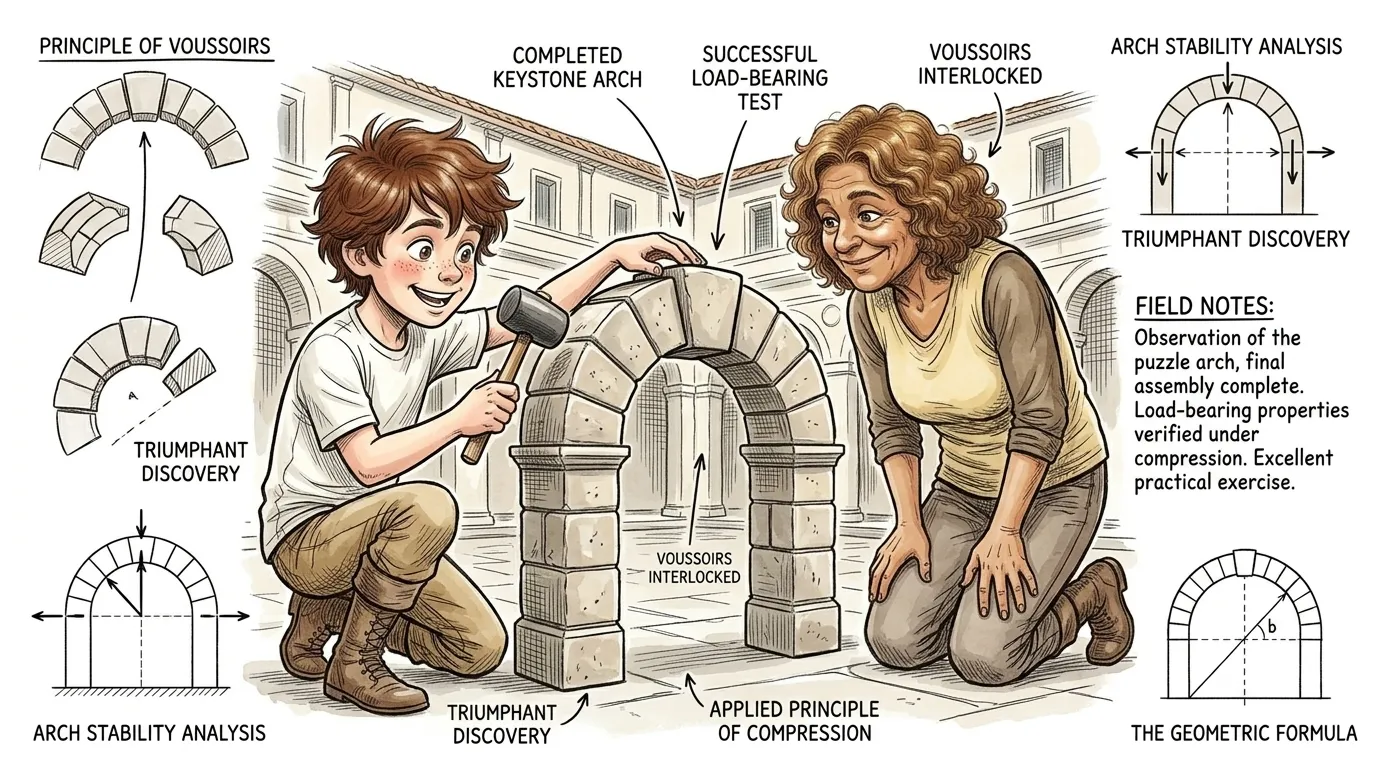
With renewed focus, they slowly worked through the puzzle, finding solutions with patience and a calm resolve. They realized that Marcus Aurelius's wisdom wasn't just for emperors in ancient times; it was a way to navigate the small and large challenges of their own lives, today.
""It's like a superpower for your mind," Priya remarked, finally snapping a tricky piece into place. "Controlling my reaction made me feel much stronger than getting mad would have." Anika beamed, the Roman arch now standing firm. "Yes! Marcus Aurelius teaches us that true strength comes from within, from how we choose to think and act, even when everything around us feels chaotic. His ideas are still so useful!""
Philosophy Note: Marcus Aurelius's Meditations offers timeless guidance on resilience, self-control, and finding tranquility amidst life's uncertainties. His work continues to influence modern psychology and personal development.
Page 10

Leaving the museum, Priya and Anika understood that Marcus Aurelius's philosophy wasn't just history; it was a living principle. Every moment offered a choice: to be swept away by external events or to anchor oneself in the power of one's own mind. They carried this ancient wisdom with them, ready to face the world.
""So, it's not about never feeling sad or frustrated," Priya clarified as they walked out into the sunshine. "It's about choosing what to do with those feelings, and focusing on what I can actually change." Anika nodded thoughtfully. "Exactly. Marcus Aurelius reminds us that while the world might be full of things we can't control, our inner response, our choices, and our character are always up to us. That's where true freedom and peace begin.""
Philosophy Note: The lasting impact of Marcus Aurelius lies in his articulation of Stoic principles as a practical guide for living a virtuous and tranquil life, emphasizing personal agency in the face of uncontrollable external factors.
About this story
- Audience: kids (ages 6–12)
Questions and answers
Read Wonder Philosophy on your phone
Wonder Philosophy is available on Android and iPhone and iPad. Get Wonder Philosophy on Google Play · Get Wonder Philosophy on the App Store.