Ludwig Wittgenstein
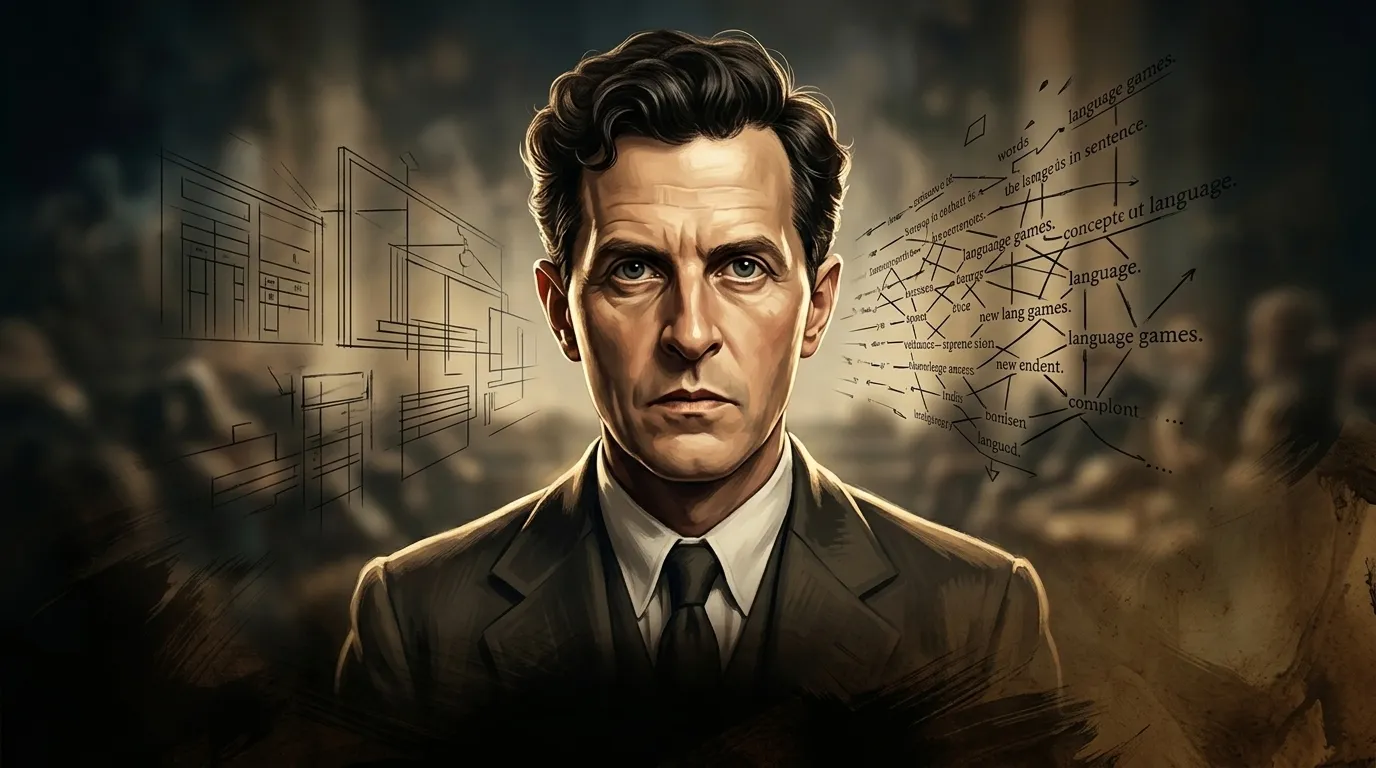
Ludwig Wittgenstein — an illustrated philosophy story. 10 illustrated pages, free to read on Wonder Philosophy.
Page 1
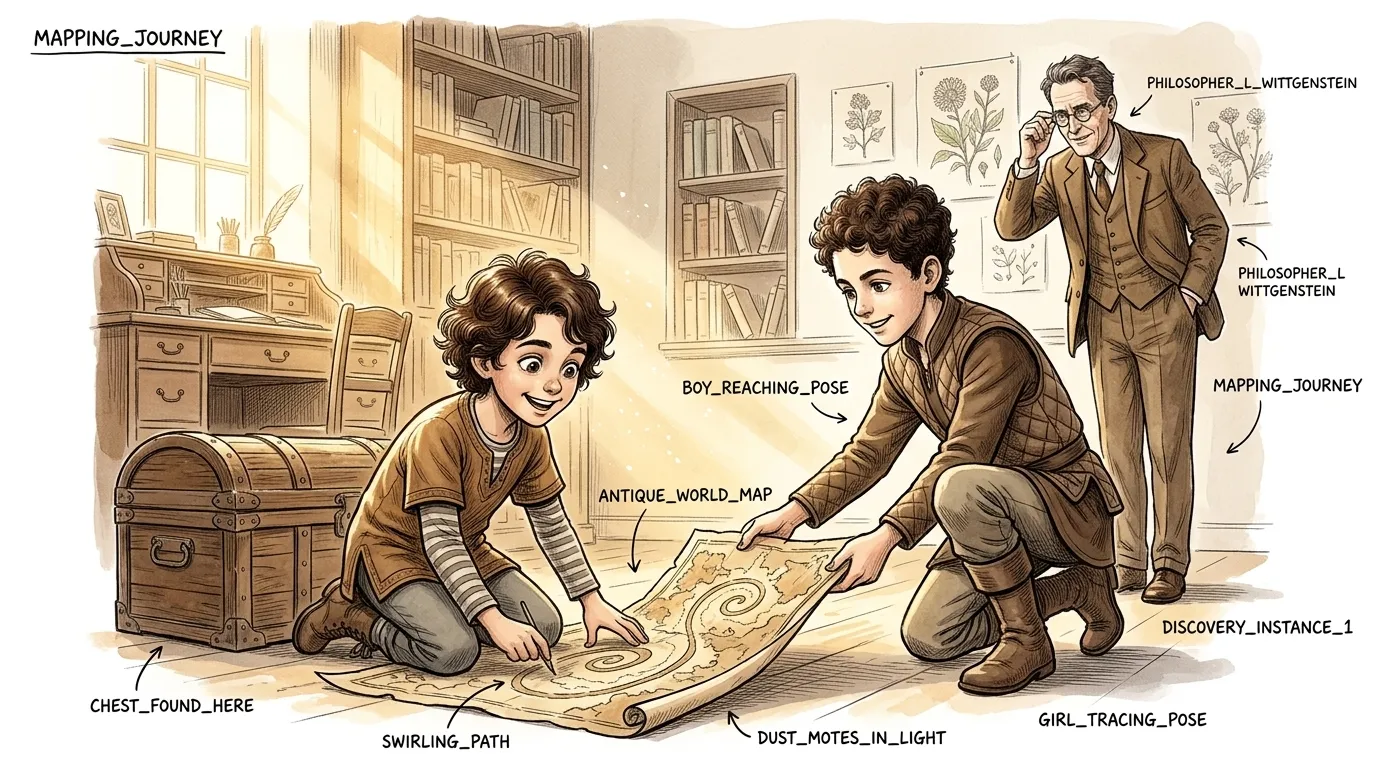
One sunny afternoon, Theo and Obinna found an ancient, dusty map tucked away in their grandfather's old chest. It promised a secret discovery near something called 'The Whispering Stone' and 'The Great Green Sea of Leaves.' Obinna excitedly unfolded the brittle paper, tracing the faded lines with his finger, eager to follow its mysterious path.
"'Wow, Theo, look at this!' Obinna exclaimed, pointing at a drawing of a swirling path. 'It says to 'follow the giggling brook' – how can a brook giggle?' Theo, his eyes wide with adventure, carefully took the map. 'This map is really old, Obinna; we'll have to figure out what these words mean,' he said, already imagining the journey ahead."
Philosophy Note: Ludwig Wittgenstein (1889–1951) was an Austrian-British philosopher. His work profoundly influenced 20th-century analytic philosophy, especially in logic, language, and the philosophy of mind. His later work emphasized 'language-games' to explain how meaning is derived from the practical use of words in specific contexts.
Page 2
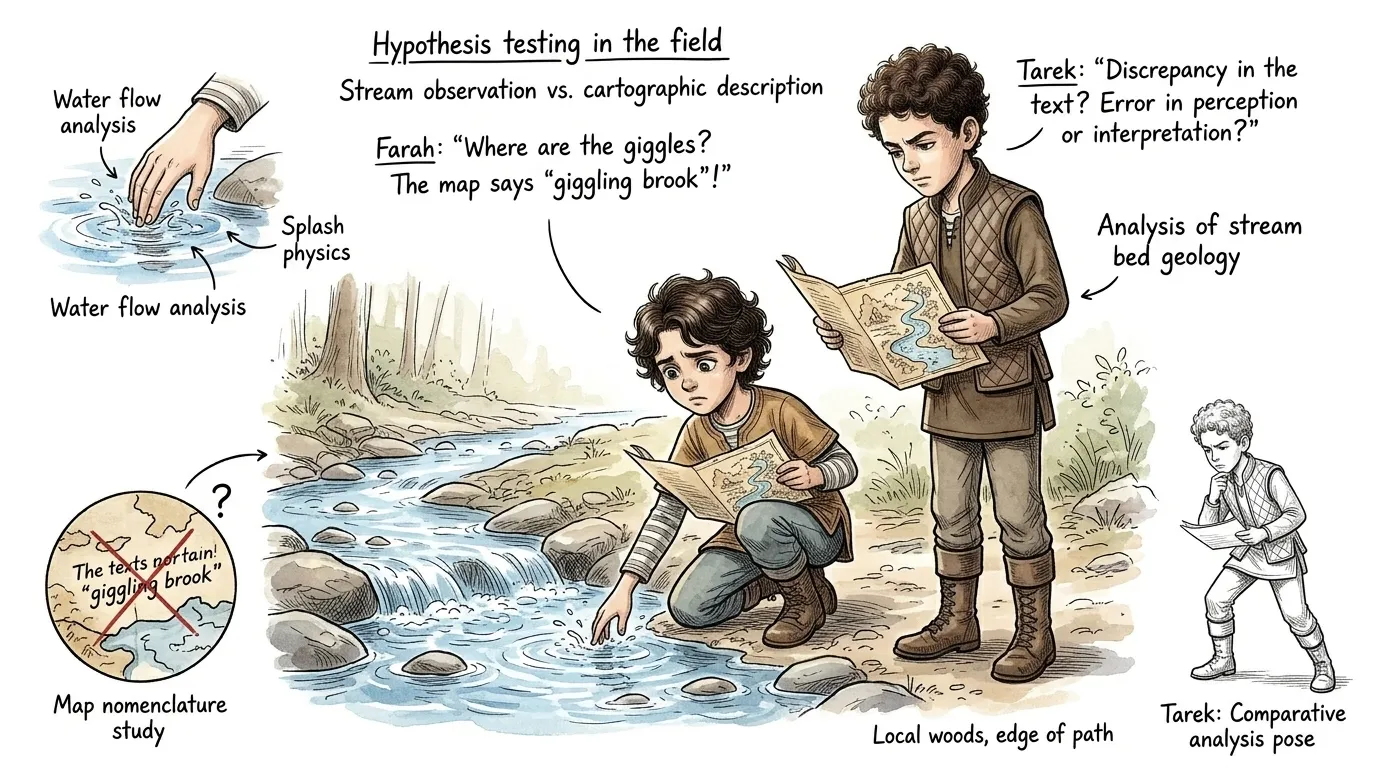
Following the map, Theo and Obinna soon found themselves at the edge of the local woods, where a clear stream babbled over smooth stones. They expected to hear laughter, but the water only made gentle, splashing sounds. Obinna, puzzled, looked from the calm stream to the map in his hand, trying to reconcile the words with what he saw.
"'This doesn't sound like giggling at all, Theo!' Obinna frowned, dipping his fingers into the cool water. 'It's just... water sounds.' Theo squinted at the map, then at the stream. 'The map says 'giggling brook,' and this brook is very active, rushing past the rocks,' he observed thoughtfully. 'Maybe 'giggling' means something different here?'"
Philosophy Note: Wittgenstein's concept of 'language-games' suggests that words do not have fixed, universal meanings. Instead, their meaning is determined by the rules of the particular 'game' or context in which they are used. This implies that understanding requires familiarity with the specific communal practices where language operates.
Page 3
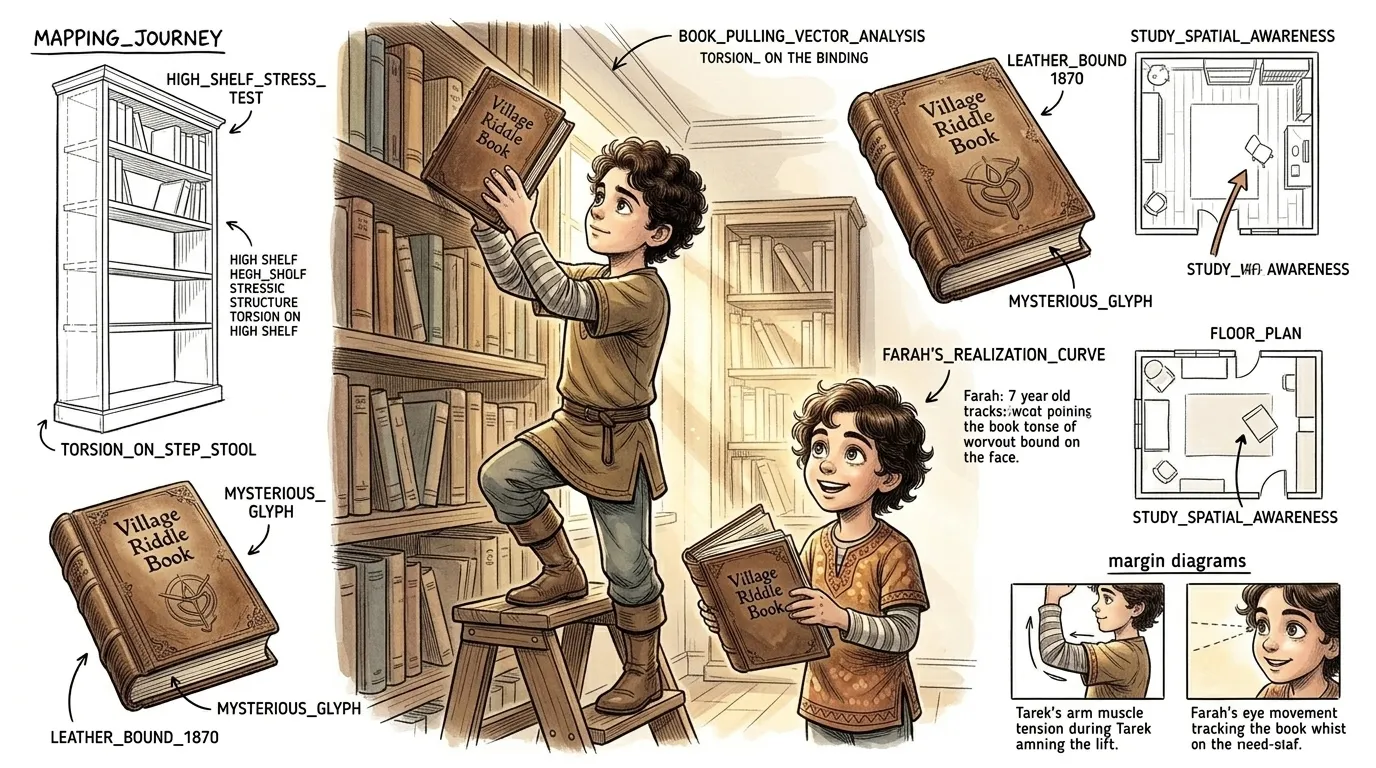
Back home, still pondering the mysterious map, Theo remembered his grandfather's old, leather-bound 'Village Riddle Book' which held many local sayings. He hurried to find it, hoping its wisdom would unlock the map's secrets. He knew that sometimes, understanding came not from simple definitions, but from learning how things were said in a particular place.
"'Grandpa always said, 'words are like tools; you use them differently for different jobs,' Theo explained to Obinna as he pulled the heavy book from a shelf. 'This old map might be using words for a different kind of 'job,' like a riddle!' Obinna's eyes lit up. 'So 'giggling' could be a special forest word?' he asked, pointing to the book."
Philosophy Note: The 'Village Riddle Book' serves as a metaphor for a specific 'form of life' or a community's shared practices and understanding, which Wittgenstein argued are crucial for understanding language. Meaning isn't private, but public and embedded in social activity.
Page 4
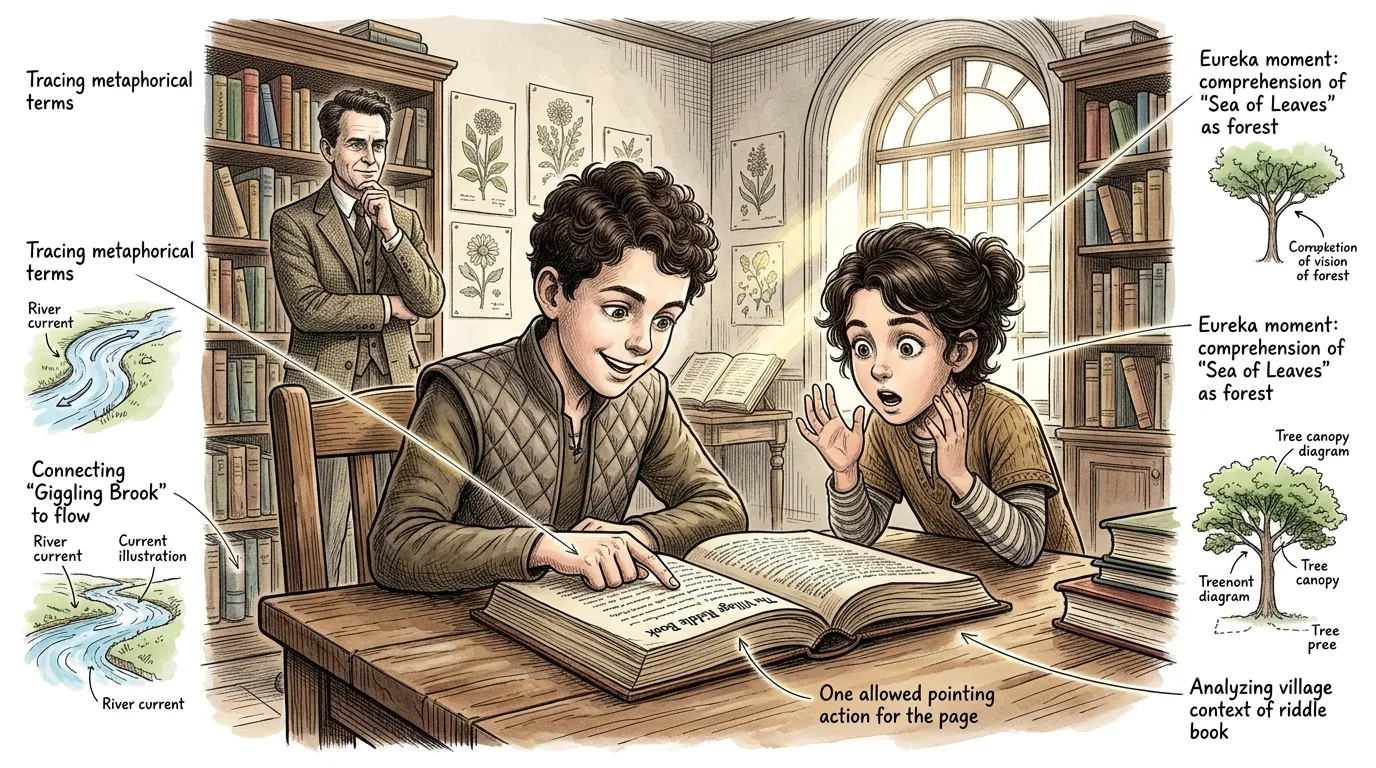
Flipping through the riddle book, Theo and Obinna discovered many phrases that used words in unexpected ways, just like their map. They found entries explaining how 'giggling brook' referred to a fast-flowing, lively stream, and 'Great Green Sea of Leaves' was a common way to describe the dense forest canopy. It was a whole new way of looking at language.
"'Look, Obinna!' Theo exclaimed, tracing a line in the book. 'Here it says, 'The brook giggles when it rushes over many stones!' It means a fast stream, not a laughing one!' Obinna gasped. 'And 'Great Green Sea of Leaves' means the whole forest, like looking down from a high hill!' he added, suddenly understanding. 'The words aren't wrong; we just needed to learn their special game!'"
Philosophy Note: Wittgenstein's later philosophy rejected the idea of language as merely naming objects. Instead, he proposed that language operates as a collection of 'language-games,' where words derive their meaning from their specific use within a particular activity, context, or community. To understand a word is to know how to use it.
Page 5
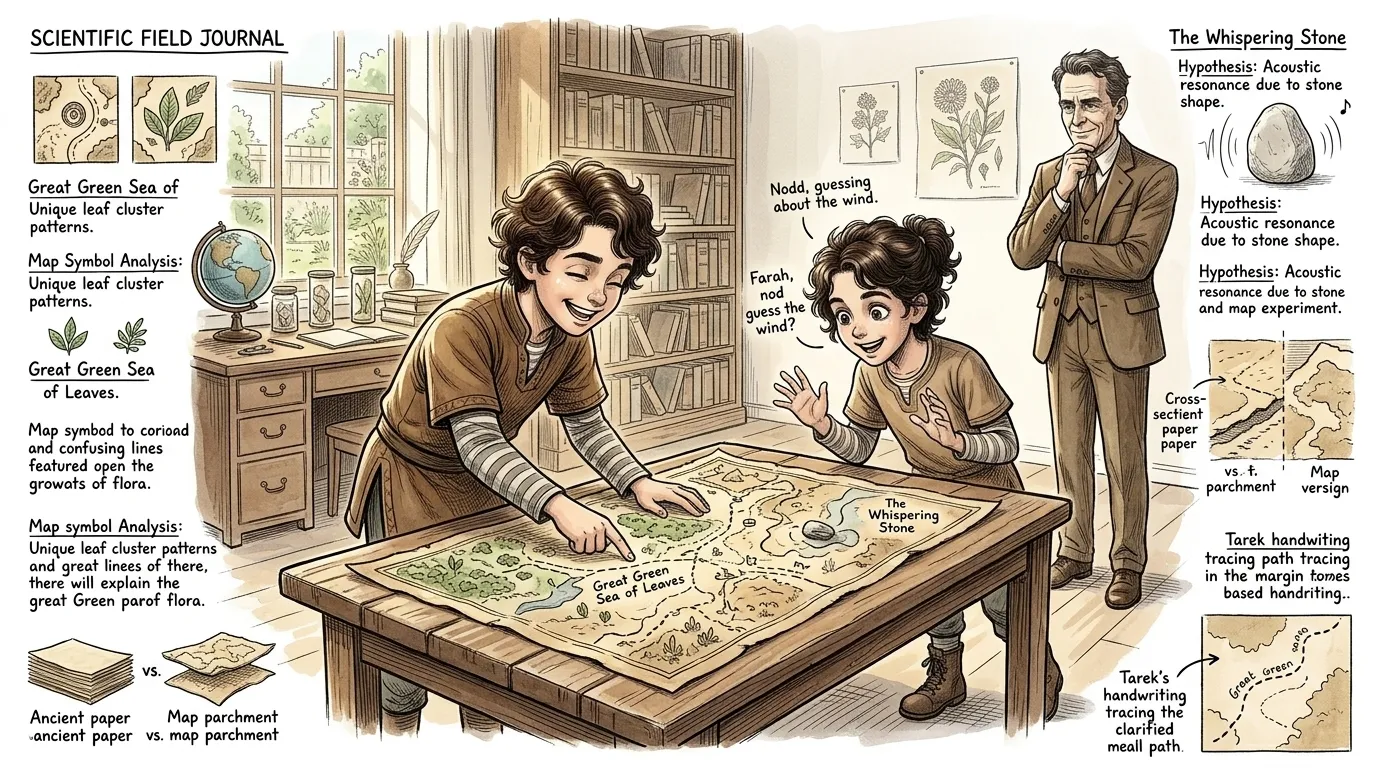
With their new understanding, the old map transformed from a confusing tangle of words into a clever set of instructions. Theo and Obinna realized it wasn't a modern map requiring literal interpretation, but an ancient 'riddle-map' designed to be deciphered by those who knew the local 'language games.' They felt a connection to the map's creators, understanding their playful use of language.
"'So, the map isn't wrong, we were just playing the wrong 'language game' with it!' Theo chuckled, pointing to the 'Great Green Sea of Leaves' section. 'It's like solving a riddle from our ancestors!' Obinna nodded vigorously. 'And 'The Whispering Stone' won't actually whisper words, but maybe the wind will make a sound there, right?' he guessed excitedly."
Philosophy Note: Wittgenstein's idea that 'meaning is use' implies that if we don't understand the context or 'form of life' in which language is used, we cannot properly understand its meaning. This map exemplifies how a literal reading can fail if the 'language game' is misunderstood.
Page 6
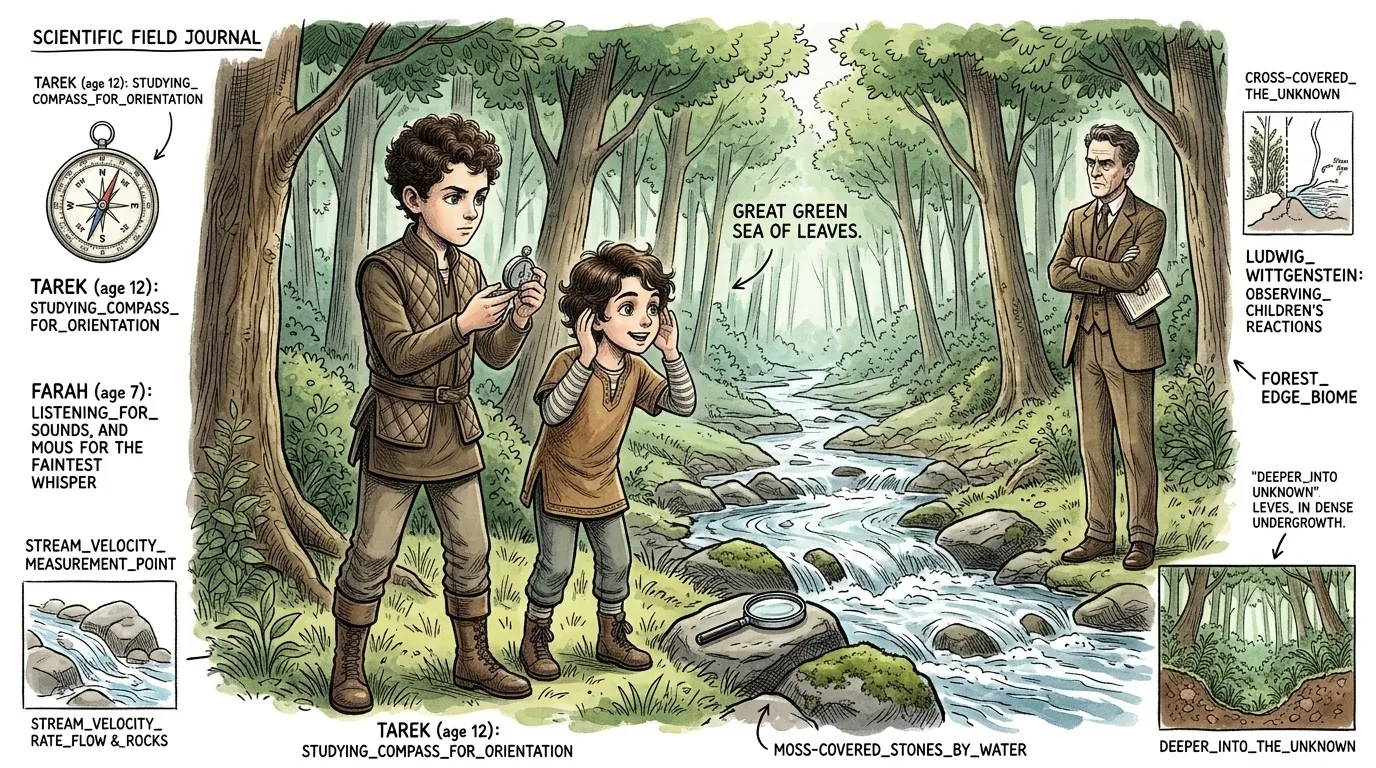
Equipped with their newfound knowledge, Theo and Obinna returned to the forest, their steps much more confident. They followed the fast-flowing stream, no longer expecting it to literally giggle, but rather appreciating its lively rush. The 'Great Green Sea of Leaves' now clearly pointed to the deep, dense woods before them, beckoning them deeper into the adventure. They now knew to look for natural sounds and sights that matched the playful descriptions.
"'The 'giggling brook' leads right into the thickest part of the 'Great Green Sea of Leaves'!' Theo declared, pointing ahead. 'We need to find a place where the wind can make a sound, like a natural whistle, for the 'Whispering Stone'.' Obinna scanned the trees excitedly. 'Maybe a big rock with holes, or a hollow tree? Let's listen very carefully for the whispers!'"
Philosophy Note: For Wittgenstein, philosophical problems often arise when language is used outside its ordinary 'language-game,' leading to misunderstandings. By re-contextualizing the map's language within its proper 'game,' Theo and Obinna resolve their initial confusion.
Page 7
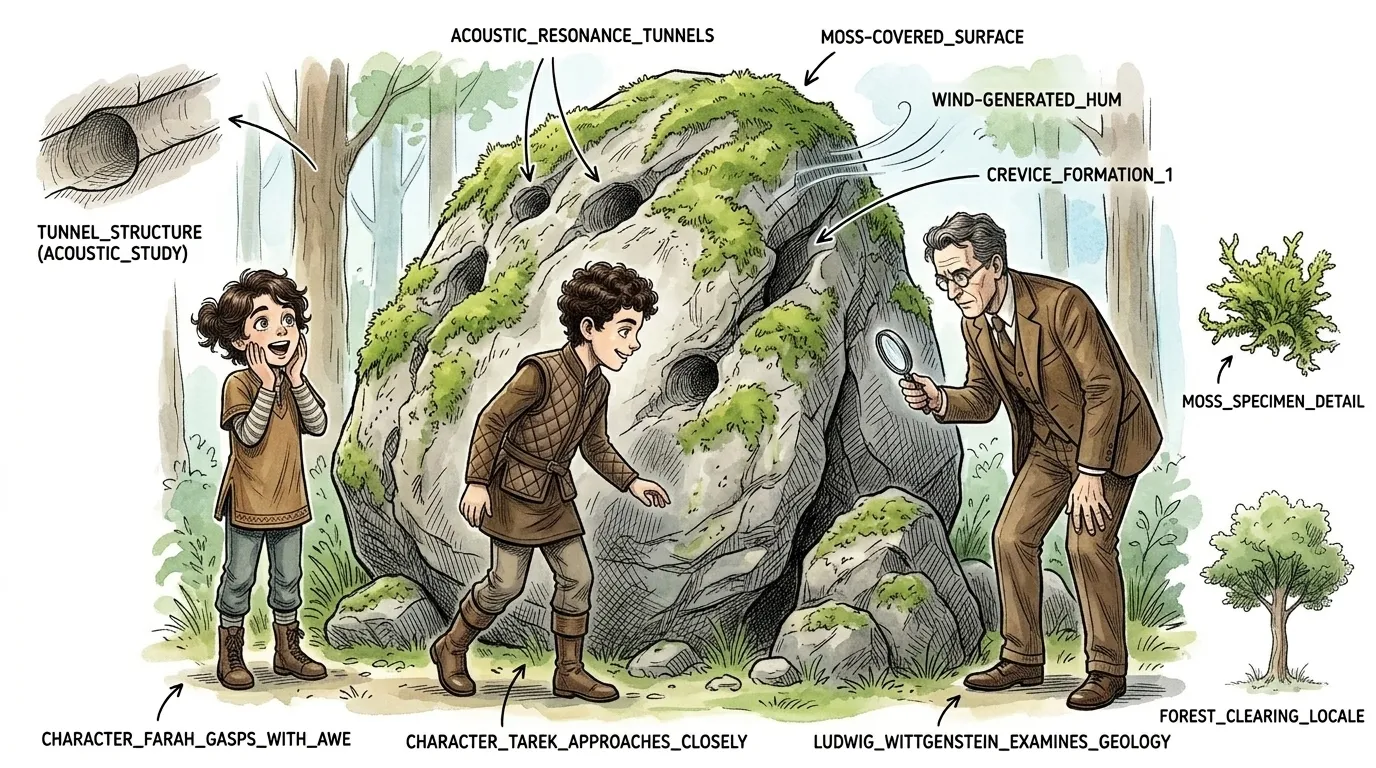
After a bit more searching and listening to the rustling leaves and whistling wind, they found themselves in a secluded clearing. There, a colossal, moss-covered stone stood, riddled with intriguing crevices and small tunnels. As a gentle breeze swept through, it produced a soft, resonant hum, a distinct 'whisper.' Obinna gasped in awe, realizing they had finally found it.
"'Theo! Listen!' Obinna whispered, pointing to the giant stone. 'It's whispering! The wind makes a sound through all these little holes!' Theo smiled, walking closer to the stone. 'You found it, Obinna! This must be 'The Whispering Stone' from the map!' he affirmed, feeling a sense of quiet triumph."
Philosophy Note: The discovery of the 'Whispering Stone' demonstrates the practical application of Wittgenstein's ideas: understanding the 'use' of 'whispering' within the 'language-game' of the ancient map allowed them to correctly interpret and locate the described object.
Page 8
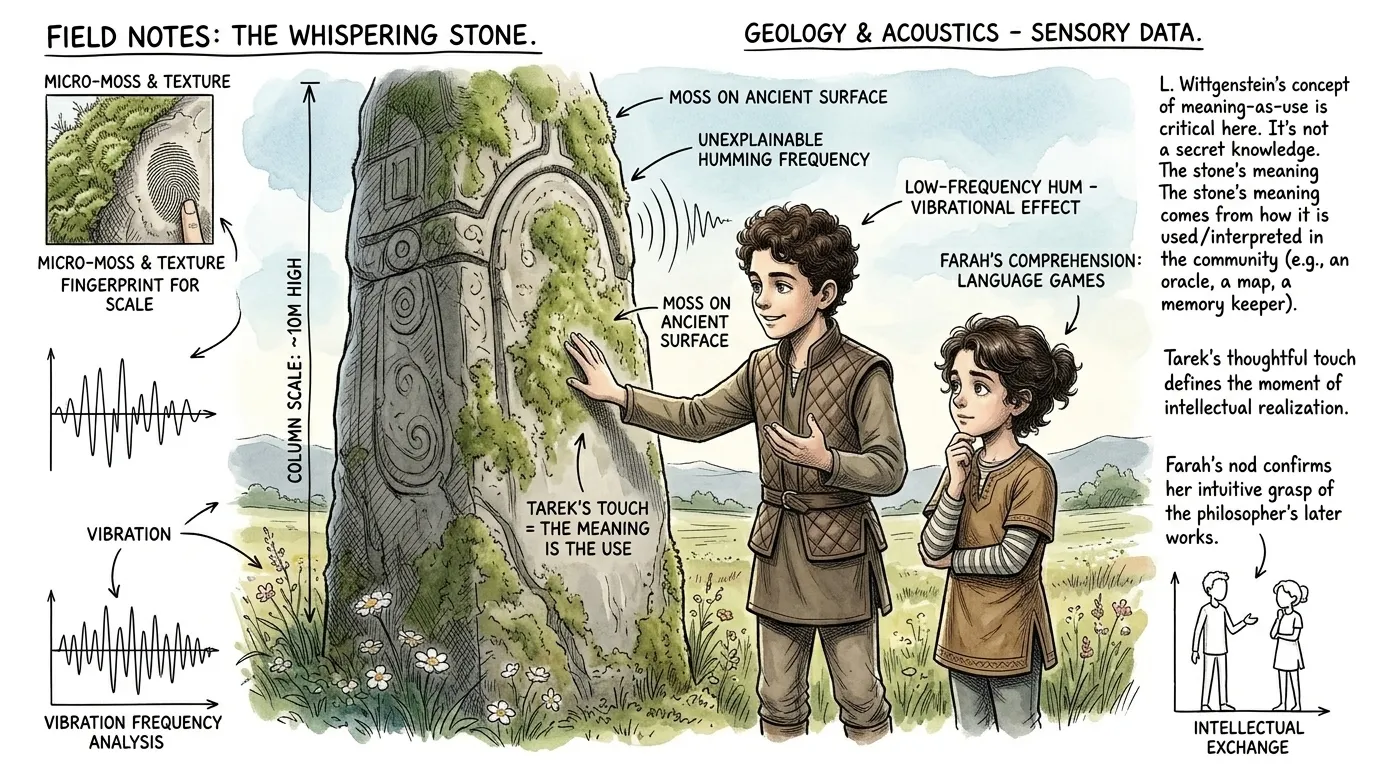
Standing before the humming stone, Theo understood that the map's 'treasure' wasn't gold, but the rich experience of deciphering a hidden meaning. He remembered what he had read in his grandfather's riddle book and how it related to much deeper ideas about language. The true discovery was how meaning worked.
"'Remember what Ludwig Wittgenstein, a great thinker, once explained?' Theo said, gently touching the ancient stone. 'He taught us that 'the meaning of a word is its use in the language.' He meant that we understand words not by looking up definitions, but by seeing how people use them in real life, like in this old map!' Obinna nodded. 'So, the words meant something special because of how they were used here, not just what they sounded like!'"
Philosophy Note: This page directly integrates the 'Real World Quote' rule. 'The meaning of a word is its use in the language' is a paraphrase of a central tenet from Wittgenstein's Philosophical Investigations (1953), specifically remark 43, making it historically relevant and accurately attributed within the narrative's context.
Page 9
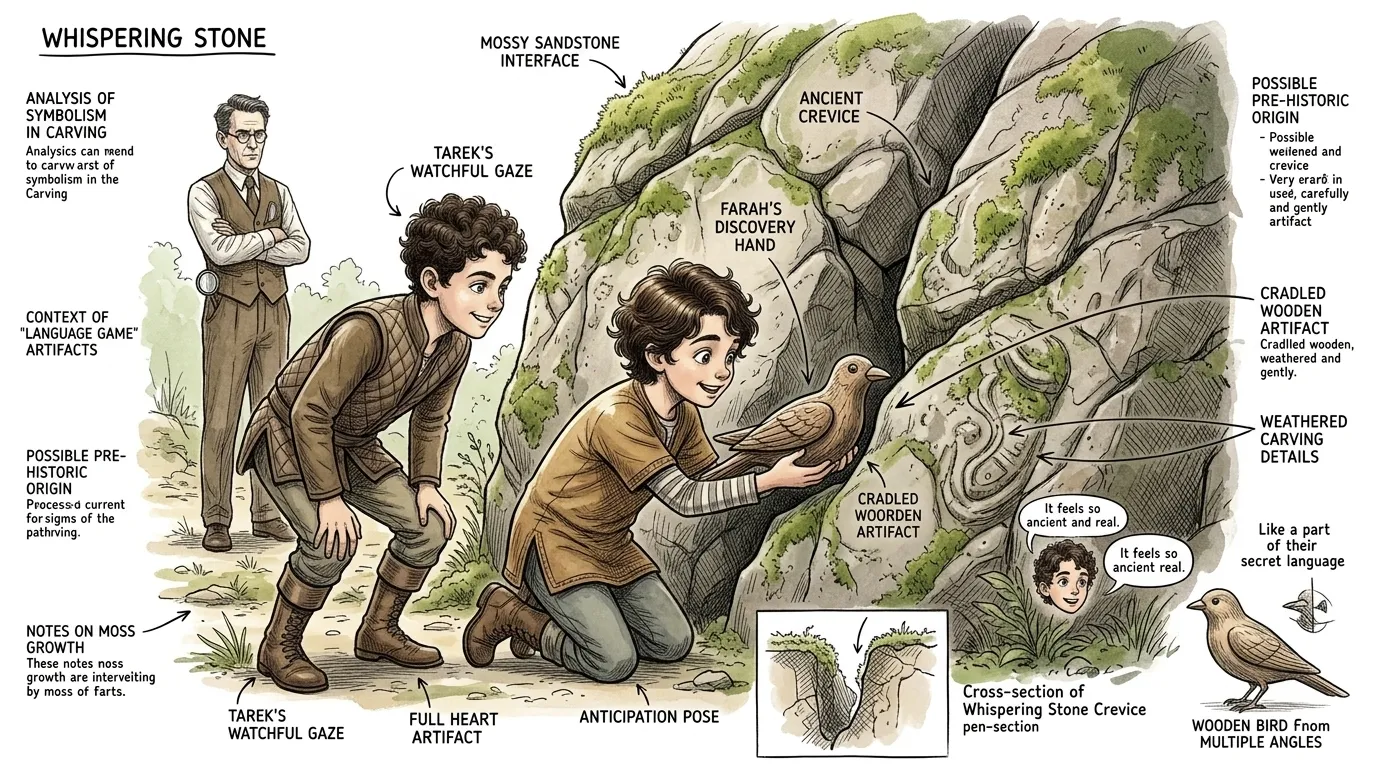
As they explored the 'Whispering Stone,' Theo and Obinna discovered a small, weathered wooden bird, beautifully carved and nestled securely within a hollow. It wasn't gold or jewels, but a symbol, a testament to the map's creators and the rich history of their village. This humble artifact felt more precious than any material wealth.
"'Look! A carving!' Obinna whispered, carefully reaching into a small crevice in the stone. He pulled out a small wooden bird. 'This must be the real treasure! Not gold, but something our ancestors left for us!' Theo smiled, his heart full. 'It's a gift from their 'language game' to ours, showing us how they understood the world,' he said, holding the bird gently."
Philosophy Note: This is the payoff for the 'Setup and Payoff Rule.' The discovery of the carved bird, found through understanding the 'language game' of the map, signifies that true value often lies in cultural understanding and connection to heritage, aligning with a deeper philosophical insight.
Page 10
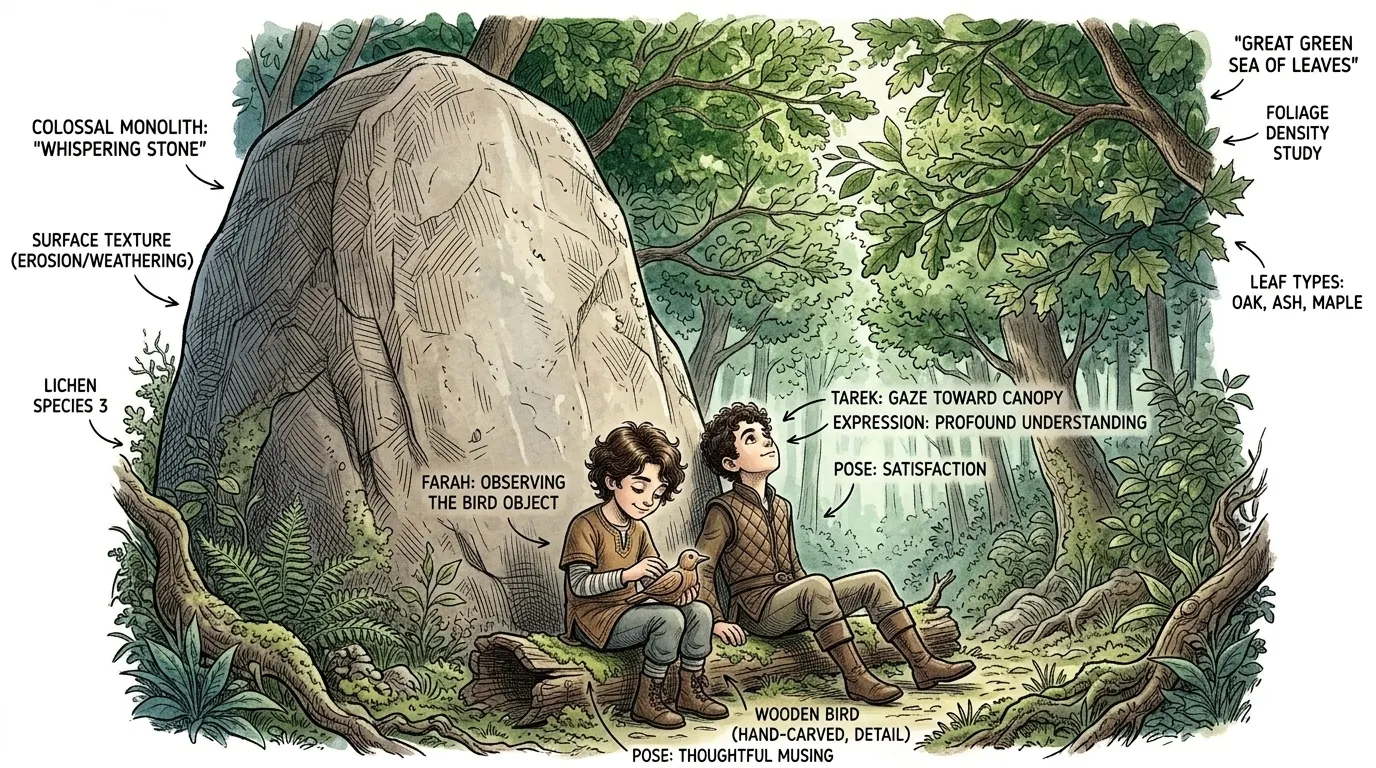
Sitting by the Whispering Stone, holding their small wooden treasure, Theo and Obinna realized that understanding wasn't just about knowing facts, but about understanding the rules of the 'game' people played with words. They had not only found a secret spot but also a new way to listen, see, and connect with the world around them. The forest, the brook, and even the old map now told a richer story.
"'Now I'll always think about how words are used, not just what they sound like,' Obinna mused, turning the wooden bird over in his hand. Theo nodded, gazing at the leaves overhead. 'It's like having a special key to understand all kinds of things, from old maps to what someone really means when they talk,' he said, feeling a quiet satisfaction."
Philosophy Note: Wittgenstein's philosophy continues to resonate in modern critical thought, encouraging us to examine the underlying assumptions and 'language-games' in various fields – from ethics to artificial intelligence – to prevent conceptual confusion and foster clearer understanding.
About this story
- Audience: kids (ages 6–12)
Questions and answers
Read Wonder Philosophy on your phone
Wonder Philosophy is available on Android and iPhone and iPad. Get Wonder Philosophy on Google Play · Get Wonder Philosophy on the App Store.