Julia Kristeva
Julia Kristeva — an illustrated philosophy story. 10 illustrated pages, free to read on Wonder Philosophy.

Page 1

Julia Kristeva, a pivotal figure in contemporary thought, challenges our most fundamental assumptions about who we are. Her work invites us to confront the uncomfortable truth that our identity is not a fixed, solid entity, but a dynamic, ever-forming process. At its core is the concept of 'abjection,' a primal force of exclusion that paradoxically defines the very boundaries of the self.
""There, too, are the boundaries drawn by the symbolic, by what we call reason, logic, the beautiful, the good, the true... All that is not that, is abject.""
Philosophy Note: Julia Kristeva: French philosopher, linguist, psychoanalyst (b. 1941) Core Concepts: Abjection, Subject-in-Process, Semiotic Chora Era: Late 20th - 21st Century
Page 2
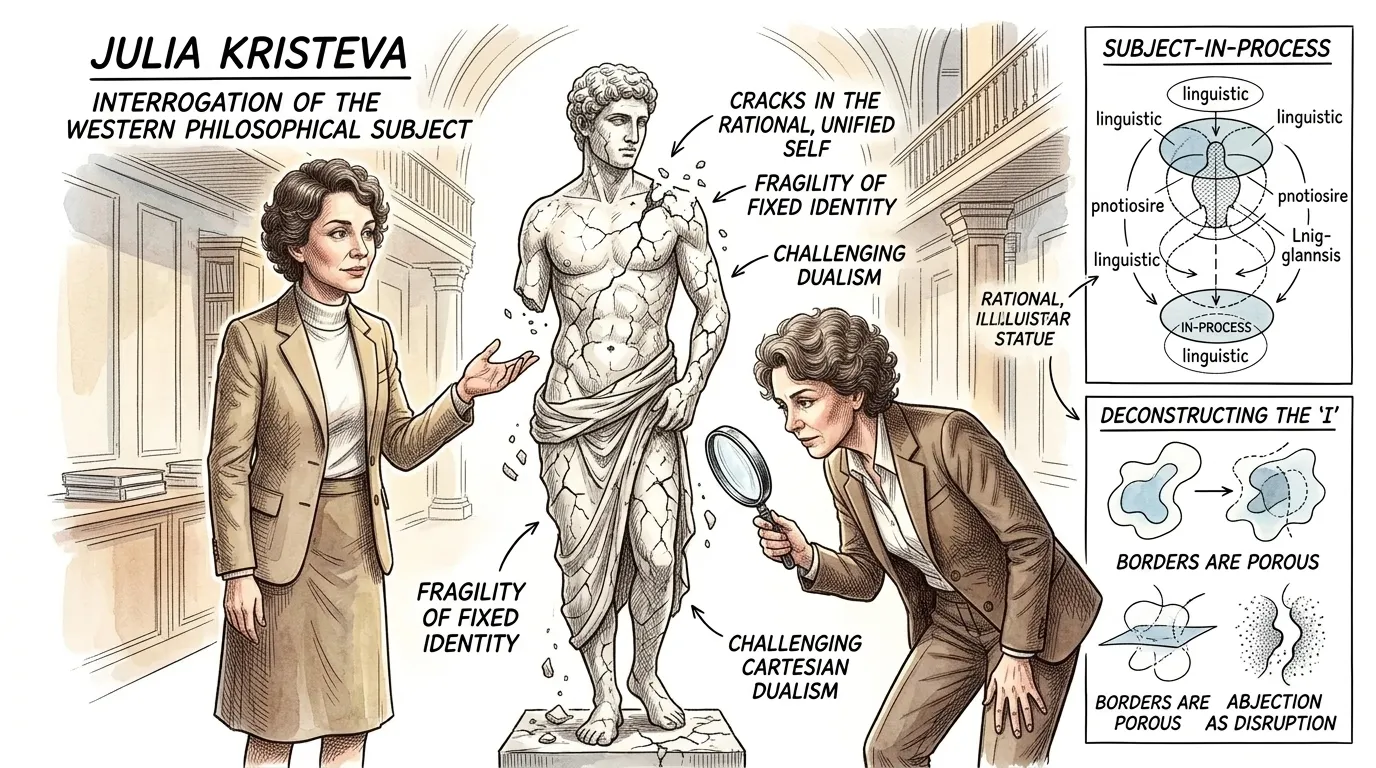
For centuries, Western philosophy has upheld the ideal of a rational, unified, and self-contained individual. From Descartes' 'I think, therefore I am' to the Enlightenment's celebration of autonomous reason, the self was imagined as a stable center of consciousness. Kristeva, however, confronts this notion head-on, arguing that this coherent self is always precarious, constantly under construction and threatened by forces both internal and external. It is a carefully maintained illusion, vulnerable to collapse at any moment.
Philosophy Note: Western Philosophical Ideal: Unified, rational subject Challenge: Post-structuralist critiques of fixed identity Precursors: Nietzsche, Freud, Lacan
Page 3
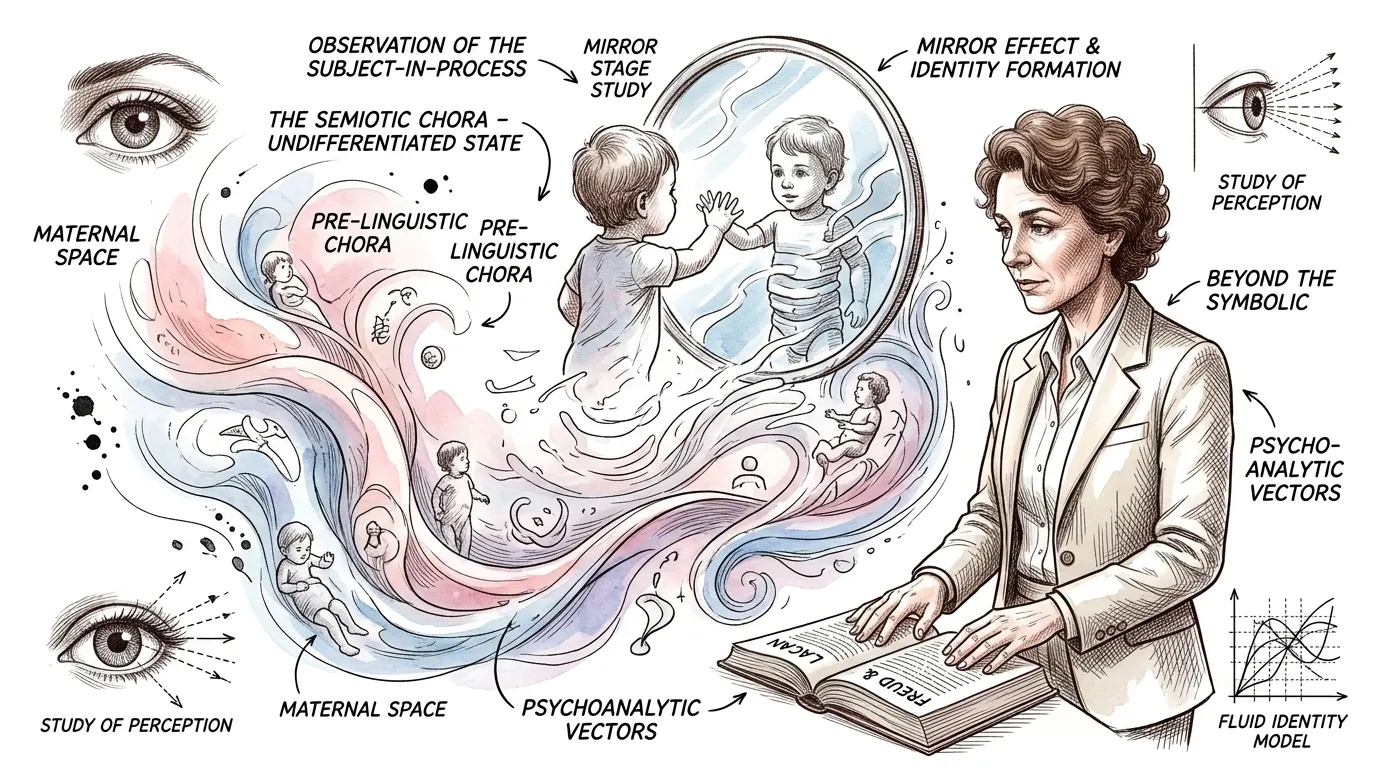
Kristeva's understanding of the fluid self is deeply rooted in psychoanalysis. She draws significantly from Sigmund Freud's exploration of the unconscious and Jacques Lacan's theories of the 'mirror stage,' where a child first develops a sense of self through an external image. Yet, Kristeva pushes further, delving into the 'pre-Oedipal' realm, a period before language and fixed sexual identity. This is a time of primal drives and maternal connection, where the self is not yet separated and defined, a chaotic, undifferentiated state that continues to resonate within us. This early experience profoundly shapes our later struggle to maintain a coherent identity.
"As Jacques Lacan famously articulated, 'The mirror stage is a drama whose internal thrust is precipitated from insufficiency to anticipation – and which for the subject, caught in the lure of spatial identification, machines the succession of phantasies that extends from a fragmented body-image to a form of its totality.' Kristeva builds upon this, exploring the even earlier, pre-linguistic forces at play."
Philosophy Note: Influences: Sigmund Freud (Unconscious, drives), Jacques Lacan (Mirror Stage, Symbolic) Kristeva's focus: Pre-Oedipal, maternal, semiotic chora
Page 4

To understand the fluid self, Kristeva introduces two fundamental modes of meaning: the semiotic and the symbolic. The 'symbolic order' is the realm of structured language, grammar, logic, and societal rules. It's how we make sense of the world through naming and categorizing. The 'semiotic chora,' however, is a pre-linguistic, pre-oedipal realm of drives, rhythms, and sounds—a chaotic, pulsating energy rooted in the maternal body. It's the 'music' of language, the affects and intonations, the disruptive forces that constantly threaten to break through the symbolic's rigid structures. Both are always present, engaged in a dynamic tension within us.
Philosophy Note: Semiotic Chora: Pre-linguistic drives, rhythms, sounds, affects Symbolic Order: Structured language, logic, social norms Dynamic tension defines meaning
Page 5

Abjection is Kristeva's most challenging and perhaps most vital concept. It is not simply disgust or fear; it is the radical exclusion of something that was once part of us, or threatens our very definition. The abject is what disturbs identity, system, order. It is what does not respect borders, rules, or the in-between. It is the waste, the corpse, the bodily fluid that reminds us of our own fragility and mortality, blurring the line between self and not-self. Confronting the abject is to confront the breakdown of meaning itself, a crisis for the coherent subject.
"Kristeva asserts that 'It is thus not the lack of cleanliness or health that makes abjection, but what disturbs identity, system, order. What does not respect borders, rules, the in-between.' This powerful idea reveals the true stakes of our psychological and social boundaries."
Philosophy Note: Abjection: What disturbs identity, system, order; the expulsion of that which threatens the self's boundaries More than disgust: breakdown of meaning
Page 6

Against the traditional, fixed notion of identity, Kristeva proposes the 'subject-in-process' or 'subject on trial.' This concept emphasizes that our identity is not a static given but a continuous, often tumultuous negotiation between the structured symbolic order and the disruptive semiotic chora, constantly challenged by the abject. We are always forming, always dissolving, always becoming. Our sense of self is a temporary stabilization, achieved through the repression of the semiotic and the expulsion of the abject. This process is never complete, leaving us with a fundamentally fluid and unstable core.
Philosophy Note: Subject-in-Process: Identity as an ongoing, unstable negotiation Defined by repression of semiotic and expulsion of abject Never fully fixed
Page 7
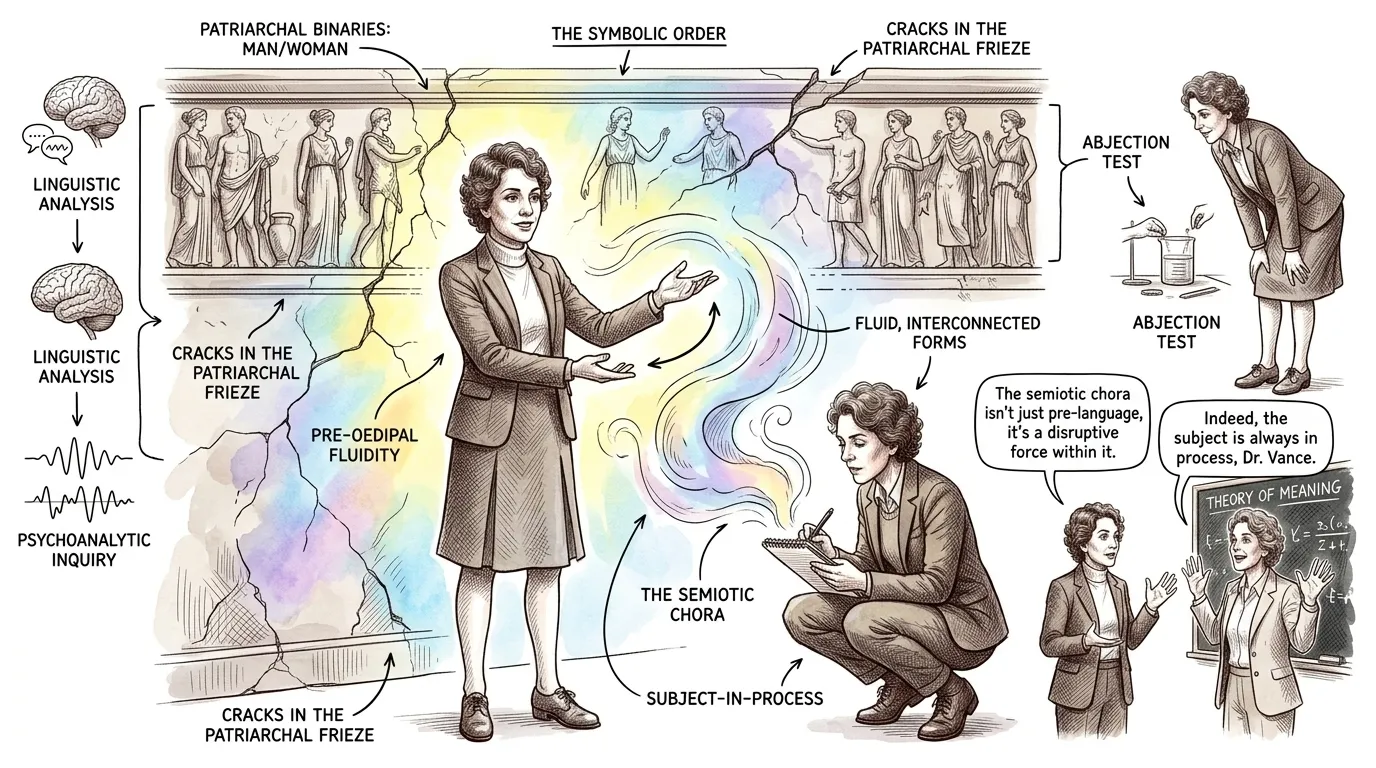
Kristeva's work has had a profound impact on feminist theory, though her approach is often distinct from traditional feminist positions. She challenges the idea of a fixed female identity, arguing that both men and women are subjects-in-process, equally susceptible to the forces of the semiotic and the abject. Her focus on the maternal and the pre-Oedipal disrupts patriarchal language and structures, which often rely on rigid binaries and stable identities. By exploring the fluidity of gender and meaning, Kristeva opens new avenues for understanding liberation beyond simple inversions of power dynamics, seeking a more fundamental disruption of oppressive systems.
Philosophy Note: Impact on Feminism: Challenges fixed female identity, disrupts patriarchal binaries Focus on maternal and pre-Oedipal as disruptive forces Seeks fundamental systemic change
Page 8
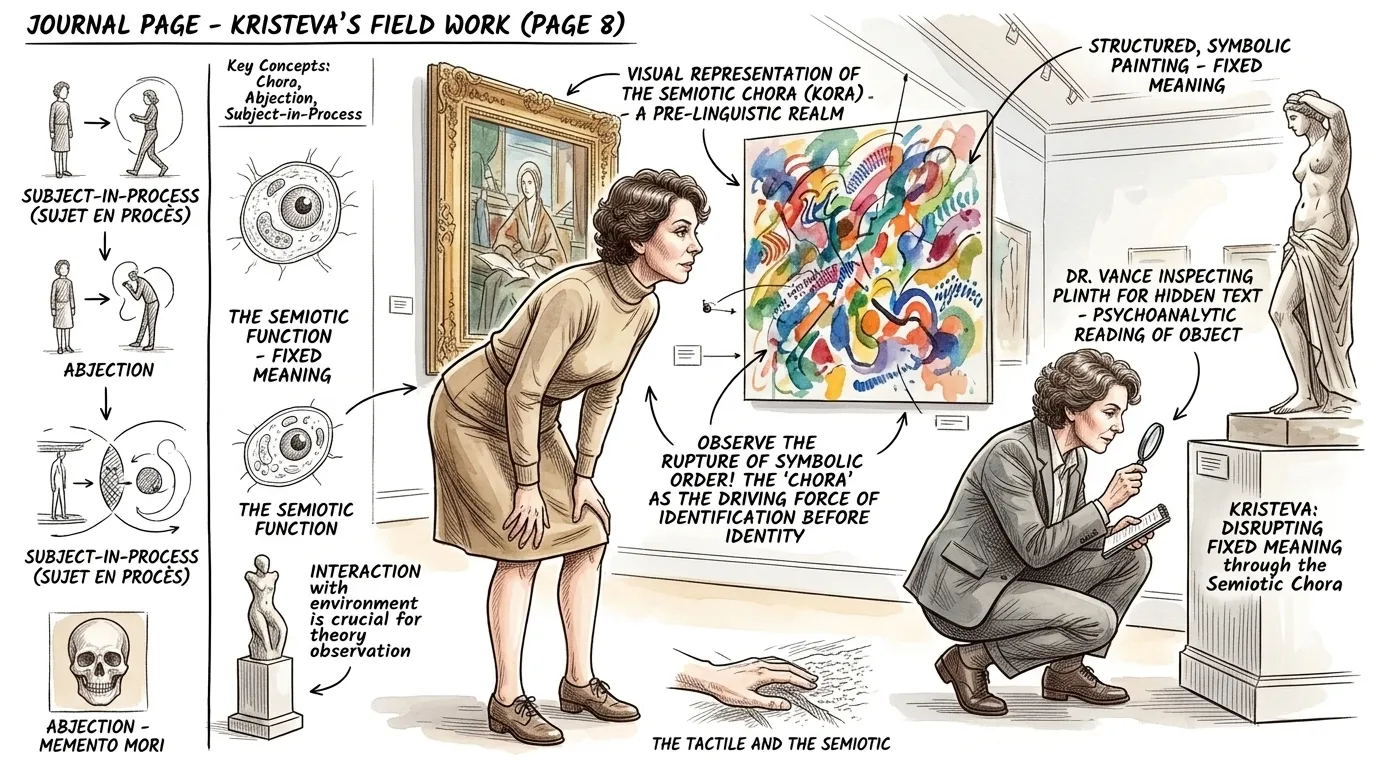
Kristeva's theories find rich application in the realm of art and literature, particularly in avant-garde and experimental works. She sees poetry, modernist novels, and abstract art as spaces where the semiotic chora can erupt, disrupting the symbolic order and revealing the fluidity of meaning. Artists, by playing with rhythm, sound, and the 'unspeakable,' can tap into the pre-linguistic forces that shape us, creating works that evoke the abject and challenge our conventional modes of understanding. This artistic rebellion against fixed forms offers a glimpse into the dynamic, unstable nature of our own internal worlds.
Philosophy Note: Application: Avant-garde art, poetry, experimental literature Semiotic eruption: Art as a space to disrupt symbolic order Revealing fluid, unstable meaning
Page 9

Kristeva's insights resonate profoundly in our contemporary world, where identity is increasingly fluid and contested. From the complexities of gender and sexuality beyond binary definitions to the fragmentation of self in the digital age, her work helps us conceptualize the constant renegotiation of who we are. Her ideas shed light on the allure of nationalism and fundamentalism as desperate attempts to impose rigid boundaries against the perceived 'abject' other, whether it's migrants, differing ideologies, or simply the unknown. Embracing the 'subject-in-process' allows us to navigate these evolving landscapes with greater awareness.
Philosophy Note: Modern Relevance: Gender fluidity, digital identity, nationalism, mental health Explaining anxieties of identity in flux Navigating the 'abject' in society
Page 10

Julia Kristeva's legacy is an enduring invitation to rethink the very foundations of our being. Her work encourages us to move beyond the comforting illusion of a stable, unified self and to instead embrace the inherent fluidity, contradiction, and even unruly nature of human existence. By recognizing the powerful, often unsettling forces of the semiotic chora and the abject, we gain a deeper understanding not only of our individual psychology but also of the social and political dynamics that shape our world. Her philosophy, while challenging, ultimately offers a path towards a more nuanced and resilient engagement with the complexities of life.
Philosophy Note: Legacy: Rethinking foundations of being, embracing fluidity and contradiction Deeper understanding of psychology, social, and political dynamics Path to nuanced, resilient engagement
About this story
- Audience: general readers
Questions and answers
Read Wonder Philosophy on your phone
Wonder Philosophy is available on Android and iPhone and iPad. Get Wonder Philosophy on Google Play · Get Wonder Philosophy on the App Store.