John Dewey
John Dewey — an illustrated philosophy story. 8 illustrated pages, free to read on Wonder Philosophy.
Page 1
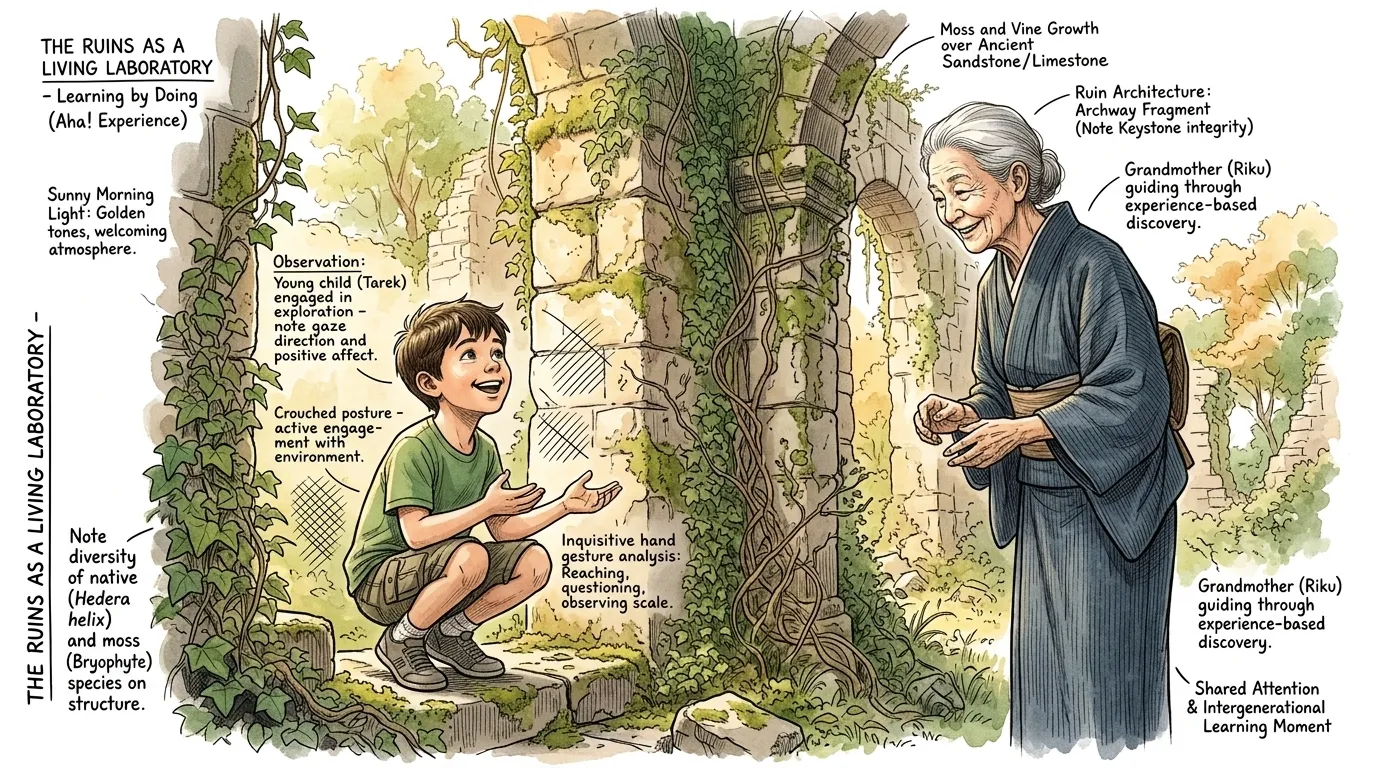
One sunny morning, Tarek and his grandmother, Riku, set out to explore the old, overgrown ruins at the edge of town.
"'Look, Grandma Riku! Everything here is so old,' Tarek exclaimed, pointing at crumbling stone walls covered in moss. 'How did people ever build these amazing things without all our modern tools?' Riku smiled, her eyes twinkling. 'They didn't just read about building in books, Tarek; they learned by doing, by trying and figuring things out with their hands and minds.'"
Philosophy Note: John Dewey (1859-1952) was an American philosopher and educational reformer who championed 'learning by doing,' emphasizing experience as central to education.
Page 2
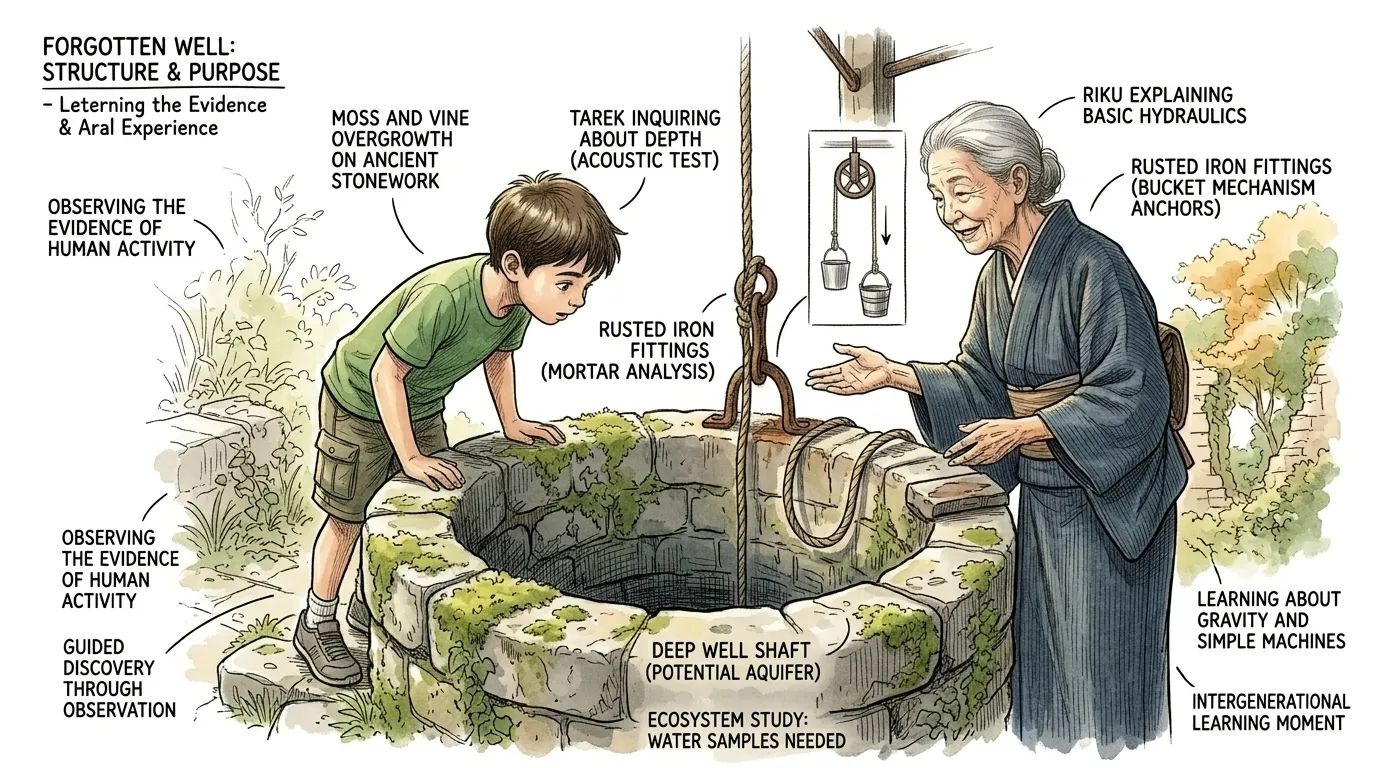
They ventured deeper, stumbling upon what looked like a very old, forgotten well.
"'This well is so deep! How did people get water from it?' Tarek asked, peering down carefully. 'They used simple machines, like a bucket and rope system,' Riku explained, gesturing to some rusted iron fittings. 'It wasn't always easy, and sometimes their first ideas didn't work. But each time, they learned more about what did work by experimenting.'"
Philosophy Note: Dewey believed that true education involves interaction with the environment, where learners actively engage in solving real problems rather than passively receiving information.
Page 3
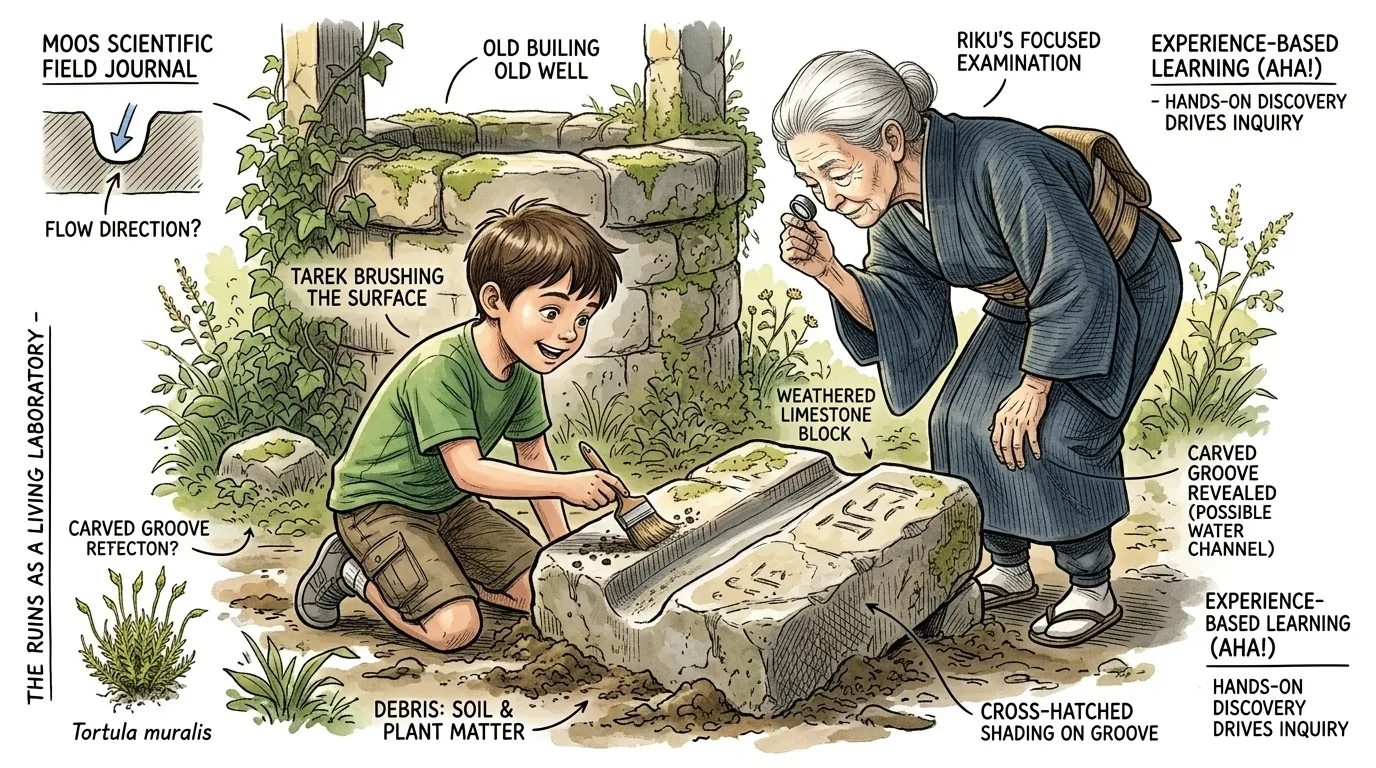
Near the well, half-buried in the soil, Tarek discovered a peculiar, heavy stone block with a long, smooth groove carved into it.
"'Grandma Riku, look at this strange stone!' Tarek exclaimed, brushing dirt off the block. Riku carefully examined it. 'This looks like part of an ancient lever system, Tarek. It's a simple machine that helps move heavy things.' She paused, then added, 'You know, the ancient philosopher Aristotle once said, "For the things we have to learn before we can do them, we learn by doing them." It means the best way to understand how something works is to actually try it yourself!'"
Philosophy Note: Aristotle (384–322 BC), a Greek philosopher, also recognized the importance of practical experience and habituation in learning and developing virtues.
Page 4
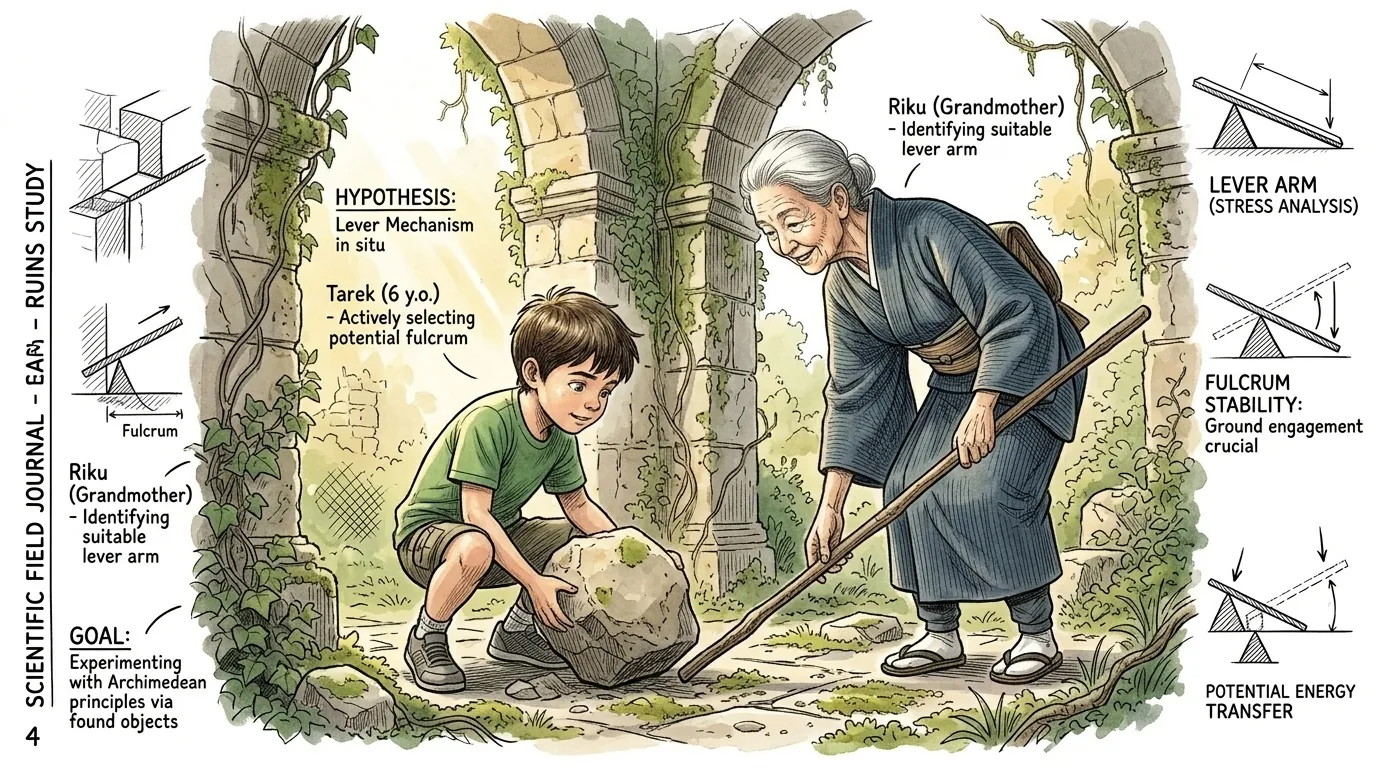
Inspired by Aristotle's words, Tarek and Riku decided to find a way to demonstrate the lever principle.
"'If we can find something to act as the lever and a fulcrum to pivot it on, we could lift something heavy!' Tarek suggested excitedly. Riku nodded. 'Exactly! We need a long, strong stick and a smaller, sturdy stone to place underneath it. Then, we can see how little effort it takes to move something big.'"
Philosophy Note: The lever is a simple machine, one of the earliest tools used by humans to amplify force, demonstrating fundamental principles of physics through practical application.
Page 5
After some searching, they found a strong, fallen tree branch and a perfectly shaped, flat stone.
"'This branch is perfect, Grandma! And this flat stone will make a great pivot point,' Tarek declared, carefully placing the stone. Riku smiled, 'Now, let's find something heavy that we want to move, something that would be too heavy to lift on our own.' Tarek's eyes scanned the area, already looking for their challenge."
Philosophy Note: Dewey advocated for education that encourages inquiry, experimentation, and critical thinking, mirroring the scientific method of hypothesis and testing.
Page 6
They found a moderately sized, stubborn rock blocking a small pathway.
"'This rock is too big to push, Grandma,' Tarek stated, trying to budge it with his foot. Riku pointed to their lever setup. 'But it's not too big for our lever! Remember what Aristotle said about learning by doing? Now is our chance to put that knowledge into action, not just talk about it.'"
Philosophy Note: Dewey's philosophy of 'instrumentalism' suggests that ideas are tools for problem-solving, and their value lies in their practical application and consequences.
Page 7
Together, they positioned the lever, sliding the branch under the rock and placing the flat stone beneath it as a fulcrum.
"'Okay, Tarek, now press down on the long end of the branch with all your might,' Riku instructed. Tarek pushed, grunting with effort. Slowly, with a grinding sound, the large rock began to tilt upwards! 'It's moving!' Tarek shouted, his eyes wide with surprise and satisfaction. 'It actually worked!'"
Philosophy Note: A central criticism of Dewey's 'progressive education' was the concern that it might de-emphasize traditional academic knowledge in favor of practical skills, though Dewey himself sought a balance.
Page 8
With a final push, the rock rolled away, clearing the path.
"'We did it, Grandma! We moved the big rock!' Tarek cheered, looking proudly at the now-clear path. Riku nodded, putting an arm around him. 'Yes, we did. And you didn't just hear about levers today, Tarek. You experienced how they work. That's the best kind of learning, the kind that stays with you, because you figured it out yourself by doing.'"
Philosophy Note: John Dewey's enduring legacy is his contribution to educational reform, advocating for schools to be 'laboratories of democracy' where students learn critical thinking, problem-solving, and civic responsibility through active participation.
About this story
- Audience: general readers
Read Wonder Philosophy on your phone
Wonder Philosophy is available on Android and iPhone and iPad. Get Wonder Philosophy on Google Play · Get Wonder Philosophy on the App Store.