Jean Baudrillard
Jean Baudrillard — an illustrated philosophy story. 10 illustrated pages, free to read on Wonder Philosophy.

Page 1
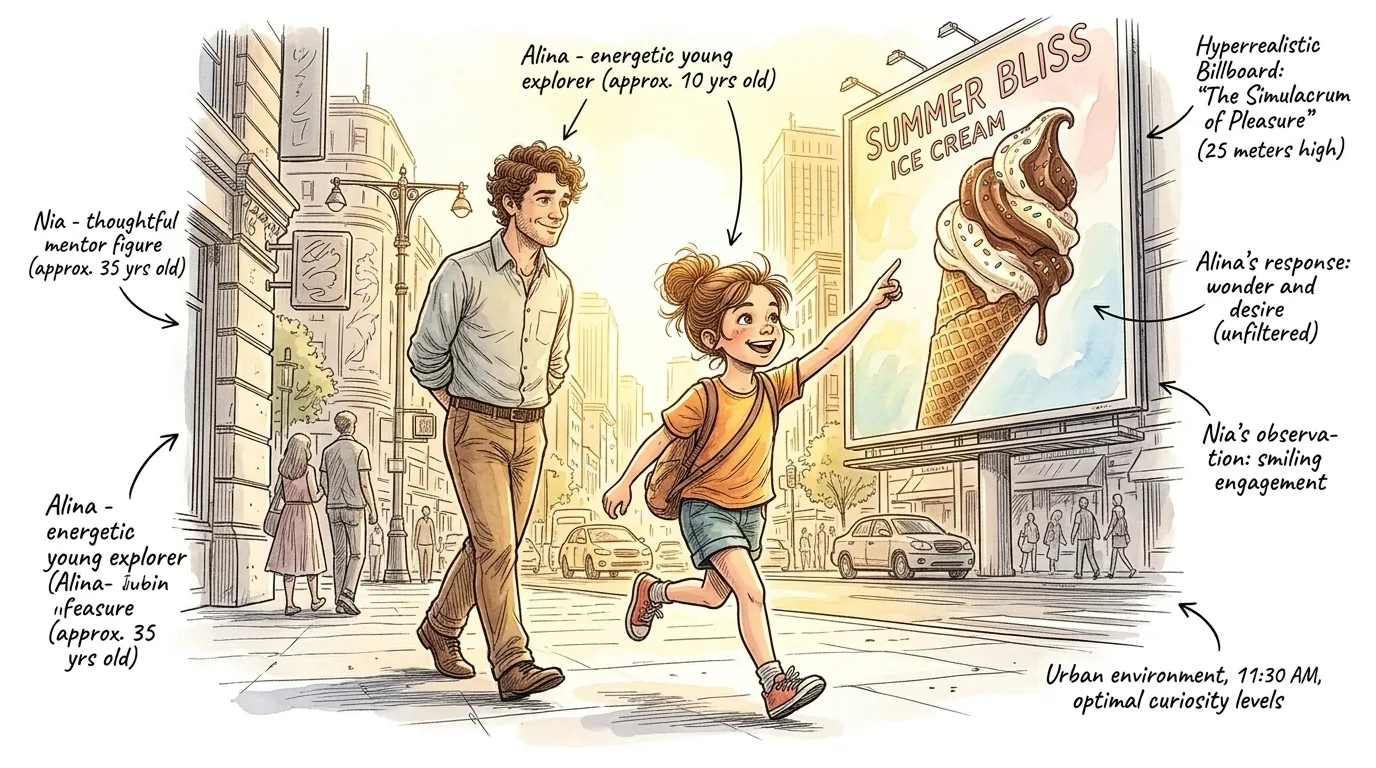
Alina skipped ahead, then stopped abruptly, pointing at a giant billboard. "Nia, look at that ice cream! It looks so perfect, so creamy and delicious!"
"'Doesn't it almost feel more real than actual ice cream?', Alina asked, her eyes wide with longing. 'Like the picture is the best version there could ever be!'"
Philosophy Note: The experience of images and representations becoming more compelling than their real-world counterparts is central to Jean Baudrillard's philosophy of simulacra.
Page 2
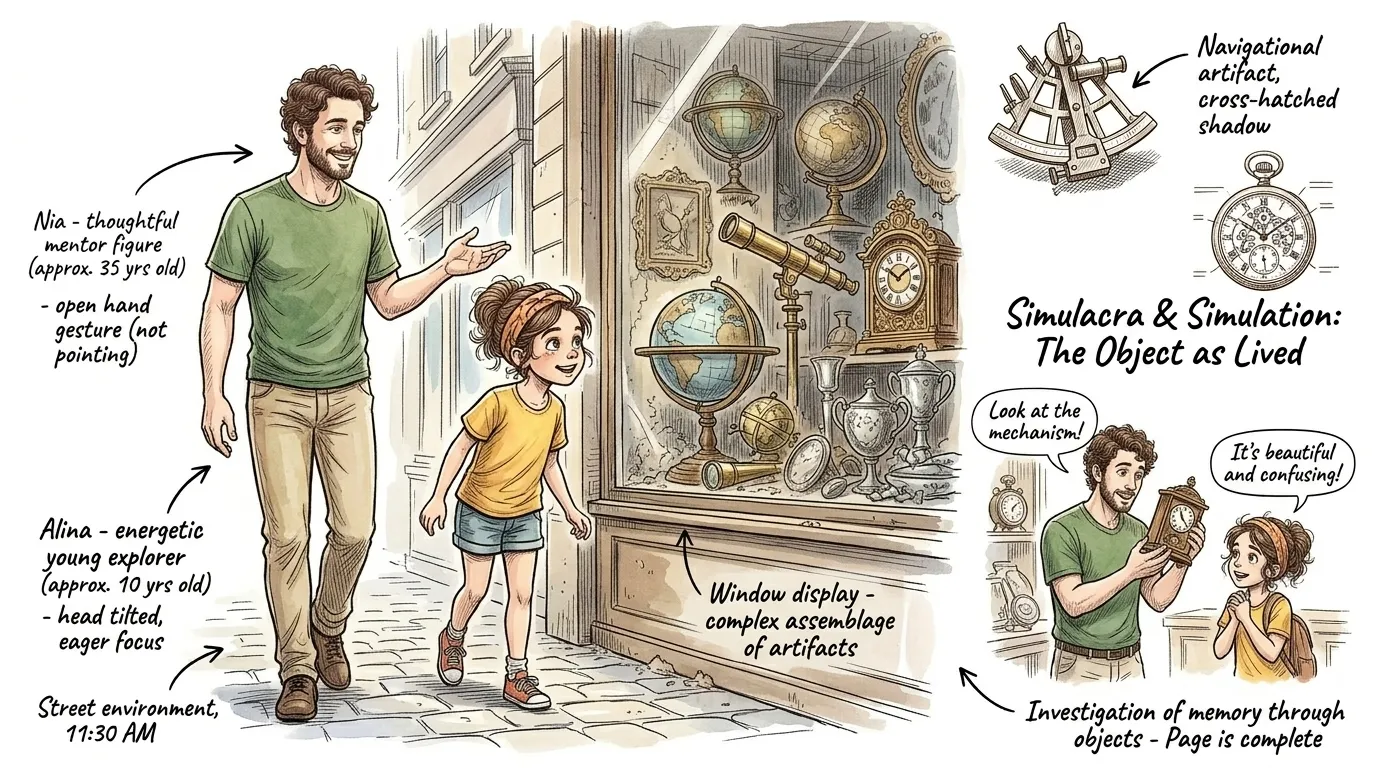
Nia smiled. 'That feeling you have, Alina, is something a very interesting French thinker named Jean Baudrillard spent his life exploring.' He gestured towards a dusty antique shop window.
"'Baudrillard believed that sometimes, copies can become so powerful, they almost replace reality itself. Come, look at this!' Nia said, drawing her towards a fascinating display."
Philosophy Note: Jean Baudrillard (1929–2007) was a French sociologist and philosopher whose work focused on the nature of reality, media, and consumer culture in the postmodern era. His most famous concepts include 'simulacra' and 'hyperreality'.
Page 3
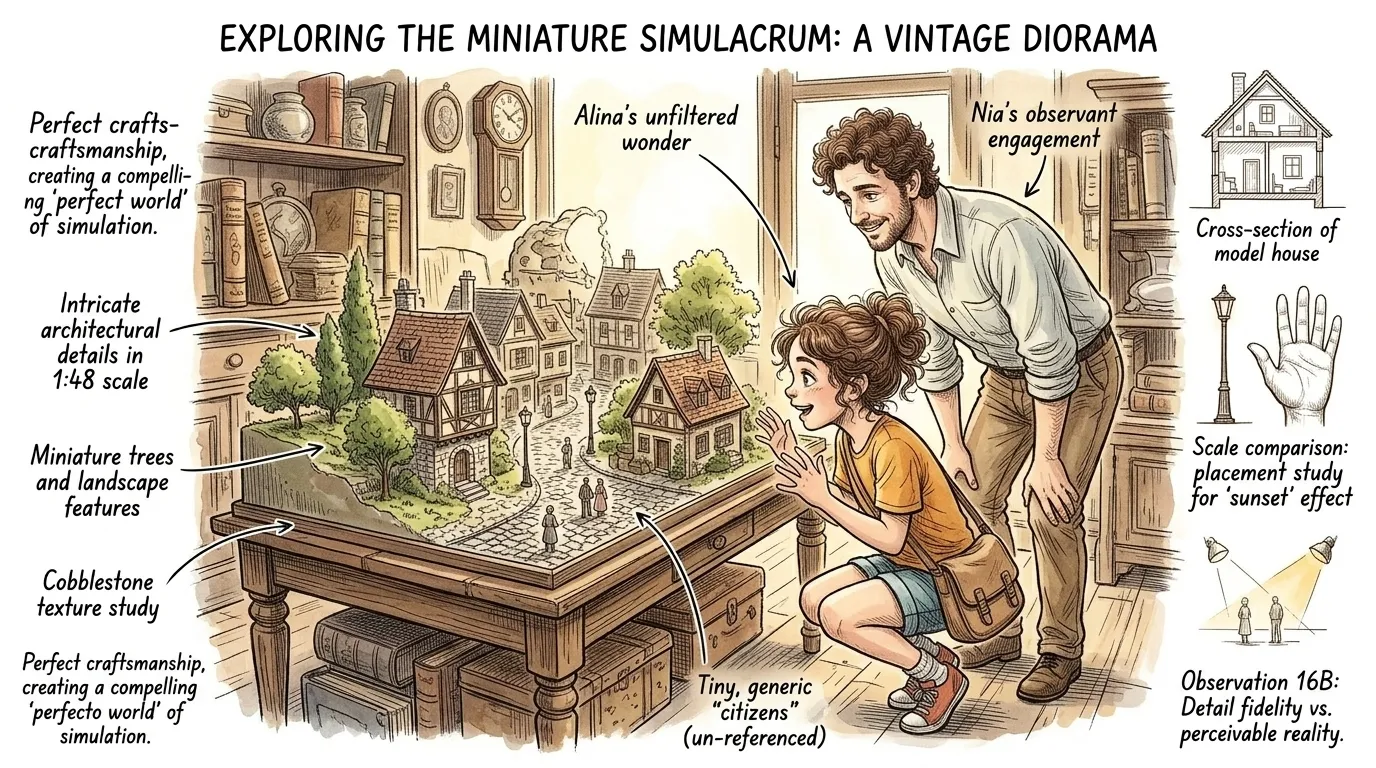
Inside the shop, their eyes were drawn to the tiny model village Nia had spotted. It was exquisite, with every miniature detail perfectly crafted, from the cobblestone streets to the tiny trees.
"'This little village is so perfect, it feels like I could shrink down and live right inside it,' Alina exclaimed, peering closer. 'It's almost more perfect than a real village!'"
Philosophy Note: Baudrillard's exploration began with the idea that our modern world is increasingly filled with 'simulacra' – copies that no longer refer to an original reality. The model village here serves as a perfect, albeit simplified, example of a 'simulacrum'.
Page 4
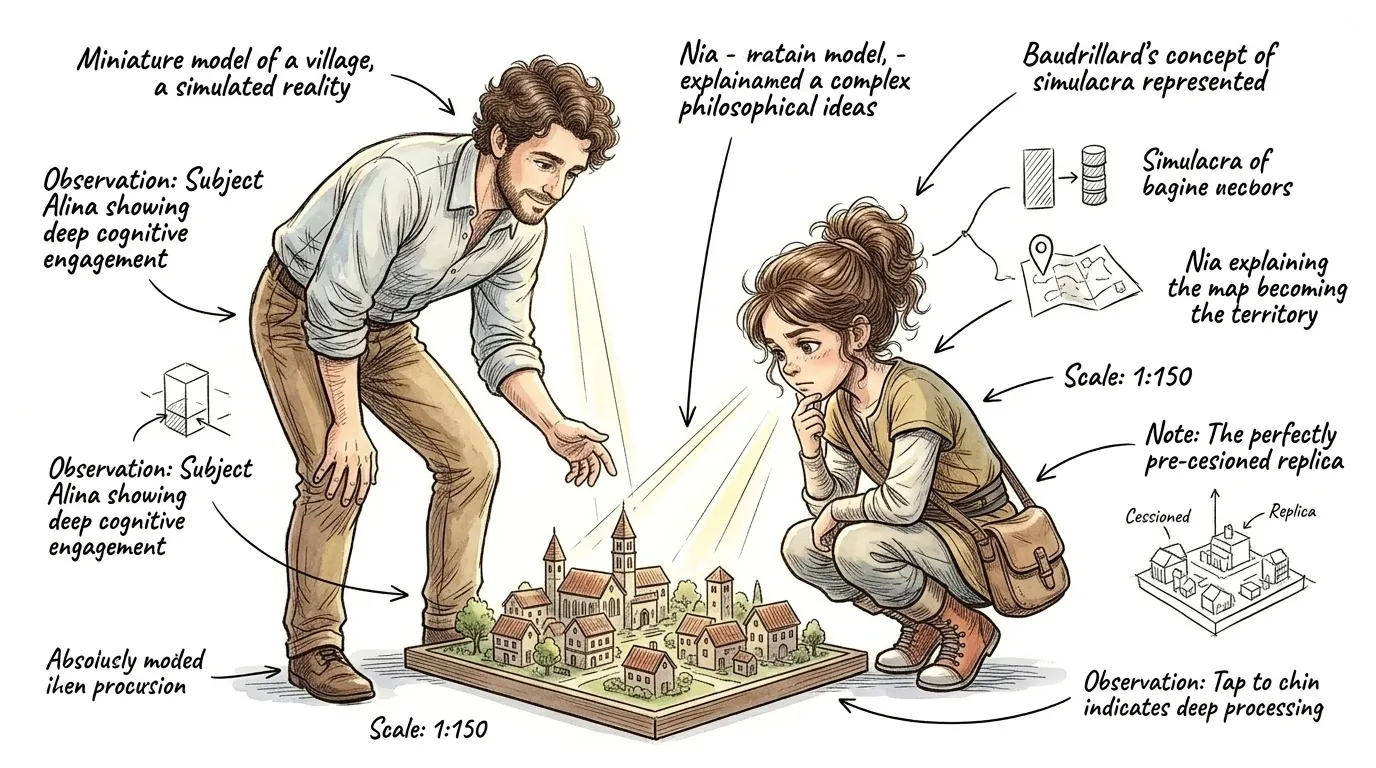
Nia explained, 'For Baudrillard, this model village isn't just a copy of a real village. It's so detailed, so ideal, that it begins to stand on its own as a kind of 'reality'.' He watched Alina's thoughtful face.
"'It's a 'simulacrum',' Nia continued, 'a copy that doesn't just represent something, but sometimes becomes more important or even replaces the idea of an original, like that perfect ice cream on the billboard.'"
Philosophy Note: Baudrillard articulated four orders of simulacra, moving from a faithful copy to a pure simulacrum that has no relation to any reality. In the modern world, especially with digital media, many images are 'pure simulacra' – they create their own reality.
Page 5
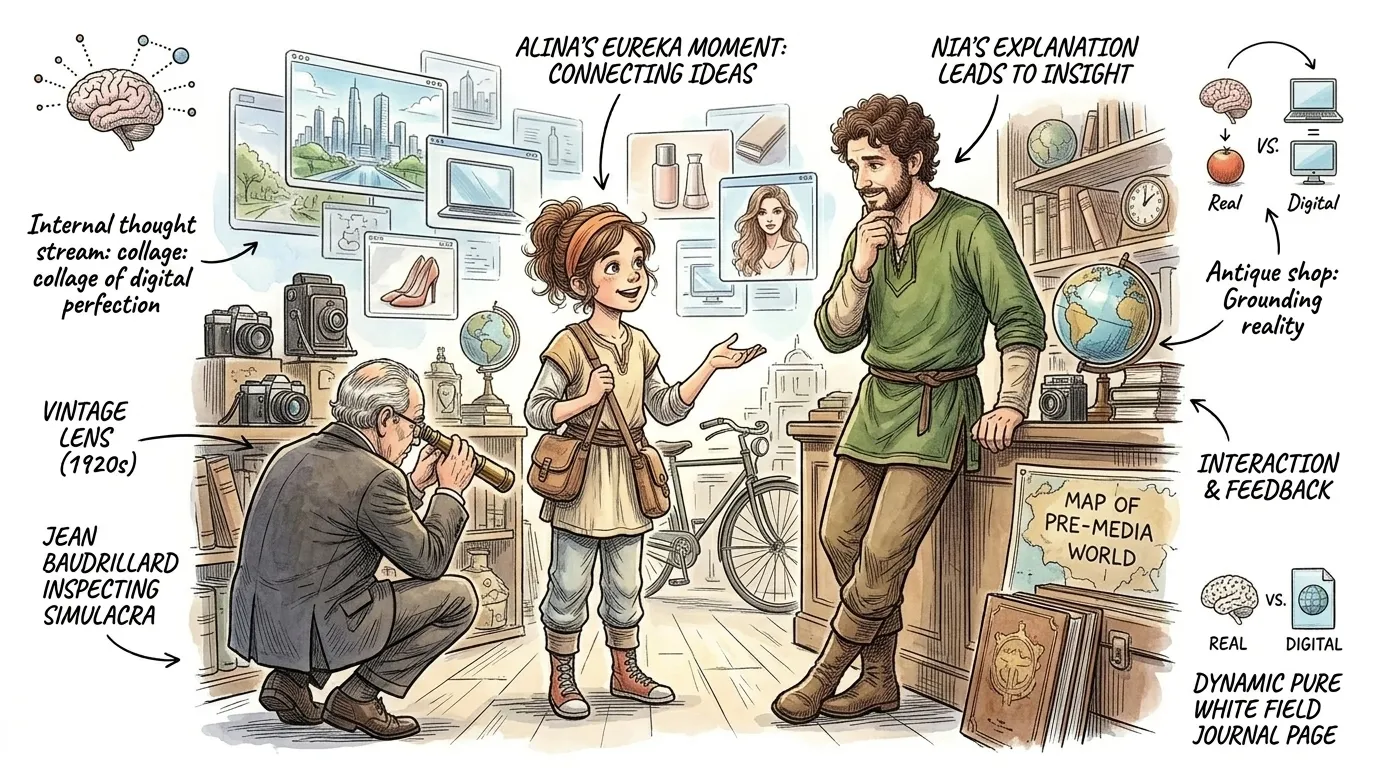
Alina thought about how many perfect images she saw online – flawless faces, ideal homes, incredible adventures. It all started to make sense.
"'So, the whole world of those perfect images, like the ice cream, is what Baudrillard called 'hyperreality'?' Alina asked, connecting the ideas. 'It feels real, but it's built from copies and signs, not always a direct experience?'"
Philosophy Note: Hyperreality, for Baudrillard, is a state where the distinction between reality and its simulation vanishes. Experiences in hyperreality, such as theme parks, virtual reality, or heavily mediated news, feel more 'real' or intense than actual reality, often because they are perfect, curated copies.
Page 6
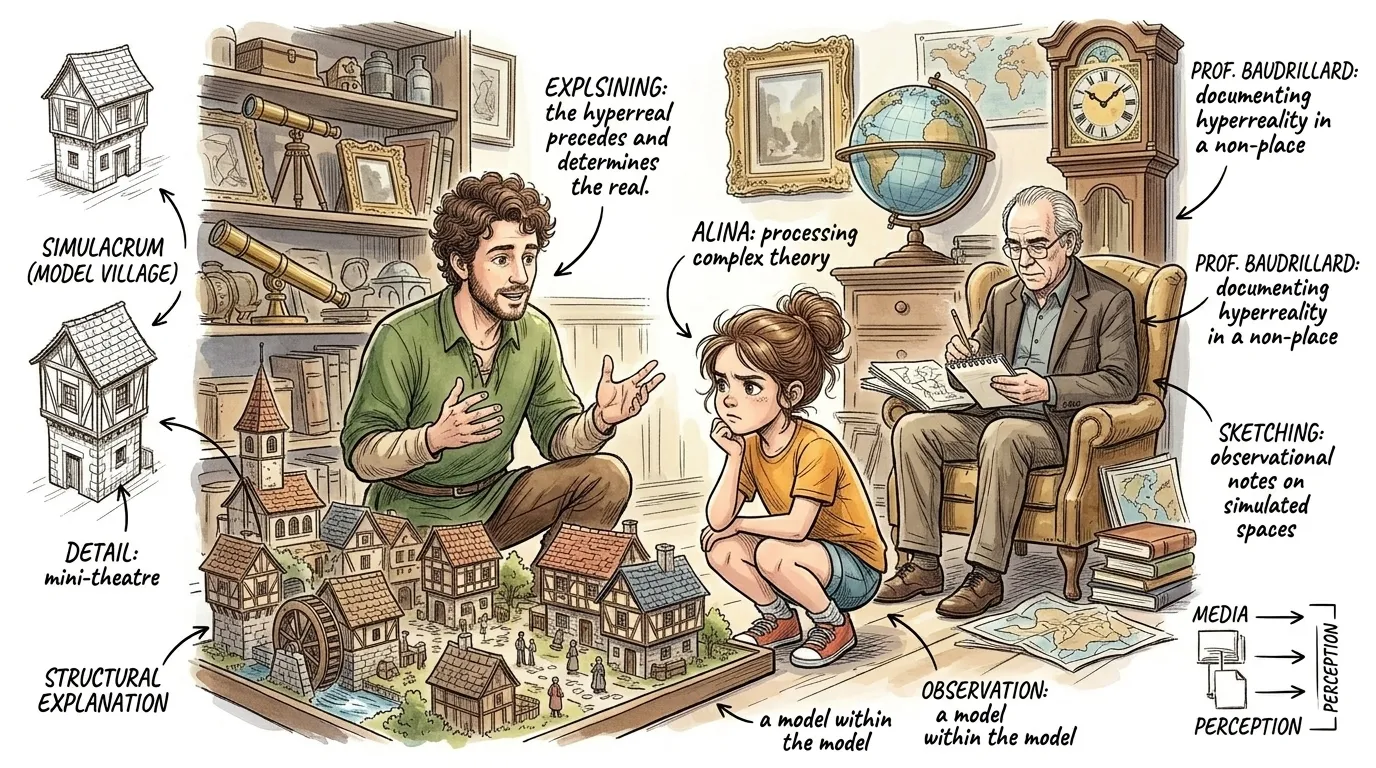
Nia nodded, explaining that Baudrillard worried we might eventually forget what the original real thing even looked like. The copy becomes the only thing we know, or even value.
"'It's like if everyone only ever saw pictures of that perfect ice cream,' Nia explained. 'Eventually, they might forget what a melting, imperfect, truly delicious ice cream feels like, because the picture is so much more appealing.'"
Philosophy Note: A central concern for Baudrillard was the 'precession of simulacra' – the idea that simulacra precede and determine the real, rather than the other way around. This leads to a world where the 'real' loses its meaning, or is indistinguishable from its copies.
Page 7
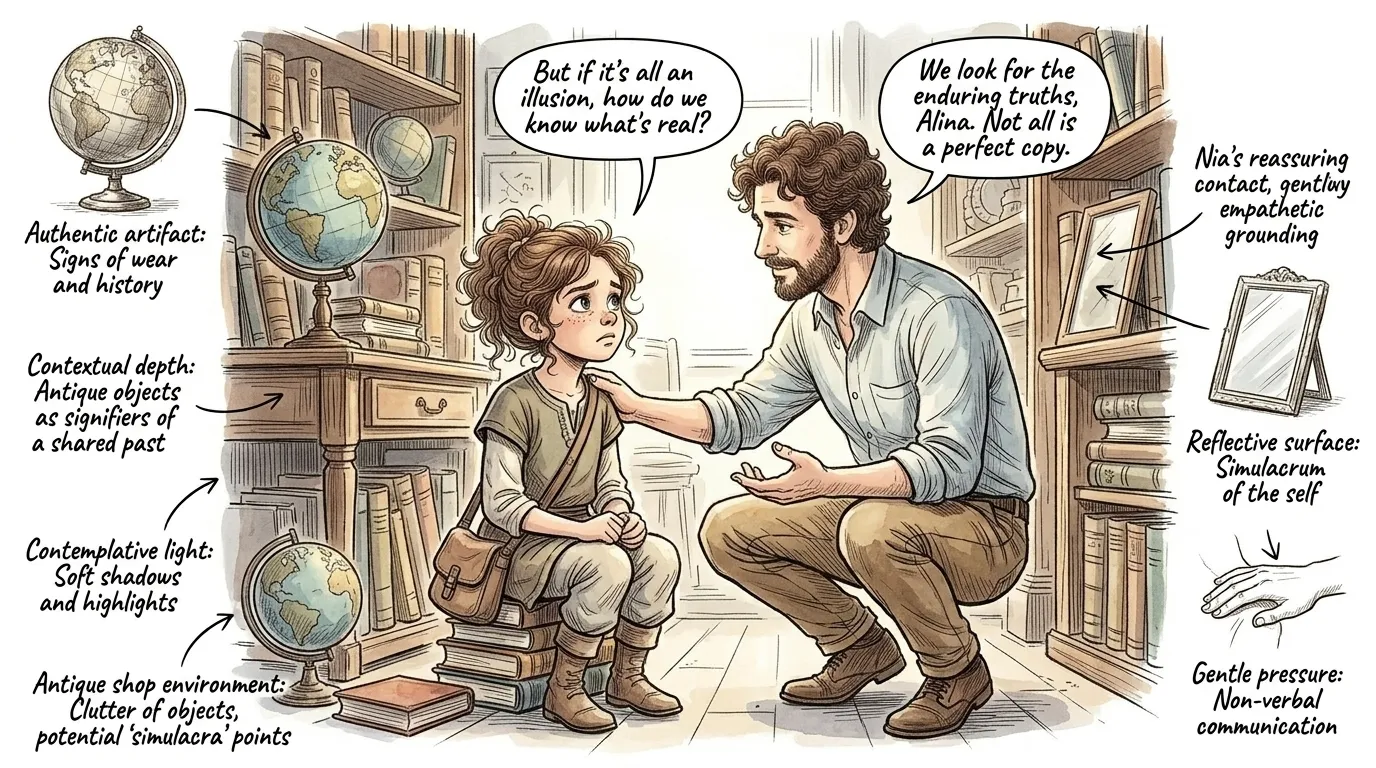
Alina frowned, a flicker of concern in her eyes. 'So, does that mean nothing is really real anymore? Are we just living in a giant illusion made of copies?'
"'Not at all, Alina,' Nia reassured her, placing a gentle hand on her shoulder. 'As William Shakespeare once wrote, 'All that glisters is not gold.' It means we need to look closer and ask questions.'"
Philosophy Note: Baudrillard's work is often misunderstood as nihilistic. However, his aim was to make us critically aware of the nature of the postmodern condition, not to deny reality entirely. Critical thinking and skepticism are key tools for navigating hyperreality.
Page 8
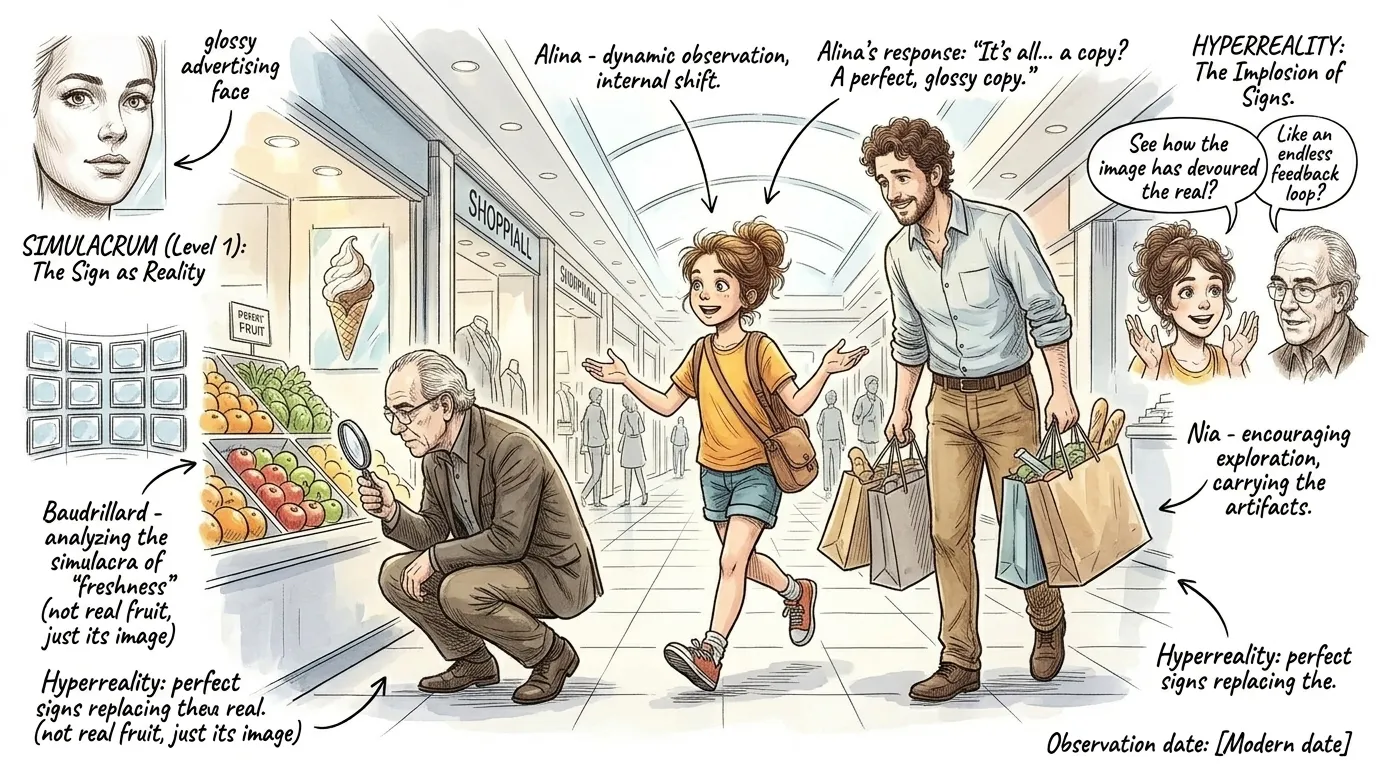
Later, as they walked through a modern shopping mall filled with bright lights and perfect displays, Alina looked at everything with new eyes, remembering the miniature village.
"'It's like this whole mall is a giant hyperreality, isn't it?' Alina observed, gesturing at the glossy storefronts. 'Every display is like a perfect little model, just like that village, but for things we can buy!'"
Philosophy Note: Shopping malls, advertising, theme parks, and mass media are prime examples of 'hyperreal' environments. They present idealized versions of reality that are meticulously crafted to be more appealing, often blurring the lines between what is authentic and what is a constructed experience.
Page 9

Nia smiled, pleased at Alina's insight. 'Exactly. Understanding Baudrillard isn't about becoming cynical. It's about becoming a better, more thoughtful observer of the world around you.'
"'It makes me want to think about what's really 'real' and what's a fantastic copy every time I see something perfect on a screen,' Alina mused, her brow furrowed in concentration."
Philosophy Note: Baudrillard's theories remain highly relevant in an age of pervasive digital media, virtual reality, and artificial intelligence. They offer a framework for understanding how our perception of reality is constantly mediated and shaped by representations.
Page 10
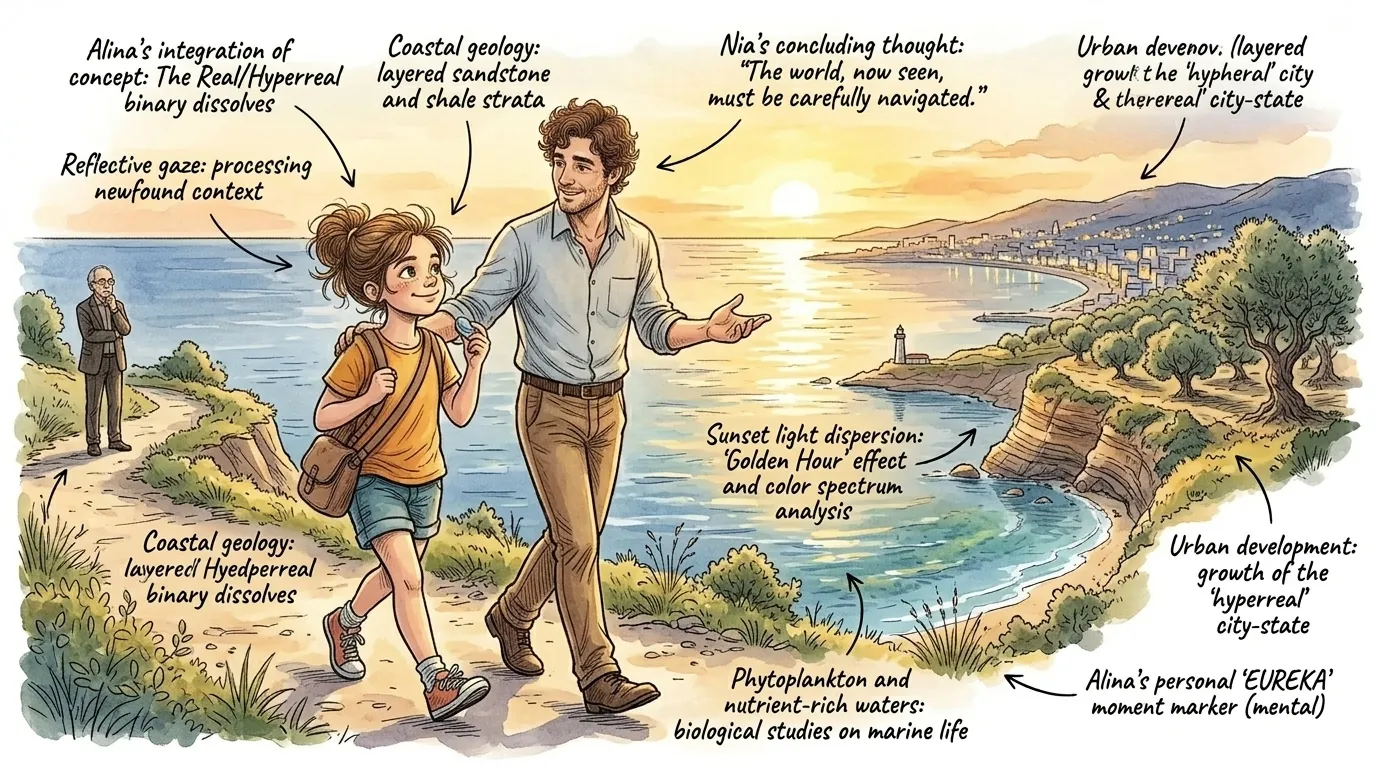
As the day ended, Alina felt a new sense of awareness. The world hadn't changed, but how she looked at it certainly had.
"'Remember, Alina,' Nia said softly, 'Baudrillard invites us to question our perceptions, to wonder if what we see is truly real, or a brilliant copy that has taken on a life of its own.'"
Philosophy Note: Jean Baudrillard's enduring legacy is his powerful critique of consumer society and media, urging us to be vigilant about the simulations that increasingly define our reality, fostering a deeper engagement with critical thought in a complex world.
About this story
- Audience: kids (ages 6–12)
Questions and answers
Read Wonder Philosophy on your phone
Wonder Philosophy is available on Android and iPhone and iPad. Get Wonder Philosophy on Google Play · Get Wonder Philosophy on the App Store.