Jacques Derrida
Jacques Derrida — an illustrated philosophy story. 10 illustrated pages, free to read on Wonder Philosophy.

Page 1
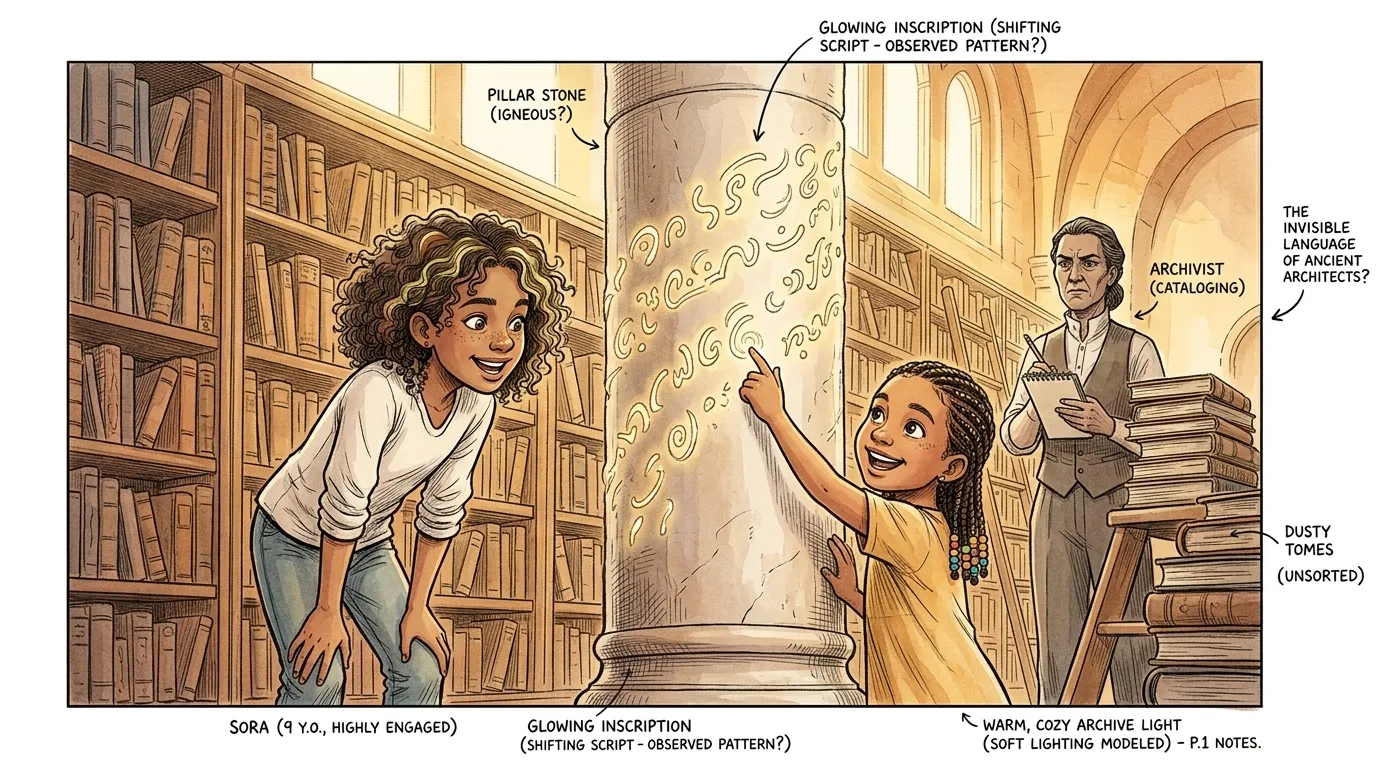
Sora and Nalini ventured into the whispered quiet of the Grand Archive, a place where dusty tomes held centuries of thought. They discovered an ancient inscription on a forgotten pillar that seemed to shift with the light, making its meaning strangely elusive. Nalini pointed to the swirling script, wondering aloud about what hidden layers of meaning might lie beneath the surface.
"'Look, Sora! This symbol looks like a key, but also like a question mark,' Nalini exclaimed, tracing the worn lines with her finger. 'It feels like it's trying to tell us something, but not directly.' Sora nodded thoughtfully, gazing at the intricate carving. 'It's like it wants us to know that things aren't always as solid or straightforward as they first appear. Sometimes, to truly understand something, you have to look beyond what's obvious, even take it apart a little.'"
Philosophy Note: The core principle introduced here is 'deconstruction' – the idea that concepts, texts, and meanings are not as fixed or stable as they seem. Jacques Derrida (1930–2004), a French philosopher, developed this influential approach to philosophy and literary theory in the late 20th century, challenging traditional understandings of language, meaning, and truth.
Page 2

Deeper within the archive, they stumbled upon a section dedicated to old philosophical debates. Among the towering stacks, they found a peculiar, leather-bound volume titled 'The Unwritten Rules,' its pages filled with dense, elegant script. Nalini carefully opened it, and a strange, pressed flower fell out, revealing a marginal note written in tiny, faded ink about the subtle nuances of language.
"'This book talks about how we think words always have one perfect meaning, like a locked box with one key,' Nalini observed, pointing to a passage. 'But this little note here says, 'The lock has many tumblers, and the keys are always changing!'' Sora smiled, leaning closer. 'That's a lot like what a philosopher named Jacques Derrida thought. He was a thinker from France who started asking big questions about how language really works, and why we assume some ideas are more 'original' or 'true' than others.'"
Philosophy Note: Jacques Derrida, born in French Algeria, became a pivotal figure in post-structuralism and continental philosophy. He challenged 'logocentrism,' the Western philosophical tradition's emphasis on speech and a foundational 'truth' or 'origin' for meaning, arguing that writing and language are far more complex and indeterminate than commonly understood.
Page 3
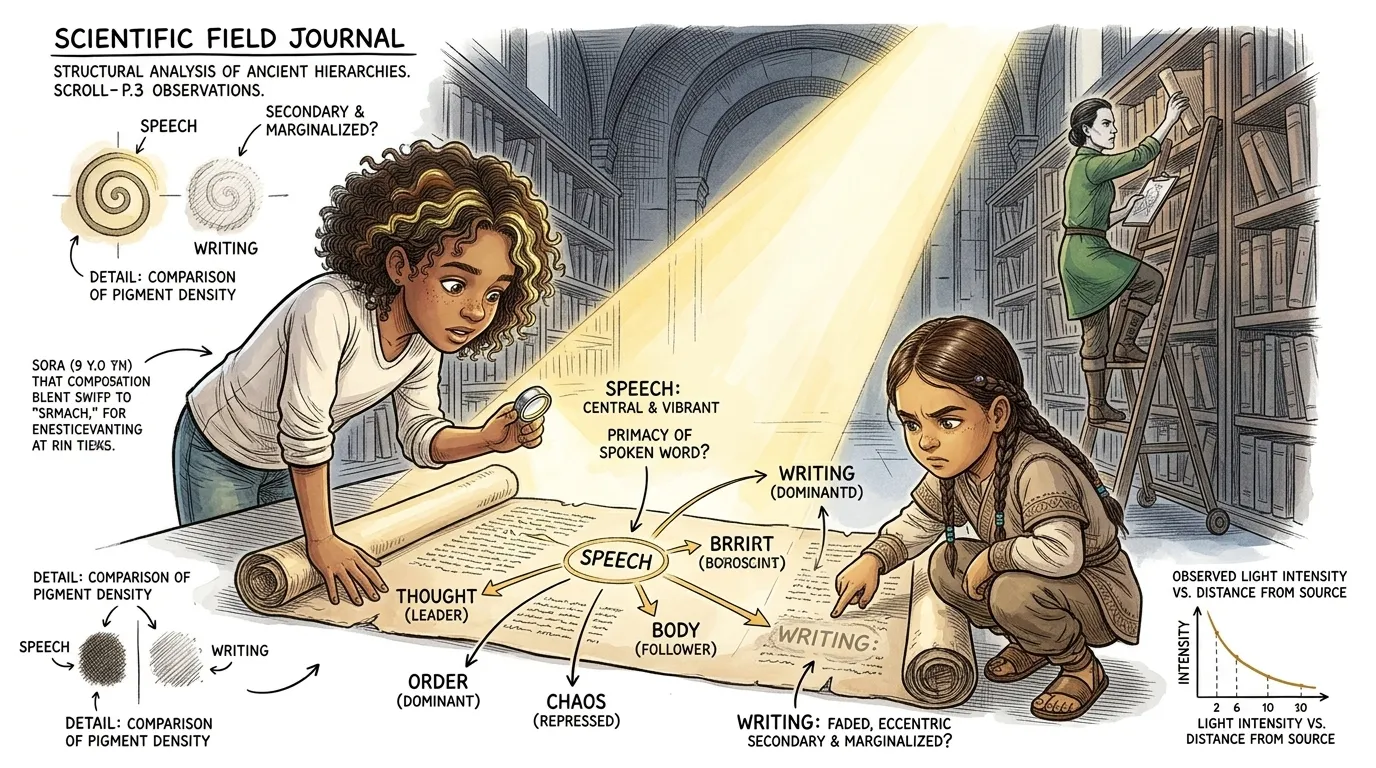
They continued their exploration, discovering an ancient scroll that depicted various concepts in pairs, like 'Speech and Writing' or 'Presence and Absence.' The images showed 'Speech' always as bright and central, while 'Writing' was faded and off to the side, creating a clear sense of hierarchy. Nalini furrowed her brow, noticing how one side of each pair always seemed more important.
"'Why does 'Speech' always look like the hero, and 'Writing' like its quiet helper?' Nalini asked, pointing to the scroll. 'It makes it seem like talking is always better or more real than writing things down.' Sora considered this. 'Exactly! Traditional philosophy often thought that. It valued immediate presence and spoken words as purer, closer to original thought, believing writing was just a copy, a secondary version. But Derrida questioned these very ideas, showing how writing is not just a pale imitation, but has its own powerful and independent ways of making meaning.'"
Philosophy Note: Traditional Western metaphysics, often called 'logocentrism' by Derrida, prioritized speech as directly conveying presence and meaning, while viewing writing as a derivative, potentially corrupting representation. Derrida argued that this hierarchical thinking, prevalent since Plato, incorrectly assumes a stable, self-present origin for meaning, a notion he systematically challenged through deconstruction.
Page 4
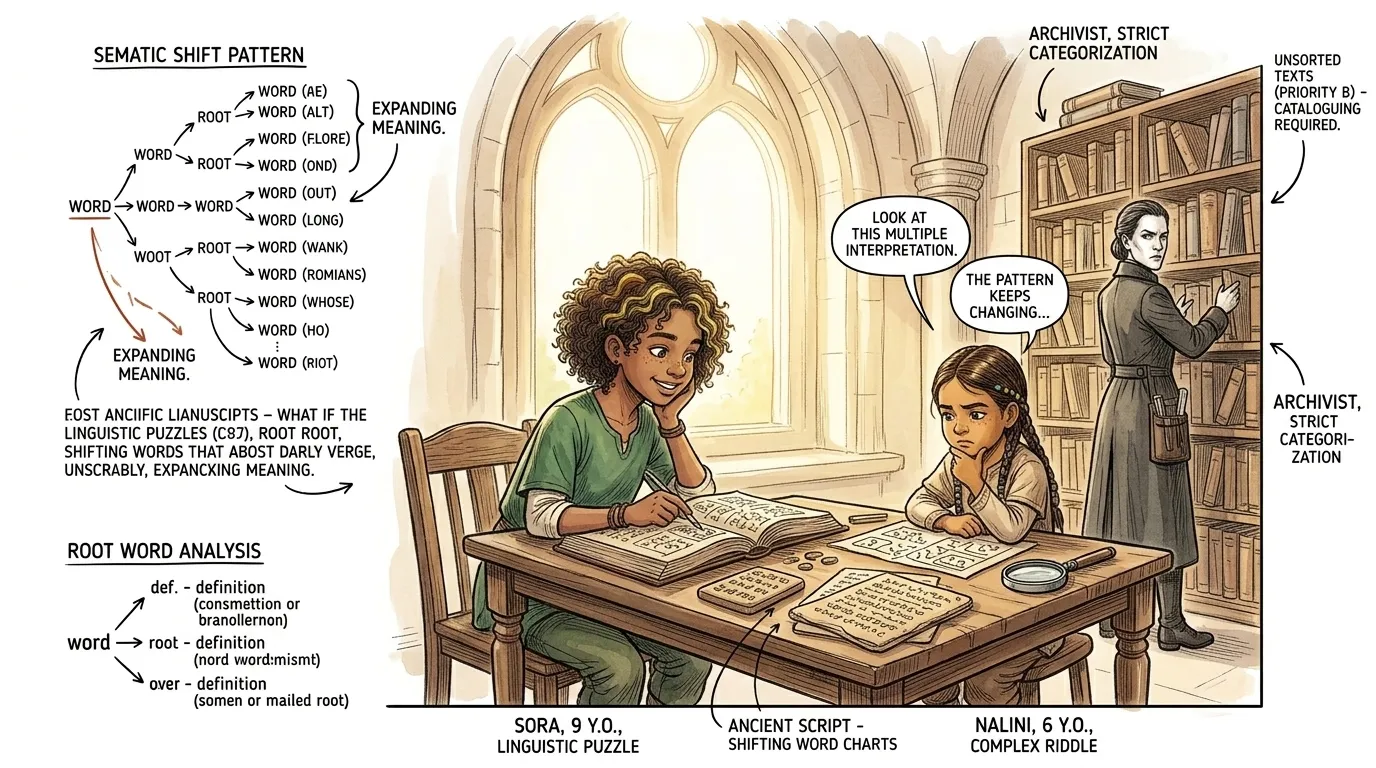
Near a grand, arched window, they found a collection of old linguistic puzzles. One riddle asked for the 'true' meaning of a common word, but every answer they tried seemed incomplete or led to another question. The more they thought about it, the more the word's meaning seemed to shift and expand, never quite settling into one single, perfect definition. They realized the riddle itself was playing with their expectations.
"'This riddle is tricky! It keeps saying there's one 'true' meaning, but every time we think we have it, it slips away,' Nalini confessed with a slight frown. 'It's almost like the word itself doesn't want to be caught!' Sora smiled. 'That's exactly the point Derrida made. He argued that words don't have one single, fixed meaning that an author perfectly controls. Once words are written or spoken, they interact with all other words, and their meaning is always open to new interpretations, shifting and changing. We can never quite pin them down completely.'"
Philosophy Note: Derrida argued against the idea of a 'transcendental signified' – a concept or ultimate meaning that anchors all language. For him, meaning is not fully present or fixed within a word but is instead derived from its difference from other words (Saussure's influence) and is endlessly 'deferred' through a chain of signifiers. This concept is central to his idea of 'différance,' a portmanteau of 'difference' and 'deferral.'
Page 5
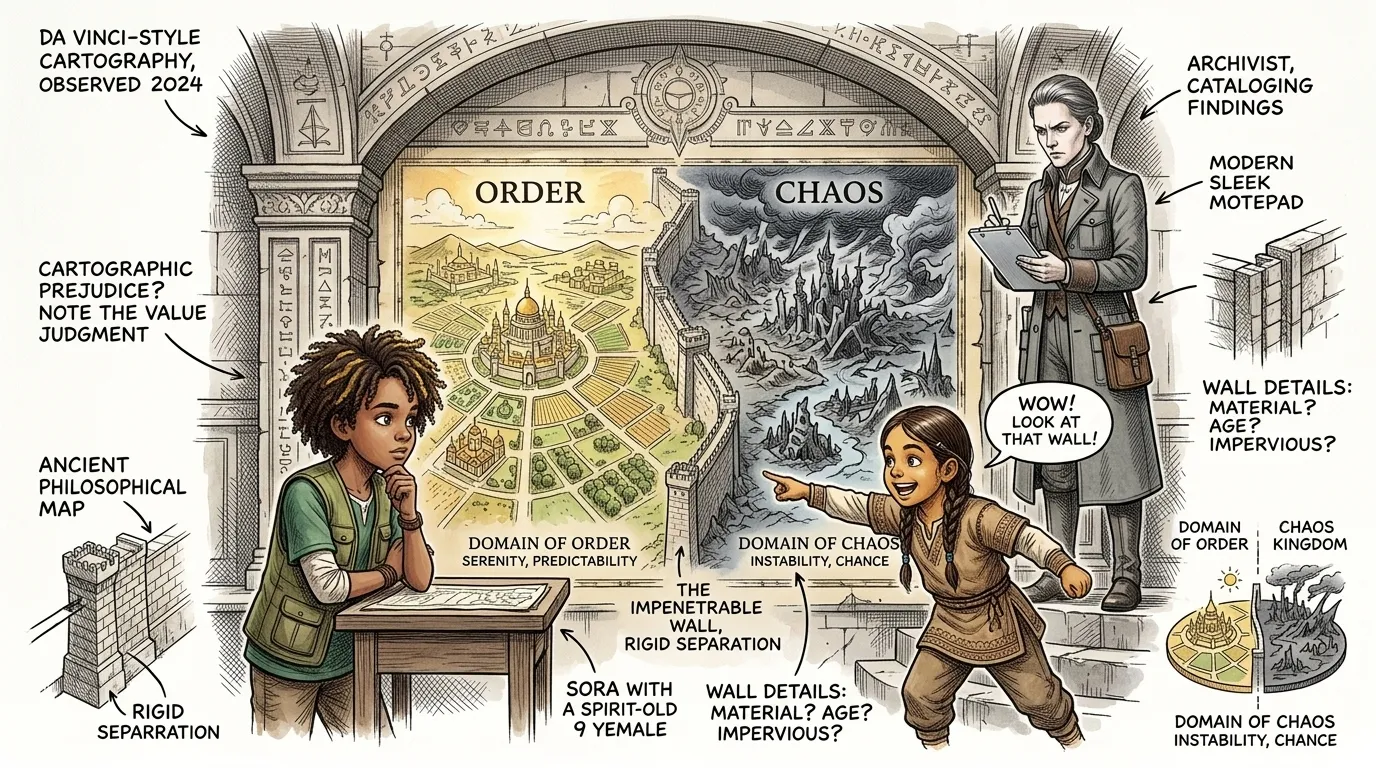
They continued their exploration, arriving at an alcove filled with philosophical maps. One enormous, ancient map showed two kingdoms, 'Order' and 'Chaos,' separated by a rigid, impenetrable wall. The 'Order' kingdom was depicted as golden and serene, while 'Chaos' was dark and turbulent, clearly presenting a value judgment. Nalini noticed how starkly different they were made to seem.
"'Look, Sora! The map says 'Order' is good and 'Chaos' is bad, and they can never mix,' Nalini exclaimed, pointing to the grand map. 'But I bet even in 'Order,' there's a little bit of wildness, and in 'Chaos,' there might be some kind of pattern!' Sora nodded. 'That's a brilliant observation! Derrida showed how our thinking often relies on these 'binary oppositions'—pairs like good/evil, inside/outside, male/female—where one side is always subtly privileged as superior or original. Deconstruction reveals that these pairs aren't truly separate but depend on each other, and the lines between them are often blurred, not solid walls.'"
Philosophy Note: Deconstruction frequently targets these binary oppositions, revealing how they function hierarchically and how the 'privileged' term often relies on the 'subordinate' term for its own definition. Derrida demonstrates that these distinctions are not natural or absolute but constructed, and by examining the 'margins' or 'suppressed' aspects, one can disrupt the perceived stability of the system.
Page 6
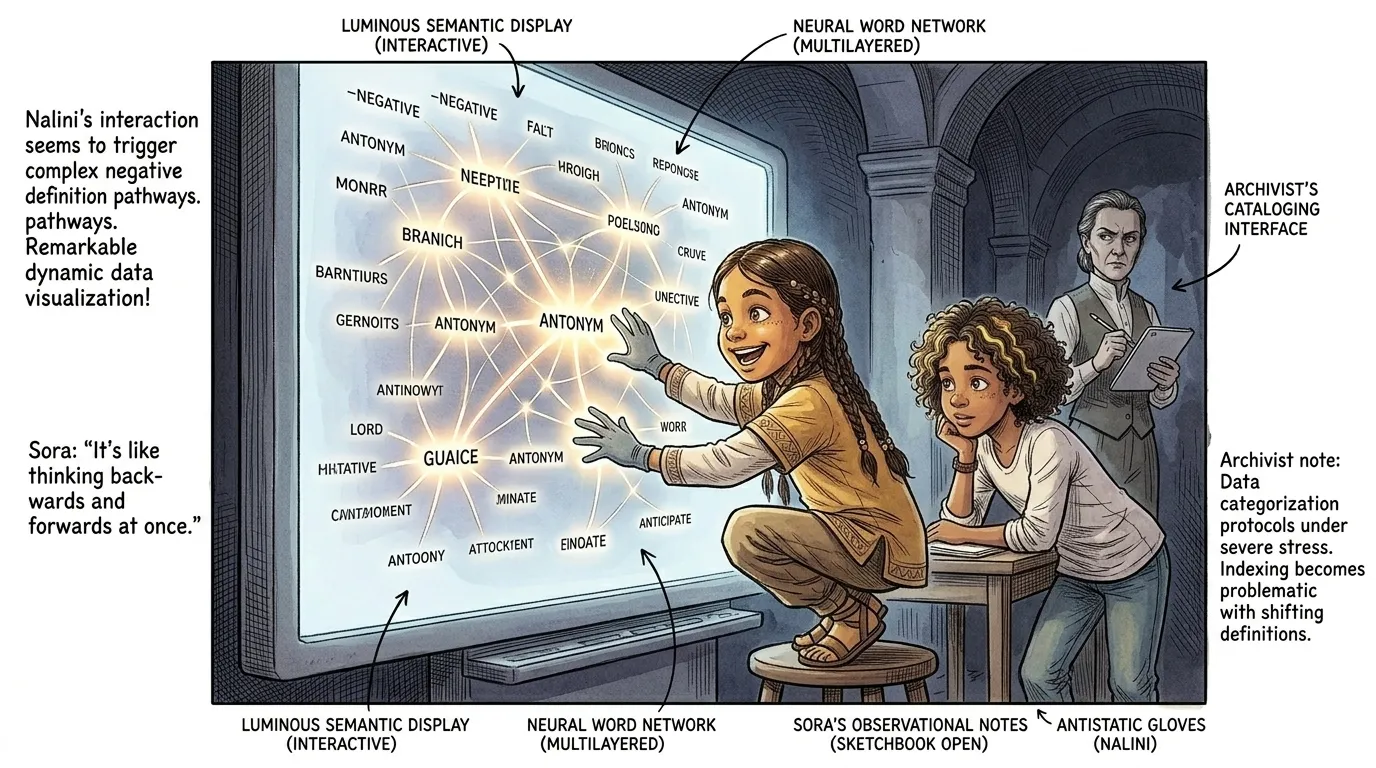
They moved to a section with a large, interactive display that showed how words were connected to each other, like a vast spiderweb. When they touched one word, it didn't just highlight its 'fixed' meaning, but also all the other words it was not, and all the meanings it could become depending on context. It was a dizzying, beautiful dance of potential.
"'This is amazing, Sora! When I touch 'light,' it doesn't just show me the definition of light, but also everything that is not light, like 'darkness,' and all the different ways 'light' can be used, like 'light in spirit' or 'light a fire,' Nalini exclaimed excitedly. 'It's like words are always moving and changing!' Sora agreed. 'Yes! Derrida called this 'différance'—a blend of 'difference' and 'deferral.' It means that meaning is never fully present in a single word. It's always defined by its differences from other words, and it's always deferred, meaning it's never completely finished or stable. It's an endless play of possibilities!'"
Philosophy Note: Derrida's concept of 'différance' is one of his most complex and central ideas. It deliberately plays on the French words 'différer' (to differ) and 'différer' (to defer), suggesting that meaning is constituted through a system of differences between signs and is perpetually postponed, never fully present or ultimately resolved. This challenges the notion of a stable, self-contained meaning for any given text or concept.
Page 7
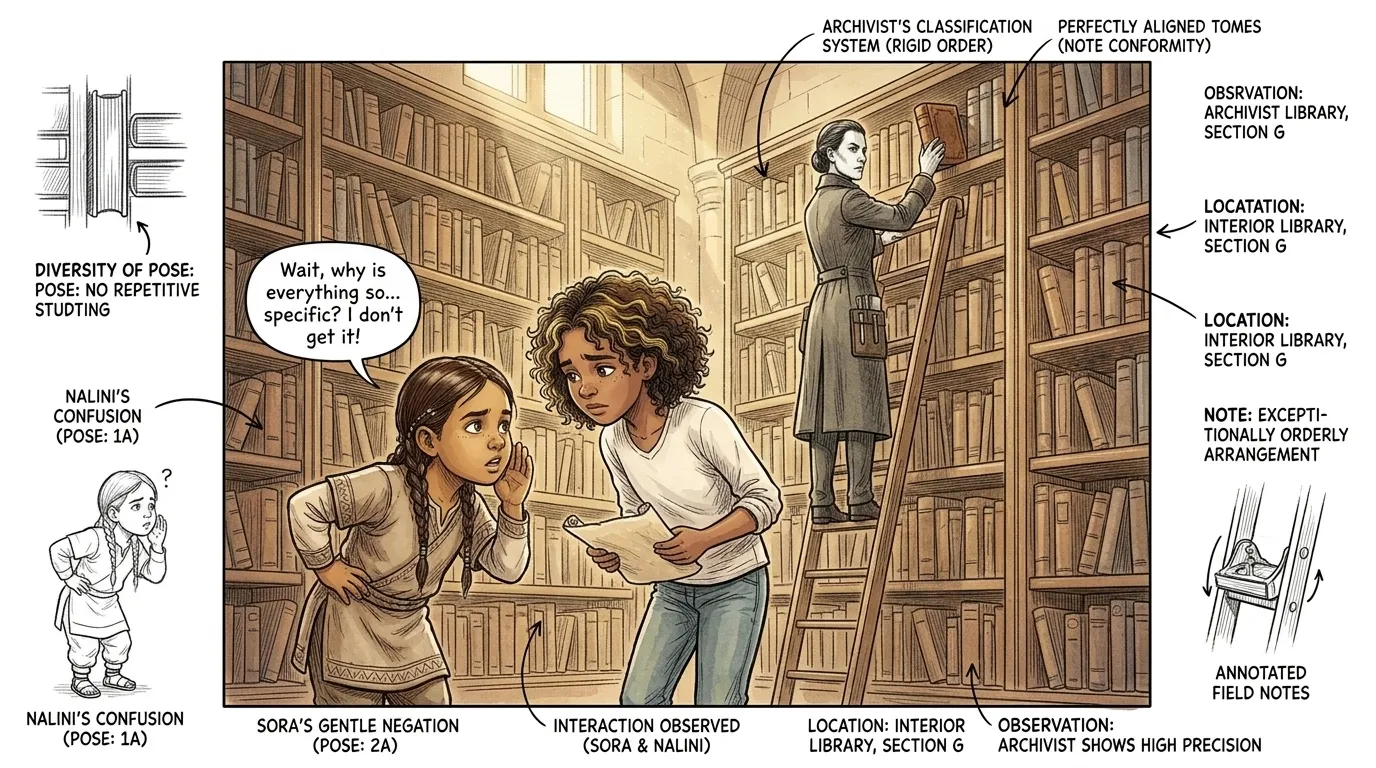
As they explored, they encountered a stern-looking archivist who was meticulously organizing books according to very strict, unquestionable categories. The archivist seemed to believe that every book had one, singular purpose and place, and any deviation would cause chaos. Nalini felt a pang of confusion, wondering if questioning meanings would just make everything fall apart. Sora, however, remembered a powerful thought about connections and change.
"'If every meaning can shift, does that mean nothing is real, and everything is just confusing?' Nalini whispered, glancing at the rigid archivist. Sora shook her head gently. 'Not at all! Derrida wasn't saying meaning doesn't exist, but that it's more complex and fluid than we often assume. As the great Roman philosopher Seneca the Younger once said, 'Every new beginning comes from some other beginning's end.' This means that even when we think something is completely new or fixed, it's always connected to what came before, just like how understanding a word often relies on knowing other words. It's about seeing those connections, not destroying them.'"
Philosophy Note: Deconstruction is often misunderstood as nihilism or simply dismantling meaning. However, Derrida stressed that it is not about destroying meaning but about understanding its construction, its inherent instability, and the implicit hierarchies within language and thought. His work is a rigorous philosophical engagement, not a dismissal of meaning, but a deeper inquiry into its conditions of possibility.
Page 8
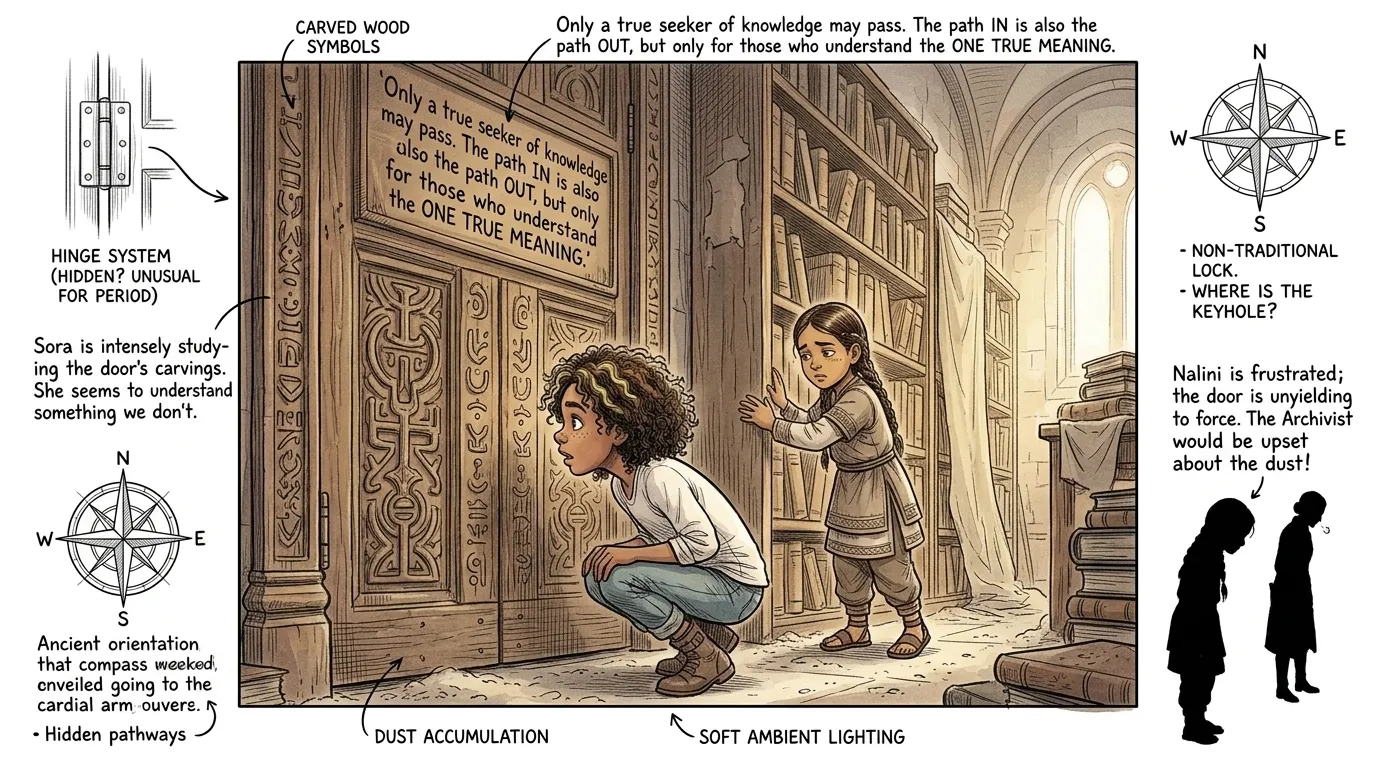
Further into the forgotten wing, they found themselves facing an ancient, heavily carved wooden door. Above it, an enigmatic inscription read: 'Only a true seeker of knowledge may pass. The path IN is also the path OUT, but only for those who understand the ONE TRUE MEANING.' Nalini felt a knot of frustration, thinking they were truly stuck, but Sora recalled their earlier discoveries about how words could conceal more than one interpretation, and how binaries were not always as solid as they seemed. They looked at the inscription again, but with fresh eyes.
"'Oh no, Sora! 'The path IN is also the path OUT,' but then it says 'ONE TRUE MEANING'! That just sounds like the riddle we couldn't solve before,' Nalini sighed, pushing gently on the unyielding door. 'We're trapped!' Sora paused, then her eyes lit up. 'Wait! Remember what Derrida taught us about those binary oppositions like 'in' and 'out'? They're not always separate! And meaning isn't fixed! What if 'the path IN' isn't a physical path, but an idea? What if 'ONE TRUE MEANING' is actually a trick, and the real way out is to see that 'in' and 'out' are just two sides of the same journey of understanding? Maybe the 'true meaning' is that there are many true meanings!'"
Philosophy Note: This scenario demonstrates a practical application of deconstruction. By challenging the binary opposition of 'in/out' and the assumption of a 'one true meaning,' Sora and Nalini can rethink the problem. Deconstruction teaches us to look for the implicit hierarchies, the suppressed meanings, and the interdependence of concepts, thereby opening up new interpretations and possibilities that were previously obscured by conventional thinking.
Page 9
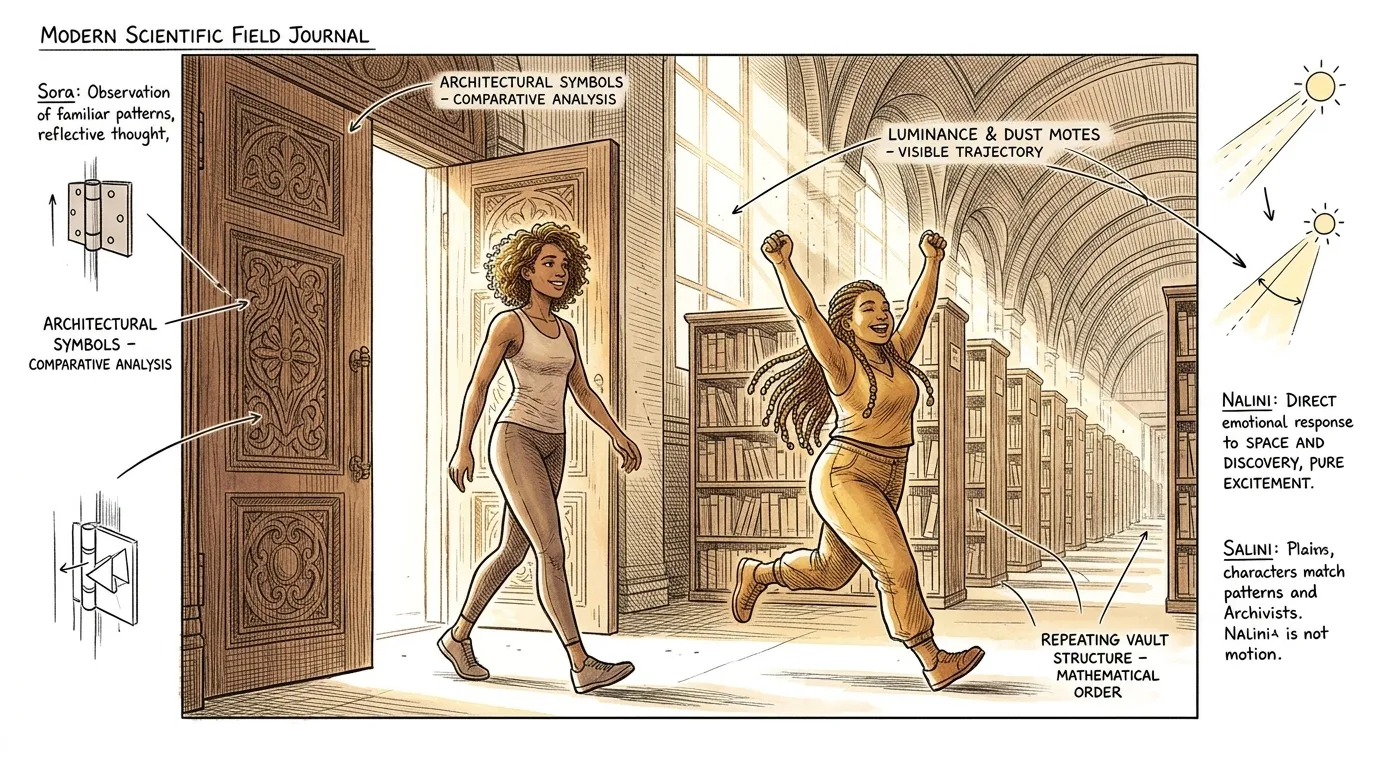
Suddenly, with a soft click, the heavy door swung inward, revealing not another dark corridor, but a sunlit hall that led directly back to the main, familiar part of the library. They had found their way by embracing complexity, not rigid rules. As they walked through the sun-drenched aisles, Sora reflected on how these ideas connected to the world beyond the archive walls.
"'We did it, Sora! We weren't trapped after all, we just had to think differently about the words!' Nalini cheered, skipping ahead. Sora smiled. 'Exactly! Understanding Derrida helps us think critically about all the messages, rules, and stories we encounter every day. It teaches us not to just accept things at face value, but to ask: Who made this rule? What assumptions is it built on? What alternative meanings could there be? It helps us to be more thoughtful and aware citizens in a complex world.'"
Philosophy Note: Derrida's work remains highly relevant today, particularly in literary criticism, legal theory, and cultural studies. It encourages a critical posture towards institutions, dominant narratives, and power structures embedded in language. By revealing the constructed nature of meaning and the instability of foundational concepts, deconstruction provides tools for analyzing bias, questioning authority, and fostering a more nuanced understanding of complex social and political issues.
Page 10
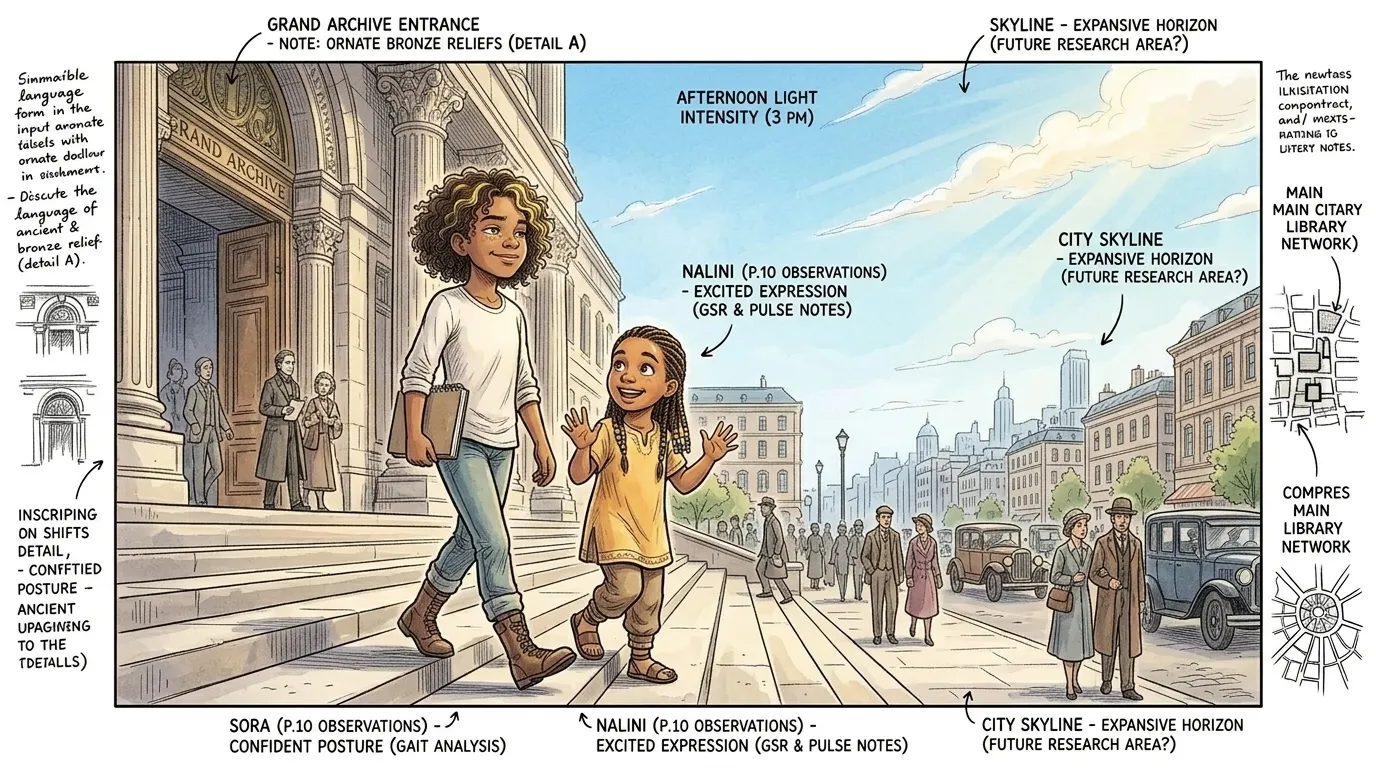
They emerged from the Grand Archive, blinking in the bright afternoon light of the city, their minds buzzing with new insights. The world around them, once seemingly straightforward, now appeared rich with layers of meaning and interpretation. Nalini felt empowered by the idea that she could question and explore, and Sora knew this journey of critical thought was just beginning.
"'So, it means we get to question everything and look for different possibilities, even when someone says there's only one way?' Nalini asked, her eyes wide with newfound excitement. 'That's so much more interesting than just accepting what you're told!' Sora nodded, a thoughtful smile playing on her lips. 'Absolutely. Embracing the complexity that Derrida showed us isn't about chaos; it's about deeper understanding. It empowers us to think for ourselves, to unpack assumptions, and to find richer, more inclusive ways of making sense of our world. It's a never-ending adventure in thought!'"
Philosophy Note: Derrida's legacy lies in his radical re-evaluation of Western metaphysics and language. Deconstruction continues to be a vital methodology for scholars and critical thinkers across disciplines, promoting a rigorous skepticism towards self-evident truths and encouraging constant vigilance against the subtle workings of power through linguistic and conceptual structures. It remains an essential framework for navigating the complexities of identity, knowledge, and culture in the modern era.
About this story
- Audience: kids (ages 6–12)
Questions and answers
Read Wonder Philosophy on your phone
Wonder Philosophy is available on Android and iPhone and iPad. Get Wonder Philosophy on Google Play · Get Wonder Philosophy on the App Store.