Gilles Deleuze
Gilles Deleuze — an illustrated philosophy story. 10 illustrated pages, free to read on Wonder Philosophy.

Page 1
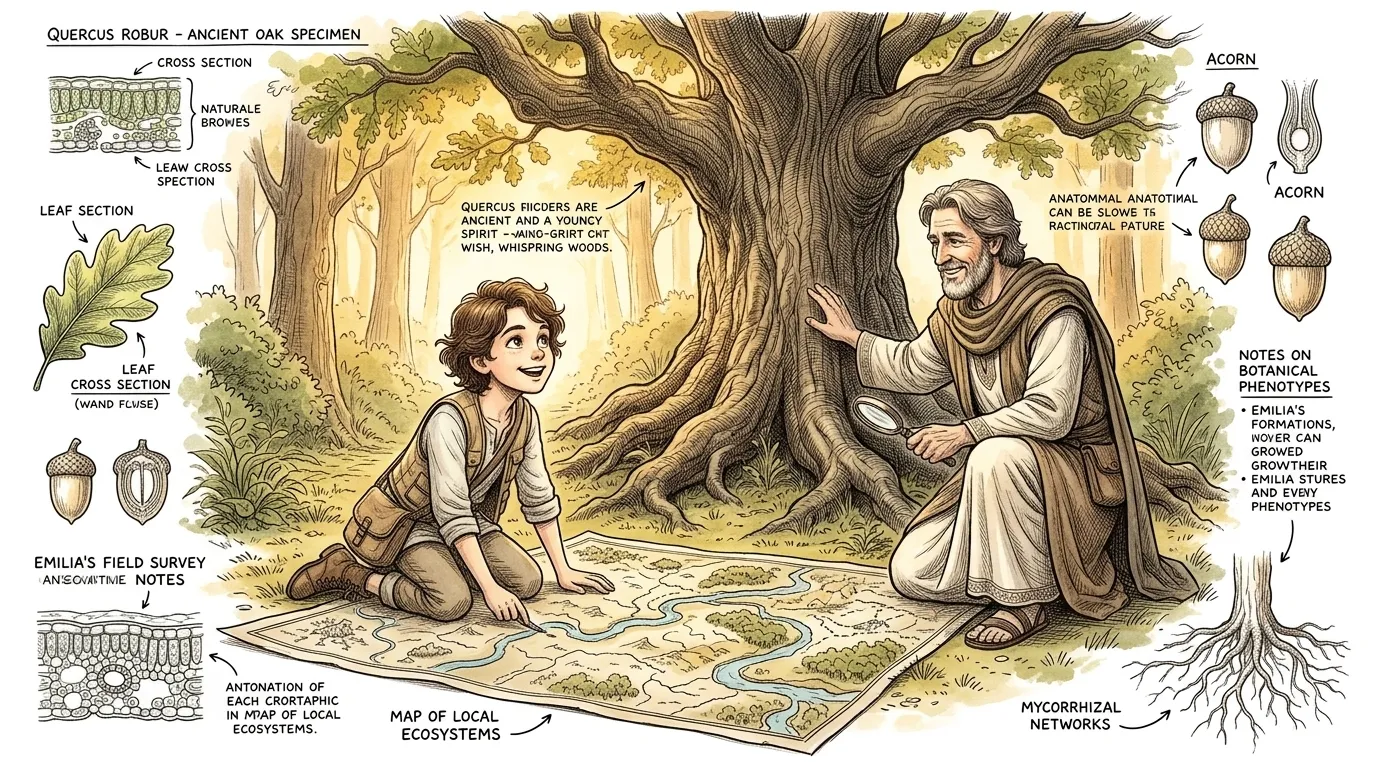
Emilia and Rafael stood at the edge of the whispering woods, a map spread between them. The old paper showed a single, clear path leading to the hidden waterfall, but Emilia saw a problem. "It says to follow the winding river, Rafael," she pointed, "but the riverbank looks too steep here."
"'Maybe there's another way, a secret way?' she wondered aloud, looking past the obvious trail. Rafael smiled, his eyes twinkling as he glanced towards a massive, ancient oak tree nearby."
Philosophy Note: Gilles Deleuze, a French philosopher, often challenged conventional 'linear' ways of thinking, suggesting that reality is far more interconnected and less hierarchical than typically assumed.
Page 2
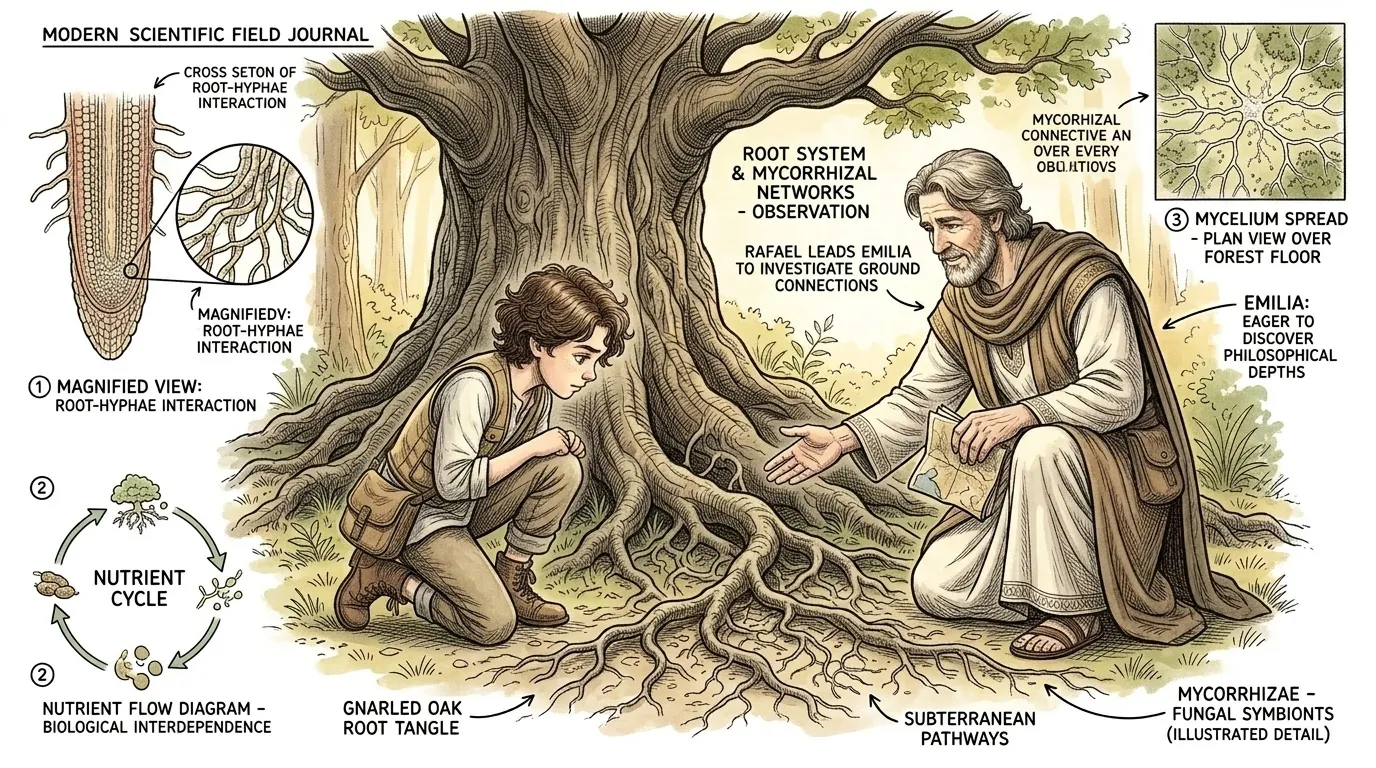
Rafael gently folded the map. "Sometimes, the most interesting paths aren't the ones drawn on paper, Emilia," he explained, leading her closer to the giant oak. He knelt beside a tangle of roots that snaked out from the tree's base, disappearing and reappearing in the earth.
"'Look at these roots. They don't just go straight down from the trunk, do they?' he asked. 'They spread out everywhere, connecting in all sorts of surprising ways under the ground. A thinker named Gilles Deleuze talked about how many things in the world work like this.'"
Philosophy Note: The concept of the 'rhizome,' developed by Deleuze and Guattari, describes a non-hierarchical, non-linear system of organization, contrasting with tree-like (arborescent) structures. It emphasizes interconnectedness and multiple entry/exit points.
Page 3
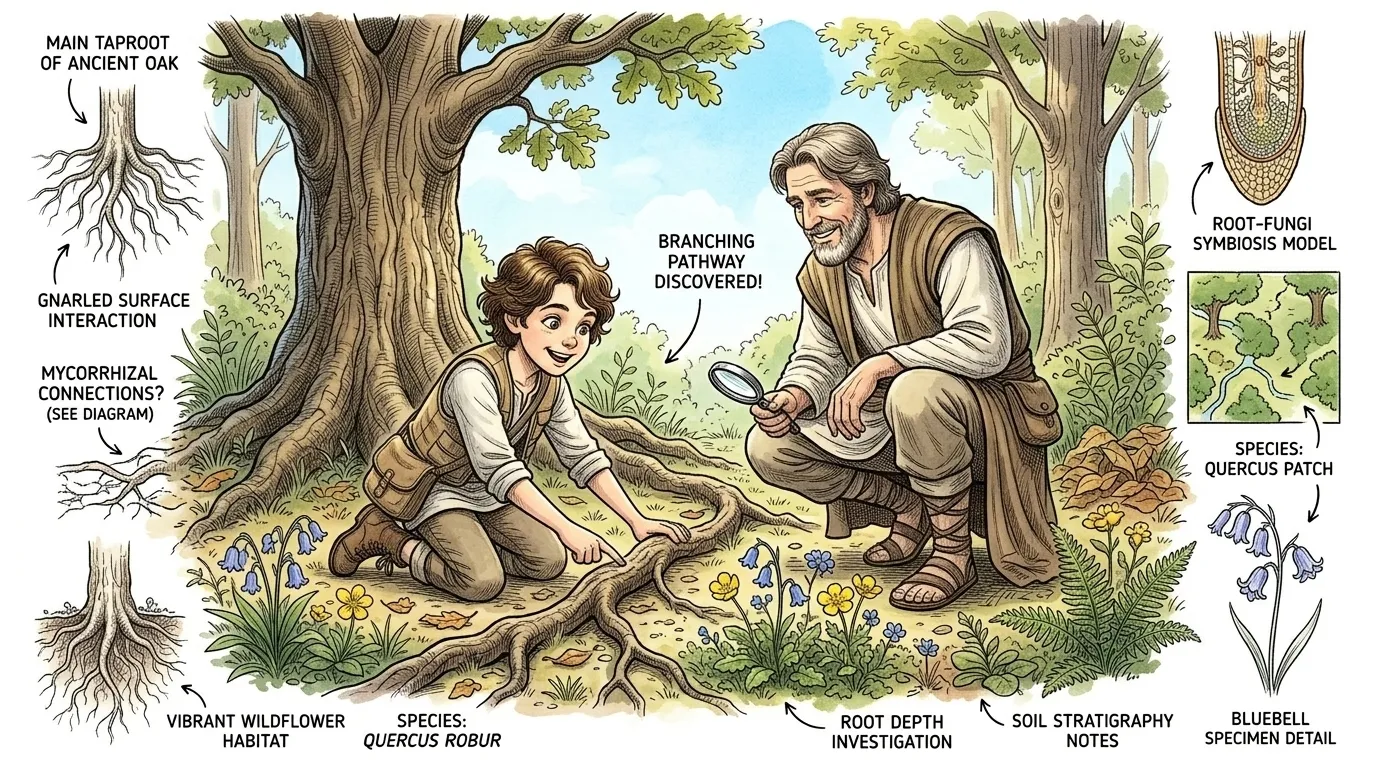
Emilia knelt too, tracing a gnarled root with her finger. "It's like a secret underground web!" she exclaimed, discovering a smaller root that branched off in an unexpected direction, leading towards a patch of wildflowers. Rafael nodded, pleased.
"'Exactly!' he confirmed. 'Deleuze called this a 'rhizome' — a way of growing and connecting that isn't central or linear, but spreads out, creating pathways everywhere. It's like how ideas can link up in surprising ways, not just in a straight line from one to the next.'"
Philosophy Note: A 'rhizome' is characterized by its horizontal, non-structured growth, challenging traditional classifications and hierarchies. It has no beginning or end, always in the middle, creating connections between heterogeneous points.
Page 4
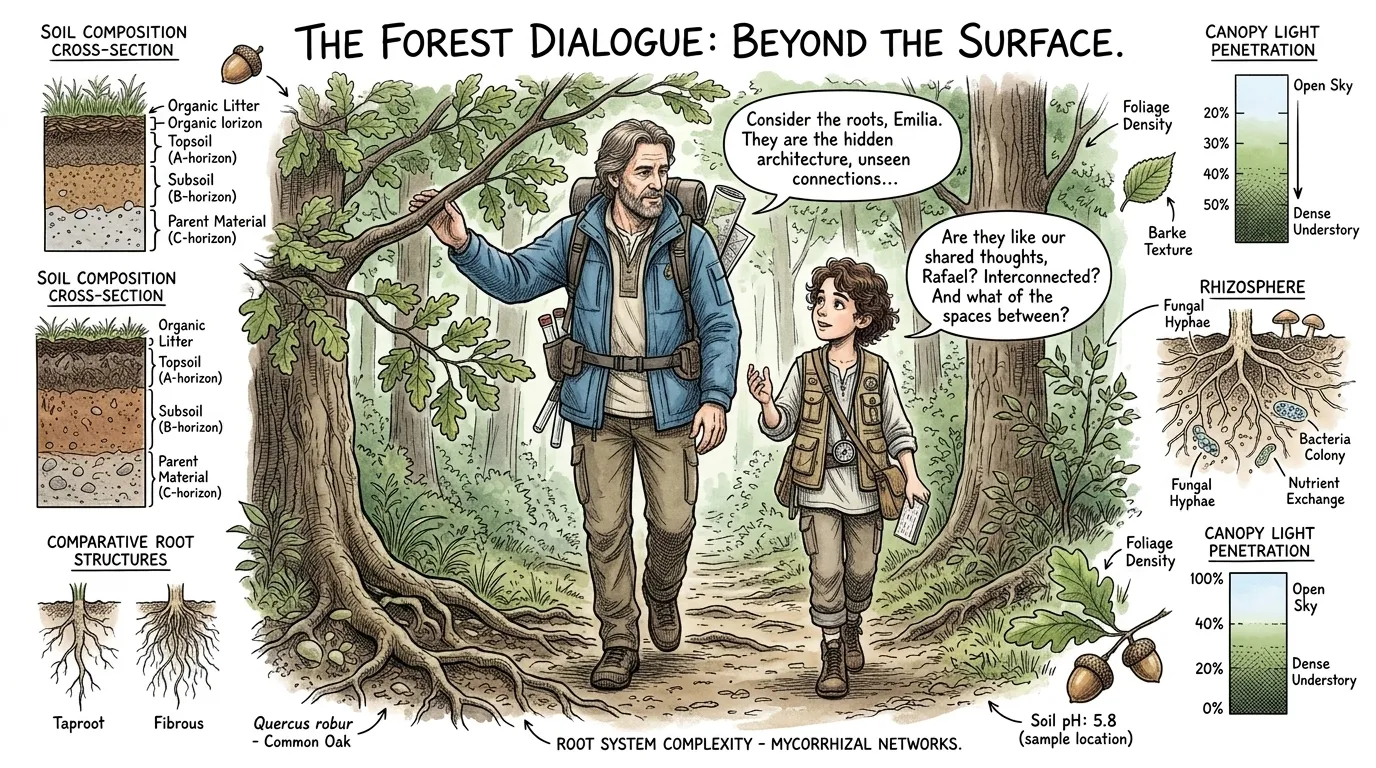
They continued walking, leaving the great oak behind, but Emilia kept thinking about the roots. "So, it means there's no main root, just lots of connected ones?" she asked, trying to understand fully. Rafael pushed aside a low-hanging branch.
"'Precisely,' he replied. 'Unlike a tree, which grows up from a single trunk, a rhizome can have many entry and exit points, connecting in unexpected ways. Deleuze thought that sometimes, our minds work best when we think like a rhizome, making connections we never expected.'"
Philosophy Note: Deleuze advocated for 'lines of flight' and 'deterritorialization' – moving beyond rigid structures and established paths to explore new possibilities and connections. This fosters creativity and resists categorization.
Page 5
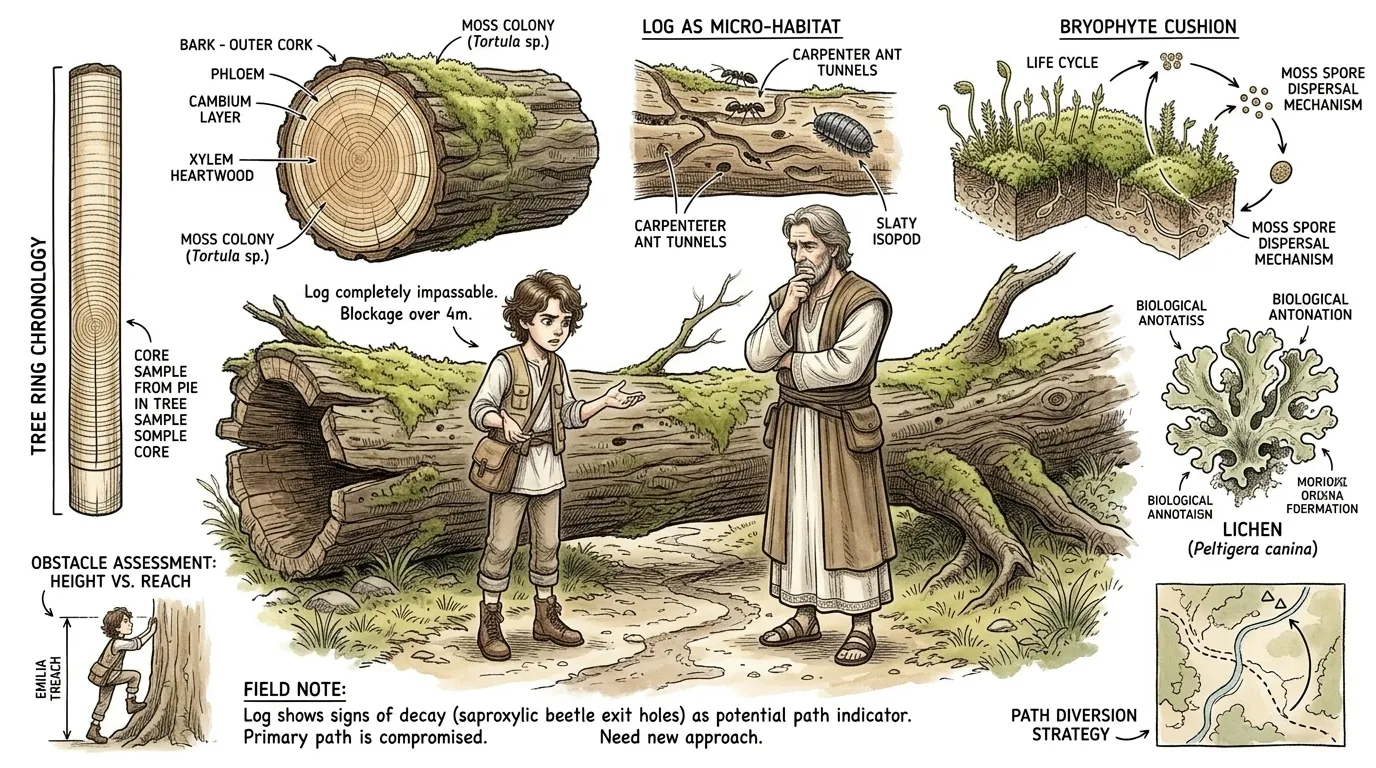
Suddenly, their winding path came to an abrupt halt. A massive fallen log, covered in moss, completely blocked their way forward. Emilia sighed, seeing no obvious way around it, as the map offered no alternative.
"'Oh no, the path is completely blocked!' she exclaimed, her shoulders slumping. 'The map only shows this one way to the waterfall, and we can't go over or under this giant log!' Rafael surveyed the situation with a thoughtful expression, tapping his chin."
Philosophy Note: A common challenge in problem-solving is becoming stuck on a single, linear solution, ignoring alternative connections or 'lines of flight' that could offer a way forward.
Page 6
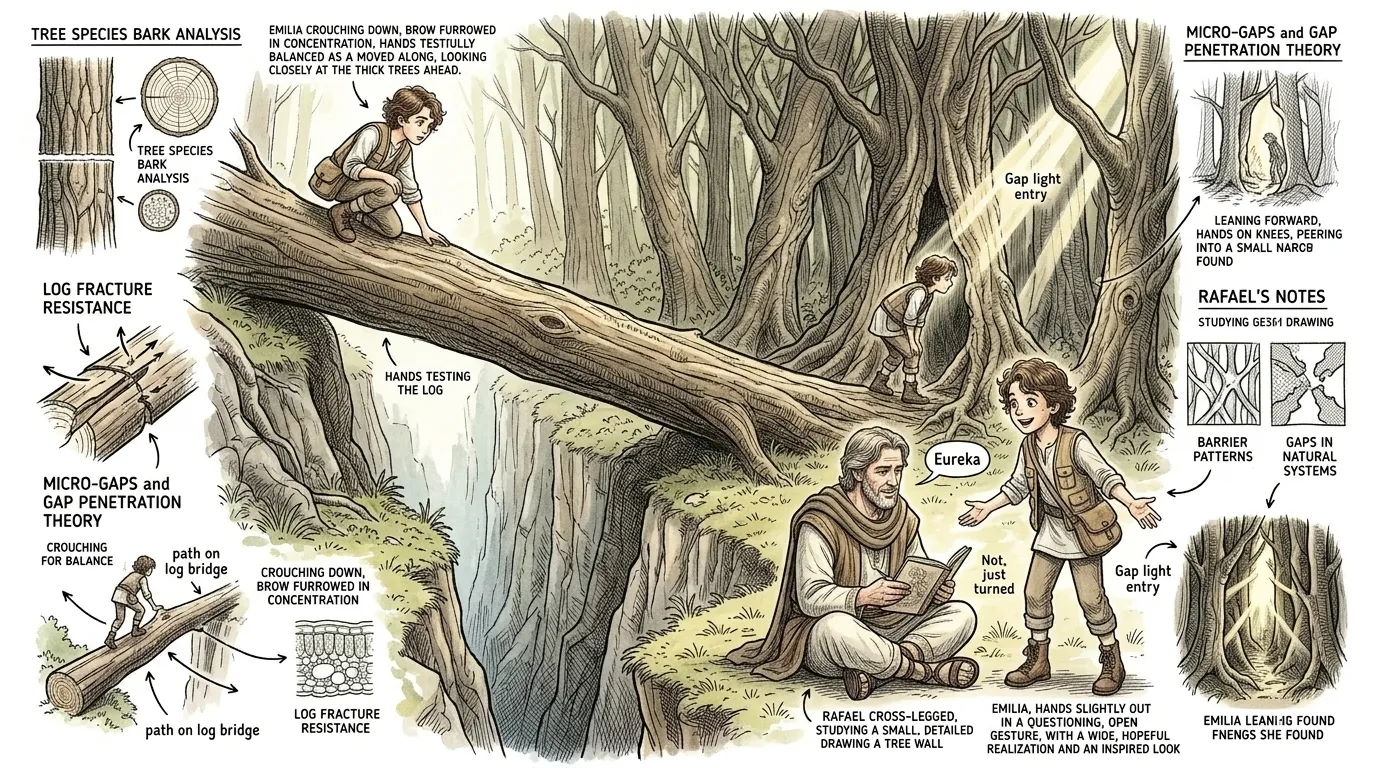
Emilia walked along the enormous log, searching for any small gap, but found none. The trees here grew thick and close, making it impossible to walk around. She felt a familiar frustration building, the kind where her mind felt stuck.
"'We can't just stand here,' she murmured, then suddenly her eyes widened. 'Wait! What if we don't think like a straight line? What if we think like those tangled roots, like Gilles Deleuze said?' she asked, looking at Rafael hopefully."
Philosophy Note: Applying rhizomatic thinking to a problem involves looking for non-obvious connections, tangential paths, and multiple points of entry or departure, rather than adhering to a predefined, hierarchical structure.
Page 7
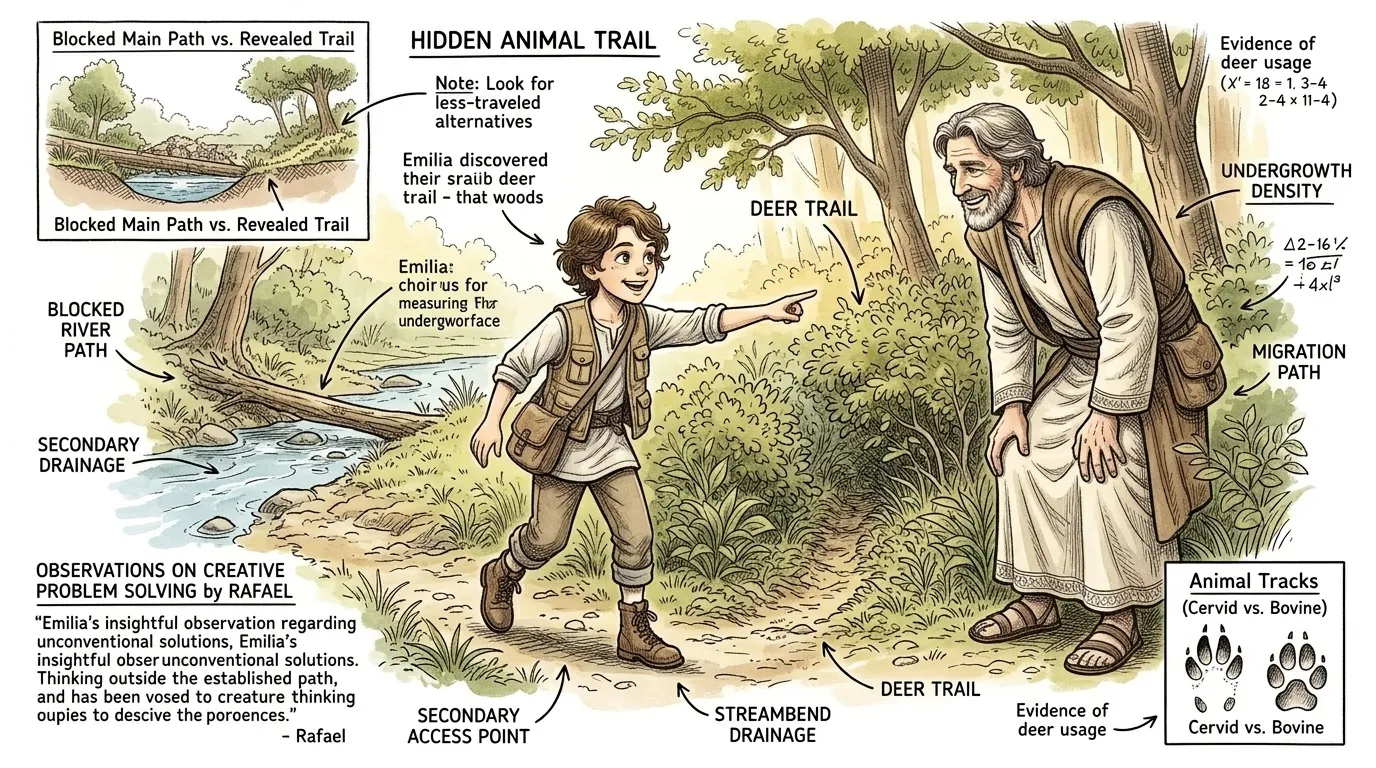
Rafael's smile broadened. "Excellent thinking, Emilia! Where would a rhizome look for a way around? Not necessarily forward, but perhaps sideways, or even a bit backward to find a new connection?" Emilia looked around with fresh eyes, no longer just at the blocked path.
"'Look!' she exclaimed, pointing to a barely visible deer trail that veered sharply into the dense undergrowth, away from the river. 'It's not on the map, and it's not a clear path, but it's a connection, just like those roots!'"
Philosophy Note: This moment embodies the Deleuzian idea of 'deterritorialization' – breaking free from established territories or paths to create new connections and possibilities. The deer trail represents a 'line of flight' not accounted for by the main map.
Page 8
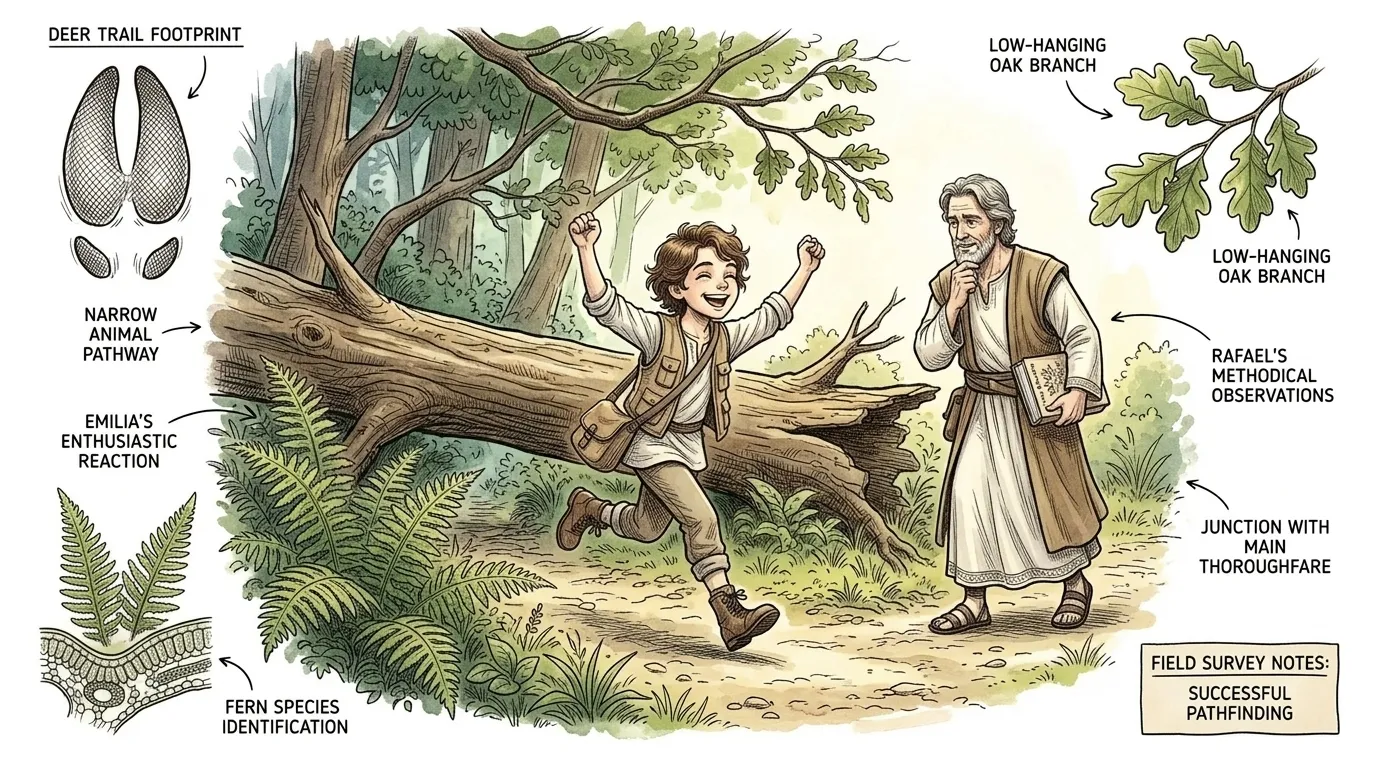
They carefully followed the narrow deer trail, pushing through ferns and ducking under branches. It wasn't easy, but the path clearly led around the massive log, taking them deeper into the unexplored part of the woods. Emilia felt a thrill of victory with every step.
"'We did it!' Emilia cheered, emerging onto the main path beyond the obstacle. 'That was much better than just stopping! It's like finding a new kind of map in your head.' Rafael nodded, a thoughtful expression on his face, as the sound of the waterfall grew louder."
Philosophy Note: The successful navigation around the obstacle by using 'rhizomatic' thinking demonstrates the practical application of Deleuze's philosophy in problem-solving, emphasizing adaptability and the search for multiple connections.
Page 9
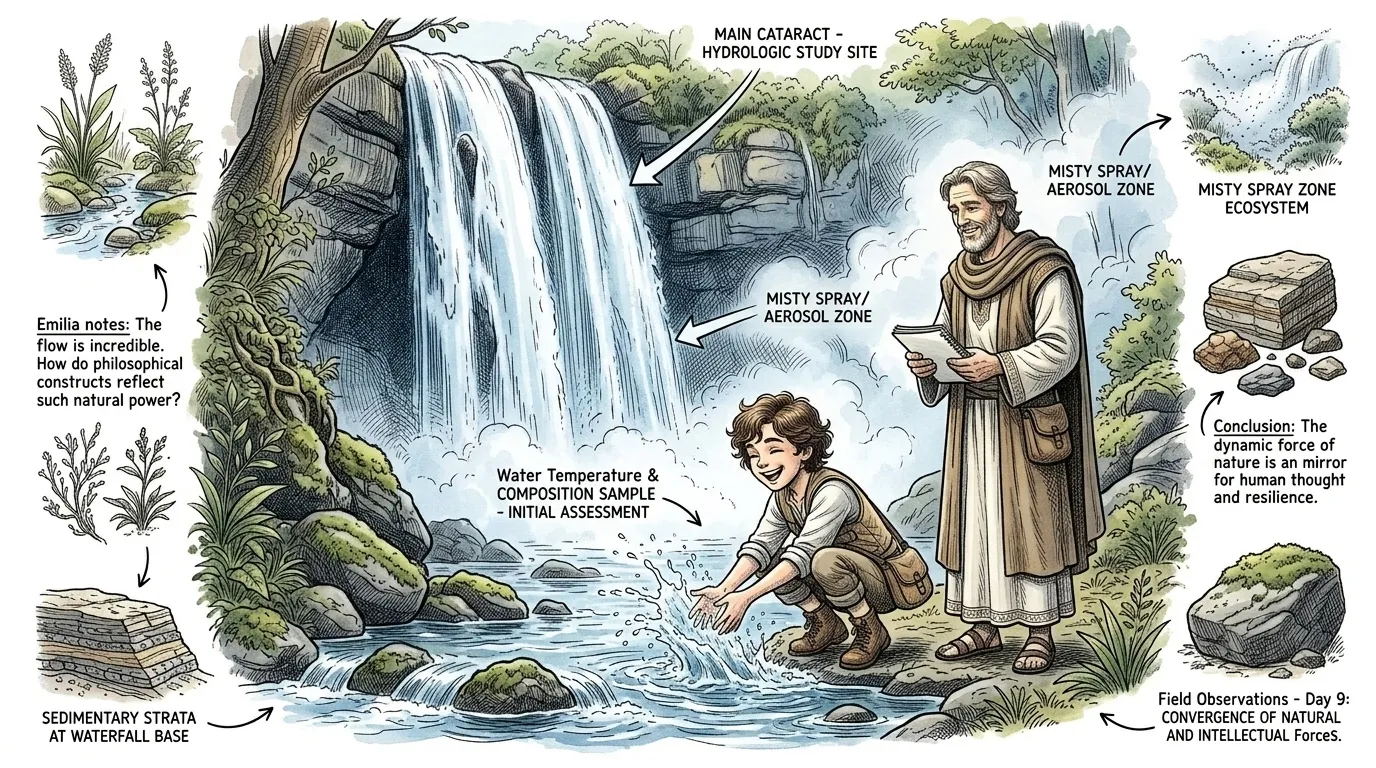
Finally, they reached the roaring waterfall, its misty spray cooling their faces. The water tumbled down a series of rocky steps, not a single drop following a perfectly straight line. Emilia smiled, thinking of the tangled roots and their detour.
"'That was a much better way to find the waterfall, even if it wasn't on the map,' she said, splashing her hand in a cool stream. Rafael agreed, adding, 'It makes me think of what Albert Einstein once said: "Logic will get you from A to B. Imagination will take you everywhere." That's a bit like thinking rhizomatically, isn't it?'"
Philosophy Note: Albert Einstein's quote highlights the value of creative, non-linear thought. This resonates with Deleuze's philosophy, which encourages moving beyond rigid, 'logical' frameworks to embrace more fluid and imaginative ways of understanding the world.
Page 10
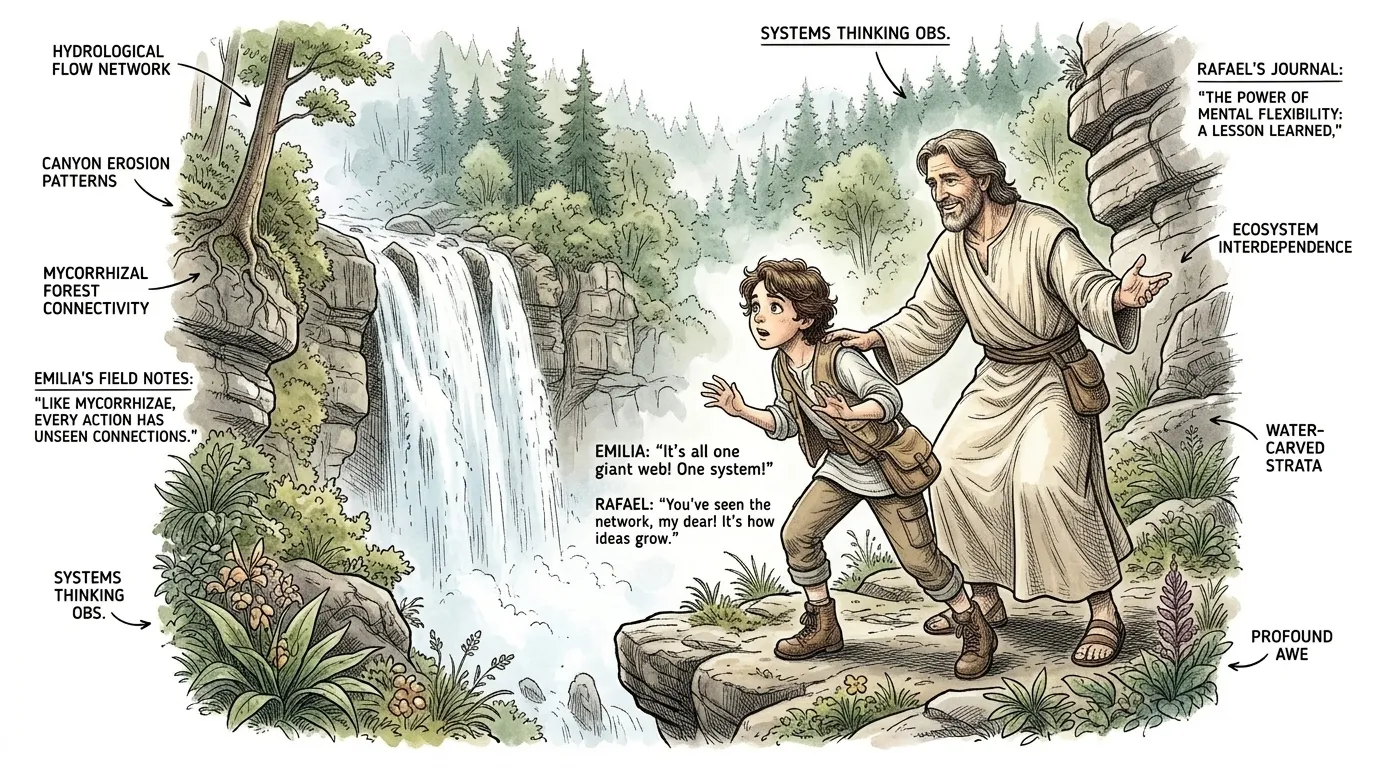
Emilia gazed at the water, then at the surrounding forest, seeing a million tiny connections everywhere she looked. She realized that problems, like paths, don't always have just one solution. There are always other ways to link ideas and find solutions.
"'So, the world is full of these rhizomes, if you just know how to look for them,' Emilia mused, a new understanding dawning in her eyes. 'It means we can always find new ways to connect and discover things, even when the straight path is blocked!' Rafael smiled proudly, knowing she had grasped an important lesson about the power of flexible thinking."
Philosophy Note: Deleuze's philosophy encourages a continuous exploration of connections and a rejection of rigid systems. This 'rhizomatic' approach fosters adaptability, innovation, and a deeper appreciation for the complex, interwoven nature of reality, reminding us that knowledge is always in flux and interconnected.
About this story
- Audience: kids (ages 6–12)
Read Wonder Philosophy on your phone
Wonder Philosophy is available on Android and iPhone and iPad. Get Wonder Philosophy on Google Play · Get Wonder Philosophy on the App Store.