Hannah Arendt
Hannah Arendt — an illustrated philosophy story. 10 illustrated pages, free to read on Wonder Philosophy.

Page 1
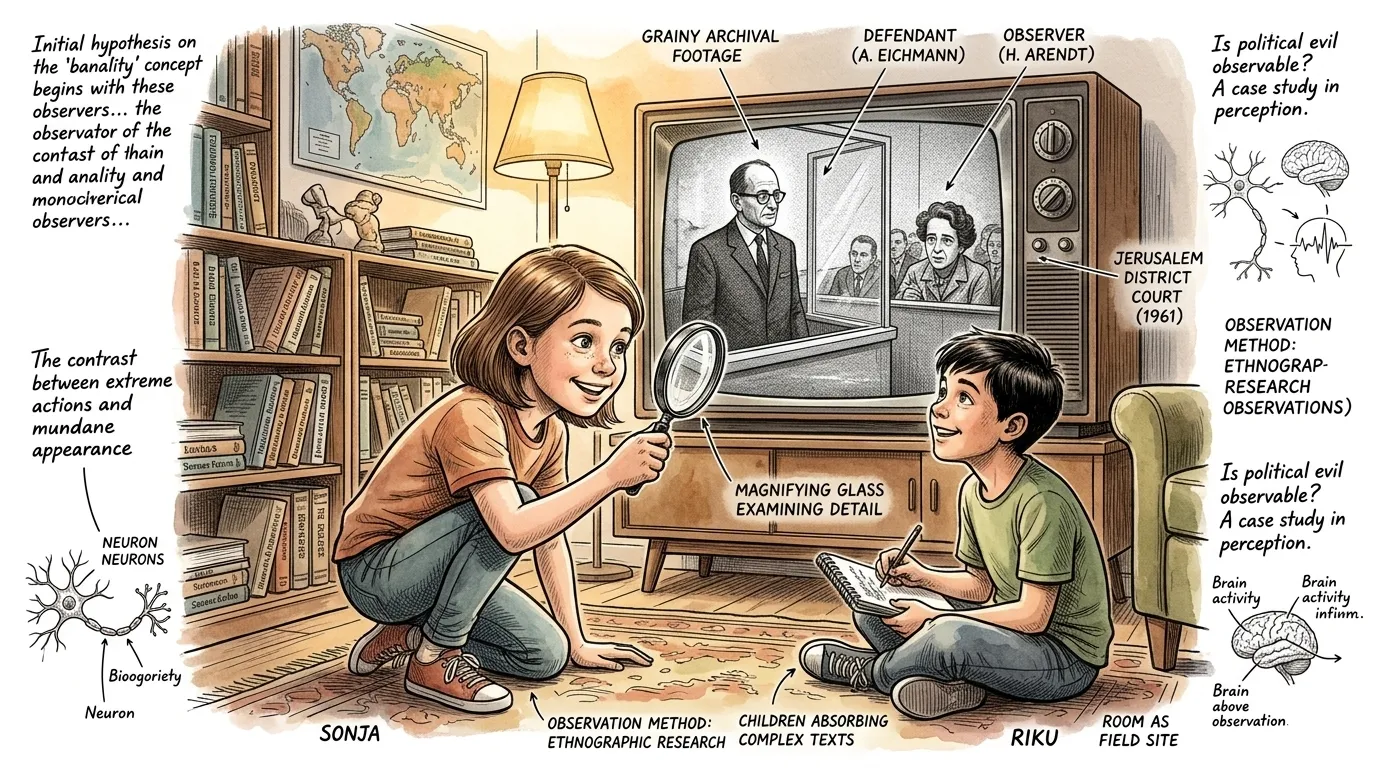
At the Jerusalem District Court, a man named Adolf Eichmann stood accused, not of monstrous cruelty, but of seemingly ordinary bureaucratic acts. Thousands watched, expecting to see a demon, but Hannah Arendt saw something far more chilling: a man who simply never truly thought about the consequences of his actions. This profound insight, 'the banality of evil,' reshaped our understanding of human responsibility.
""Look at the crowd, Riku," Sonja whispered, pointing at the grainy footage. "They're all waiting to see pure evil." Riku nodded, his eyes fixed on the screen. "But Arendt said he wasn't monstrous, just... thoughtless. How can that be?""
Philosophy Note: Hannah Arendt (1906-1975) was a German-born American political theorist. Her report on the 1961 trial of Adolf Eichmann in Jerusalem introduced the controversial concept of 'the banality of evil,' arguing that profound evil can be committed by ordinary people who fail to think critically and exercise moral judgment.
Page 2
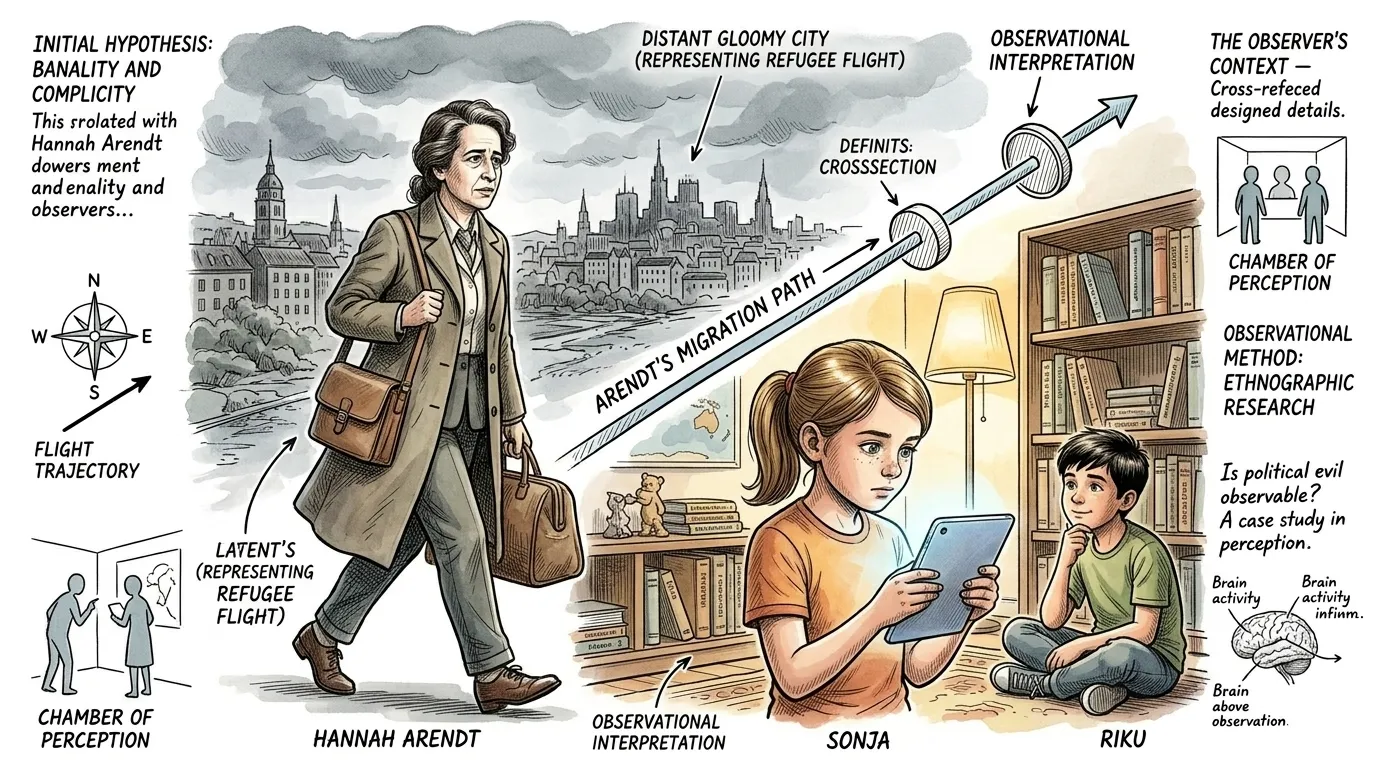
Arendt's own life was profoundly marked by the rise of totalitarianism. As a Jewish intellectual in Germany, she fled the Nazi regime, becoming a stateless refugee. Her personal experience of displacement and persecution fueled her lifelong quest to understand how societies could descend into such brutality, and what it meant to lose one's place in the world. She studied deeply with influential philosophers, yet carved her own distinct path.
""Arendt escaped Nazi Germany herself," Sonja observed, reading from her tablet. "That must have shaped everything she thought about." Riku nodded thoughtfully. "Her mentors were powerful thinkers, but she refused to simply repeat their ideas. She saw how important it was to think for yourself, especially when facing something truly new and terrible.""
Philosophy Note: Arendt's intellectual journey began with existential philosophy, notably under Martin Heidegger and Karl Jaspers. However, her direct experience with totalitarianism compelled her to shift her focus from purely theoretical philosophy to political theory, seeking to understand the nature of power, freedom, and human action in the modern world.
Page 3
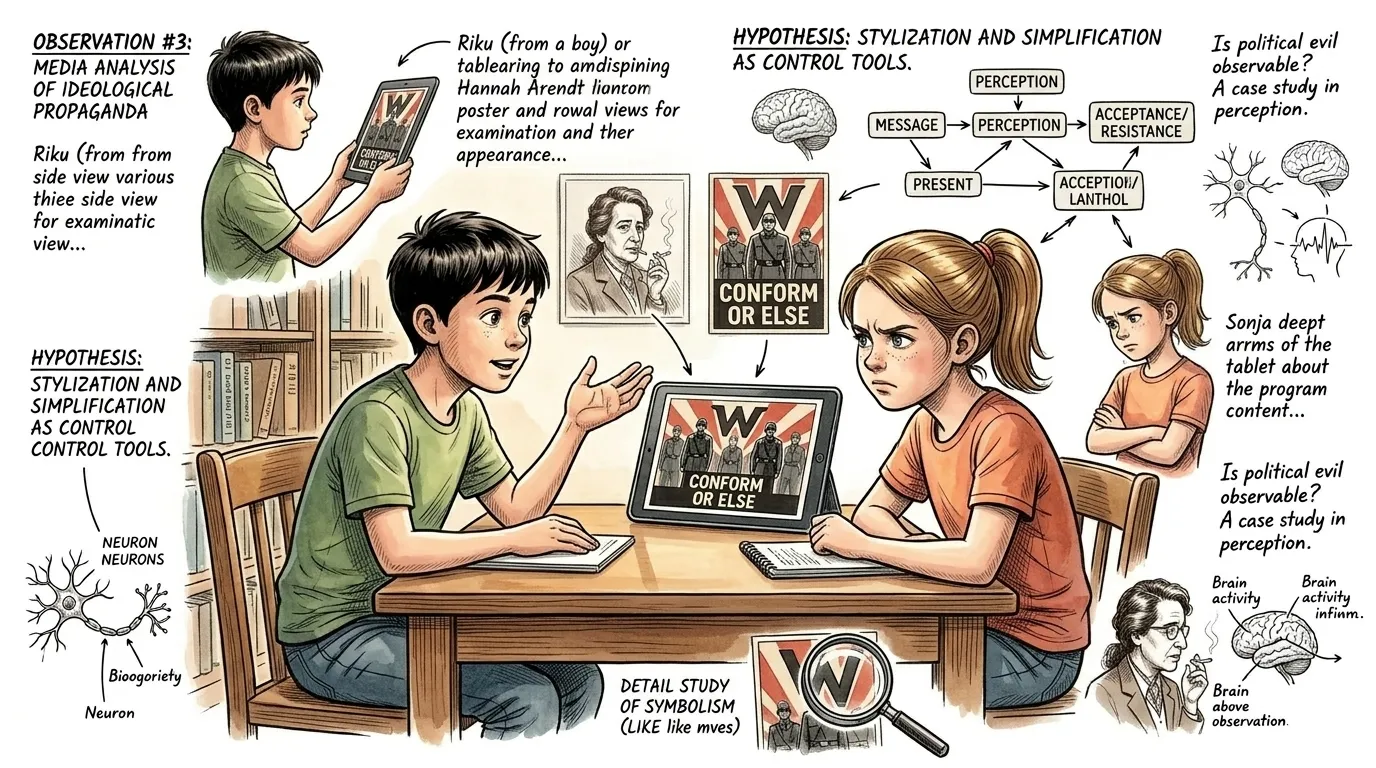
Arendt saw totalitarianism, not merely as an extreme form of tyranny, but as a completely new political structure. It didn't just seek to control actions; it aimed to control thought itself, isolating individuals and eroding their ability to form independent judgments. This system thrives when people passively accept narratives without critical engagement, creating a terrifying vacuum where individual responsibility dissolves. The very fabric of human connection and shared reality is systematically dismantled.
""Arendt wasn't just talking about dictatorships," Riku explained, gesturing to an image of a propaganda poster on his tablet. "She said totalitarianism was different—it tried to make people stop thinking for themselves entirely." Sonja frowned. "So, it's not just about obeying orders, but about losing the ability to even question them?""
Philosophy Note: In 'The Origins of Totalitarianism' (1951), Arendt distinguished totalitarian regimes (like Nazi Germany and Stalinist Russia) from traditional tyranny. She argued that totalitarianism aims for total domination, transforming human nature itself by destroying individuality, isolating people, and forcing them into a consistent, ideological worldview.
Page 4

When Arendt attended the Eichmann trial, she encountered not a monster, but a man who appeared utterly commonplace. Eichmann was a diligent bureaucrat, focused on logistics and career advancement, who simply did his job, which happened to be organizing the genocide of millions. His defense was that he was 'just following orders,' revealing a chilling detachment from the human consequences of his actions. This profound lack of self-reflection, rather than deep-seated hatred, formed the core of what Arendt termed 'the banality of evil.'
""The shocking thing wasn't how evil Eichmann looked, but how normal," Sonja stated, pointing to a photo of Eichmann on her tablet. Riku added, "Arendt realized he wasn't driven by fanaticism, but by a failure to think, to put himself in the place of his victims. He was just a cog in a machine.""
Philosophy Note: Arendt's book 'Eichmann in Jerusalem: A Report on the Banality of Evil' (1963) documented the trial. She observed that Eichmann seemed to lack any profound motives, displaying a disturbing inability to think about the moral implications of his actions, reducing the atrocities he organized to mere administrative tasks.
Page 5
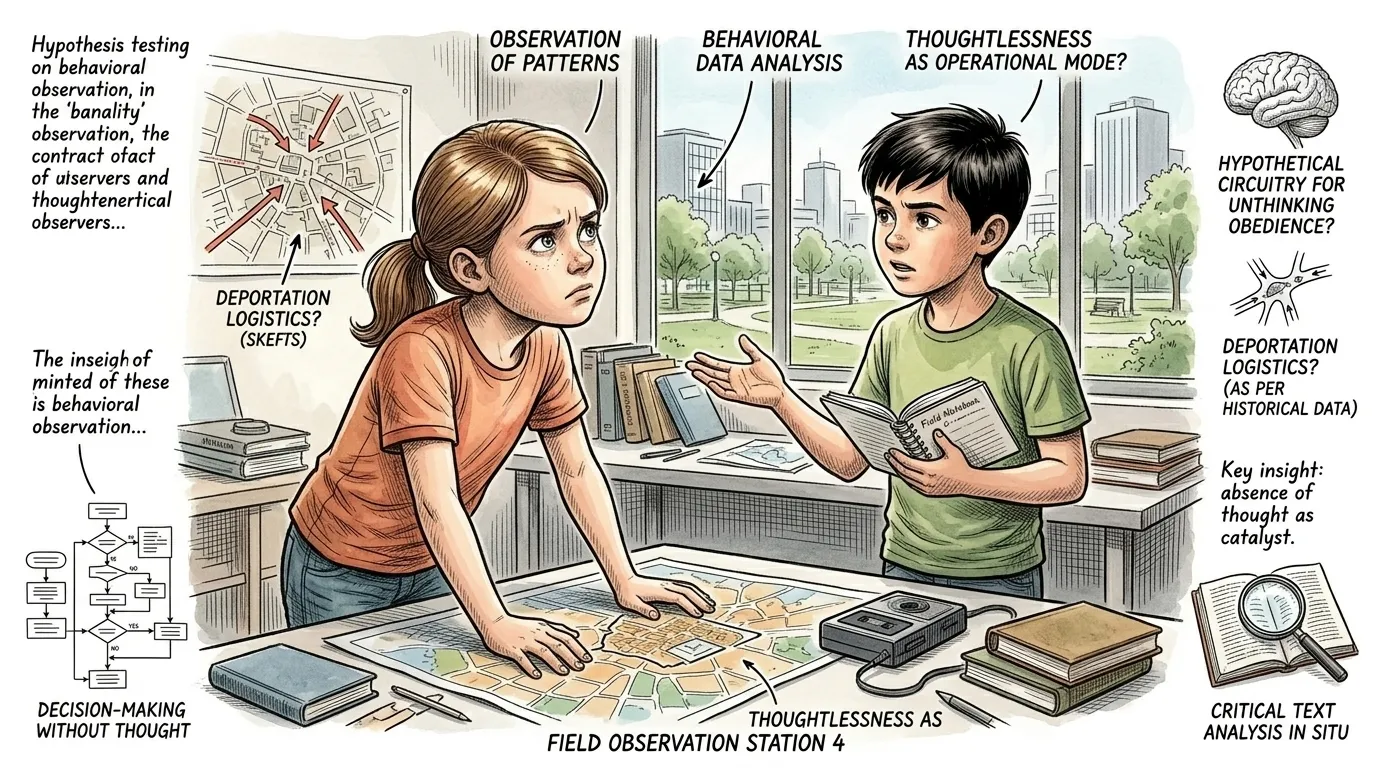
Arendt argued that Eichmann's evil stemmed from 'thoughtlessness,' a profound inability to engage in inner dialogue or reflect on his actions from different perspectives. He operated on clichés, bureaucratic procedures, and a desire to fit in, never truly grappling with the reality of what he was doing. This wasn't ignorance, but an active refusal to think, to exercise one's faculty of judgment. For Arendt, this failure to think was a more terrifying source of evil than any monstrous intention, because it could arise in anyone.
""So, it wasn't that he wanted to be evil, but that he just... didn't think?" Sonja asked, her brow furrowed. Riku replied, "Exactly. He couldn't imagine himself in another person's shoes, or even challenge his own beliefs. He just followed the rules without question.""
Philosophy Note: Arendt differentiated 'thoughtlessness' from 'stupidity' or 'ignorance.' It was, for her, a failure to activate the mind's capacity for judgment and self-reflection, to engage in the inner 'two-in-one' dialogue, which prevents individuals from critically evaluating their actions and their world.
Page 6

For Arendt, true human freedom lay in the capacity for 'action,' which she distinguished from mere labor or work. Action involves initiating something new, engaging in public life, and speaking with others to shape a shared world. This 'vita activa,' or active life, is where individuals can assert their unique identities, challenge norms, and collectively create meaning. It is precisely this public space for action that totalitarianism seeks to annihilate, reducing citizens to isolated, unthinking cogs in a machine.
""Arendt believed that to truly be human, we have to act in the world, not just follow along," Riku explained, pointing to a diagram he sketched on his tablet showing different spheres of human activity. "She called it the 'vita activa' – an active life of thinking and engaging with others." Sonja nodded. "So, when people stop thinking and acting, that's when totalitarianism can take root?""
Philosophy Note: In 'The Human Condition' (1958), Arendt outlined three fundamental human activities: labor (biological necessity), work (creating artificial objects), and action (direct interaction among people in the public sphere). Action, for Arendt, is the highest and most political form of human activity, enabling freedom and the revelation of unique human identity.
Page 7

Arendt's 'Banality of Evil' ignited immense controversy. Many critics accused her of excusing Eichmann's crimes or blaming the victims, deeply misunderstanding her intention. She was not denying the horror of the Holocaust or suggesting Eichmann was innocent. Instead, she sought to understand the mechanisms by which such evil could occur, how ordinary individuals could participate without fitting the traditional image of a demonic villain. Her aim was to warn against the dangers of thoughtlessness itself, not to mitigate guilt.
""A lot of people were furious with Arendt's ideas," Sonja said, scrolling through articles on her tablet. "They thought she was making excuses for Eichmann." Riku shook his head. "But she was trying to show something more dangerous: that evil isn't always monstrous. It can be alarmingly ordinary, born from a failure to think and judge, not necessarily from a deep hatred.""
Philosophy Note: The controversy surrounding 'Eichmann in Jerusalem' highlighted the difficulty of confronting uncomfortable truths about the nature of evil. Arendt consistently clarified that her concept did not absolve Eichmann, but rather focused on a distinct phenomenon: the execution of evil by those who do not reflect on its moral implications, often driven by careerism and obedience.
Page 8

Arendt believed that the ability to 'think' – to engage in silent inner dialogue, to question one's own assumptions, and to view the world from multiple perspectives – was humanity's best defense against the 'banality of evil.' This act of thinking leads to 'judging,' the capacity to distinguish right from wrong without relying on pre-established rules. She didn't offer easy answers, but a profound challenge: that each person holds the responsibility to actively think and judge, especially when faced with collective pressures or bureaucratic systems. To simply follow along without internal scrutiny is to open the door to unthinkable horrors.
""So Arendt's big message was that thinking isn't just about facts, but about judging for ourselves," Sonja said, looking around the bustling park they were in. "It's about asking 'Is this right?' even when everyone else says it is." Riku nodded firmly. "She once reminded us, like Socrates, that 'The unexamined life is not worth living.' It's about not letting the world make our decisions for us. We have to do the hard work of thinking.""
Philosophy Note: Arendt's later work explored the faculties of thinking and willing. She argued that the capacity for thought, particularly the internal dialogue of 'two-in-one,' is crucial for preventing evil. This ability allows individuals to pause, reflect, and make moral judgments, resisting the passive conformity that characterizes thoughtlessness.
Page 9

Arendt's insights remain acutely relevant in our interconnected world. We constantly face pressures to conform, to accept information without critical scrutiny, and to allow complex moral questions to be reduced to simplistic slogans. From the spread of misinformation in social media echo chambers to the bureaucratic indifference that can perpetuate injustice, the 'banality of evil' serves as a perpetual warning. It urges us to foster environments where critical thinking, open debate, and independent judgment are not just tolerated, but actively celebrated.
""It's like when everyone online starts believing something without checking," Sonja observed, gesturing towards imaginary screens. "Or when a big system makes decisions that hurt people, and no one questions it." Riku agreed. "Arendt would say that's where we need to remember her lesson: actively think, ask questions, and don't let anyone else do your moral work for you.""
Philosophy Note: Arendt's work offers a powerful framework for analyzing contemporary issues like groupthink, political polarization, and the dehumanizing effects of modern bureaucracy. Her call for active citizenship and independent thought is a timeless defense against the dangers of uncritical acceptance and conformity.
Page 10
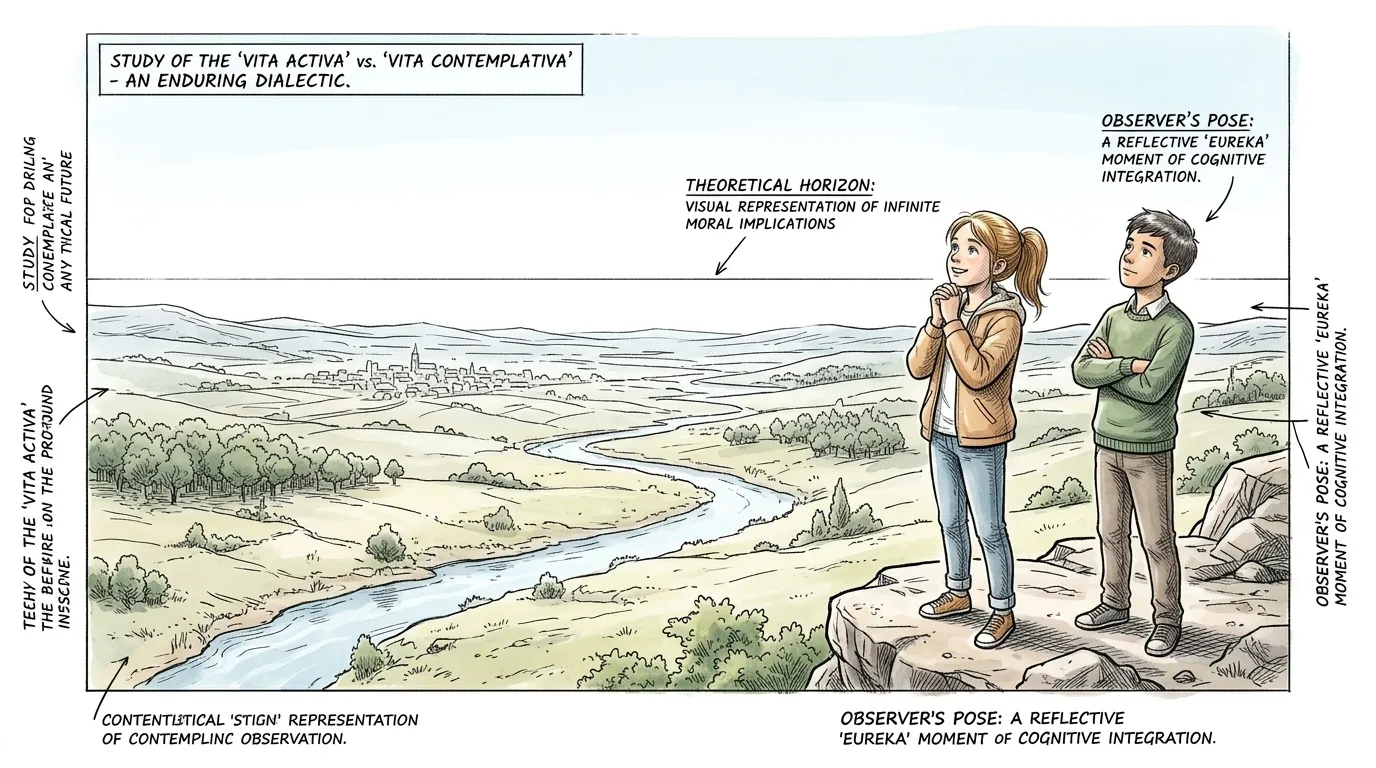
Hannah Arendt's legacy is a profound reminder that political freedom and individual integrity are deeply intertwined with our capacity to think. Her work challenges us to actively engage with the world, to speak truth to power, and to resist the comfort of thoughtlessness, even when it is difficult. In an age of complex global challenges, her insistence on the individual's moral responsibility to think and judge remains a powerful, urgent call to cultivate intellectual courage and participate in the continuous creation of a truly human world. Her philosophy doesn't offer comfort, but demands clarity and conscience.
""Arendt's ideas are tough, but they make you want to think harder," Sonja reflected, looking out at a horizon. Riku added, "It's not enough to be 'good.' We have to be actively thinking good, all the time. That's her real lesson.""
Philosophy Note: Arendt's emphasis on thinking, judgment, and action provides a crucial ethical compass for navigating the complexities of modern political and social life. Her work continues to inspire critical engagement with power structures and to underscore the vital importance of individual conscience in maintaining a free and just society.
About this story
- Audience: general readers
Questions and answers
Read Wonder Philosophy on your phone
Wonder Philosophy is available on Android and iPhone and iPad. Get Wonder Philosophy on Google Play · Get Wonder Philosophy on the App Store.