First Photograph by Nicéphore Niépce (France — 1826)
First Photograph by Nicéphore Niépce (France — 1826) — an illustrated arts story, set in France. 10 illustrated pages, free to read on Wonder Arts.
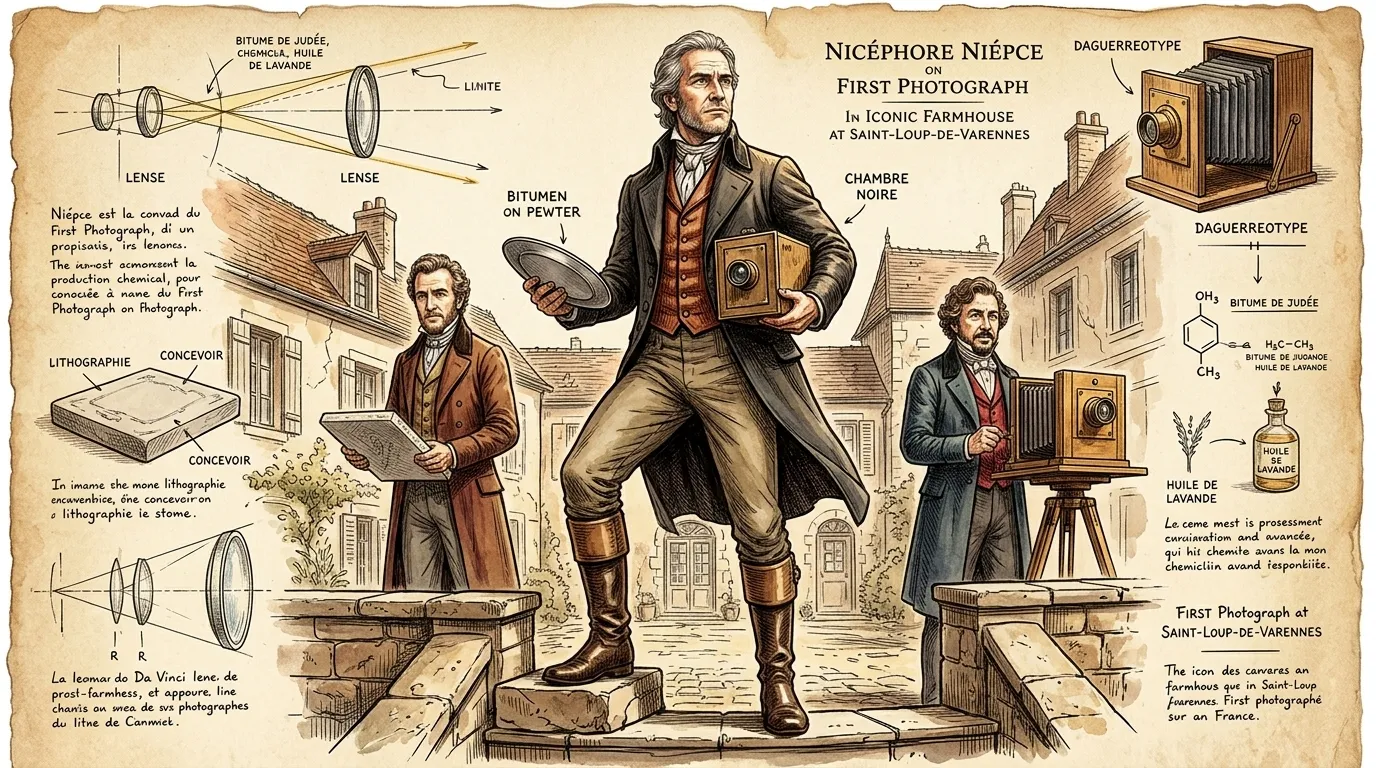
Page 1
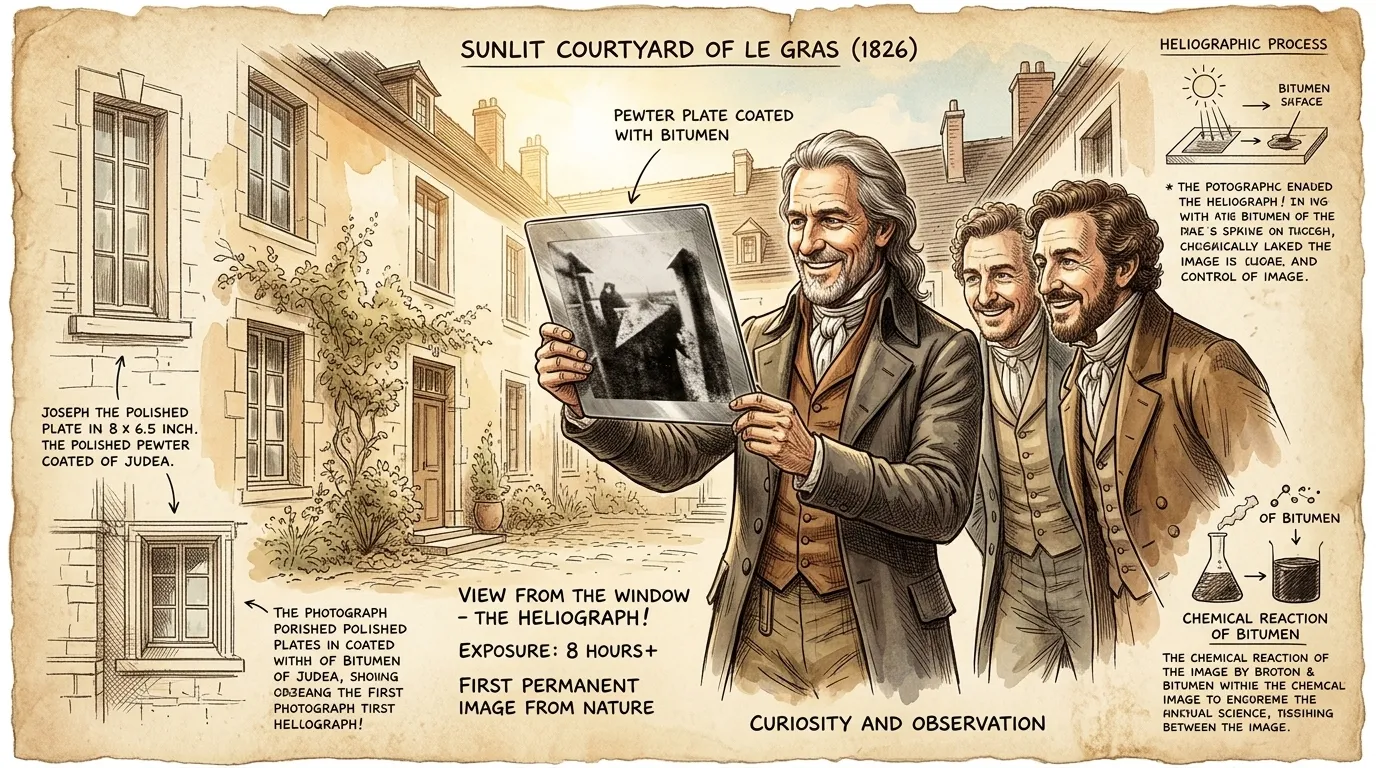
Joseph Nicéphore Niépce, a name often whispered with reverence, stands on the precipice of history in 1826. Before him rests his creation, a blurry yet groundbreaking image titled 'View from the Window at Le Gras'. This unassuming photograph, taken from his estate in France, measures roughly 8 x 6.5 inches. Its creation involved bitumen of Judea, a type of asphalt, spread on a polished pewter plate, exposed to sunlight for at least eight hours. Today, it resides in the Harry Ransom Center at the University of Texas at Austin, a testament to a moment that birthed modern photography.
""This heliograph... it is more than just an image," Niépce murmurs, his eyes reflecting the morning light. "It is a capture of time itself.""
Art Fact: The image was created using a process Niépce called 'heliography,' literally 'sun writing.'
Page 2
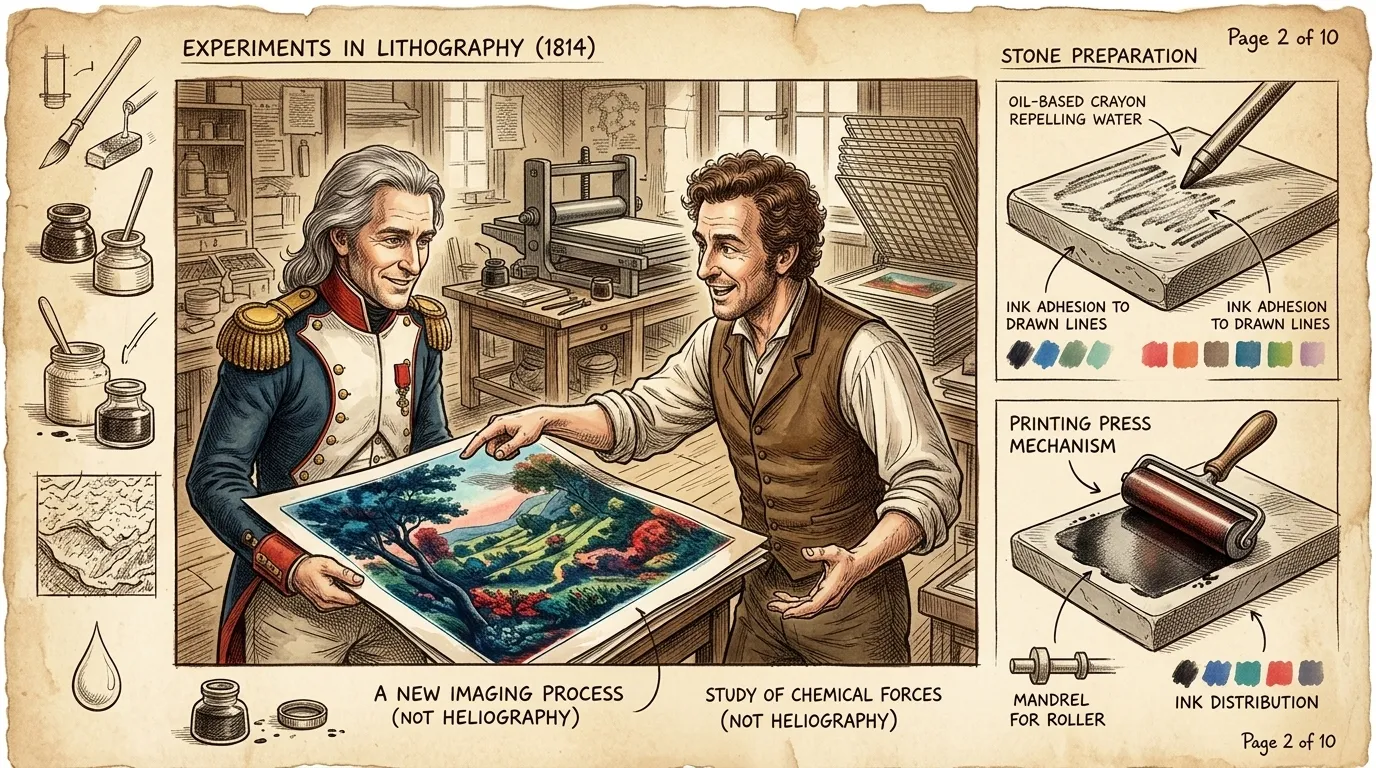
Young Nicéphore, a lieutenant in Napoleon's army, gazes intently at a lithograph. His brother Claude explains the process, the way the greasy crayon repels water, allowing ink to adhere only to the drawn image. "Imagine, Nicéphore," Claude exclaims, "reproducing images endlessly!" This sparked a desire in Niépce to find a way to automate this process, to capture images directly from nature.
""So, you're saying, I could draw the landscape, put it on paper, and reproduce it as many times as I wish?" Nicéphore asked his older brother, Claude. Claude nods. "Precisely! Isn't it amazing?""
Art Fact: Lithography, invented in the late 18th century, allowed for the mass reproduction of images.
Page 3
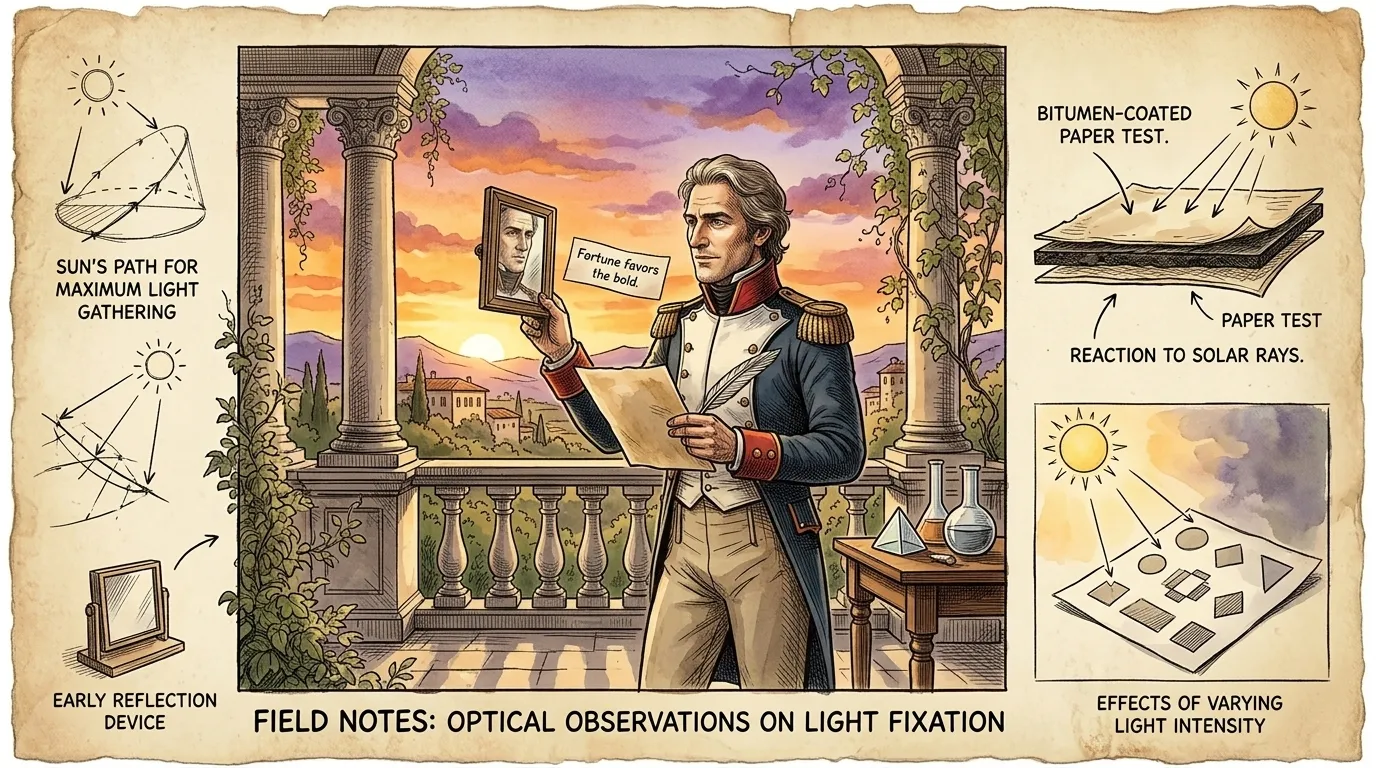
Stationed in Italy, Niépce, then a young lieutenant, finds himself reflecting on the words of Virgil. 'Fortune favors the bold,' the Roman poet had said. Niépce, far from his home and family, starts experimenting with light-sensitive materials. He remembers his love for drawing and how tedious it was. His discovery was the start of his long journey into photography.
""Virgil was right, fortune favors the bold," Nicéphore tells himself, looking at the sunset in Italy. "I must be bold, I must make this happen.""
Art Fact: Niépce's early experiments were hampered by a lack of resources and the distractions of military life.
Page 4
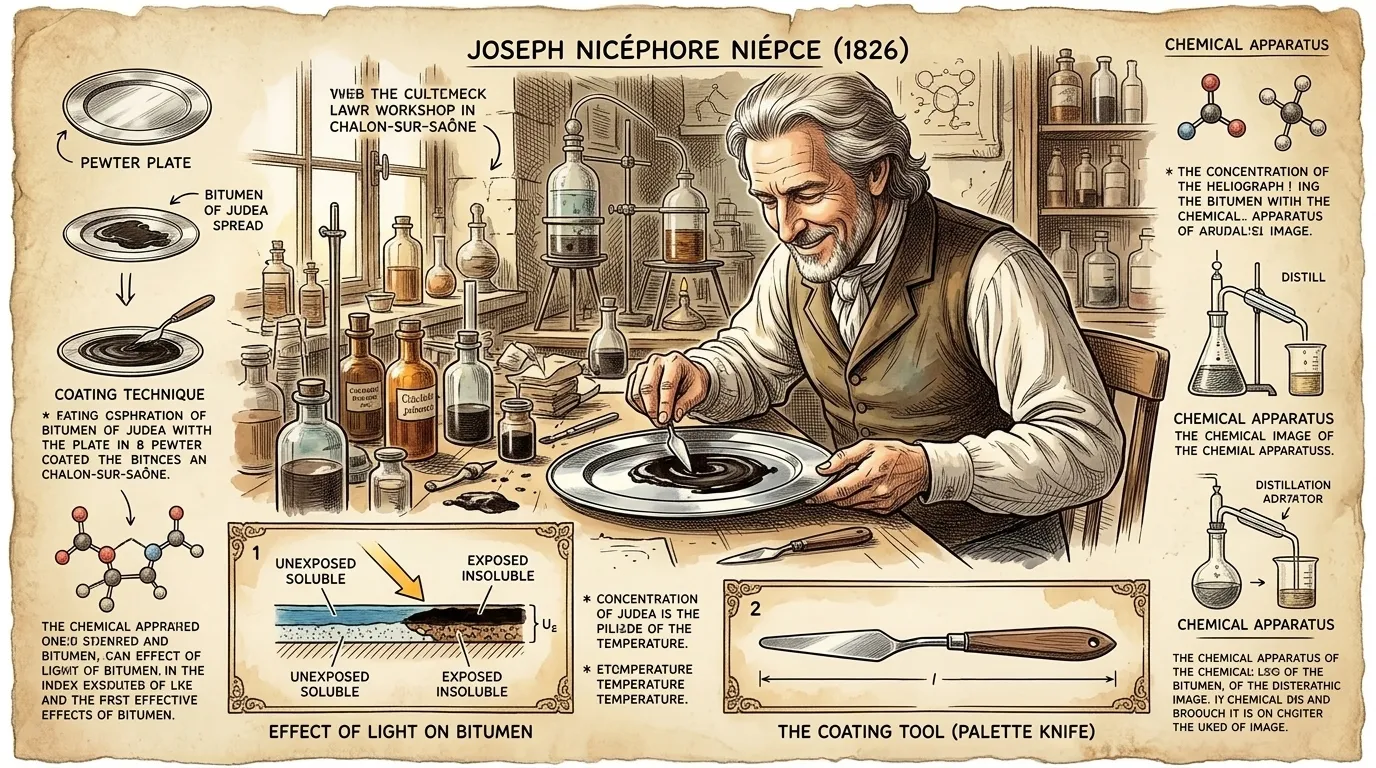
Back in Chalon-sur-Saône, Niépce delves deeper into his experiments. He discovers that bitumen of Judea, a natural asphalt, hardens when exposed to light. This is the key, he believes, to capturing a permanent image. He coats a pewter plate with the bitumen, and the air fills with the scent of chemicals as he meticulously prepares for his next attempt.
""This could be it, my lifelong dream to make a permanent image," Niépce muttered as he spread the bitumen. "Now, for the real test.""
Art Fact: Bitumen of Judea was commonly used in engraving as an acid resist.
Page 5
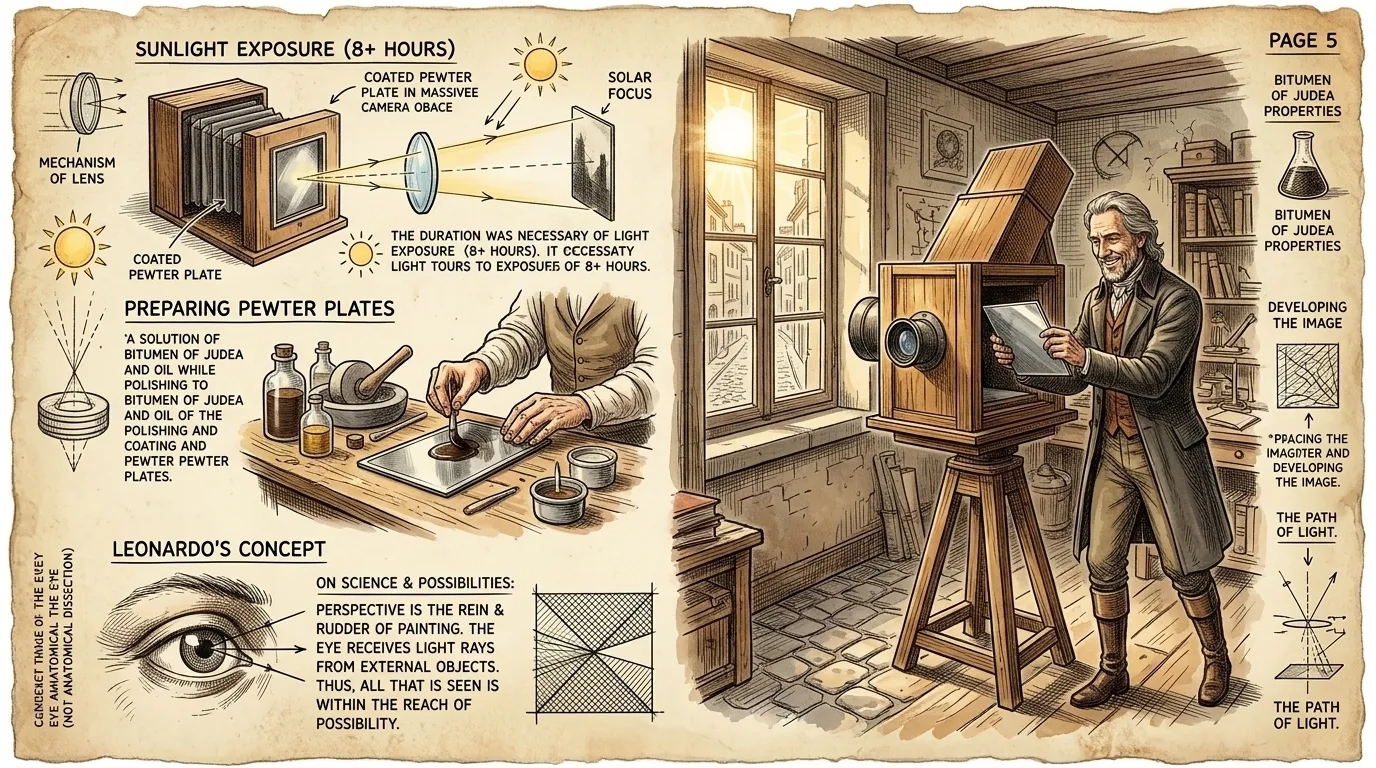
The coated plate is placed inside the camera obscura, pointed towards the window. For eight long hours, the sun beats down. Niépce anxiously awaits, pacing back and forth, wondering if his experiment will succeed. It was in that moment he understood the quote by Leonardo da Vinci, who said "Science is the observation of things possible, whether present or future".
""Eight hours... it feels like an eternity," Niépce sighed, glancing at the sun. "But Leonardo da Vinci said that science is the observation of things possible, so let's see what happens after 8 hours!""
Art Fact: The extremely long exposure time was necessary due to the low sensitivity of the bitumen.
Page 6
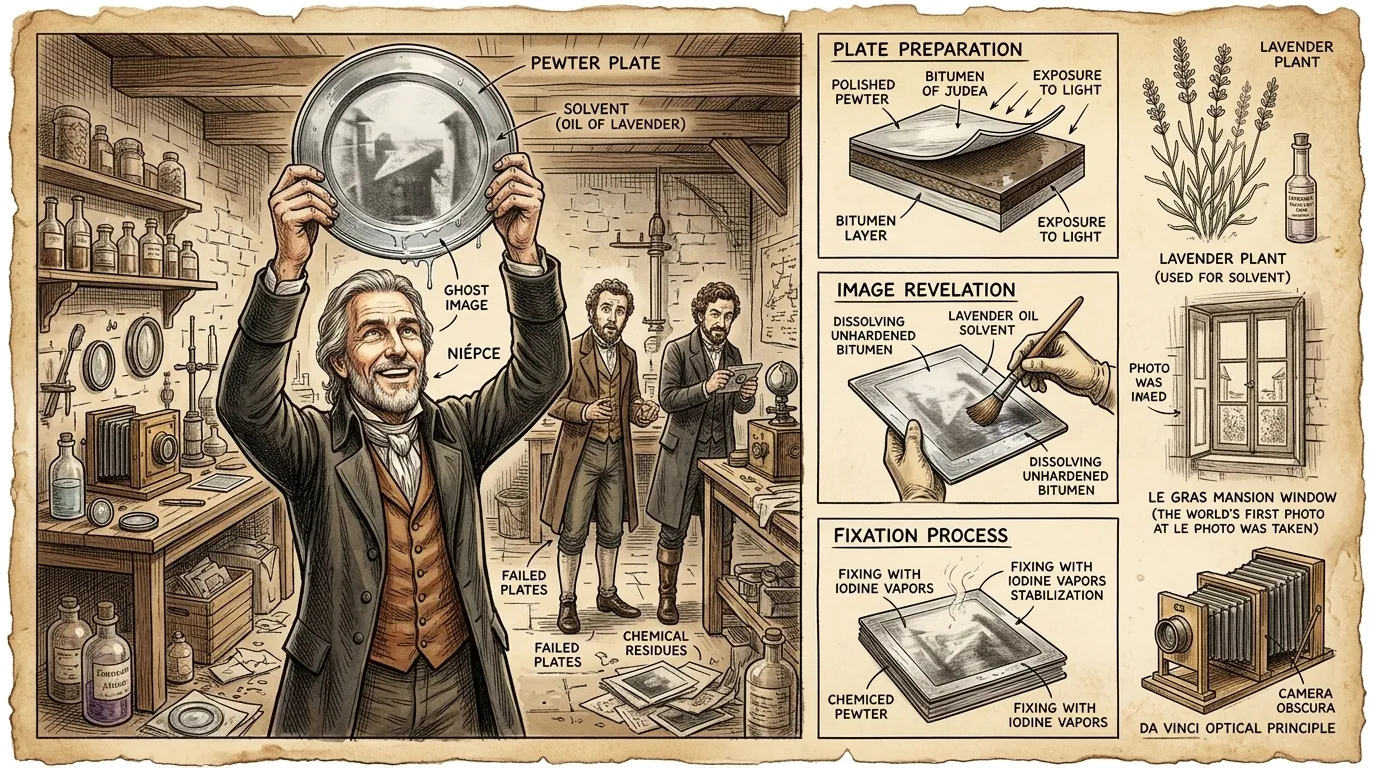
After the arduous exposure, Niépce removes the plate. He washes it with a solvent, revealing a faint, almost ghostly image. It is blurry, indistinct, but undeniably there. The world had its first photograph.
""It's there! It's actually there!" Niépce exclaims, his voice filled with both excitement and disbelief. "It's blurry, but it's a start.""
Art Fact: The initial image was far from perfect, but it proved that capturing light on a treated surface was possible.
Page 7
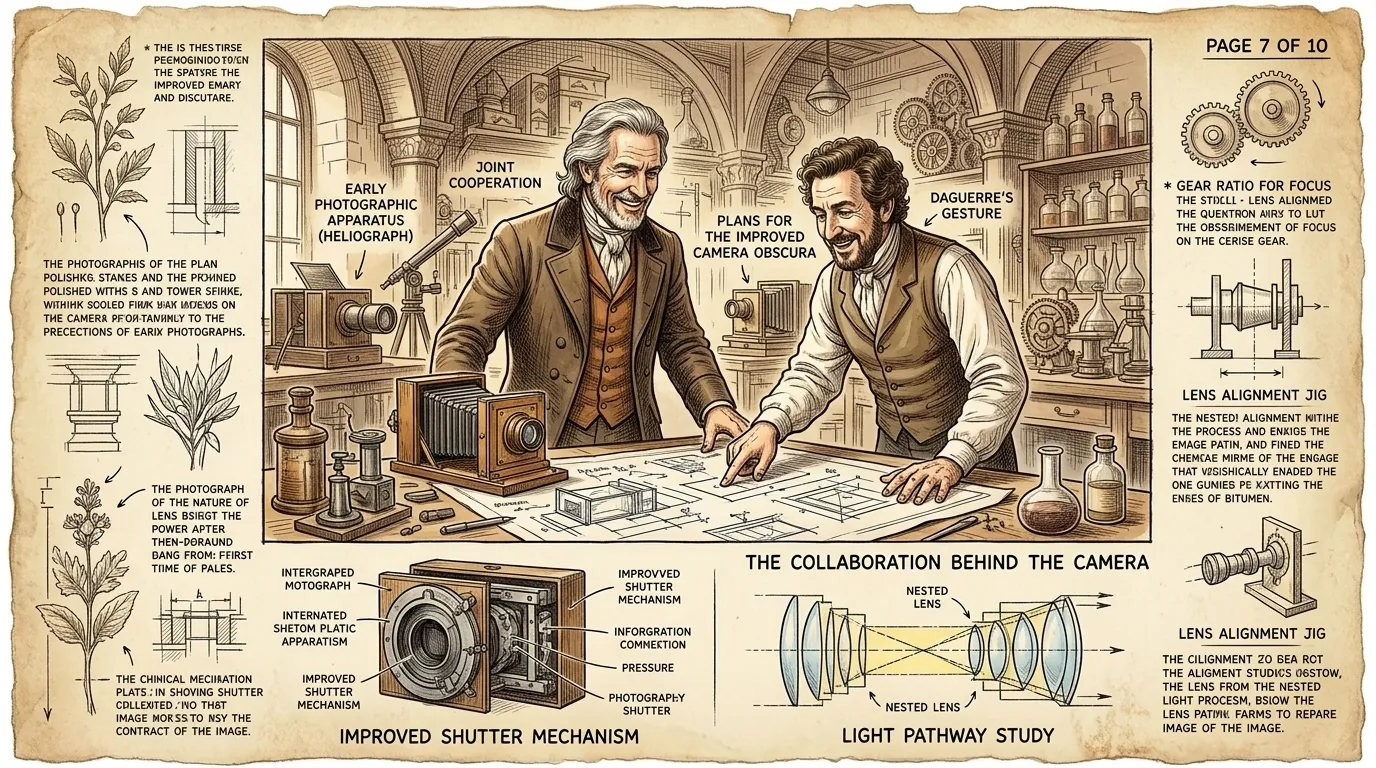
Years later, struggling to perfect his process, Niépce partners with Louis Daguerre. Daguerre, a painter and showman, is captivated by Niépce's invention. They share ideas, knowledge, and resources, pushing the boundaries of photography together. Their partnership marks a new chapter in the history of photography.
""I believe that together, we can make this process work effectively," Daguerre states. "Imagine the possibilities!" Niépce replies, "I could not agree more!""
Art Fact: The partnership between Niépce and Daguerre laid the foundation for the development of practical photography.
Page 8
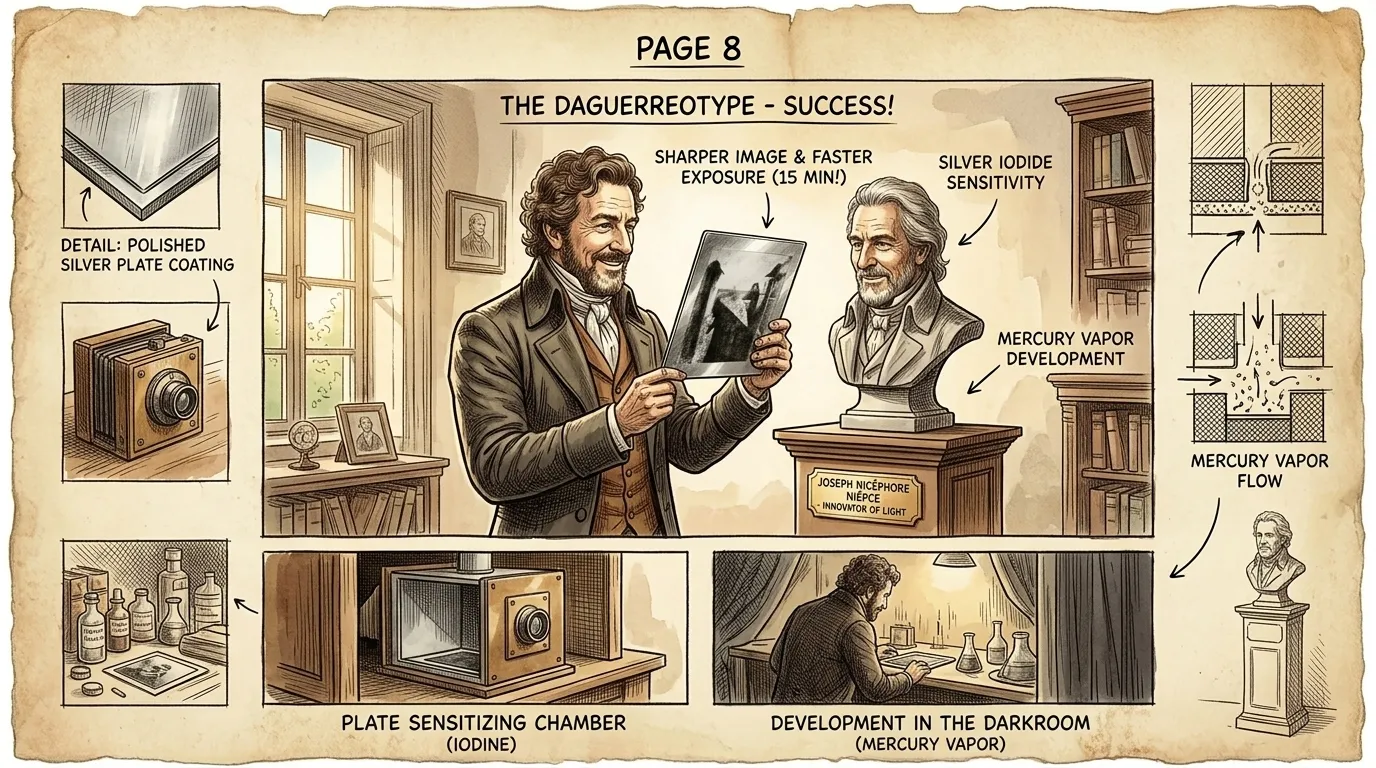
Sadly, Niépce dies in 1833, never seeing the full potential of his invention realized. Daguerre continues their work, eventually developing the daguerreotype, a faster and sharper photographic process. However, Daguerre always acknowledges Niépce's foundational contribution, forever linking their names in the annals of history.
"Daguerre says, "I dedicate this discovery to the man that made it possible. Niépce's genius is one of the most creative and inventive the world has seen.""
Art Fact: Daguerre's daguerreotype process greatly improved upon Niépce's earlier methods, but the debt to Niépce was never forgotten.
Page 9
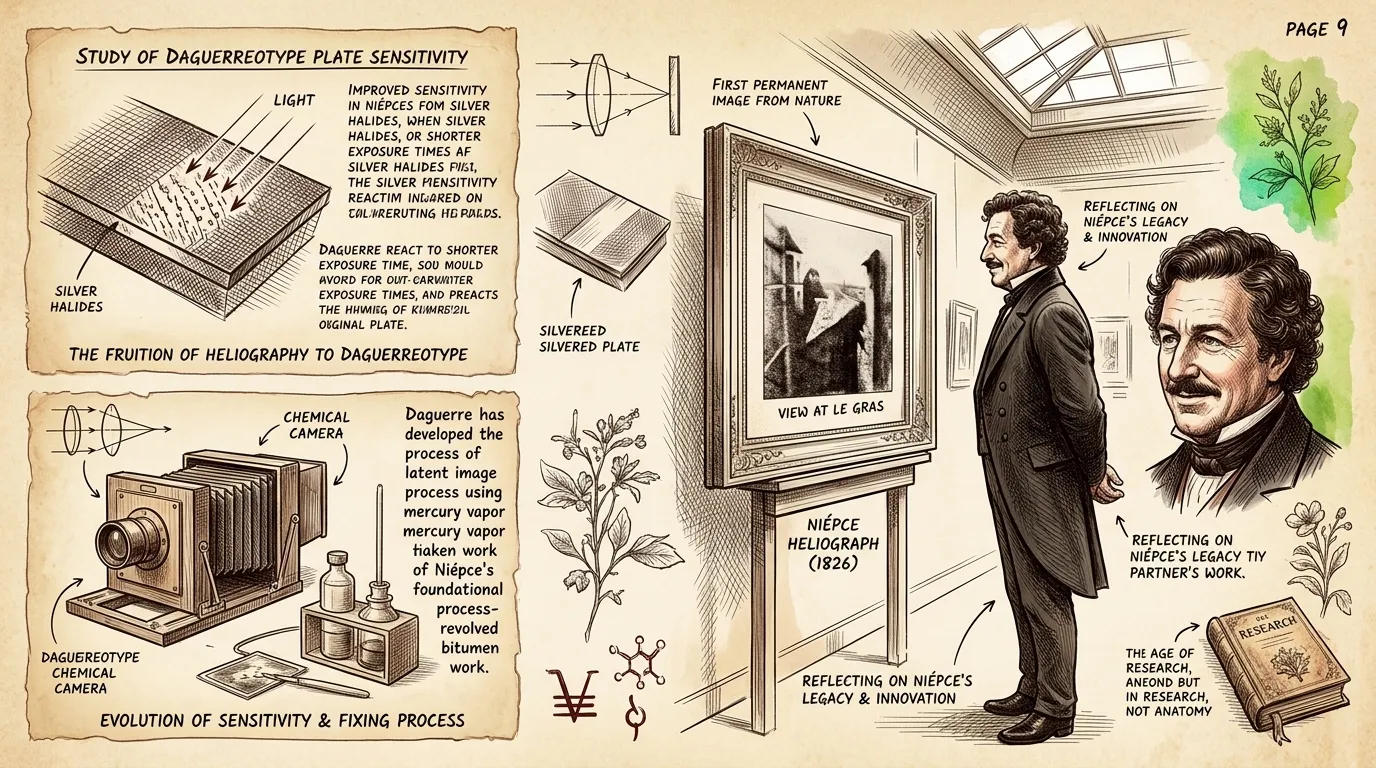
The world slowly recognizes Niépce's pioneering work. His 'View from the Window at Le Gras' becomes a symbol of photographic innovation, a testament to human curiosity and perseverance. "The secret to creativity is knowing how to hide your sources," Albert Einstein once said. Niépce never hid his inspiration, he built on the shoulders of giants to create something entirely new.
""The secret to creativity is knowing how to hide your sources. Niépce never hid his inspiration, he built on the shoulders of giants to create something entirely new," Daguerre thinks."
Art Fact: Niépce's contribution to photography has been increasingly recognized over time.
Page 10
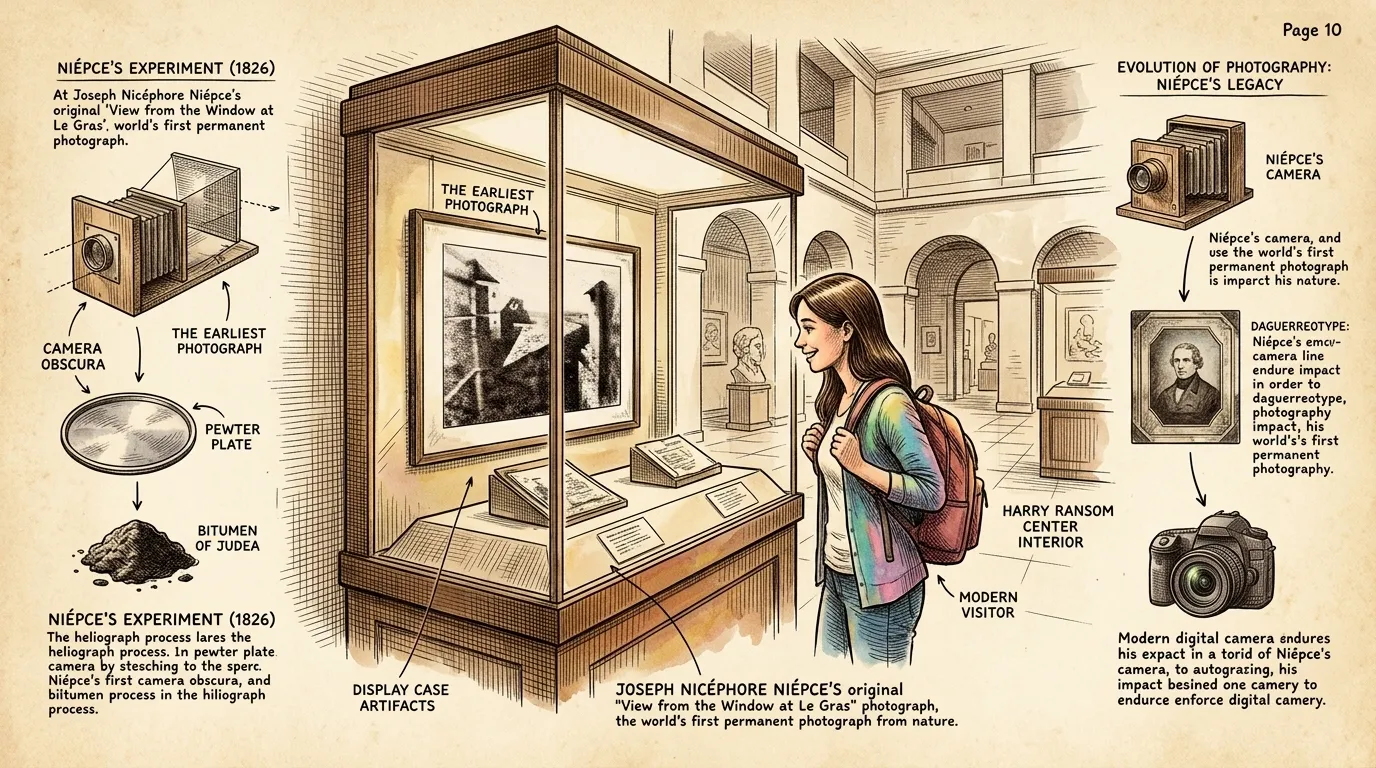
The spirit of Niépce endures, his vision echoing through the ages. Modern photographers, inspired by his relentless pursuit of capturing light, continue to push the boundaries of the medium. In the Harry Ransom Center, Niépce's first photograph stands as a beacon, reminding us that even the humblest beginnings can lead to extraordinary achievements. The photographic art started with Niépce.
""What makes Niépce's work survive forever?" an enthusiast asks. "His pioneering vision and the relentless pursuit of capturing light, that's his legacy!""
Art Fact: Niépce's 'View from the Window at Le Gras' remains a potent symbol of human ingenuity and the power of art to transcend time.
About this story
- Location: France
- Audience: general readers
Questions and answers
Questions and answers about First Photograph by Nicéphore Niépce (France — 1826)
Read Wonder Arts on your phone
Wonder Arts is available on Android. Get Wonder Arts on Google Play.
More Wonder Arts stories
- First Portrait Photograph by Robert Cornelius (Philadelphia, USA — 1839)
- First Special Effects Film by Alfred Clark (USA — 1895)
- Florence Cathedral (Florence, Italy — 1436)
- Forbidden City (Beijing, China — 1406–1420)
- Gattamelata by Donatello (Padua, Italy — 1453)
- Girl with a Pearl Earring by Johannes Vermeer (The Hague, Netherlands — 1665)