Forbidden City (Beijing, China — 1406–1420)
Forbidden City (Beijing, China — 1406–1420) — an illustrated arts story, set in China. 10 illustrated pages, free to read on Wonder Arts.
Page 1

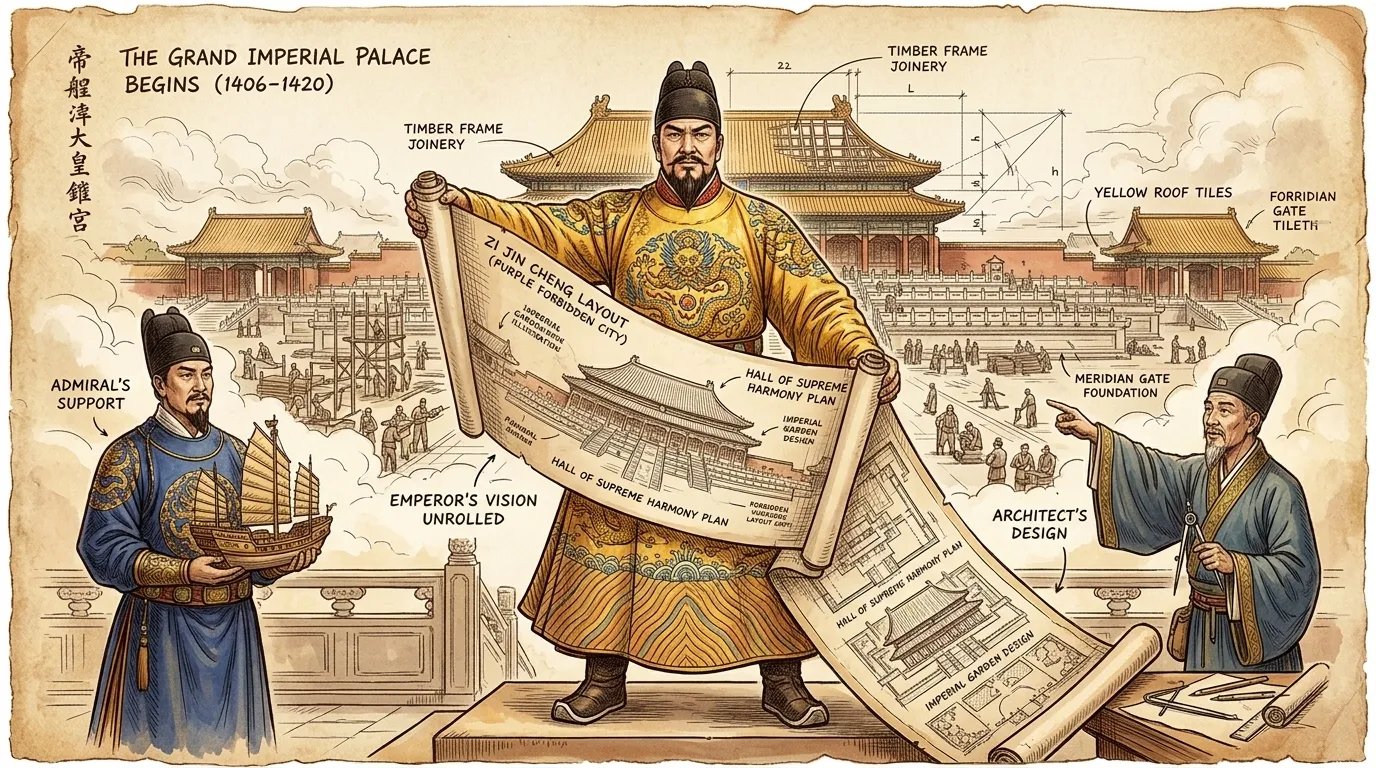
Zhu Di, the Yongle Emperor, stands before his magnificent creation, the Forbidden City. Completed in 1420, the complex covers 180 acres and comprises 980 buildings. Legend has it that the emperor envisioned the city in a dream, mirroring the structure of the celestial realm. Its sheer scale is a testament to his power and ambition.
"Zhu Di murmured, observing the layout of the Forbidden City, 'This is more than a palace; it is a statement of Heaven's Mandate.'"
Art Fact: The Forbidden City, built between 1406 and 1420, is the largest palace complex in the world. It remained the center of Chinese power for nearly 500 years. A hidden fact: the city's design adheres strictly to Feng Shui principles.
Page 2

The Emperor assigns the formidable task of gathering the finest artisans and materials from across the empire to Zheng He, his trusted eunuch. He seeks perfection and excellence in every detail of the Forbidden City. Wood from distant jungles, marble from remote quarries, and gold from the richest mines will be required. Zheng He knew this task will require absolute dedication.
"Zhu Di instructs, 'Zheng He, find the best artisans and materials, no matter the cost. As Leonardo da Vinci said, 'Details make perfection, and perfection is not a detail.' Every tile, every brushstroke, must reflect the glory of the Ming Dynasty.' Zheng He bows deeply, 'Your will shall be done, Your Majesty.'"
Art Fact: Zheng He was not only an admiral but also a key administrator in the construction of the Forbidden City. His voyages brought back exotic materials and inspiration for the palace's design.
Page 3

Cai Xin, the master architect, pores over the blueprints, envisioning a city that blends functionality with imperial grandeur. He understood the critical importance of the layout and that it had to be both defensible and aesthetically pleasing. The scale of the project feels immense.
"Cai Xin wonders aloud, tracing the lines of the palace complex with a brush, 'How can one capture the heavens within walls?' His assistant replies, 'Through balance and harmony, Master Cai. As Confucius said, 'Everything has beauty, but not everyone sees it.' We must reveal the beauty of the cosmos within these walls.'"
Art Fact: Cai Xin is credited with the overall design of the Forbidden City. His innovations in structural engineering allowed for the construction of such a vast and complex palace.
Page 4

Deep within the mountains, thousands of laborers quarry massive blocks of marble. These stones are destined to pave the courtyards and construct the foundations of the Forbidden City. It's back-breaking labor, demanding immense strength and coordination. Safety standards are nonexistent and work is harsh.
"The foreman yells, 'Heave! All together now!' A laborer grunts, wiping sweat from his brow. 'This stone will bear the weight of emperors for centuries,' he says. Another retorts, 'More likely it will bear the weight of our bones, if we aren't careful.'"
Art Fact: The marble used in the Forbidden City came from quarries hundreds of kilometers away. Transporting these massive stones was a logistical feat, requiring sledges and manpower.
Page 5

In the dense jungles of southern China, teams of lumberjacks fell ancient trees. These are for the massive pillars and beams that support the palace halls. The sound of axes echoes through the forest. Many of these workers will never return to their families.
"A lumberjack shouts, 'Timber!' An ancient tree crashes to the ground. Another sighs, 'So many trees for one man's palace.' A third answers, 'But it is a palace for all of China, not just one man.'"
Art Fact: The best timber came from Phoebe zhennan trees, which were highly valued for their strength and resistance to decay. These trees were often reserved exclusively for imperial use.
Page 6

Near Jingdezhen, the imperial kilns blaze day and night, firing millions of tiles for the roofs of the Forbidden City. Each tile must be perfect in color and form, reflecting the imperial dragon's scale. Imperfections lead to harsh punishments.
"The kiln master shouts, 'Maintain the heat! Not a single tile must be flawed.' An apprentice replies, 'The Emperor's demands are relentless.' The master scowls, 'Our lives depend on meeting them.'"
Art Fact: The distinctive yellow glazed roof tiles of the Forbidden City were manufactured in Jingdezhen, a city famous for its porcelain production.
Page 7

Artisans apply gold leaf to the intricate carvings and ornamentation. The gold glistens in the sunlight, signifying wealth and power. Meticulous application demands focus.
"An artisan whispers, carefully applying a thin sheet of gold, 'Each stroke brings the city closer to the heavens.' Another replies, 'And closer to the Emperor's favor. As Oscar Wilde said, 'I have the simplest tastes. I am always satisfied with the best.''"
Art Fact: Gold was used extensively in the Forbidden City, symbolizing imperial authority and wealth. The process of applying gold leaf was highly specialized and required exceptional skill.
Page 8

Even as the city nears completion, political intrigue brews within the court. Rivals and enemies seek to undermine the Emperor's vision. Their whispers and plots threaten the stability of the newly established capital.
"A courtier whispers, 'The Emperor's extravagance will bankrupt the empire.' Another replies, 'His ambition knows no bounds. But as Niccolo Machiavelli wrote, 'It is much safer to be feared than loved, when one of the two must be chosen.'"
Art Fact: The construction of the Forbidden City was not without its detractors. Some officials argued that it was a wasteful expenditure of resources that could have been used for defense or public works.
Page 9

In 1420, the Forbidden City is officially inaugurated. A grand ceremony is held, attended by dignitaries, scholars, and officials from across the empire. The Yongle Emperor ascends the throne, signifying the beginning of a new era.
"The Master of Ceremonies proclaims, 'Let the drums roll! Let the bells chime! Let the world know that the Forbidden City is complete!' The Emperor declares, 'May this city stand as a testament to the glory of the Ming Dynasty for generations to come.'"
Art Fact: The inauguration of the Forbidden City marked the formal transfer of the capital from Nanjing to Beijing. It was a moment of great national pride and celebration.
Page 10

Centuries later, the Forbidden City still stands, a testament to human ingenuity and imperial ambition. Its golden roofs and red walls echo with the voices of emperors, concubines, and eunuchs. It continues to inspire awe and wonder. As the Chinese proverb says, 'A journey of a thousand miles begins with a single step' — the Yongle Emperor took that step and shaped an empire.
"A modern visitor remarks, 'It's breathtaking. To think it was built so long ago!'"
Art Fact: Today, the Forbidden City is a UNESCO World Heritage Site and one of the most popular tourist destinations in the world, attracting millions of visitors each year. Its survival is a miracle; it is an architectural masterpiece.
About this story
- Location: China
- Audience: general readers
Questions and answers
Questions and answers about Forbidden City (Beijing, China — 1406–1420)
Read Wonder Arts on your phone
Wonder Arts is available on Android. Get Wonder Arts on Google Play.
More Wonder Arts stories
- Gattamelata by Donatello (Padua, Italy — 1453)
- Girl with a Pearl Earring by Johannes Vermeer (The Hague, Netherlands — 1665)
- Girl with a Pearl Earring — The Hague, Netherlands — 1665
- Grande Odalisque by Jean-Auguste-Dominique Ingres (France — 1814)
- Great Sphinx of Giza by Ancient Egyptian artisans (Giza, Egypt — c. 2500 BC)
- Guernica by Pablo Picasso (Madrid, Spain — 1937)