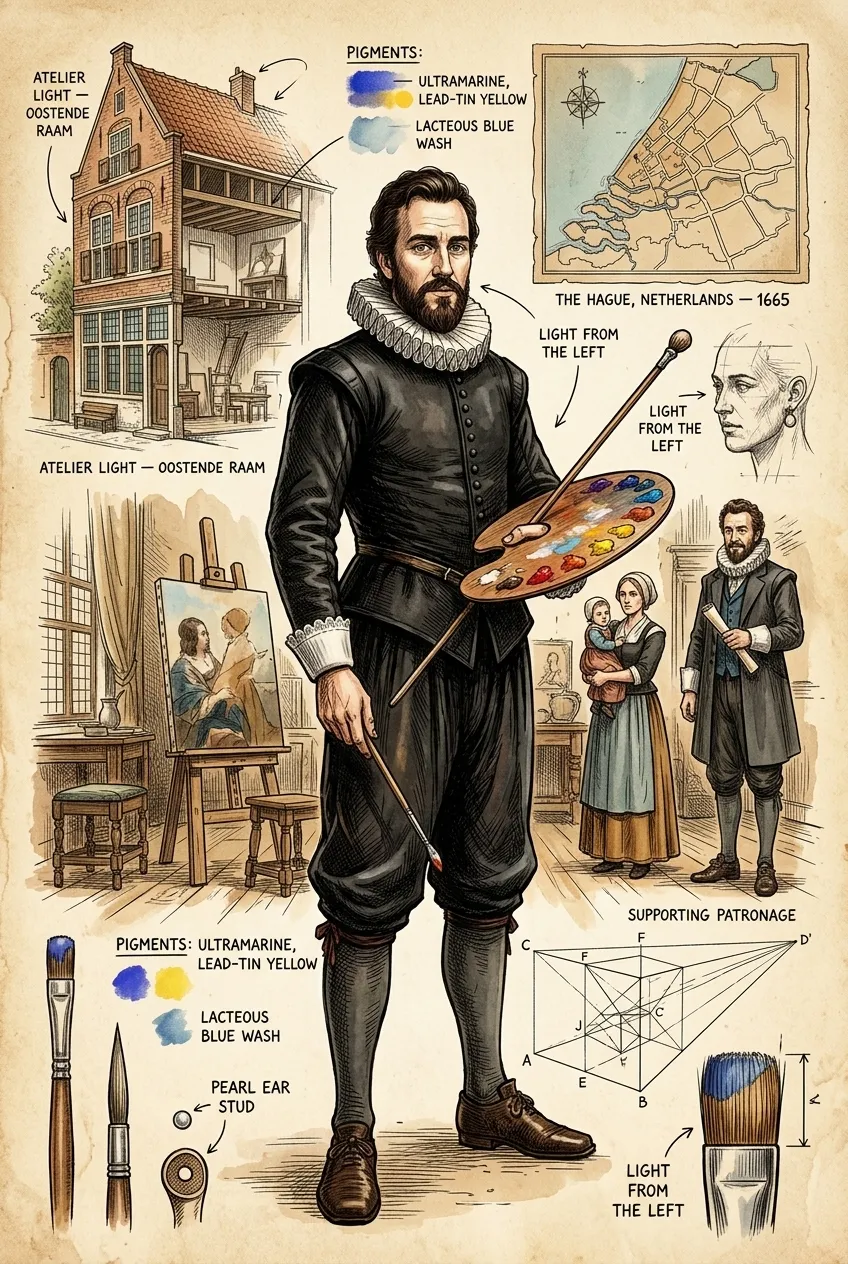
Girl with a Pearl Earring — The Hague, Netherlands — 1665
Girl with a Pearl Earring — The Hague, Netherlands — 1665 — an illustrated arts story, set in Global. 10 illustrated pages, free to read on Wonder Arts.
Page 1
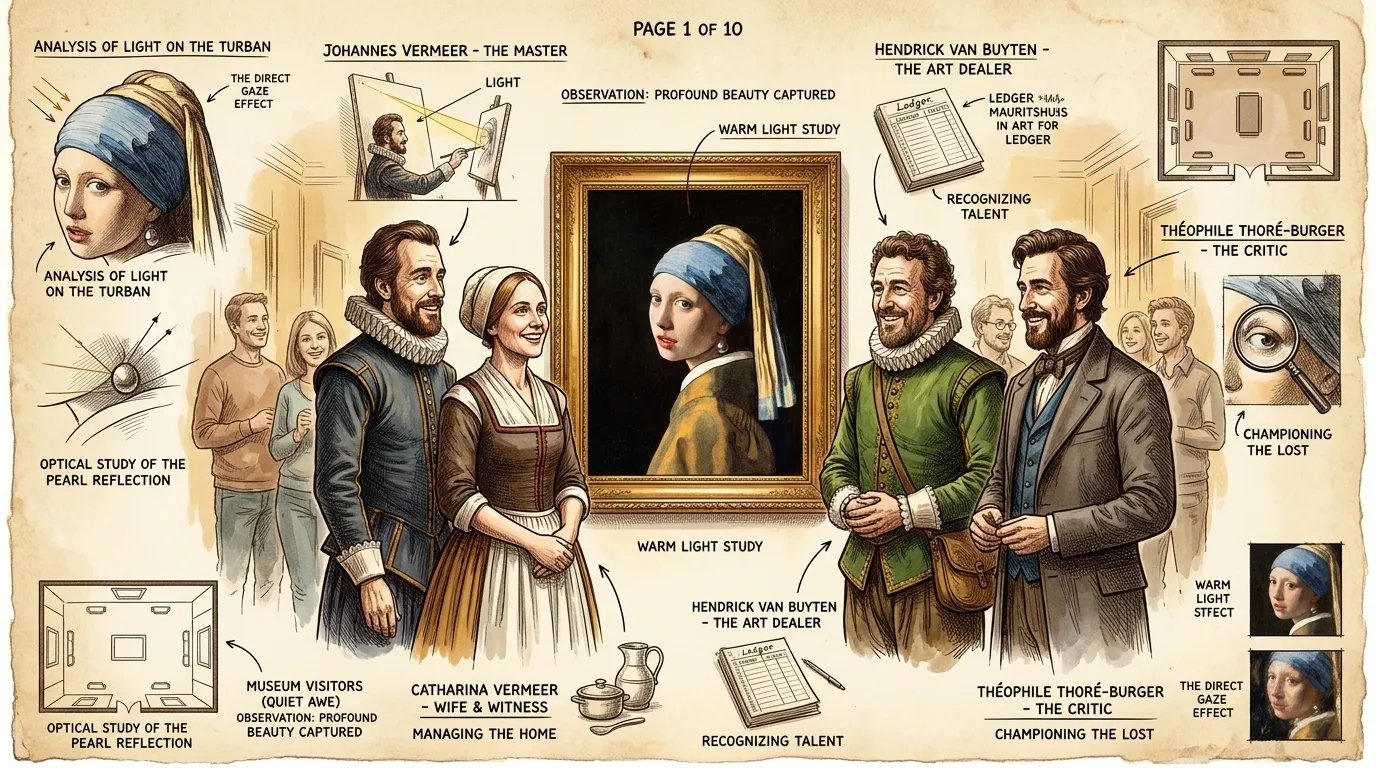
In the Mauritshuis museum in The Hague, Netherlands, hangs a captivating portrait. 'Girl with a Pearl Earring' by Johannes Vermeer, painted around 1665, is smaller than one might expect, only 44.5 by 39 centimeters. Yet, its impact is immense. Stolen in 1986 and recovered only years later, the painting continues to draw crowds, a testament to its enduring mystery and beauty.
Art Fact: The Mauritshuis houses a significant collection of Dutch Golden Age paintings, including several works by Vermeer and Rembrandt.
Page 2
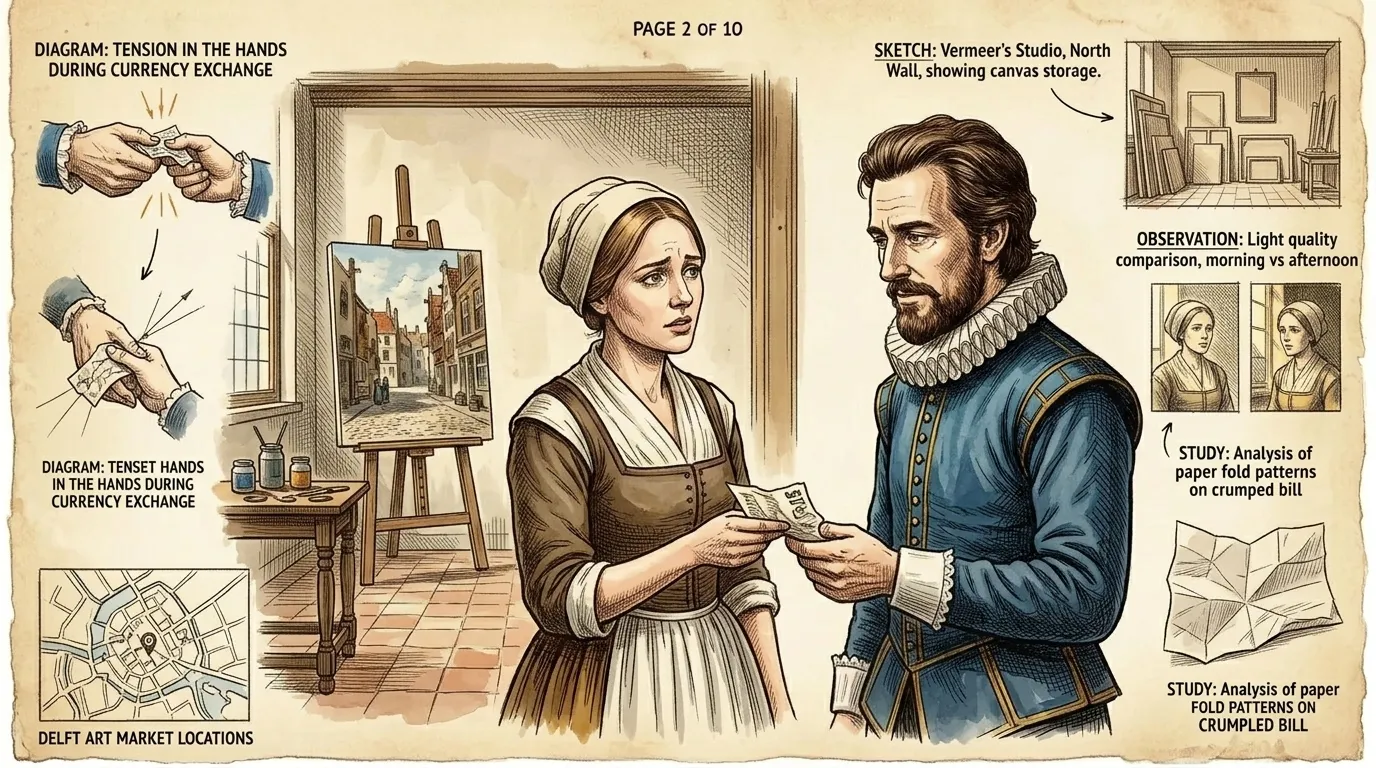
Johannes Vermeer, born in Delft in 1632, was a painter of quiet interiors and serene portraits. Few details of his life are known, adding to the enigma surrounding him. He was an innkeeper and art dealer as well as a painter. Vermeer once said, as Plutarch said, that, 'The mind is not a vessel to be filled, but a fire to be kindled.' He sought to capture the inner light, the essence, of his subjects.
"'Johannes, another bill is due,' Catharina, Vermeer's wife sighs, handing him the paper. 'And the baker demands payment.' Vermeer sighs. 'Patience, my dear. My work will provide. It must."
Art Fact: Johannes Vermeer's known oeuvre consists of only around 34 paintings, a relatively small number compared to his contemporaries.
Page 3
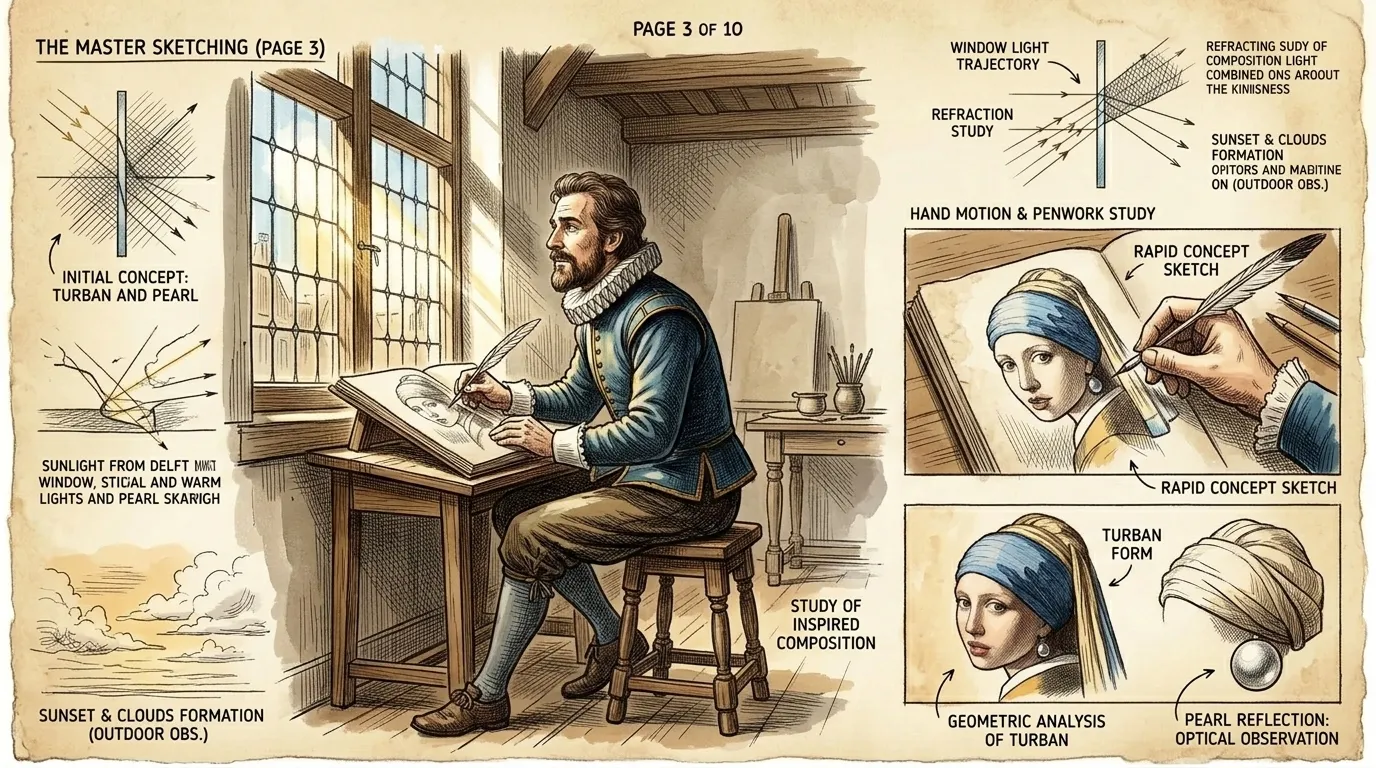
Vermeer's Delft was a city of merchants and artisans, a hub of the Dutch Golden Age. The light, the faces, the fabrics, all became his inspiration. A young woman, perhaps a neighbor or a maid, caught his eye. He imagined her, not as a wealthy lady, but as a figure of simple grace, adorned with an exotic turban and a single, luminous pearl.
"Vermeer muses, staring out of his studio window, 'The light... it transforms the mundane into the divine.' He sketches feverishly in his notebook. 'A turban... a pearl... yes, that is it!'"
Art Fact: The exact identity of the 'Girl with a Pearl Earring' remains unknown, fueling speculation and adding to the painting's allure.
Page 4
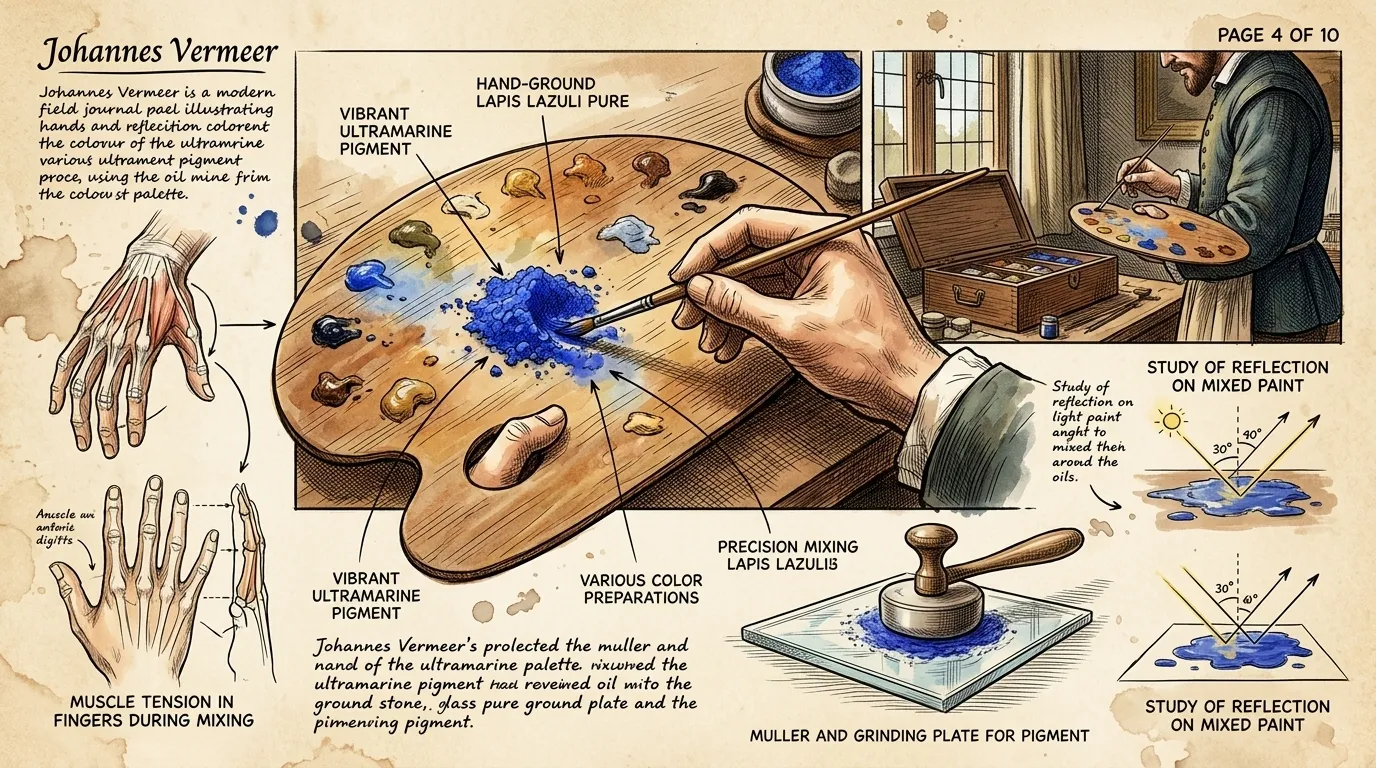
Vermeer began with a carefully prepared canvas, applying thin layers of paint to create a smooth, light-reflecting surface. He used a limited palette, relying on the subtle interplay of light and shadow to model the girl's features. Ultramarine, a costly pigment derived from lapis lazuli, was used for the turban, highlighting its exotic allure.
"Vermeer carefully mixes his paints on a wooden palette. 'Ultramarine...' he whispers to himself, 'a king's ransom in a single turban.'"
Art Fact: Vermeer's meticulous technique involved the use of a camera obscura, a device that projected an image onto a surface, aiding in accurate perspective and detail.
Page 5
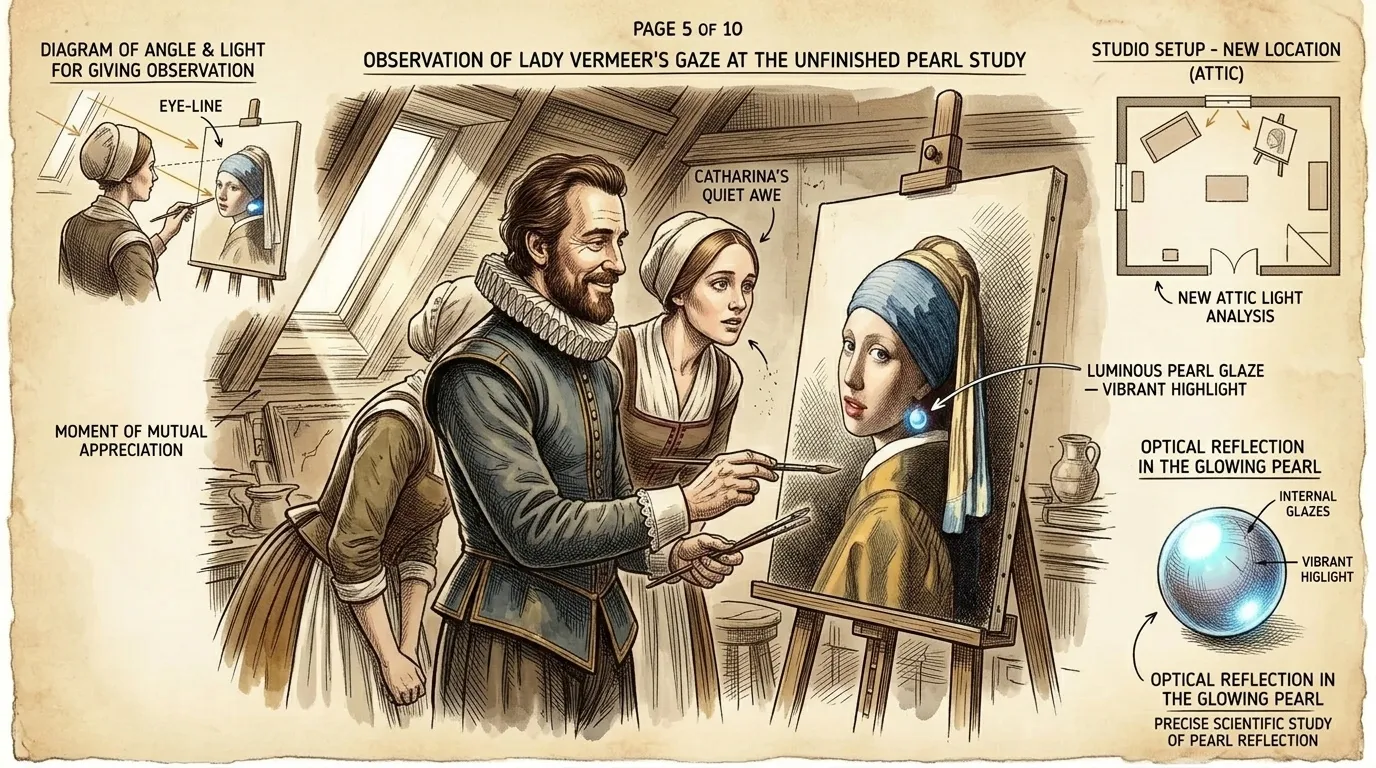
The pearl itself is a masterstroke. It isn't simply white, but a complex interplay of reflected light, shadow, and color. Vermeer used subtle glazes to capture its luminous quality, making it the focal point of the composition. The pearl seems to glow from within, drawing the viewer's eye and holding it captive.
"Catharina peers over Vermeer's shoulder. 'The pearl... it seems to breathe,' she murmurs. Vermeer nods, pleased. 'It is the soul of the painting, Catharina.'"
Art Fact: Art historians have debated whether the pearl is real or an imitation made of glass, given its size and the social status of the sitter.
Page 6
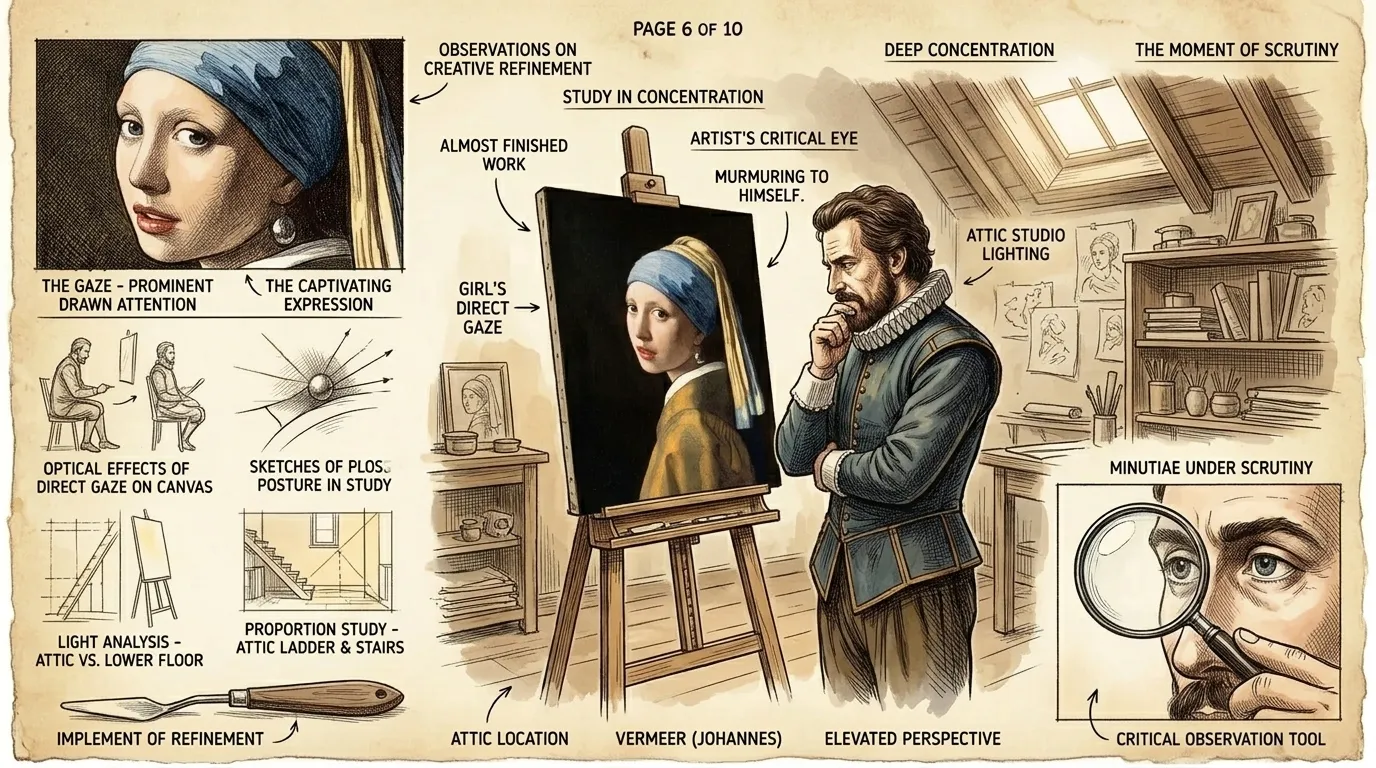
The girl's direct gaze is what truly captivates. She looks out at the viewer, not with arrogance or invitation, but with a sense of openness and curiosity. Her mouth is slightly parted, as if she is about to speak. This directness makes her feel remarkably modern, bridging the gap between the 17th century and today.
"Vermeer steps back from the canvas, studying his work critically. 'The eyes... they must speak,' he mutters to himself. 'They must draw the viewer in, hold them captive.'"
Art Fact: The painting's title in Dutch is 'Meisje met de parel', which translates literally to 'Girl with the pearl'.
Page 7
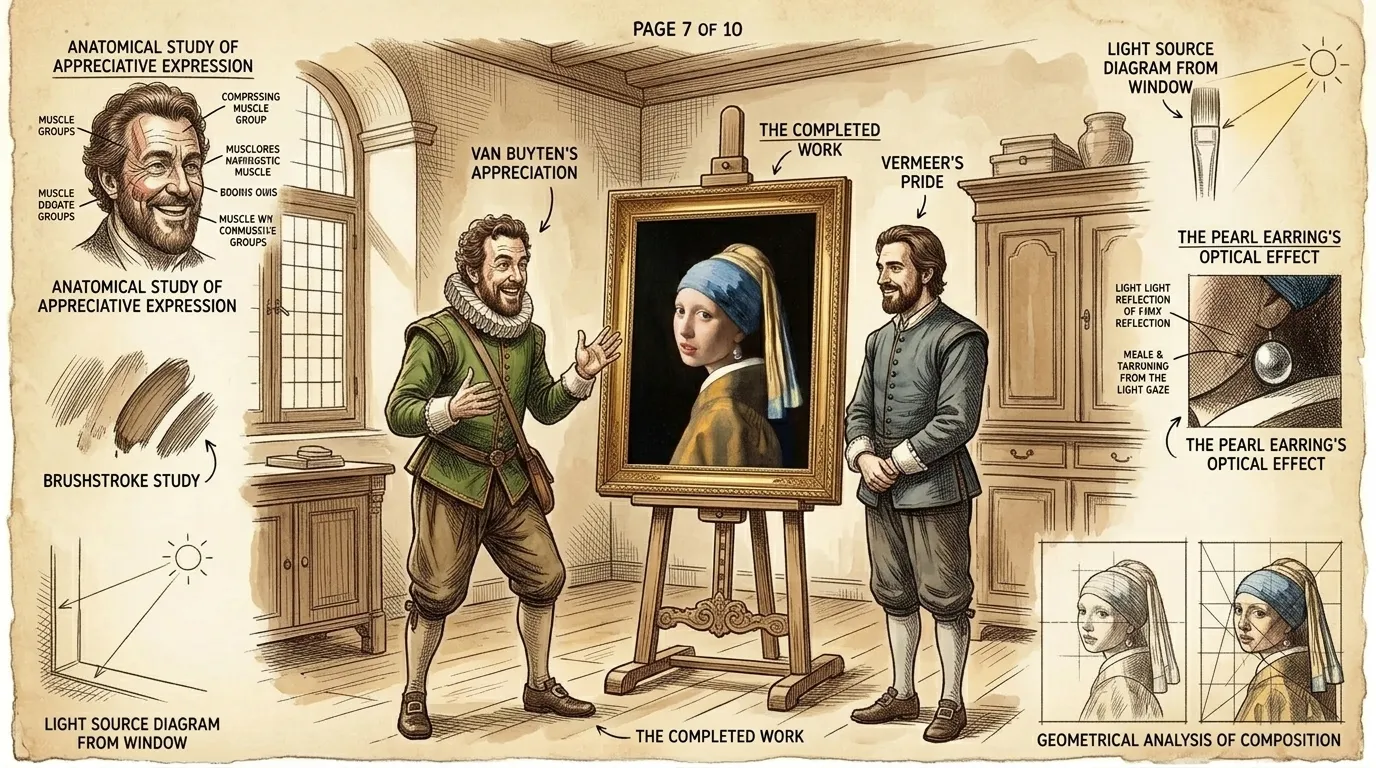
'It is not enough to know, one must also apply; it is not enough to will, one must also do,' as Goethe aptly stated, a principle Vermeer embodied. 'Girl with a Pearl Earring' is not just a portrait, but a 'tronie' - a Dutch term for a character study, not necessarily intended to be a likeness of a specific person. Vermeer sought to capture an ideal of beauty and innocence, rather than a precise representation.
"A local art dealer, Hendrick van Buyten, visits Vermeer's studio. 'Johannes, this 'tronie' is exceptional!' he exclaims. 'The light, the expression... it is truly captivating.' Vermeer smiles modestly. 'I sought to capture more than just a likeness, Hendrick.'"
Art Fact: Vermeer often painted 'tronies', allowing him freedom of expression and exploration of human emotion outside of commissioned portraits.
Page 8
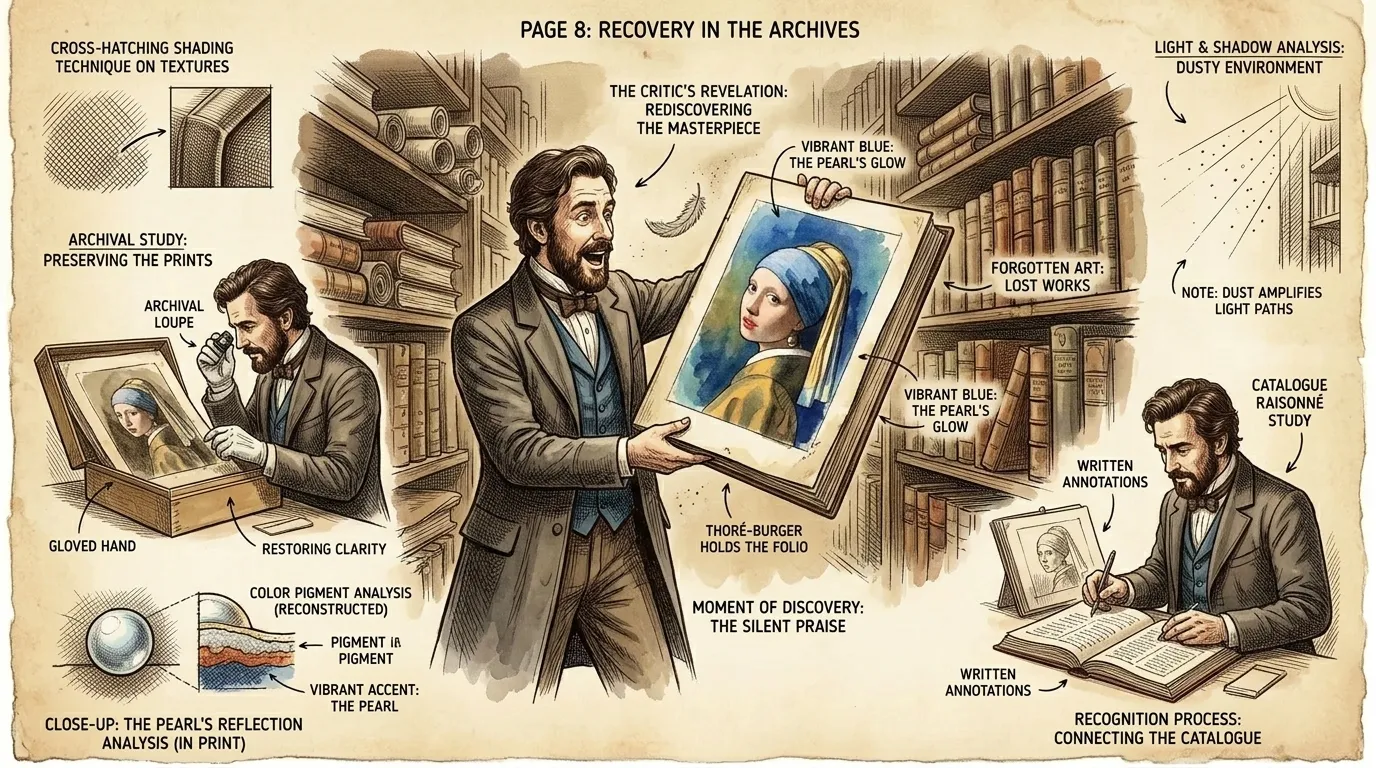
After Vermeer's death in 1675, his work was largely forgotten for centuries. It wasn't until the 19th century that his genius was rediscovered by critics and art historians. 'Girl with a Pearl Earring' began its ascent to iconic status, its beauty and mystery captivating a new generation.
"The art critic Théophile Thoré-Burger exclaims, excitedly after discovering Vermeer's paintings, 'This painter... this Vermeer! He is a revelation! A master of light and shadow!'"
Art Fact: Théophile Thoré-Burger, writing under the pseudonym William Bürger, was instrumental in reviving Vermeer's reputation in the 19th century.
Page 9

The painting's allure has only grown in recent years, fueled by Tracy Chevalier's historical novel 'Girl with a Pearl Earring' (1999) and the subsequent film adaptation (2003). These works of fiction have brought the painting to a wider audience, sparking interest in Vermeer's life and work and generating a wave of passion and love for art.
"A moviegoer exits a cinema after watching the film adaptation of 'Girl with a Pearl Earring', speaking to her friend, 'The film was beautiful! It really brought the painting to life for me.'"
Art Fact: The novel and film adaptation have contributed significantly to the painting's popularity and cultural significance in the 21st century.
Page 10
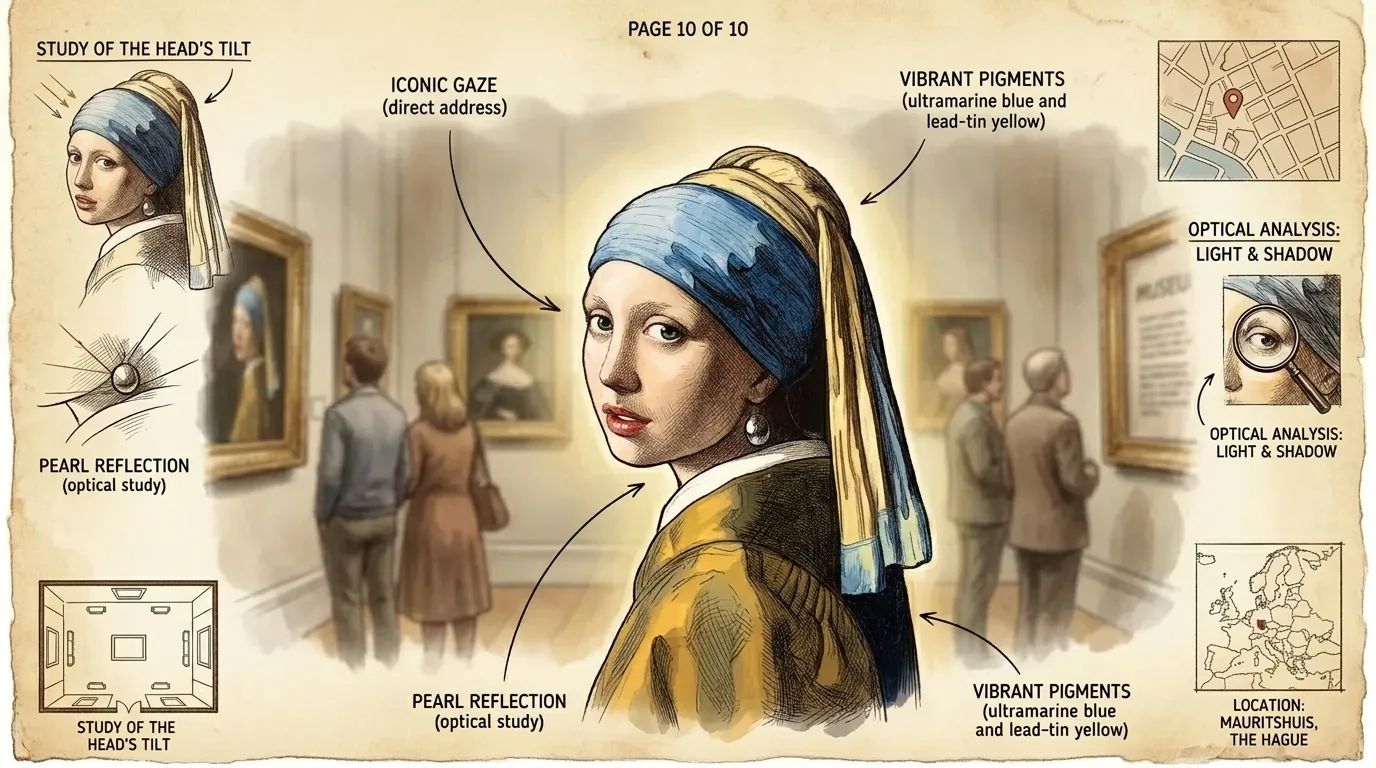
'Girl with a Pearl Earring' remains one of the most beloved and enigmatic paintings in the world. Its beauty lies not only in Vermeer's masterful technique, but also in the mystery that surrounds it. The girl's gaze continues to challenge and captivate, a timeless reminder of the power of art.
Art Fact: 'Girl with a Pearl Earring' is considered one of the most important and recognizable paintings in the world, a testament to Vermeer's genius and the enduring power of art.
About this story
- Location: Global
- Audience: general readers
Questions and answers
Questions and answers about Girl with a Pearl Earring — The Hague, Netherlands — 1665
Read Wonder Arts on your phone
Wonder Arts is available on Android. Get Wonder Arts on Google Play.
More Wonder Arts stories
- Grande Odalisque by Jean-Auguste-Dominique Ingres (France — 1814)
- Great Sphinx of Giza by Ancient Egyptian artisans (Giza, Egypt — c. 2500 BC)
- Guernica by Pablo Picasso (Madrid, Spain — 1937)
- Guernica — Pablo Picasso
- Hagia Sophia (Istanbul, Turkey — 537 AD)
- Haystacks Series by Claude Monet (France — 1891)