Haystacks Series by Claude Monet (France — 1891)
Haystacks Series by Claude Monet (France — 1891) — an illustrated arts story, set in France. 10 illustrated pages, free to read on Wonder Arts.
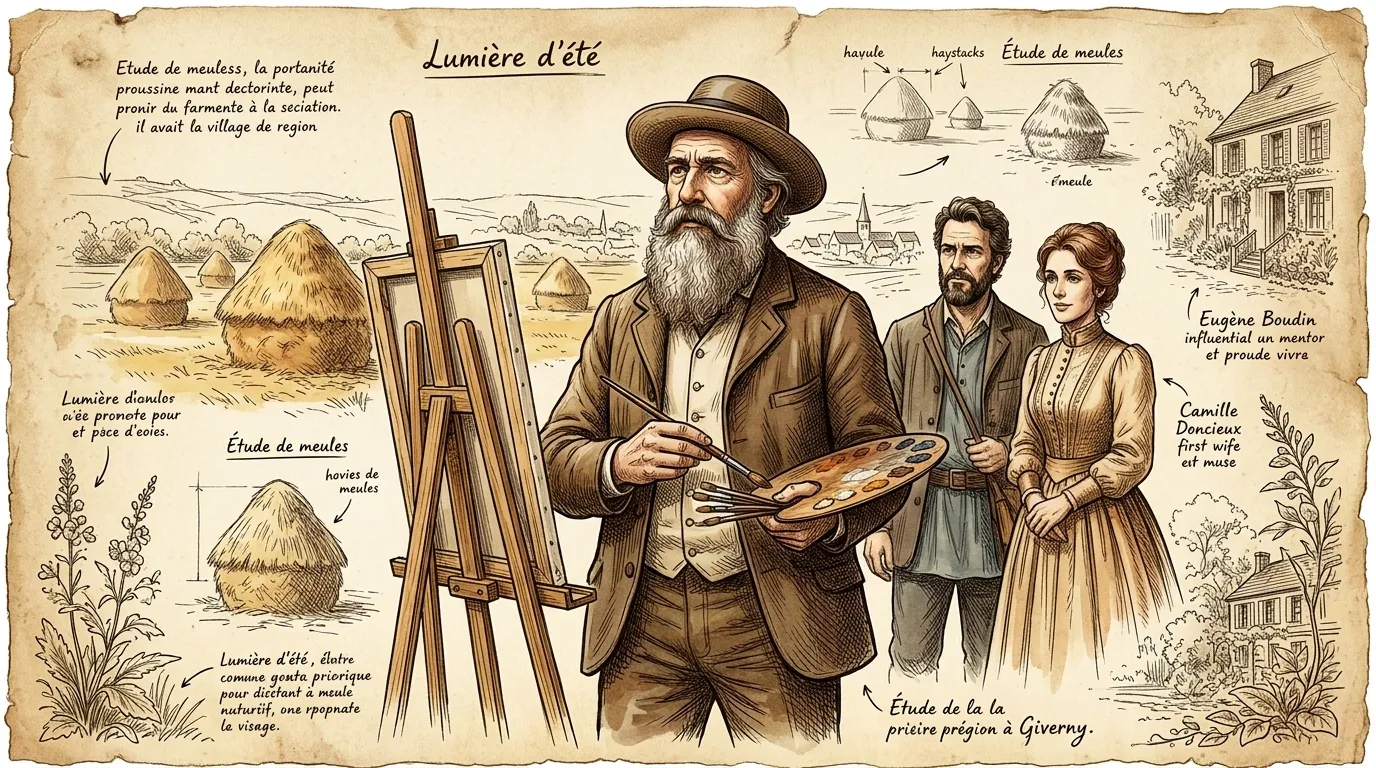
Page 1
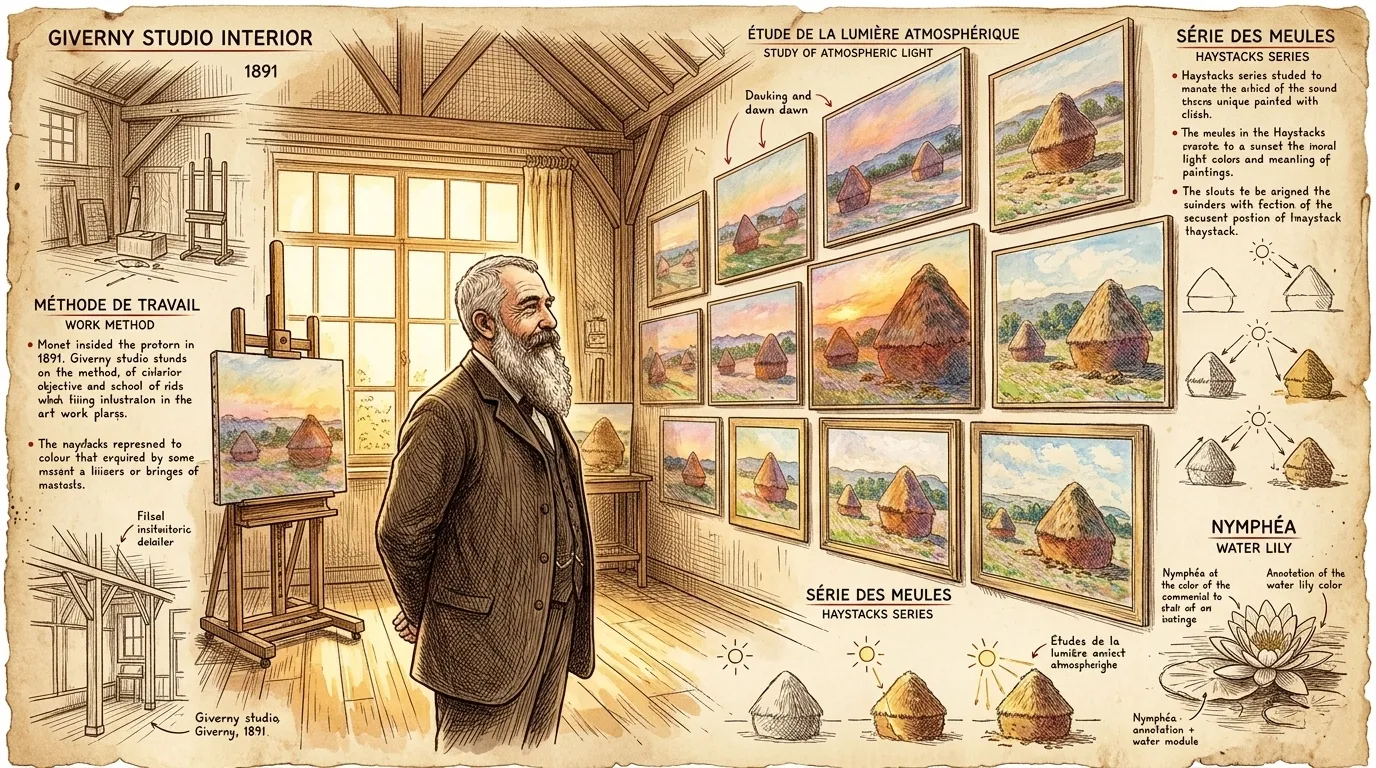
Claude Monet, a painter obsessed with capturing the fleeting moment, stands before his series of 'Haystacks' in his Giverny studio in 1891. He sought to capture the same scene under different conditions, at different times of the day. The paintings, each about 2 feet high and 3 feet wide, shimmer with the light and color that would define Impressionism. Sold individually, they fetched prices that astonished even Monet himself, with one selling for a record 110.7 million in 2019.
"Monet murmurs, 'What I need most is money,' a phrase often heard within these walls, he would always say. But it is not true, I need light, and time, and patience to capture these ephemeral moments, a challenge that constantly eludes me."
Art Fact: The 'Haystacks' series, also known as 'Grainstacks,' consists of twenty-five Impressionist paintings begun in the late summer of 1890 and continuing through the following winter.
Page 2

Early in his career, Monet faced immense financial hardship. During the Franco-Prussian War, whilst taking refuge in London with his new wife Camille and their young son Jean, he was struck by the lack of funds. His letters back to friends in Paris reveal his desperation.
"Monet says to Camille, his voice strained, 'If I cannot sell these paintings, what then, Camille? How will we feed Jean? As Seneca said, 'A gem is not polished without rubbing, nor is a man perfected without trials.' Perhaps this poverty will make me a better artist, but it is cold comfort tonight."
Art Fact: Monet's early financial struggles fueled his determination to succeed and innovate, which would eventually lead to his Impressionistic breakthrough.
Page 3

As a young man, Monet's artistic path was forever altered by Eugène Boudin, an established landscape painter who encouraged him to paint 'en plein air' – outdoors. Boudin's influence was transformative.
"Boudin, his weathered face creased with a smile, advised, 'Monet, the studio is but a cage. Get out there, feel the wind, see the light dance on the water. As Leonardo da Vinci said, 'Painting embraces all the ten functions of the eye; that is to say, darkness, light, body and color, substance and form, distance and nearness, motion and rest.' Do not just paint what you see, but what you feel."
Art Fact: Eugène Boudin taught Monet the importance of capturing the fleeting effects of light and atmosphere, a cornerstone of Impressionism.
Page 4

Monet's deliberate use of color theory challenged the established artistic norms. He began experimenting with complementary colors, juxtaposing them to create a vibrant and shimmering effect. This approach would become a hallmark of Impressionism.
"In a letter to his friend Pissarro, Monet wrote, 'Pissarro, I am beginning to see how light itself is composed of color. The shadows are not merely the absence of light, but colors in their own right. It's almost as if, as Picasso said, 'Colors, like features, follow the changes of the emotions.' These colors speak a language all their own."
Art Fact: Monet's revolutionary use of color transformed painting by capturing the subjective experience of light and atmosphere.
Page 5

Monet, along with other Impressionists, was deeply influenced by Japanese art, particularly ukiyo-e woodblock prints. The flat planes of color, bold compositions, and emphasis on nature in these prints shaped his artistic vision.
"Talking to his art dealer, Durand-Ruel, Monet says, 'Have you seen these Japanese prints? Their depiction of nature, their bold use of color and form, it's revolutionary. As Van Gogh said, 'Japanese art... shows you what to do with color,' I think it is time we change how we view art, and how we paint."
Art Fact: Japanese prints introduced Monet to new compositional techniques and perspectives, enriching his artistic vocabulary.
Page 6

Monet's fascination with capturing the fleeting moment led him to paint the same subject under different conditions. He worked rapidly, trying to capture the light and atmosphere before they changed. This immediacy became a defining feature of his style.
"To Alice Hoschedé, his second wife, Monet states, 'The light changes so quickly! One must be swift, decisive. I must seize the moment, capture the ephemeral, before it vanishes. As Marcel Proust said, 'Remembrance of things past is not necessarily the remembrance of things as they were.' I must work quickly to get the moment as it truly is."
Art Fact: Monet's pursuit of capturing the ephemeral transformed painting by prioritizing the subjective experience of seeing.
Page 7

While Monet's work eventually achieved widespread acclaim, it initially faced harsh criticism. Critics accused him of sloppiness and lack of finish. However, as the impressionist style gained popularity so did Monet.
"At an exhibition, a critic sneers, 'Monet's paintings are mere impressions, unfinished sketches! This is not art, it is an insult to the eye!' But another observer retorts, 'But does it not capture the moment, the light, the feeling of a fleeting scene with extraordinary skill? As Oscar Wilde said, 'Every great portrait is a portrait of the artist, not of the sitter.' Perhaps he's painting what he feels, not what he sees."
Art Fact: Monet's initial rejection by the art establishment underscores the radical nature of Impressionism and its challenge to traditional artistic values.
Page 8
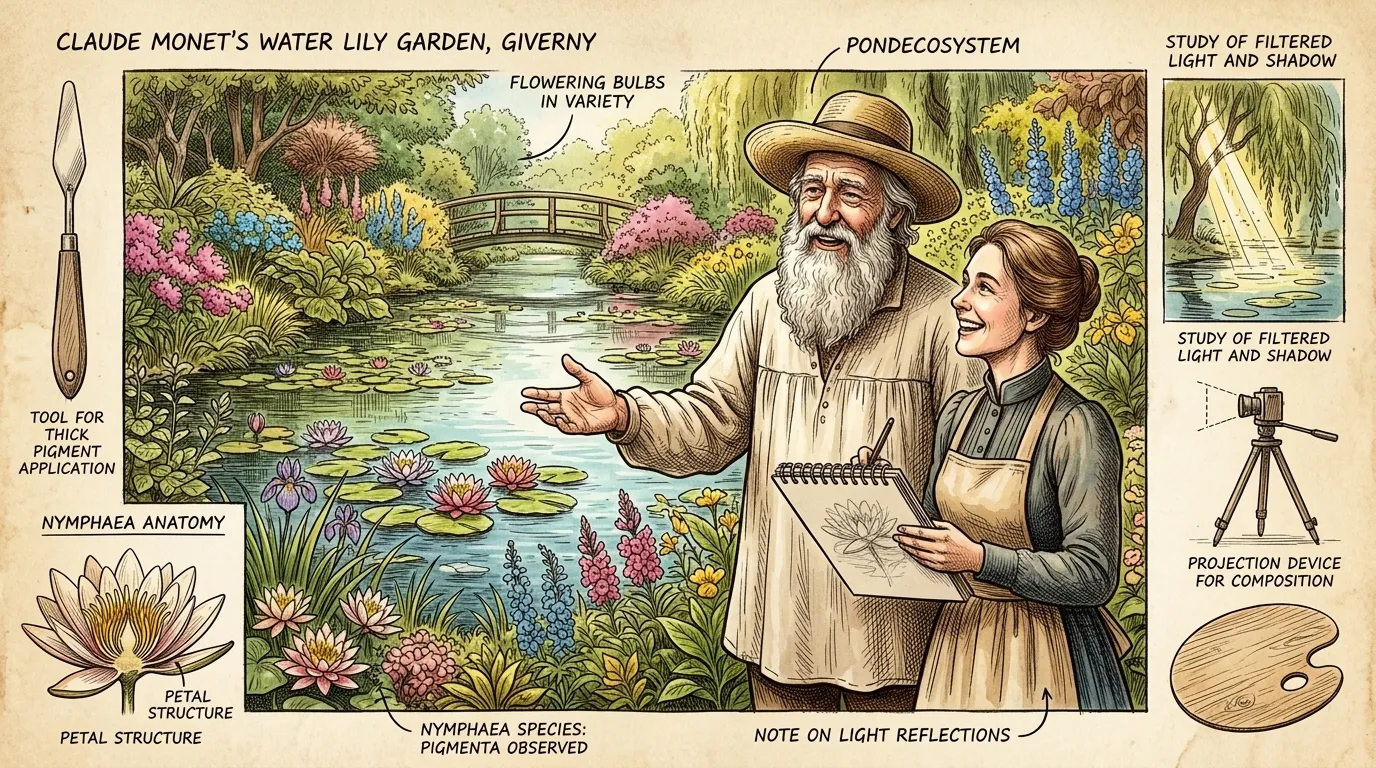
Monet's move to Giverny in 1883 provided him with the perfect environment to pursue his artistic vision. The gardens and surrounding landscapes became his primary inspiration.
"Monet says to his step-daughter, Blanche Hoschedé Monet, 'Here in Giverny, I have found my paradise. The light, the water, the gardens, they are endless inspiration. As Vincent van Gogh said, 'I dream my painting, and then I paint my dream,' this is where my dreams come to life."
Art Fact: Giverny provided Monet with a sanctuary where he could focus on his art and fully develop his unique vision.
Page 9

Monet's work had a profound impact on the course of art history. He paved the way for future generations of artists to explore new forms of expression and to challenge traditional artistic conventions. His works are revered to this day.
"A student says in an art class, 'Monet showed us that art is not about depicting reality, but about capturing the subjective experience of seeing. His legacy lives on.' To which his Professor responds, 'indeed. As Maya Angelou said, 'You can't use up creativity. The more you use, the more you have.'"
Art Fact: Monet's Impressionism shifted the focus of art from objective representation to subjective experience, influencing countless artists.
Page 10

Today, Monet's 'Haystacks' series resides in museums around the world, captivating audiences with their vibrant colors and evocative depictions of light. They stand as a testament to the power of art to capture the fleeting beauty of the world. His obsession with the Haystacks would last forever.
"Monet's enduring words echo through time, 'I would like to paint the way a bird sings.' And indeed, his art sings of light, color, and the eternal beauty of nature."
Art Fact: The 'Haystacks' series remains a celebrated example of Impressionism, inspiring artists and captivating audiences worldwide.
About this story
- Location: France
- Audience: general readers
Questions and answers
Questions and answers about Haystacks Series by Claude Monet (France — 1891)
Read Wonder Arts on your phone
Wonder Arts is available on Android. Get Wonder Arts on Google Play.
More Wonder Arts stories
- Heart of the Andes by Frederic Edwin Church (USA — 1859)
- Hermes and the Infant Dionysus by Praxiteles (Greece — c. 340 BC)
- Hermitage Museum (St. Petersburg, Russia — 1764)
- Honjō Masamune Sword by Gorō Nyūdō Masamune (Japan — 13th Century)
- Hope by George Frederic Watts (London, UK — 1886)
- Hudson River School by Thomas Cole (New York, USA — c. 1825)