Hermes and the Infant Dionysus by Praxiteles (Greece — c. 340 BC)
Hermes and the Infant Dionysus by Praxiteles (Greece — c. 340 BC) — an illustrated arts story, set in Greece. 10 illustrated pages, free to read on Wonder Arts.
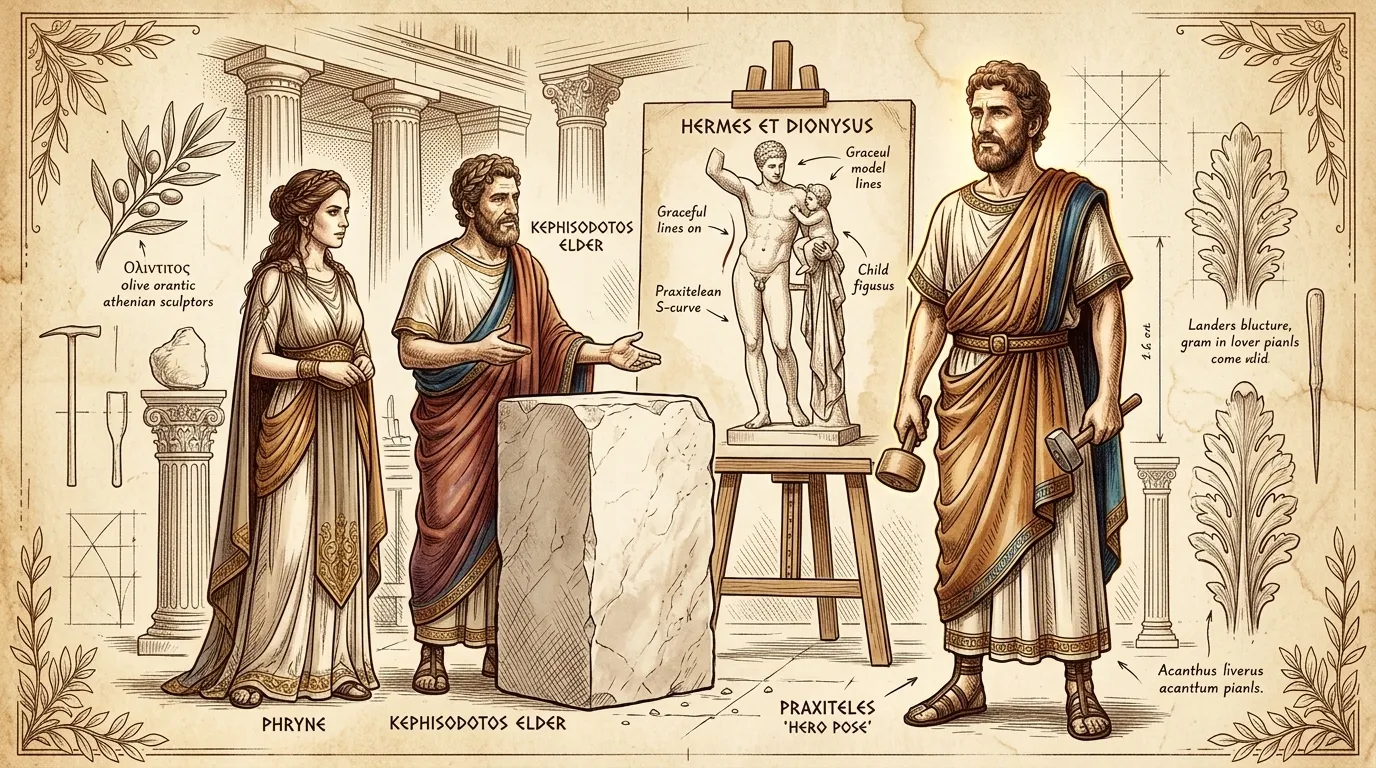
Page 1
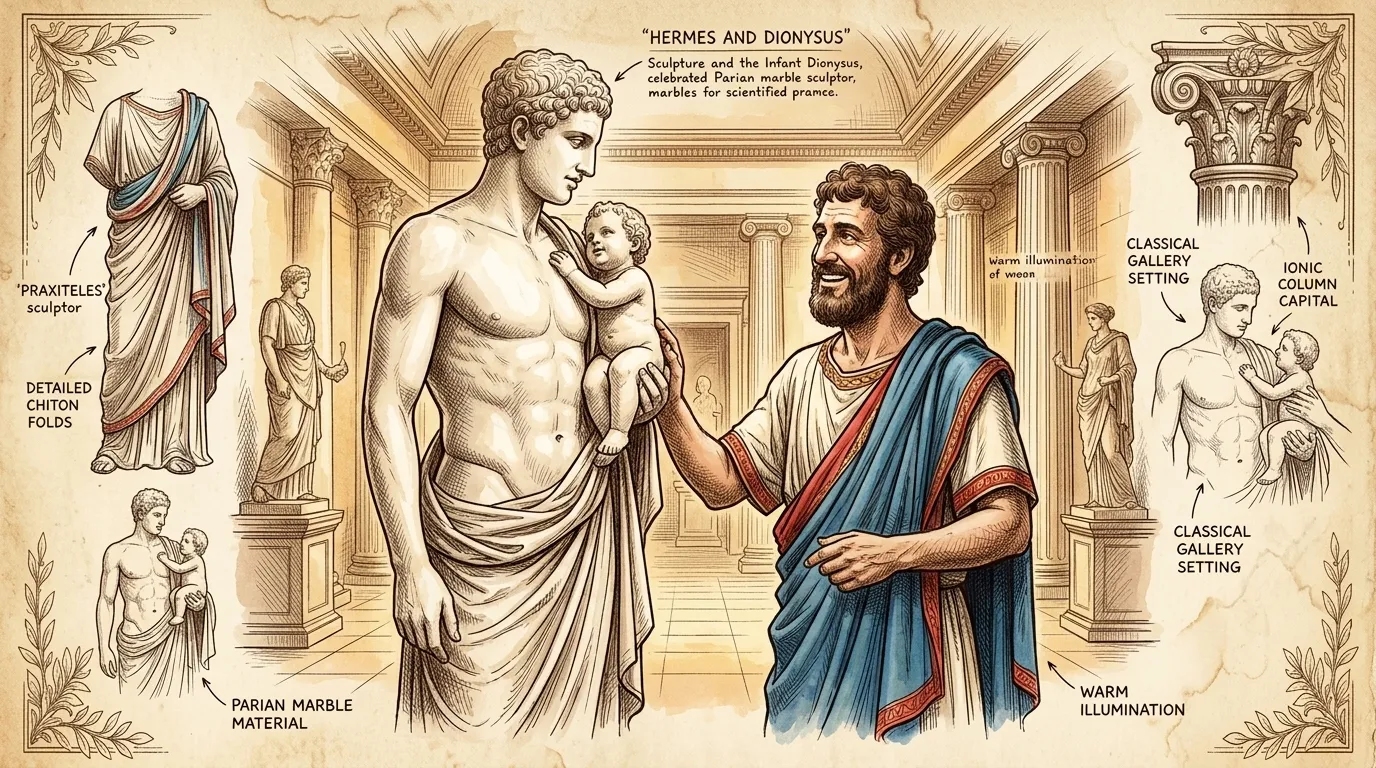
Here stands Praxiteles, circa 340 BC, before his celebrated sculpture, 'Hermes and the Infant Dionysus.' This Parian marble statue, now residing in the Archaeological Museum of Olympia, captures a tender, human moment. Standing at 2.1 meters tall, its survival is a testament to its enduring beauty and the skill of its creator. The statue's discovery in 1877 during excavations solidified its place as a cornerstone of Classical Greek sculpture.
""My ambition," Praxiteles muses, touching Hermes' arm, "was to capture not merely form, but the fleeting grace of divinity itself.""
Art Fact: The statue is renowned for its sensuous rendering of the human form and the gentle interaction between the two figures.
Page 2
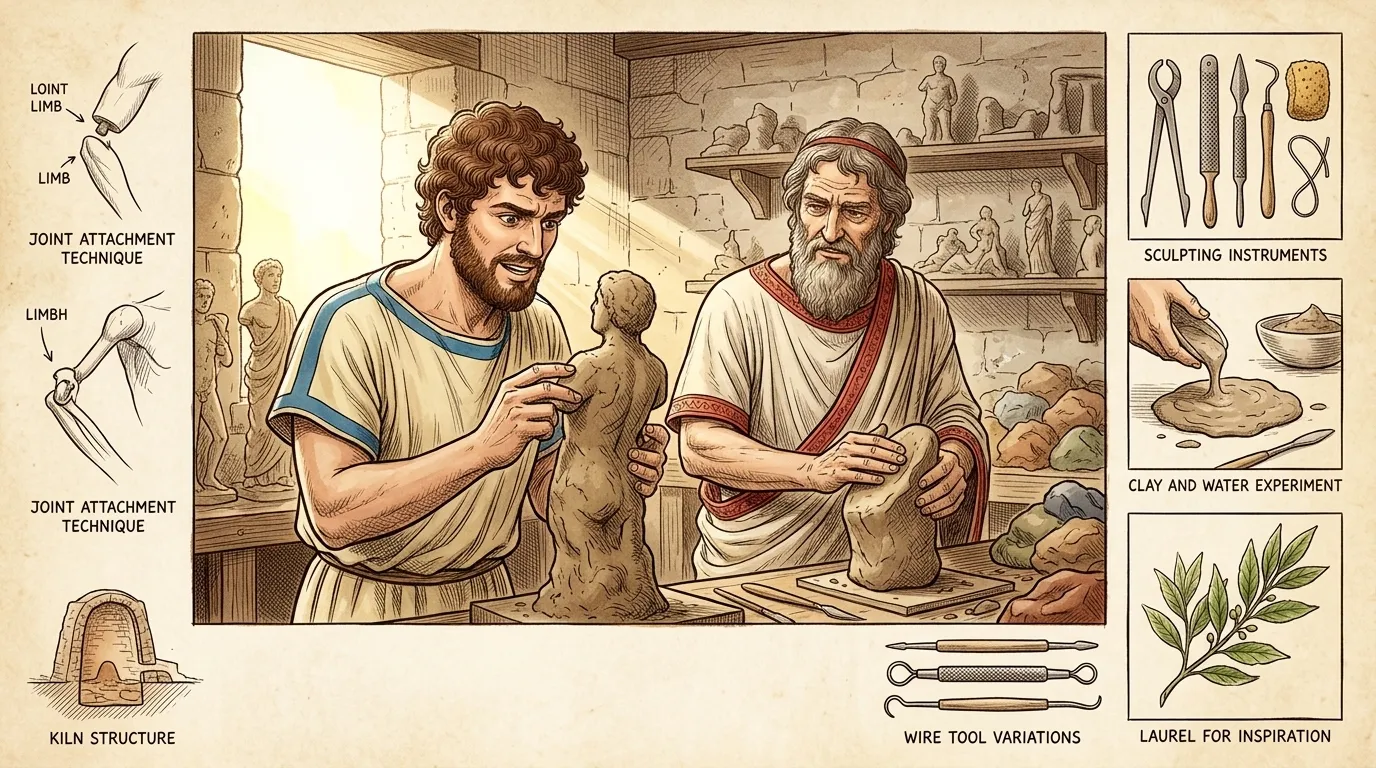
Young Praxiteles, barely a man, apprenticed under the tutelage of Kephisodotos the Elder, his father. The elder sculptor, known for his allegorical figures, instilled in Praxiteles a deep understanding of anatomy and form. "Observe the rhythm of life, my son," Kephisodotos would say, smoothing clay, "for within it lies the essence of beauty."
"Praxiteles, examining a rough clay sketch, asks, "Father, how do you breathe life into mere earth?" Kephisodotos replies, "Through patient observation and unwavering dedication to the human form.""
Art Fact: Kephisodotos the Elder was a significant influence, though few of his works survive to compare with his son's.
Page 3
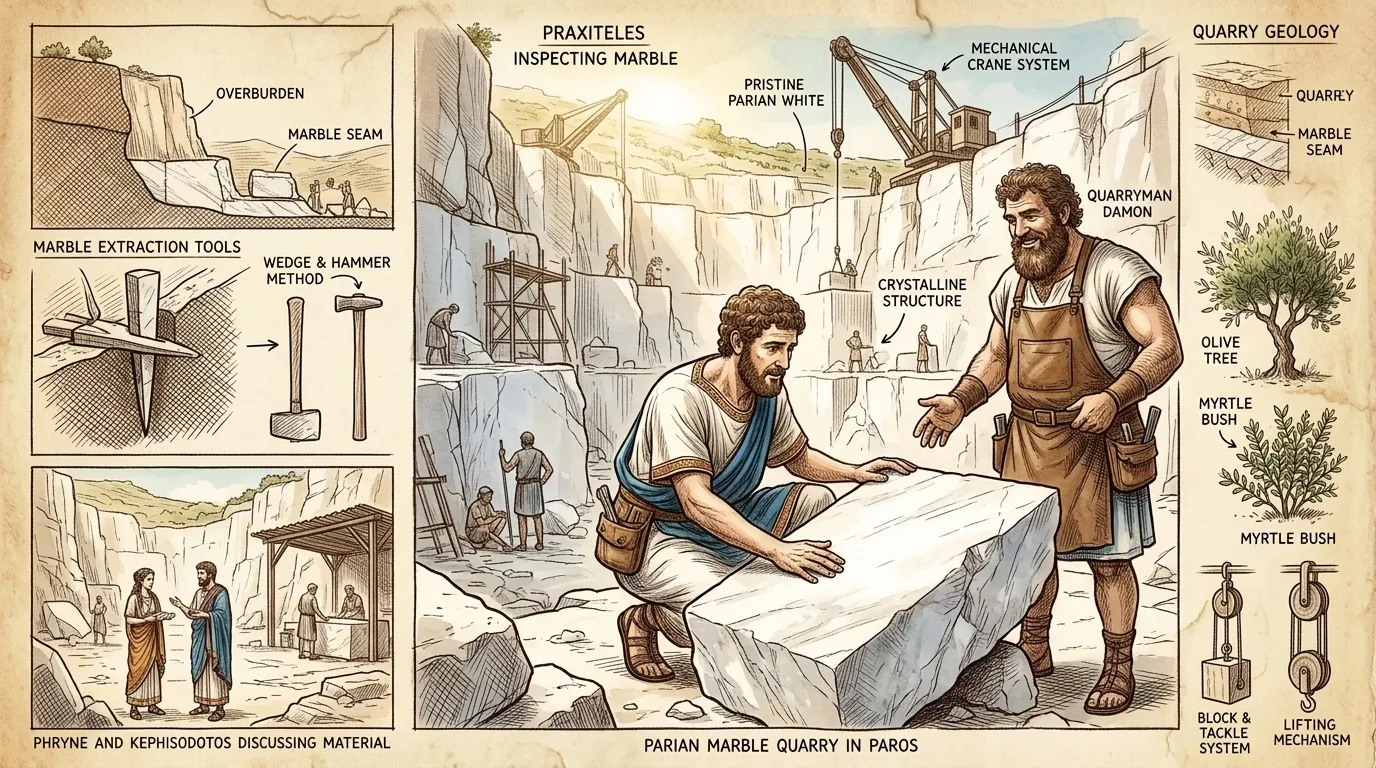
Praxiteles encountered Parian marble for the first time during a visit to a quarry on the island of Paros. Its pristine whiteness and smooth texture captivated him. He understood then that only this material could truly capture the ethereal beauty he sought to express. The head quarryman, a burly man named Damon, proclaimed, "This stone holds the light of the gods themselves!"
"Praxiteles, running his hand over a slab of marble, says, "This...this is more than stone. It is potential itself!" Damon replies, "Indeed, young sculptor. Treat it with respect, and it will reveal its secrets.""
Art Fact: Parian marble, known for its fine grain and luminous quality, became Praxiteles' preferred medium.
Page 4
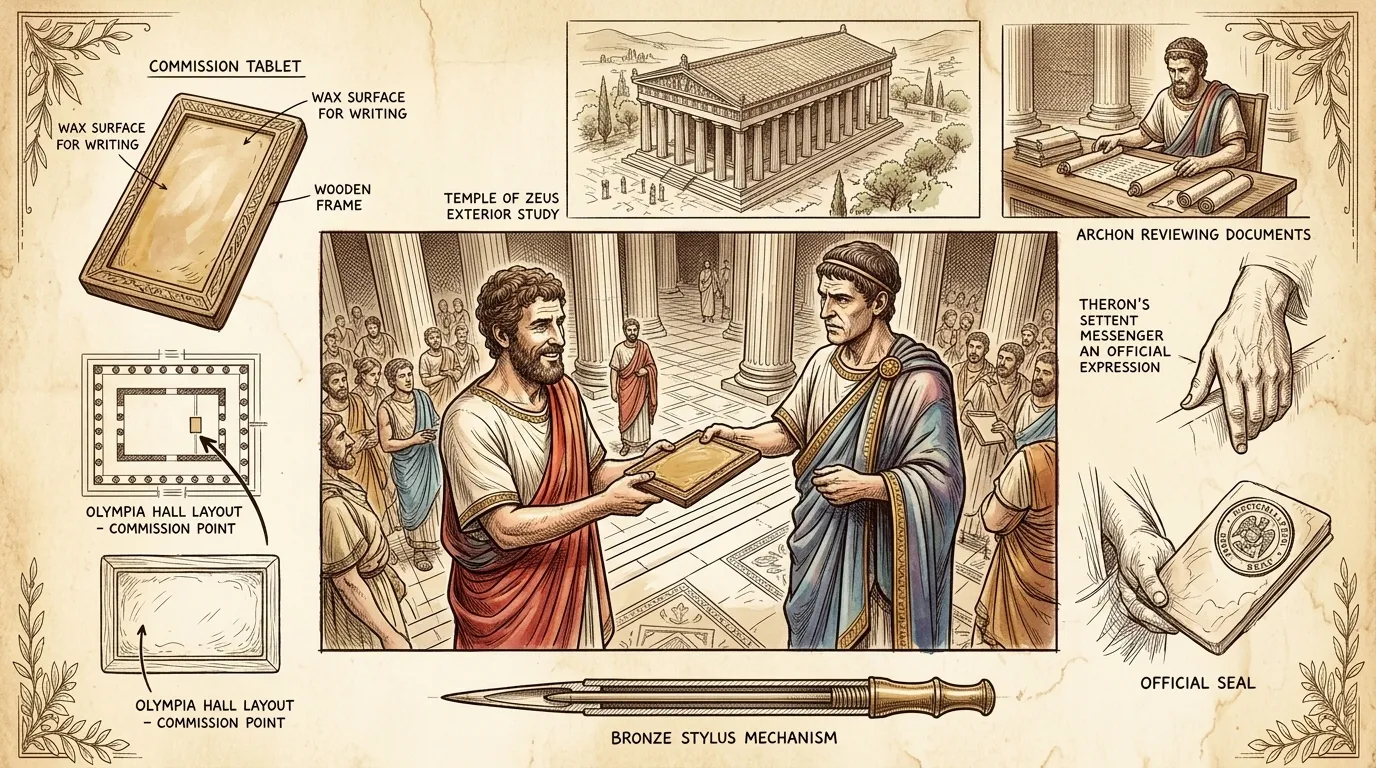
Word of Praxiteles' growing skill reached the ears of the Elean authorities, custodians of the sacred site of Olympia. Eager to enrich their sanctuary, they commissioned a statue intended not for a temple, but the Heraion, the city's public space. The messenger, a stern-faced man named Theron, presented the terms: "A statue worthy of the gods, young sculptor, and worthy of Olympia."
"Praxiteles, accepting the wax tablet, responds, "I accept the commission. My statue will capture the humanism, the tenderness, the light that pervades even the most divine of beings." Theron nods, "Then begin.""
Art Fact: The commission from the Eleans was a turning point, giving Praxiteles a prestigious opportunity.
Page 5
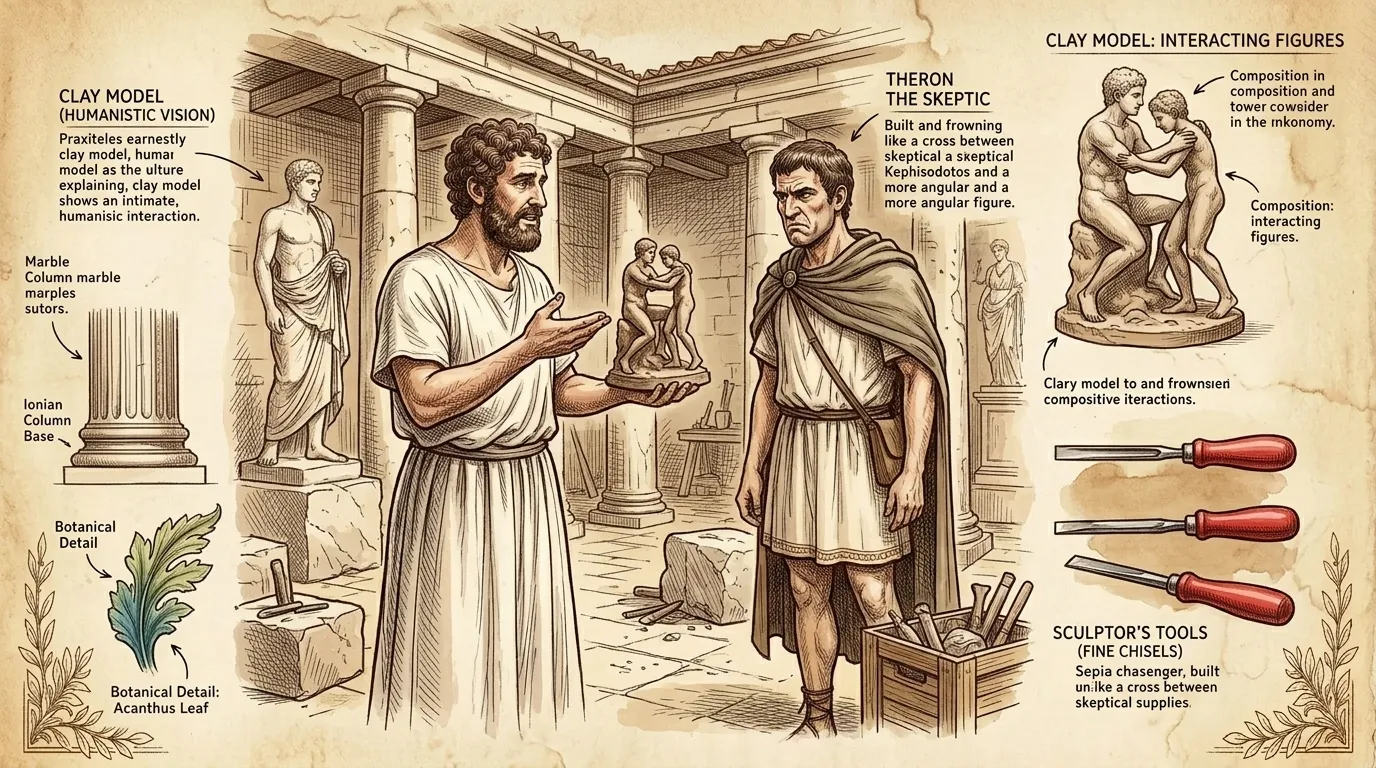
Unlike many of his contemporaries, Praxiteles sought to infuse his gods with human qualities. He envisioned Hermes not as a remote deity, but as a caring guardian. As the philosopher Socrates once said, "Know thyself," and Praxiteles poured his understanding of human care and love into his sculpture.
""The gods are not distant, Theron," Praxiteles explained, gesturing to a small clay model. "They, too, experience joy, sorrow, and the simple pleasure of connection." Theron frowned, "Such sentiment is unusual, sculptor. I expect strength!""
Art Fact: Praxiteles' humanistic approach to depicting gods set him apart from earlier sculptors.
Page 6
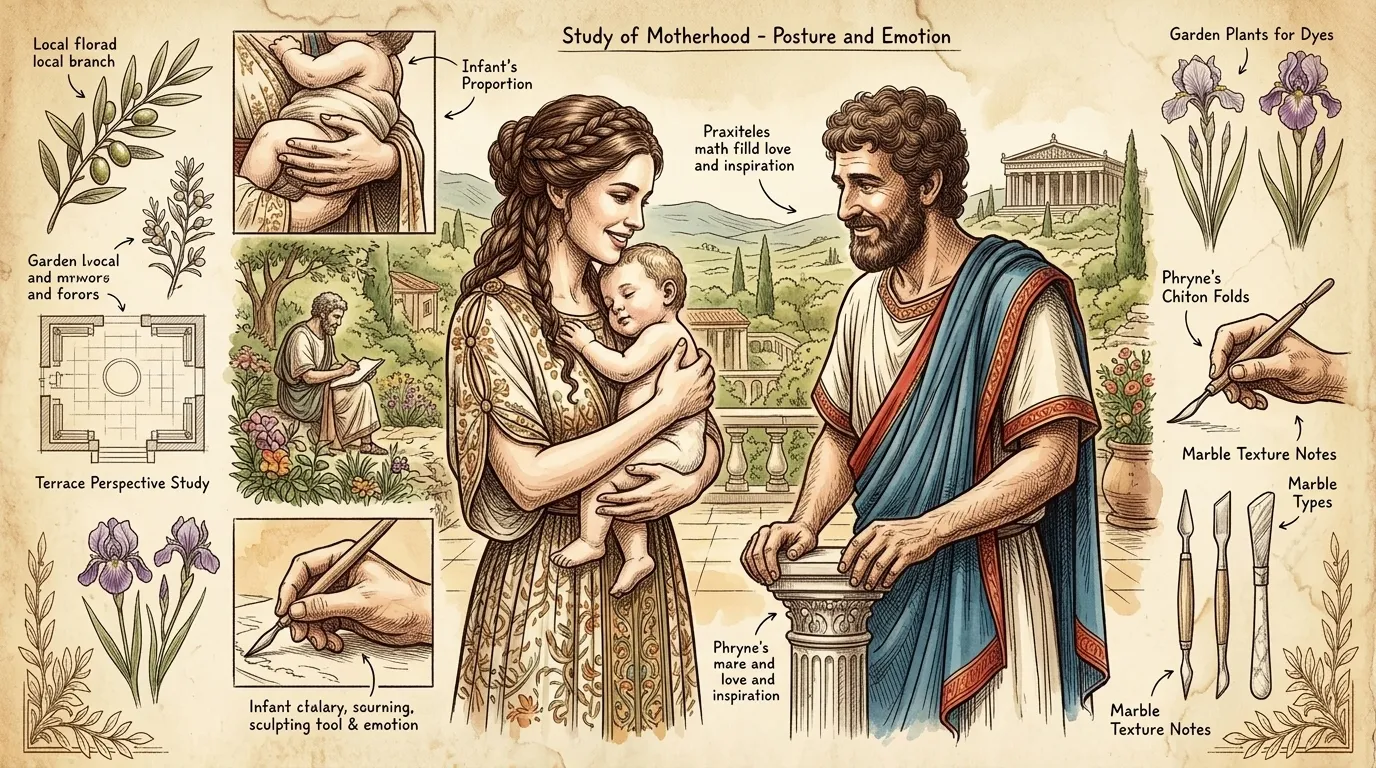
Praxiteles found profound inspiration in his family, particularly in observing the tenderness between parents and children. He watched his wife, Phryne, as she cradled their infant son, a scene that echoed in his mind as he sculpted Hermes and the infant Dionysus. The love between parent and child became his subject. "Family is where life begins and love never ends," Praxiteles once confessed to the playwright Menander, capturing the essence of his artistic vision.
"Phryne, holding their child, smiles at Praxiteles. "See how he gazes at you, my love? Capture that adoration in your Hermes." Praxiteles, watching them, responds, "I will, my dearest. I will make him truly divine.""
Art Fact: Praxiteles' personal life deeply influenced his artistic interpretation of divine figures.
Page 7
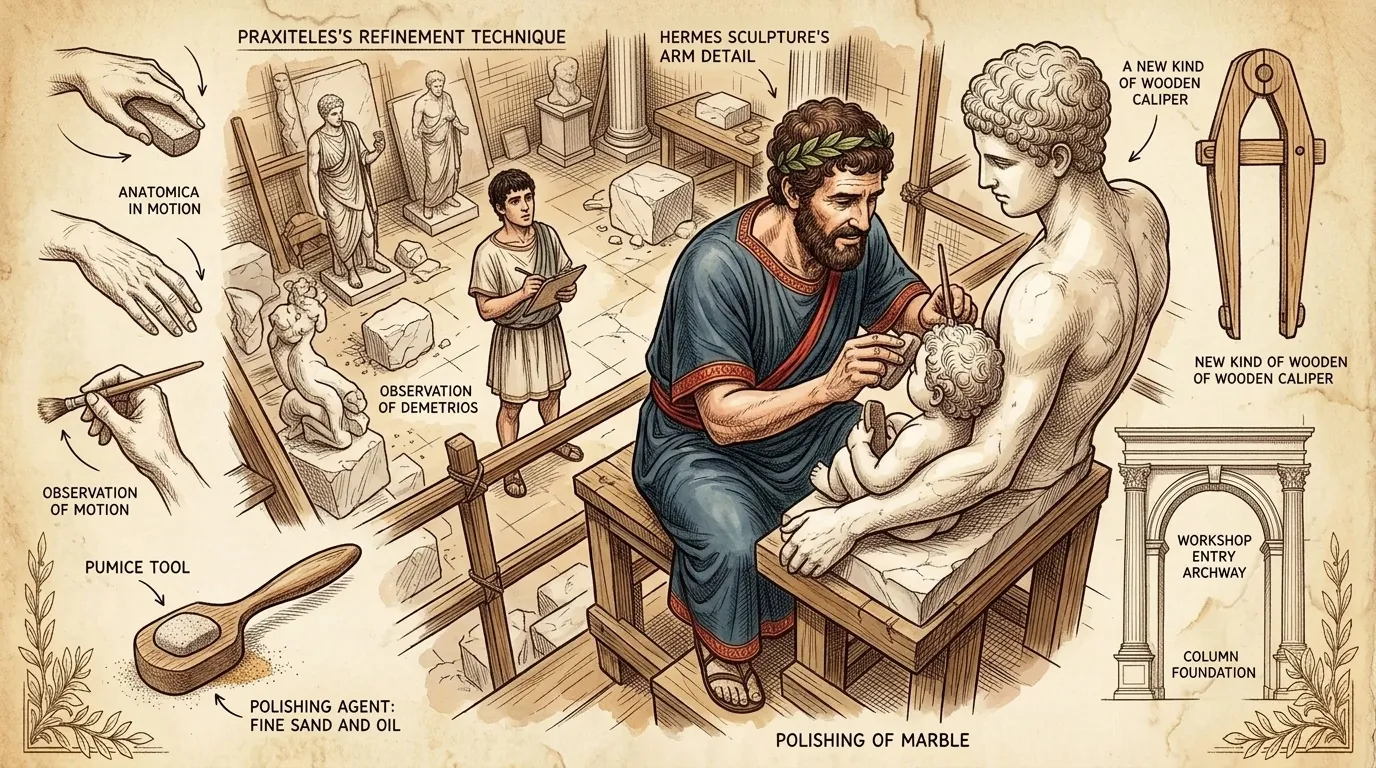
Praxiteles was known for his meticulous attention to detail, especially in the final polishing of his sculptures. He believed that the surface of the marble should reflect light in a way that enhanced the figures' lifelike appearance. "The devil is in the details," Praxiteles quoted, a sentiment he echoed from his mentor, understanding that true beauty lay in the precise execution of every element.
"Praxiteles, gently polishing Hermes' arm, instructs his assistant, Demetrios, "The smoothness must be like skin, Demetrios. The light must dance upon it as it does upon the sea.""
Art Fact: Praxiteles' dedication to the final polishing was legendary, adding to the sculpture's realism.
Page 8
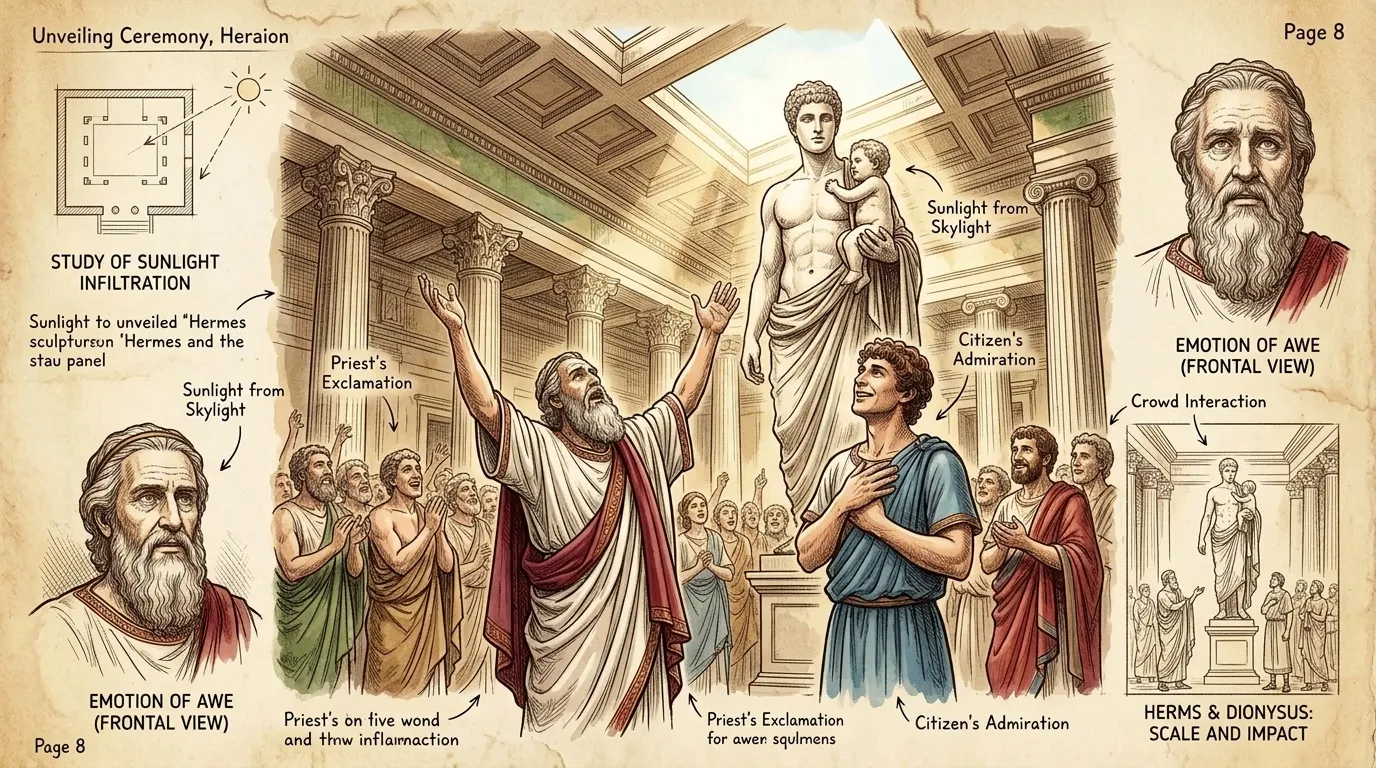
When 'Hermes and the Infant Dionysus' was finally unveiled in the Heraion of Olympia, it was met with immediate acclaim. The sculpture captivated all who saw it, its beauty and humanity resonating deeply. The Eleans rejoiced, their sanctuary enriched by Praxiteles' masterpiece. A visiting poet, Antigenes, wrote: "In stone, he captured not just form, but the very soul!"
"An Elean priest exclaims, "Praxiteles has given us more than a statue; he has given us a vision of divinity itself!" A citizen remarks, "The tenderness in Hermes' gaze is... human!""
Art Fact: The statue's unveiling was a moment of triumph, solidifying Praxiteles' reputation as a master sculptor.
Page 9
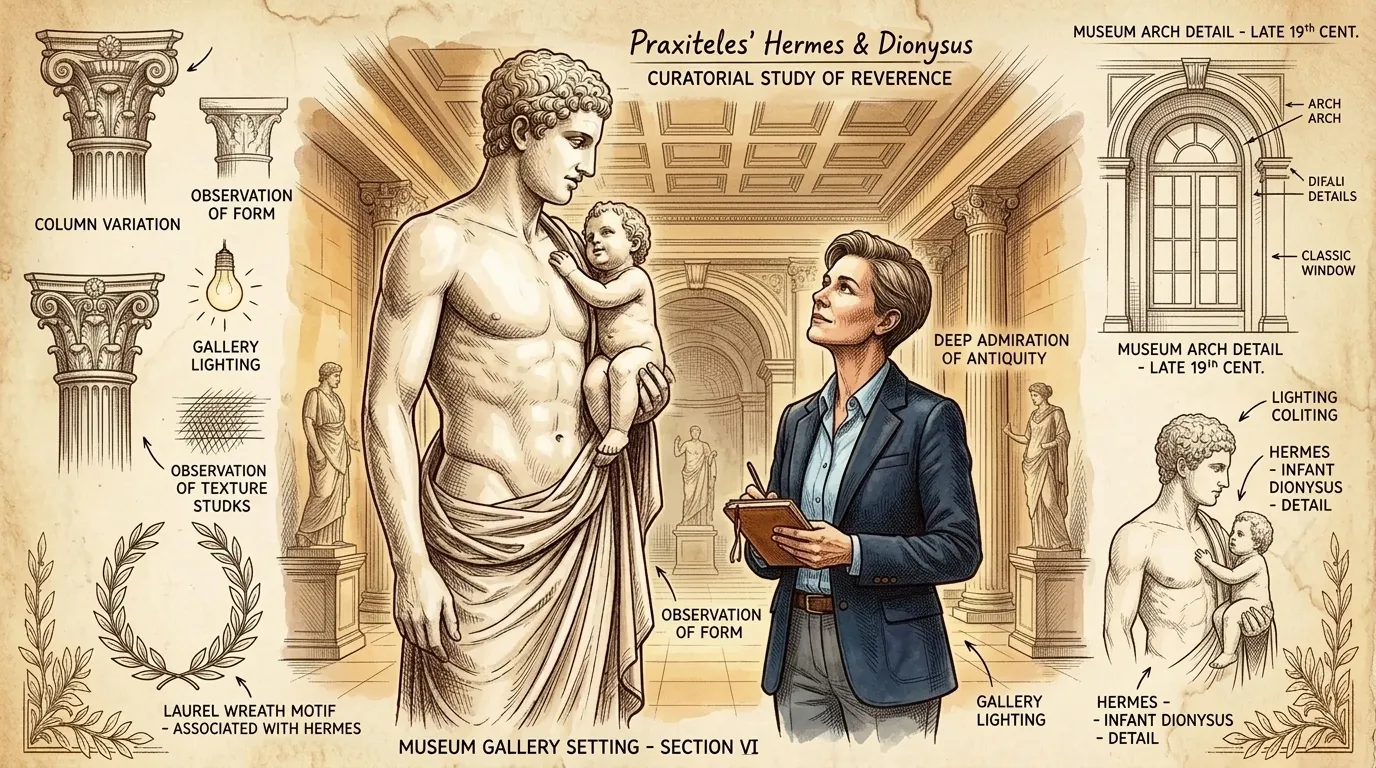
Though centuries have passed, and empires have risen and fallen, 'Hermes and the Infant Dionysus' continues to move viewers. It stands as a testament to the enduring power of art to capture the essence of human emotion. "Time is a great author," said Francis Bacon, "always writing a perfect ending," and Praxiteles' work lives on, continuing to captivate and inspire.
"A modern-day curator, standing before the statue, whispers, "Even now, after millennia, the tenderness of Hermes' gaze is palpable. He remains timeless.""
Art Fact: The statue's survival and continued appreciation highlight its enduring legacy.
Page 10
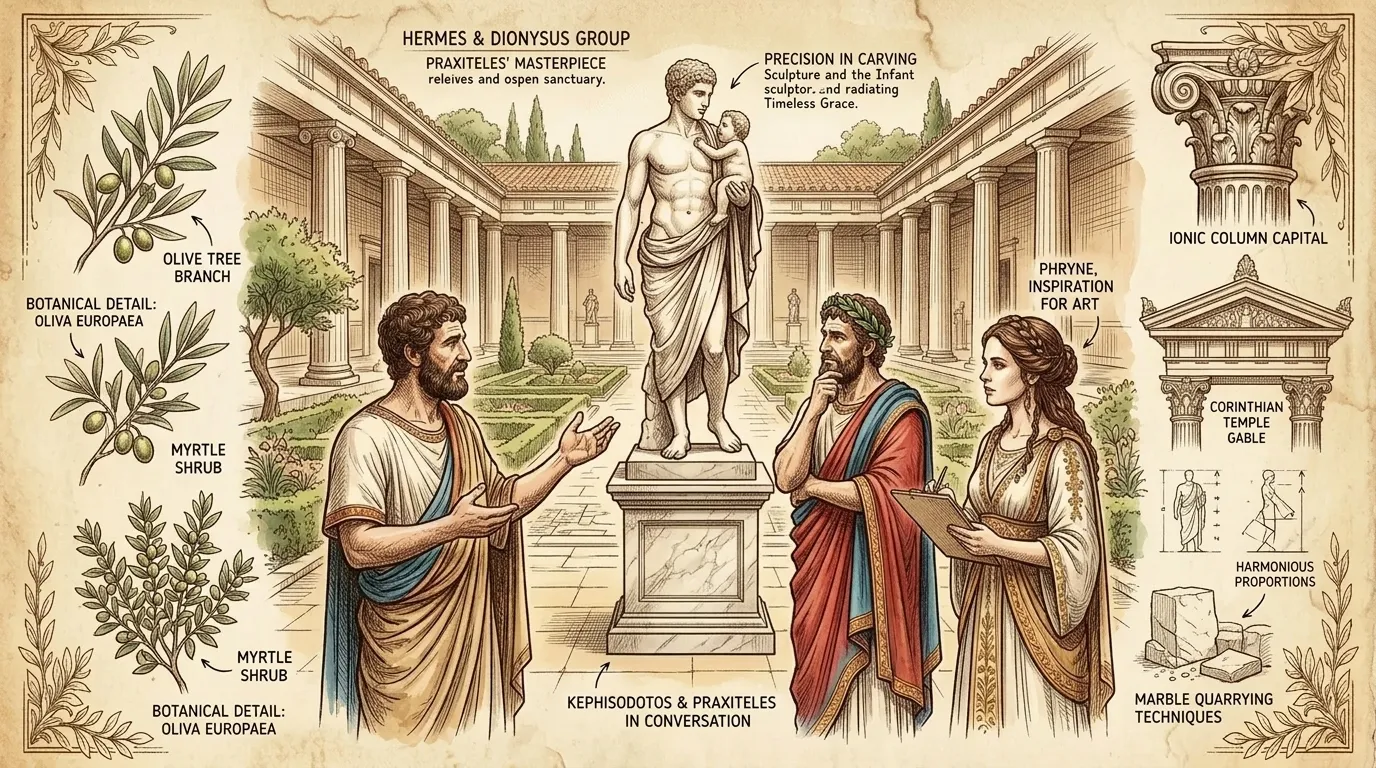
Praxiteles' vision endures, echoing through the ages. He redefined classical sculpture, infusing it with humanity and grace. His 'Hermes and the Infant Dionysus' remains a symbol of parental love, artistic skill, and the timeless beauty of the human form. The sculptor's genius lies in capturing not just the physical, but the soul of his subjects, ensuring his work transcends time itself.
"Praxiteles' legacy, etched in marble, stands as a testament to the power of art to transcend time, reminding us that beauty and humanity are immortal."
Art Fact: Praxiteles' legacy lives on, inspiring generations of artists and art lovers.
About this story
- Location: Greece
- Audience: general readers
Questions and answers
Questions and answers about Hermes and the Infant Dionysus by Praxiteles (Greece — c. 340 BC)
Read Wonder Arts on your phone
Wonder Arts is available on Android. Get Wonder Arts on Google Play.
More Wonder Arts stories
- Hermitage Museum (St. Petersburg, Russia — 1764)
- Honjō Masamune Sword by Gorō Nyūdō Masamune (Japan — 13th Century)
- Hope by George Frederic Watts (London, UK — 1886)
- Hudson River School by Thomas Cole (New York, USA — c. 1825)
- Hungarian Rhapsodies by Franz Liszt (Weimar, Germany — 1846)
- Hylas and the Nymphs by John William Waterhouse (London, UK — 1896)