Heart of the Andes by Frederic Edwin Church (USA — 1859)
Heart of the Andes by Frederic Edwin Church (USA — 1859) — an illustrated arts story, set in United States. 10 illustrated pages, free to read on Wonder Arts.
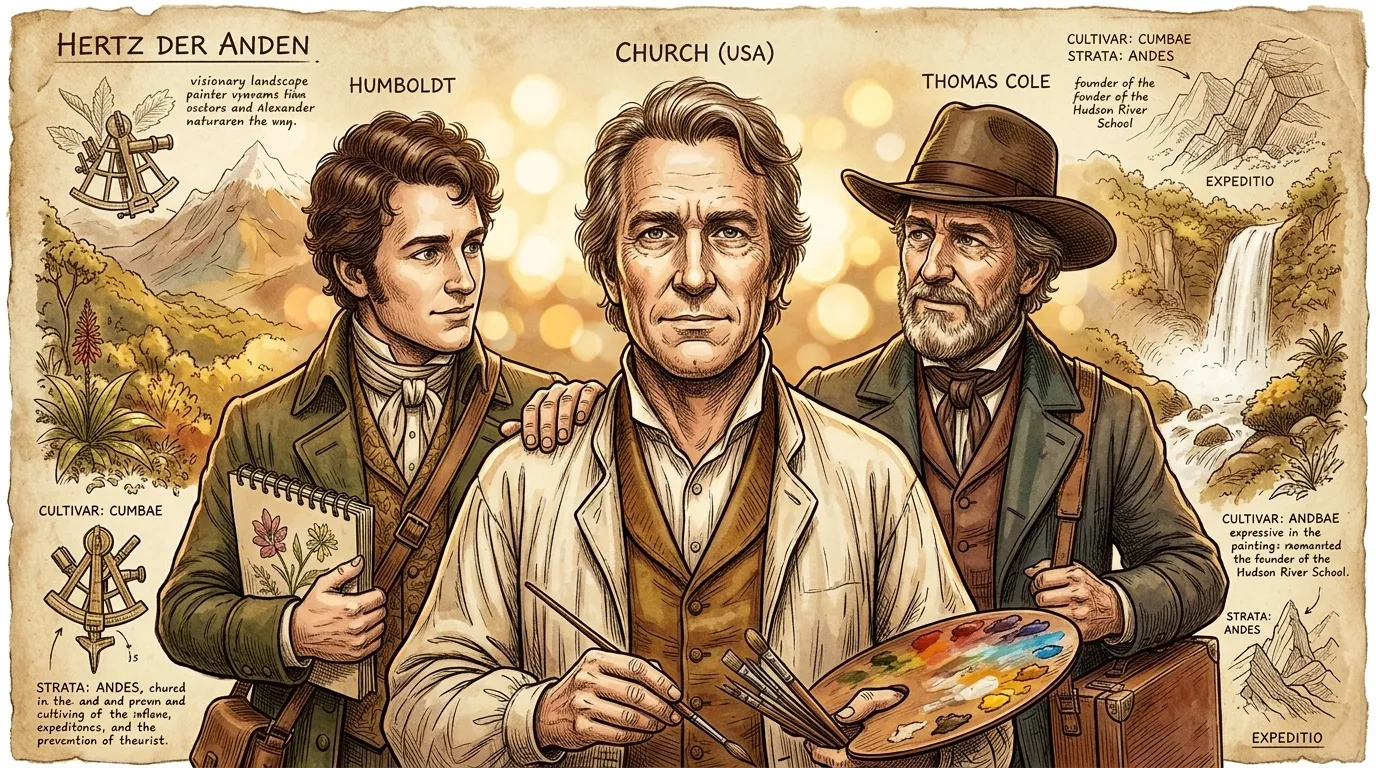
Page 1
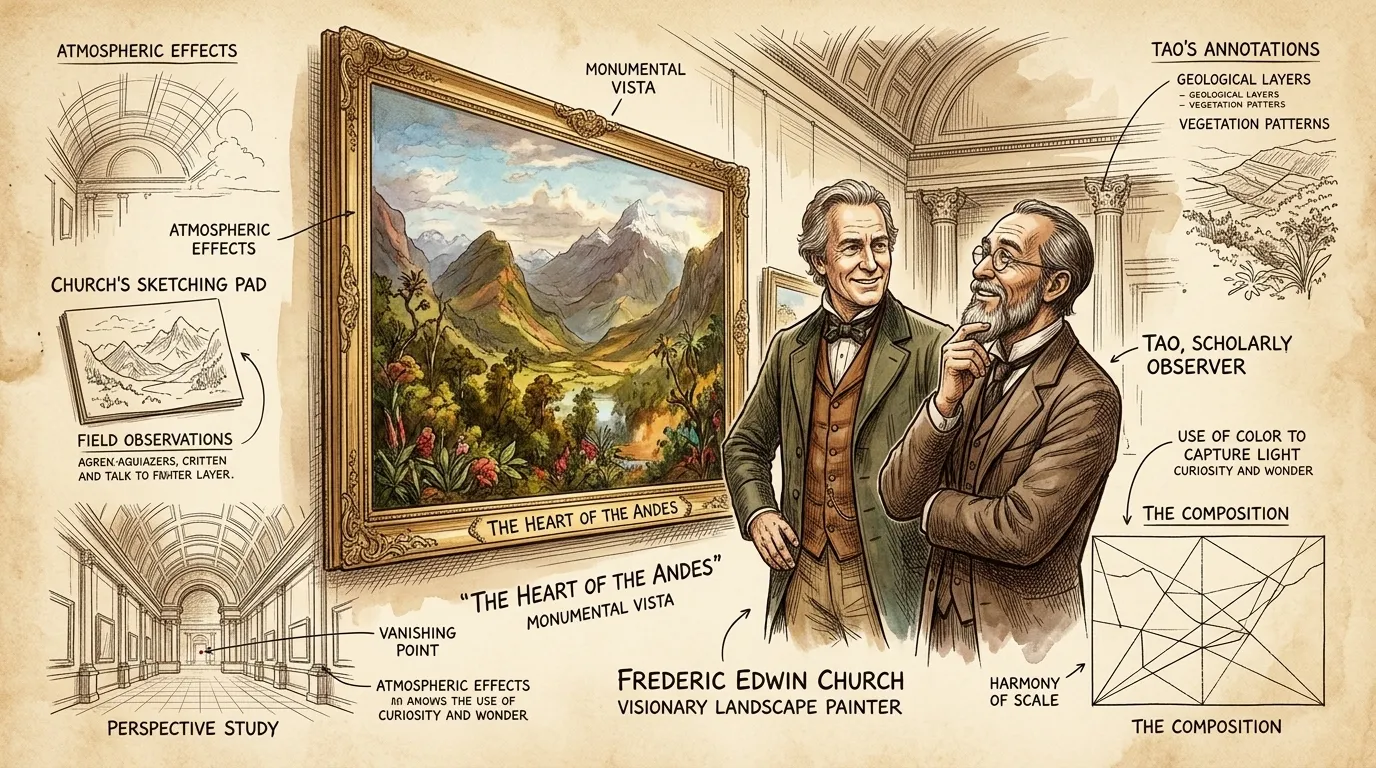
Frederic Edwin Church stands before his monumental canvas, 'The Heart of the Andes,' completed in 1859. The painting, a staggering 5'6" x 9'10", is a panorama of the South American landscape, now housed at the Metropolitan Museum of Art. Its unveiling was a sensation, commanding a ticket price for viewing, much like a theatrical performance. Church believed the painting captured the spiritual essence of the Andes. The artist, Tao, has dedicated his life to studying it.
"Tao: (to himself, whispering) To capture the essence... the very soul of a place."
Art Fact: Fun fact: 'The Heart of the Andes' was so popular that Church provided viewers with opera glasses to examine its details, much like one would at a grand theatrical performance.
Page 2
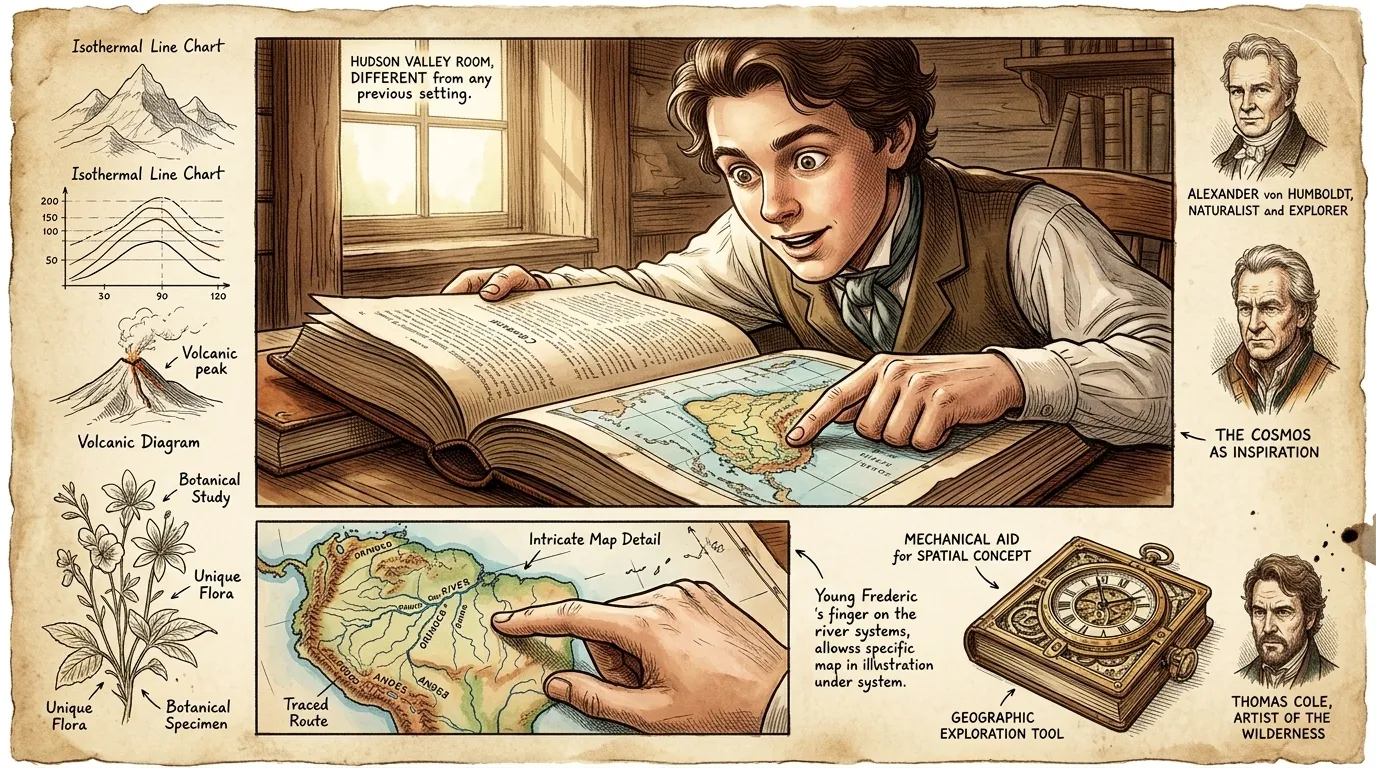
Young Frederic, barely a teenager, pores over Alexander von Humboldt's 'Cosmos' in his Hudson Valley home. Humboldt's vivid descriptions of South America ignite a lifelong passion. He dreams of painting landscapes that capture the interconnectedness of nature, just as Humboldt described. Frederic traces the maps with his finger, imagining the towering peaks and verdant valleys.
"Frederic: (reading aloud) 'The grandest forms of nature are united with a richness of vegetable forms... a new world is unfolded, it is the world of the tropics!'"
Art Fact: Alexander von Humboldt's writings deeply influenced Church. The artist even traced Humboldt's footsteps through South America to gain a personal understanding of the landscape.
Page 3
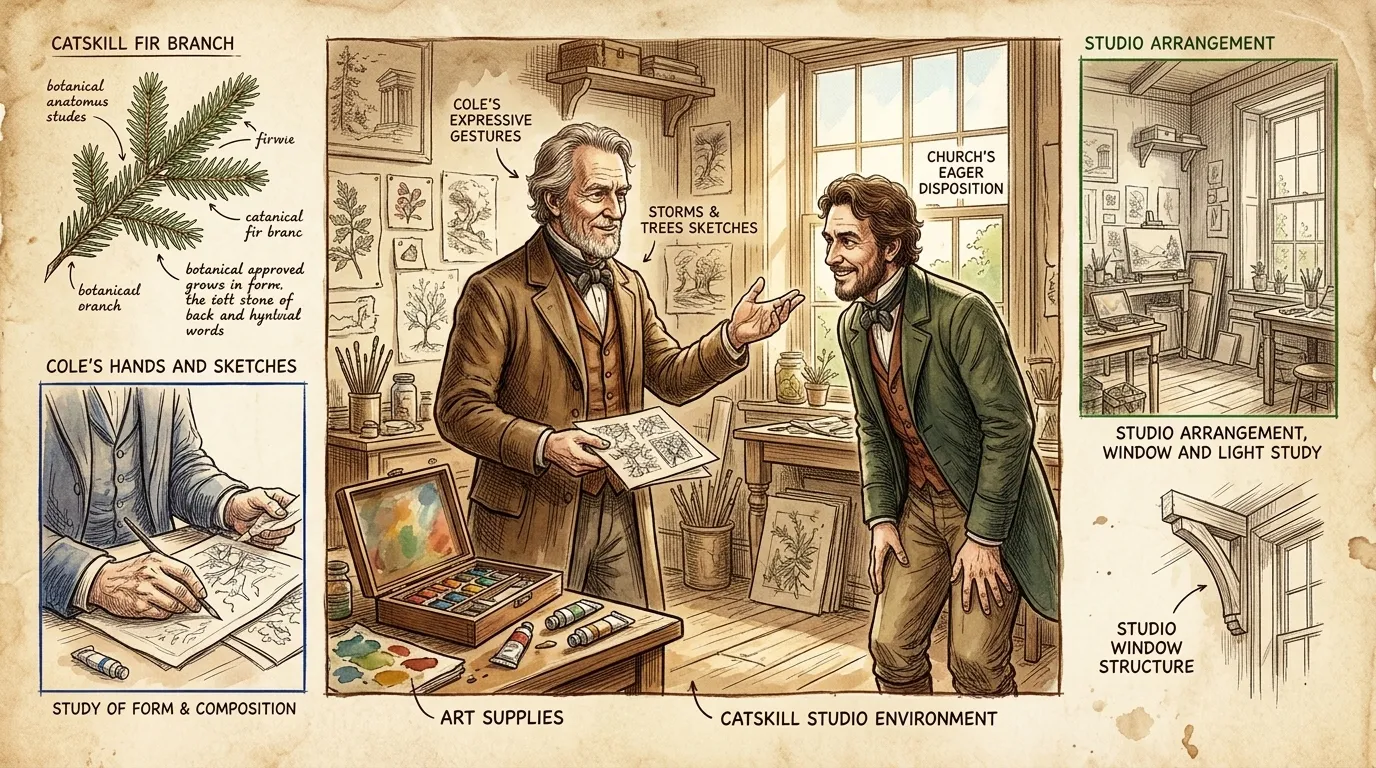
Thomas Cole, Church's mentor, imparts wisdom in his Catskill studio. He stresses the importance of detailed observation and spiritual connection to nature. Cole shows Church sketches he made of storms and trees.
"Cole: (sternly, but kindly) 'Frederic, it is not enough to simply reproduce what you see. You must capture the spirit of the landscape, its divine essence! The sublime is in the heart of nature!' Church responds: 'Thank you, sir!'"
Art Fact: Thomas Cole, the founder of the Hudson River School, served as Church's mentor, instilling in him a deep appreciation for the American landscape and the spiritual power of nature.
Page 4
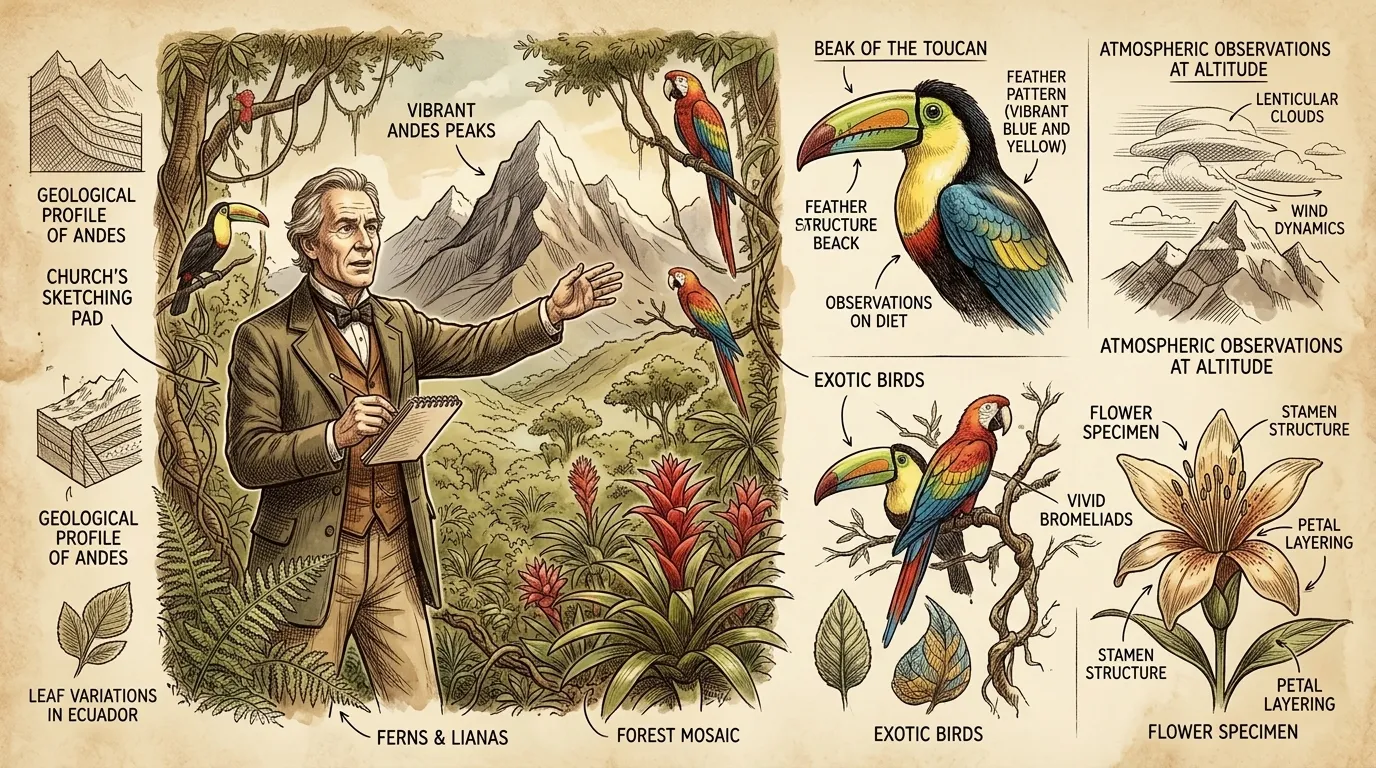
Church arrives in Ecuador, overwhelmed by the vibrant colors and dramatic landscapes. He sketches furiously, trying to capture the immense scale of the Andes. The air is thick with humidity, the sounds of exotic birds fill the air, and exotic flowers fill the forests.
"Church: (to himself, amazed) 'It's even more magnificent than Humboldt described! The sheer scale...the vibrant light! It's breathtaking!'"
Art Fact: Church made two trips to South America, in 1853 and 1857, spending months sketching and studying the landscape in preparation for 'The Heart of the Andes.'
Page 5
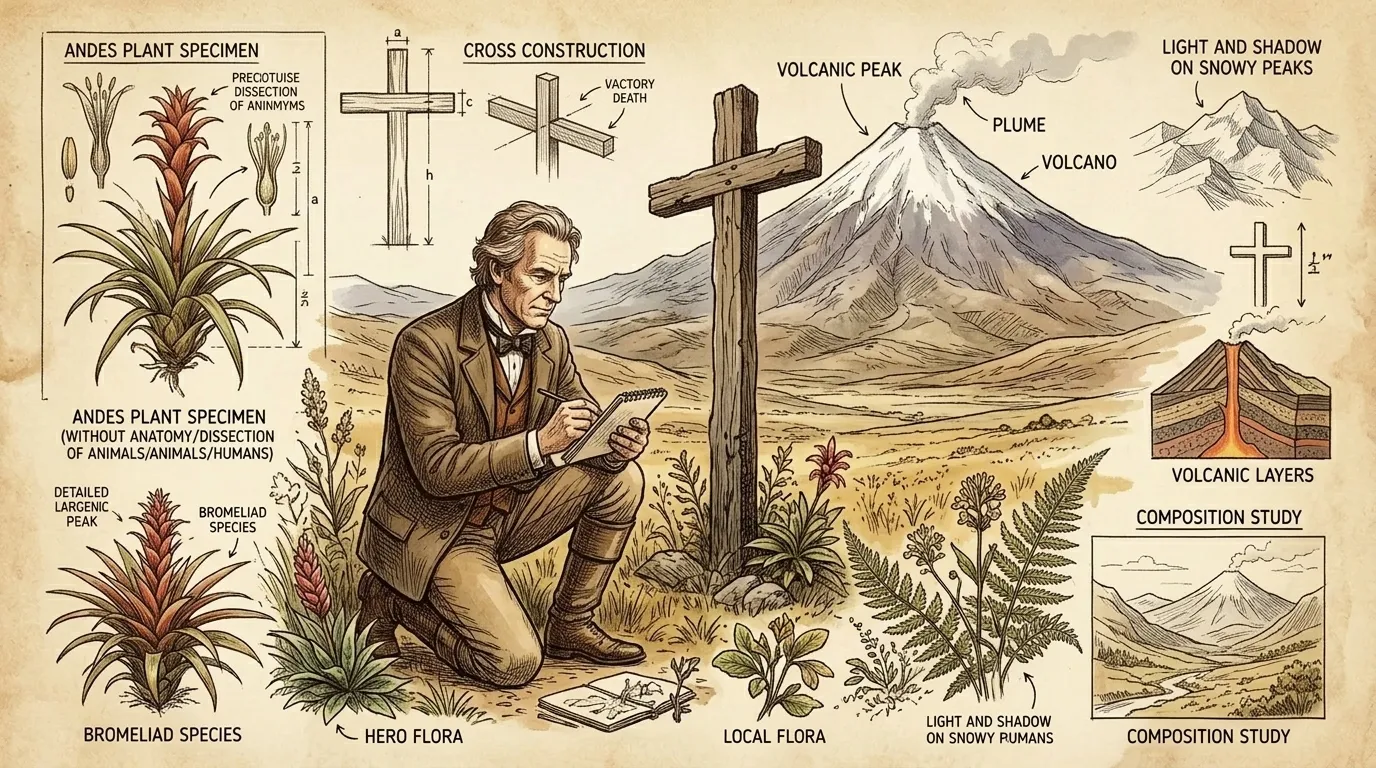
While sketching in the Andes, Church is struck by the juxtaposition of a simple wooden cross and a towering volcano. This image encapsulates the spiritual and geological forces shaping the landscape. He meticulously documents every detail, understanding the importance of realism. The cross is weathered, a testament to faith, and the volcano a symbol of the earth's power.
"Church: (muttering to himself) 'The cross... a symbol of hope, juxtaposed against the raw power of the volcano. It's the heart of this world, faith versus nature.'"
Art Fact: The cross in 'The Heart of the Andes' is a recurring motif in Church's work, representing the intersection of faith and nature in the South American landscape.
Page 6
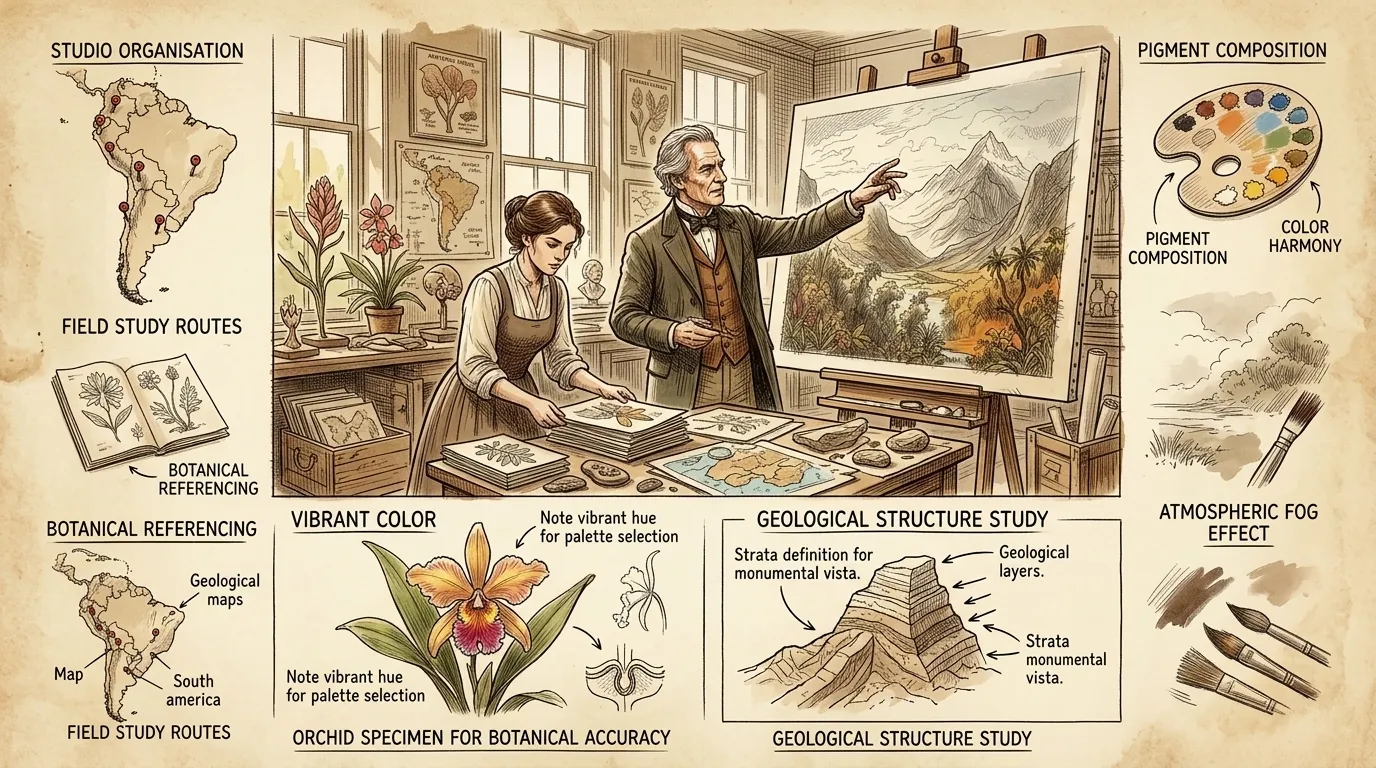
Back in his New York studio, Church begins to assemble his sketches into a monumental composition. He meticulously blends realism with romantic ideals. His studio is filled with sketches, maps, and botanical specimens from South America. He understands this must be accurate to be impactful.
"Church: (to his assistant) 'Every detail must be precise. The orchids, the trees, the geological formations... they must all be accurate. Only then will the painting truly capture the heart of the Andes!'"
Art Fact: Church spent months meticulously assembling his sketches and studies into the final composition of 'The Heart of the Andes,' striving for both realism and a sense of idealized beauty.
Page 7
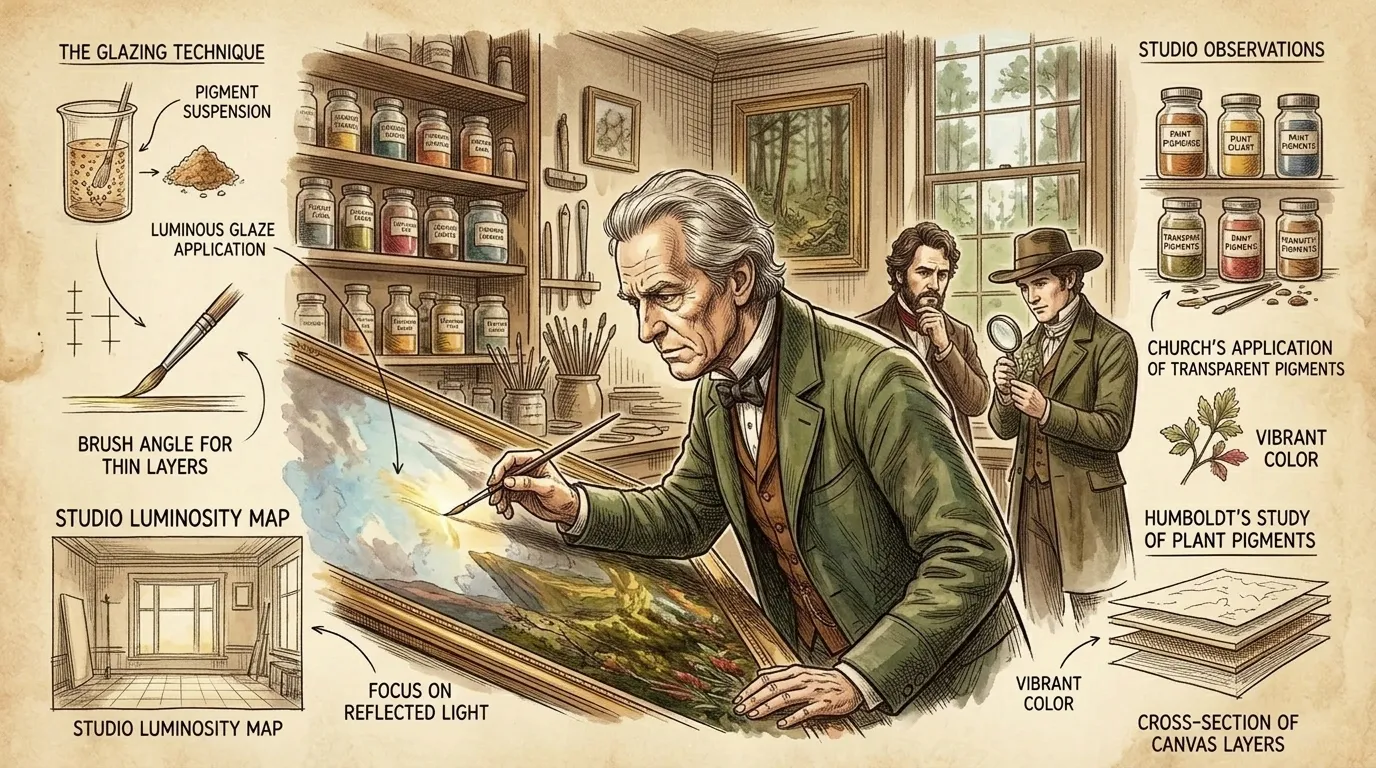
Church experiments with layering glazes to achieve the extraordinary luminosity he seeks. He wants the painting to glow with an inner light. The artist is determined to paint with his own light.
"Church: (to himself) 'The light... it must glow from within. Layer upon layer of color, building to a crescendo of luminosity!'"
Art Fact: Church was known for his mastery of light, using delicate glazes and carefully chosen colors to create a sense of atmospheric depth and luminosity in his paintings.
Page 8
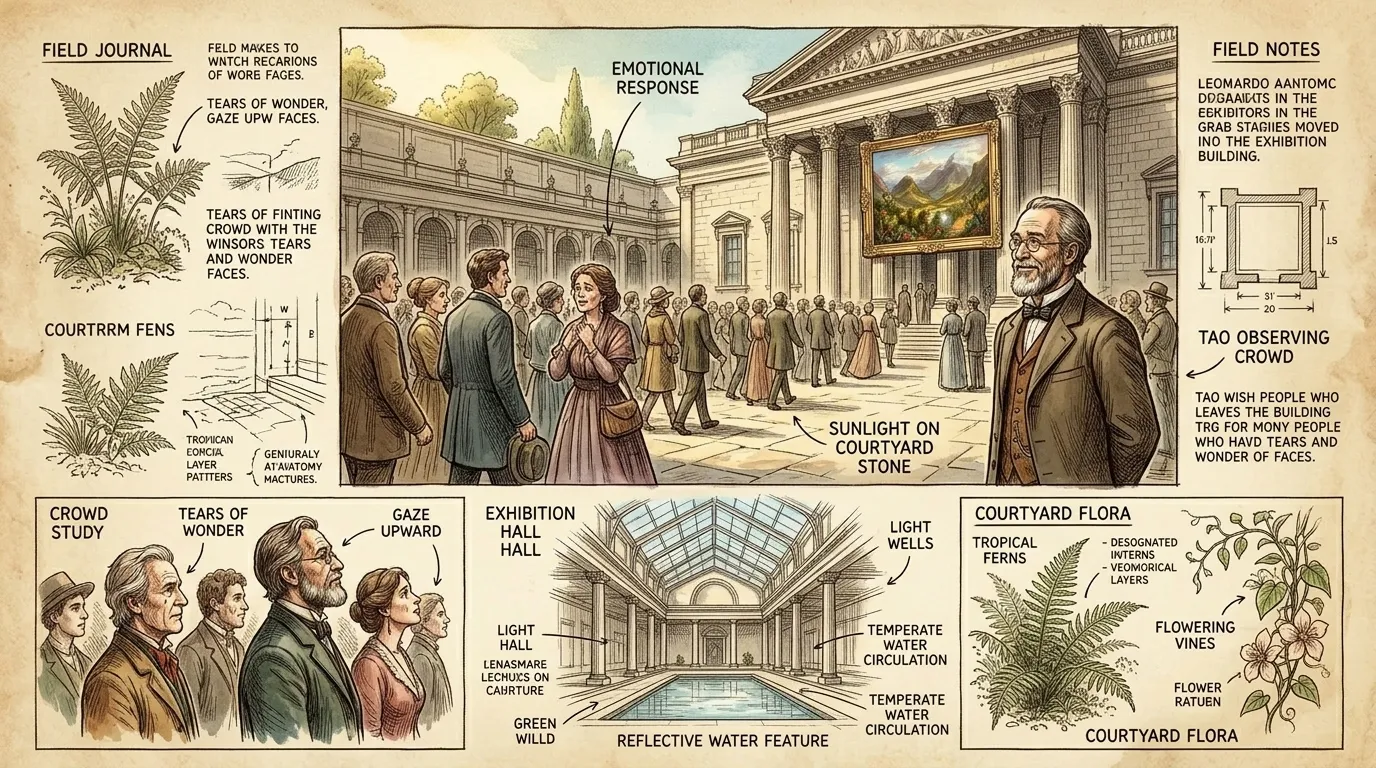
The painting is unveiled, and the public is moved to tears. Church's attention to detail, combined with the grandeur of the subject, creates a profound emotional impact. The observatory is filled with people. People stare up at the painting with tears in their eyes.
"Spectator 1: (whispering) 'It's...it's breathtaking. I feel like I'm actually there!' Spectator 2: 'It's more than just a painting. It's a spiritual experience!' Tao quotes French writer Marcel Proust: 'The real voyage of discovery consists not in seeking new landscapes, but in having new eyes."
Art Fact: The initial exhibition of 'The Heart of the Andes' was a major cultural event, drawing crowds of enthusiastic viewers and critical acclaim. It sold for 10,000, a record price for an American painting at the time.
Page 9
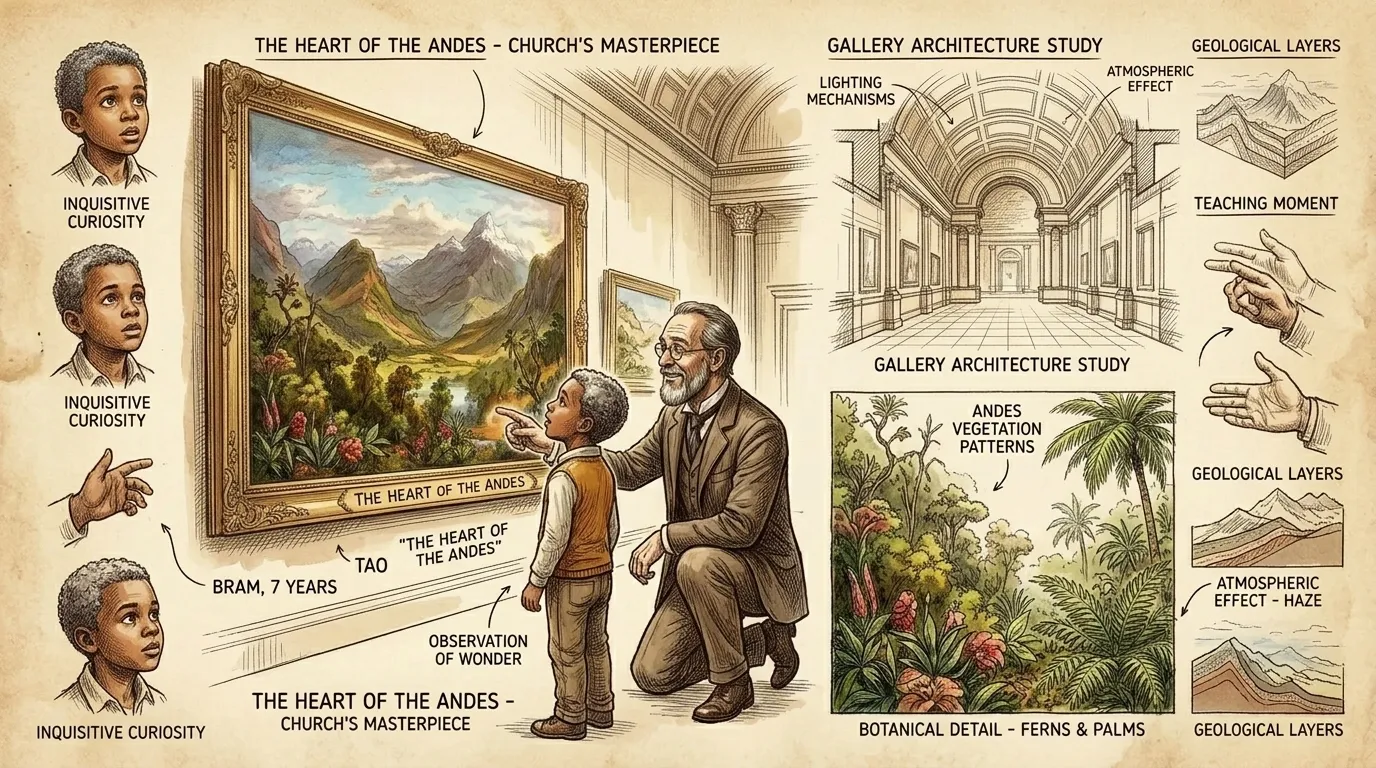
Centuries later, 'The Heart of the Andes' continues to inspire awe. The spirit of Humboldt and Cole lives on through Church's masterpiece. The painting has been moved multiple times. A determined 12-year-old male, lean and athletic, with light ivory skin with rosy cheeks and thick straight black hair with a gentle wave at the ends, stands quietly in front of the painting.
"Bram, a curious 7-year-old male, average height with a round face, with warm caramel skin and close-cropped salt-and-pepper hair, whispers: 'Tao, what makes it so special?'. Tao: 'It reminds us of the beauty of nature and the importance of protecting it.'. Bram: 'Oh!'"
Art Fact: Church's work continues to inspire artists and art lovers. His legacy endures as a visionary landscape painter and a champion of environmental awareness.
Page 10
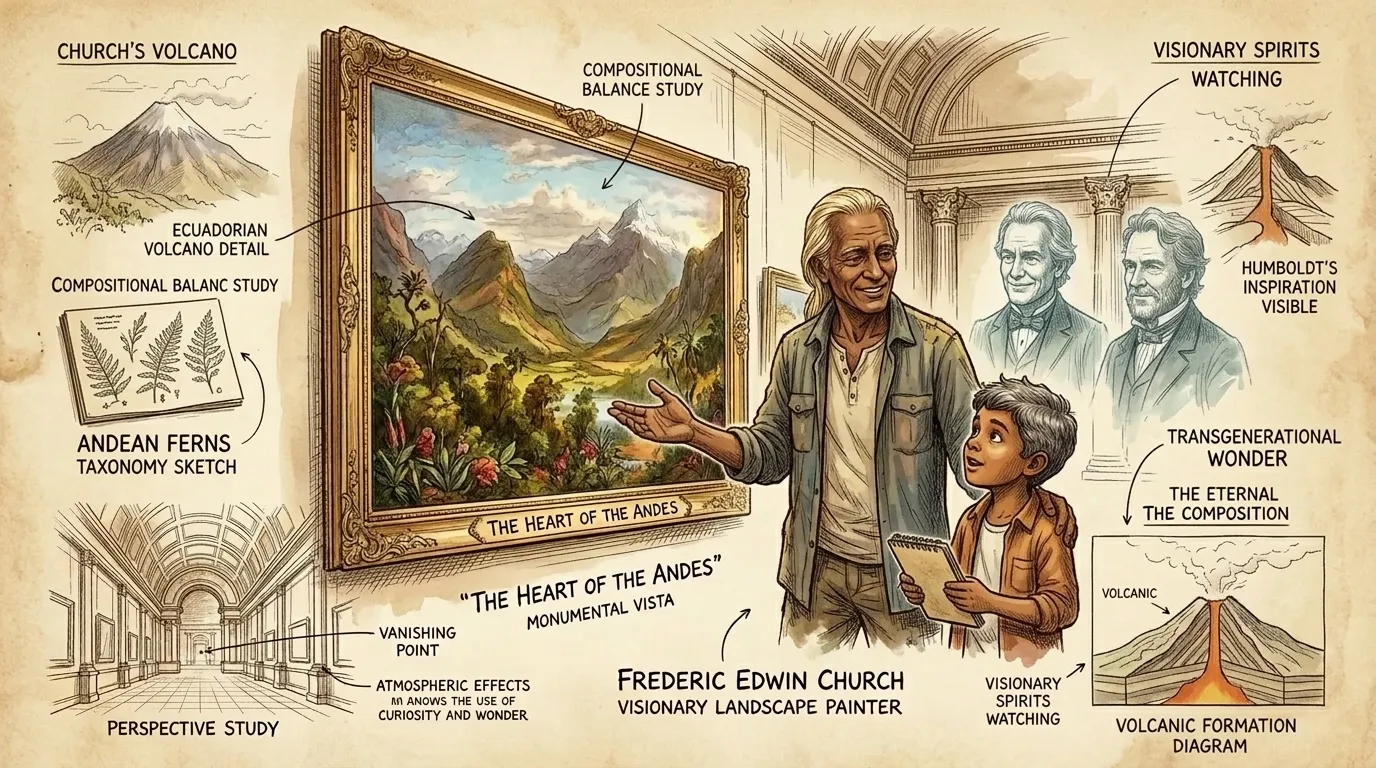
The 'Heart of the Andes' survives as a testament to the power of art to connect us to nature and to each other. The ghosts of Church, Humboldt, and Cole look on with pride. It captures the true heart of the Andes. The painting stands in an enormous museum.
"Arjun, an elderly man in his late 60s male, tall and lean, with deep brown skin and medium-length straight blonde hair tucked behind his ears: 'It reminds us that the heart of the Andes is also within us all!'. Bram: 'Wow!'"
Art Fact: The 'Heart of the Andes' endures because it transcends mere representation, capturing the spiritual and emotional essence of a place, forever inviting viewers to connect with the beauty and grandeur of the natural world.
About this story
- Location: United States
- Audience: general readers
Questions and answers
Questions and answers about Heart of the Andes by Frederic Edwin Church (USA — 1859)
Read Wonder Arts on your phone
Wonder Arts is available on Android. Get Wonder Arts on Google Play.
More Wonder Arts stories
- Hermes and the Infant Dionysus by Praxiteles (Greece — c. 340 BC)
- Hermitage Museum (St. Petersburg, Russia — 1764)
- Honjō Masamune Sword by Gorō Nyūdō Masamune (Japan — 13th Century)
- Hope by George Frederic Watts (London, UK — 1886)
- Hudson River School by Thomas Cole (New York, USA — c. 1825)
- Hungarian Rhapsodies by Franz Liszt (Weimar, Germany — 1846)