Guernica by Pablo Picasso (Madrid, Spain — 1937)
Guernica by Pablo Picasso (Madrid, Spain — 1937) — an illustrated arts story, set in Spain. 10 illustrated pages, free to read on Wonder Arts.
Page 1

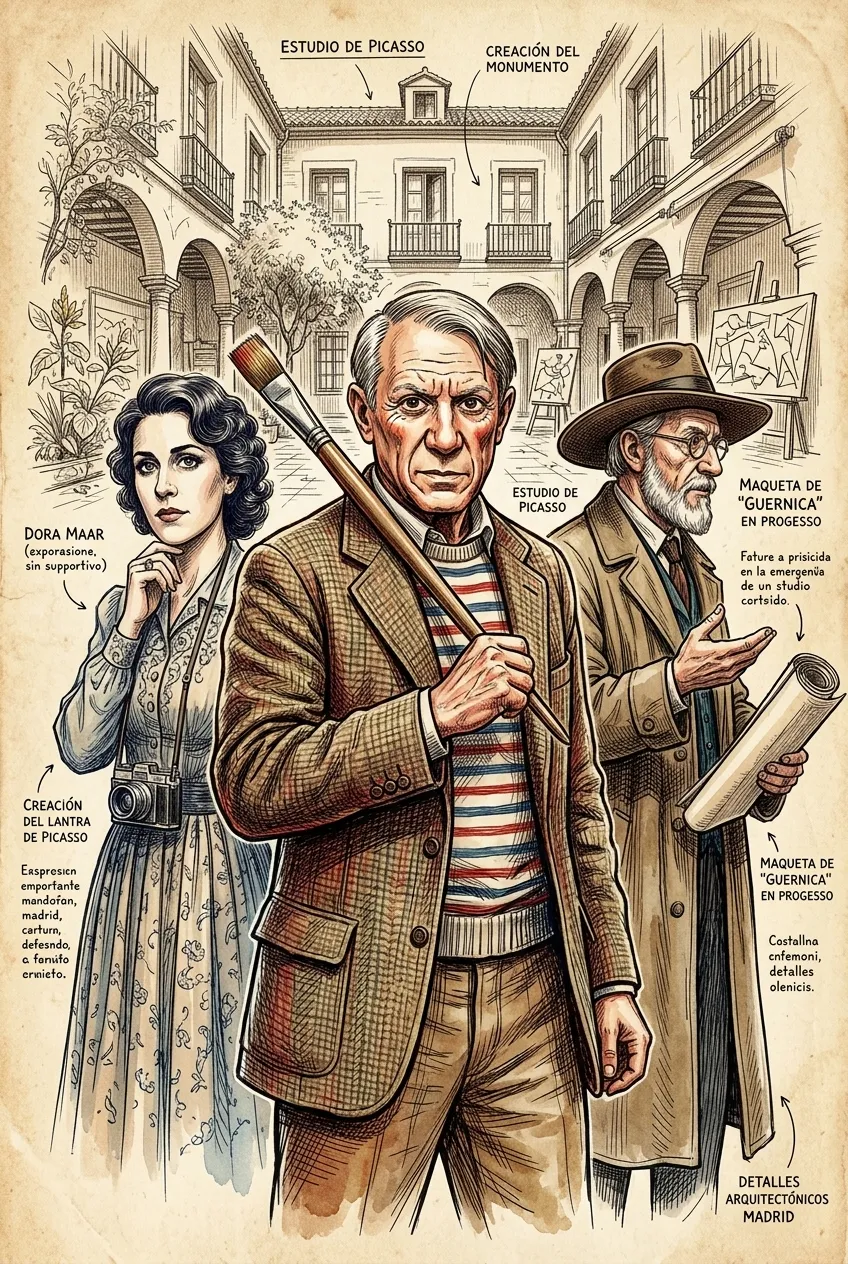
In the radiant city of Aethoria, where buildings floated amongst the clouds, Pablo Picasso stood before his creation. 'Guernica,' a monumental canvas measuring 11 feet tall and 25 feet wide, pulsed with raw emotion. Little did the world know, this would become Picasso's response to the horrors of the Spanish Civil War. Its monochromatic palette spoke volumes where color could not.
"Picasso murmured, brushing a stray lock of dark hair from his brow, "This is not what I want to do, but it is what I must do.""
Art Fact: Guernica, painted in 1937, is housed at the Museo Reina Sofía in Madrid. It remains a powerful symbol of the devastation of war and the suffering it inflicts on innocent civilians.
Page 2

News reached Picasso in his Parisian studio—a city soaring amid the clouds—of the bombing of Guernica, a Basque town in northern Spain. The reports were stark: innocent lives lost, a community shattered. This act of violence became the catalyst for his artistic fury. He felt an obligation to immortalize the event.
"Poet Dora Maar, Picasso's lover, stood beside him, her face etched with concern. "This is inhuman, Pablo. You must give voice to this tragedy.""
Art Fact: The bombing of Guernica on April 26, 1937, was carried out by Nazi German and Fascist Italian air forces at the request of the Spanish Nationalists.
Page 3

Picasso made a pivotal decision: to strip away color. He wanted 'Guernica' to mirror the stark reality of suffering, a world devoid of hope and vibrancy. His monochrome palette—grays, blacks, and whites—became the visual language of his grief. He saw the truth of devastation in a way that vibrant colors could not convey.
"When Gertrude Stein, a writer and art collector, questioned this decision, Picasso replied, "Gertrude, how can joy be conveyed during a time of such despair? We must use a palette of grief to evoke a similar feeling!""
Art Fact: Picasso's choice of a monochromatic palette was deliberate, intended to evoke the atmosphere of newsreel photography and to convey the somber mood of the tragedy.
Page 4

The figure of the bull, a recurring motif in Picasso's work, took on a new significance in 'Guernica.' It became a symbol of the brutal force unleashed upon the innocent. Its dark, looming presence embodied the inhumanity of war. He often said that the bull could represent brutality and darkness.
"Jaume Sabartés, his close friend, watched as Picasso sketched the bull, its form both powerful and wounded. "Pablo, this bull... it is more than just an animal. It speaks of the darkness we cannot ignore.""
Art Fact: The bull in 'Guernica' has been interpreted in various ways, often representing Spain itself, or the embodiment of brutality and darkness.
Page 5

One of the most poignant figures in 'Guernica' is the weeping woman, her face contorted in anguish. She represents the universal suffering of mothers who have lost their children to war. Her tears, like shards of glass, reflect the pain of a shattered world. This figure encapsulated the suffering that Picasso wished to convey.
"As he painted, Picasso muttered, "She embodies all the mothers, all the children... their pain must be seen!""
Art Fact: The weeping woman became a recurring motif for Picasso, who created several studies of the figure following the completion of 'Guernica'.
Page 6

When 'Guernica' was exhibited at the Paris International Exposition, it became an immediate sensation. Critics praised its power and emotional intensity. It became a symbol of resistance against fascism and a rallying cry for peace. The floating city of Paris watched from beyond, as the world was deeply moved by this display of artistic solidarity.
"Christian Zervos, an art critic, declared, "Picasso has given voice to the voiceless. 'Guernica' is not just a painting; it is a testament to the resilience of the human spirit!""
Art Fact: Despite its powerful message, 'Guernica' was not universally praised. Some critics found its style too abstract and its message too ambiguous.
Page 7

Picasso's statement on the Spanish Civil War captured the human spirit when placed in the face of a tragedy. This timeless painting served as an opportunity for the artist to voice his discontent for the atrocities of war, and the effects that it had on the human soul. The Spanish Civil War was a monumental event of this time, and influenced the way Picasso would portray reality moving forward.
"Picasso once told his close friend, Juan Miró, "I paint forms as I think them, not as I see them." "
Art Fact: The Spanish Civil War lasted from 1936 to 1939, resulting in the deaths of over 500,000 people and leading to the establishment of a dictatorship under General Francisco Franco.
Page 8
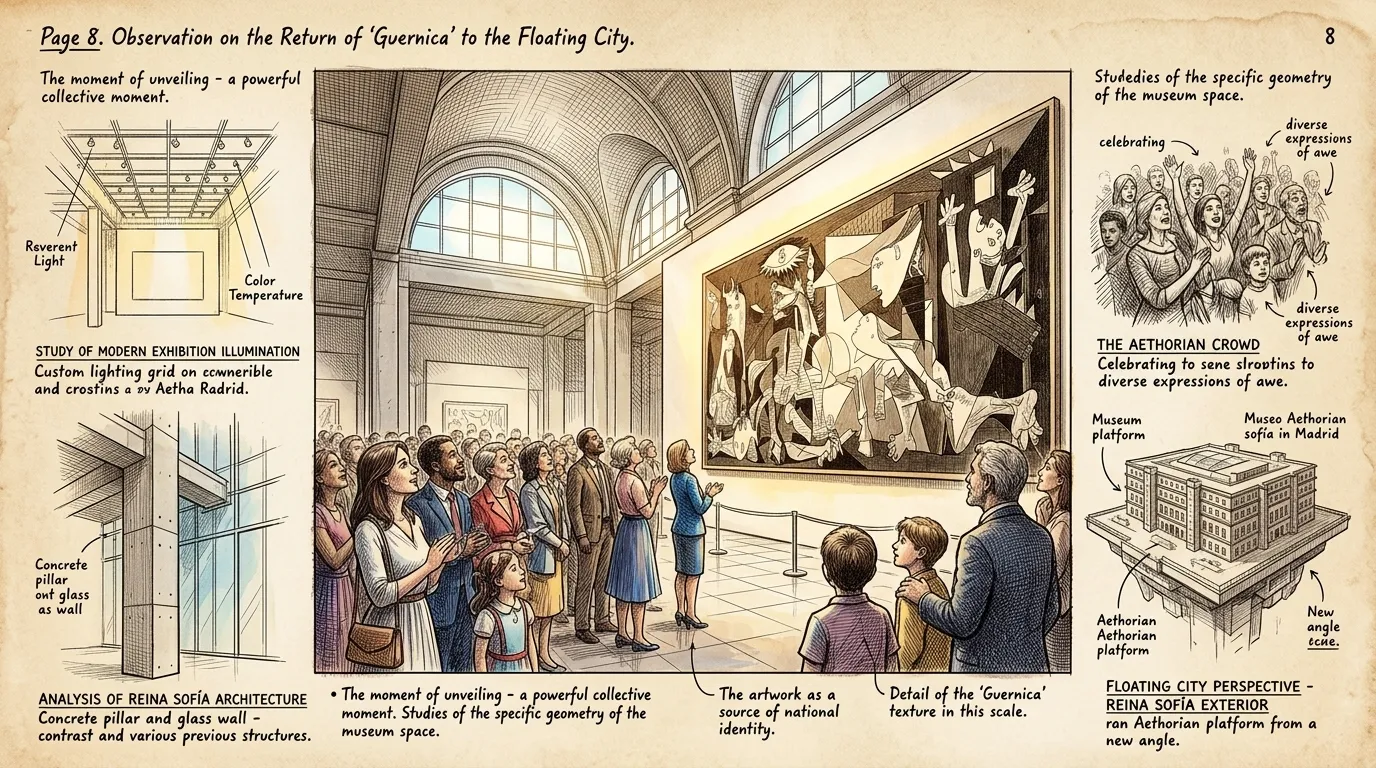
After decades in exile, 'Guernica' finally returned to Spain, a symbol of the nation's transition to democracy. It found its permanent home at the Museo Reina Sofía in Madrid, where it continues to inspire reflection and dialogue. The people of the floating city of Aethoria celebrated its return, a testament to its enduring power.
"As the painting was unveiled in Madrid, King Juan Carlos I stated, "'Guernica' is a symbol of our shared history, a reminder of the past, and a beacon of hope for the future.""
Art Fact: 'Guernica' was initially held at the Museum of Modern Art in New York, with Picasso stipulating that it should only be returned to Spain once democracy had been restored.
Page 9

Today, 'Guernica' continues to resonate with audiences worldwide. Its anti-war message remains as relevant as ever. The echoes of its creation can be heard in the art and activism of each new generation. This shows the painting's ability to be timeless, and influence generations to come.
"A young artist visiting the Museo Reina Sofía remarked, "'Guernica' is a call to action. It reminds us that art has the power to challenge injustice and inspire change.""
Art Fact: 'Guernica' has been used in countless anti-war protests and campaigns, its imagery instantly recognizable as a symbol of resistance.
Page 10

Picasso's legacy endures through 'Guernica,' a painting that continues to challenge and inspire. It stands as a testament to the artist's ability to transform personal anguish into a universal plea for peace. The inhabitants of the floating city of Aethoria, and beyond, understand the importance of this message.
"Pablo Picasso's words echo today, as people continue to come and see "Guernica:" "Painting is not made to decorate apartments. It is an instrument of war.""
Art Fact: Why does Picasso's work survive forever? Because it reminds us that even in the face of unimaginable suffering, the human spirit can find a voice and create a lasting testament to hope.
About this story
- Location: Spain
- Audience: general readers
Questions and answers
Questions and answers about Guernica by Pablo Picasso (Madrid, Spain — 1937)
Read Wonder Arts on your phone
Wonder Arts is available on Android. Get Wonder Arts on Google Play.