The Course of Empire by Thomas Cole (USA — 1836)
The Course of Empire by Thomas Cole (USA — 1836) — an illustrated arts story, set in United States. 10 illustrated pages, free to read on Wonder Arts.

Page 1
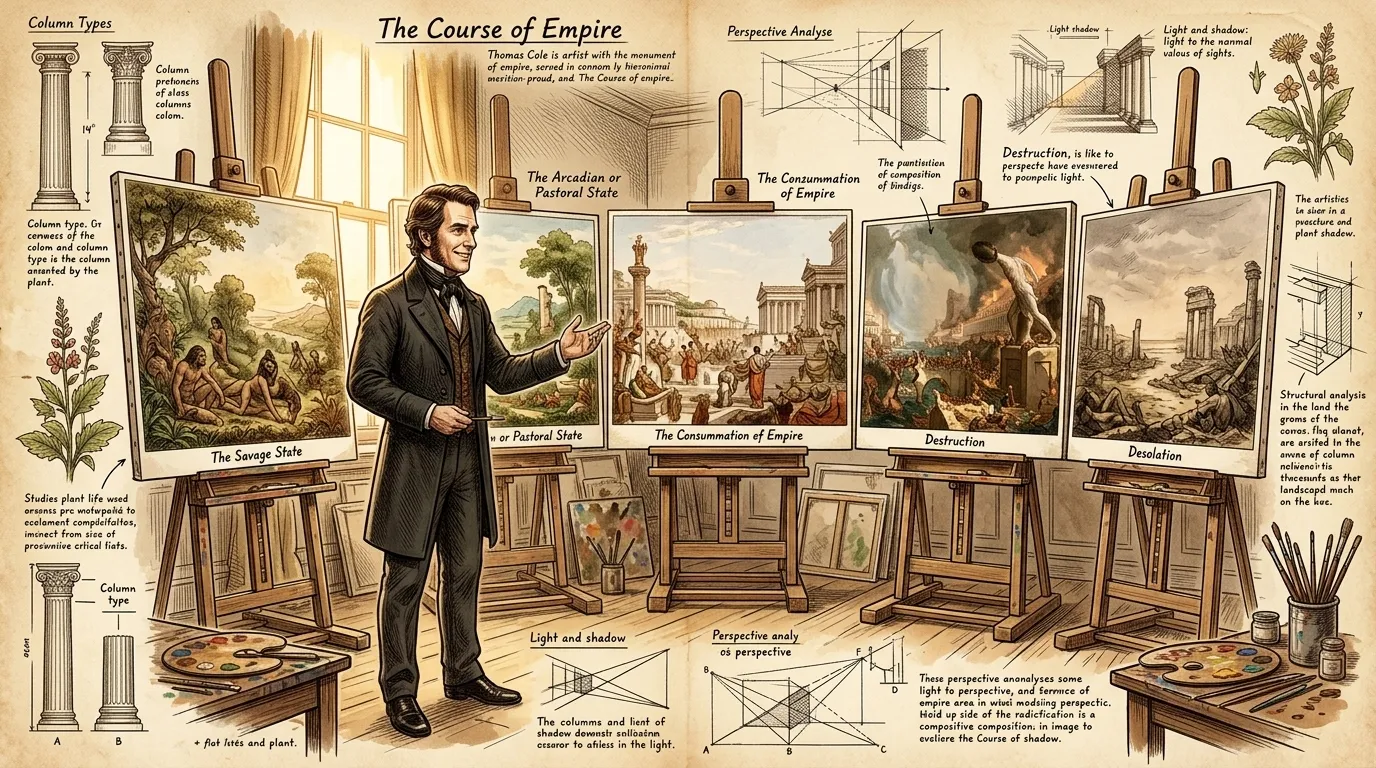
Thomas Cole, the founder of the Hudson River School, stands before his ambitious allegorical series, The Course of Empire. Completed in 1836, these five paintings depict the cyclical rise and fall of an ancient civilization. Housed at the New-York Historical Society, the paintings, each measuring approximately 39.5 x 63.5 inches, have sparked debate for their commentary on American expansionism and the ephemeral nature of power. Cole, a master of light and landscape, imbued each scene with a sense of impending doom.
""This is my testament," Cole murmurs, his eyes reflecting the flickering candlelight, "a warning etched in color and form.""
Art Fact: The series was commissioned by Luman Reed, a wealthy New York merchant and art patron.
Page 2
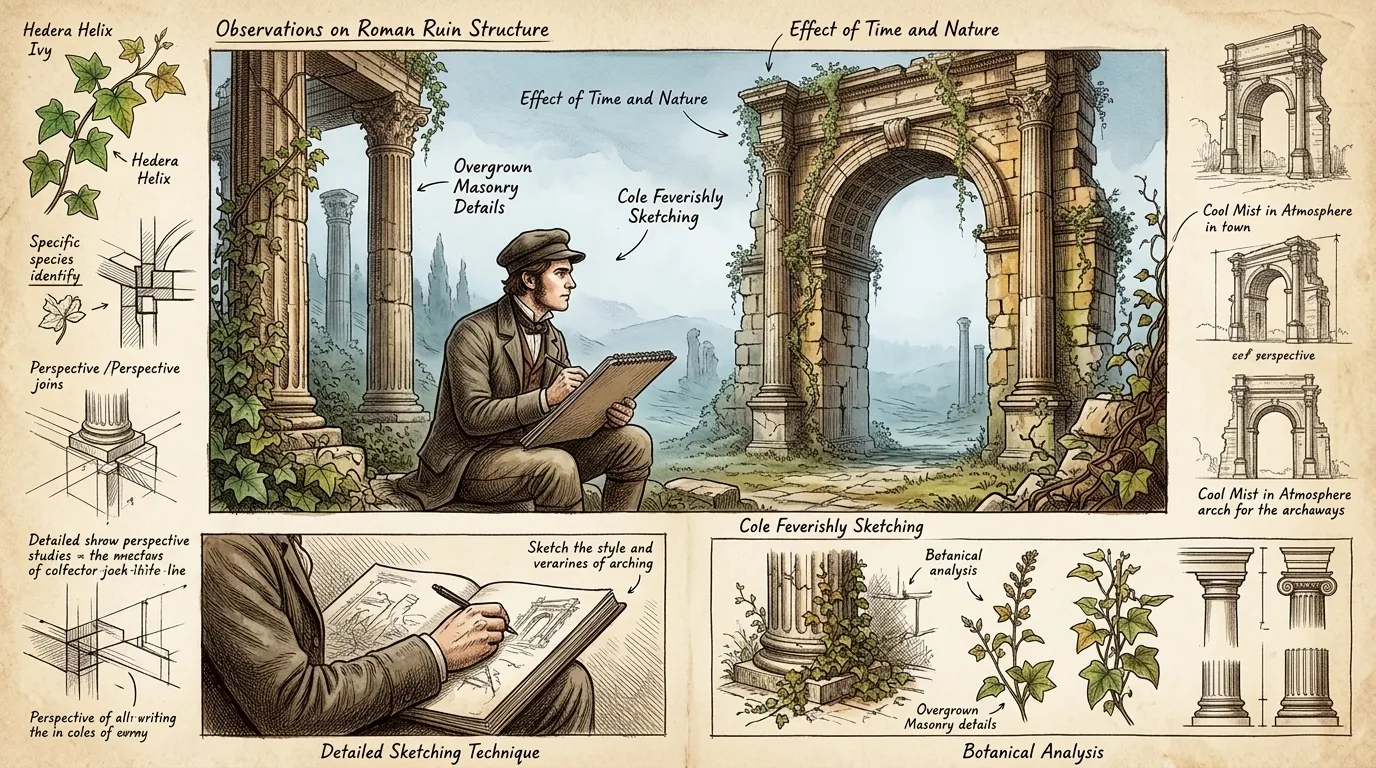
Young Thomas, barely a man, finds himself amidst the ancient ruins of Rome. The crumbling columns and overgrown landscapes stir within him a sense of history and mortality. He sketches feverishly, trying to capture the grandeur and decay, a visual vocabulary he knows he will one day need. This trip across the sea marks a pivotal moment in his artistic journey, a first encounter with the weight of civilizations past.
""These stones whisper tales of triumph and tragedy," Cole remarks to himself, his breath misting in the cold air. "I must learn to listen.""
Art Fact: Cole's travels in Europe exposed him to the works of Claude Lorrain and J.M.W. Turner, influencing his approach to landscape painting.
Page 3
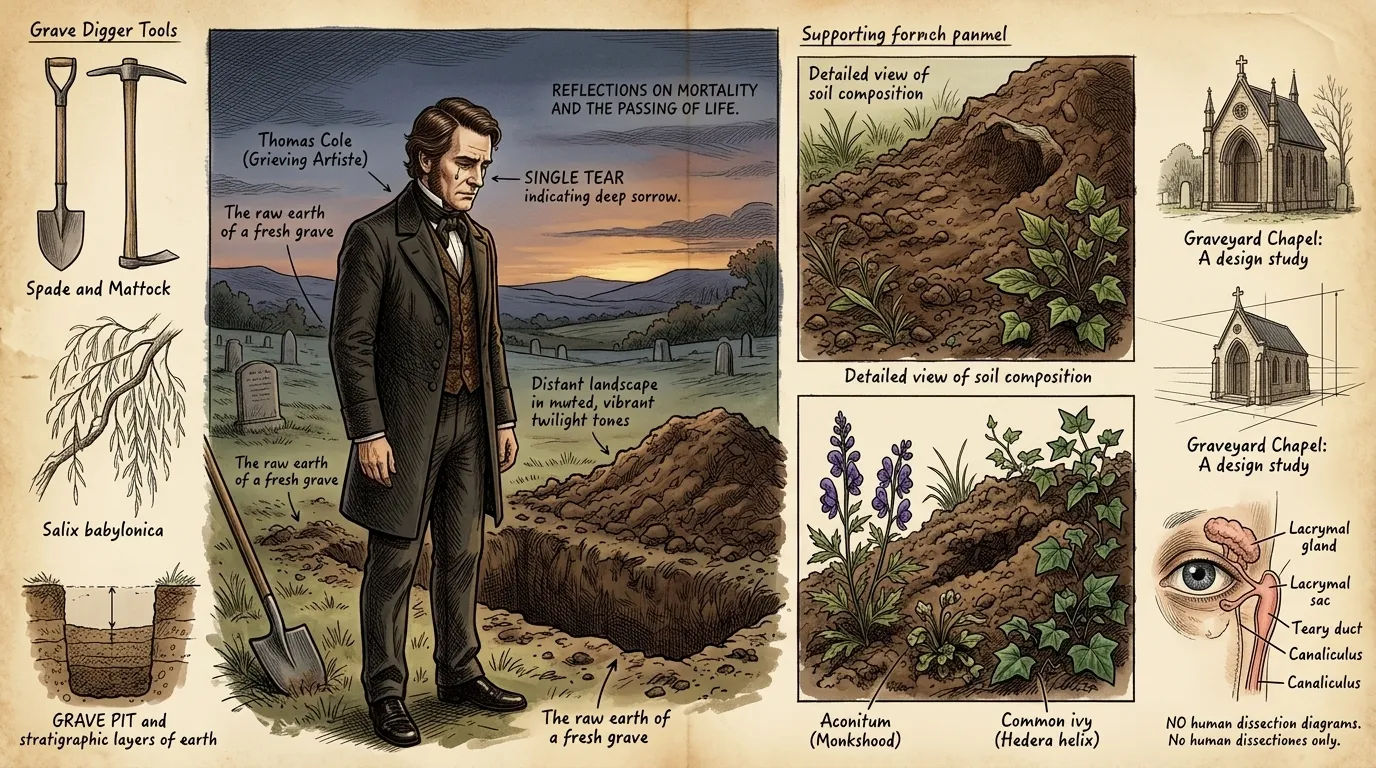
Grief hangs heavy in the air. Thomas stands beside his sister's freshly dug grave, the raw earth a stark contrast to the vibrant landscapes he usually paints. The weight of mortality presses down on him, fueling a new understanding of the ephemeral nature of life and beauty. The somber scene etches itself onto his soul, a theme that will resonate deeply within The Course of Empire.
""We are but dust and shadow," Cole whispers, quoting the Book of Psalms, a tear tracing a path down his cheek. "Our empires, too, will crumble.""
Art Fact: Cole's personal losses deeply influenced the melancholic and moralizing themes in his art.
Page 4

While sketching along the banks of the Hudson River, Cole meets Asher B. Durand, a fellow artist and engraver. Their conversation sparks a shared vision: to capture the unique beauty of the American landscape, to create an art that is distinctly American. This encounter fuels Cole's determination to establish the Hudson River School, a movement that will redefine American art.
""We must paint what we see, Mr. Cole," Durand exclaims, gesturing towards the majestic river, "not imitate the styles of Europe!""
Art Fact: Asher B. Durand later became a leading figure in the Hudson River School, known for his detailed landscapes.
Page 5

Luman Reed, a wealthy New York merchant, visits Cole's studio. Impressed by the artist's vision, Reed commissions a series of paintings, giving Cole the freedom and financial security to realize his grand ambition. This patronage marks a turning point, providing Cole with the opportunity to create The Course of Empire and to explore his philosophical ideas on a monumental scale.
""Mr. Cole," Reed declares, his voice booming with confidence, "I want you to paint me a story, a saga that will resonate through the ages!""
Art Fact: Luman Reed was a major patron of the arts in New York City, supporting numerous artists and writers.
Page 6
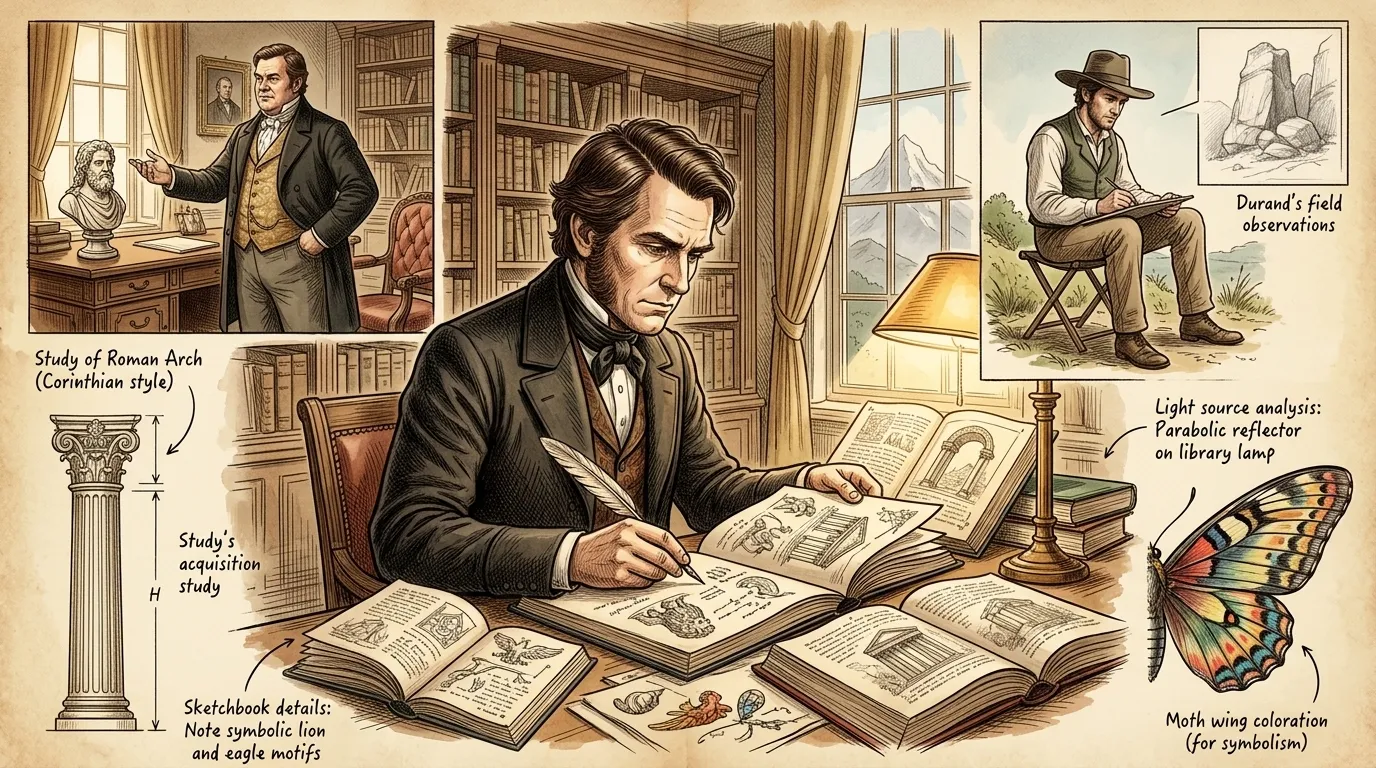
Cole pores over books on ancient history, architecture, and mythology, filling sketchbooks with ideas for his allegorical series. He studies the ruins of empires, the rise and fall of civilizations, seeking to understand the patterns of human ambition and decay. These studies inform the intricate details and symbolic language of The Course of Empire.
""Those who cannot remember the past," Cole reads aloud from Edmund Burke, "are condemned to repeat it. I will ensure this lesson is not forgotten.""
Art Fact: Cole drew inspiration from a wide range of sources, including classical literature, history, and mythology.
Page 7
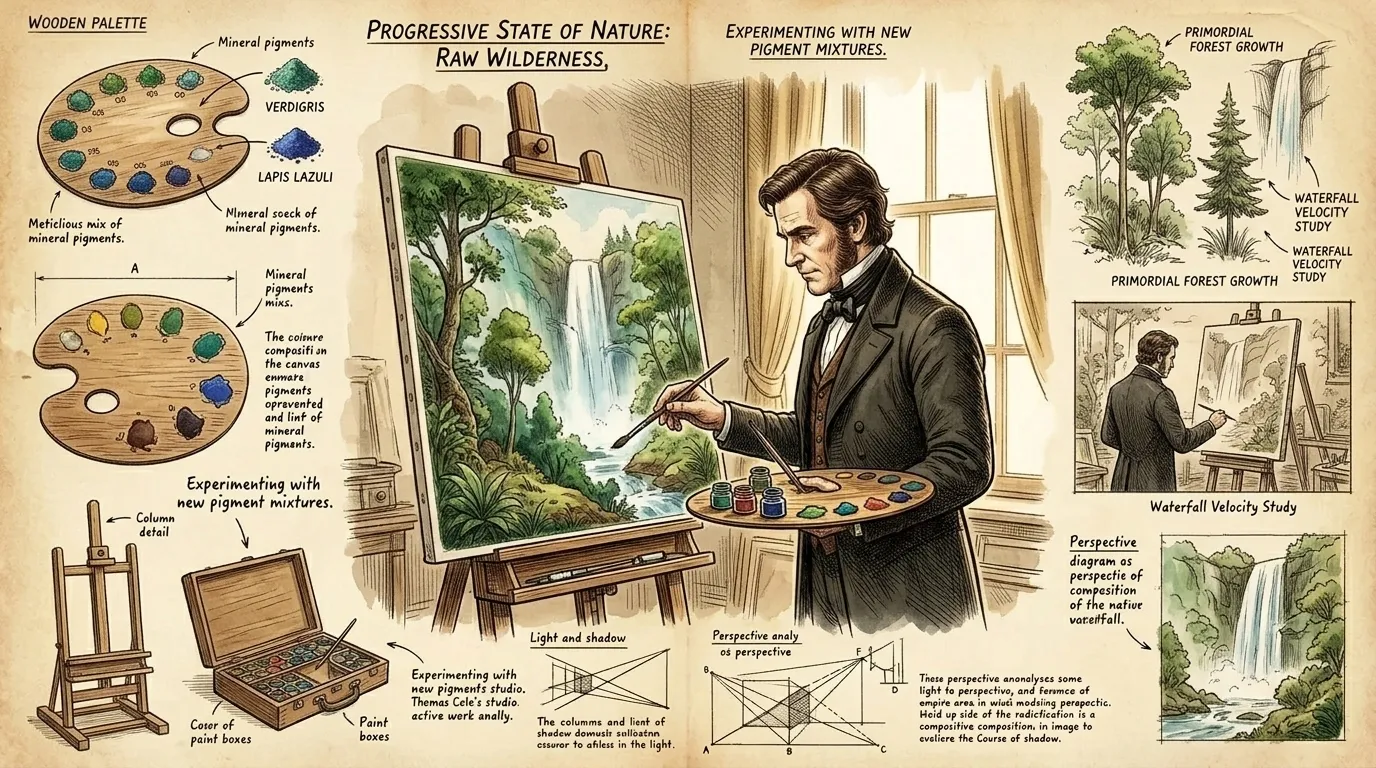
Cole begins work on the first painting in the series, The Savage State. He meticulously depicts a pristine landscape, untouched by civilization, a scene of untamed beauty and potential. This marks the beginning of his visual narrative, the first chapter in the story of an empire's rise and fall. The raw power of nature dominates the canvas, a reminder of the forces that both create and destroy.
""Before the city, there is the wilderness," Cole muses, mixing pigments on his palette, "a blank canvas upon which destiny is painted.""
Art Fact: The Savage State represents the dawn of civilization, a time of simplicity and harmony with nature.
Page 8
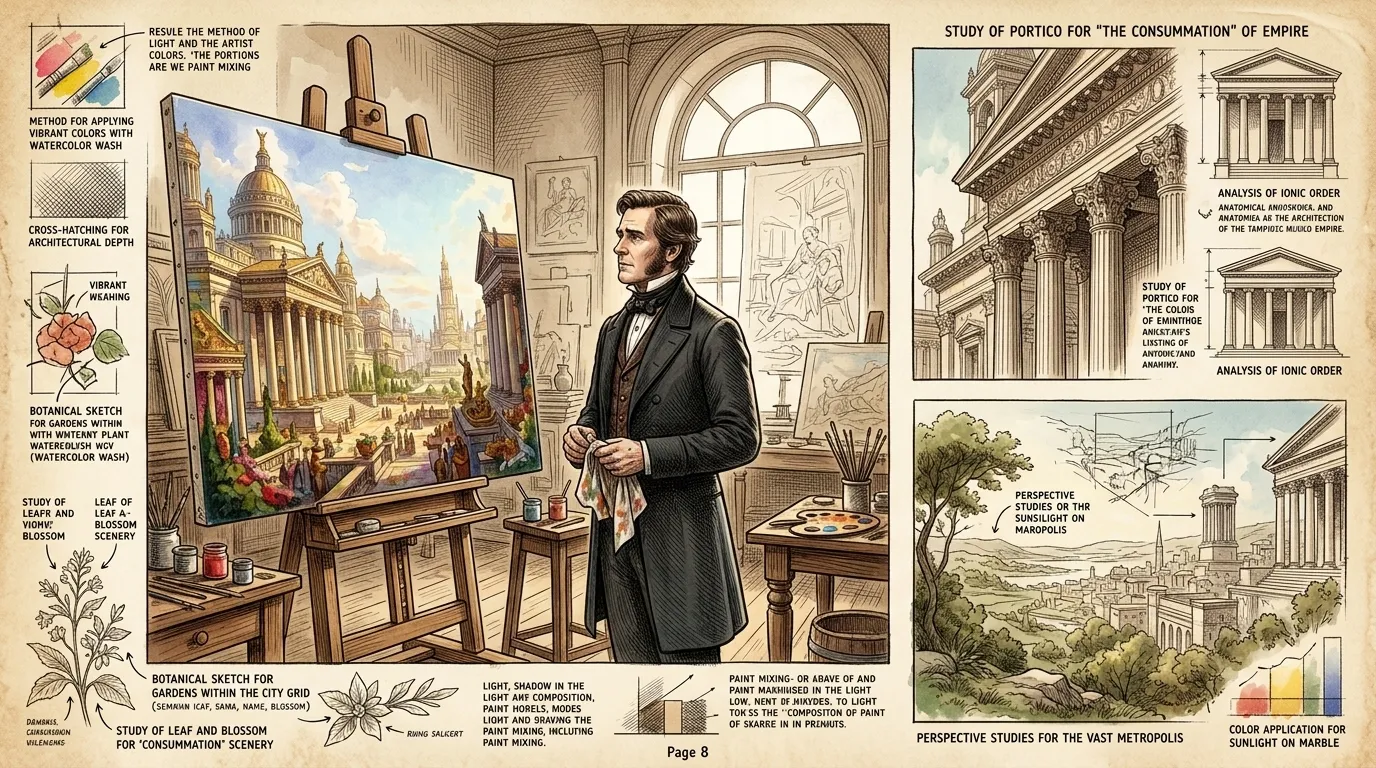
Years later, Cole puts the final touches on Consummation, the fourth and most ambitious painting in the series. The canvas bursts with vibrant colors, depicting a bustling city at the height of its power and glory. Architectural marvels rise towards the heavens, filled with countless figures engaged in commerce, celebration, and conquest. Cole sees the scene a brilliant yet fragile moment, poised on the brink of collapse.
""This," Cole whispers, stepping back to admire his work, "is the pinnacle, the moment of greatest hubris. And it is all fleeting.""
Art Fact: Consummation is often interpreted as a commentary on the excesses and dangers of unchecked ambition.
Page 9
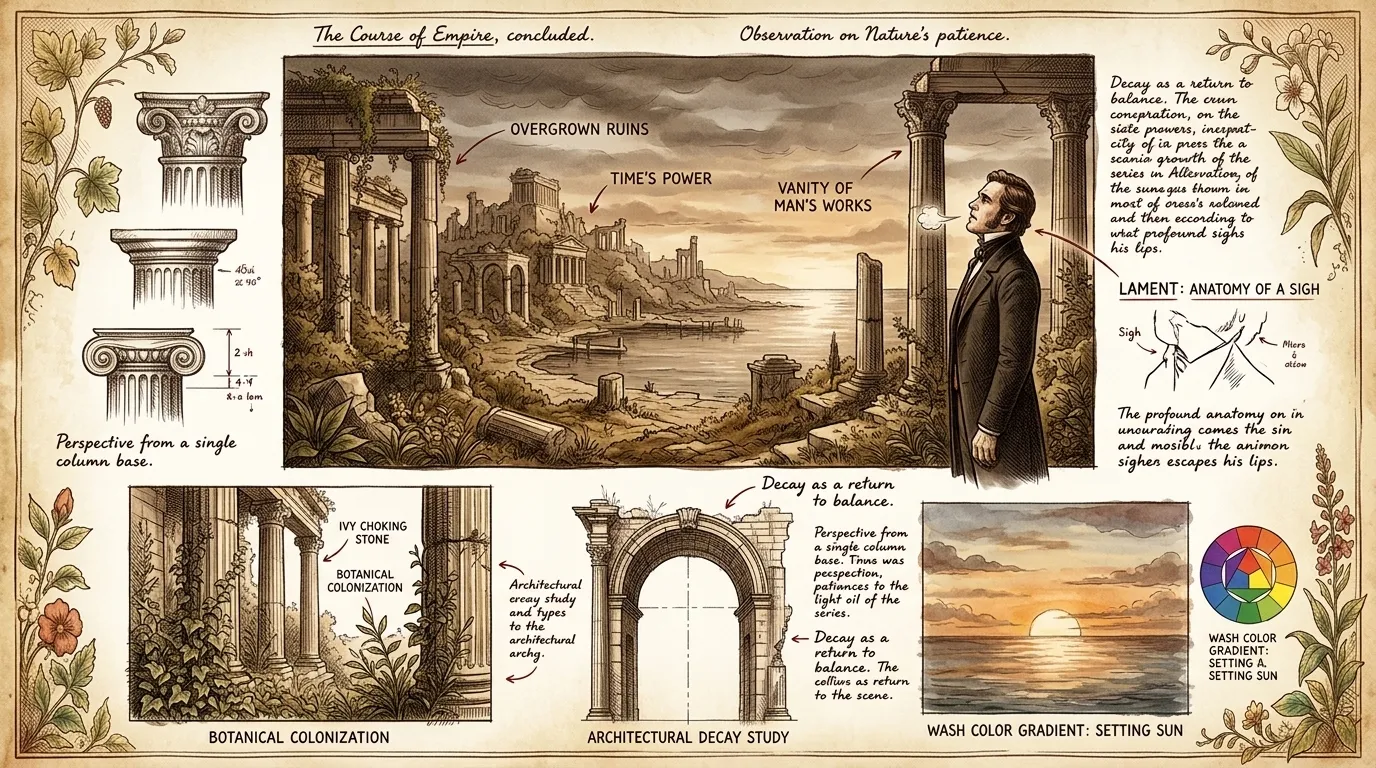
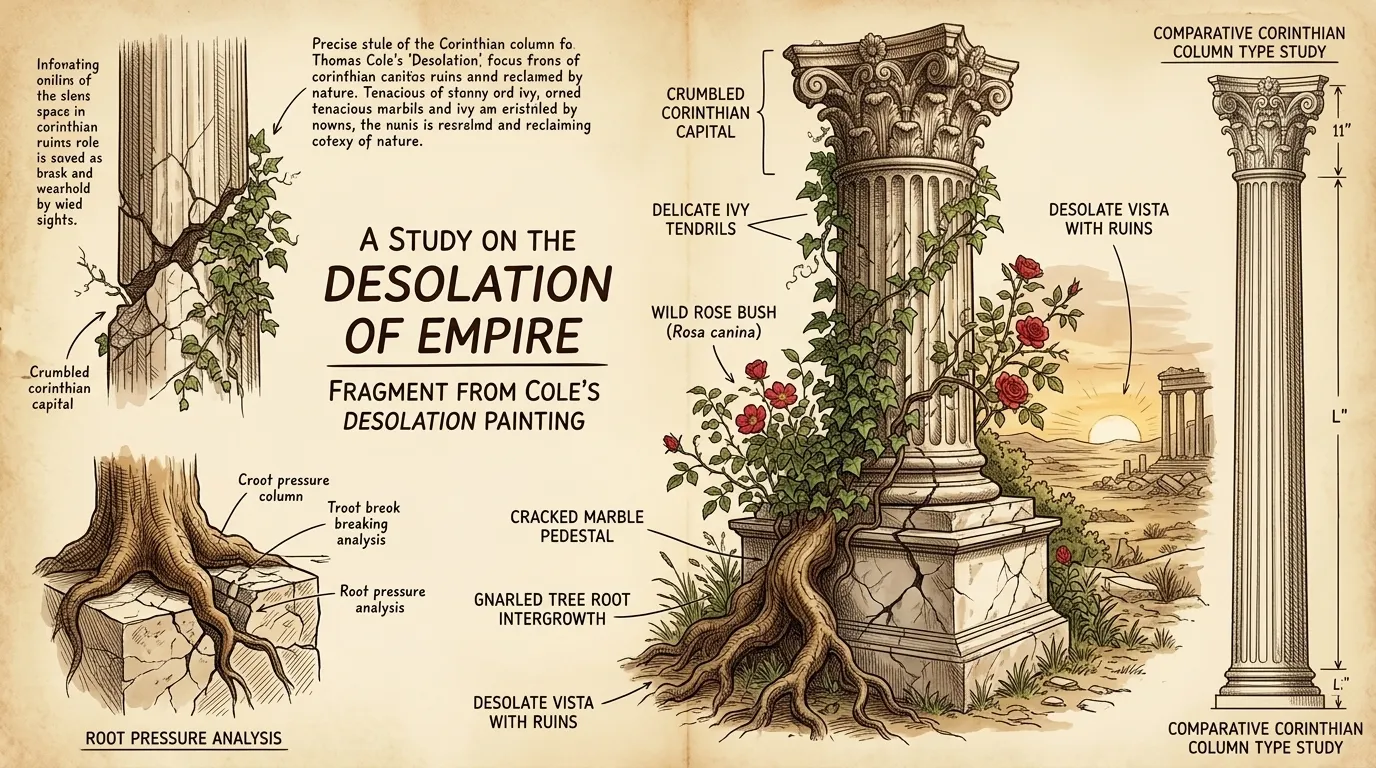
Cole stands back to contemplate Desolation, the final painting in The Course of Empire. The city is now a ruin, ravaged by war and decay. Nature reclaims the land, with crumbling columns and overgrown vegetation. The sun sets on the shattered remains of a once-great civilization, a stark reminder of the transience of earthly power. Cole understands his warning has come to life. The painter sees the final act
""Sic transit gloria mundi," Cole sighs, echoing the ancient lament, "Thus passes the glory of the world." The empire has fallen."
Art Fact: Desolation represents the inevitable decline and fall of civilizations, a warning against hubris and unchecked ambition.
Page 10
“Sic transit gloria mundi,” Cole sighs, echoing the ancient lament, “Thus passes the glory of the world.” The empire has fallen.
Luman Reed approaches, his face etched with a somber understanding. "A powerful statement, Thomas," he murmurs, gazing at the canvas. "Do you believe it inevitable? That all empires are destined for such ruin?"
Cole turns to him, his eyes reflecting the dying light in the painting. “Perhaps not *inevitable*, Luman, but certainly probable. We build, we strive… and then nature reclaims what was hers.” Asher B. Durand nods slowly beside them, sketching rapidly in a small book. "A humbling thought," he offers quietly.
Cole places a hand on Reed’s shoulder. “Let this be a lesson, my friend. A reminder that true greatness lies not in dominion, but in harmony."
About this story
- Location: United States
- Audience: general readers
Questions and answers
Questions and answers about The Course of Empire by Thomas Cole (USA — 1836)
Read Wonder Arts on your phone
Wonder Arts is available on Android and iPhone and iPad. Get Wonder Arts on Google Play · Get Wonder Arts on the App Store.
More Wonder Arts stories
- The Creation of Adam by Michelangelo (Vatican City, Rome — 1512)
- The Dance Class by Edgar Degas (Paris, France — 1874)
- The Death of Sardanapalus by Eugène Delacroix (Paris, France — 1827)
- The Dying Gaul by Epigonus (Rome, Italy — c. 230 BC)
- The Execution of Lady Jane Grey by Paul Delaroche (London, UK — 1833)
- The Fighting Temeraire by J.M.W. Turner (London, UK — 1839)