The Death of Sardanapalus by Eugène Delacroix (Paris, France — 1827)
The Death of Sardanapalus by Eugène Delacroix (Paris, France — 1827) — an illustrated arts story, set in France. 10 illustrated pages, free to read on Wonder Arts.
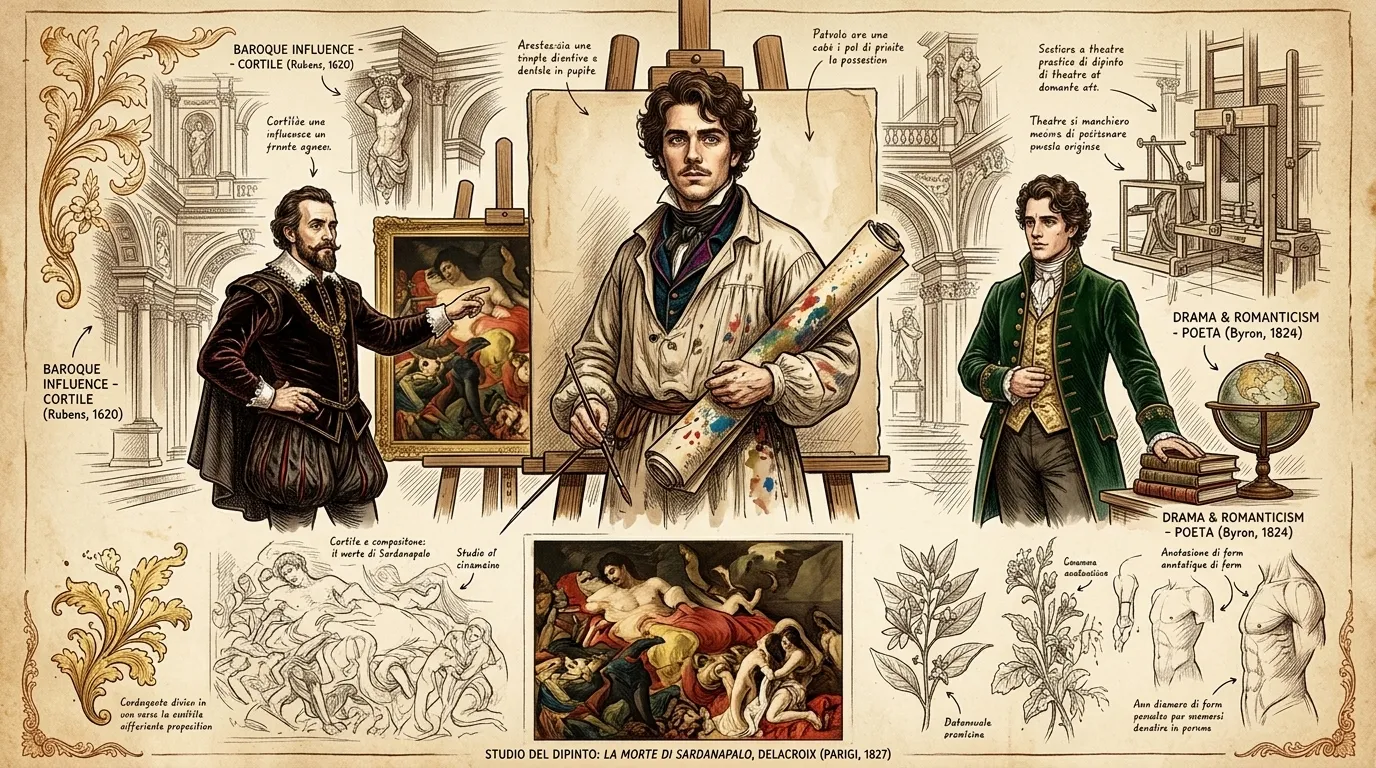
Page 1
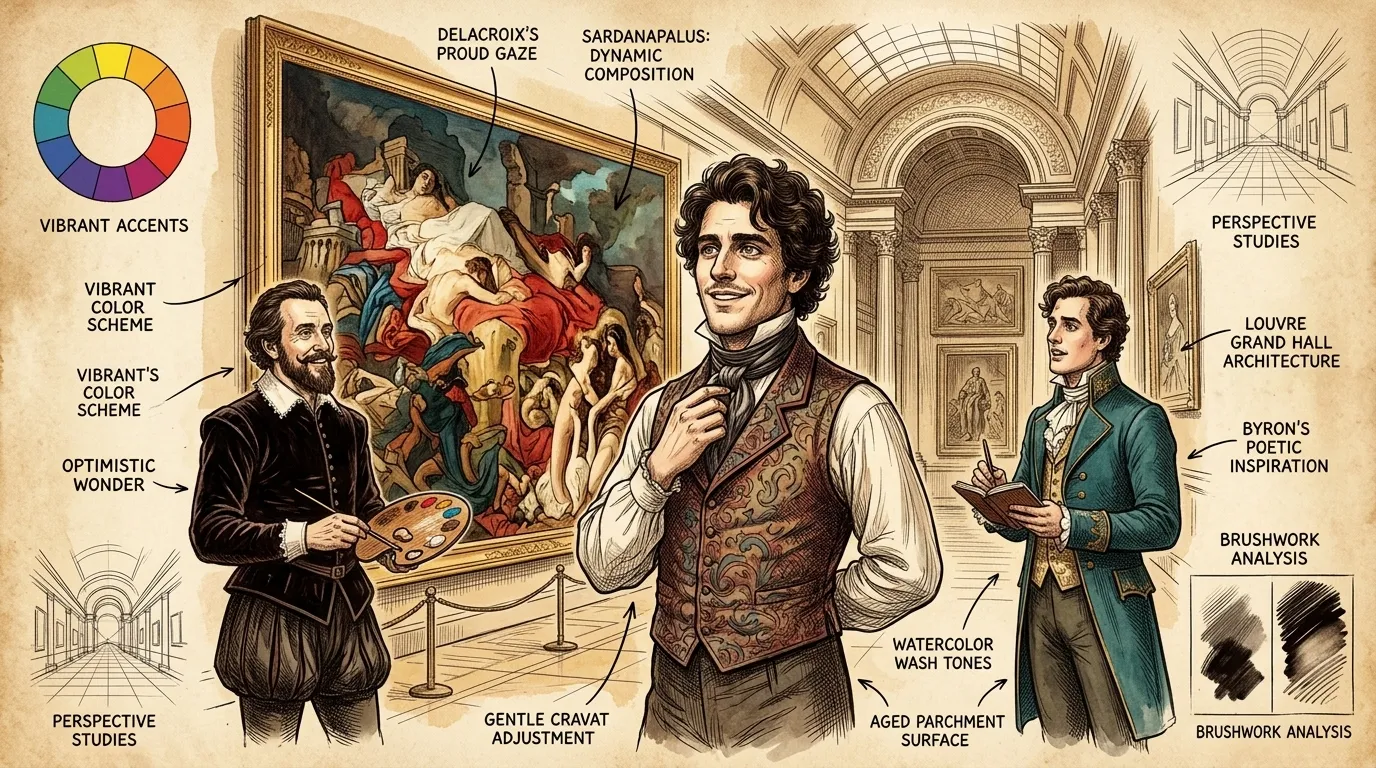
Eugène Delacroix, a towering figure in the Romantic movement, stands before his colossal painting, 'The Death of Sardanapalus.' Completed in 1827, the artwork measures nearly 13 x 16 feet and is currently housed in the Louvre Museum in Paris. Its initial reception was mixed, some critics praising its audacious color and composition, while others condemned its violence and supposed lack of moral purpose. Little did they know the secrets woven into its very fabric.
"Delacroix mutters, adjusting his cravat. 'Will they ever truly understand the passion, the inferno, within this canvas?'"
Art Fact: The painting's opulent depiction of destruction drew inspiration from Lord Byron's poem 'Sardanapalus', telling of the Assyrian king who chose to destroy all his possessions, including his concubines and slaves, rather than surrender to his enemies.
Page 2
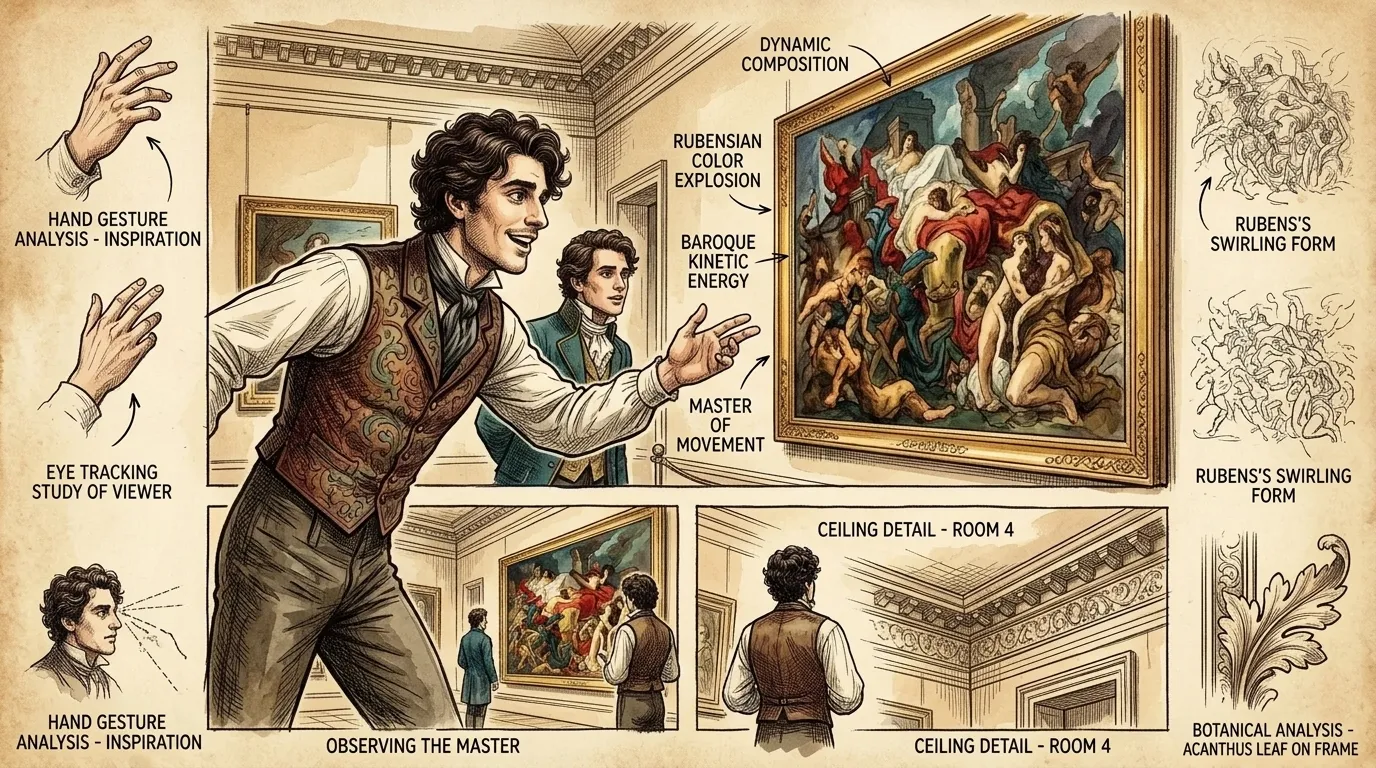
In his youth, Delacroix was deeply influenced by the vibrant colors and dynamic compositions of Peter Paul Rubens. He spent countless hours studying Rubens' paintings in the Louvre, absorbing the master's techniques. The dramatic use of light and shadow, the swirling movement of figures – all hallmarks of Rubens – would later find their way into Delacroix's own work.
"Delacroix, as a young man, exclaims to a fellow student, 'Look at the passion! Rubens makes the canvas explode with life. We must learn to capture such raw energy!'"
Art Fact: Delacroix's study of Rubens was crucial to his development as a colorist. He admired Rubens' ability to create a sense of movement and drama through his brushwork and use of color.
Page 3
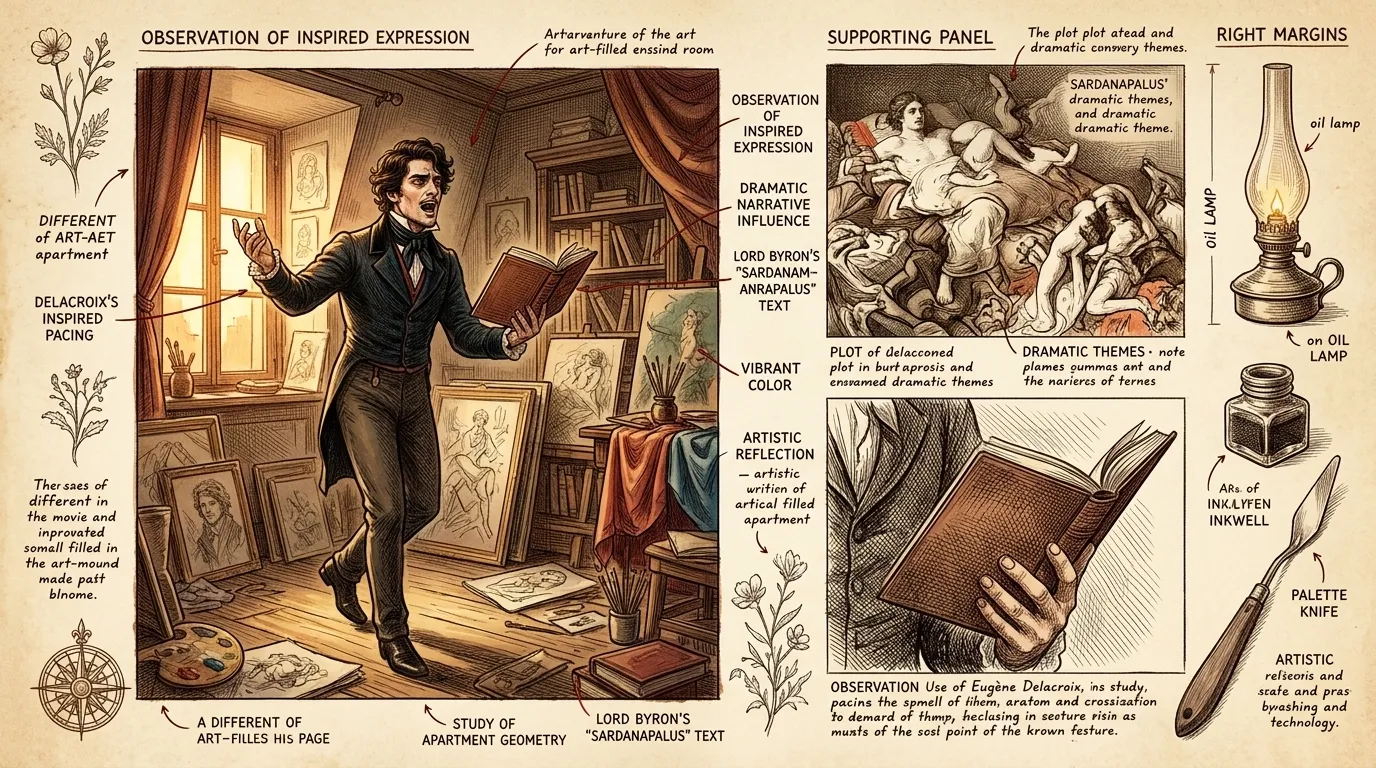
A pivotal moment arrived when Delacroix encountered Lord Byron's dramatic poem, 'Sardanapalus'. The tale of the decadent Assyrian king, facing defeat, choosing to immolate his palace and all its treasures, ignited Delacroix's imagination. He saw in Byron's words a canvas for his own artistic visions.
"Delacroix, pacing his small apartment, declaims, 'Byron's words! 'I have reigned, and have not merited this death!' The king's defiance, his tragic grandeur... it demands to be painted!'"
Art Fact: Lord Byron's poem provided Delacroix with the dramatic narrative and exotic setting that fueled his artistic vision. The poem's themes of power, decadence, and destruction resonated deeply with the artist.
Page 4
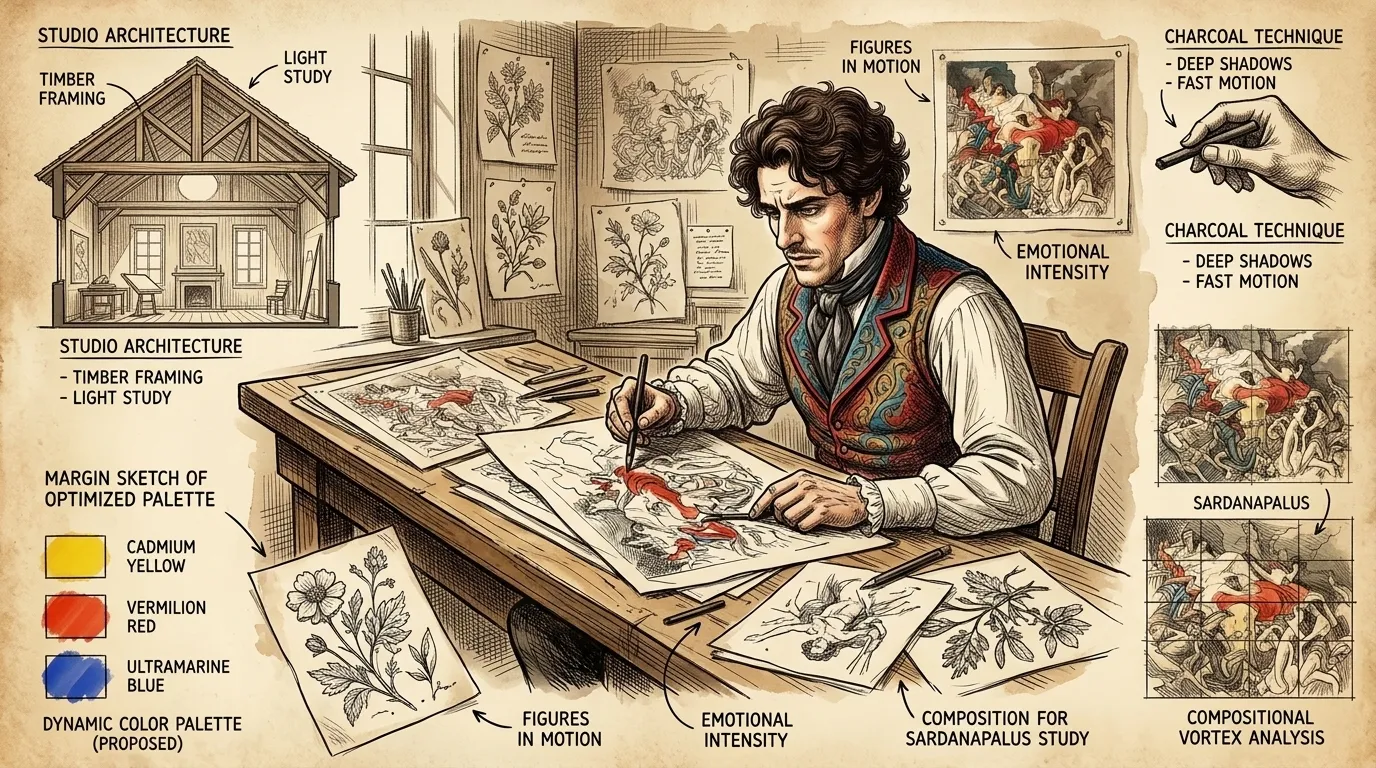
Delacroix began to translate Byron's words into visual form, creating a series of rough sketches. These early studies explored the composition, the arrangement of figures, and the overall sense of chaos and drama. He experimented with different poses and gestures, seeking to capture the emotional intensity of the scene.
"Delacroix, charcoal in hand, says to himself, 'The king must be central, yet overwhelmed. The figures writhing, a vortex of destruction!'"
Art Fact: These early sketches reveal Delacroix's meticulous approach to composition. He carefully considered the placement of each figure to create a dynamic and emotionally charged scene.
Page 5
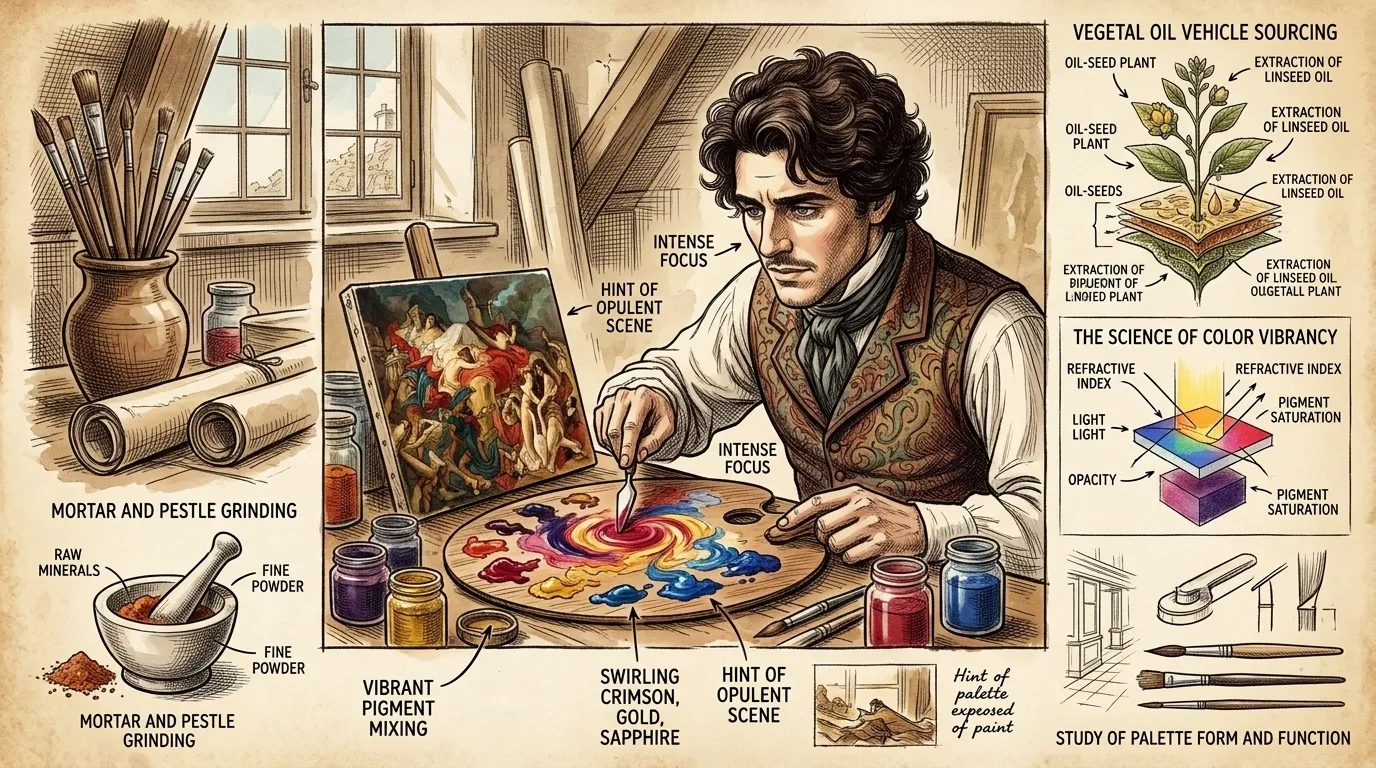
Delacroix began to experiment with color, seeking to create a vibrant and dramatic palette. He drew inspiration from the exotic colors of the Orient, using rich reds, golds, and blues to evoke a sense of opulence and decadence. He knew the colors themselves would tell a story.
"Delacroix, mixing paints on his palette, declares, 'Crimson for the blood, gold for the treasure, sapphire for the king's robes! The colors must sing of both beauty and destruction!'"
Art Fact: Delacroix's use of color was revolutionary for his time. He employed complementary colors to create a sense of tension and drama, and he used bold contrasts to emphasize the emotional intensity of the scene.
Page 6
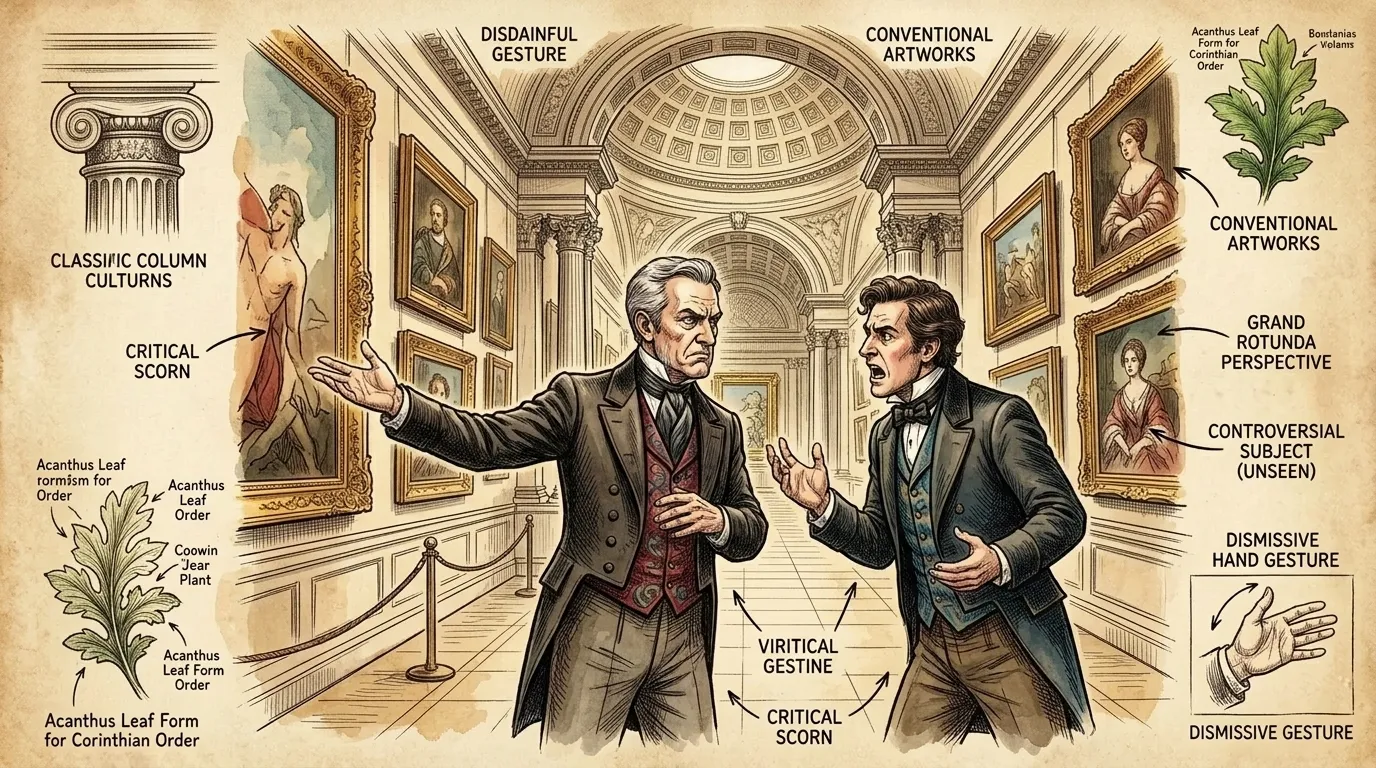
As Delacroix neared completion, whispers of his painting's audacious nature reached the art critics of Paris. Many were scandalized by the subject matter and the painting's unbridled emotion. It was a departure from the classical restraint they valued.
"A critic scoffs to another, 'Such barbarity! Such a riot of color! It lacks all sense of decorum. This Delacroix is clearly a madman!'"
Art Fact: The painting challenged the established norms of academic art. Its emotional intensity and dramatic subject matter were seen as a threat to the classical tradition.
Page 7
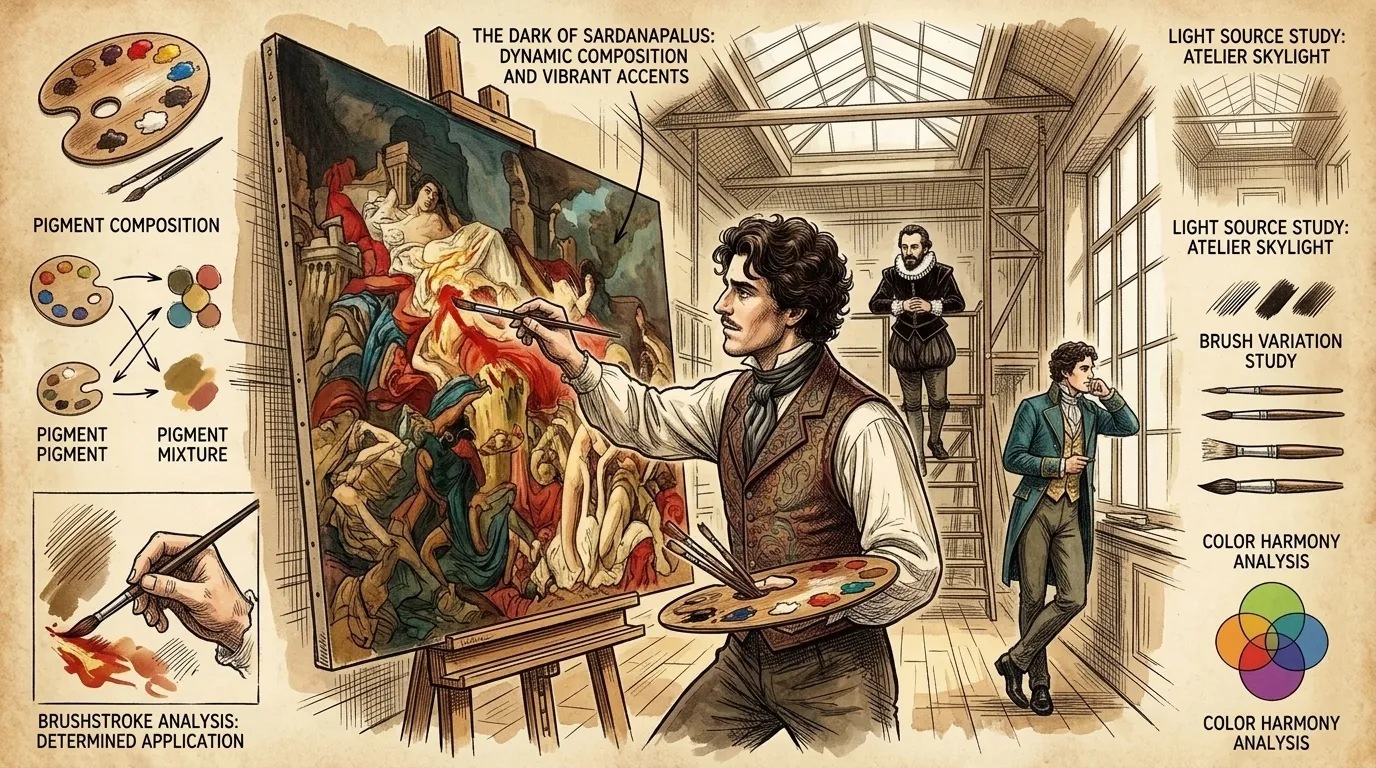
Despite the criticism, Delacroix remained steadfast in his artistic vision. He believed in the power of emotion and imagination, and he refused to compromise his artistic integrity. 'The love of glory is the last infirmity cast off by noble minds,' he muttered, remembering Milton's words, a reassurance that even ambition has its place.
"Delacroix, brush in hand, replies, 'Let them condemn. I paint not to please, but to express the truth as I see it! Let them criticize, Milton once said, 'The love of glory is the last infirmity cast off by noble minds,' and I shall embrace it!'"
Art Fact: Delacroix's unwavering commitment to his artistic vision is a testament to his courage and independence. He refused to be swayed by the opinions of others, and he remained true to his own artistic convictions.
Page 8
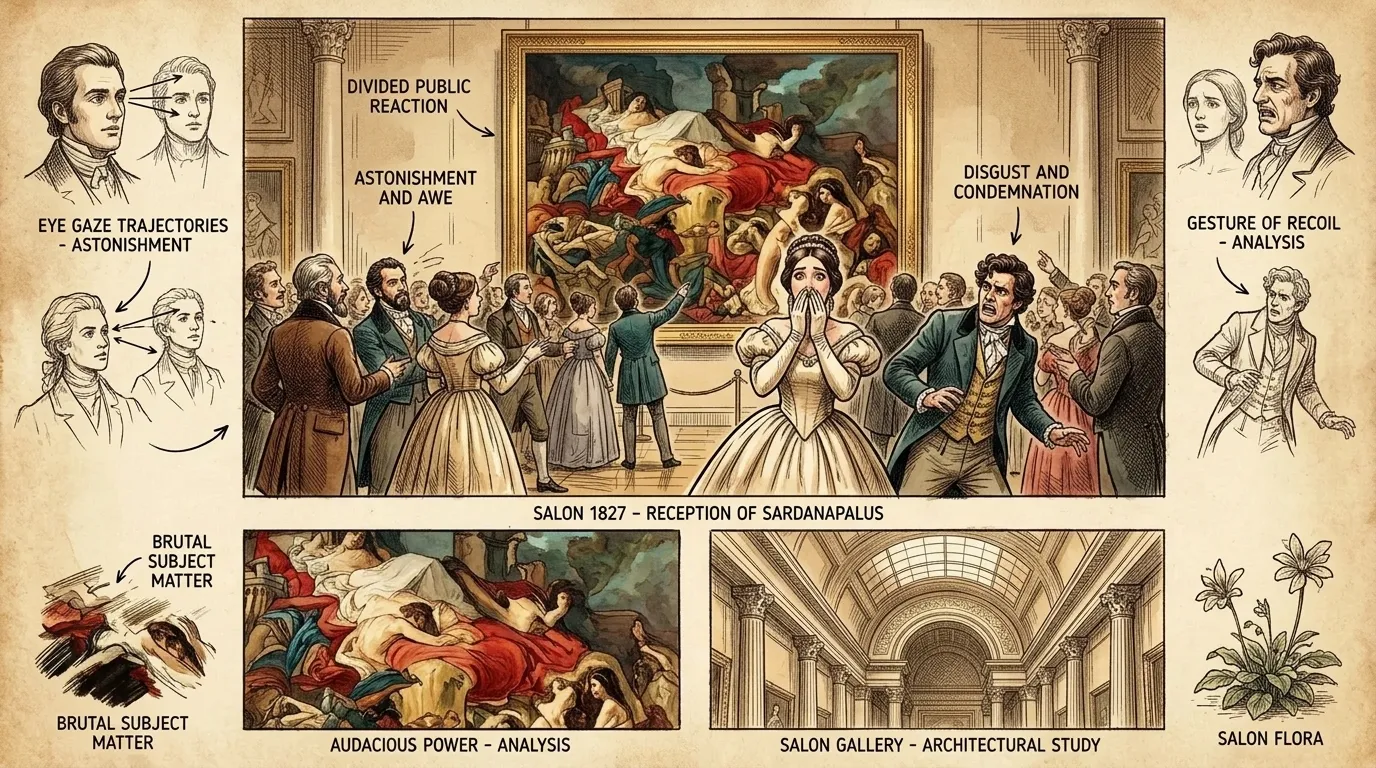
When 'The Death of Sardanapalus' was finally exhibited at the Salon of 1827, it ignited a firestorm of controversy. Critics and the public alike were divided, some praising its audacious power, others condemning its brutality and lack of moral purpose. But everyone was talking about it.
"A visitor gasps, 'Such... such passion! I've never seen anything like it!' Another replies, 'It's an abomination! A celebration of violence and decadence!'"
Art Fact: The controversy surrounding the painting only added to its notoriety. It became a symbol of the Romantic movement's rejection of classical restraint and its embrace of emotion and imagination.
Page 9
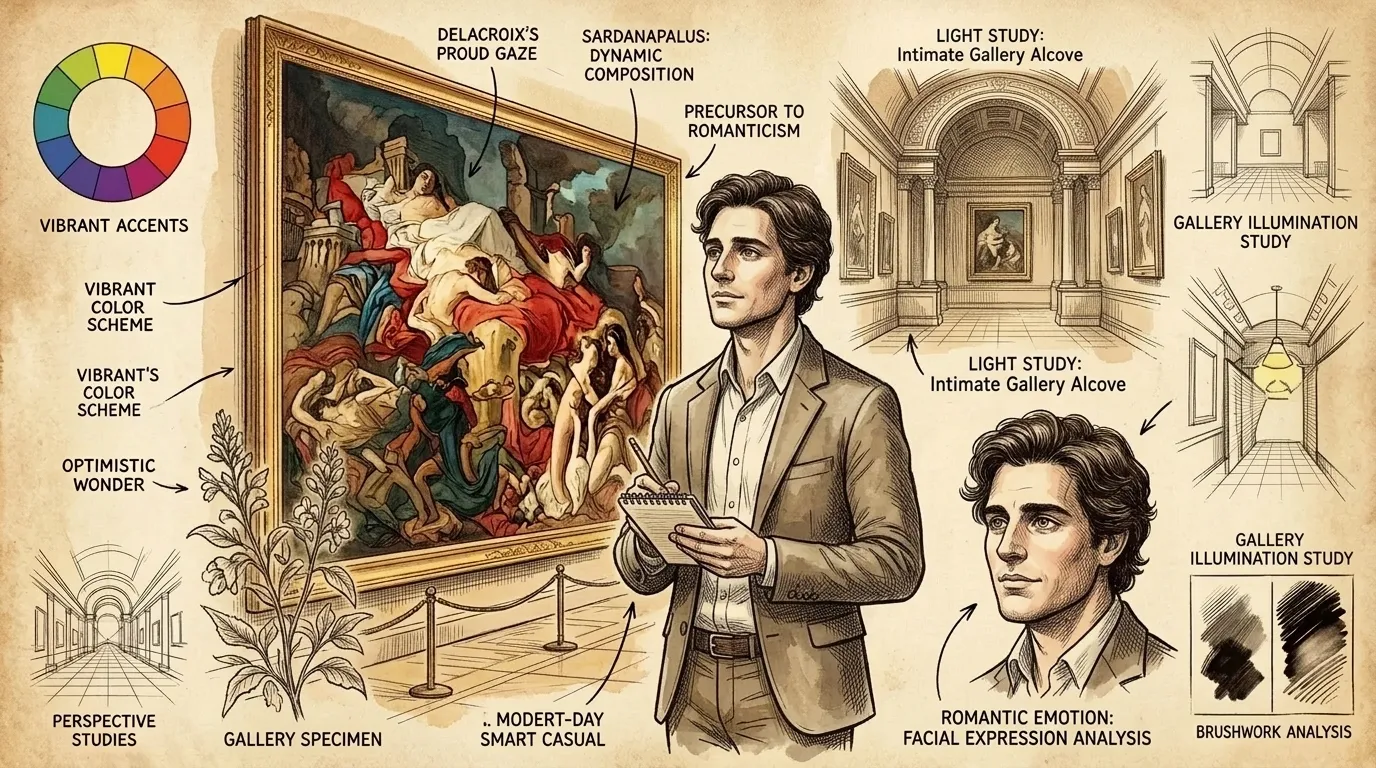
Despite the mixed reception, 'The Death of Sardanapalus' marked a turning point in the history of art. It ushered in a new era of Romanticism, one that embraced emotion, imagination, and the power of the individual artist. Delacroix had shattered the old order.
"An admirer says quietly, 'He has shown us what is possible. Art can be more than just representation; it can be a window into the soul."
Art Fact: The painting inspired a new generation of artists to break free from the constraints of academic art and to explore their own unique visions.
Page 10
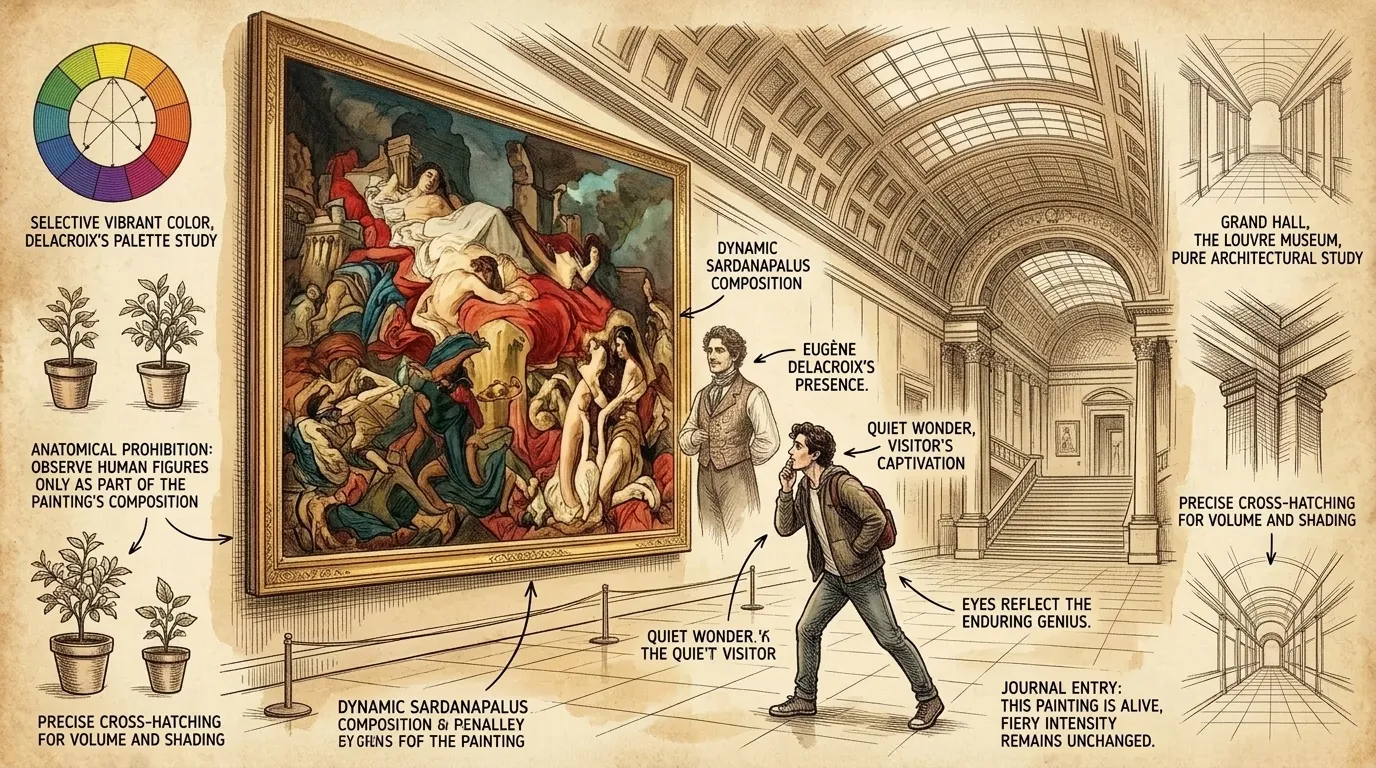
Today, 'The Death of Sardanapalus' hangs in the Louvre Museum, a testament to Delacroix's genius and the enduring power of Romanticism. It continues to provoke and inspire, its fiery colors and dramatic composition capturing the imagination of all who behold it. Delacroix's work survives because, as he himself might have put it, 'The mind is never right but when it is at peace with itself' — and his art was his peace.
"A visitor whispers, 'Even now, centuries later, it burns with the same fire.'"
Art Fact: The painting remains a powerful symbol of artistic freedom and the enduring legacy of the Romantic movement.
About this story
- Location: France
- Audience: general readers
Questions and answers
Questions and answers about The Death of Sardanapalus by Eugène Delacroix (Paris, France — 1827)
Read Wonder Arts on your phone
Wonder Arts is available on Android and iPhone and iPad. Get Wonder Arts on Google Play · Get Wonder Arts on the App Store.
More Wonder Arts stories
- The Dying Gaul by Epigonus (Rome, Italy — c. 230 BC)
- The Execution of Lady Jane Grey by Paul Delaroche (London, UK — 1833)
- The Fighting Temeraire by J.M.W. Turner (London, UK — 1839)
- The Four Seasons by Antonio Vivaldi (Venice, Italy — 1725)
- The Garden of Earthly Delights by Hieronymus Bosch (Madrid, Spain — c. 1505)
- The Gleaners by Jean-François Millet (Paris, France — 1857)