The Creation of Adam by Michelangelo (Vatican City, Rome — 1512)
The Creation of Adam by Michelangelo (Vatican City, Rome — 1512) — an illustrated arts story, set in Global. 10 illustrated pages, free to read on Wonder Arts.
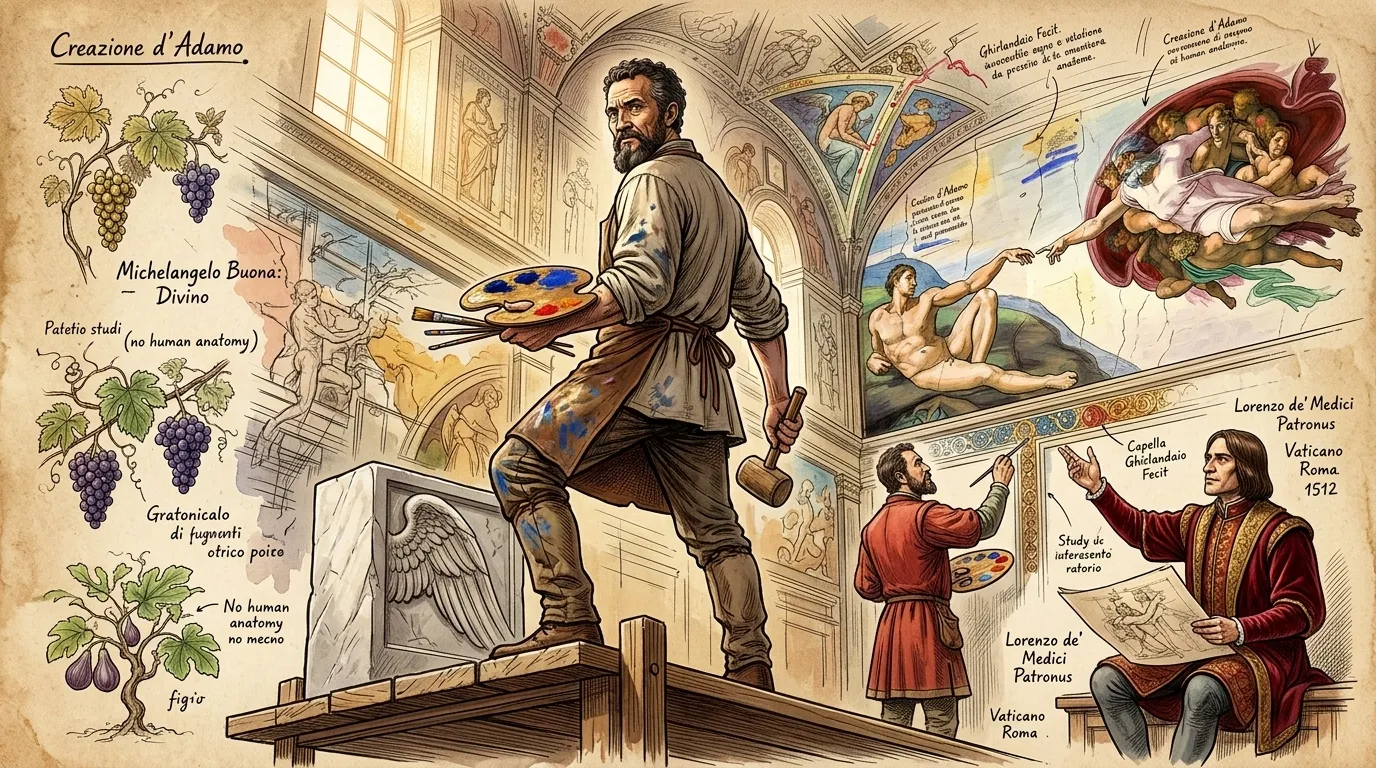
Page 1
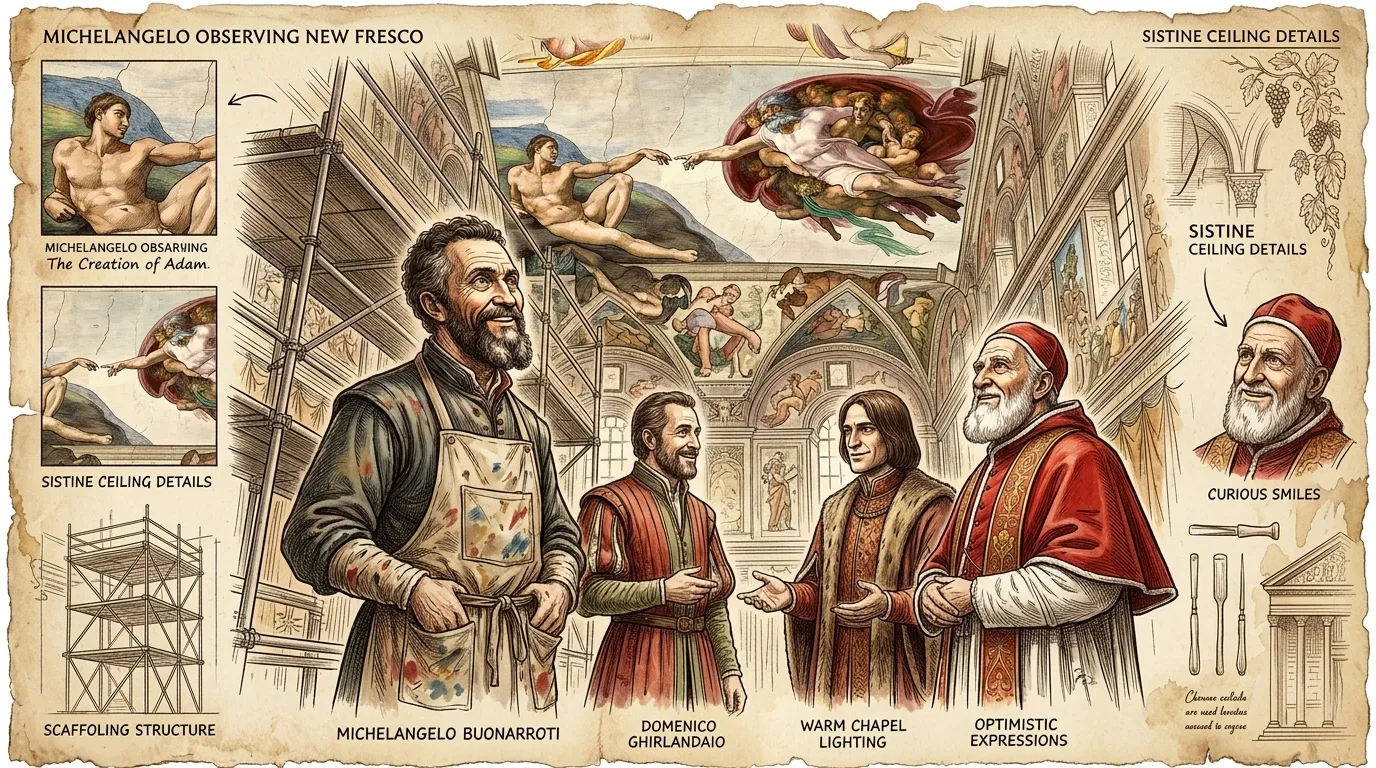
Michelangelo Buonarroti stands beneath the scaffolding, his gaze fixed on the Sistine Chapel ceiling. The year is 1512. Years of relentless work culminate in this moment: the unveiling of 'The Creation of Adam.' This fresco, measuring approximately 9 feet 4 inches by 19 feet, is more than just paint; it's a testament to human potential. Its estimated value is incalculable, a treasure beyond measure. This is Classical art at its purest.
"Michelangelo murmurs to himself, 'Now, let Rome see what I have wrought. Let them see the divine spark.'"
Art Fact: The fresco is part of a larger series depicting scenes from Genesis, commissioned by Pope Julius II.
Page 2
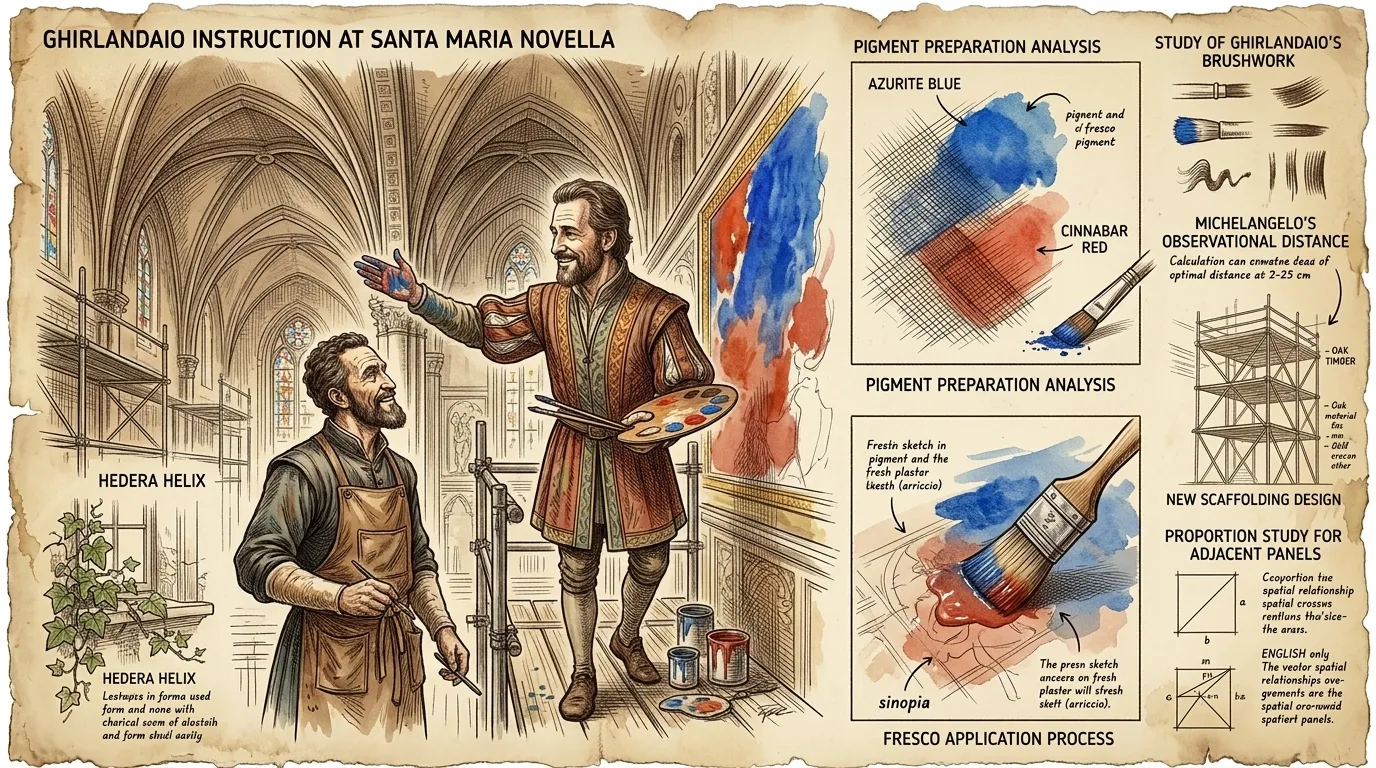
Young Michelangelo, barely a teenager, watches Domenico Ghirlandaio paint within the Basilica di Santa Maria Novella. The vibrant colors and masterful forms ignite a fire within him. Ghirlandaio turns, catching the boy's intense stare. 'You have the eye, Michelangelo,' Ghirlandaio observes. 'But the eye alone is not enough.'
"Ghirlandaio advises, 'Study the masters, dissect the human form, and never cease to learn.' Michelangelo replies eagerly, 'I will, Master. I will surpass them all!'"
Art Fact: Michelangelo apprenticed with Ghirlandaio from 1487 to 1488, learning the fundamentals of fresco technique.
Page 3
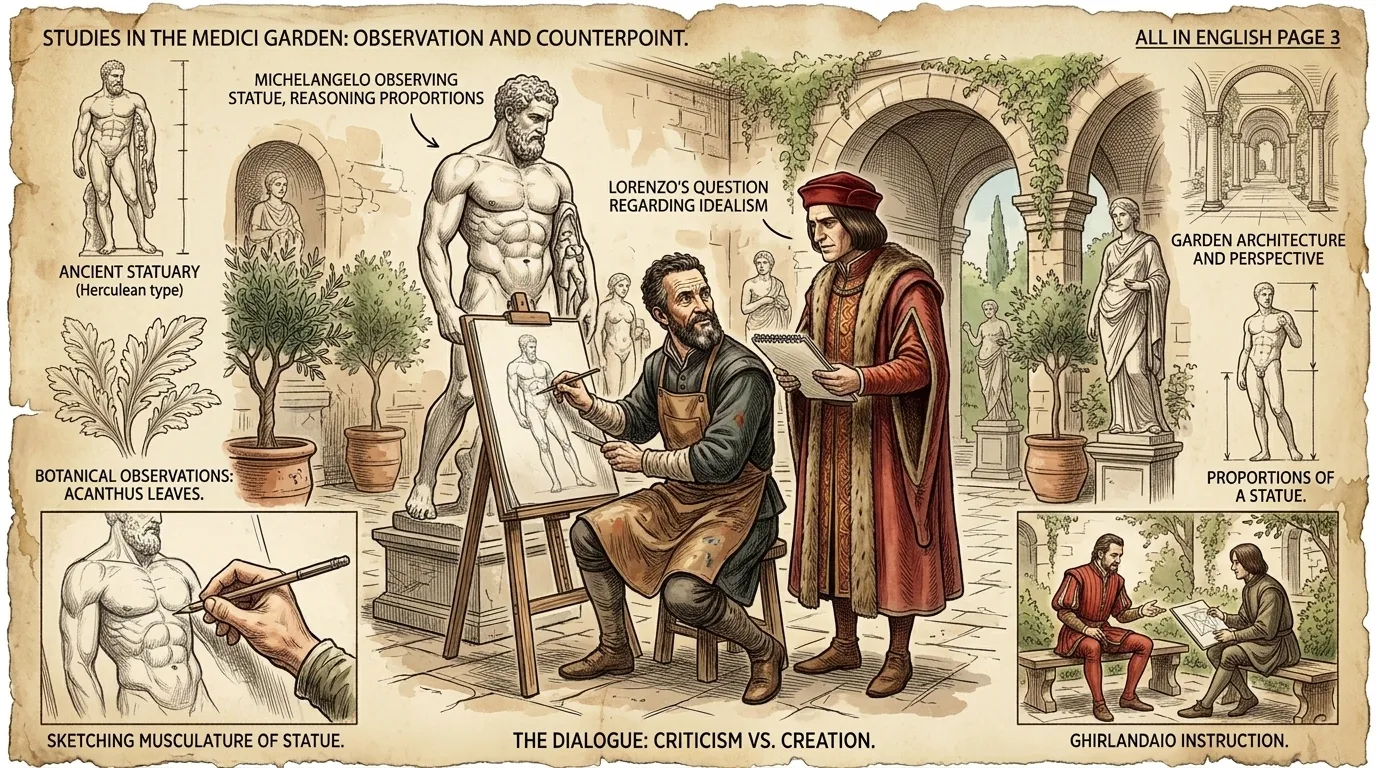
In the Medici gardens, Michelangelo meticulously sketches a dissected corpse. Lorenzo de' Medici observes, a critical eye fixed on the young artist. 'You seek to understand the body, Michelangelo?' Lorenzo asks. 'But art is not merely imitation. It is about revealing the soul.'
"Michelangelo counters, 'How can I reveal the soul if I do not understand the vessel that holds it? I need to know the body to show the spirit!'"
Art Fact: Michelangelo's access to corpses for anatomical study was granted by the Church, a rare privilege at the time.
Page 4
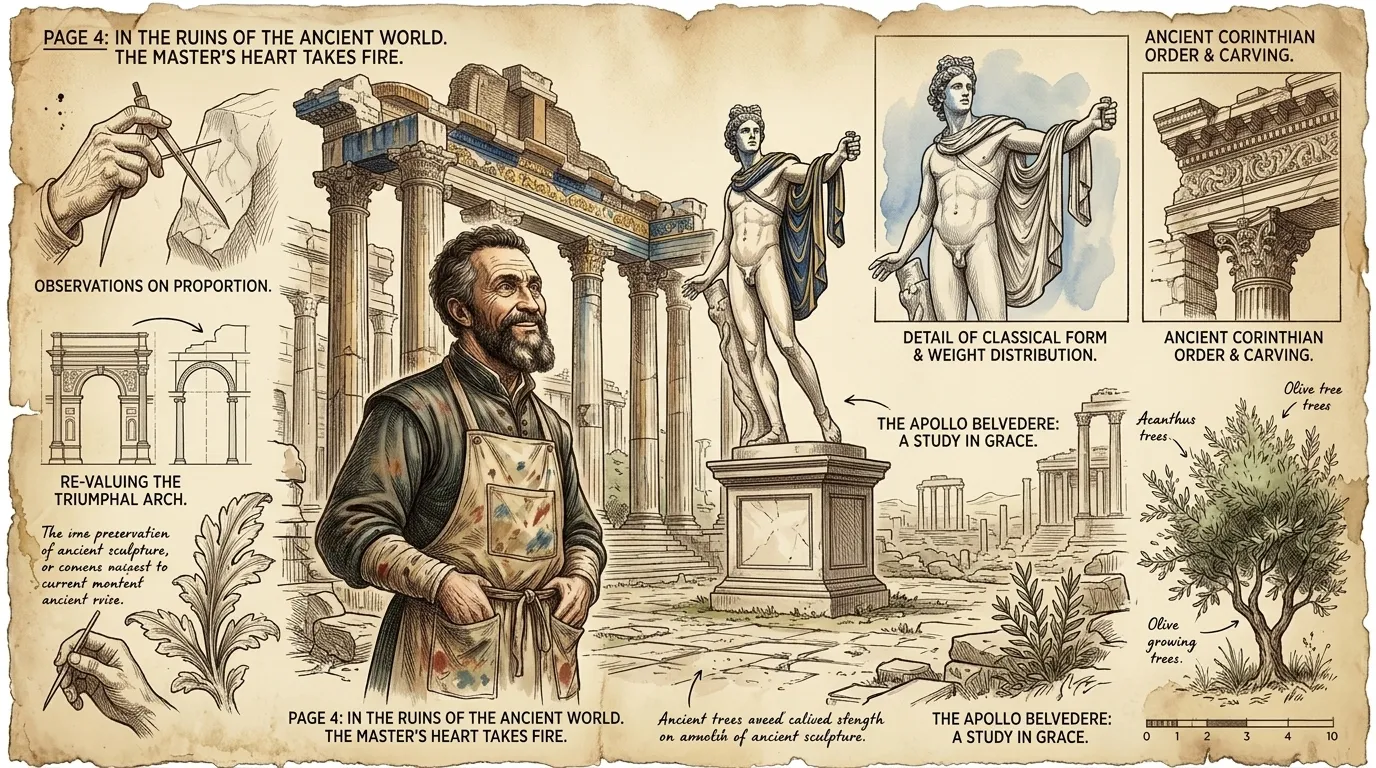
WIDE ANGLE. Michelangelo stands amidst the ruins of ancient Rome, his gaze fixed on the colossal statue of the Apollo Belvedere. The sheer power and grace of the classical form fill him with inspiration. 'The ancients,' he muses, 'understood the language of the body. They saw the divine in the human form.'
"A passing Roman scholar remarks, 'Michelangelo, you seem captivated. The Apollo is indeed a marvel. 'As Seneca said, Every new beginning comes from some other beginning's end.' Perhaps Rome will inspire your own new beginning!''"
Art Fact: The Apollo Belvedere, rediscovered in the 15th century, became a cornerstone of Renaissance artistic ideals.
Page 5
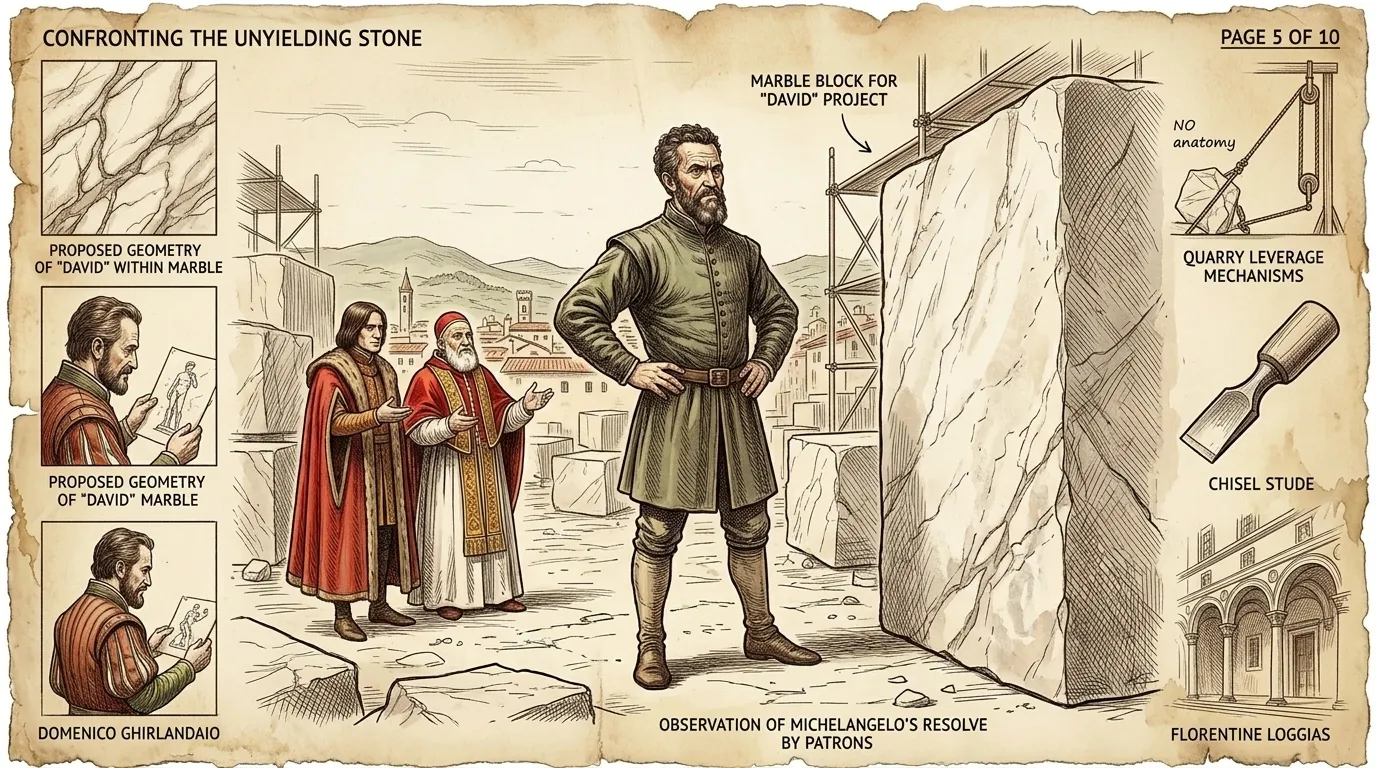
/ TILTED WIDE. Michelangelo, now renowned for his skill, confronts a massive block of marble in Florence. Commissioned to create 'David,' he faces the challenge with fierce determination. The marble had been started by another sculptor who deemed it 'impossible.'
"An advisor of the Florentine council says, 'Michelangelo, this marble has defeated others. Are you sure you can succeed?' Michelangelo confidently retorts, 'I will liberate the figure within. Doubt me not, my skill will prevail!'"
Art Fact: Michelangelo worked on 'David' in secret, behind a wooden fence erected to shield his progress from public view.
Page 6
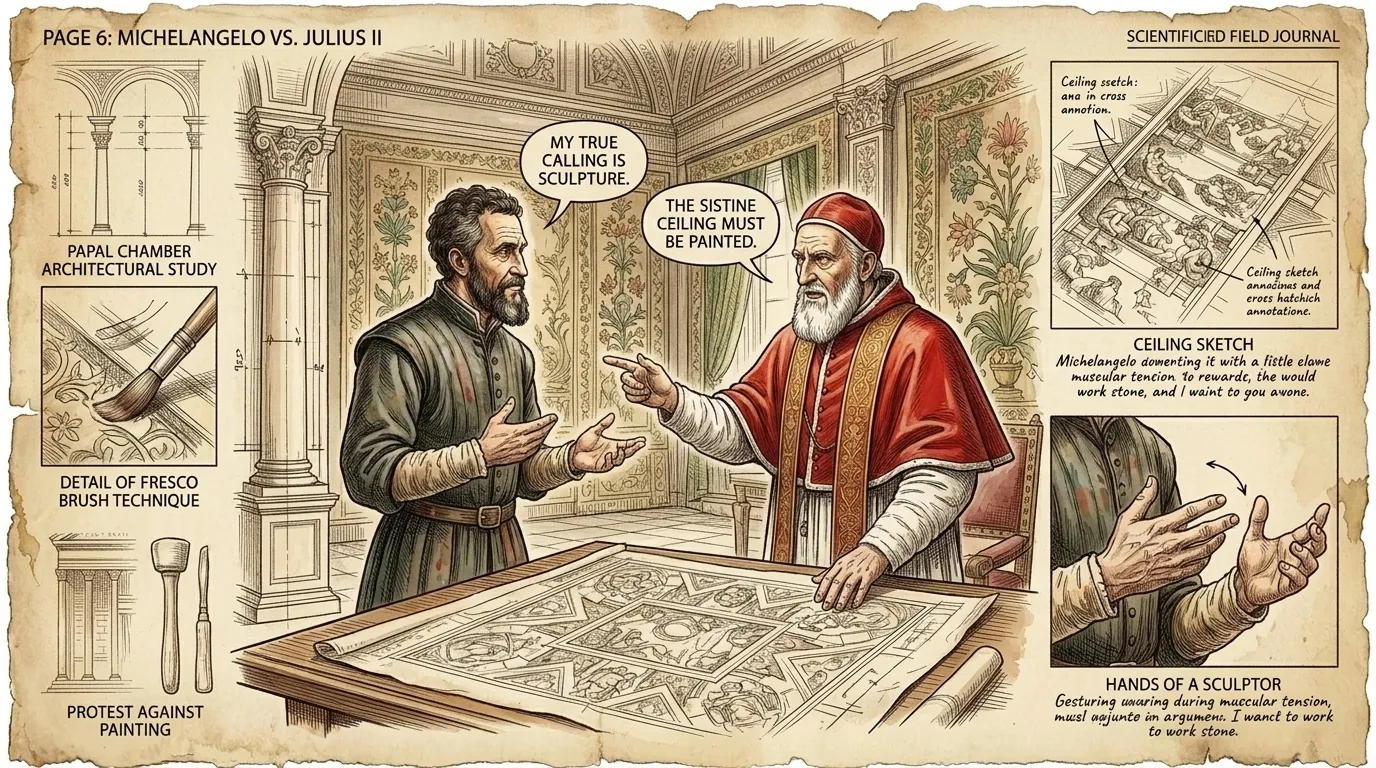
/ WIDE. Michelangelo stands before Pope Julius II, who gestures emphatically towards a sketch of the Sistine Chapel ceiling. The Pope demands Michelangelo paint it. Michelangelo, more sculptor than painter, argues that this task suits him ill. 'Sculpture is my true calling,' Michelangelo protests. 'I am not a painter of ceilings!'
"Pope Julius II insists, 'Michelangelo, I command it! Your skill is unquestionable. As Michelangelo said, 'I saw the angel in the marble and carved until I set him free.' Now, set your genius free on this ceiling!' Rome needs to witness the marvel of creation!'"
Art Fact: Michelangelo initially resisted the Sistine Chapel commission, believing his talents lay more in sculpture.
Page 7
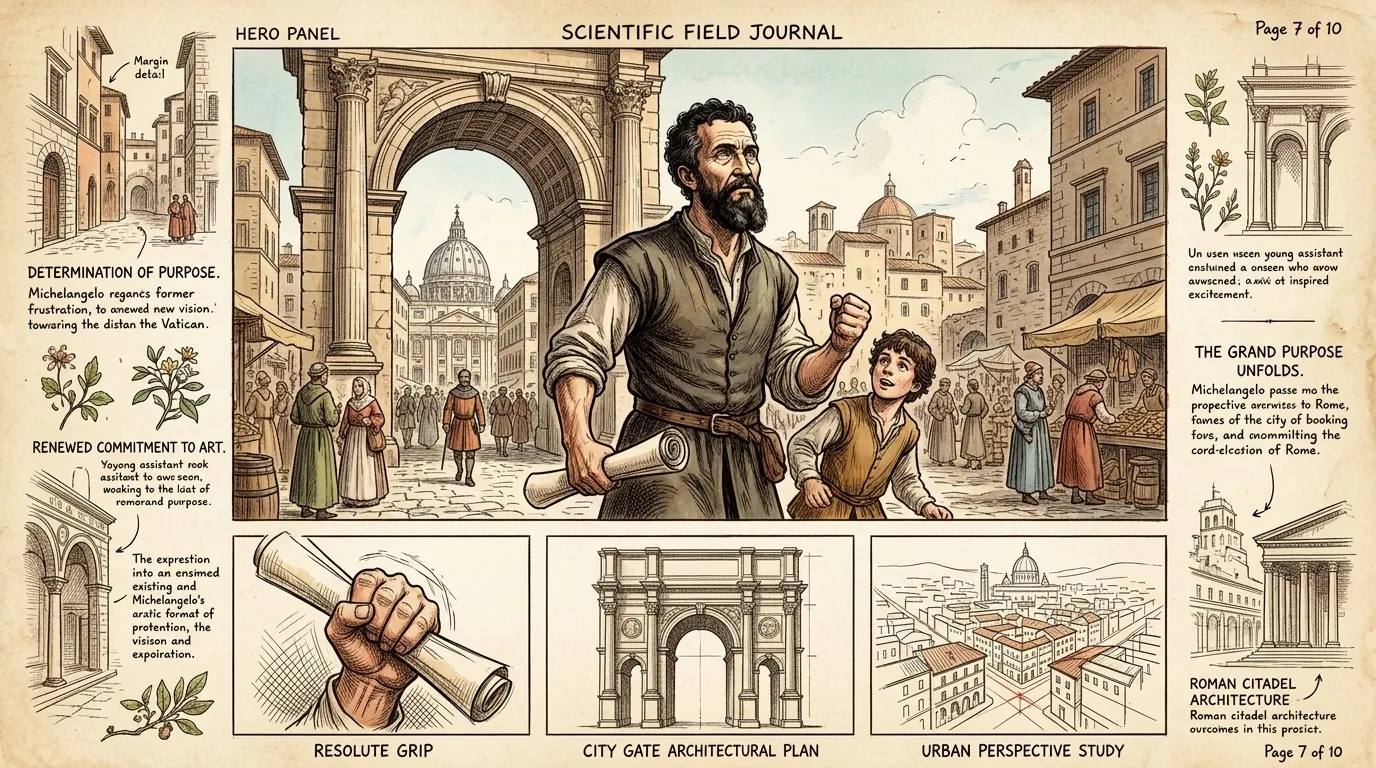
WIDE ANGLE. Michelangelo, frustrated with the project, flees Rome, only to be recalled by Pope Julius II. Upon his return, a new vision begins to form. 'I cannot escape my destiny,' he realizes. 'If the Pope demands a painting, then I shall create a world upon that ceiling!'
"Michelangelo declares to his assistant, 'I will paint the story of humanity, from creation to redemption! And I shall do it in a manner Rome has never witnessed!'"
Art Fact: Michelangelo briefly abandoned the Sistine Chapel project due to creative frustrations and disputes with Pope Julius II.
Page 8
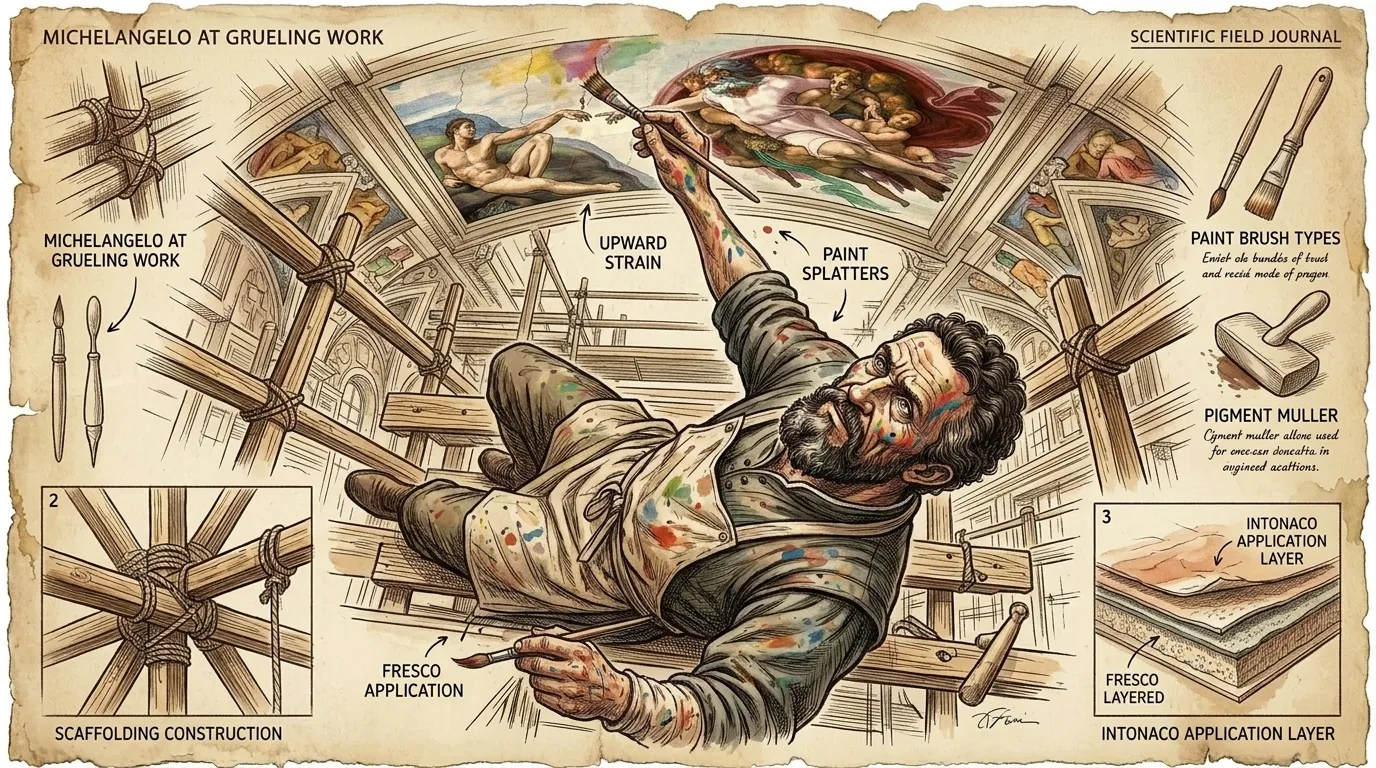
Michelangelo lies on his back on the specially constructed scaffolding, painstakingly applying paint to the Sistine Chapel ceiling. The work is grueling and solitary. Paint splatters and drips onto his face. His neck strains with the constant upward gaze. He coughs from the dust. 'This is my suffering. Every creation costs a creator something...'
"Michelangelo groans, 'Oh, how my back aches! But the vision is so great, and that pain is nothing! I have no other choice but to forge through until completion.'"
Art Fact: Michelangelo designed his own scaffolding for the Sistine Chapel, a testament to his engineering skill.
Page 9
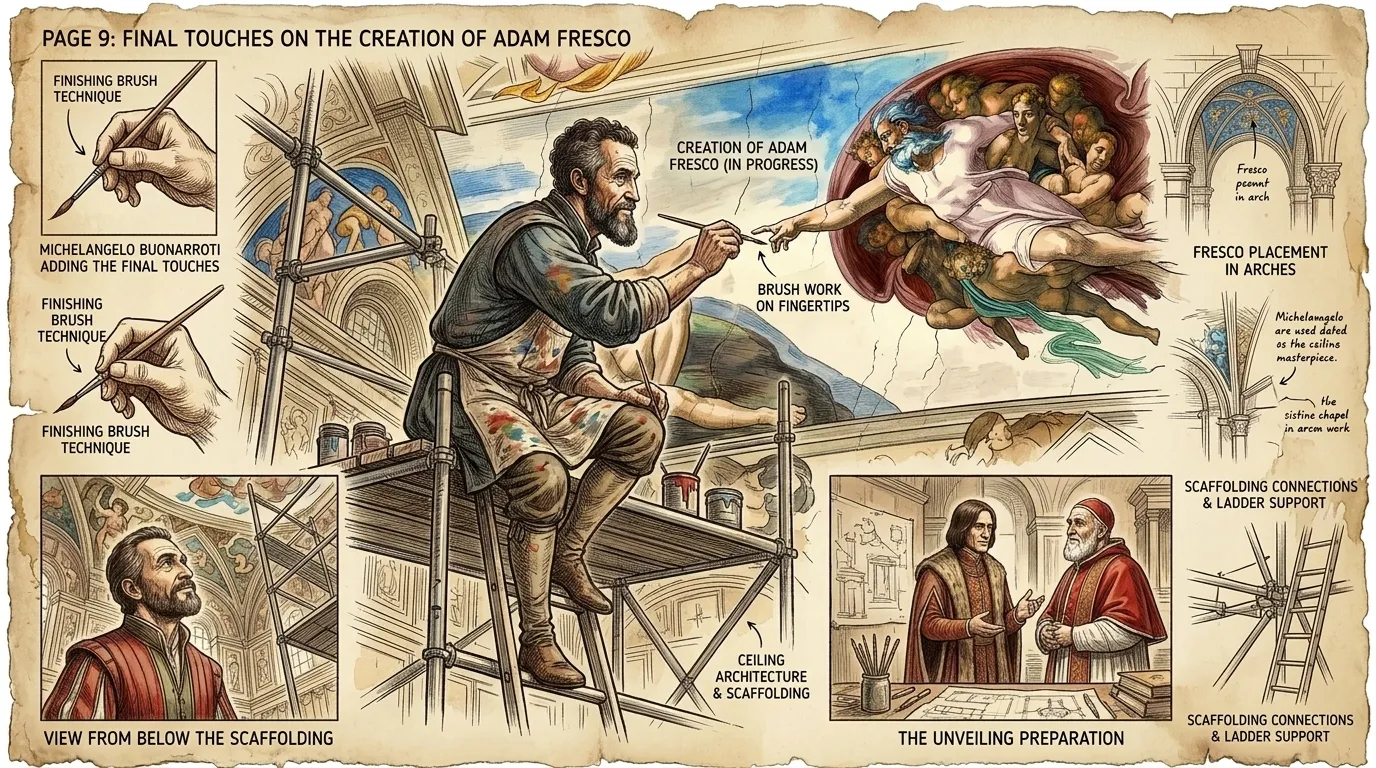
Michelangelo, perched high above, adds the final touches to 'The Creation of Adam.' With a delicate stroke, he brings Adam's hand almost to touch God's. The moment of divine inspiration captured for eternity.
"Michelangelo whispers, 'Let there be life! Let there be humanity, created in the image of God.'"
Art Fact: The almost-touching hands of God and Adam are one of the most iconic images in art history.
Page 10
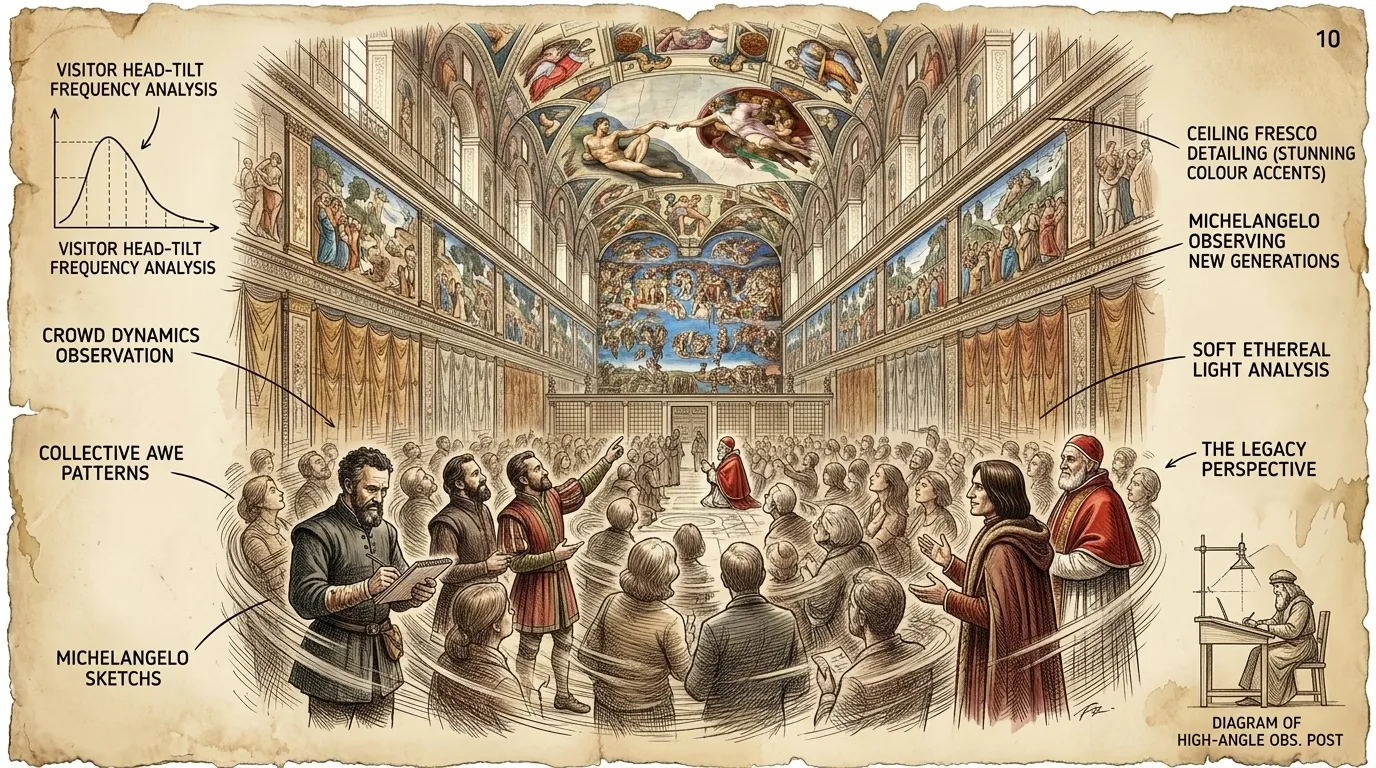
EXTREME WIDE ANGLE. Centuries later, the Sistine Chapel teems with visitors, their eyes drawn upward to 'The Creation of Adam.' Michelangelo's legacy endures, his art continuing to inspire awe and wonder. Though his body passed, his artwork continues on to live forever.
"None"
Art Fact: Michelangelo's 'Creation of Adam' remains one of the most recognizable and influential images in Western art, inspiring artists and viewers for centuries. As Michelangelo himself said: 'If people knew how hard I worked to get my mastery, it wouldn't seem so wonderful at all.'
About this story
- Location: Global
- Audience: general readers
Questions and answers
Questions and answers about The Creation of Adam by Michelangelo (Vatican City, Rome — 1512)
Read Wonder Arts on your phone
Wonder Arts is available on Android and iPhone and iPad. Get Wonder Arts on Google Play · Get Wonder Arts on the App Store.
More Wonder Arts stories
- The Dance Class by Edgar Degas (Paris, France — 1874)
- The Death of Sardanapalus by Eugène Delacroix (Paris, France — 1827)
- The Dying Gaul by Epigonus (Rome, Italy — c. 230 BC)
- The Execution of Lady Jane Grey by Paul Delaroche (London, UK — 1833)
- The Fighting Temeraire by J.M.W. Turner (London, UK — 1839)
- The Four Seasons by Antonio Vivaldi (Venice, Italy — 1725)