The Night Watch — Amsterdam, Netherlands — 1642
The Night Watch — Amsterdam, Netherlands — 1642 — an illustrated arts story, set in Global. 10 illustrated pages, free to read on Wonder Arts.
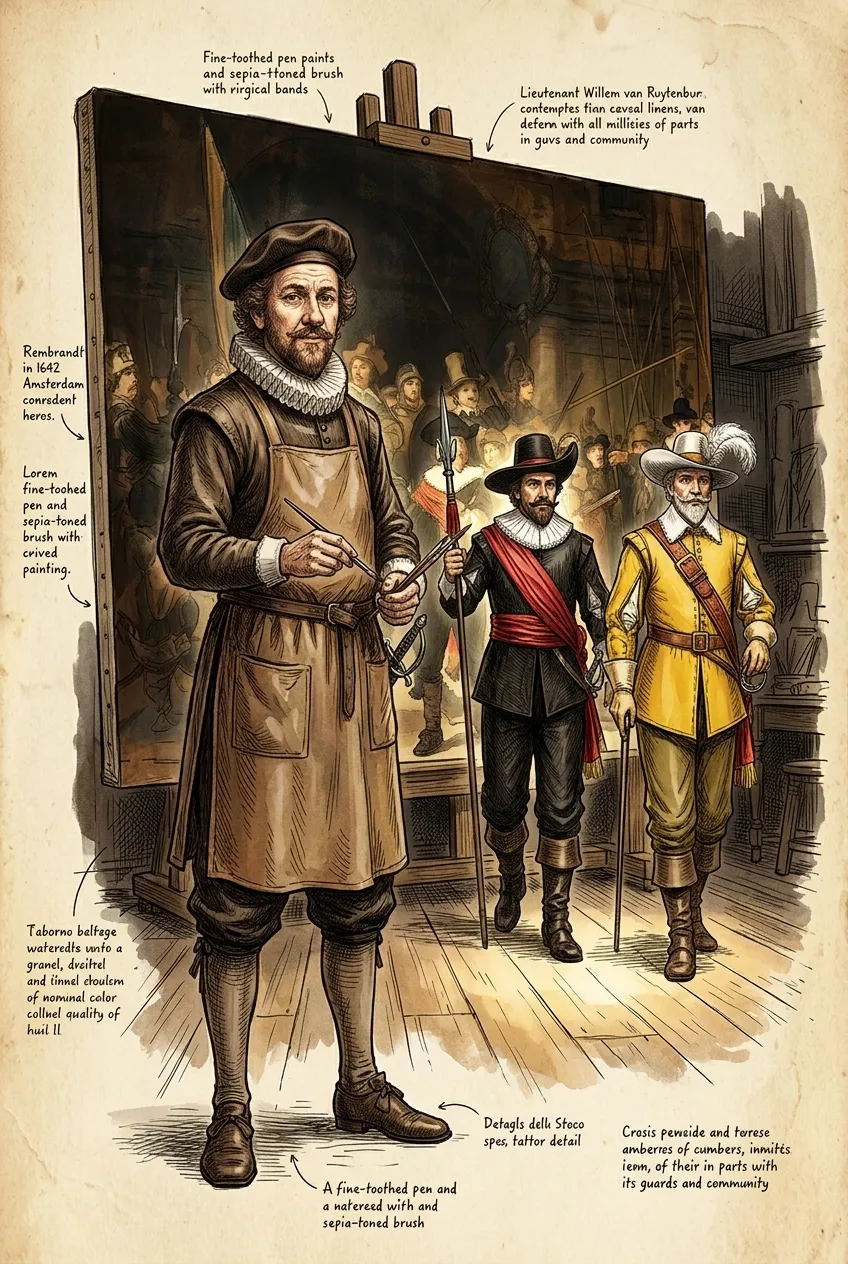
Page 1
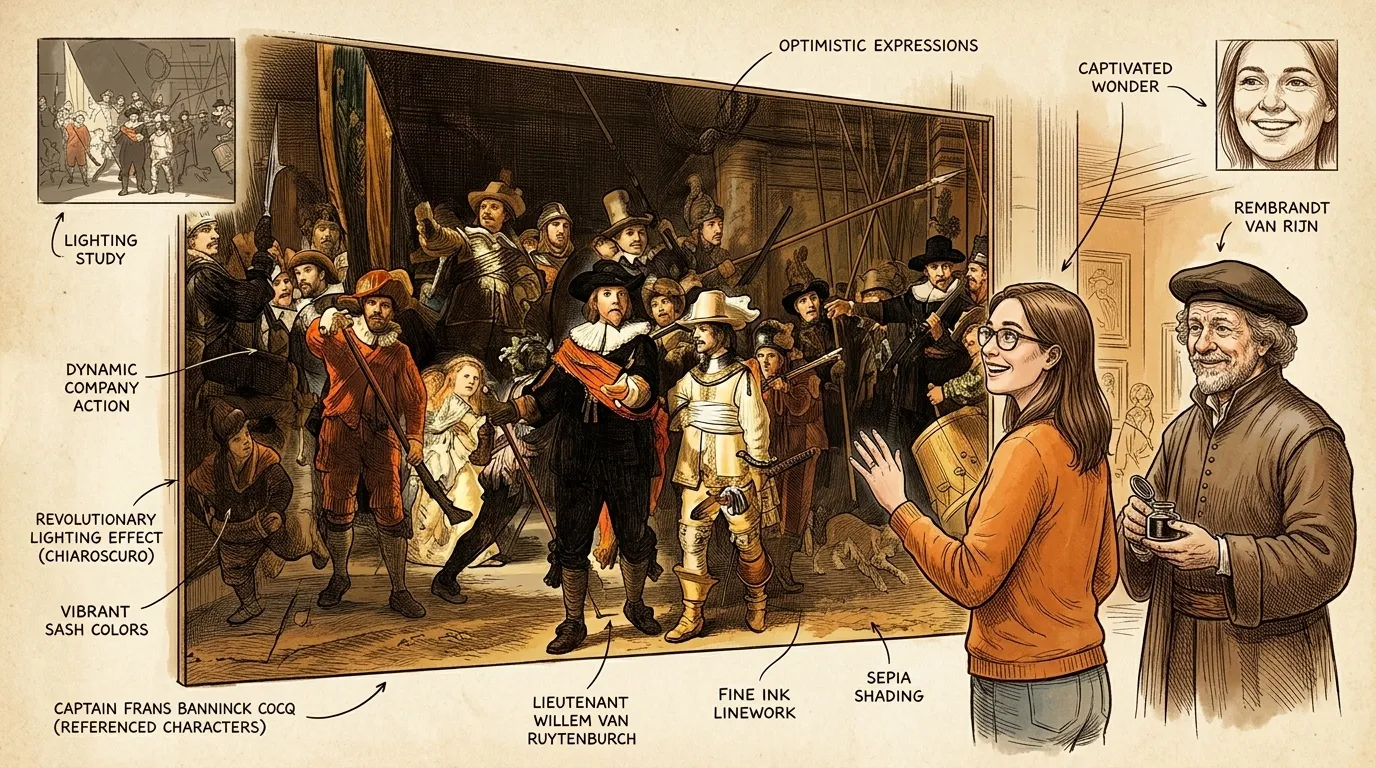
In the heart of Amsterdam, 1642, stands Rembrandt van Rijn's colossal masterpiece, 'The Night Watch.' Officially titled 'Militia Company of District II under the Command of Captain Frans Banninck Cocq,' this oil on canvas dominates the Rijksmuseum at a staggering 11.91 x 14.44 feet. Its dynamic composition and innovative use of light and shadow revolutionized portraiture, but the painting's journey has been fraught with drama, including a knife attack in 1975.
""This is not merely a portrait, but a drama!" exclaims a visitor, gazing up at the imposing canvas. "The figures seem to leap from the frame, caught in a moment of vital action!""
Art Fact: The painting's nickname, 'The Night Watch,' is a misnomer resulting from centuries of accumulated dirt and varnish, which darkened the scene considerably. Only after cleaning was it discovered that the scene takes place in daylight.
Page 2
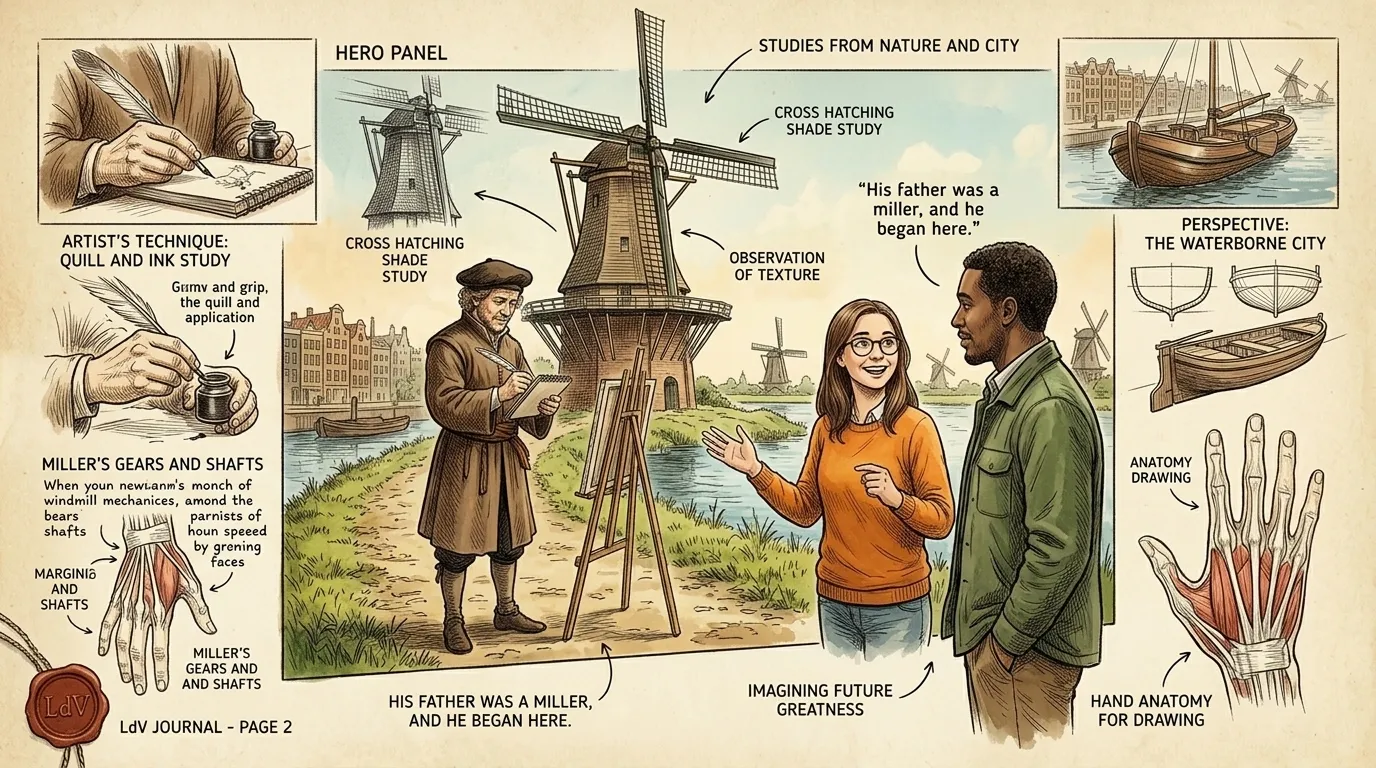
Rembrandt Harmenszoon van Rijn, born in Leiden in 1606, was the son of a miller. His early life was marked by a relentless pursuit of artistic skill. He apprenticed with local masters before venturing to Amsterdam, where he quickly established himself as a sought-after portraitist. His ambition was fueled by a desire to capture not just likeness, but the very soul of his subjects. "Painting is concerned with only one thing: telling a story," he once declared, hinting at his narrative approach.
""Imagine," Sora says to Idris, "growing up in a windmill's shadow and becoming one of the greatest painters in history! It just shows what passion and hard work can do.""
Art Fact: Rembrandt's use of impasto—thickly applied paint—added texture and depth to his canvases, a technique that would become a hallmark of his style.
Page 3
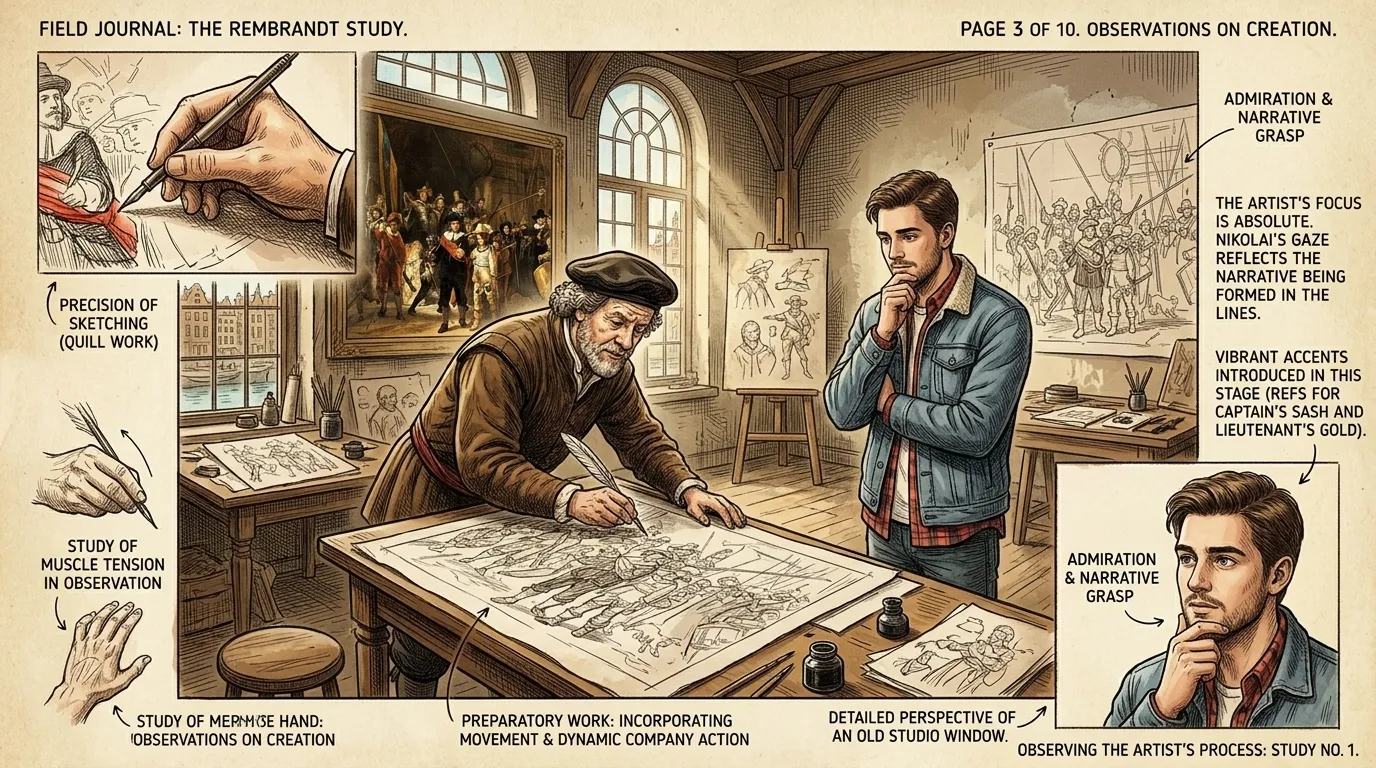
In 1638, Rembrandt received a prestigious commission from Captain Frans Banninck Cocq and his lieutenant, Willem van Ruytenburch, to paint their militia company. Such group portraits, known as 'schutterstukken,' were common in Dutch society. But Rembrandt envisioned something far more ambitious than the static rows of faces that defined the genre. He sought to capture the company in a moment of dynamic action, a snapshot of civic pride and military readiness.
"Nikolai, observing a preparatory sketch, remarks, "He's not just painting faces; he's painting a story, a moment in time. I remember Leonardo da Vinci saying, 'Painting embraces all the ten functions of the eye; that is to say, darkness, light, body and colour, substance and form, motion and rest,' and you can see all of that here!""
Art Fact: Group portraits of civic guards were status symbols in the Dutch Republic, reflecting the wealth and power of the city's elite.
Page 4
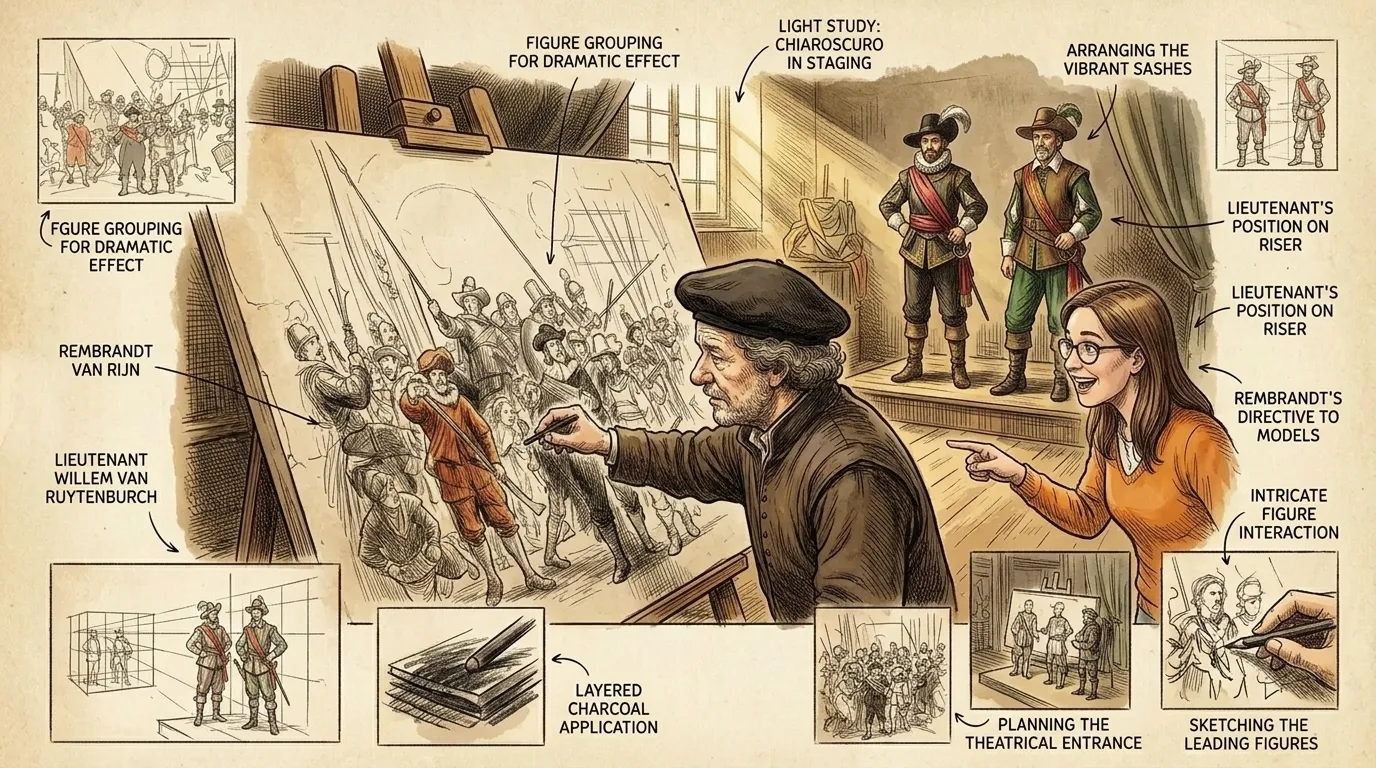
Rembrandt's studio became a hive of activity. Models posed, draped in military finery. He meticulously studied each figure, capturing their individual characteristics and placing them strategically within the composition. He experimented with lighting, creating dramatic contrasts that emphasized the most important figures while obscuring others in shadow. The canvas, primed and stretched, awaited the master's touch. It was a colossal undertaking, even for an artist of his caliber.
""Look at the way he's arranged them!" Idris exclaims, pointing to a figure in a preparatory sketch. "It's like they're on a stage, ready for a play!""
Art Fact: Rembrandt's use of real weapons and costumes added authenticity to the scene, enhancing its dramatic impact.
Page 5
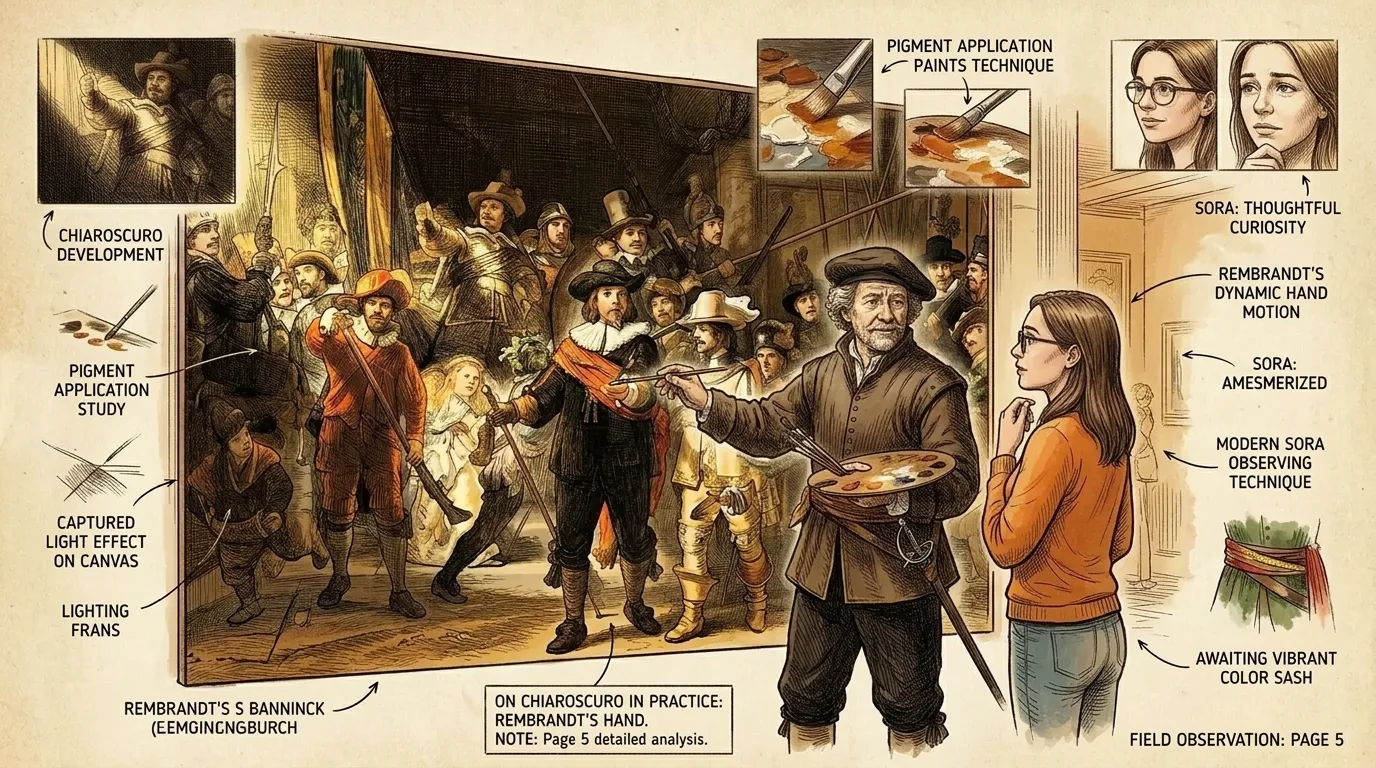
With broad strokes, Rembrandt laid down the underpainting, establishing the basic forms and composition. Then, using a variety of brushes and techniques, he began to build up the layers of paint, carefully modeling each figure and object. His mastery of chiaroscuro—the interplay of light and shadow—created a sense of depth and drama that was unparalleled in Dutch art. Light became a character in itself, guiding the viewer's eye and revealing the story within the painting.
""It's all about the light, isn't it?" Sora muses, watching Rembrandt work. "The way he uses it to highlight certain figures and hide others... it's pure genius!""
Art Fact: Rembrandt often used ground pigments mixed with linseed oil to create his paints, carefully controlling the consistency and color of each hue.
Page 6
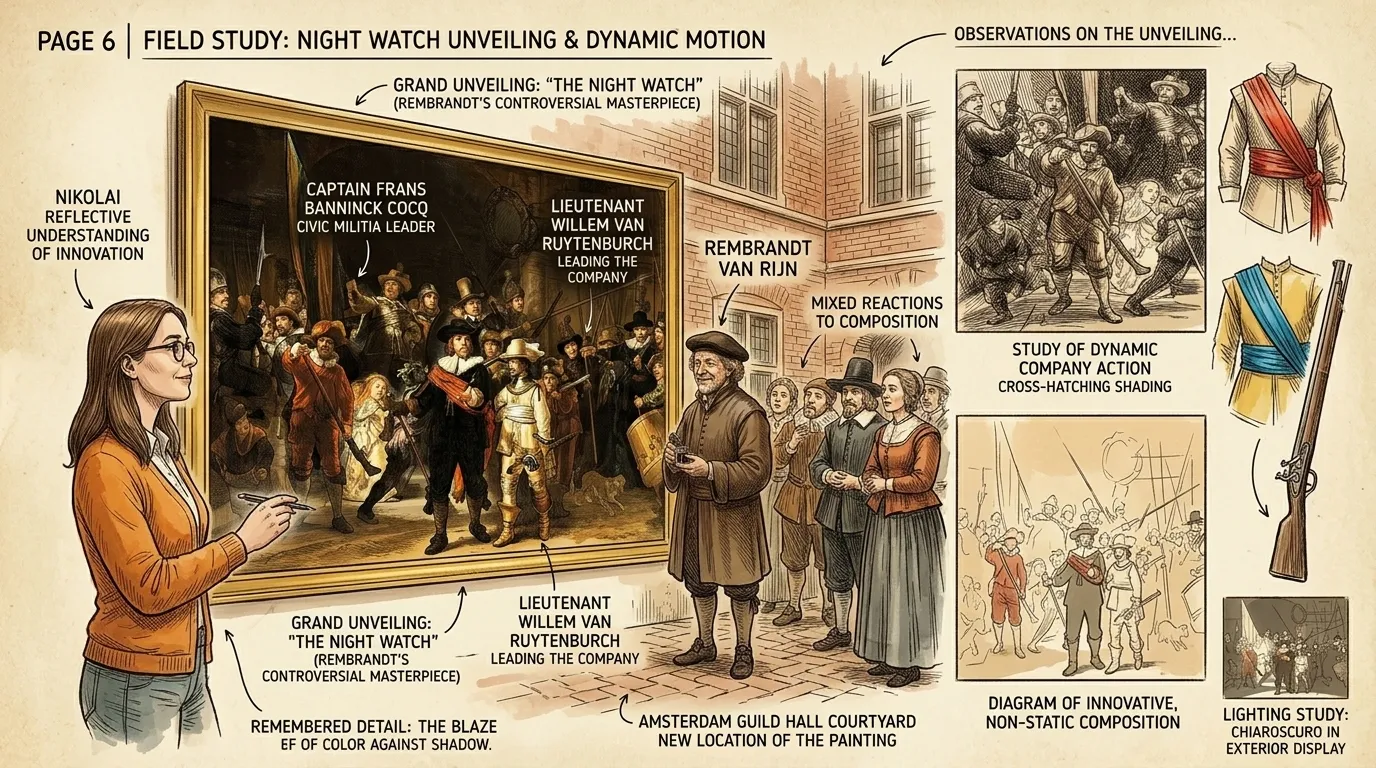
When 'The Night Watch' was unveiled, it was met with mixed reactions. Some praised Rembrandt's innovation and dramatic flair. Others criticized the painting's unconventional composition, particularly the way some figures were obscured by shadow. Some of the militiamen who had paid for the commission were reportedly unhappy with their placement in the painting. Rembrandt had dared to prioritize artistic vision over strict representation, and the consequences were immediate.
"Nikolai gestures, quoting the artist: "Some complained they were not prominently displayed, but as Rembrandt said, 'I have overcome things that would make strong men faint!' He would not compromise his vision.""
Art Fact: It is believed that Rembrandt's decision to depict the company in motion, rather than in a static pose, contributed to the initial controversy.
Page 7
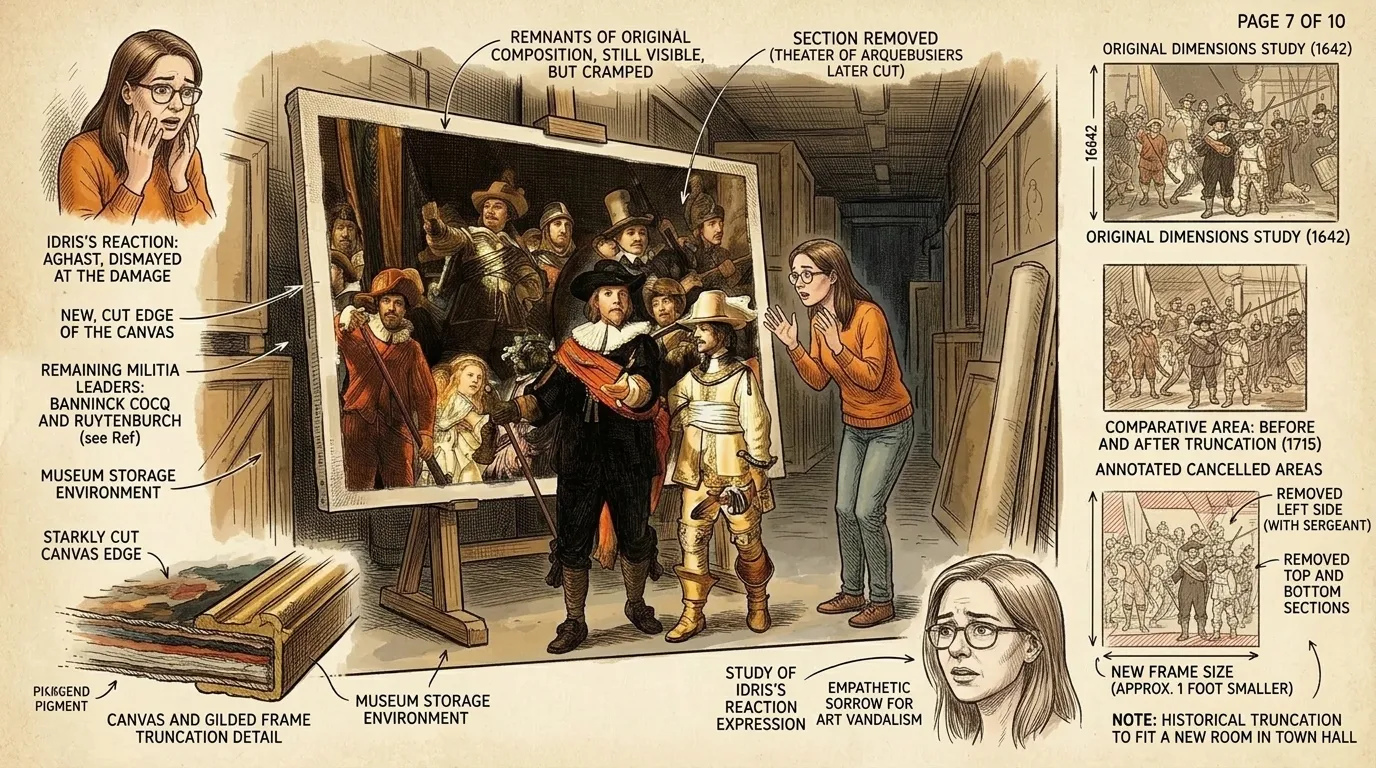
In 1715, 'The Night Watch' was moved from the Kloveniersdoelen to the Amsterdam Town Hall. To fit its new location, the painting was drastically trimmed on all four sides, removing several figures and altering the composition significantly. This act of vandalism, driven by practical necessity, forever changed the appearance of Rembrandt's masterpiece. The painting lost some of the dynamism it had when it was first made.
""Can you imagine?" Idris asks, aghast. "Cutting a masterpiece just to fit a wall! That's like tearing pages out of a book to make it shorter!""
Art Fact: The removed sections of 'The Night Watch' have never been recovered, leaving a permanent void in the painting's history.
Page 8
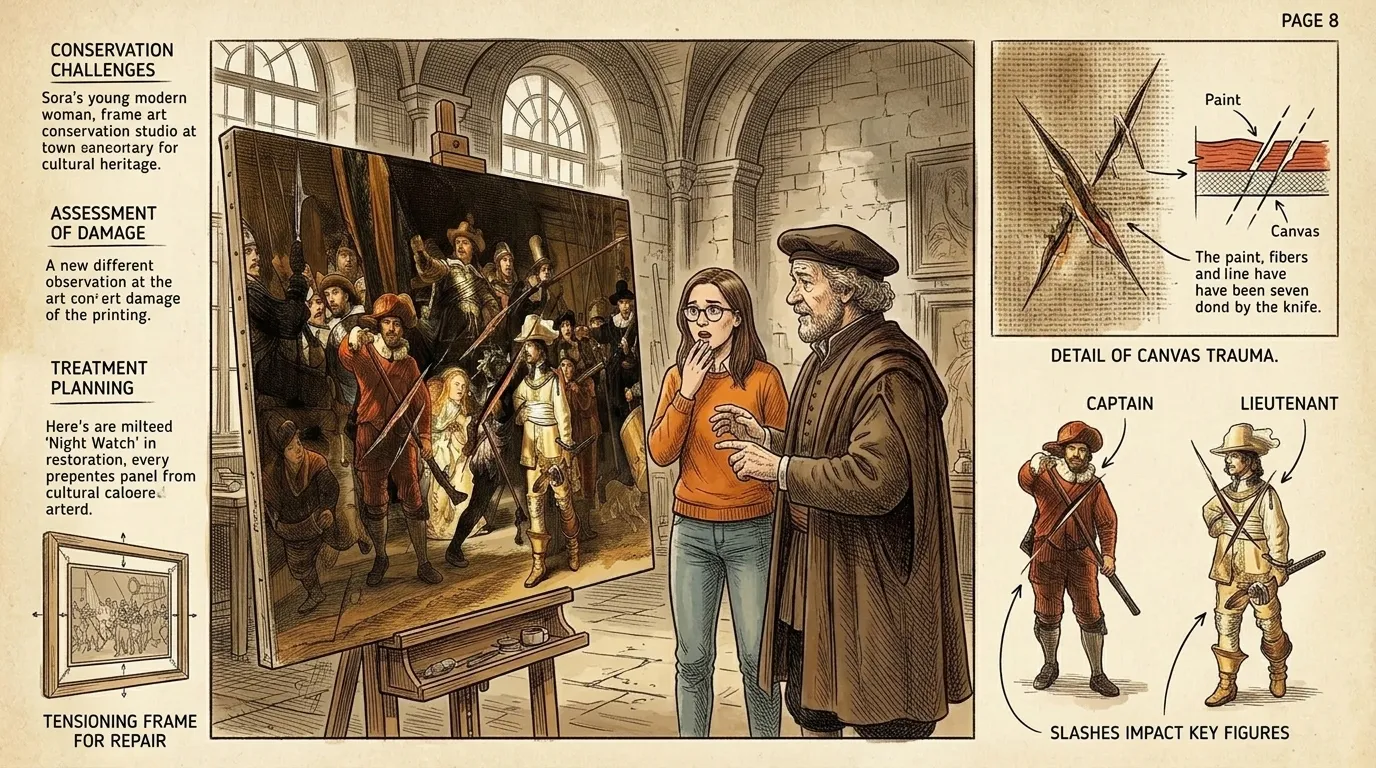
Throughout its history, 'The Night Watch' has been the target of vandalism. In 1911, a unemployed shoemaker slashed the painting with a knife. In 1975, a Dutch schoolteacher attacked the painting with a bread knife, causing extensive damage. The quick actions of museum staff and expert restoration efforts saved the painting each time, but the scars of these attacks remain.
"Sora says with surprise, "But how could someone want to destroy such a beautiful thing? It's incredible that this masterpiece has been through so much! Franklin D. Roosevelt stated, 'The only thing we have to fear is fear itself.' It's like they were afraid of its power!""
Art Fact: The 1975 attack resulted in the creation of a highly skilled team of restorers dedicated to the preservation of 'The Night Watch.'
Page 9
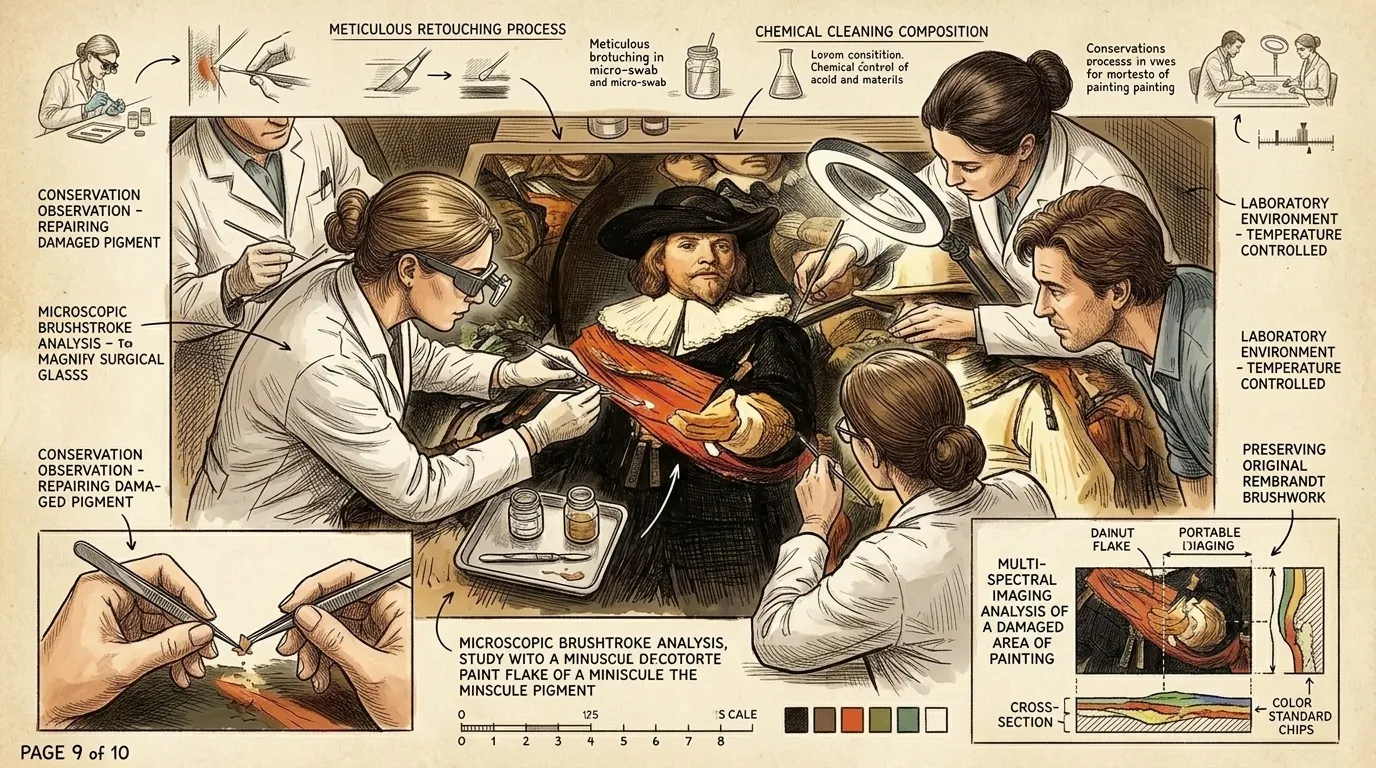
Following each act of vandalism, 'The Night Watch' underwent painstaking restoration. Conservators meticulously cleaned, repaired, and retouched the damaged areas, using advanced techniques to preserve Rembrandt's original brushstrokes. Each restoration was a testament to the enduring power of art and the dedication of those who safeguard our cultural heritage. The effort underscores the irreplaceable value placed on the work.
""It's like bringing it back to life," Nikolai says, watching the conservators work. "Piece by piece, they're resurrecting Rembrandt's vision.""
Art Fact: Modern restoration techniques often involve the use of microscopic imaging and chemical analysis to identify and preserve the original materials.
Page 10
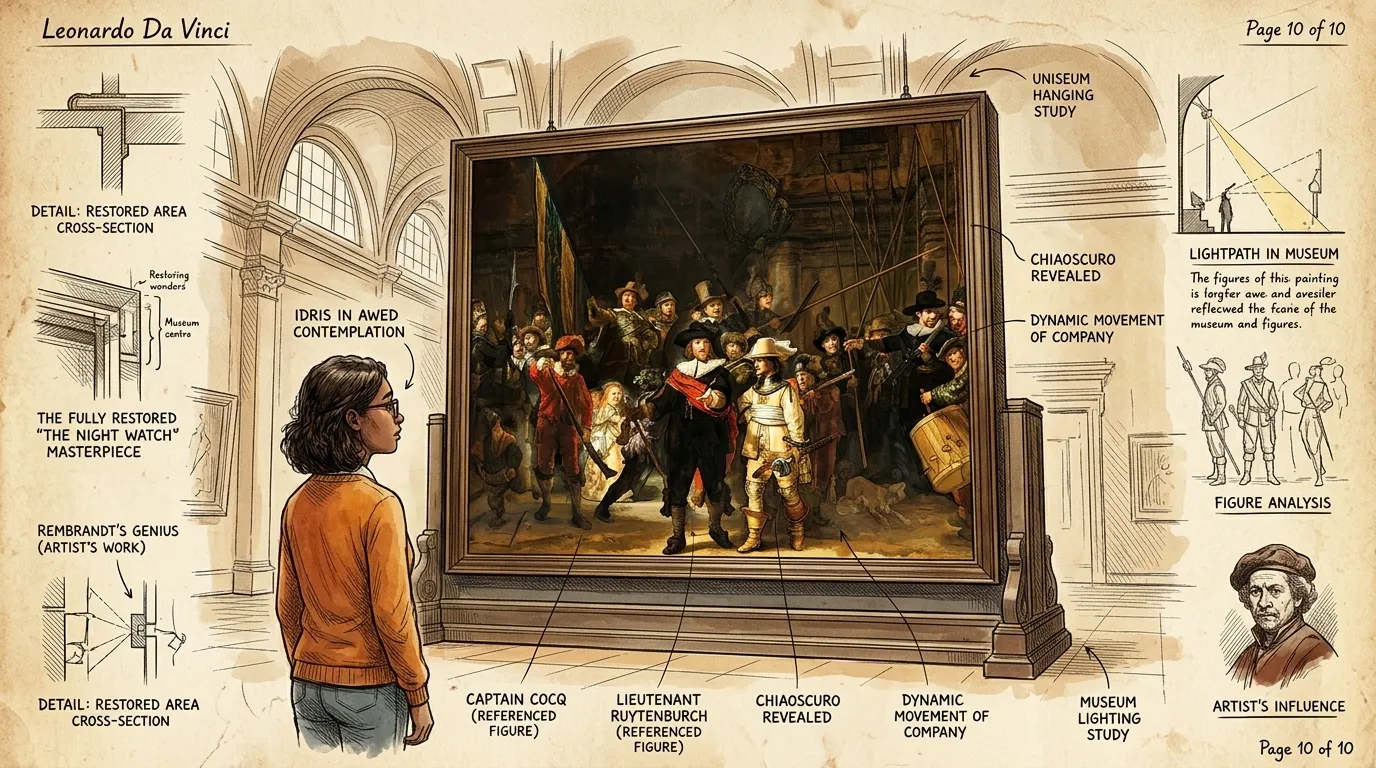
Today, 'The Night Watch' remains one of the most iconic and beloved paintings in the world. Its dynamic composition, masterful use of light and shadow, and dramatic narrative continue to captivate audiences centuries after its creation. Housed in the Rijksmuseum, it stands as a testament to Rembrandt's genius and the enduring power of art to transcend time. 'The Night Watch' is more than a painting; it's a window into the soul of the Dutch Golden Age.
""Look at this," Idris says quietly, gazing at the painting in awe. "Centuries later, and it still makes you feel like you're right there with them!""
Art Fact: The 'Night Watch' has inspired countless artists, writers, and filmmakers, solidifying its place in the cultural canon.
About this story
- Location: Global
- Audience: general readers
Read Wonder Arts on your phone
Wonder Arts is available on Android. Get Wonder Arts on Google Play.
More Wonder Arts stories
- The Night Watch by Rembrandt van Rijn (Amsterdam, Netherlands — 1642)
- The Nightmare by Henry Fuseli (London, UK — 1781)
- The Origin of the World by Gustave Courbet (France — 1866)
- The Oxbow by Thomas Cole (USA — 1836)
- The Pantheon (Rome, Italy — 126 AD)
- The Persistence of Memory by Salvador Dalí (New York City, USA — 1931)